Tag Archives: Messiah

The Land

But now thus saith the LORD that created thee, O Jacob, and he that formed thee, O Israel, Fear not: for I have redeemed thee, I have called thee by thy name; thou art mine. (Isaiah 43:1)

One cannot escape the flood of wars and rumors of wars coming from the Middle East. More than two weeks ago, at the climax of the Feast of Tabernacles in Israel, Hamas terrorists invaded southern Israel. They killed many innocent civilians and took away many captives. They raped women and tortured and killed children and babies. Their atrocities left the world in shock. Not since ISIS have such horrors been on full display for the world to see.

As expected, the “free” world denounced the heinous acts and pledged to stand with Israel. After shaking off the shock, Israel took the offensive against Hamas in the Gaza Strip. Typical of Israel’s approach, the IDF took great measures to warn the civilians in the Gaza Strip to flee to the southern border for their own safety. Then the relentless bombing of Gaza City by the IDF started striking strategic targets of known Hamas strongholds. Unlike Israel and the IDF who value innocent human life, Hamas hunkers down in schools, mosques, hospitals, and civilian housing buildings. They use their own people as human shields knowing that Israel will not attack where innocents may be harmed. However, this time Israel took off the gloves. With sufficient warning to the civilian population, all Hamas targets were attacked.

It did not take long for the “friends” of Israel to start pressuring Israel for restraint in sympathy for the poor Palestinians. Certainly, a (very) small percentage of Palestinians do not agree with the actions of Hamas against innocent Israeli citizens. However, a great majority of them voted for Hamas leadership. In their schools, they teach their children to hate Jews and encourage them from a very young age to kill Jews. When Palestinian terrorists kill Jews in Israel, there are celebrations in the streets of Gaza. So, we should not be so quick to feel sorry for their sufferings; it is not totally undeserved.

It was not long before the US visited Israel to publicly profess solidarity with Israel in this war against terror, while behind the scenes pressuring Israel to allow for “humanitarian” aid for the poor suffering Palestinians. The US threatened to withhold munitions, support parts for Israeli fighters (F-16s and others), and money for the war effort. In the meanwhile, the US continues to send money to Iran which funds its proxies (Hamas, Hezbollah, Islamic Jihad, etc.) to do its dirty work. Money also continues to flow to the Palestinians from the US, which Hamas diverts for its own purposes. They do not care for the Palestinian people.

As Israel continues to prosecute this war, world support for her effort will quickly wane. Even now protests in favor of the poor Palestinians are rising all over the world, including here in the US, Israel’s “friend.” The world has a perverted idea that somehow the Palestinians have some kind of claim to the land of “Palestine.” Without going into great detail, the “Palestinian State” was established in 1965 by the Palestinian Liberation Organization (PLO), and Yasser Arafat, an Egyptian. Before then, there were no “Palestinian” people. The land was called Palestine because the Roman Emperor Hadrian renamed Judea to Syria Palestina and Jerusalem to Aelia Capitolina in order to remove Judah and Jerusalem from the memory of rebellious Jews. Thus, even our Bible maps continue to name the land Palestine. However, the land never belonged to Palestinians, nor did Palestinians ever exist.

The land belongs to God and He says so in so many words. In fact, He begins by asserting ownership of the entire planet. “Now therefore, if ye will obey my voice indeed, and keep my covenant, then ye shall be a peculiar treasure unto me above all people: for all the earth is mine” (Exodus 19:5, emphasis mine). Notice that while making this claim, He also identifies the children of Israel as His “peculiar treasure … above all people,” not Arabs, Palestinians, or any other nation. Furthermore, God claims the land of Israel as His own. “The land shall not be sold for ever: for the land is mine; for ye are strangers and sojourners with me” (Leviticus 25:23, emphasis mine). God “gave” the land to Israel for their stewardship, not to be sold to anyone else, because it belongs to God, not to them. Through the psalmist, David, God names some of the parcels of land. “Gilead is mine; Manasseh is mine; Ephraim also is the strength of mine head; Judah is my lawgiver” (Psalm 108:8). See the following (linked) passages where God makes claim to the land: 2 Chronicles 7:19-20; Isaiah 14:24-25; Jeremiah 2:7; 16:17-18; Ezekiel 38:16; Joel 1:6; 3:2.

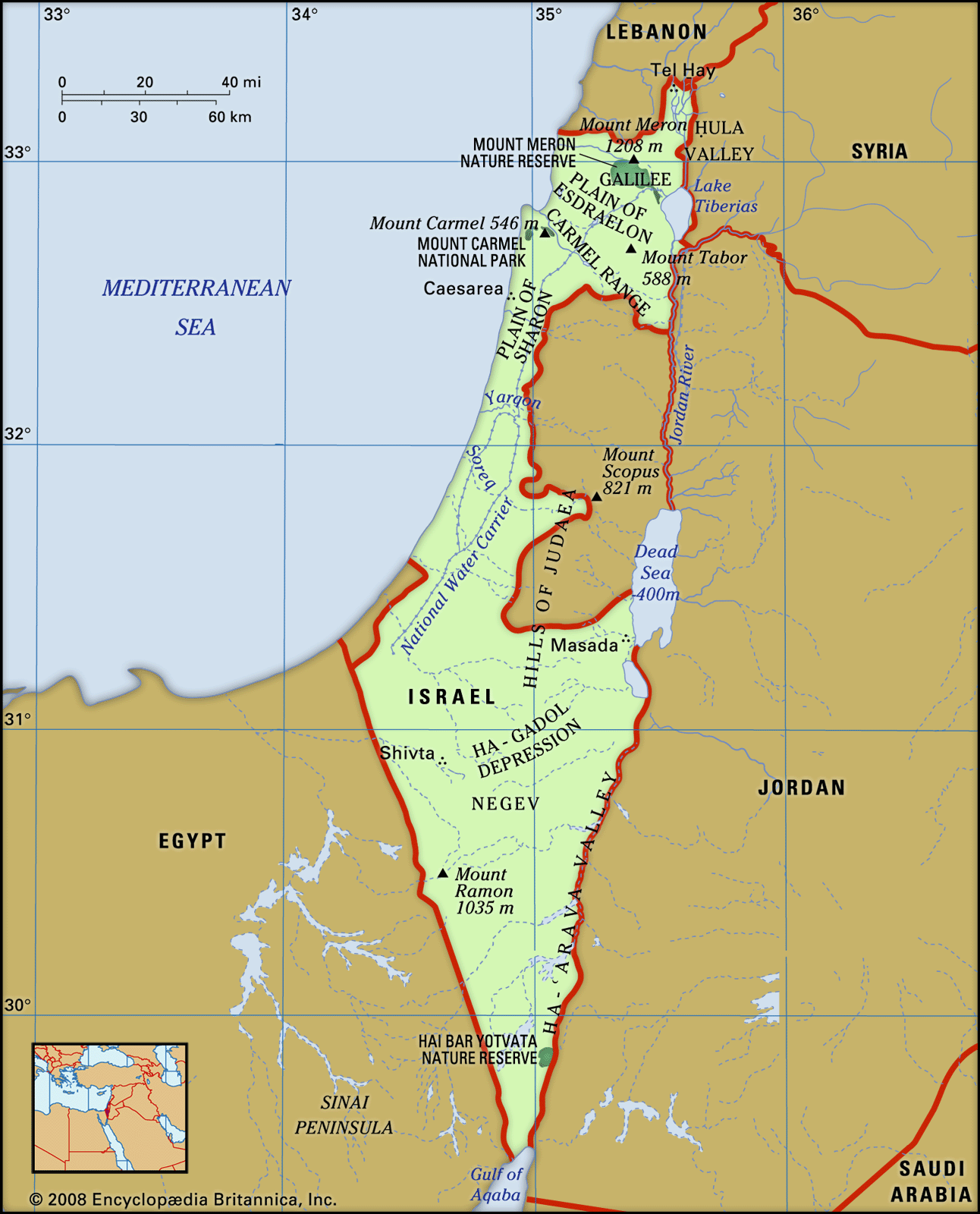
Before the children of Israel inhabited the land, it was possessed by the cursed line of Canaan, son of Noah’s son Ham (Genesis 9:25). For reasons known only to God, He called Abram (Abraham) out of the land of the Chaldees (Genesis 11:28) and promised to give him the land (Genesis 12:7). The land God promised extended beyond the current boundaries of Israel including the Sinai Peninsula, parts of Jordan, all of Syria and Lebanon, to the Euphrates River and up to the southern border of Turkey (Genesis 13:14-15). The land was promised to Abraham and his descendants unconditionally with no strings attached (Genesis 15:7, 9-21). “In the same day the LORD made a covenant with Abram, saying, Unto thy seed have I given this land, from the river of Egypt unto the great river, the river Euphrates” (Genesis 15:18, emphasis mine). The promise has no term limits; it is an eternal promise. “For all the land which thou seest, to thee will I give it, and to thy seed for ever” (Genesis 13:15, emphasis mine).

The promise did not remain with Abraham. It was passed on to his son Isaac (Genesis 26:3, 5) and his grandson, Jacob (later renamed Israel – Genesis 28:3-4, 13-15). Time and again, the promise of the land to the descendants of Abraham, Isaac, and Jacob (Israel) is repeated in Scripture: Genesis 17:8; Exodus 6:8; 12:25; 13:5, 11; 33:1; Deuteronomy 1:8; 8:1; 10:11; 11:9, 21; 19:8; 28:11; 30:20, 21, 23; 34:4; Joshua 1:6; 21:43; Judges 2:1; Nehemiah 9:15, 23. God swore upon Himself to uphold His promise. “For when God made promise to Abraham, because he could swear by no greater, he sware by himself, Saying, Surely blessing I will bless thee, and multiplying I will multiply thee” (Hebrews 6:13-14). God promised the land to the descendants of Abraham, Isaac, and Israel (Jacob), not for a certain timeframe but forever. “Be ye mindful always of his covenant; the word which he commanded to a thousand generations; Even of the covenant which he made with Abraham, and of his oath unto Isaac; And hath confirmed the same to Jacob for a law, and to Israel for an everlasting covenant, Saying, Unto thee will I give the land of Canaan, the lot of your inheritance” (1 Chronicles 16:15-18, emphasis mine). “Everlasting” means that it will never end.

It is God’s land to give to whomever He chooses, and He chose the people of Israel. Abraham had other sons besides Isaac. He had Ishmael through his concubine Hagar (Genesis 16:15). After Sarah died, Abraham remarried and had six other sons by Katura (Genesis 25:1-2). None of these received the promise of the land, only Isaac and later Israel (Jacob). God’s “gift” of the land to Israel is also repeated over and over in Scripture: Leviticus 14:34; 23:10; 25:38; Numbers 27:12; 32:7, 9, 11; 33:53; Deuteronomy 5:31; 6:23; 9:23; 12:1, 10; 16:20; 17:14; 19:14; 21:1; 24:4; 25:15, 19; 27:3; 28:8; 32:52; Joshua 1:2, 11, 15; 5:6; 18:3; 1 Kings 8:34, 40; 9:7; 2 Kings 21:8; Nehemiah 9:36; Jeremiah 25:5; Ezekiel 20:15, 28.

The land belongs to Israel and more land than they currently occupy. The Bible describes the boundaries of the promised land. God showed Abraham the extent of the land promised (Genesis 13:14-15). God repeated the boundaries to Moses (Exodus 23:31) and again to Joshua upon entering the Promised Land (Joshua 1:4). The land on which the Nation of Israel exists today is only a small part of what God has given them, and yet, wrongheaded people want to take away what little they possess now. God will not have it! It is His land, and He will not allow it to be parceled out by outsiders. “Defile not therefore the land which ye shall inhabit, wherein I dwell: for I the LORD dwell among the children of Israel” (Numbers 35:34, emphasis mine). God also has a special affinity for Jerusalem. “Since the day that I brought forth my people out of the land of Egypt I chose no city among all the tribes of Israel to build an house in, that my name might be there; neither chose I any man to be a ruler over my people Israel: But I have chosen Jerusalem, that my name might be there; and have chosen David to be over my people Israel” (2 Chronicles 6:5-6, emphasis mine)

God did drive the Jews out of their land for their rejection of their Messiah, but that was only a temporary measure. God has not permanently disinherited His people. There has always been the promise of restoration in the latter days. “And I will send the sword, the famine, and the pestilence, among them, till they be consumed from off the land that I gave unto them and to their fathers” (Jeremiah 24:10). “For, lo, the days come, saith the LORD, that I will bring again the captivity of my people Israel and Judah, saith the LORD: and I will cause them to return to the land that I gave to their fathers, and they shall possess it … Therefore fear thou not, O my servant Jacob, saith the LORD; neither be dismayed, O Israel: for, lo, I will save thee from afar, and thy seed from the land of their captivity; and Jacob shall return, and shall be in rest, and be quiet, and none shall make him afraid … For I will restore health unto thee, and I will heal thee of thy wounds, saith the LORD; because they called thee an Outcast, saying, This is Zion, whom no man seeketh after.  Thus saith the LORD; Behold, I will bring again the captivity of Jacob’s tents, and have mercy on his dwellingplaces; and the city shall be builded upon her own heap, and the palace shall remain after the manner thereof” (Jeremiah 30:3, 10, 17-18, emphasis mine).

Even though Israel has sinned and remains in sin even now, God in His mercy will restore His people. “Fear thou not, O Jacob my servant, saith the LORD: for I am with thee; for I will make a full end of all the nations whither I have driven thee: but I will not make a full end of thee, but correct thee in measure; yet will I not leave thee wholly unpunished” (Jeremiah 46:28, emphasis mine). The full restoration of Israel will happen when the nation, as a whole, recognizes and turns to their Messiah. “And I will pour upon the house of David, and upon the inhabitants of Jerusalem, the spirit of grace and of supplications: and they shall look upon ME whom they have pierced, and they shall mourn for him, as one mourneth for his only son, and shall be in bitterness for him, as one that is in bitterness for his firstborn” (Zechariah 12:10, emphasis mine).

The land of Israel belongs to God. He has allotted it to the descendants of Abraham, Isaac, and Jacob, i.e., Israel. No one else has any right to that land, and there will be no peace in the Middle East until those who would divide the land, or who would exterminate the Jews from the land acknowledge that the land belongs to them.

5 Comments

Filed under Apologetics, Current Events, End Times, Theology

An Expected End

For I know the thoughts that I think toward you, saith the LORD, thoughts of peace, and not of evil, to give you an expected end. (Jeremiah 29:11)[1]

Christians often quote the verse above without understanding the context in which it was given. It is one of those feel-good verses that makes us feel special believing that God is looking out for us and only has good things in store for us. While that is certainly true to a great extent – God does care and provide for His own, and I can certainly testify to that in my own life. However, deeper thought should be given to the circumstances surrounding this passage.

The ten northern tribes of Israel were conquered and expatriated by Assyria around 722 B.C., and a short 136 years later, the southern kingdom, comprised of the two remaining tribes, Judah and Benjamin, was taken captive by Babylon. It was during this time that Jeremiah prophesied. Indeed, before the Babylonian conquest, Jeremiah urged Judah to repent of its idolatry and avoid what God determined to bring upon them. So deep had they fallen into sin that God actually instructed Jeremiah to stop praying on their behalf.[2]

God finally had it with His people and He summoned “His servant,” Nebuchadnezzar,[3] to conquer them and take them away captive, which he did in 586 B.C. Nebuchadnezzar took Daniel, the prophet, and his friends,[4] captive in this first of three rounds of deportations.

Early in their captivity there arose false prophets telling the captives that their captivity would not be long and that God soon liberate them. That was not God’s plan, and He instructed Jeremiah to send a letter “unto the residue of the elders which were carried away captives, and to the priests, and to the prophets, and to all the people whom Nebuchadnezzar had carried away captive from Jerusalem to Babylon” (Jeremiah 29:1). In short, the letter instructed the people to settle down and prepare for a long stay – build houses, plant gardens, have children and grandchildren. Their stay would not be permanent, but it would be long – 70 years[5] to be exact. God encouraged them to “seek the peace of the city … and pray unto the LORD for it: for in the peace thereof shall ye have peace” (Jeremiah 29:7).

Surely these were not ideal conditions for God’s people. Psalm 137 records how they felt. “By the rivers of Babylon, there we sat down, yea, we wept, when we remembered Zion. We hanged our harps upon the willows in the midst thereof. For there they that carried us away captive required of us a song; and they that wasted us required of us mirth, saying, Sing us one of the songs of Zion. How shall we sing the LORD’S song in a strange land?” (Psalm 137:1-4).

Under these circumstances, God promised, “For thus saith the LORD, That after seventy years be accomplished at Babylon I will visit you, and perform my good word toward you, in causing you to return to this place. For I know the thoughts that I think toward you, saith the LORD, thoughts of peace, and not of evil, to give you an expected end” (Jeremiah 29:10-11, emphasis mine). God’s “good plan” for them was not immediate. Not until a generation away would God’s plan be realized. In the meantime, they had to endure the captivity, pray for their captors and get by in the best way they could. There was no easy way out.

The phrase, “to give you an expected end,” gives pause for thought. When we consider the rest of Israel’s history, we learn that their relationship with God did not improve that much. Yes, they finally gave up their overt idolatry, but they exchanged it for the idolatry of “religion” and “legalism.” After they returned to their homeland and after they rebuilt their Temple, God stopped talking to them for 400 years until Jesus came. So steeped were they in the practice of their religion and legalism, that they completely missed their promised Messiah. Their rejection of their Savior led to the dissolution of their nation and the dispersing of their people among the nations of the world.

Yet, when the prophets speak of the “expected end” – the Day of the Lord – Israel once again becomes a nation, and they finally recognize their Messiah whom they missed at His first coming. God says, “And I will pour upon the house of David, and upon the inhabitants of Jerusalem, the spirit of grace and of supplications: and they shall look upon me whom they have pierced, and they shall mourn for him, as one mourneth for his only son, and shall be in bitterness for him, as one that is in bitterness for his firstborn” (Zechariah 12:10). This, I believe, is their “expected end” to which God referred in Jeremiah 29:11.

Now, with all this in mind, how does this verse apply to us? In many respects, we as Christians, are living in a kind of Babylon. The world grows continually more wicked every day. As Jesus warned, we live “as in the days of Noah.”[6] He said that we “are not of the world,”[7] yet we are “in the world.”[8] Our citizenship is in heaven.[9] Therefore, we need to conduct our lives in a manner befitting our true Kingdom. We should be good citizens in our current state and pray for our leaders and the welfare of our nation. We may not change the world (indeed, the Bible tells us that we won’t), but we do have an influence on people around us. And, God does know the thoughts and plans He has for us – thoughts of “peace” – the peace that only comes from His Holy Spirit in us. Jesus said, “Peace I leave with you, my peace I give unto you: not as the world giveth, give I unto you. Let not your heart be troubled, neither let it be afraid” (John 14:27). We also have an “expected end” with Him in heaven for all eternity, whether we meet Him in death or in the air.[10]

So, next time you hear Jeremiah 29:11 quoted out of context, think on these things. If you do not know Jesus as your personal Lord and Savior, please read my page on “Securing Eternal Life.”


Notes:

[1]  Many modern translations read, “For I know the plans I have for you, declares the Lord, plans for welfare and not for evil, to give you a future and a hope” (ESV) or “For I know the plans that I have for you,’ declares the Lord, ‘plans for prosperity and not for disaster, to give you a future and a hope” (NASB). The Hebrew word that they translate as “welfare” and “prosperity” is “shâlôm,” which the KJV accurately translates as “peace.” It is no wonder that Christians often misapply this verse.

[2]  Jeremiah 7:16; 11:14; 14:11

[3]  Jeremiah 25:9; 27:6

[4]  Daniel 1:3-6

[5]  Jeremiah 29:10

[6]  Matthew 24:37

[7]  John 17:14

[8]  John 17:15

[9]  Philippians 3:20

[10]  1 Thessalonians 4:16-17

Comments Off on An Expected End

Filed under Apologetics, Bible, Christianity, Religion, Second Coming of Christ, Theology

Victorious Entrance

And I saw heaven opened, and behold a white horse; and he that sat upon him was called Faithful and True, and in righteousness he doth judge and make war. His eyes were as a flame of fire, and on his head were many crowns; and he had a name written, that no man knew, but he himself. And he was clothed with a vesture dipped in blood: and his name is called The Word of God. And the armies which were in heaven followed him upon white horses, clothed in fine linen, white and clean. And out of his mouth goeth a sharp sword, that with it he should smite the nations: and he shall rule them with a rod of iron: and he treadeth the winepress of the fierceness and wrath of Almighty God. And he hath on his vesture and on his thigh a name written, KING OF KINGS, AND LORD OF LORDS. (Revelation 19:11-16)

This Sunday, March 28, celebrates Palm Sunday when we commemorate Jesus’ entry into Jerusalem in the final week of His earthly ministry. We term this event as the “Triumphal Entry,” but in many respects, the term is a misnomer.

Daniel predicted the event to the very day of its occurrence. “Seventy weeks [70 x 7 years, or 490 years] are determined upon thy people [Israel or the Jews] and upon thy holy city [Jerusalem], to finish the transgression, and to make an end of sins, and to make reconciliation for iniquity, and to bring in everlasting righteousness [beginning with the Millennial reign of Messiah], and to seal up the vision and prophecy, and to anoint the most Holy [Messiah]. Know therefore and understand, that from the going forth of the commandment to restore and to build Jerusalem [decreed by Artaxerxes Longimanus, 444 BC] unto the Messiah the Prince shall be seven weeks [7 x 7 or 49 years], and [plus] threescore and two weeks [62 x 7 or 434 years; 49 + 434 = 483 years]: the street shall be built again, and the wall, even in troublous times. And after threescore and two weeks shall Messiah be cut off, but not for himself: and the people of the prince that shall come shall destroy the city and the sanctuary; and the end thereof shall be with a flood, and unto the end of the war desolations are determined” (Daniel 9:24-26, emphasis mine). Daniel divides the 490 years (70 weeks) into three segments of 49, 434, and 7 years. The first segment began when Artaxerxes Longimanus issued the fourth decree to rebuild Jerusalem with its walls in 444 BC, and ended in 395 BC when the project was completed – 49 years.[1] The next segment encompassed the 400+ “silent years” until Jesus, Messiah, entered into Jerusalem. Four hundred eighty three (483) years were fulfilled at that time and the final segment of seven years remains to be fulfilled. At the end of the 483 years, to the very day, Jesus, Messiah, was “cut off” at the cross.

The prophet, Zechariah, predicted that the Messiah would present Himself riding on a donkey. “Rejoice greatly, O daughter of Zion; shout, O daughter of Jerusalem: behold, thy King cometh unto thee: he is just, and having salvation; lowly, and riding upon an ass, and upon a colt the foal of an ass” (Zechariah 9:9, emphasis mine). All four Gospel writers record this event from their unique perspectives.[2] Most Bibles that use sub-title divisions of chapters title this event as the “Triumphal Entry.” However, Jesus did not enter Jerusalem as conquering king. He presented Himself as the Melek Shâlêm, the King of Peace. A conquering king would have presented himself with great pomp and ceremony,[3] riding on a white charger followed by his conquering armies, parading the spoils of his conquests.

Jesus entered humbly as the King of Peace. His week would end with a tortuous, humiliating death on a Roman cross. From a human perspective, that hardly qualifies as a triumph. However, the following Sunday, the earth shook[4] as Jesus ripped apart the chains of death and conquered man’s final enemy.[5] “O death, where is thy sting? O grave, where is thy victory? The sting of death is sin; and the strength of sin is the law. But thanks be to God, which giveth us the victory through our Lord Jesus Christ” (1 Corinthians 15:55-57). Yet, we still die physically, but our spirit lives on. “We are confident, I say, and willing rather to be absent from the body, and to be present with the Lord” (2 Corinthians 5:8). One day, even physical death will be lost even to the memory. “And death and hell were cast into the lake of fire. This is the second death” (Revelation 20:14). Our present bodies (whether alive or dead) will be transformed into eternal bodies like the body of the resurrected Christ. “Now this I say, brethren, that flesh and blood cannot inherit the kingdom of God; neither doth corruption inherit incorruption. Behold, I shew you a mystery; We shall not all sleep, but we shall all be changed, In a moment, in the twinkling of an eye, at the last trump: for the trumpet shall sound, and the dead shall be raised incorruptible, and we [who are living at the time] shall be changed. For this corruptible must put on incorruption, and this mortal must put on immortality” (1 Corinthians 15:50-53, emphasis mine).

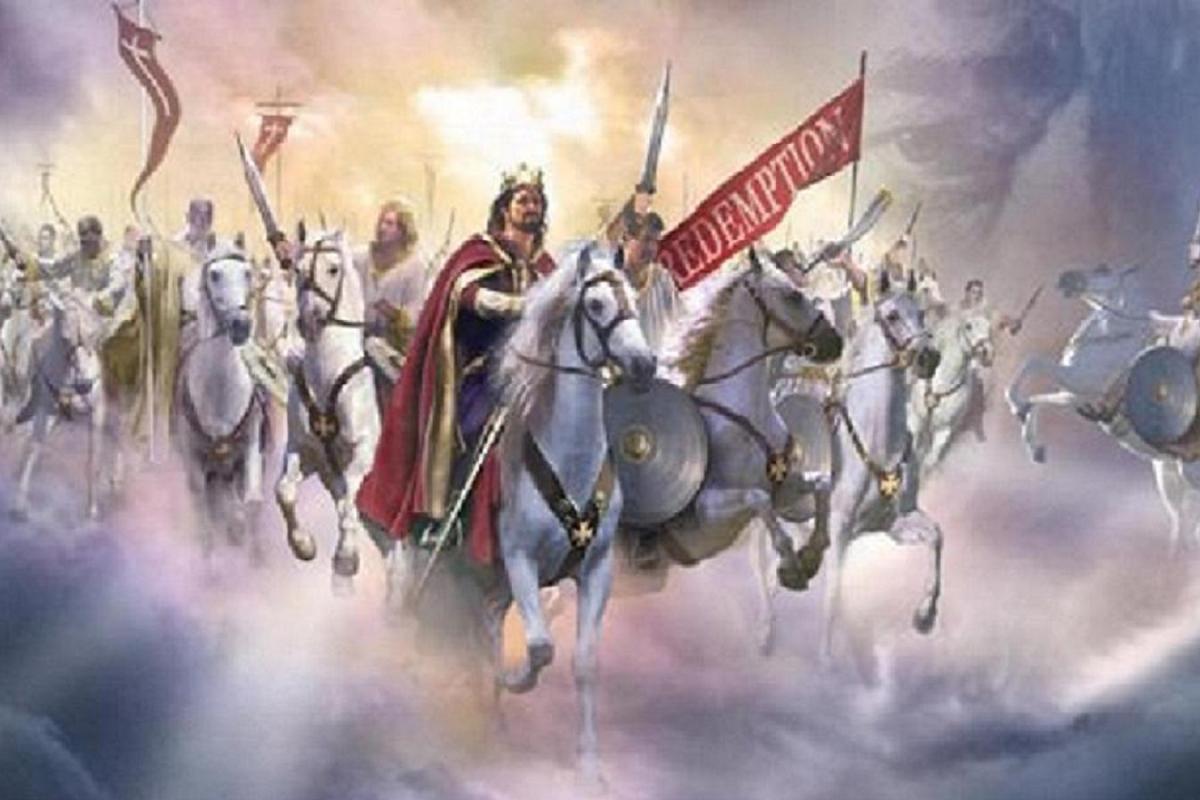
Jesus conquered death at His resurrection, but He has yet to enter Jerusalem in triumph. Our starting verse above, Revelation 19:11-16, describes His real Triumphal Entry. He will enter Jerusalem from His departure point on the Mount of Olives riding on a white horse – not a donkey this time. He will be followed by His heavenly hosts (angelic armies) and by the spoils of His victory, His saints, all riding white horses and dressed in white robes – no weapons in hand. When His foot touches Earth, the Mount of Olives will split in two,[6] half to the north and half to the south. From there He will travel north to the Jezreel Valley, for the Battle of Armageddon. That too is a misnomer, because it will be no battle at all. “And out of his mouth goeth a sharp sword, that with it he should smite the nations: and he shall rule them with a rod of iron: and he treadeth the winepress of the fierceness and wrath of Almighty God” (Revelation 19:15, emphasis mine). That “sword” out of His mouth is His Word. He will speak and the “battle” will be over. “And the LORD shall be king over all the earth: in that day shall there be one LORD, and his name one” (Zechariah 14:9).

Now, that is a Triumphal Entry!

The current events of our world signal that the time of Jesus’ Victorious Entrance is soon approaching. He will come for His Bride, the Church, at any moment; although we do not know when. However, if the signs indicate that His return is near, that means the catching up of His Bride is even closer. Soon after that, Daniel’s final week, the last seven years known as the Tribulation, will begin. Those who are not snatched away by Jesus will remain on earth to suffer through the judgments of God like at no other time in world history. If you are not sure where you stand with Jesus, you can escape that awful time by putting your trust in Him as your Savior. Read my page on “Securing Eternal Life.”

Notes:


[1]  John F Walvoord and Roy B. Zuck, The Bible Knowledge Commentary- Old Testament, (SP Publications, 1985), p.1363.

[2]  Matthew 21:1-11; Mark 11:1-11; Luke 19:28-44; John 12:12-19

[3]  “The Triumphal Entry,” — https://erniecarrasco.com/2019/04/14/the-triumphal-entry/

[4]  Matthew 28:2

[5]  1 Corinthians 15:26

[6]  Zechariah 14:4

Comments Off on Victorious Entrance

Filed under Apologetics, Bible, Christianity, Current Events, Death, Easter, End Times, Evangelism, Gospel, Heaven, Hell, Holidays, Resurrection, Salvation, Second Coming of Christ, Theology