
Tag Archives: Religion and Spirituality

Draw Near to God

Draw nigh to God, and he will draw nigh to you. Cleanse your hands, ye sinners; and purify your hearts, ye double minded. (James 4:8)

What an amazing promise! It is amazing because we know that God is always near. “The LORD is nigh unto them that are of a broken heart; and saveth such as be of a contrite spirit” (Psalm 34:18). “The LORD is nigh unto all them that call upon him, to all that call upon him in truth” (Psalm 145:18). The truth is that God is present everywhere, and there is no place that He is not.

The psalmist, David, poses the rhetorical question, “Whither shall I go from thy spirit? or whither shall I flee from thy presence? If I ascend up into heaven, thou art there: if I make my bed in hell, behold, thou art there. If I take the wings of the morning, and dwell in the uttermost parts of the sea; Even there shall thy hand lead me, and thy right hand shall hold me. If I say, Surely the darkness shall cover me; even the night shall be light about me. Yea, the darkness hideth not from thee; but the night shineth as the day: the darkness and the light are both alike to thee. For thou hast possessed my reins: thou hast covered me in my mother’s womb” (Psalm 139:7-13).

If God is everywhere, why should we draw near to Him? How can we draw any nearer than we already are? The separation is not that of proximity, but rather that of relationship. We have all experienced having a strained relationship with a loved one for one reason or another. While we can be in the same room or even next to one another, we feel a separation until we get the matter resolved.

James, speaking to Christians, implies that we may experience a separation from God, not because He is removed from us, but because our sin has erected a barrier that strains our relationship with Him. He still loves us, but there is tension between Him and us. And just like with our human relationships, we must seek to reconcile the rift – “kiss and make up” as it were. Unlike with human relationships, the fault is never with God, but always with us, and unlike with human relationships, God is always ready to forgive and forget. “If we confess our sins, he is faithful and just to forgive us our sins, and to cleanse us from all unrighteousness” (1 John 1:9).

“Hands” are the agents of action, and for sin to be sin, it must be acted upon. Earlier in his epistle, James says, “But every man is tempted, when he is drawn away of his own lust, and enticed. Then when lust hath conceived, it bringeth forth sin: and sin, when it is finished, bringeth forth death” (James 1:14-15). So, we need to cleanse ourselves from sinful acts. Thankfully for the Christian, this is not something that we accomplish in our own strength, but through the power of the Holy Spirit within us. However, we still need to call upon that power and submit to His direction.

We purify our hearts and minds through what we “feed” them. If we continue to feed our hearts and minds on the things of this world, our desires will be for those things making us “double-minded.” Double-mindedness is a sad place to live. We want to enjoy our relationship with God and enjoy what the world offers at the same time. Jesus said you cannot serve two masters. “No man can serve two masters: for either he will hate the one, and love the other; or else he will hold to the one, and despise the other. Ye cannot serve God and mammon” (Matthew 6:24).

The old hymn repeats, “Trust and obey, for there’s no other way to be happy in Jesus, than to trust and obey.” So, when you feel far from God, guess who moved. God is nearby, He is not the one that caused the rift in your relationship. It might be time for you to take a serious self-check.

Comments Off on Draw Near to God

Filed under Christianity, Religion, Theology

Squirrel

As a dog returneth to his vomit, so a fool returneth to his folly. (Proverbs 26:11)

Oh! He is so smart! And persistent. And the girth of his plump furry body testifies to the success of his thieving ways!

He showed up at my bird feeder early this spring. I sicced Chico, our “chug,” on him a couple of times, but that only deterred him as long as Chico patrolled the back yard. Once Chico returned inside, he was at it again.

I shooed him off a couple of times, but he never went far. As soon as I went into the house, he was at the bird feeder again. So I thought maybe I should go have a talk with him to see if we could come to an agreement. The next time he showed up I walked up to him slowly in a non-threatening way. When I got within four feet of him, he hopped off the feeder and perched on the fence to see what I would do.

I looked him in the eye and spoke softly. “Hey, Squirrel. I put this seed out for birds, not for squirrels. If I wanted to feed you and your buddies, I would have made it more convenient for you. As it is, you have managed to outwit all the obstacles I’ve employed to keep you off of this feeder. I appreciate your cunning, but I would appreciate it more if you stopped getting fat on the seed I put out for the birds.”

He just stared me, as if to say, “What do you plan to do about it?” I could see that reasoning would get me nowhere with this critter. So, I waved my arms and ordered, “Get out of here, Squirrel!” He left but came back about ten minutes later. That’s it! I dug up my old pellet pistol, loaded it with a fresh CO2 cartridge, and filled the magazine with lead pellets. I went to the back door and slowly walked to a place where I could get a clear shot. Squirrel acknowledged me but kept on eating. I took careful aim and slowly squeezed the trigger. Poof! Nothing happened. Squirrel kept eating. I squeezed the trigger again. Poof! Again, nothing happened. I opened the firing chamber and found that my rounds were jamming in the magazine. This was not the first time this pistol failed me. Now I was more determined to get that pesky squirrel.

Online, I found a nice Glock ™ CO2 pistol. It looks exactly like a regular Glock 40 caliber semi-auto, but it fires pellets rather than bullets. So I ordered the Glock and within a couple of days, I was ready to face Squirrel again. When my package arrived, I went straight to the garage where I keep my “ammo” and picked up the container of pellets to load the magazine. This pistol holds 16 rounds! Eagerly, I pulled out the magazine on the Glock and went to load it. ARG! My pellets did not fit the fill hole in the magazine. This pistol required .177 caliber steel BBs! I placed another online order for BBs and waited another two days. In the meantime, I kept Chico busy chasing away Mr. Squirrel.

When the BBs arrived, I loaded up my Glock and waited. Sure enough, thieving Mr. Squirrel showed up at my bird feeder again. This time I was ready. I stepped outside. Squirrel just looked at me. I took careful aim, squeezed the trigger, and NOTHING! What? The pistol was on safety. Squirrel kept eating. Okay. Safety off, aim, fire! POW! The discharge sounded almost like a .22. The BB found its target and Squirrel didn’t know what hit him. He shot up the feeder, onto the fence and over. When he got to the backside of the fence, I knew I hit him because, as he hung there by his back legs, all I could see was his tail flicking as if to say, “Ouch! That hurt!”

I didn’t see Squirrel again for about a week. However, he must have gotten over the sting of being shot with a BB from a powerful CO2 pistol, because he was soon back to his thieving ways. I suspected that might happen, so I started keeping my Glock on the fireplace mantle by the door. There he was again with his back to me and his face firmly planted in my bird feeder. I opened the sliding glass door and slowly stepped outside. This time Squirrel took off before I could take aim. Oh well! At least I got him off my bird feeder.

About 30 minutes later, I looked out my back door, and there he was again. Fat, fluffy, fur-ball stuffing his face with my expensive bird seed! This time, I slowly opened the door. He was so busy stuffing his face that he took no notice of the door opening. Without stepping outside, I took aim through the open door. I had him square in my sights. I slowly squeezed the trigger. NOTHING!  Dang safety! Squirrel kept gorging. I took the pistol off of safety and this time the BB spat through the muzzle with a resounding POW! Right on target! Squirrel was so shocked by the sting that, instead of running away, he started running toward me aiming for our live oak. I aimed, shot again and missed. He ran straight up the live oak and hid within the thick branches. It took some effort, but I found him and shot him again. This time, he ran down the tree, across the yard, up the fence, and into the alley. That will show him!

It wasn’t long before Squirrel forgot again. Within three days he was back. I watched as he feasted on stolen booty. As I watched, I sensed he knew the cost of his sin. He munched a little and cast an eye toward the back door. Coast clear. Another nibble or two. I knew he was on the alert because he kept looking back toward the door, so I very slowly slid open the door. As soon as the air seal broke on the door Squirrel was gone. But he came back. Now I knew that he could hear the seal break on the door, so I started leaving the door cracked open just a bit. That worked … ONCE. I shot Squirrel again, but in a day or two, he was back again. This time, he mounted the bird feeder from the back side where he could keep an eye on the door while hiding behind the bird feeder. As soon as I open the door, he vanishes. I need to rethink my strategy.

Sometimes, we are a lot like Squirrel. We know certain acts – maybe even sinful acts – result in painful consequences. However, because we enjoy doing whatever it is that causes us pain, we continue the pursuit of “sin” hoping that perhaps this time we can get away with it. When we learn that the consequences persist, we pursue our desires by different means hoping that the next time there won’t be any consequences or that they will not be as bad. Kind of like our proverb says, “like a dog returning to his vomit.” We should learn from Squirrel and not be the “fool [that] returneth to his folly.”

8 Comments

Filed under Christianity, Random Musings

On A Hill Far Away…

And Other Biblical Misconceptions

 And he bearing his cross went forth into a place called the place of a skull, which is called in the Hebrew Golgotha: (John 19:17)

With the forthcoming opening of the ICR Discovery Center for Science and Earth History, I and a co-laborer (whom I cannot name because I did not request his permission) have been honored with the task of creating the scenery for the Life of Christ Diorama that will reside across from the Empty Tomb exhibit. An ICR benefactor donated the diorama for exhibition in the Discovery Center. The set contains thousands of pieces – buildings, tents, people, animals, furnishings, etc. – fabricated mostly by an Italian company. The extensive collection cannot all fit in the space allotted, so our leaders determined only to display pivotal scenes in the life of Christ.

Not to give away all the details of the diorama, I want to focus on the crucifixion scene. Where to position the crucifixion scene came into question. Should it be elevated on top of a hill or should it be placed on a lower level between the road and the hill? As Christians, we know the familiar words of the old hymn, “The Old Rugged Cross.” The lyrics say, “On a hill far away, stood an old rugged cross…” I do not know if it is due to the lyrics of the beloved hymn or due to some other handed down tradition, but we all imagine that Jesus was crucified at the top of Mount Calvary. However, musical lyrics or timeless tradition should not be the basis for what we believe. What does the Bible say?

And when they were come unto a place called Golgotha, that is to say, a place of a skull… (Matthew 27:33)

And they bring him unto the place Golgotha, which is, being interpreted, The place of a skull. (Mark 15:22)

And when they were come to the place, which is called Calvary, there they crucified him, and the malefactors, one on the right hand, and the other on the left. (Luke 23:33)

And he bearing his cross went forth into a place called the place of a skull, which is called in the Hebrew Golgotha: (John 19:17) (Emphasis mine)

The Bible does not often provide specific detail of events, but very often it does. The language of the Gospels is Greek. The Greek word for “hill” is either oros or bounos; the latter used only in Luke 3:5, and the former used in several passages in the N.T.[1] Furthermore, Greek prepositions indicate precise positions. The Greek preposition for “on” or “upon” is epi. It means “superimposition,” that is, to be “over” or “upon.” None of the four Gospels give any indication that the crucifixion took place “on a hill called Mount Calvary”[2] regardless of what the song lyrics say. Furthermore, the public spectacle of crucifixion[3] intended as a deterrent against lawlessness took place in the most public of places, usually, a busy roadside where passersby could get a close look at the suffering victims.

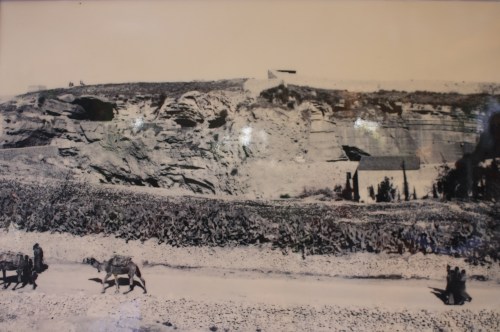
I researched, albeit not extensively, information about the location of the crucifixion. Most of the information[4] argues about three possible “places,” and most shy away from making dogmatic statements. The possible locations offered are, The Church of the Holy Sepulcher (which supposedly houses both the crucifixion and burial sites), The Garden Tomb[5] area (which is very near a limestone formation whose face features two prominent grottos that look like the eye sockets of a human skull), or just some unknown place outside of the Old City (of Jerusalem) designated by the Romans for public executions. All of these resources spoke of the “place” but none ventured to suggest whether the crucifixion took place “on” the hill or “by” the hill, but all agreed that it was “at” Golgotha/Calvary.

The “experts” fail to commit to “on” or “by”, but all four Gospels omit the preposition epi (on). To me that says that Jesus was crucified “at” Calvary, not “on” Calvary. My conclusion led me to determine that the diorama will feature the crucifixion scene near the road with a skull-shaped hill in the background. Besides scriptural reasons, there are practical reasons for my decision. A crucifixion on top of a hill, while it might be visible to all, could easily be ignored by passersby thus defeating the deterrent factor of the event. To get a close-up view – and who would want to – would require extra effort making it a disincentive for gathering a crowd, thus defeating the intended purpose of the Romans. However, if the crucifixion took place on a busy road, the only way to avoid the spectacle would be to take the long way around to enter the city. A roadside crucifixion makes more sense to me.

What does that have to do with salvation? Nothing. Jesus dying for you and me on the cross and rising again on the third day matters more than the place or the position. However, there are many non-believers who will find fault with any perceived discrepancy in Scripture. As Christians, we need to “be ready always to give an answer to every man that asketh you a reason of the hope that is in you with meekness and fear” (1 Peter 3:15). Controversies like these will come up. For example: “Jesus said He would be in the grave three days and three nights.[6] There are not three days and three nights between Friday and Sunday. The Bible is wrong!” Another example is the anointing of Jesus. “All the Gospels give accounts of Jesus’ anointing, but they are all different”[7] How would you respond to this challenge? A careful study of Scripture will reveal that there were three separate anointings; Matthew and Mark refer to one before the crucifixion, Luke recounts one before the Transfiguration, and John records one by Mary after Jesus raised her brother Lazarus after four days dead.

Other examples can be cited, but the point is that we need to “Study to shew thyself approved unto God, a workman that needeth not to be ashamed, rightly dividing the word of truth,” (2 Timothy 2:15) rather than relying on song lyrics, traditions, or human scholarship. Do not just read your Bible, study it!

Notes:


[1]  Matthew 5:14; Luke 1:36, 65; 3:5; 4:29; 9:37

[2]  “I Believe In A Hill Called Mount Calvary” – https://www.youtube.com/watch?time_continue=12&v=OPByLTzkctc

[3]  “Crucifixion” – https://en.wikipedia.org/wiki/Crucifixion

[4]  “Where Was Jesus Crucified? – Golgotha ‘the Place of the Skull’” – https://www.biblestudytools.com/bible-study/topical-studies/where-was-jesus-crucified.html

[5] “Jesus’ crucifixion site? (A ‘Skull’, Garden & Tomb)” – https://www.youtube.com/watch?time_continue=7&v=-7fHnnqre1o

[6]  “Three Days, Three Nights” – https://erniecarrasco.com/2014/07/13/three-days-three-nights/

[7]  “Jesus Last Days” – https://erniecarrasco.com/2018/03/25/jesus-last-days/

Comments Off on On A Hill Far Away…

Filed under Apologetics, Bible, Christianity, Religion, Salvation

Making Time Count

So teach us to number our days, that we may apply our hearts unto wisdom. (Psalm 90:12)

On Tuesday of this last week, I completed my 69th lap around the sun. The Sunday before, June and I led the last lesson in the Crown ™ Do Well: The Crown Biblical Financial Study.[1] The lesson was on “Eternity,” and one of the questions we were asked to ponder was this: “Estimate the number of days you have left on earth. How does this impact your thinking?” Wow! That is a sobering thought! Psalm 90:10 brings this thought into sharp focus. “The days of our years are threescore years and ten [70]; and if by reason of strength they be fourscore years [80], yet is their strength labour and sorrow; for it is soon cut off, and we fly away” For me, age 70 looms a mere 366 days (2020 is a leap year). And “if by reason of strength” I reach 80 years, that is only 4020 days away (there are three leap years between 2020-2030). For me, at least, that is not a lot of time. However, no one is guaranteed tomorrow; we are all living on borrowed time.

The same psalm, quoted above, offers a prayer to help us think soberly about the time we are given. “So teach us to number our days, that we may apply our hearts unto wisdom” (Psalm 90:12). Time is a precious asset and to squander it on frivolity[2] is poor stewardship. Frivolity opposes “wisdom.” God gives us all the freedom to “apply our hearts unto wisdom” or to apply our hearts to frivolity. That was heavy food for thought.

Then on Friday, our devotional in Days of Praise: “Redeeming the Time,”[3] by ICR’s founder, Dr. Henry M. Morris brought this thought back to mind. In the devotional, Dr. Morris points out that “time is a very valuable asset, in danger of being lost forever unless it is rescued or redeemed.” It occurs to me that we experience the “present” in nanoseconds.[4] We constantly move from the past into the future, so when we misuse time, that is lost forever. Therefore, the only way to “redeem” time is to redeem it in the “future” toward which we are moving. That requires thought and planning – always.

Dr. Morris further asserts, “If we squander our money or lose our health, there is always the possibility of earning more money or being restored to health, but wasted time is gone forever.”

As I begin my 70th trip around the sun, I want to remember what a precious commodity time is. I what to remember that the time I am given is not mine and it can be taken away from me at any time. Jesus said, “Lay not up for yourselves treasures upon earth, where moth and rust doth corrupt, and where thieves break through and steal: But lay up for yourselves treasures in heaven, where neither moth nor rust doth corrupt, and where thieves do not break through nor steal … But seek ye first the kingdom of God, and his righteousness; and all these things shall be added unto you. (Matthew 6:19-20, 33). My time belongs to God; therefore I want to invest it wisely in His kingdom. “So teach [me] to number [my] days, that [I] may apply [my] heart unto wisdom” (Psalm 90:12).

Notes:


[1]  Crown Financial Ministries website: https://www.crown.org/

[2]  Dictionary.Com definition of : frivolous: https://www.dictionary.com/browse/frivolous

[3]  Henry M. Morris, Ph.D., “Redeeming the Time”: https://www.icr.org/article/11211/

[4]  “No Time Like the Present”: https://erniecarrasco.com/2015/01/18/no-time-like-the-present/

4 Comments

Filed under Christianity, Heaven, Philosophy, Random Musings, Religion, Theology

It Does Matter

For as Jonas was three days and three nights in the whale’s belly; so shall the Son of man be three days and three nights in the heart of the earth. (Matthew 12:40)

Recently I listened to a message on the crucifixion. The message excelled in many respects by providing insight into that fateful day of our Lord’s life. However, one part of the message troubled me. The messenger commented that some theologians believe Jesus was crucified on Friday, while others say He was crucified on Thursday. I know that; I’ve heard those arguments before. That is not what troubled me. What troubled me was his comment that the day on which the crucifixion took place does not really matter. The fact of the crucifixion is what really matters.

WOAH!

It does matter! Jesus said very specifically that “the Son of man [shall] be three days and three nights in the heart of the earth” (Matthew 12:40). That is three full days and three full nights.[1] You cannot get three full days and three full nights from a Friday crucifixion even if you allow for partial days and nights. Why does that matter?

One reason it matters is that “according to one Jewish tradition, the soul hovered about the body for three days in hope of reentering it.”[2] If it were not three full days and nights, then, as some have asserted, He could have resuscitated in the coolness of the tomb and walked out. (There are many problems with that idea, but that rabbit can be chased another day.)

Jesus raised Lazarus four days after his death. Lazarus was so dead that “by this time he stinketh: for he hath been dead four days” (John 11:39). Decomposition had already set in. That being the case, would it have been better for Jesus to remain in the tomb four days rather than three? No, because Scripture predicted that Jesus’ body would not decompose: “For thou wilt not leave my soul in hell; neither wilt thou suffer thine Holy One to see corruption” (Psalm 16:10). For that reason, it needed to be three full days and three full nights – long enough for the spirit to depart (in the estimation of the Jews), yet not long enough for decomposition to set in.

Another argument against a Friday crucifixion finds its basis in history. Most theologians hold the opinion that Jesus was crucified in A.D. 30. Passover, the day on which Jesus was crucified, always falls on Nissan 14 – the fourteenth day of the first month of the year.[3] Nissan 14, 30 A.D. fell on a Wednesday, not a Friday.[4] A Wednesday crucifixion allows for three full nights and three full days, meaning that Jesus would have risen anytime after 6:00 PM on Saturday evening, the first day of the week by Jewish reckoning – the day begins after sundown.

I believe those are good arguments against a Friday crucifixion, but they are not the best argument. The best argument is Jesus’ own words. He very specifically said that He would be in the heart of the earth, i.e., the grave, for three days and three nights. Anything less than that makes Jesus a liar. Do you really want to go there! If we believe God’s Word is inerrant – and Jesus IS God – then we must accept what HE said, and reject what errant men say. It Does Matter!

HE IS RISEN INDEED!

Notes:


[1]  “Three Days, Three Nights” – https://erniecarrasco.com/2014/07/13/three-days-three-nights/

[2]  Herschel Hobbs, The Illustrated Life of Jesus, (Nashville, Holman Bible Publishers, 2000), 183.

[3]  Leviticus 23:5

[4]  http://www.cgsf.org/dbeattie/calendar/?roman=30

2 Comments

Filed under Apologetics, Bible, Christianity, Easter, Gospel, Religion, Resurrection, Theology