Tag Archives: Religion

Not Passed On In The Genes

genetic-battle

And Solomon did evil in the sight of the LORD, and went not fully after the LORD, as did David his father. (1 Kings 11:6)

I have heard the lament of many good Christian parents who did all they knew to do to “bring [their children] up in the nurture and admonition of the Lord” (Ephesians 6:4) only to have them walk away from the faith as adults. This is nothing new, and the Bible offers examples from which we can take comfort.

Israel had no greater king than David. Although the Bible makes no effort to hide David’s imperfections, it does make one claim that defines David’s overall character. David was a man after God’s own heart (Acts 13:22). With all of his flaws, David’s greatest desire was to please God. “As the hart panteth after the water brooks, so panteth my soul after thee, O God. My soul thirsteth for God, for the living God: when shall I come and appear before God?” (Psalm 43:1-3).

One would think that kind of love for God would be reflected in his children, but the record shows that David’s children did not share the same devotion.  Amnon, David’s first-born son by Ahinoam’s (2 Samuel 3:2) loved (actually lusted after) his half-sister Tamar so much that he raped her (2 Samuel 13). Tamar was Absalom’s sister by Maacah. When Absalom (his name means “Father of Peace”) heard of Amnon’s deed, he waited for a time to see if his father, David would take any action. When that did not happen, Absalom acted on his own accord and had his older half-brother murdered. After two years of self-exile, he was allowed to return to Jerusalem, but David refused to see him. This caused Absalom to rebel against his father and incite a coup to overthrow the king. David fled for his life, and the rebellion was finally quelled with the slaying of Absalom, much to David’s regret. All of this illustrates the point that children do not automatically inherit the parent’s zeal for God. Some may blame David for being an inattentive father. Some may attempt to excuse him; after all, he had a kingdom to manage. But the Bible is clear, God holds every individual responsible for his own actions.

Another illustration of this truth shows up in David’s successor, Solomon, supposedly the wisest of all Israel’s kings. But a close inspection of the Biblical record reveals a different story. At the beginning, Solomon started out on the right track. On his ascendancy, David charged his son, “I go the way of all the earth: be thou strong therefore, and shew thyself a man; And keep the charge of the LORD thy God, to walk in his ways, to keep his statutes, and his commandments, and his judgments, and his testimonies, as it is written in the law of Moses, that thou mayest prosper in all that thou doest, and whithersoever thou turnest thyself (1 Kings 2:2-3, emphasis mine). Early in his reign, Solomon honored his father’s admonition. “And Solomon loved the LORD, walking in the statutes of David his father” (1 Kings 3:3) so much so that when God offered him anything he wished, he asked for wisdom to rule God’s people (1 Kings 3:5-13). God granted him not only wisdom, but wealth and fame.

Solomon used his God-given gifts to build the Temple, purportedly the envy of the known world. Solomon built up the kingdom and extended it borders, and God granted him peace throughout his realm. “So king Solomon exceeded all the kings of the earth for riches and for wisdom. And all the earth sought to Solomon, to hear his wisdom, which God had put in his heart” (1 Kings 10:23-24, emphasis mine). However, not long after the Temple construction dust settled, Solomon’s love for God waned, replaced by a love for something else. “But king Solomon loved many strange women, together with the daughter of Pharaoh, women of the Moabites, Ammonites, Edomites, Zidonians, and Hittites; Of the nations concerning which the LORD said unto the children of Israel, Ye shall not go in to them, neither shall they come in unto you: for surely they will turn away your heart after their gods: Solomon clave unto these in love” (1 Kings 11:1-2. emphasis mine). These “strange” women were not of Israelite stock. Solomon violated God’s prohibition against marrying “foreign” women, not because God is “racist,” (He’s not; He created all nations of one blood- Acts 17:26), but for “religious” reasons. These women all worshiped demonic gods, and God knew they would negatively influence His people. “For it came to pass, when Solomon was old, that his wives turned away his heart after other gods: and his heart was not perfect with the LORD his God, as was the heart of David his father. For Solomon went after Ashtoreth the goddess of the Zidonians, and after Milcom the abomination of the Ammonites” (1 Kings 11:4-5). What happened to Solomon? Did he not have a great example in his father David?

Yet, hope remains. Solomon is known for his many proverbs and sayings. It is said that Solomon “spake three thousand proverbs” (1 Kings 4:32), only a fraction of which survived as recorded in the Book of Proverbs. Near the end of his life, perhaps he regained some of his wisdom, which he tried to pass on to the son who would succeed him, Rehoboam. Proverbs 1-9 record Solomon’s words of advice to his son where he admonishes his son to seek “wisdom.” Imagine that! The Biblical record is clear that his son ignored his father’s counsel, which resulted in splitting the kingdom. That Solomon returned to his “first love” at the end of his life comes through in the Book of Ecclesiastes, “probably [written] in his old age, as he was looking back on the happy early years of his reign and regretting his tragic failures in his later years.”[1] The tone seems rather pessimistic, which results from man’s quest to fill one’s life through material and/or sensual means. In the end, Solomon reveals the true source of joy and satisfaction. “Let us hear the conclusion of the whole matter: Fear God, and keep his commandments: for this is the whole duty of man” (Ecclesiastes 12:13).

Having experienced my own children walking away from God, I can only sympathize with those experiencing the same thing.  I can relate to all the second guessing that goes on in the hearts and minds of such parents. They wonder where they failed, where they went wrong, what they could have done differently. Parents, regardless of the heartache we endure over our lost children, we must realize that God does not hold us responsible for the actions of our children after they are on their own.  “The soul that sinneth, it shall die. The son shall not bear the iniquity of the father, neither shall the father bear the iniquity of the son: the righteousness of the righteous shall be upon him, and the wickedness of the wicked shall be upon him” (Ezekiel 18:20, emphasis mine). It works both ways. I have also known many good Christians that had wicked parents. God holds each individual responsible. We can only hope and pray that, like Solomon, one day they will see the vanity of their lives, and return to the God of their fathers. Only God can change the heart. Salvation is not passed on in the genes.

Notes:


[1]  Henry M. Morris, Ph.D., The Henry Morris Study Bible, (Master Books, Green Forest, AR, 2012), 985.

Post Script:

By Dr. James J.S. Johnson

  1. Perfect example in a well-known Christian family, the son of 2 very godly parents, Francis & Edith Schaeffer, is Franky Schaeffer, a vile & blasphemous apostate Christian-hater – total opposite of his parents; in fact, the true “heir” to the Schaeffer ministry is Fran & Edith’s son-in-law, Udo Middelmann  —  see  www.theschaefferfoundation.com/bios_francis_a_schaeffer_foundation.php .
  2. A less famous example is a less-well-known (yet very godly) couple, Ian & Ginny McLaren, whose vile & blasphemous apostate son is emergent-church “prophet” Brian McLaren.
  3. But my 3rd post-script is the reverse – my own father was an apostate clergyman who spent huge amounts of energy denigrating the Holy Bible – yet, by God’s grace, I rejected his blasphemy.

No one can blame their parents, or get into Heaven on their parents’ coattails.  God has no “grandchildren” – He is the Heavenly Father (not grandfather) of the redeemed; Satan is father of the lost.

><> JJSJ

4 Comments

Filed under Apologetics, Christianity, Evangelism, Religion, Salvation, Theology

AMEN!

amen-with-man

And unto the angel of the church of the Laodiceans write; These things saith the Amen, the faithful and true witness, the beginning of the creation of God; (Revelation 3:14)

AMEN! It’s a common interjection often expressed to show agreement or approval and often without knowledge of what the word means. Can I get an AMEN!

The word can be either an interjection, an adverb, or a noun. Dictionary.Com defines it like this: as an interjection, “it is so; so be it (used after a prayer, creed, or other formal statement to express solemn ratification or agreement;” as an adverb, “verily; truly.” and as a noun, “an utterance of the interjection ‘amen.’” The 1828 Noah Webster’s Dictionary defines it as follows:

AMEN‘. This word, with slight differences or orthography, is in all the dialects of the Assyrian stock. As a verb, it signifies to confirm, establish, verify; to trust, or give confidence; as a noun, truth, firmness, trust, confidence; as an adjective, firm, stable. In English, after the oriental manner, it is used at the beginning, but more generally at the end of declarations and prayers, in the sense of, be it firm, be it established.

For the best understanding of the word, we need to look to its origins in the Bible. We find the first use of the word in Numbers 5:22. In context, a woman is brought before the high priest for suspicion of adultery by her husband who has the “spirit of jealousy.” The priest would make a concoction of “holy water” and dust from the floor of the tabernacle, and he would make the woman drink it with the understanding that if she is guilty, the truth will manifest physically in her body. “And this water that causeth the curse shall go into thy bowels, to make thy belly to swell, and thy thigh to rot: And the woman shall say, Amen, amen” (Numbers 5:22, emphasis mine). “Amen,” in English, is a transliteration of the Hebrew ‘âmên (Imagine that!). Strong’s Dictionary defines it thus: “sure; abstractly faithfulness; adverbially truly: – Amen, so be it, truth.” In this case, the woman would be expressing complete agreement with the test as indicated by the repetition of the amen – “so be it, so be it”

Deuteronomy 27 presents a long list of curses for violating the laws of God to which all the people must express agreement with an “Amen.” The next time we find AMEN in the Bible is in 1 Kings 1, where King David establishes his son, Solomon, as his successor. He calls for Zadok the priest, Nathan the prophet and Benaiah the son of Jehoiada, Solomon’s future top military officer, to witness the king’s transfer of power. “And Benaiah the son of Jehoiada answered the king, and said, Amen: the LORD God of my lord the king say so too” (1 Kings 1:36, emphasis mine). In this case Benaiah affirmed the king’s decree: “it is so” or “let it be so.”

First Chronicles 16 records the time when David brought the Ark to Jerusalem (after the incident with Uzzah recorded in 2 Samuel 6). Beginning with verse 8, the account recounts a psalm of David which is later repeated in Psalms 105:1-15; 96:1-13; and 106: 1, 47-48, and ends with: “Blessed be the LORD God of Israel for ever and ever. And all the people said, Amen, and praised the LORD” (1 Chronicles 16:36, emphasis mine). Here, not only do the people agree, but they also affirm the truth of the statement. Their acknowledgement of the truth of the statement prompts them to praise the Lord.

Another example of acknowledging the truth of a statement appears in Nehemiah, the eighth chapter. Historically this took place after the return of the Jews from Babylonian captivity where Nehemiah was tasked with restoring the bulwarks of Jerusalem, while Ezra, the priest, rebuilt the Temple. The walls were completed in the sixth month, and the following month, on Rosh Hashanah, the long neglected Torah was presented to Ezra. “And Ezra opened the book in the sight of all the people; (for he was above all the people;) and when he opened it, all the people stood up: And Ezra blessed the LORD, the great God. And all the people answered, Amen, Amen, with lifting up their hands: and they bowed their heads, and worshipped the LORD with their faces to the ground” (Nehemiah 8:5-6, emphasis mine). Notice that at this point the Torah – “the book of the law of Moses” (v. 1) – had not been read. The double affirmation was to the statement “the LORD, the great God” – Yahweh ha’ĕlôhı̂ym hagâdôl. “Tis true, tis true,” they exclaimed, and with hands lifted “they bowed their heads, and worshipped the LORD with their faces to the ground.” The record states that the people “stood” (v. 5) from morning until midday (v. 3) to listen to the reading. Ezra stood on a platform – a pulpit – and “the Levites, caused the people to understand the law: and the people stood in their place” (Nehemiah 8:7). The returning Jews had been captive in Babylon for 70 years and had for the most part forgotten the Hebrew language. They were more familiar with the language of Babylon – Aramaic. “So they read in the book in the law of God distinctly, and gave the sense, and caused them to understand the reading” (Nehemiah 8:8, emphasis mine). That is something every good Bible teacher must be careful to do. “Study to shew thyself approved unto God, a workman that needeth not to be ashamed, rightly dividing the word of truth” (2 Timothy 2:15).

AMEN appears in only four psalms: Psalm 41:13; 72:19; 89:52; and 106:48. In each psalm, the Amen affirms the eternal nature of God. In the prophets, only Jeremiah uses the word once. In this instance, God promised the return of Judah from Babylonian captivity in two years. “Even the prophet Jeremiah said, Amen: the LORD do so: the LORD perform thy words which thou hast prophesied, to bring again the vessels of the LORD’S house, and all that is carried away captive, from Babylon into this place” (Jeremiah 28:6, emphasis mine). Here “Amen” expresses the desire that God will perform His will – “let it be so.”

The New Testament takes the Hebrew “‘âmên” and transliterates it into the Greek “amēn,” but the meaning is the same. So, we can see that when we say “amen” in English, we are really speaking Hebrew. However, the proper pronunciation sounds more like “ah-men” rather than “ay-men” as pronounced in Texanese.

The King James translators of the New Testament (NT) made a distinction between the interjection (“it is so” or “so be it”) and the adverb (“verily, truly”). The word appears the same in the Greek, but the translators rendered it differently in the NT as either “Amen” or “Verily.” The distinction is especially important when Jesus speaks. Being God, anything Jesus says is truth, but when He takes the extra effort to emphasize a statement with “Verily, verily,” we need to pay extra heed to His words. What does Jesus mean when He says, “For verily I say unto you, Till heaven and earth pass, one jot or one tittle shall in no wise pass from the law, till all be fulfilled” (Matthew 5:18, emphasis mine)? The “jot” is the smallest Hebrew letter yod (י) and the “tittle” is the smallest mark that distinguishes two similar looking letters like the Dalet (ד) and the Resh (ר). To that extent, Jesus says “Truly” He will preserve His Word. Those who like to criticize the Bible and say “this does not belong” or “this must be added” should consider Jesus’ “true” words. The psalmist said, “I will worship toward thy holy temple, and praise thy name for thy lovingkindness and for thy truth: for thou hast magnified thy word above all thy name” (Psalm 138:2, emphasis mine). Since God has such high regard for His Word, how much more should we take care to handle His Word rightly!

When Jesus says “verily” once, it is worthy of close attention, but when He repeats it twice, it is worthy of double attention. It is interesting that in all of the Gospels, only John, who identifies Jesus as the “Word” and as God, records the double stress on “verily.” Twenty-five times John records Jesus saying, “Verily, verily, I say unto you.” A good point to note is that Jesus never said, “Thus saith the Lord.” He spoke by His own authority as the Lord. In response to Nathaniel’s acknowledgment that “thou art the Son of God; thou art the King of Israel” (John 1:49),  Jesus answered, “Verily, verily [Amen, amen], I say unto you, Hereafter ye shall see heaven open, and the angels of God ascending and descending upon the Son of man” (John 1:51, emphasis mine). Commentators vary on what Jesus meant by this statement, but to me it seems that Jesus was talking about His second coming when He will “truly, truly” be the King of Israel.

To Nicodemus, “Jesus answered and said unto him, Verily, verily, I say unto thee, Except a man be born again, he cannot see the kingdom of God” (John 3:3, emphasis mine). To us all, Jesus says, “Verily, verily, I say unto you, He that heareth my word, and believeth on him that sent me, hath everlasting life, and shall not come into condemnation; but is passed from death unto life. Verily, verily, I say unto you, The hour is coming, and now is, when the dead shall hear the voice of the Son of God: and they that hear shall live.” (John 5:24-25, emphasis mine). That makes me want to shout, “Hallelujah! Amen, amen! It’s true; it’s true!” Again Jesus says, “Verily, verily [Truly, truly], I say unto you, He that believeth on me hath everlasting life” (John 6:47, emphasis mine). Yet again Jesus says, “Verily, verily [Amen, amen], I say unto you, If a man keep my saying, he shall never see death” (John 8:51, emphasis mine).

In the final book of the Bible, Jesus refers to Himself as “the Amen, the faithful and true witness, the beginning of the creation of God” (Revelation 3:14, emphasis, mine). He is the final affirmation, the ultimate truth. AMEN!

Comments Off on AMEN!

Filed under Apologetics, Bible, Christianity, Evangelism, Gospel, Religion, Salvation, Theology

Thees, Thous, and Wot Nots

AV-1611

He said unto him, What is written in the law? how readest thou? (Luke 10:26)

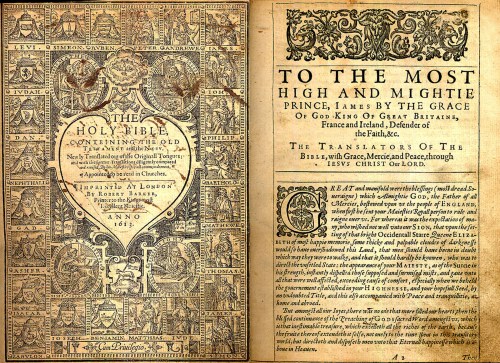
One of most common complaints or criticisms I hear about the King James Version of the Bible (KJV) is that Elizabethan English is just too difficult to understand. I even heard one well-known preacher declare from the pulpit that the KJV was just a “stupid translation.” That is a rather sad pronouncement coming from a supposedly well-educated cleric. I suggest that such comments demonstrate the reader’s educational privation rather than a problem with the KJV.

The KJV is the first English translation I ever owned, and I do not recall ever having a problem understanding it even in elementary school. Now, I will admit that reading it aloud presented problems in vocalizing the archaic language, but that did not impair my understanding of it. However, to be precise, The KJV is not truly Elizabethan English. It can better be described as “biblical” English. At the time of the KJV translation (1611) no one used thee, thou, thine or ye in common English. If you read Shakespeare, you will not find these words used, only “you” or “yours.”

So, what is up with the unusual language? The KJV translators wanted to convey the original Hebrew and Greek as accurately and literally as possible.

They were so concerned about it that they even took over the very phraseology of the Hebrew and Greek. We find in our [KJV] Bibles, all kinds of Hebrew expressions and concepts that are not natural to the English way of speaking. In fact, it can even be said that the English of the King James Version is not the English of the 17th century, nor of any century. It is an English that is unique, for it is Biblical English-an English formed by the Hebrew and Greek of the Bible. It is Biblical English because the translators were more interested in being faithful to the originals than in making their translation in the street language of the day

That they sought an accurate translation is further indicated by the fact that they italicized every word that did not have a corresponding word in the original … Moreover, to insure the fact that the reader understands the meaning of certain original words, they added 4,223 marginal notes that gave the literal meaning of the original words, and 2,738 notes with alternate translations. The result is that in the King James Version we have an accurate translation that puts the others to shame.[1] (Emphasis mine)

One writer noted that, “Our culture doesn’t think like this today. I believe it is a problem when we start talking about translations that we are so obsessed with the ease for men, rather than translating the Bible in a respectful, elevating fashion out of reverence for God.”[2] I suggest that “our culture” has become lazy when dealing with the Word of God. Paul in writing to Timothy exhorts his protégé to “Study to shew thyself approved unto God, a workman that needeth not to be ashamed, rightly dividing the word of truth” (2 Timothy 2:15). The Greek word translated “study” is spoudazō which means to be “diligent,” to “make an effort, endeavor, labor.” One is not supposed to read the Bible as one does a dime store novel. It demands one’s full attention, and thought. It must engage one’s mind fully. One must meditate on the Word and wrestle with those things that seem difficult to understand.

The verse I just quoted, 2 Timothy 2:15, uses the archaic word “shew.” That stumps many modern readers, but why? Most modern dictionaries still list the word. In fact, one can go on the internet to Dictionary.com to find the definition. It simply means “show.” How hard is that? One of my favorite old English words is “wot.” It is only used ten times in the KJV, so even there it is rare. The first time it is used is in Genesis 21:26: “And Abimelech said, I wot not who hath done this thing: neither didst thou tell me, neither yet heard I of it, but to day” (emphasis mine). Wot does that mean? (Pardon the pun.) Again, the word is still listed in modern dictionaries. Here is the definition from Dictionary.com: “first and third person singular present of wit,” or “to know.” So, in our previous verse, we can substitute “know” for “wot” and it would read: “And Abimelech said, I know not who hath done this thing…” Once we know that, we should no longer have a problem with it.

Present tense verbs that end in “th” in the KJV cause some people grief, but these too have an easy fix. In most cases, all one need do is substitute “s” for the “th.” The first such occurrence appears in Genesis 1:20: “And God said, Let the waters bring forth abundantly the moving creature that hath life, and fowl that may fly above the earth in the open firmament of heaven” (emphasis mine). Take the present tense verb “hath” and substitute “s” for “th” and you have the modern English verb “has.” There is nothing difficult about this. Again, one can still find the old spelling in modern dictionaries. With a little “study” these “roadblocks” can be smoothed out.

One of the things I like best about the biblical English employed by the KJV is the distinction made between the singular and plural form of the second person pronoun. In modern English (and, by the way, in Elizabethan English) the second person pronoun is “you” whether singular or plural. That is not so in the biblical English of the KJV. The reason for this is that the original languages, Hebrew and Greek, make the distinction. In writing about this, Dr. Henry M. Morris said, “[We] forget that “thee,” “thou,” and “thine” were used to express the second person singular, with “you,” “ye,” and “yours” reserved for second person plural. Today we use “you” indiscriminately for both singular and plural, thereby missing the precise meaning of many texts of Scripture.”[3] The first example of the second person singular is found in Genesis 2:16: “And the LORD God commanded the man, saying, “Of every tree of the garden thou mayest freely eat” (emphasis mine). This is significant to know, because here God was speaking directly to Adam – ONLY. Eve had not been created at this point. Why is that important? Because in Genesis 3:1-6 we see Satan attack the one who had received the command indirectly – Eve. God did not give the command to both Adam and Eve, although it was meant for both; He gave the command directly to Adam – singular. We then see the first occurrence of “ye” in Genesis 3:1: “Now the serpent was more subtil than any beast of the field which the LORD God had made. And he said unto the woman, Yea, hath God said, Ye shall not eat of every tree of the garden?” (Emphasis mine). When Satan approaches Eve, he knows about the commandment God gave and he knows that the commandment applied to both of them, so we see the plural form of the second person pronoun – ye.

Now, when the reader knows this, the reader’s understanding of Scripture increases. Some may argue that in modern English, context will determine whether the second person pronoun is singular or plural, but that is not always the case in Scripture. For example, as one reads on, one will find that sometimes the “nation” of Israel is addressed in the singular (using thee, thou, thine), and sometimes it is addressed in the plural (using, ye, you, yours). Understanding the biblical English provides the insight to know whether God is addressing the nation as a unit or as individuals. This is important because God deals with nations as a whole, and He also deals with the individuals that make up a nation. So, “thee” or “ye” makes a big difference in understanding Scripture that most modern Bible translations ignore.

The beautiful prose of the King James is a treasure which should not be lost. It has been acclaimed widely as the greatest example of English literature ever written. Apart from a few archaic words which can be easily clarified in footnotes, it is as easy to understand today as it was four hundred years ago. This is why the common people today still use and love it. It is the “intelligentsia” who tend to favor the modern versions. The King James uses mostly one and two-syllable words, and formal studies have always shown its readability index to be 10th grade or lower.[4]

Many years ago, someone convinced me that the New American Standard Bible (NASB) was the best literal translation. Today the same is said of the English Standard Version (ESV). I concur that those are good translations. I also agree with the one who said, “The best translation is the one you will read.” Besides the points presented here in defense of the KJV, there are many other good reasons to prefer the KJV over all other translations. Dr. Henry M. Morris offers a fair analysis of several modern translations and presents his reasons for preferring the KJV in an article entitled “Should Creationists Abandon the King James Version?” listed in the end notes below. I would encourage the readers to read and consider what Dr. Morris has to say. It convinced me to once again take up the good old King James Bible. Once again, the best translation is the one you will read, and as my good friend, Dr. James J.S. Johnson, often repeats, “The worst translation is the ‘Closed’ Bible.”

Notes:


[1]  Seven Houck, “The King James Version of the Bible,”  http://www.prca.org/pamphlets/pamphlet_9.html#translat

[2]  Kent Brandenburg, “King James Version: Elizabethan English?” http://kentbrandenburg.blogspot.com/2009/10/king-james-version-elizabethan-english.html

[3]  Henry M. Morris, Ph.D., “Should Creationists Abandon The King James Version?” http://www.icr.org/article/should-creationists-abandon-king-james-version

[4]  Ibid.

17 Comments

Filed under Apologetics, Bible, Christianity, Religion

Work

Work-needed

But Jesus answered them, My Father worketh hitherto, and I work. (John 5:17)

According to the U.S. Bureau of Labor and Statistics, the current unemployment rate as of this writing is 5.0%. On the surface, that looks pretty good, but when one considers that the unemployment rate rose to over 10% in late 2008 and remained there for almost four years before starting to drop; and that many that lost jobs then, and since then, remain unemployed and off the unemployment rolls, the current report is deceptive. The current statistic draws from a smaller pool of workers. With fewer jobs to go around, companies maintain minimum staffing simply to survive. Not to mention, Obama Care encourages employment of part-time help rather than hiring full-time employees to avoid paying health benefits. As a result, fewer workers are being laid off, so the unemployment number looks better than the actual unemployment. Sources differ, but the actual unemployment rate is somewhere between 40% and 60% meaning that at least half of the country is out of work.

The scarcity of work not only serves to stagnate the economy, but it potentially promotes an increase in crime and civil unrest. Having been created in the image of God (Genesis 1:26-27), humans need to work. Jesus made the point in John 5:17 (above) that God works, and He (Jesus) works. It follows, then that we, His creatures, must work; it comes with being created in the image of God.

So, what happens when we don’t work? A line in an old song says, “busy hands are happy hands; hands that can’t go wrong.” An old saying says, “An idle mind is the devil’s workshop.” God set the pattern for work in six days of Creation. “And on the seventh day God ended his work which he had made; and he rested on the seventh day from all his work which he had made” (Genesis 2:2). Later He would codify that pattern into law. “Six days shalt thou labour, and do all thy work: But the seventh day is the sabbath of the LORD thy God: in it thou shalt not do any work … For in six days the LORD made heaven and earth, the sea, and all that in them is, and rested the seventh day: wherefore the LORD blessed the sabbath day, and hallowed it” (Exodus 20:9-11). The command was repeated again: “Six days may work be done; but in the seventh is the sabbath of rest, holy to the LORD” (Exodus 31:15), and again: “Six days thou shalt labour, and do all thy work: But the seventh day is the sabbath of the LORD thy God: in it thou shalt not do any work” (Deuteronomy 5:13-14). The pattern was established from the beginning. The place where God placed man in the beginning was not a place of leisure. “And the LORD God took the man, and put him into the garden of Eden to dress it and to keep it” (Genesis 2:15).

Work is something God created for man’s benefit. God could have called the entire creation into existence in a nanosecond, but He “worked” in six days to set the pattern for us. Have you ever wondered why the 7-day week is ubiquitous in all the earth? Nowhere on earth is there a four-day week or a ten-day week. All across the earth, the world observes a seven-day week.

Work is God’s gift to us. Yes, work can become “laborious” because of the Fall (Genesis 3:17-19), but it remains in us to work because of the image of God which we carry. The psalmist, Moses, said, “Let thy work appear unto thy servants, and thy glory unto their children. And let the beauty of the LORD our God be upon us: and establish thou the work of our hands upon us; yea, the work of our hands establish thou it” (Psalm 90:16-17). We reflect the image of God through our work. Knowing that should encourage us to do our work with excellence. Modernizing Paul’s words he exhorts us: “[Employees], obey in all things your [employers] according to the flesh; not [only when they are watching you], as [flatterers]; but in singleness of heart, fearing God: And whatsoever ye do, do it heartily, as to the Lord, and not unto men; Knowing that of the Lord ye shall receive the reward of the inheritance: for ye serve the Lord Christ (Colossians 3:22-24).

Since work is something that God does which He imparted to His image bearers, is it any wonder there is so much unrest when there is no work to be had? It would be good, if our policy makers understood that.

1 Comment

Filed under Christianity, Creation, Current Events, Religion, Theology

Loving God

Woman in Worship 6214442_ml

If ye love me, keep my commandments … If a man love me, he will keep my words. (John 14:15, 23)

How can one love God? Jesus said, “God is a Spirit: and they that worship him must worship him in spirit and in truth” (John 4:24). How does one love or worship “a Spirit”? By definition, a spirit is immaterial. A spirit cannot be heard, seen, smelled, tasted, or touched. Those who choose not to believe in God use this as an excuse. Understandably, it is difficult for us material beings to relate to the Spirit of God. Some, I think, attempt to make the connection by raising hands and swaying to the music of a Sunday morning worship service in order to achieve some sort of euphoric state. (I’m not making fun. I have no way of knowing what goes on inside the heart of others. I’m only making an observation.) I cannot do that. I am not a touchy-feely person that requires a lot of external stimulus. I know God intuitively. God is real regardless of how I feel or whether I can sense Him or not, but to love Him, I must understand His personhood.

One aspect of God’s personhood is His desire to have fellowship with His creation. From the beginning we read, “And they [Adam and Eve] heard the voice of the LORD God walking in the garden in the cool of the day … And the LORD God called unto Adam, and said unto him, Where art thou?” (Genesis 3:8-9). God feels hurt when betrayed, but acts justly, yet with mercy. When Adam and Eve disobeyed, God expressed hurt when He said, “Behold, the man is become as one of us, to know good and evil” (Genesis 3:22), and although He had created the Garden of Eden just for them, He acted justly “and now, lest he put forth his hand, and take also of the tree of life, and eat, and live for ever: Therefore the LORD God sent him forth from the garden of Eden” (Genesis 3:22-23). Yet He showed mercy toward the couple. Rather than kill them outright, “Unto Adam also and to his wife did the LORD God make coats of skins, and clothed them” (Genesis 2:21) substituting the life of innocent animals to cover their sin.

From the beginning we find that, while God is just in punishing sin, His love for us, His creation created in the image of God (Genesis 1:26-27), manifests itself in His grace and mercy. We see this pattern revealed again in His dealing with Cain for murdering Abel (Genesis 4). We sense God’s pain: “And he said [to Cain], What hast thou done? the voice of thy brother’s blood crieth unto me from the ground” (Genesis 4:10). Because of this horrific act, God executed justice by banishing Cain to a life of wandering (Genesis 4:12), but He showed mercy on him by placing an identifying mark on him to keep others from taking revenge on him (Genesis 4:15).

Still, a greater example comes from the Flood account in Genesis 6-9. By that time mankind had become so wicked and corrupt, “And it repented the LORD that he had made man on the earth, and it grieved him at his heart” (Genesis 6:6, emphasis mine). The word translated “repented” is the Hebrew word nâcham, which means to “sigh” or “breathe strongly,” or, by implication, “to be sorry.” It does not mean that God changed His mind (Malachi 3:6). The end of that verse expresses God’s hurt over man’s depravity: “it grieved him at his heart.” God’s justice came in the form of the Flood. “But Noah found grace in the eyes of the LORD” (Genesis 6:8, emphasis mine). Because of His grace, i.e. love, God showed mercy in saving His creation from complete destruction.

We could go on and on with examples, but from the beginning of Genesis, the pattern was set for the personhood of God. He is just, loving and merciful (and much more). We should also note, in these first examples that it is man who does wrong, but it is God who first responds out of His love for us. Indeed, “We love him, because he first loved us” (1 John 4:19). John writes in his Gospel, “For God so loved the world, that he gave his only begotten Son, that whosoever believeth in him should not perish, but have everlasting life (John 3:16, emphasis mine). The word order in the Greek emphasizes God’s love – “so loved God the world.” So great is God’s love that He acted. “Herein is love, not that we loved God, but that he loved us, and sent his Son to be the propitiation for our sins” (1 John 4:10).

The shama proclaims “Hear, O Israel: The LORD our God is one LORD: And thou shalt love the LORD thy God with all thine heart, and with all thy soul, and with all thy might” (Deuteronomy 6:4-5). When Jesus was asked what was the greatest commandment, He quoted the shama, (Matthew 22:36-38). It seems rather paradoxical that God, who first loved us, demands that we love Him when our natural inclination is to reject Him. “As it is written, There is none righteous, no, not one: There is none that understandeth, there is none that seeketh after God” (Romans 3:10-11, emphasis mine). Yet this jilted lover reached down to those who rejected him (John 1:10-11) and literally gave His life to rescue us from the very clutches of eternal death.

When we come to a deep understanding of that reality, our desire should be to return that love. But how? We can’t wrap our arms around Him. We can’t kiss His wounded head, hands, and feet. How can we express our love for Him in a tangible way that truly demonstrates our love?  How can we “love the LORD [our] God with all [our] heart, and with all [our] soul, and with all [our] might”? God gave the answer. “And these words, which I command thee this day, shall be in thine heart: And thou shalt teach them diligently unto thy children, and shalt talk of them when thou sittest in thine house, and when thou walkest by the way, and when thou liest down, and when thou risest up. And thou shalt bind them for a sign upon thine hand, and they shall be as frontlets between thine eyes” (Deuteronomy 6:6-8). In short, we demonstrate our love for God by obeying His commandments. Someone might say, “But that is Old Testament. We live under the New Testament; we are not bound by the Law.” That is both true and false. We cannot be saved by obeying the Law, but that does not nullify the Law. It still serves as our standard, i.e. our guide book. There is a saying, “If you aim at nothing, you’ll hit it every time.”

The Law gives us something to aim for. The fact that we cannot perfectly meet that standard is the reason Jesus had to die in our place. And He said, “If ye love me, keep my commandments” (John 14:15). Note that “commandments” is plural. Jesus, who is God in the flesh (John 1:1, 14), gave those commandments to Moses, and He says, “For I am the LORD, I change not” (Malachi 3:6). However, He did condense all of His Law down to two: (1) “love the Lord thy God with all thy heart, and with all thy soul, and with all thy mind.”  (2) “And the second is like unto it, Thou shalt love thy neighbour as thyself.” Then He said, “On these two commandments hang all the law and the prophets” (Matthew 22:37-40). If we can do all of that, then we are keeping all of His commandments, and thereby we demonstrate our love for Him. But how do we know we are keeping those two? Check the guide book – the Old Testament.

Loving God has nothing to do with the euphoric experience you get, or don’t get, out of Sunday morning “worship” service. Loving God means obeying His commandments. That is how you show your love for God, and no fuzzy feelings are required.

3 Comments

Filed under Christianity, Religion, Theology, Worship