Tag Archives: Salvation

Why Christmas?

For God sent not his Son into the world to condemn the world; but that the world through him might be saved. (John 3:17)

It is said that “familiarity breeds contempt.” One need look no further than the season of Christmas to see the truth of this axiom. Forget about the lost world that has no concept of the true meaning of Christmas. Christians, who should possess at least a rudimentary understanding of the significance of the season, too often get caught up in the madness associated with “the holidays” right along with those who know no better.

In all the cacophony of TV and radio commercials, traffic noise, buzzing shopping malls, clanging Salvation Army bells, and “holiday” music at every turn, does the question even come up? Why Christmas? Why all the fuss? In spite of all the warm sentiments intoned by joyful holiday songs, the season carries with it an increase in stress, depression and even suicide. So much for “Happy Holidays!” Why bother?
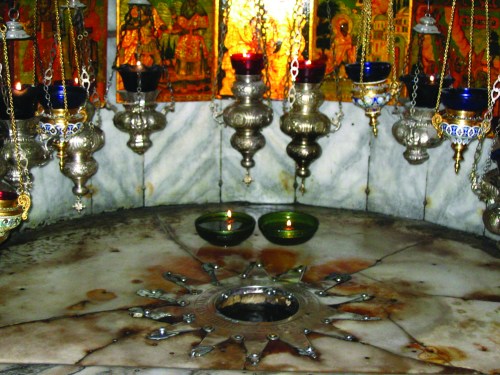
Church of the Nativity, Bethlehem, Israel

I remember visiting the Church of the Nativity in Bethlem, Israel last year. We stood for two and a half painful hours on hard, uneven limestone floors waiting to see the supposed place of Jesus’ birth. When we finally crouched through the constricted cave opening, we found a small alcove adorned with a plethora of lighted candles illuminating a gold 14-pointed star in the center of a polished marble floor. A hole in the center of the star marked the very spot where Mary gave birth to the baby Jesus. The garish display rendered the prolonged anticipation anticlimactic. Perhaps in a similar fashion, the significance of Christmas has been long lost to the millennia of ostentatious trappings and traditions we have attached to it.

So, why Christmas? Stop! Silence the noise! Trash the shiny paper and bright bows and ribbons! Douse the twinkling lights! Be still and think!

We, humans, suffer from a terminal condition called death. We inherited this terminal condition from our original parents, Adam and Eve (Genesis 3). They were originally created to live forever, but their disobedience to God’s only command brought upon them the death penalty. Did I mention that they were created to live forever? The death penalty, therefore, comes in two phases: physical death and spiritual death. Because of Adam’s sin, we all die physically. “And as it is appointed unto men once to die, but after this the judgment” (Hebrews 9:27). However, the spirit continues through eternity. Spiritual death is eternal separation from the Creator; the Bible calls that the “second death.” “And death and hell were cast into the lake of fire. This is the second death” (Revelation 20:14).

Because of Adam’s sin, all humans suffer the same fate. “Wherefore, as by one man sin entered into the world, and death by sin; and so death passed upon all men, for that all have sinned” (Romans 5:12). No one is excluded from the death sentence, and all must pay the price. “For the wages of sin is death …” (Romans 6:23).

However, God made a temporary provision for covering the sins of man. It was the blood sacrifice of an innocent animal, but that was not a permanent fix. “For it is not possible that the blood of bulls and of goats should take away sins” (Hebrews 10:4). The fact remains that sin is humanity’s problem. Animals do not sin; they are innocent. Therefore, the “wages of sin” must be paid by man, not animals, but that is the problem. No human is innocent, i.e., sinless. “All have sinned, and come short of the glory of God” (Romans 3:23).

The Bible teaches God loves us, even though we are all sinners. However, God is holy and just, and He cannot and will not allow sin to go unpunished. “The Lord is not slack concerning his promise, as some men count slackness; but is longsuffering to us-ward, not willing that any should perish, but that all should come to repentance” (2 Peter 3:9, emphasis mine). God does not want us to be eternally separated from Him, but the sin debt must be paid.

Therefore God became a man born of a virgin untouched by any man so that He could be born completely free from the curse of sin. He grew up like any other man but without sin. “For we have not an high priest [Jesus Christ] which cannot be touched with the feeling of our infirmities; but was in all points tempted like as we are, yet without sin” (Hebrews 4:15, emphasis mine). “Let this mind be in you, which was also in Christ Jesus: Who, being in the form of God, thought it not robbery to be equal with God: But made himself of no reputation, and took upon him the form of a servant, and was made in the likeness of men: And being found in fashion as a man, he humbled himself, and became obedient unto death, even the death of the cross” (Philippians 2:5-8, emphasis mine). “For Christ also hath once suffered for sins, the just for the unjust, that he might bring us to God, being put to death in the flesh, but quickened by the Spirit” (1 Peter 3:18).

Why Christmas? “For God so loved the world, that he gave his only begotten Son, that whosoever believeth in him should not perish, but have everlasting life” (John 3:16, emphasis mine). There’s your Christmas present! God became a man to be the perfect sacrifice to pay the wages of sin in our stead so that we will not have to be eternally separated from Him. He offers us our redemption as a gift if we choose to accept it. That’s why Christmas.

7 Comments

Filed under Christianity, Christmas, Evangelism, Gospel, Holidays, Salvation, Theology

It’s Here Again

Glory ye in his holy name: let the heart of them rejoice that seek the LORD. (1 Chronicles 16:10)

Thanksgiving Day came and went. We enjoyed a no muss, no fuss Thanksgiving, just June, me, and our dog pack. We brought the old pre-lit Christmas tree down from the attic and set it up. Another section of lights failed. That makes two sections that need to be filled in. We decided the tree is going to the curb at the end of this season. We will look for a new one at the end of season close-out sales.

June and I spent the day decorating the Christmas tree. The dogs just watched or got in the way. Personally, I don’t think the all trouble is worth the effort. The tree is up for five or six weeks. Few people ever see it other than June, me, and the dogs, and, because both of us work, it’s only seen a couple of hours a day except for weekends. Then at the end of the season, it all has to be disassembled and put back up in the attic again until next year. I just don’t see the point.

We don’t do Black Friday as a rule. However, I needed some plastic putty for a model I’m building and decided to go to Michael’s ™ to hunt for some. June never allows me to go shopping without checking for coupons. She found a Michael’s ™ flyer advertising their Christmas trees for half off, so she decided to accompany me on my quest. We found a perfect replacement for our condemned tree and other small items, but no putty. No worries, Amazon ™ has anything one could want as long as one is willing to wait for delivery.

With our errands done, we prepared to enjoy a nice evening with our very good friends. We played some table games and then enjoyed a non-traditional Thanksgiving meal together. Truth be told, every day should be a day of thanksgiving.

We set aside Saturday to decorate the outside of the house for Christmas. I exercise fairly regularly, but the older I get, the less benefit I seem to get from all the effort. By the end of the day, my back ached, and my feet cried out for mercy. After a quick dinner of leftovers, we worked on completing the inside decorating. Decorating the house for Christmas involves much more than putting up a Christmas tree. June and I have a collection of more than 60 nativities that we like to display. However, before displaying them, we have to make space for them by putting away other knickknacks. This too is a lot of effort considering the limited audience that will enjoy them. The dogs don’t care. Still, the house looks nice, and it feels like Christmas.

I have written much about Christmas. If interested, the reader can find those in the “Categories” column on the right under “Christmas.” The reader will find that I have a low opinion of all the “trappings” of Christmas. I do not care for the commercialization of Christmas. I do not care for the sentimentality attached to Christmas. I do not care for all the hubbub associated with the season. It is doubtful that “the reason for the season” was born in December.

That said, there is much I do like about Christmas. I love the music of Christmas, especially the carols. In my church, the Sunday following Thanksgiving, we start singing the Christmas carols. The carols remind me that the Creator of the universe, the Maker of you and me, lowered Himself to human form and entered His world as a helpless human baby. THAT is awesome! But it did not end there. He grew up and lived among His creation as the only perfect and sinless man to ever walk the face of the earth. Finally, He gave Himself as the only suitable sacrifice to atone for our sins. THAT is amazing! But He did not just die. He conquered death for you and me so that we can live forever with Him.

He ascended into heaven, but He left with the promise to return for those who have trusted Him. The time draws near of His return. When He returns, He will reign as King of Kings and Lord of Lords on earth for 1000 years. People mistake the hymn “Joy to the World” for a Christmas carol describing Jesus first coming, but it is not. The hymn describes His second coming and His future reign on earth. Next time you sing it, pay close attention to the lyrics.

I love what Christmas represents. I believe Jesus was born sometime in September. No one knows for sure. Regardless, it is good to set aside a time to reflect on just what an incredible thing God did to save His creation. He offers His salvation as a gift. However, as with any gift, it must be accepted before it is appropriated. Reader, if this great gift is not yours and you would like to take it as your own, read my page on “Securing Eternal Life.”

I cannot change the things I do not like about Christmas, and being a Scrooge benefits no one. Therefore, I will try to overlook the Christmas distortions and focus on the awesome and amazing gift of God. He is the reason for the season after all.

Comments Off on It’s Here Again

Filed under Christianity, Christmas, Current Events, Gospel, Holidays, Random Musings, Salvation, Second Coming of Christ, Theology

A Nutshell History of the World

Remember the former things of old: for I am God, and there is none else; I am God, and there is none like me, Declaring the end from the beginning, and from ancient times the things that are not yet done, saying, My counsel shall stand, and I will do all my pleasure: (Isaiah 46:9-10)

World history can evenly be divided into three segments of 2,000 years each: from creation to Abraham; from Abraham to Jesus; and from Jesus to the present. I realize that academic historians and anthropologists with Ph.D. degrees will disagree, but they have earned the right to be wrong; so I will acknowledge their opposition and move on.

Beginning with Genesis 1, the Bible records the creation in just six 24-hour days. Genesis 2 details the creation of man – Adam and Eve. Genesis 3 records the Fall of man and the first promise of Messiah. This event probably took place less than a month after creation. I come to this conclusion because God instructed Adam and Eve to be fruitful, multiply, and fill the earth (Genesis 1:28). Considering God’s assessment of His “very good” creation (Genesis 1:31), Adam and Eve were perfect human specimens and should not have had any trouble reproducing.

Additionally, a woman’s menstrual cycle lasts about 28 days. It takes 14 days for the ovary to release a ripened egg (ovum).[1] The ovum has another week where it is ready for fertilization. If not fertilized within that week, it will be sluffed off in the menstrual period, and the cycle begins again. Considering this, the Fall may have been less than two weeks after creation.

Genesis 4 records the first murder – Cain killing his brother Abel – and the ungodly descendants of Cain. Genesis 5 records the Godly descendants of Seth (Adam’s son to replace Abel). That genealogy records a period of about 1,658 years.[2], [3] When reading the genealogies recorded in Genesis 5, one must keep in mind that these records are from event to event – the age of the father at the birth of that son. Furthermore, the birth of the named son does not demand that he be the firstborn as precluded by the common phrase “and he begat sons and daughters (Genesis 5:4, 7, 10, 13, 16, 19, 22, 26, 30). Therefore, one can employ simple addition to add up the ages of the father at the birth of the named son.[4]

Genesis 6-9 records the depravity of man that brought God’s judgment upon the Earth through the Global Flood. Only Noah, his family. and all the animals that God brought to the Ark were saved. The animals included dinosaurs, and the Bible does mention dinosaurs although not by that name. Sir Richard Owen first coined the word dinosaur in 1841. The King James Bible was published in 1611, more than 200 years before the word “dinosaur” was invented. Before that time, these creatures were collectively known as “dragons.” The Book of Job names two of these creatures, Behemoth and Leviathan (Job 40-41), whose description is unlike anything known to modern man.

The Flood lasted 370 days (Genesis 7:11; 8:14), based on a 360-day year. After the Flood, the Earth was still in turmoil with a lot of active volcanos and much warmer oceans. These factors contributed to the Ice Age that followed.[5] The Book of Job, considered by many Bible scholars as the oldest book in the Bible, speaks more about snow, ice, and cold than any other book of the Bible suggesting that the earth was experiencing the Ice Age at that time. Creation scientists believe the Ice Age lasted only about 200-400 years, but there was only one, not many as the secular scientists suggest.

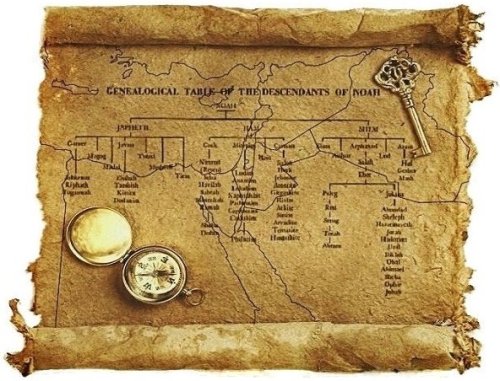
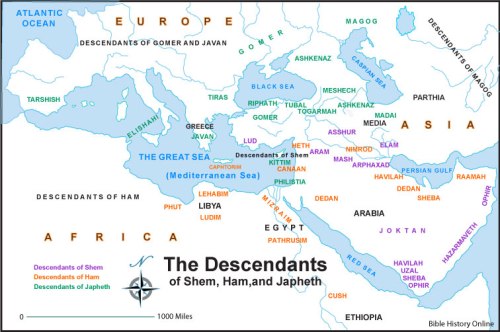
Genesis 10 is called the Table of Nations. It records the descendants of Noah’s sons, Shem, Ham, and Japheth and where they settled around the world after their dispersion at Babel. Shem’s descendants ultimately led to the Lord Jesus Christ (Luke 3:36).

Finally, Genesis 11 records the Tower of Babel and the confusion of tongues/languages. This event is the origin of all the ethnic groups (not “races”) in the world. Neanderthals were among those that scattered at Babel. Recent scientific discoveries show that Neanderthals are/were 100% human. Genesis 11 also records the genealogy of Abraham through whom God would bless all the nations of the earth 2,000 years later. The rest of the Old Testament deals with the history and the future history of Abraham’s descendants.

The future history concerns the coming of Messiah to rule all nations from His throne in Jerusalem. The Old Testament records future history in two parts. At His first coming/advent, “He came to His own, and His own received Him not” (John 1:11). He was crucified, buried, but He rose from the dead after three days and ascended to heaven (Acts 1:9-10; Ephesians 1:19-23). From there we await His return – His second coming (John 14:1-3; Acts 1:11). At that time, He will fulfill the future history recorded by the Old Testament prophets concerning His reign on earth. The time of His second advent draws near. As there were six days of creation and a Sabbath day of rest (Genesis 1:1-2:3), so have there been six millennia of history, and we await the seventh millennium (Revelation 20:1-7) of rest where Messiah will rule the nations with a “rod of iron” (Psalm 2:9; Revelation 2:27; 12:5; 19:15).

At the end of the millennial reign of Christ, world history ends and eternity, for us, begins. Are you ready? See my page on “Securing Eternal Life.”

Notes:


[1]  “Female Reproductive System” – https://tulsafertilitycenter.com/female-infertility/female-reproductive-cycle.php

[2]  “Age of the Earth” – https://erniecarrasco.com/2018/10/14/age-of-the-earth-2/

[3]  “Age of the Earth” – https://erniecarrasco.com/2014/02/23/age-of-the-earth/

[4]  James J. S. Johnson, J.D., TH.D, “How Young Is the Earth? Applying Simple Math to Data Provided in Genesis” – http://www.icr.org/article/how-young-earth-applying-simple-math-data-provided/

[5]  Jake Hebert, Ph.D., “Was There an Ice Age?” – http://www.icr.org/article/was-there-ice-age

2 Comments

Filed under Apologetics, Bible, Christianity, Creation, Evangelism, Origins, Religion, Salvation, Second Coming of Christ, Theology

Still Listening Again

Behold, I shew you a mystery; We shall not all sleep, but we shall all be changed, In a moment, in the twinkling of an eye, at the last trump: for the trumpet shall sound, and the dead shall be raised incorruptible, and we shall be changed (1 Corinthians 15:51-52).

Every year for at least the last decade – ever since I learned about the Feasts of the Lord[1] – around this time of year, I start getting a little anxious with excitement wondering if this will be the year that Jesus will call His bride home.[2], [3], [4], [5], [6] This Monday, September 10, the Feast of Trumpets comes around again. For those of us who look forward to the Rapture of the Church, this is a “high watch” day. The reason for this, as I have explained in the past, is because this is the next Feast not fulfilled by Jesus’ First Advent. Therefore, it stands to reason that Rosh Hashanah (the Feast of Trumpets) would be a good time for Jesus to summon His Bride, the Church, home. Every year as I have waited, the day has come and gone, and we are still here. You might think that eventually I would experience “Rapture Fatigue” and give up on the whole idea. However, I still have oil in my lamp and even some extra! (Matthew 25:4)

Some will criticize and remind us that Jesus said, “But of that day and hour knoweth no man, no, not the angels of heaven, but my Father only” (Matthew 24:36). The Rapture is imminent. It could happen at any time, and we ought always to be ready. Nothing prophetically remains unfulfilled for this event to take place. Israel celebrated her 70th rebirthday this past May. We live in the generation that witnessed the “fig tree” bud (Matthew 24:32-33). This year wraps up the 70th Year of Jubilee since Moses gave the ordinance 3500 years ago. Israel is the focal point of end-times prophecy, so our attention must focus on current events in the Middle East. The stage is being set for what “prophecy watchers” call the “Ezekiel 38-39 War.” At the time of this writing, Russia, Turkey, and Iran are meeting concerning their involvement in Syria. Damascus almost resembles the ruinous heap described in Isaiah 17:1.

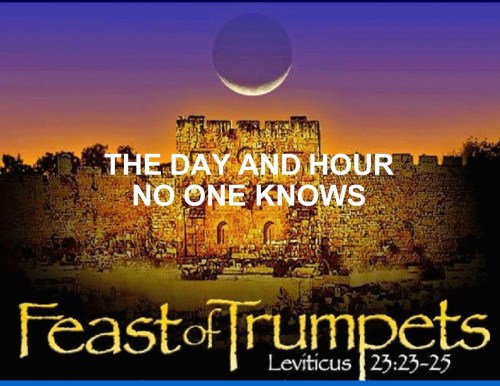
Will these things happen before or after the Rapture? We cannot tell. No man knows the day or the hour, but we sense that the time is near. Will the Rapture take place at the Feast of Trumpets? Perhaps. The Feast of Trumpets is celebrated over two days because it is based on the verified appearance of the new moon. Since the exact time of the appearance cannot be accurately predicted, the Feast of Trumpets is known as the feast of which “no man knows the day or the hour.” This year the watch is set for Monday and Tuesday, September 10 & 11 beginning at sundown on Sunday, September 9 (the date of this posting).

Will Jesus call for His Bride in the coming weeks? I do not know, but I hope so, and I am ready! How about you? If you are unsure, read my pages on “Securing Eternal Life” and on “Heaven.”

Notes:


[1]  “Rosh HaShanah” https://erniecarrasco.com/2016/10/03/rosh-hashanah/

[2]  “Still Waiting!” – https://erniecarrasco.com/2017/09/24/still-waiting/

[3]  “Now’s A Good Time!” https://erniecarrasco.com/2017/09/17/nows-a-good-time/

[4]  “Coming Soon!” https://erniecarrasco.com/2017/07/09/coming-soon/

[5]  “Rosh HaShanah”  https://erniecarrasco.com/2016/10/03/rosh-hashanah/

[6]  “Still Listening” https://erniecarrasco.com/2015/09/20/still-listening/

3 Comments

Filed under Apologetics, Christianity, Current Events, End Times, Evangelism, Gospel, Religion, Second Coming of Christ, Theology

Merit-Based Salvation

For God shall bring every work into judgment, with every secret thing, whether it be good, or whether it be evil. (Ecclesiastes 12:14)

There exists a common misconception among non-Christians and, sadly, even among some Christians, that when it comes time to meet our Maker that we can gain entrance into the celestial realm based on our merits. As our lead verse suggests, “God shall bring every work into judgment … whether it be good, or whether it be evil.” If challenged, those who hold that view almost always see themselves as better than most. They may admit to “small” sins like telling a “white lie” now and then, stealing a pack of gum, failing to correct a cashier when given too much change, or something equally innocuous. By their estimation, their “good” works will outweigh their “evil” works on the cosmic scales, and God will say, “Good enough!”

To some extent, it seems that the Bible teaches merit-based salvation. Our lead verse teaches that God looks at every work, both good and evil. Superficially, one may get the impression that He weighs the two – good on one side, evil on the other. First Peter 1:17 says that “the Father, who without respect of persons judgeth according to every man’s work…” (emphasis mine). Indeed, at the end of time when Christ’s millennial reign on earth has ended, a scene unfolds where all who ever lived appear before the judgment seat of Christ. “And the sea gave up the dead which were in it; and death and hell delivered up the dead which were in them: and they were judged every man according to their works” (Revelation 20:13).

It indeed appears that people will be judged according to their works. Should this be cause for hope for those counting on their own goodness? Taking a closer look at our leading verse, note that God scrutinizes “every work” and determines whether it is good or evil based on His standard of goodness. God made man in His image (Genesis 1:27), and for that reason, God deemed man “very good” (Genesis 1:31), but man messed that up in the Garden of Eden (Genesis 3). Beginning with fig leaves (Genesis 3:7), man’s attempt at covering up his sin always falls short of the perfection he possessed before the Fall. Only perfection qualifies for entry into the presence of God. “And there shall in no wise enter into it any thing that defileth, neither whatsoever worketh abomination, or maketh a lie: but they which are written in the Lamb’s book of life” (Revelation 21:27, emphasis mine). Interestingly, I cannot find the word “sin” in the book of Revelation, but there are several synonyms: anything that defiles, whatever works abomination or makes a lie. All of that is sin, so whether one has a little sin or a lot of sin, one is disqualified from entering heaven.

The Great White Throne Judgment scene in Revelation sees “books” opened, and the “dead” judged by the content of the books “according to their works” (Revelation 20:12). Evidently, there are “ledger books” recording both the good and evil deeds of every person that has ever lived. Since NOTHING that defiles “shall in no wise enter,” no one qualifies. “As it is written, There is none righteous, no, not one … For all have sinned, and come short of the glory of God” (Romans 3:10, 23). However, “The Lord is not slack concerning his promise, as some men count slackness; but is longsuffering to us-ward, not willing that any should perish, but that all should come to repentance” (2 Peter 3:9). There the guilty sinner stands before the Righteous Judge, “and another book was opened, which is the book of life … And whosoever was not found written in the book of life was cast into the lake of fire” (Revelation 20:15).

Reader, is your name written in the Book of Life? Do not think you are good enough – that your sins are minor compared to someone else. Only perfection gains entry into heaven and no one qualifies. However, there is a way. Please read my page on “Securing Eternal Life.”

Comments Off on Merit-Based Salvation

Filed under Apologetics, Christianity, Evangelism, Gospel, Religion, Salvation, Theology