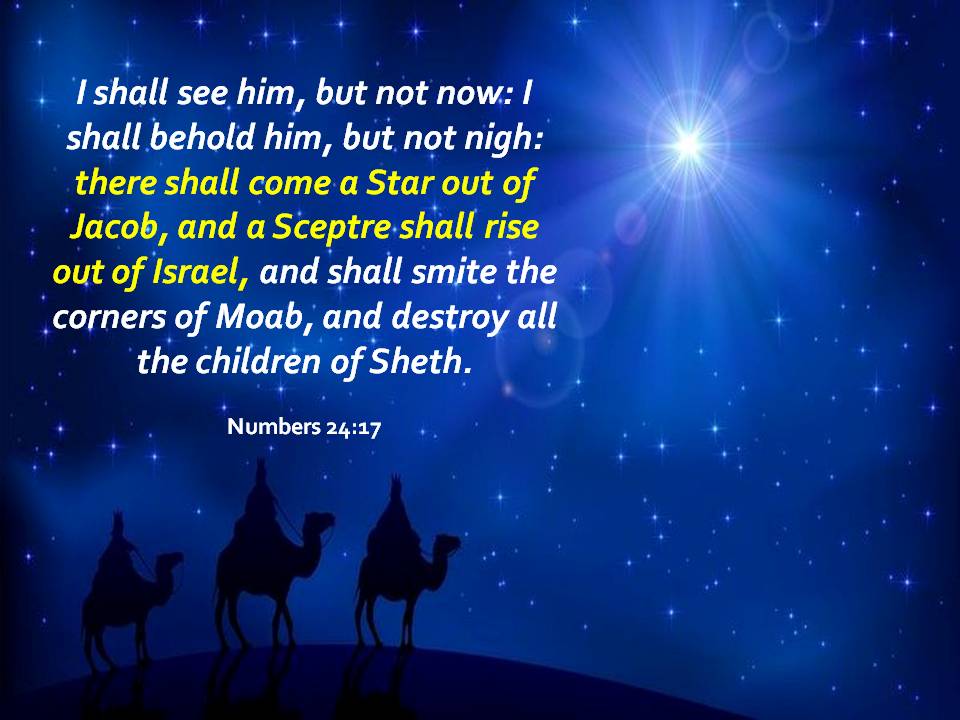
I shall see him, but not now: I shall behold him, but not nigh: there shall come a Star out of Jacob, and a Sceptre shall rise out of Israel, and shall smite the corners of Moab, and destroy all the children of Sheth. (Numbers 24:17)
As 2020 winds down to a close, we can look back and say, “It was a terrible year!” For me, it started with a drastic change in life called retirement. And before I could really adjust to my new lifestyle, COVID-19 hit and changed life for all of us. Do I need to recount the chaotic events? In November, we voted in the 2020 Presidential Election, and the candidate who campaigned the least and attracted the smallest following miraculously won the election – supposedly. Now we face the real possibility of having a Socialist government for the first time in our nation’s history. President Trump alleges that the election was stolen, and much evidence exists indicating that he has reason to protest and contest the results. He has a great team of lawyers that are fighting to get the election overturned (I pray that they do), but time is running out. However, there is still hope.
I have said this before, and I am still convinced that whether Biden becomes our next President or President Trump wins his second term, we face troubled times ahead. But there is hope. At least, for the Christian there is hope. We only need to remember that our primary citizenship is in heaven with our Lord, and the intensity of the trouble we experience today should alert us that He will soon return to take us home to be with Him. The intensity of the trouble will increase, and the more it increases, the closer we are to His calling us home. There is always hope.
Long ago, as the children of Israel wandered in the wilderness hoping for their Promised Land, their enemies rose up to thwart their plans. One such enemy was Balak, the king of Moab, who hired the prophet Balaam to curse Israel.[1] Balaam was not a “prophet of God,” but he knew God well enough to know that God would not allow him to speak against His people. No matter how Balaam tried, he could only speak the words God directed him to speak. In the end, Balaam pronounced a blessing on Israel, rather than a curse.
In that blessing, Balaam prophesied, “there shall come a Star out of Jacob, and a Sceptre shall rise out of Israel” (Numbers 24:17, emphasis mine). On the face of it, the prophecy refers to a coming king of Israel that “shall smite the corners of Moab.” If we stop there, the prophecy leaves us in a lurch, but the Holy Spirit keeps no secrets from those who have “ears to hear.”
In his Gospel, Matthew tells us that “there came wise men from the east to Jerusalem, saying, Where is he that is born King of the Jews? for we have seen his star in the east and are come to worship him” (Matthew 2:1-2, emphasis mine). Yes, the baby born in Bethlehem was the Star, but a real star – a celestial object – appeared out of Jacob (Israel) to announce His birth. It is because of that Star that we have our Blessed Hope.
Let your loins be girded about, and your lights burning; (Luke 12:35)
I am currently reading the Gospel of Luke in my personal Bible study, and, as often happens when I read my Bible, something caught my attention that I had not seen before. In Luke Chapter 12, Jesus had finished telling the parable of the rich fool[1] who had a bumper crop and started planning about what he would do with his newly acquired wealth. That night, God called him to account. “But God said unto him, Thou fool, this night thy soul shall be required of thee: then whose shall those things be, which thou hast provided?” (Luke 12:20). Jesus’ point was that earthly riches do not amount to much in light of eternity. He said, “So is he [a fool] that layeth up treasure for himself, and is not rich toward God” (Luke 12:21). He went on to teach regarding the futility of worrying about the things of this world because God knows our needs, and He will provide for all our needs (not necessarily our “wants”). The ravens do not sow, reap, or store up food, yet God feeds them.[2] The lilies of the fields neither toil nor spin, yet God clothes the earth more beautifully than Solomon’s apparel.[3] So, Jesus taught, we should not overly concern ourselves with food or clothing because God will provide for our needs. Instead, He said, “But rather seek ye the kingdom of God; and all these things shall be added unto you … For where your treasure is, there will your heart be also” (Luke 12:31, 34)
With that in mind, since this life and this world does not last, He went on to encourage His listeners to be ready for His Second Coming. (I am not sure if His audience caught the significance of His message, but looking back, it should be clear to us.) “Let your loins be girded about, and your lights burning” (Luke 12:35). Having your “loins girded” is an expression that meant to prepare oneself for work, and one only lights a lamp when it gets dark. So the idea is that we should be on the alert and watching. We are to watch and work as we “seek the kingdom of God.”
He went on to amplify His meaning. “And ye yourselves like unto men that wait for their lord, when he will return from the wedding; that when he cometh and knocketh, they may open unto him immediately” (Luke 12:36, emphasis mine). I highlighted in bold italics what I missed before. Jesus spoke in the form of a parable which His audience, His disciples, and His apostles would not have clearly understood at that time. He often used the example of a landowner – a lord or master – leaving on a long journey and leaving the care of his properties in the hands of stewards, i.e., “servants.”[4] All of these parables convey the idea that the Lord will leave – which Jesus did in His ascension – and will return at some undetermined time. In the meantime, His servants continue to conduct His business – in our case that of proclaiming the Gospel – until He returns.
What popped out at me in this passage is the phrase “when he will return from the wedding.” What relevance does a wedding have with the main point of the story? Note also the definite article. It is not just “a” wedding; it is the wedding. The significance is subtle and easy to miss, but indeed it carries great relevance to Christians living in this day.
Before Jesus went to the cross, He told His apostles, “Let not your heart be troubled: ye believe in God, believe also in me. In my Father’s house are many mansions: if it were not so, I would have told you. I go to prepare a place for you. And if I go and prepare a place for you, I will come again, and receive you unto myself; that where I am, there ye may be also” (John 14:1-3, emphasis mine). When His apostles heard this, they caught the imagery of a Galilean wedding. When a man proposed marriage to a young woman, if she accepted the proposal, he would leave to build a house for her. Once the father of the groom inspected and approved the house, he would give his son permission to go get his bride. The wedding would take place and the wedding feast that followed would last for seven days.
Likewise, Jesus, the Bridegroom, is betrothed to His Bride, the Church. His Bride is made up of those who have accepted His proposal.[5] Now He is gone preparing a place for His Bride, and when the Father approves of the house,[6] He will come to get His Bride and take her to the home He has prepared for her. The wedding feast[7] will last one week (seven years).[8] At the end of the seven years, Jesus will return with His Bride to reclaim His kingdom on earth.
The audience that heard the parable was Jewish, and they probably missed the significance of the lord returning from the wedding. Weddings were frequent and common events in those days as they are today. Jews then and now, for the most part, missed the Messiah. Yet Jesus admonishes these who fail to recognize Him to have their “loins girded” and their “lamps burning” in preparation for their Lord’s return from the “wedding.”
After Jesus snatches away His Bride and the seven-year wedding feast begins, those who remain on the earth will experience the seven-year Tribulation. During that time, many Jews will recognize the Messiah they missed and 144,000 of them will preach the Gospel message around the world.[9] Many Jews as well as Gentiles will be saved by their message. It is these whom Jesus admonishes to work, watch, and be ready for His coming. “Blessed are those servants, whom the lord when he cometh shall find watching: verily I say unto you, that he shall gird himself, and make them to sit down to meat, and will come forth and serve them. And if he shall come in the second watch, or come in the third watch, and find them so, blessed are those servants” (Luke 12:37-38).
“The Lord is not slack concerning his promise, as some men count slackness; but is longsuffering to us-ward, not willing that any should perish, but that all should come to repentance” (2 Peter 3:9, emphasis mine). Even after the Rapture of the Church, even in the midst of the Great Tribulation, God is “not willing that any should perish.” Sadly, for many, that time will be the final opportunity for salvation but at such a high cost. Reader, if you do not know the Savior, please do not wait until the last moment. Accept the Bridegroom’s proposal today. Find my page on “Securing Eternal Life” and prepare to enjoy the wedding feast rather than work in the time of Great Tribulation.
Remember the former things of old: for I am God, and there is none else; I am God, and there is none like me, Declaring the end from the beginning, and from ancient times the things that are not yet done, saying, My counsel shall stand, and I will do all my pleasure: (Isaiah 46:9-10)
On Tuesday, November 3 the final votes will be cast to see if Donald Trump retains the presidency or if Joe Biden will take command. Aside from the presidential race, there are many challenging races for places in the House of Representatives and in the Senate. They say, as they have in every political race in the past, that this is the most significant race in history. The pundits may be right.
I voted early and in person last week. As you might guess from last week’s article,[1] I voted for all Republicans except for three Democrats that ran uncontested. I later learned that I could have left those positions unmarked. In Texas, where I voted, they removed the option to vote a straight party ticket, so I had to mark each candidate for each office individually. It was not bad. The process took less than 15 minutes.
So, what’s next? I am no prophet or the son of a prophet to know what the immediate future might bring. Several scenarios come to mind, and none, by worldly standards, look too promising. The presidential race is running neck-and-neck. If the crowds gathering for the Trump rallies give any indication, President Trump may win a decisive victory. If he wins (and I pray he does) chaos in our streets will get worse. The Democrats condone ANTIFA and BLM by the very fact that they refuse to denounce their lawlessness. Some conspiracy theorists suggest that the funding for these lawless groups comes from Democrat sources. Such allegations are difficult to prove, but judging from Democrat attitudes toward our President, I suspect those allegations are true. From the day of his inauguration, the Democrats have unrelentingly attacked President Trump to find some way to forcefully remove him from office. The viciousness of their assaults suggests that they will only double down if he wins a second term. In fact, they already talk about impeachment proceedings against Trump’s latest judicial pick, Justice Amy Coney Barrett, if she will not recuse herself from current cases coming before the court. One of those cases might be the legitimacy of the election should Trump win, and the election is contested. The fury, hate, and anger of the Democrats will explode, and they will turn loose their hounds of hell to terrorize the nation. It will not be pretty!
If Joe Biden wins, some believe the Democrats will find some way of replacing him – the 25th Amendment[2] comes to mind – and Kamala Harris will become President. Even if Biden remains, we can kiss the America we once knew goodbye. All one needs to do is read the Democrat Party Platform to see the heavy Socialist leanings of the Democrat Party. The only reason they do not call themselves Socialists is because they know the term offends most Americans, but regardless of how they identify themselves, the ideology is clear. The Democrat Party is all about government control. This COVID “plandemic,” as some have called it, is nothing but an experiment in population control – forced masking, social distancing, closing down churches, closing schools, restricting businesses, etc. Then there is the Green New Deal, which will impose greater controls – curtail oil production in lieu of “renewable energy” like wind and solar. The Green New Deal will enforce restrictive building codes to make all structures energy-efficient without regard to the high cost of such an undertaking. The Socialists, I mean Democrats, will open our borders to allow anyone and everyone into our country with the promise of providing social welfare, free healthcare (because it’s a “right”) to everyone. By various means, they plan to redistribute wealth making everyone equally poor. The “pigs” on the other hand will live in luxury while the rest of us animals freeze and starve to death out in the barn.[3]
Neither option seems too promising. However, at least with a Trump presidency, we can trust that he really does have America’s best interest at heart. He is a nationalist. He believes in putting America first. The Democrats only care about putting their party first.
So, what’s next? I have no clue! I do know this. Jesus is coming soon! The signs He gave[4] announcing His return intensify every day. Some scoff and say, such things – wars, rumors of wars, earthquakes, famines, etc. – have been happing throughout history. Yes, but not all at once! All the signs are converging. Jesus said, “All these are the beginning of sorrows” (Matthew 24:8). The “sorrows” He describes are birth pangs. Like a woman in labor, the pains come infrequently and erratically, but they become more frequent and more regular the nearer the time of the birth. What we see now is just the “beginning of sorrows.” Jesus gave these signs about His Second Coming. These signs will intensify during the seven-year Tribulation before He returns to reign on earth. However, before He returns to reign on earth for 1000 years,[5] He will snatch up His bride, the body of believers that have “gone to sleep” and those who are alive[6] at the Rapture of the Church. Because I see the signs for His Second Coming converging and intensifying, I know the Rapture can happen at any time, maybe before the election or maybe right after the election. Regardless, the only hope for this broken world is Jesus.
At a personal level, the only hope for a hopeless, broken, messed up life, even in this world, is Jesus. Time is getting short. If you do not know Jesus, please get acquainted. I can help; just read my page on “Securing Eternal Life.” It makes no difference who is sitting in the White House; what matters is who reigns in your “heart-house.”
[2] Section 4 of the 25th Amendment in part reads, “Whenever the Vice President and a majority of either the principal officers of the executive departments of such other body as Congress may by law provide, transmit to the President Pro tempore of the Senate and the Speaker of the House of Representatives their written declaration that the President is unable to discharge the powers and duties of his office, the Vice President shall immediately assume the powers and duties of the office as Acting President.”
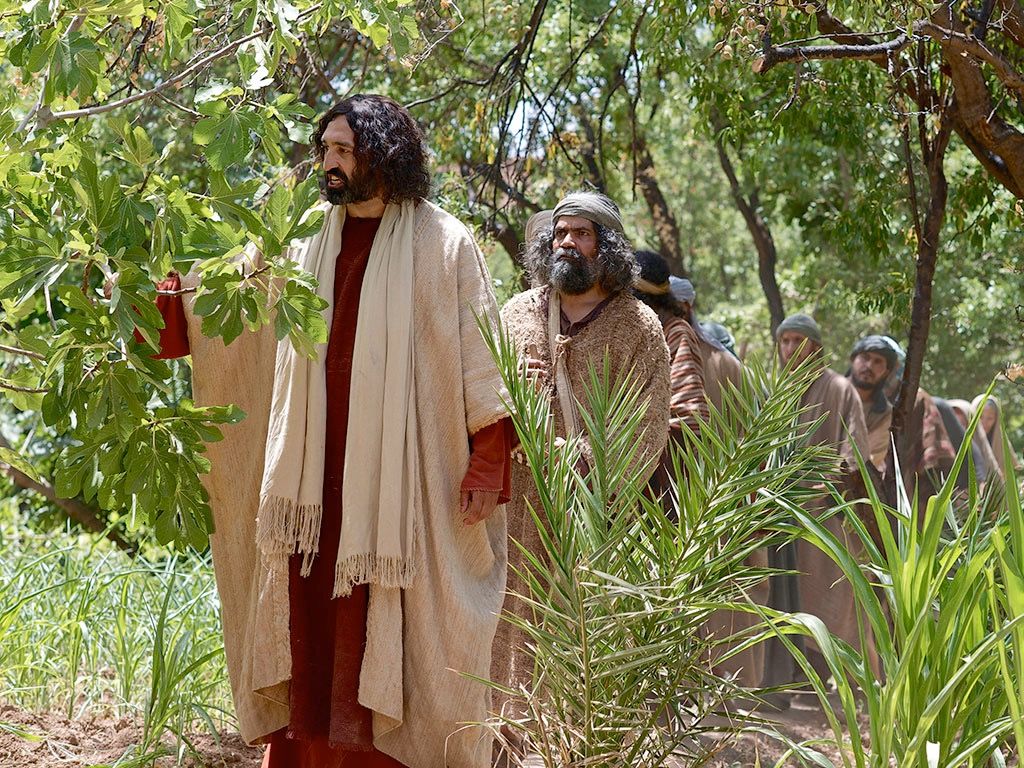
Now learn a parable of the fig tree; When his branch is yet tender, and putteth forth leaves, ye know that summer is nigh: (Matthew 24:32)
During Jesus’ last week of His earthly ministry before His crucifixion and shortly after His Triumphal Entry into Jerusalem, Matthew and Mark record a strange incident when Jesus cursed a fig tree because it had no fruit and immediately, the tree withered.
Jesus entered Jerusalem on what we know as Palm Sunday. He went directly to the Temple cast out the money changers and those who sold animals for the upcoming Passover sacrifice.[1] To us Gentiles, it seems strange that it offended Jesus that these men were turning the Holy Temple into a marketplace. However, as Jesus drove out the merchants, He exclaimed, “Is it not written, My house shall be called of all nations the house of prayer? but ye have made it a den of thieves” (Mark 11:17).
A long-held Jewish tradition during Passover is to get all the leaven out of the house before the Passover celebration. Leaven represents sin, and it must be removed from the house. The Temple was Jesus’ house, and He was cleansing it from the sin within in preparation for the coming Passover.
At this point, I need to mention an apparent contradiction between Mark’s account of the Temple cleansing and that of both Matthew and Luke. Both Matthew and Luke record that the cleansing took place on the same day as the Triumphal Entry – Palm Sunday.[2] However, Mark indicates that the cleansing took place on the following day (Monday). Mark records that on Palm Sunday, “Jesus entered into Jerusalem, and into the temple: and when he had looked round about upon all things, and now the eventide was come, he went out unto Bethany with the twelve. And on the morrow [Monday], when they were come from Bethany … And they come to Jerusalem: and Jesus went into the temple, and began to cast out them that sold and bought in the temple” (Mark 11:11-12, 15, emphasis mine). So, did Jesus cleanse the Temple on Palm Sunday or on the following day? Great biblical minds have no clue! I am not one who finds contradictions in the Bible because “God is not the author of confusion.”[3] Two Gospel writers say the cleansing took place on Sunday, and one (Mark, who was not an eyewitness) says it was on Monday. I believe all three accounts are correct. It is possible that there were two cleansings, one on Sunday and one on Monday. I will leave it at that for now.
Only Matthew and Mark record the incident with Jesus cursing the fig tree, and both agree that it happened on Monday morning as Jesus returned to Jerusalem from Bethany where He was probably staying in the home of Lazarus, Martha, and Mary.[4] What happened next seems rather strange. Jesus spotted a fig tree along the way and being hungry, He went to see if it had any figs.[5] Mark remarks that “the time of figs was not yet” (Mark 11:13). Finding no figs on the tree, Jesus cursed the tree, and it soon “dried up from the roots” (Mark 11:20).
It seems strange that Jesus, the Creator,[6] would not know that it was not the time for figs, So, why would He expect to find figs on the tree? Some commentators suggest that the tree should have had some unripe fruit on it that could be eaten.
“Toward the end of March the leaves begin to appear, and in about a week the foliage coating is complete. Coincident with [this], and sometimes even before, there appears quite a crop of small knobs, not the real figs, but a kind of early forerunner. They grow to the size of green almonds, in which condition they are eaten by peasants and others when hungry.”[7]
That makes some sense. Both Matthew and Mark remark that Jesus found nothing but leaves on the tree. There were not even “knobs” to eat on the tree. But was that sufficient cause for Jesus to curse the tree? The same commentators quoted above, suggested that Jesus used this incident as an object lesson to emphasize Luke’s parable about the fig tree that bore no fruit.[8] However, neither Matthew nor Mark includes that parable in their Gospels, and Luke omits the cursing of the fig tree, so their argument does not seem to be very strong.
Jesus, the Creator, knew it was too early for figs, and He knew He would not find figs on the tree. So the cursing of the tree had another purpose. Jesus never did anything without a purpose.
Later in the week as Jesus sat with His disciples on the Mount of Olives, they asked Him for signs of the last days and the end of the world. The detailed description of the last days, known as the “Olivet Discourse,” is found in all three Synoptic Gospels.[9] “But of that day and hour knoweth no man, no, not the angels of heaven, but my Father only” (Matthew 24:36). However, Jesus said the times would be discernible, and He used the fig tree to illustrate. “Now learn a parable of the fig tree; When his branch is yet tender, and putteth forth leaves, ye know that summer is nigh: So likewise ye, when ye shall see all these things, know that it is near, even at the doors. Verily I say unto you, This generation shall not pass, till all these things be fulfilled” (Matthew 24:32-34, emphasis mine).
The fig tree represents the nation of Israel. Several passages in the Old Testament make this association. God says, “I found Israel like grapes in the wilderness; I saw your fathers as the firstripe in the fig tree at her first time …” (Hosea 9:10, emphasis mine). “He [the king of Babylon] hath laid my vine waste, and barked my fig tree: he hath made it clean bare, and cast it away; the branches thereof are made white” (Joel 1:7, emphasis mine). God also refers to Israel as His (grape) “vine.” Concerning Israel’s restoration, Scripture says, “Then will the LORD be jealous for his land, and pity his people … Be not afraid, ye beasts of the field: for the pastures of the wilderness do spring, for the tree beareth her fruit, the fig tree and the vine do yield their strength” (Joel 2:18, 22, emphasis mine).
Jesus’ parable of the fig tree gives the signal for the beginning of the end-time events. Israel, the fig tree, budded on May 14, 1948, signaling that “summer” is near. Jesus said that “this generation,” the one that sees the fig tree bud, will not pass until all these signs are accomplished. “Heaven and earth shall pass away, but my words shall not pass away” (Matthew 24:35).
So, why did Jesus curse the fig tree? God chose Israel to be a “priest nation” to all the nations of the world, beginning with Abraham; “in thee shall all families of the earth be blessed” (Genesis 12:3, emphasis mine). To Israel, God says, “And ye shall be unto me a kingdom of priests, and an holy nation …” (Exodus 19:6). It was Israel’s task to reveal God to the nations of the world. Instead, Israel followed in the idolatrous steps of the surrounding nations. Israel, the fig tree, did not produce the fruit God expected. Jesus’ object lesson in cursing the fig tree demonstrated that God would no longer use Israel to bless the nations and to be the priest nation to the world. Instead, He assigned that task to other “husbandmen.”[10] To these new husbandmen, i.e., the Church, Jesus said, “But ye shall receive power, after that the Holy Ghost is come upon you: and ye shall be witnesses unto me both in Jerusalem, and in all Judaea, and in Samaria, and unto the uttermost part of the earth” (Acts 1:8, emphasis mine).
So, the fig tree withered and can no longer produce fruit. Instead, Jesus assigned the task of bringing God to the world to the Church. As for the fig tree, “they shall fall by the edge of the sword, and shall be led away captive into all nations: and Jerusalem shall be trodden down of the Gentiles, until the times of the Gentiles be fulfilled” (Luke 21:24, emphasis mine).
That time is near. It started when the fig tree budded in 1948. The fig tree has yet to produce any fruit, but that is because the Church is still yielding fruit, albeit at a waning rate. Soon, the Church will be plucked up, and God’s fig tree will have another opportunity to yield its fruit. “And I heard the number of them which were sealed: and there were sealed an hundred and forty and four thousand of all the tribes of the children of Israel” (Revelation 7:4, emphasis mine). During the Tribulation, the 144,000 Israeli evangelists will carry the Gospel to all the world and produce much “fruit” for the Lord. “After this I beheld, and, lo, a great multitude, which no man could number, of all nations, and kindreds, and people, and tongues, stood before the throne, and before the Lamb, clothed with white robes, and palms in their hands” (Revelation 7:9, emphasis mine).
In the end, the fig tree will produce the fruit for which it was created. However, it must be understood that not every individual Israeli will be saved. Their salvation does not come from their nationality (Israel) or their religion (Judaism). Just as with every other person, salvation comes only through faith in Jesus the Messiah. Jesus said, “I am the way, the truth, and the life: no man cometh unto the Father, but by me” (John 14:6). The 144,000 remnant of Israel that carry the Gospel to all the world will be saved by the same message that “whosoever believeth in him [Jesus] should not perish, but have everlasting life” (John 3:16). Those that hear and believe the message of the 144,000 will be saved the same way.
Reader, if you do not know Jesus, now is a great time to get acquainted. Read my page on “Securing Eternal Life” and get that settled today.
[7] Walter C. Kaiser Jr., Peter H. Davids, F.F. Bruce, Manfred T. Brauch, Hard Saying of the Bible, (InterVarity Press Academic, Downers Grove, Illinois, 1996), p. 442, quoting W.M. Christie, “The Barren Fig Tree.”
Jesus saith to him, He that is washed needeth not save to wash his feet, but is clean every whit: and ye are clean, but not all. (John 13:10)
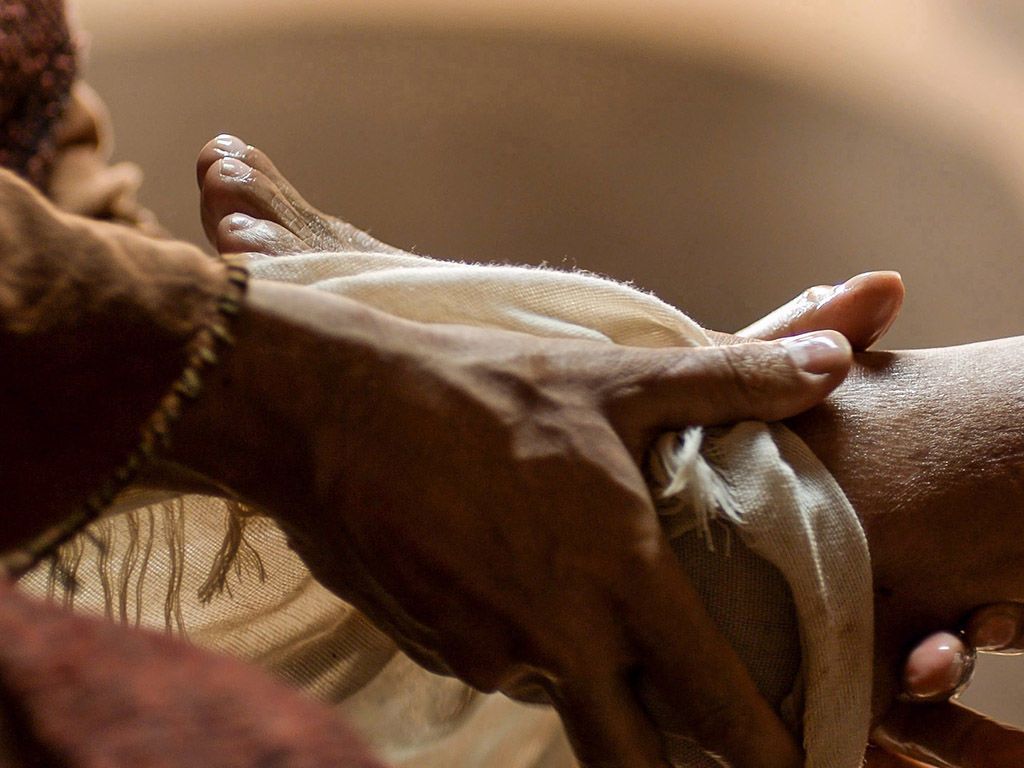
On the evening before His crucifixion, Jesus celebrated Passover with His disciples. The Apostle John records in his Gospel that Jesus “laid aside his garments; and took a towel, and girded himself” (John 13:4) and proceeded to wash the feet of His disciples.
In those days, the majority of travel was done on foot. The footwear of the day protected only the sole of the feet leaving the rest of the feet exposed to the elements. Most of the roads were no more than dirt trails so that feet collected a good amount of road dirt.
It was customary for the host of a house to welcome the traveler by washing the road dirt off their feet. This task was assigned to the lowest servant or the youngest member of the household. For whatever reason, no one performed the customary foot washing at this house, perhaps because it was a private gathering not hosted by the homeowner.
Whatever the reason, Jesus chose this time to give an object lesson. Jesus rose from the table, removed his outer garment, took a towel, and some water, and performed the task of the lowliest servant. Jesus washed all of the disciples’ feet, but when he got to Peter, Peter protested. “Lord, dost thou wash my feet?” (John 13:6). Peter was not being “holier than thou,” in his refusal to have Jesus wash his feet. Perhaps, as he watched Jesus wash the other’s feet, he thought, “Why didn’t someone else do that? The Master should not be the one doing that! Maybe I should be the one washing feet.” Whatever may have crossed his mind, it was obvious that he was humiliated that his Lord should lower Himself to that position.
“Jesus answered and said unto him, What I do thou knowest not now; but thou shalt know hereafter” (John 13:7). We seldom know what God is doing in our lives when we go through trials, but when we look back on our lives, we can see how God directed our circumstances for our good.[1] Peter did not get the lesson; “Thou shalt never wash my feet. Jesus answered him, If I wash thee not, thou hast no part with me. Simon Peter saith unto him, Lord, not my feet only, but also my hands and my head. Jesus saith to him, He that is washed needeth not save to wash his feet, but is clean every whit: and ye are clean, but not all.” (John 13:8-10).
Jesus washed all of the disciples’ feet. They did not need a bath; only their feet needed washing, but Jesus said not all were clean. The unclean one to whom Jesus referred as Judas Iscariot who would betray Him. It’s not that Judas failed to take his Sabbath Day mikvah; Jesus referred to Judas’ spiritual condition, not his physical cleanliness. Therefore, the significance of the foot-washing act goes deeper than road grime.
The disciples were “clean” because they believed that Jesus was their expected Messiah. When Jesus had asked, “Whom do you say that I am?” Peter confessed, “Thou art the Christ, the Son of the living God” (Matthew 16:16). The key to salvation (i.e., cleansing) is “That if thou shalt confess with thy mouth the Lord Jesus, and shalt believe in thine heart that God hath raised him from the dead, thou shalt be saved” (Romans 10:9). Obviously, Judas had not believed: therefore, he was not clean.
As we traveled to Washington, D.C. for the Franklin Graham 2020 Prayer March[2] last week, this topic came up in our conversation. My brother Eli made a very interesting analogy applicable to the Church today. Like Jesus’ disciples (and we too are disciples) we walk around in this filthy world every day, and the grime of the world cannot help but stick to our “spiritual feet.” Then, every time we gather for worship and fellowship, we have the opportunity to wash each other’s feet. We do not need a bath because the Bible says that “ye are washed, but ye are sanctified, but ye are justified in the name of the Lord Jesus, and by the Spirit of our God” (1 Corinthians 6:11). Our “spiritual” feet only need washing. Therefore, the Bible encourages us to gather together. “Let us draw near with a true heart in full assurance of faith, having our hearts sprinkled from an evil conscience, and our bodies washed with pure water … Not forsaking the assembling of ourselves together, as the manner of some is; but exhorting one another: and so much the more, as ye see the day approaching.” (Hebrews 10:22, 25, emphasis mine). Our gathering together is the way we wash each other’s feet by praying for each other and encouraging one another in the faith.
Another parallel that can be drawn from this account is that not all are clean. The twelve apostles walked with Jesus for three years of His earthly ministry, yet one of them was lost, i.e., not clean, the entire time. In the same way, not all within the Church are all saved. Some practice all the “right things” on the outside, but inwardly they have not truly believed. Jesus referred to these as “tares.”[3] When He returns for His Bride, the Church, these will be left behind. For now, feet only need washing if you have placed your trust in Jesus Christ. If not, you need a bath. If you are not sure of your standing before God, please read my page on “Securing Eternal Life.”



 Ernie's Musings