Tag Archives: Sin

Extreme Measures

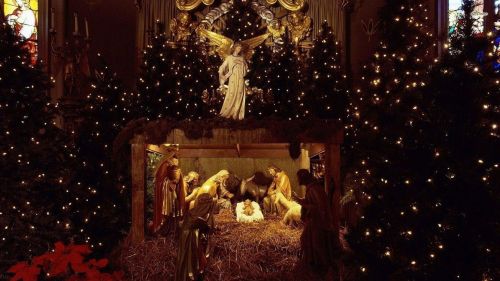
nativity-scene

And the Word was made flesh, and dwelt among us, (and we beheld his glory, the glory as of the only begotten of the Father,) full of grace and truth. (John 1:14)

The baby in the feeding trough, surrounded by smelly farm animals and adored by a small crowd including a soft-faced young mother, strong bewildered father, common shepherds and majestic kings makes for a sweet, albeit often overlooked, tableau. If noticed at all, its significance evaporates in clouds of sentimentality. How precious!

Do you not see! The Creator of heaven and earth reduced to a helpless, needy, human infant boy. The Owner and Master of all Creation presented to the world through the birth canal of a young virgin girl. The conception itself made an object of ridicule and shame; conceived outside the “knowledge” of a poor carpenter willing to accept the ridicule of the town’s people, and adopt someone else’s child. The engineer and designer of a finely tuned universe born in a dirty cave allotted to animals rather than a fine palace suitable for the King of the Universe. Rather than a reception by kings, dignitaries, and nobles, the first to greet Him were the low-class, detestable shepherds that kept the sheep for the Temple sacrifices.

This was “God With Us,” Emmanuel. God wrapped up in human flesh. Who could conceive of such a thing! The Jews expected a Messiah to turn Israel into a superpower; but Messiah was a man, not God in the flesh even though Isaiah had predicted, “Therefore the Lord himself shall give you a sign; Behold, a virgin shall conceive, and bear a son, and shall call his name Immanuel” (Isaiah 7:14). “And he shall pass through Judah; he shall overflow and go over, he shall reach even to the neck; and the stretching out of his wings shall fill the breadth of thy land, O Immanuel” (Isaiah 8:8).

No religion in the world envisions a god condescending to the level of mankind. The Greek gods occasionally mated with humans to produce demigods, yet they remained aloof from humanity. Islam has a god that demands absolute submission of his creation and even perfection (if that were possible) is subject to rejection according to his whim. Eastern religions like Buddhism and Hinduism picture god as some nebulous ether of which all the universe is made and of which we are all part, and the human must achieve an unknowable level of perfection in order to be joined to that undefinable “oneness.”

Only the Bible – both Old and New Testaments – brings the Creator down to the lowest level of humankind in order to elevate humanity to a place near equal to God Himself. (The created thing can NEVER be equal to its creator.) The thought is incomprehensible. The method seems too extreme. If God is so great – omniscient, omnipotent, omnipresent, etc. – could He not come up with a more sensible plan? Surely, some kind of merit system to earn a place at His side would be more appropriate. At least, that is what every other world religion offers. Man must do certain things – pray five times a day while facing Mecca, crawl ten miles over sharp rocks to light a candle for a saint, disassociate oneself from all worldly things, etc. – to appease the gods. However, that is not what the God of the Bible does (or did). He took extreme measures to rescue His fallen creation.

Man severed the intimate bond he had with his Creator at the Garden of Eden (Genesis 3:6-7). Love is an act of the will. It is always an act of the will. It cannot be imposed. It cannot be coerced. It must be offered and accepted freely and willingly, otherwise it is not love. Therefore, God placed only one stipulation on the man He created. “And the LORD God commanded the man, saying, Of every tree of the garden thou mayest freely eat: But of the tree of the knowledge of good and evil, thou shalt not eat of it: for in the day that thou eatest thereof thou shalt surely die (Genesis 2:16-17, emphasis mine). The man chose wrongly, and all of mankind, along with the whole of creation, suffered the curse of that choice. God introduced temporary measures to cover for human shortcomings – He shed the blood of innocent animals to cover (atone) their nakedness (Genesis 3:21), He accepted the sacrifice of innocent animals for the sins of man (Genesis 4:4; 8:20-21), and He institutionalized the sacrificial system shedding innocent animal blood to atone for sins (Exodus 12) – but this was insufficient. “For it is not possible that the blood of bulls and of goats should take away sins” (Hebrews 10:4). Animals, while innocent of any wrongdoing, are not responsible for the fall of man. The sentence for the infraction was death for the guilty party – the man. Therefore, the only reasonable and adequate sacrifice must be that of an innocent man, but there are none. “For all have sinned, and come short of the glory of God” (Romans 3:23).

What then! God took extreme measures to resolve the problem. God, Himself, put on human flesh. Through an act possible only for the omniscient, omnipotent, Creator God created a single-cell human zygote, in the pure virgin womb of a young Jewish maiden that developed as a normal human embryo. “But when the fulness of the time was come, God sent forth his Son, made of a woman, made under the law” (Galatians 4:4). God was born like any normal human baby. “Behold the Lamb of God, which taketh away the sin of the world” (John 1:29). “Christ Jesus: Who, being in the form of God, thought it not robbery to be equal with God: But made himself of no reputation, and took upon him the form of a servant, and was made in the likeness of men: And being found in fashion as a man, he humbled himself, and became obedient unto death, even the death of the cross” (Philippians 2:5-8, emphasis mine).

Only the blood of a perfectly sinless, innocent man could suffice to pay the “wages of sin” (Romans 6:23). God took extreme measures to buy back His fallen creation. There was no other way to solve the sin problem. Jesus said, “I am the way, the truth, and the life: no man cometh unto the Father, but by me” (John 14:6, emphasis mine).

The next time you view a nativity scene, look beyond the sweet baby in the manger and see the cross. Two trees still grow in God’s garden, the Tree of Life, i.e. the Cross of Christ, and the worldly tree of man’s perverted “knowledge of good and evil.” One tree gives eternal life, the other eternal death, i.e. eternal separation from the Creator. The choice is yours.
Comments Off on Extreme Measures

Filed under Christianity, Christmas, Evangelism, Gospel, Holidays, Religion, Salvation, Theology

Jesus’ Seven Signs in John (6)

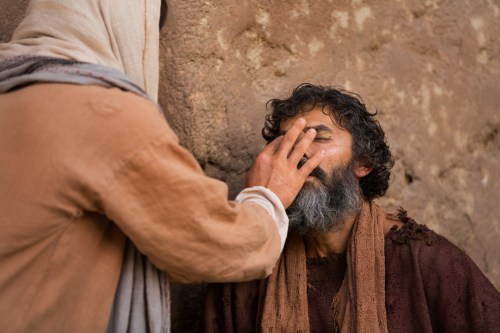
jesus-annoints-a-man-born-blind

I must work the works of him that sent me, while it is day: the night cometh, when no man can work. (John 9:4)

Why does God allow suffering? That question usually comes from God deniers uninterested in finding truth, but more interested in challenging the faith of those who claim to know the truth. Of course, the fundamental answer to the question fails to satisfy the skeptic, that is, that the origin of human suffering, and all other forms of evil, is due to the fall of man (Genesis 3). However, regardless of that fact, the doubter thinks, “There has to be something more to it than that!”

The disciples were no different. Popular thought at the time said that human suffering, i.e. illness, poverty, calamity, etc., was the result of personal sin, while good health, wealth, good fortune, etc., were signs of God’s favor on a righteous individual.

Jesus went to Jerusalem to celebrate the Feast of Tabernacles (John 7:2), a 21-day long celebration which started on Tishri 1 with the Feast of Trumpets, included the Day of Atonement, and culminated Feast of Tabernacles. The latter lasted eight days. The timing of this event in the ninth chapter of John’s Gospel is not clear from John’s account, and the other Gospels are silent about this time – perhaps because Jesus went to Jerusalem alone (John 7:10) – but John records the events in Chapters 7 through 9 sequentially as if they all transpired during this feast time. How John came by these details is uncertain, but perhaps he accompanied Jesus alone.

Regardless, the events of Chapters 7 and 8 include several encounters with the Pharisees. In one very memorable event, the Pharisees brought to Jesus a woman caught “in the very act” (John 8:4) of adultery so that He could pronounce judgement on her. After this, Jesus made His second I AM statement, “I am the light of the world” (John 8:12).[1] More emphatic than that was His outright proclamation: “Verily, verily, I say unto you, Before Abraham was, I am” (John 8:58, emphasis mine). They clearly understood His point. “Then took they up stones to cast at him: but Jesus hid himself, and went out of the temple, going through the midst of them, and so passed by” (John 8:59, emphasis mine).

Evidently, His disciples discovered that He was in Jerusalem and joined Him. “And as Jesus passed by, he saw a man which was blind from his birth. And his disciples asked him, saying, Master, who did sin, this man, or his parents, that he was born blind?” (John 9:1-2, emphasis mine). In their way of thinking, someone sinned resulting in total blindness for this man from birth. “There were grave difficulties in seeing how a man could have sinned before his birth. And it is not much easier to think that a man should bear such a terrible punishment for the sin of his parents. So the disciples put the matter to Jesus.”[2]

“Jesus answered, Neither hath this man sinned, nor his parents: but that the works of God should be made manifest in him” (John 9:3). Jesus made it clear that human suffering is not necessarily the result of sin. The account of Job exemplifies the opposite (Job 1-2). Job was righteous before God, yet God allowed Satan to bring calamity into his life. In the end, God restored to Job all that he had lost and more. However, that is not always the case. Sin does have consequences. Think of David’s sin with Bathsheba (2 Samuel 11-12). Even though God forgave David, the baby that resulted from the affair died, and David’s house knew nothing but conflict the remainder of his life. Then there was the one Jesus healed at the Pool of Bethesda.[3] After he was healed, Jesus cautioned him, “Behold, thou art made whole: sin no more, lest a worse thing come unto thee” (John 5:14, emphasis mine). Apparently, his malady resulted from sin, but that was not the case with the blind man. “Neither hath this man sinned, nor his parents.” (Only God could know that!) This blindness could not be explained other than the result of a fallen world, and “that the works of God should be made manifest in him.”

The day before, following the incident with the woman caught in adultery, Jesus made His second I AM statement: “I am the light of the world” (John 8:12). This day He encounters a man who has never experienced “the light of the world,” and He reiterates, “As long as I am in the world, I am the light of the world” (John 9:5, emphasis mine). John said as much at the beginning of his Gospel: “In him [Jesus] was life; and the life was the light of men. And the light shineth in darkness; and the darkness comprehended it not” (John 1:4-5, emphasis mine). Such an idea is rather abstract, but now Jesus would manifest it in a physical way.

“When he had thus spoken, he spat on the ground, and made clay of the spittle, and he anointed the eyes of the blind man with the clay” (John 9:6). Unlike other healings performed by Jesus where His word sufficed to accomplish the miracle, here the Creator actually did something. The act of making clay with His spittle reminds us of His initial creation of man where “the LORD God formed man of the dust of the ground, and breathed into his nostrils the breath of life; and man became a living soul” (Genesis 2:7). The man, having been “born blind,” possibly had no eyeballs. By forming clay to anoint the eyes, Jesus many have been going back to the original “specs” to create an entire new set for the man. The Bible does not say, but that is “my guess.”

This blind man had not asked for healing, as others had (e.g., Mark 10:46-52), and thus had not yet exhibited any kind of trust in Jesus. This is probably why Jesus used a process, rather than merely a word, to heal on this occasion. The man whose eyes had been anointed with the clay still had to exhibit faith by washing in the pool of Siloam before he could see.[4]

“And said unto him, Go, wash in the pool of Siloam, (which is by interpretation, Sent.) He went his way therefore, and washed, and came seeing” (John 9:7, emphasis mine). Oh, did I mention? “And it was the sabbath day when Jesus made the clay, and opened his eyes” (John 9:14, emphasis mine). The blind Pharisees concerned themselves more with a breach of their protocol than they did for the man’s suffering, and they completely missed the creation miracle by “the Lord of the Sabbath” (Mark 2:28; Luke 6:5).  Sometimes the answer to suffering is so that Jesus can be glorified.

Notes:


[1]  See https://erniecarrasco.com/2016/09/04/jesus-seven-i-am-statements-in-john-2/

[2]  Leon Morris, The New International Commentary on the New Testament: The Gospel According to John, Revised, (Wm. B. Eerdmans Publishing Co., Grand Rapids, MI, 1995), 425.

[3]  See https://erniecarrasco.com/2016/11/06/jesus-seven-signs-in-john-3/

[4]  Henry M. Morris, The Henry Morris Study Bible, (Master Books, Green Forest, AR, 2012), 1591.

Comments Off on Jesus’ Seven Signs in John (6)

Filed under Apologetics, Bible, Creation, Gospel, Origins, Religion, Theology

Alpha And Omega

Alpha Omega Bible

I am Alpha and Omega, the beginning and the ending, saith the Lord, which is, and which was, and which is to come, the Almighty.  (Revelation 1:8)

These words recorded by the Apostle John, the one “whom Jesus loved” (John 13:23; 20:2; 21:7, 20), introduce the One who would “reveal” the details of the final events of world history. At this time, John was an old man probably in his nineties, exiled on the island of Patmos “for the word of God, and for the testimony of Jesus Christ” (Revelation 1:9). It was Sunday, “the Lord’s Day,” and John was “in the Spirit” (Revelation 1:10).  John does not say, but I imagine that he was reading and meditating on Daniel’s prophecy and praying. John earned the nickname “Camel Knees” (so I am told) for the calluses he developed from hours on his knees in prayer. While in that posture, “a great voice, as of a trumpet” interrupted his meditation, and the resurrected Lord introduced Himself as “Alpha and Omega, the first and the last” (Revelation 1:10-11).

John recognized Him, although he had never seen Him like this before – “clothed with a garment down to the foot, and girt about the paps with a golden girdle. His head and his hairs were white like wool, as white as snow; and his eyes were as a flame of fire; And his feet like unto fine brass, as if they burned in a furnace; and his voice as the sound of many waters” (Revelation 1:13-15). John, in the company of Peter and James, witnessed Jesus transfigured on the mountain (Luke 9:28-36) in the days of Jesus’ short ministry on earth. That experience left the disciples awestruck, but it was nothing compared to this appearance.

Alpha, the first letter in the Greek alphabet, represents the beginning of the Word. In his Gospel, John wrote, “In the beginning was the Word, and the Word was with God, and the Word was God. The same was in the beginning with God. All things were made by him; and without him was not any thing made that was made” (John 1:1-3, emphasis mine). The Word of God, the Holy Bible, opens with the same phrase: “In the beginning God created the heaven and the earth” (Genesis 1:1, emphasis mine). God, the “uni-plural” Elohim, created the universe – all things – through His spoken Word: “And God said, Let there be light: and there was light. And God saw the light, that it was good: and God divided the light from the darkness” (Genesis 1:3-4, emphasis mine). John says, “In him [the Word] was life; and the life was the light of men. And the light shineth in darkness; and the darkness comprehended it not” (John 1:4-5, emphasis mine).

The Alpha of the Bible goes on to describe the six-day creation acts of God. On the sixth day, the Elohim created all the land-dwelling animals, and at last, He created man. “And God said, Let us make man in our image, after our likeness: and let them have dominion over the fish of the sea, and over the fowl of the air, and over the cattle, and over all the earth, and over every creeping thing that creepeth upon the earth. So God created man in his own image, in the image of God created he him; male and female created he them” (Genesis 1:26-27, emphasis mine). The switch between the plural (us/our) and the singular (his/he) provides the first insight (in English) to the triune nature of God, which is developed later in Scripture. However, in the original language of Hebrew, that insight appears in the very first verse. God (Elohim) is the plural form of the noun for god (el); however, the verb “created” (bara) appears in the singular form, which under other circumstances would be a grammatical booboo in Hebrew.

So, God creates man in His own image, which among other things, implies that man too is triune in nature. One aspect of that triune nature involves the physical form that animates and transports “the soul” of man. “And the LORD God formed man of the dust of the ground, and breathed into his nostrils the breath of life; and man became a living soul” (Genesis 2:7, emphasis mine). What physical shape would reflect “the image of God”? The Hebrew word translated “formed,” yâtsar, describes the work of a potter molding and shaping a lump of clay into a useful vessel. The Word, by whom “all things were made,” molded and shaped the kind of body He would one day inhabit. “And the Word was made flesh, and dwelt among us, (and we beheld his glory, the glory as of the only begotten of the Father,) full of grace and truth” (John 1:14, emphasis mine).

God took His image bearer “And the LORD God planted a garden eastward in Eden; and there he put the man whom he had formed” (Genesis 2:8). There God provided for man’s every need. The Garden of Eden provided an abundance of food and water (Genesis 2:9-10) with a perfect climate (Genesis 2:5-6). Best of all, sickness and death did not exist. God gave His stamp of approval on His perfect creation. “And God saw every thing that he had made, and, behold, it was very good. And the evening and the morning were the sixth day” (Genesis 1:31, emphasis mine). Death could not exist in a “very good” creation because the Bible says that death is “the last enemy” (1 Corinthians 15:26).

God and His image enjoyed intimate fellowship as God walked “in the garden in the cool of the day” (Genesis 3:8). However, love coerced is not love. Love must be a willful choice, and God allowed for the choice. “And the LORD God commanded the man, saying, Of every tree of the garden thou mayest freely eat: But of the tree of the knowledge of good and evil, thou shalt not eat of it: for in the day that thou eatest thereof [dying] thou shalt surely die” (Genesis 2:16-17, emphasis mine). Death did not exist in the Garden of Eden, but the potential did exist. Man had the choice, and man made the wrong choice. “And when the woman saw that the tree was good for food, and that it was pleasant to the eyes, and a tree to be desired to make one wise, she took of the fruit thereof, and did eat, and gave also unto her husband with her; and he did eat” (Genesis 3:6, emphasis mine). Man made the choice, and death entered God’s perfect creation.

The remainder of the Bible tells the story of God’s work in restoring fellowship with His fallen and dying creation. Only the blood of a perfect and innocent victim could make amends or reparation for the perpetual infraction. “For the life of the flesh is in the blood: and I have given it to you upon the altar to make an atonement for your souls: for it is the blood that maketh an atonement for the soul” (Leviticus 17:11, emphasis mine). The blood of animals fell short of the requirement because it was man, not animals, that sinned. “For it is not possible that the blood of bulls and of goats should take away sins” (Hebrews 10:4). The atoning blood-sacrifice must be that of a perfect, innocent man; nothing less would do. However, no man fit the bill, for “As it is written, There is none righteous, no, not one” (Romans 3:10). No human solution could be found. Therefore, “the Word was made flesh, and dwelt among us” (John 1:14, emphasis mine). “But [the Word] made himself of no reputation, and took upon him the form of a servant, and was made in the likeness of men: And being found in fashion as a man, he humbled himself, and became obedient unto death, even the death of the cross” (Philippians 2:7-8, emphasis mine). “But this man [the Word], after he had offered one sacrifice for sins for ever, sat down on the right hand of God” (Hebrews 10:12, emphasis mine). The debt is paid in full, and God offers the pardon as a gift to whoever will accept it. A choice must still be made – accept the gift or reject it. Love is not coerced.

Omega is the final letter in the Greek alphabet. Just as Alpha opens the book with God’s perfect image bearers in the pristine Garden of Eden, Omega closes the final book in a new heaven and new earth (Revelation 21:1) – Eden restored. There, the fellowship between Creator and creature is renewed (Revelation 21:3). Death and the grave no longer exist (Revelation 20:14), neither do tears, sorrow or pain (Revelation 21:4). The Tree of Life is there (Revelation 22:2), but not the Tree of the Knowledge of Good and Evil. The residents of the new heaven and new earth chose God’s free pardon during their time on earth. They chose to love God of their own volition; therefore there is no longer any curse, nor the option to choose evil (Revelation 22:3), “and they shall see His face” (Revelation 22 4) – the One who started it all. “I am Alpha and Omega, the beginning and the end, the first and the last” (Revelation 22:13).

2 Comments

Filed under Bible, Christianity, Creation, End Times, Evangelism, Gospel, Heaven, Origins, Religion, Salvation, Theology

Loving God

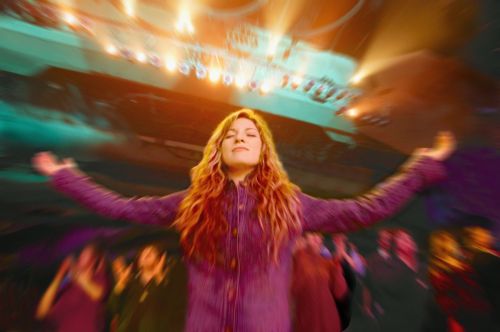
Woman in Worship 6214442_ml

If ye love me, keep my commandments … If a man love me, he will keep my words. (John 14:15, 23)

How can one love God? Jesus said, “God is a Spirit: and they that worship him must worship him in spirit and in truth” (John 4:24). How does one love or worship “a Spirit”? By definition, a spirit is immaterial. A spirit cannot be heard, seen, smelled, tasted, or touched. Those who choose not to believe in God use this as an excuse. Understandably, it is difficult for us material beings to relate to the Spirit of God. Some, I think, attempt to make the connection by raising hands and swaying to the music of a Sunday morning worship service in order to achieve some sort of euphoric state. (I’m not making fun. I have no way of knowing what goes on inside the heart of others. I’m only making an observation.) I cannot do that. I am not a touchy-feely person that requires a lot of external stimulus. I know God intuitively. God is real regardless of how I feel or whether I can sense Him or not, but to love Him, I must understand His personhood.

One aspect of God’s personhood is His desire to have fellowship with His creation. From the beginning we read, “And they [Adam and Eve] heard the voice of the LORD God walking in the garden in the cool of the day … And the LORD God called unto Adam, and said unto him, Where art thou?” (Genesis 3:8-9). God feels hurt when betrayed, but acts justly, yet with mercy. When Adam and Eve disobeyed, God expressed hurt when He said, “Behold, the man is become as one of us, to know good and evil” (Genesis 3:22), and although He had created the Garden of Eden just for them, He acted justly “and now, lest he put forth his hand, and take also of the tree of life, and eat, and live for ever: Therefore the LORD God sent him forth from the garden of Eden” (Genesis 3:22-23). Yet He showed mercy toward the couple. Rather than kill them outright, “Unto Adam also and to his wife did the LORD God make coats of skins, and clothed them” (Genesis 2:21) substituting the life of innocent animals to cover their sin.

From the beginning we find that, while God is just in punishing sin, His love for us, His creation created in the image of God (Genesis 1:26-27), manifests itself in His grace and mercy. We see this pattern revealed again in His dealing with Cain for murdering Abel (Genesis 4). We sense God’s pain: “And he said [to Cain], What hast thou done? the voice of thy brother’s blood crieth unto me from the ground” (Genesis 4:10). Because of this horrific act, God executed justice by banishing Cain to a life of wandering (Genesis 4:12), but He showed mercy on him by placing an identifying mark on him to keep others from taking revenge on him (Genesis 4:15).

Still, a greater example comes from the Flood account in Genesis 6-9. By that time mankind had become so wicked and corrupt, “And it repented the LORD that he had made man on the earth, and it grieved him at his heart” (Genesis 6:6, emphasis mine). The word translated “repented” is the Hebrew word nâcham, which means to “sigh” or “breathe strongly,” or, by implication, “to be sorry.” It does not mean that God changed His mind (Malachi 3:6). The end of that verse expresses God’s hurt over man’s depravity: “it grieved him at his heart.” God’s justice came in the form of the Flood. “But Noah found grace in the eyes of the LORD” (Genesis 6:8, emphasis mine). Because of His grace, i.e. love, God showed mercy in saving His creation from complete destruction.

We could go on and on with examples, but from the beginning of Genesis, the pattern was set for the personhood of God. He is just, loving and merciful (and much more). We should also note, in these first examples that it is man who does wrong, but it is God who first responds out of His love for us. Indeed, “We love him, because he first loved us” (1 John 4:19). John writes in his Gospel, “For God so loved the world, that he gave his only begotten Son, that whosoever believeth in him should not perish, but have everlasting life (John 3:16, emphasis mine). The word order in the Greek emphasizes God’s love – “so loved God the world.” So great is God’s love that He acted. “Herein is love, not that we loved God, but that he loved us, and sent his Son to be the propitiation for our sins” (1 John 4:10).

The shama proclaims “Hear, O Israel: The LORD our God is one LORD: And thou shalt love the LORD thy God with all thine heart, and with all thy soul, and with all thy might” (Deuteronomy 6:4-5). When Jesus was asked what was the greatest commandment, He quoted the shama, (Matthew 22:36-38). It seems rather paradoxical that God, who first loved us, demands that we love Him when our natural inclination is to reject Him. “As it is written, There is none righteous, no, not one: There is none that understandeth, there is none that seeketh after God” (Romans 3:10-11, emphasis mine). Yet this jilted lover reached down to those who rejected him (John 1:10-11) and literally gave His life to rescue us from the very clutches of eternal death.

When we come to a deep understanding of that reality, our desire should be to return that love. But how? We can’t wrap our arms around Him. We can’t kiss His wounded head, hands, and feet. How can we express our love for Him in a tangible way that truly demonstrates our love?  How can we “love the LORD [our] God with all [our] heart, and with all [our] soul, and with all [our] might”? God gave the answer. “And these words, which I command thee this day, shall be in thine heart: And thou shalt teach them diligently unto thy children, and shalt talk of them when thou sittest in thine house, and when thou walkest by the way, and when thou liest down, and when thou risest up. And thou shalt bind them for a sign upon thine hand, and they shall be as frontlets between thine eyes” (Deuteronomy 6:6-8). In short, we demonstrate our love for God by obeying His commandments. Someone might say, “But that is Old Testament. We live under the New Testament; we are not bound by the Law.” That is both true and false. We cannot be saved by obeying the Law, but that does not nullify the Law. It still serves as our standard, i.e. our guide book. There is a saying, “If you aim at nothing, you’ll hit it every time.”

The Law gives us something to aim for. The fact that we cannot perfectly meet that standard is the reason Jesus had to die in our place. And He said, “If ye love me, keep my commandments” (John 14:15). Note that “commandments” is plural. Jesus, who is God in the flesh (John 1:1, 14), gave those commandments to Moses, and He says, “For I am the LORD, I change not” (Malachi 3:6). However, He did condense all of His Law down to two: (1) “love the Lord thy God with all thy heart, and with all thy soul, and with all thy mind.”  (2) “And the second is like unto it, Thou shalt love thy neighbour as thyself.” Then He said, “On these two commandments hang all the law and the prophets” (Matthew 22:37-40). If we can do all of that, then we are keeping all of His commandments, and thereby we demonstrate our love for Him. But how do we know we are keeping those two? Check the guide book – the Old Testament.

Loving God has nothing to do with the euphoric experience you get, or don’t get, out of Sunday morning “worship” service. Loving God means obeying His commandments. That is how you show your love for God, and no fuzzy feelings are required.

3 Comments

Filed under Christianity, Religion, Theology, Worship

NOah Sail!

Ark Model Display at the Answers in Genesis Creation Museum

Ark Model Display at Answers in Genesis Creation Museum

Make thee an ark of gopher wood; rooms shalt thou make in the ark, and shalt pitch it within and without with pitch. (Genesis 6:14)

The creation ministry Answers in Genesis opens its long-awaited project the Ark Encounter on July 7, 2016. As implied by the name, the project promises to give visitors an “encounter” with Noah’s Ark. The main attraction is a full-scale model of Noah’s Ark based on the Egyptian Royal cubit of 20.6 inches and making the model an enormous 515 feet long. That is almost the length of 1 ¾ football fields.

The Ark will house many exhibits including life-sized animal models – many animated to be sure – to help visitors experience what life on the Ark might have been like. This will include the storage of food for the crew of eight, plus that of all the animal passengers. It will instruct the visitors on how the care and feeding of so many animals could be accomplished with only eight people onboard.

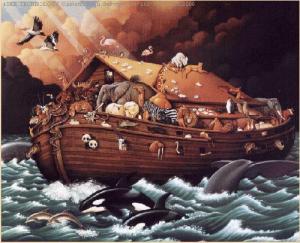
noah-arkThe importance of this attraction lies in the understanding that a large majority of people today reject the Bible as myth due to accounts such as that of the Global Flood recorded in Genesis 6-9. Even many liberal theologians compromise with the secularist in attributing the origin of the account to the Epic of Gilgamesh, or suggest that the Flood was only local and not global as described in Scripture.  Many adults today, if they think of Noah’s Ark at all, remember the stories read to them as children and remember the pictures of a tiny little boat with animals sticking their heads out of different port holes. Or they remember cute little bathtub toys with which they played at bath time. So, the idea of a wooden vessel large enough to house so many animals defies reason. The Ark Encounter will change that thinking, or at least give them something to think about.
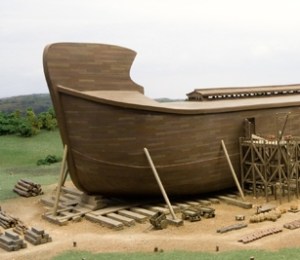
I look forward to visiting sometime after it opens, and I would encourage others to plan a trip up to northern Kentucky to experience it for yourself. While there, you can also visit Answers in Genesis Creation Museum. To get the most out of the visit, I would plan for at least three days. It will really be worth your time.

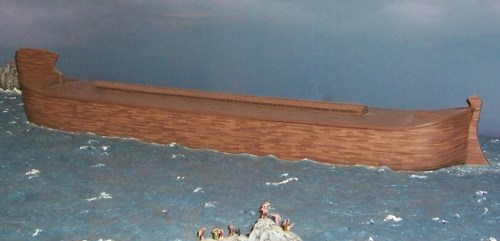
ark sail

The Sail

Not to take anything away from this most excellent endeavor by Answers in Genesis, but I do have one small bone to pick with the exterior design of the Ark. The ark replica under construction sports a tall stationary “sail” at the bow of the “ship” and a rudder-like structure, called a skeg, at the stern of the “ship.”

The Skeg

The Skeg

Tim Lovett is the designer of the ark replica. I do not know anything about Mr. Lovett, but according to the cover on his book Noah’s Ark: Thinking Outside the Box, he is a naval expert and a mechanical engineer. Lovett employed sound reasoning in the design of his ark. The “sail” is a wooden superstructure that rises high above the weather deck along the centerline of the ship. I say “ship” because the hull construction of this ark resembles what one would imagine for a modern ship with a tapered prow and stern. Hence the idea of “Thinking Outside the Box.” Prior to Lovett’s ship-like ark, most conventional thought rendered the Ark more box shaped – like a barge – than a navigable ship. Though unconventional, Lovett’s design makes good sense. The design prevents “broaching” i.e. catching a wave broadside. A tsunami-like wave in order of 100 ft or higher (which we would expect from the catastrophe described in the Flood account) could possibly swamp and capsize the vessel. On a navigable ship, an experienced sea captain would turn his ship into the wave to prevent broaching, but the Ark was not a navigable ship. Taking this into consideration, Lovett designed his ark with a sail and skeg that take advantage of the wind that generates the waves (sometimes but not always) and the motion of the wave to turn the ark in the direction of the wave and accomplish something similar to that of the experienced sea captain. It really is a very clever design.

Lovett defends his design by pointing to the ship construction of the ancient Egyptians, Phoenicians, Greeks, Romans, etc., and suggests that pre-Flood people probably possessed similar shipbuilding skills. If that were the case, then Noah probably had access to the same technology, and assuming, as we do, that pre-Flood people were actually of higher intellect than modern man (being that they were genetically closer to the perfectly created man, Adam), then it stands to reason that Noah had the intellect, knowledge and skills to build such a vessel.

There Lovett argues from scriptural silence. The Bible makes absolutely no mention of maritime travel in the pre-Flood world. We can surmise that they were technologically skilled by the descriptions given in Genesis 4:20-22, but the description is rather limited: they kept cattle, made musical instruments, and worked in brass and iron. That is really not up to the standard that we might consider technology today, however, that is not the point of the narrative. These people were not “knuckle draggers;” they were highly intelligent, yet there is nothing said about their abilities to navigate the open seas. Would that not be significant? So, Noah’s shipbuilding skills are merely a product of Lovett’s speculation, and we should leave it at that. There is nothing wrong with that as long as we remember that it is “speculation,” not Bible.

Let us consider what the Bible does say. We know that the human race had become wicked and corrupt (Genesis 6:1-7) to the point that God had no other option than to destroy them all; “But Noah found grace in the eyes of the LORD” (Genesis 6:8). God instructed Noah to build an ark. The Hebrew word translated “ark” is têbâh, and it means “box” – not a “ship” or a “boat.” It is a box.  Further, God instructed Noah what building materials to use: gopher wood and pitch. No one knows what gopher wood is. Some think it is some kind of extinct tree, and some think it may have been a method of construction or a process of laminating wood. We do not know. The point is that Noah knew what it was. “Pitch” is the Hebrew word kôpher which literally means “cover,” the same word that is used for “atonement.” Some have suggested that it was bitumen – a tar – but whatever it was, it was meant to seal the Ark and make it watertight.

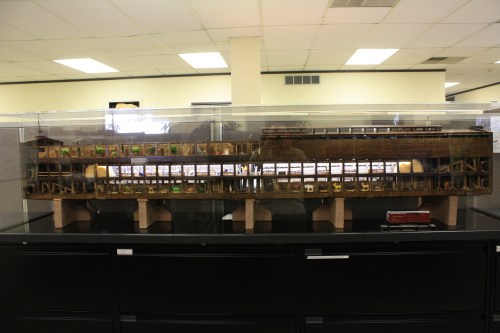
Ark Model on Display at the Institute for Creation Research

Ark Model on Display at the Institute for Creation Research

Noah was given the dimensions for the Ark 300 x 50 x 30 cubits (Genesis 6:15), and it was to have three decks and animal pens (Genesis 6:14).  God’s instructions also included a “window” (Genesis 6:16). The Hebrew word translated “window” is tsôhar, which literally means “double light,” and is translated elsewhere in the O.T. as “noon” or “midday.” Considering these details, one would think that something so prominent as a “sail” or a “skeg” would have been noted. But again, this is an argument from silence that does not necessarily negate Noah having added this detail of his own volition. We can infer from Scripture that Noah employed some of his own initiative when, at the end of the Flood, we read, “And it came to pass at the end of forty days, that Noah opened the window of the ark which he had made” (Genesis 8:6, emphasis mine). In this case the Hebrew word translated “window” is challôn, which is always translated as “window” in the O.T. This was something different than the “window” God specified for construction.

So, could the Ark withstand the ravages of the catastrophic global flood without the benefit of a sail and skeg? To answer that question, we must answer some fundamental questions. Who brought the judgment upon the human race (Genesis 6:7)? Who decided to save Noah and his family (Genesis 6:18)? Who gave the order to build the Ark and provided the specifications (Genesis 6:14-16)? Who selected and called the animals to the Ark when it was completed (Genesis 7:7-9)? Who caused the fountains of the deep to burst and for the rain to fall for 40 days and nights (Genesis 7:11-12)? Who caused the waters to continue to rise for 150 days (Genesis 7:24)? The answer to all of those questions is God. It was all God’s doing. The next question to ask is: “What was God’s purpose for the Ark?” “Of fowls after their kind, and of cattle after their kind, of every creeping thing of the earth after his kind, two of every sort shall come unto thee, to keep them alive” (Genesis 6:20, emphasis mine).

Considering that God directly planned, directed, and superintended every detail of this catastrophic event, it stands to reason that (since His plan included preserving life on the Ark) He also kept the Ark safe through the turbulence of the storm.

Noah was instructed to build a big box, not a ship. God did not require him to possess shipbuilding skills, only enough skills to build a watertight box. God would take care of the rest. So, while Tim Lovett’s design is clever, well thought out, and reasonable, it is really unnecessary when God’s plan all along was to preserve life. More than that, a simple box preserved in turbulent waters, glorifies God more than a sleek ship designed by man. A ship designed to resist rough waters glorifies the ingenuity of man; but with a simple box, God gets all the glory.

The Ark is a “type” of Christ. Salvation is through grace; it is not by works of man (Ephesians 2:8-9). Those who place their trust in Christ are saved from the storms of life and preserved to enter into a new heaven and a new earth (Revelation 21:1). It is all God’s doing. The only thing man needs to do is obey God’s call and enter through the only door (John 14:6) to be saved. No clever scheme of man, no matter how refined, can compete with God’s very simple design.

So, if you have an opportunity to visit the Ark Encounter, please do so. It will really be a blessing to you. But when you look at that massive sail and skeg, take it for what it is: a clever product of someone’s imagination. And remember, God does not need our help to accomplish His will.

You might also be interested in reading about the Arm model I built: Building the Ark.

4 Comments

Filed under Apologetics, Christianity, Evangelism, Gospel, Religion, Salvation, Theology