Tag Archives: theology

Chose or Chosen?

For many are called, but few are chosen. (Matthew 22:14)

I have found some Christian brothers that have strong Calvinist leanings. I accept most of the five points of Calvinism to some degree – Total Depravity, Unconditional Election, Limited Atonement, Irresistible Grace, and Perseverance of the Saints (T.U.L.I.P.) – but I cannot fully embrace U, L, and I. I completely agree with T and P – the Total Depravity of man, and the Perseverance of the Saints, i.e., “once saved, always saved.”

As already noted, the points that give me the most grief are U and L. Unconditional Election says that God predetermined from the beginning of time who would be saved and who would be damned for eternity. The argument is that God is sovereign, and He can do exactly as He pleases (no argument there). A favorite verse used to make this point is Romans 9:15 “For he saith to Moses, I will have mercy on whom I will have mercy, and I will have compassion on whom I will have compassion.” Here Paul referred to the time when Moses wanted to “see” God’s glory and God responded, “And he said, I will make all my goodness pass before thee, and I will proclaim the name of the LORD before thee; and will be gracious to whom I will be gracious, and will shew mercy on whom I will shew mercy” (Exodus 33:19, emphasis mine). Clearly, God was not speaking in soteriological terms. Indeed, neither was Paul in making the reference to Moses. When taken in context, Paul was referring to God’s sovereignty in determining the course of salvation in general, not in particular.

Limited Atonement builds on Unconditional Election. Limited Atonement says that Jesus died only for those who were unconditionally elected for salvation. That eliminates all the “whosoever” verses beginning with John 3:16 “For God so loved the world, that he gave his only begotten Son, that whosoever believeth in him should not perish, but have everlasting life” (emphasis mine). Since the Bible is always true and does not contradict itself in any way, this verse alone should serve to debunk Limited Atonement.

To a limited degree, I also disagree with Irresistible Grace. It is the Holy Spirit who convicts the individual’s heart of sin (John 16:8) and convinces him of his need for the Savior. The “call” is ubiquitous (Romans 1:20), however, it is felt more strongly in some than it is in others. Thus, it can indeed be resisted, and more resist the call than respond to it (Matthew 7:13-14).

The Bible speaks to both man’s autonomy in choosing and God’s work of “election.” I maintain that the answer is “Somewhere in the Middle,” and neither side of the argument can hold his view dogmatically.

Recently the debate came up again in my church. I made my case and the other side made their case and neither side convinced the other, which is usually the case. However, the fact that this debate keeps raising its ugly head, I determined to “Search the Scriptures; for in them ye think ye have eternal life: and they are they which testify of me” (John 5:39). I looked in the New Testament for all the verses I could find related to salvation for the individual. I divided my findings into three categories: (1) Choice/Free Will, (2) Predestination/Election, and (3) verses that can apply to both sides. Here is what I found: for Category 1, there were 77 verses; for Category 2, there were 15 verses. Of those, 7, when read in context, suggest that the “predestination” is of “purpose” not of salvation; for Category 3 there were 17. Rather than argue one side or the other, I think it best to allow the Bible to speak for itself, and the reader can decide for himself.

Verses for Category 1: Matthew 7:13-14, 24; 10:32-33; 11:28-30; 12:31-32, 50; 16:24-26; 18:3-4, 14; Mark 3:28-29, 35; 8:34-38; 9:37; 10:15; 16:16; Luke 6:47; 7:23; 9:23-25, 48; 12:8-10; 13:3, 5, 23-24; 17:33; 18:17; John 1:12-13; 3:3, 15-18, 36; 4:14; 5:24; 6:28-29, 35, 40, 45, 47, 51; 10:9-10; 11:25-26; 14:6; 20:29; Acts 2:21, 38; 10:43; Romans 1:16; 3:28; 4:5; 5:6, 12; 10:13; 2 Corinthians 5:21; Galatians 1:3-4; 2:16; 3:6-7, 11, 22, 24-27; Ephesians 1:7; 2:4-9; Philippians 2:5-11; Colossians 1:14; 2:13-14; 1 Thessalonians 5:9-10; 1 Timothy 1:15; 2:3-4; 4:10; 2 Timothy 1:9; Titus 2:11; 3:5-7; Hebrews 3:7-8, 15; 7:25; 9:28; 11:6; 2 Peter 3:9; 1 John 2:2; 5:1, 10-12; Revelation 22:14.

Verses for Category 2: Luke 10:22; John 6:37, 44, 65; 17:24; Romans 8:33;* Ephesians 1:5, 11; 2:10;* Colossians 3:12; 2 Thessalonians 2:13; 2 Timothy 2:10;* Titus 1:1;* 1 Peter 1:2;* 2 John 1:1, 13. The passages marked with an asterisk (*) speak of predestination, but when examined closely, the predestination is a “Predestination of Purpose” not predestination for salvation. In other words, it is the predetermined plan God has for those who are “justified” having placed their faith in the atoning work of Christ on the cross. As I read these passages my conclusion is that those who are “elect” are “elected” by virtue of their faith in Christ for salvation and their “predestination” is to be conformed to the image of Christ.

Verses for Category 3: Matthew 9:13; 10:39; 20:28; 22:14; Luke 5:32; John 7:38-39; 10:27-29; 14:23; Acts 4:12; 15:11; Romans 6:23; 8:1; 2 Corinthians 5:17; Hebrews 4:3; 1 Peter 3:18; 1 John 4:9-10. These verses can apply equally to either Category 1 or 2.

As we enter this Advent Season, we remember that God took on human flesh and entered time and space by way of a virgin’s womb to live and walk among His creation (John 1:1-3, 14). “He came unto his own, and his own received him not. But as many as received him, to them gave he power to become the sons of God, even to them that believe on his name” (John 1:11-12). He took the penalty of our sins upon Himself and shed His own blood on the cross to pay our sin debt. He was buried in a borrowed tomb and rose again on the third day, conquering death and the grave on our behalf to win our salvation. He did that for “whosoever” will accept His free, “grace” gift of salvation by faith in His finished work. “For God so loved the world, that he gave his only begotten Son, that whosoever believeth in him should not perish, but have everlasting life” (John 3:16). “Whosoever” accepts His offer by “believing in Him” is “elected” for “everlasting life.” This is the whole message of Christmas.

Reader, have you accepted Jesus’ free gift of salvation? If not, or if you are unsure, please read my page on “Securing Eternal Life.”
6 Comments

Filed under Apologetics, Bible, Christianity, Christmas, Gospel, Salvation, Theology

Shepherd of Shepherds

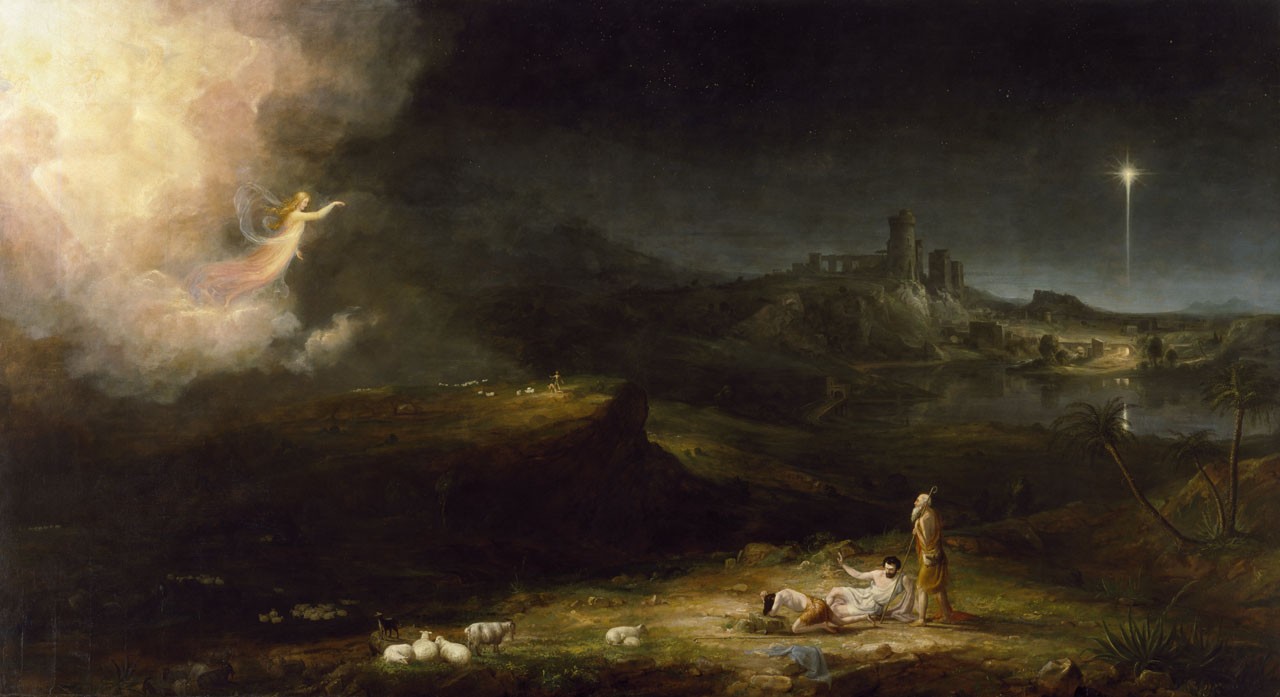
“And there were in the same country shepherds abiding in the field, keeping watch over their flock by night.” (Luke 2:8)

One of the best arguments against the birth of Christ having taken place in late December is this fact recorded by Luke in his Gospel. There were shepherds out in the fields watching over their flocks. By late December, there is not sufficient grazing to sustain large flocks of sheep. Jerusalem is near the same latitude as Dallas, Texas where I used to live, and by the middle to the end of November, there is not much left on which cattle can graze. So, they need to be fed on hay or “cake” until the next spring. So, it seems very unlikely that shepherds would be out in the fields tending to sheep in the wintertime.

The shepherds around Bethlehem generally kept the sheep and goats that were used for sacrifice in the Temple in nearby Jerusalem. Some have suggested that Jesus’ birth was around late September which coincides with the Jewish Fall Feasts: Feast of Trumpets (Rosh Hashanah), Day of Atonement (Yom Kippur), and Feast of Tabernacles (Sukkoths). These feasts required all Jewish men to make a pilgrimage to the Temple in Jerusalem. The fact that this requirement happened to coincide with the decree from Caesar Augustus for the census (Luke 2:1) may explain why “there was no room for them in the inn” (Luke 2:7) for the expectant couple. In fact, His birth may have occurred during the Feast of Tabernacles making John’s statement that “the Word was made flesh, and [tabernacled] among us” (John 1:14) even more significant. Interestingly, if one counts back nine months from the end of September, one arrives at a date sometime in late December. It could be that rather than celebrating Christ’s birth on December 25, we are actually celebrating His conception!

Regardless, it was to these simple shepherds that this paramount announcement was delivered. “For unto you is born this day in the city of David a Saviour, which is Christ the Lord” (Luke 2:11). To these shepherds who were known for feeding and protecting their flocks; who sought out the lost sheep, and rescued those that were attacked. It seems appropriate that to these the news of the arrival of the “Shepherd of Israel” should be first delivered. He who would later say, “I am the good shepherd: the good shepherd giveth his life for the sheep” (John 10:11) had come. So without hesitation, they said, “Let us now go even unto Bethlehem, and see this thing which is come to pass, which the Lord hath made known unto us” (Luke 2:15). They came “with haste” Luke tells us, “and found Mary, and Joseph, and the [Lamb of God] lying in a manger” (Luke 2:16). The name given the babe was Jesus, “for he shall save his people from their sins” (Matthew 1:21). This little Lamb of God, who was to be the Shepherd of shepherds, had finally come to them. He did not come to a palace but to a dirty, smelly stable. He was not announced to the kings of the world, but to those of the lowest social status – to shepherds.

1 Comment

Filed under Apologetics, Christianity, Christmas, Holidays, Theology

One Was Thankful

And one of them, when he saw that he was healed, turned back, and with a loud voice glorified God, (Luke 17:15)

Thanksgiving Day is upon us, and I’m sure most of us have plans for food, family, friends, and fellowship. In today’s culture, Thanksgiving Day is just a good excuse to have a day (or two) off work, indulge in gluttonous behavior, and worship before the luminous god of football followed by the giving of alms to the god of materialism the next day, all the while in complete ignorance of the significance of the day.

As I thought about Thanksgiving coming up, the Lord brought to mind the account of Jesus healing the ten lepers. We read about that in Luke 17:11-19:

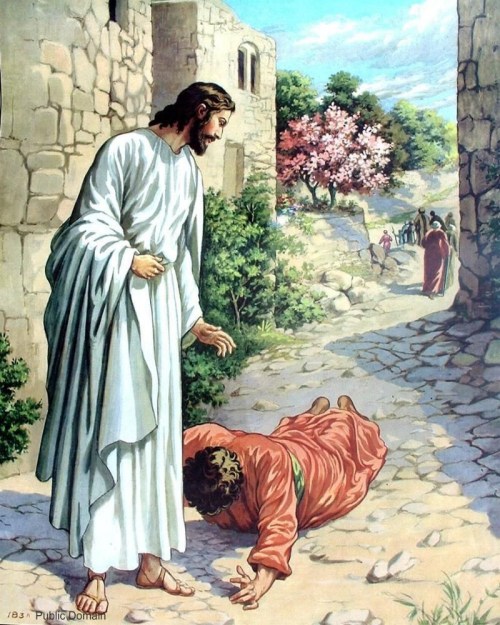
And it came to pass, as he went to Jerusalem, that he passed through the midst of Samaria and Galilee. And as he entered into a certain village, there met him ten men that were lepers, which stood afar off: And they lifted up their voices, and said, Jesus, Master, have mercy on us. And when he saw them, he said unto them, Go shew yourselves unto the priests. And it came to pass, that, as they went, they were cleansed. And one of them, when he saw that he was healed, turned back, and with a loud voice glorified God, And fell down on his face at his feet, giving him thanks: and he was a Samaritan. And Jesus answering said, Were there not ten cleansed? but where are the nine? There are not found that returned to give glory to God, save this stranger. And he said unto him, Arise, go thy way: thy faith hath made thee whole. (Luke 17:11-19)

Following the “Transfiguration” (Luke 9:28-36), Jesus “stedfastly set His face to go to Jerusalem” (Luke 9:51). Coming down from Caesarea Philippi, Luke records that Jesus “passed through the midst of Samaria and Galilee” (v. 11). He is traveling from the north to the south (toward Jerusalem), which means He must pass through Galilee first before going through Samaria. Why did Luke name Samaria first? I do not know. I could not find one commentator that could tell me, but I suspect the answer is down below. Jesus was on His way to the cross.

As the passage records, ten leprous men met Him, and while remaining at a distance –because their disease was so contagious, they were not allowed to come near other people – they cried out for Jesus to have mercy on them. They addressed Him as “Master” – Greek ἐπιστάτης (epistatēs), from epi, “superimposition, to be over, above,” and histēmi, “to stand” Together the title means “one who stands above” – Master! This is not to be confused with διδάσκαλος (didaskalos) meaning “teacher” (Luke 3:12). Thus, they recognized that Jesus had the power to heal their disease.

When Jesus saw them, “He said unto them, ‘Go show yourselves’” (v.14). Note that Jesus does not touch nor approach them. Why? Jesus had often touched lepers when He healed them, why not today? Jesus was on His way to the Cross. He could not allow Himself to become “unclean.” Note also that His Word was sufficient to heal the lepers – “as they went, they were cleansed.” This healing by His verbal command is a clear demonstration of His deity.

All ten exercised faith in believing His Word that they would be healed, but only one returned to give thanks. “When he saw that he was healed, turned back, and with a loud voice glorified God” (v. 15). “And fell down on his face at his feet, giving him thanks: and he was a Samaritan” (v. 16). He did not simply bow in reverence. He completely prostrated himself, flat with his face to the ground. He placed himself at Jesus’ feet. His attitude was one of complete humility, reverence, worship, and gratitude – “and he was a Samaritan.” That this one was a Samaritan may explain why Luke listed Samaria before Galilee. The implication is that the other nine were Jews.

Jesus seems surprised that only this one returned to give thanks. However, knowing that the Lord knows the hearts of all men, His feigned surprise was likely intended to make a point. Jesus said that “[God] is kind to the unthankful and to the evil” (Luke 6:35).

Thankfulness was not particularly characteristic of the Jews. Consider how often they complained after they were freed from Egypt. Think of how soon they fell into idol worship during the time of the Judges. Consider their presumption on God knowing that they were His people. Their lack of gratitude came as no surprise to Jesus. However, the “stranger” recognized his unworthiness and was grateful for the mercy Jesus bestowed on him.

“And he said unto him, Arise, go thy way: thy faith hath made thee whole” (v.19). The Greek word translated “whole” here is σεσωκεν (sesoken), and it means “has saved.” Literally what Jesus said is, “thy faith hath saved thee.” Obedience (which also required faith) had made him “whole,” i.e., healed him. However, his “faith” in recognizing Jesus as “Master” saved him. He was “whole” not only physically, but spiritually.

Does God Expect Us To Be Thankful?

Leviticus 22:29  And when ye will offer a sacrifice of thanksgiving unto the LORD, offer it at your own will.

  1. Not out of obligation
  2. 2 Corinthians 9:7 Every man according as he purposeth in his heart, so let him give; not grudgingly, or of necessity: for God loveth a cheerful giver.

1 Chronicles 16:8  Give thanks unto the LORD, call upon his name, make known his deeds among the people.

Can’t do the latter without the former.

1 Chronicles 16:34  O give thanks unto the LORD; for he is good; for his mercy endureth for ever.

Psalm 30:4  Sing unto the LORD, O ye saints of his, and give thanks at the remembrance of his holiness.

Considering God’s holiness and our unworthiness, how can we not be thankful for the love He has shown to us?

Psalm 95:2  Let us come before his presence with thanksgiving, and make a joyful noise unto him with psalms.

Not “come before His presence with prayer requests.” Prayer requests are fine, but let’s first thank Him.

Psalm 100:4  Enter into his gates with thanksgiving, and into his courts with praise: be thankful unto him, and bless his name.

“Bless His name,” i.e., “speak well of His name” What are some attributes of God that come to mind?

Colossians 2:6-7  As ye have therefore received Christ Jesus the Lord, so walk ye in him:  (7)  Rooted and built up in him, and stablished in the faith, as ye have been taught, abounding therein with thanksgiving.

Philippians 4:6  Be careful for nothing; but in every thing by prayer and supplication with thanksgiving let your requests be made known unto God.

1 Thessalonians 5:18  In every thing give thanks: for this is the will of God in Christ Jesus concerning you.

Consequences of Ingratitude:

Romans 1:21  Because that, when they knew God, they glorified him not as God, neither were thankful; but became vain in their imaginations, and their foolish heart was darkened.

Ingratitude darkens the heart.

2 Timothy 3:1-2, 7-9  This know also, that in the last days perilous times shall come.  (2)  For men shall be lovers of their own selves, covetous, boasters, proud, blasphemers, disobedient to parents, unthankful, unholy … (7) Ever learning, and never able to come to the knowledge of the truth. (8)  Now as Jannes and Jambres withstood Moses, so do these also resist the truth: men of corrupt minds, reprobate concerning the faith. (9)  But they shall proceed no further: for their folly shall be manifest unto all men, as theirs also was.

Benefits of Thankfulness:

Psalm 140:13  Surely the righteous shall give thanks unto thy name: the upright shall dwell in thy presence.

We are made “righteous” through Christ. Because of that we have His presence within us.

Jeremiah 30:19  And out of them shall proceed thanksgiving and the voice of them that make merry: and I will multiply them, and they shall not be few; I will also glorify them, and they shall not be small.

  1. In context, this is referring to Israel’s return from Babylonian captivity.
  2. However, the principle applies.
  3. God will bless our thankfulness.

2 Corinthians 4:15  For all things are for your sakes, that the abundant grace might through the thanksgiving of many redound to the glory of God.

  1. “redound” Greek περισσεύω (perisseuō)
  2. to superabound (in quantity or quality), be in excess
  3. God’s grace to us “supper-abounds” through thanksgiving.

2 Corinthians 9:11  Being enriched in every thing to all bountifulness, which causeth through us thanksgiving to God.

Colossians 3:15  And let the peace of God rule in your hearts, to the which also ye are called in one body; and be ye thankful.

1 Timothy 4:1-5  Now the Spirit speaketh expressly, that in the latter times some shall depart from the faith, giving heed to seducing spirits, and doctrines of devils;  (2)  Speaking lies in hypocrisy; having their conscience seared with a hot iron;  (3)  Forbidding to marry, and commanding to abstain from meats, which God hath created to be received with thanksgiving of them which believe and know the truth.  (4)  For every creature of God is good, and nothing to be refused, if it be received with thanksgiving:  (5)  For it is sanctified by the word of God and prayer.

Conclusion:

Jesus healed ten lepers. Nine of them were of “the chosen.” Their attitude reflected ingratitude for the marvelous work Jesus performed in their lives – almost as if they believed they were entitled to what they received.

One leper – a “stranger,” a Samaritan, clearly an “outsider” due to both his leprosy and his heritage – recognized his own unworthiness and the greatness of the One who healed him; and he returned to give thanks and worship the God who healed him. And he was saved.  Let us recognize that we are all lepers and give thanks for all He has done for us.

Happy Thanksgiving!

3 Comments

Filed under Apologetics, Christianity, Holidays, Religion, Salvation, Thanksgiving, Theology

Three Anointings

There came unto him a woman having an alabaster box of very precious ointment, and poured it on his head, as he sat at meat. (Matthew 26:7)

In one of my Bible readings this week, I came across an account of a woman anointing Jesus. All four Gospels record such an event. A detached, casual reading of the event can make the reader conclude that all four accounts are the same. Indeed, if we check the cross-references in our Bibles, they all seem to point to the other accounts leading the reader to assume they are all the same account. However, a close and careful examination of the four accounts will reveal a different story.

We have two, arguably three, different accounts of Jesus’ anointing. Luke’s account places the anointing long before the transfiguration while He was still in Capernaum (Luke 7:36-50).

Luke 7:36-39  And one of the Pharisees desired him that he would eat with him. And he went into the Pharisee’s house, and sat down to meat.  (37)  And, behold, a woman in the city, which was a sinner, when she knew that Jesus sat at meat in the Pharisee’s house, brought an alabaster box of ointment,  (38)  And stood at his feet behind him weeping, and began to wash his feet with tears, and did wipe them with the hairs of her head, and kissed his feet, and anointed them with the ointment.  (39)  Now when the Pharisee which had bidden him saw it, he spake within himself, saying, This man, if he were a prophet, would have known who and what manner of woman this is that toucheth him: for she is a sinner.

Matthew 26:6-9  Now when Jesus was in Bethany, in the house of Simon the leper(7)  There came unto him a woman having an alabaster box of very precious ointment, and poured it on his head, as he sat at meat.  (8)  But when his disciples saw it, they had indignation, saying, To what purpose is this waste?  (9)  For this ointment might have been sold for much, and given to the poor.

Mark 14:1-5  After two days was the feast of the passover, and of unleavened bread … (3)  And being in Bethany in the house of Simon the leper, as he sat at meat, there came a woman having an alabaster box of ointment of spikenard very precious; and she brake the box, and poured it on his head.  (4)  And there were some that had indignation within themselves, and said, Why was this waste of the ointment made?  (5)  For it might have been sold for more than three hundred pence, and have been given to the poor. And they murmured against her.

John 12:1-6  Then Jesus six days before the passover came to Bethany, where Lazarus was which had been dead, whom he raised from the dead.  (2)  There they made him a supper; and Martha served: but Lazarus was one of them that sat at the table with him.  (3)  Then took Mary a pound of ointment of spikenard, very costly, and anointed the feet of Jesus, and wiped his feet with her hair: and the house was filled with the odour of the ointment.  (4)  Then saith one of his disciples, Judas Iscariot, Simon’s son, which should betray him,  (5)  Why was not this ointment sold for three hundred pence, and given to the poor?  (6)  This he said, not that he cared for the poor; but because he was a thief, and had the bag, and bare what was put therein.

Matthew and Mark place the anointing after the Triumphal Entry (Matthew 21:1-11; Mark 11:1-11) and two days before the Passover. John places the anointing the day before the Triumphal Entry (John 12:12). Matthew and Mark place the anointing in the “house of Simon the Leper.” John seems to place the anointing in the house of Lazarus following the raising of Lazarus from the dead. Neither Matthew nor Mark names the woman who anointed Jesus. Had she been Mary, they certainly would have known who she was. John names Lazarus, Martha, and Mary who anointed Jesus. Matthew records that the “disciples” were indignant about the waste. Mark only records that “there were some that had indignation within themselves.” The difference and precision in detail between Matthew and Mark’s account and the account of John are too distinct to be an error in recording. Therefore, these are two separate anointings. Luke’s account came too early to be confused with these that took place just before the crucifixion. Luke records that the anointing took place in the house of a Pharisee named Simon – not a leper – and the woman that anointed Jesus was “a sinner.” Surely, Mary, named by John, would not have been identified as a “sinner.” She is the one that “sat at Jesus’ feet, and heard His word” (Luke 10:39). Also, Luke’s account records nothing said about the cost of the ointment being used.

In all, we have three separate accounts of Jesus being anointed by women. Even though there are some similarities, the differences are too great to conflate them as one or two. The lesson here is to let the Bible speak for itself. The experts, while we can learn much from them, are also fallen men after all; they can make mistakes too.

Matthew and Mark describe the same anointing. John records a second anointing by Mary, Lazarus’ sister (Lazarus whom Jesus raised from the dead, John 11). Both accounts take place before the Passover when Jesus would be crucified. In both instances, Jesus commented that the anointing was for His burial (Matthew 26:12; John 12:7). Jesus knew that the cross lay before Him, and He went willingly to take our sin upon Himself. He paid a debt He did not owe to cancel the debt we could never pay. Reader, our sin debt was paid by Jesus who bought our pardon with His blood. All we have to do is accept that pardon. Have you done that? If not please read my page on “Securing Eternal Life.”

Comments Off on Three Anointings

Filed under Apologetics, Bible, Christianity, Gospel, Salvation, Theology

Little Ones

Take heed that ye despise not one of these little ones; for I say unto you, That in heaven their angels do always behold the face of my Father which is in heaven. (Matthew 18:10)

The verse above was part of my daily Bible reading this week. It is a very familiar verse that I have read hundreds of times perhaps, heard sermons preached on it, and participated in Bible studies that covered it. When read out of context, it seems that Jesus refers to children – “little ones” – in this discourse, and that is the way it has been presented, or at least the way I have understood it, in the past.

However, as I read the assigned Bible passage (Matthew 18:7-35), it occurred to me that “little ones” did not refer to children. That made me stop and dig a little deeper. In order to understand the complete meaning of a passage, it is advisable always to read a single verse in its full context. In this case, we need to go back to the beginning of the chapter to get a clear picture of what was taking place.

As the chapter opens, we find Jesus’ disciples wondering and questioning Jesus as to who (among them, supposedly) would be the greatest in the “kingdom of heaven” (18:1). Matthew does not name the participants in the discussion nor do the other two synoptic Gospels.[1] Interestingly, all three record this event as having taken place shortly after the Transfiguration.[2] Mark records that the discussion took place on the return trip from Caesarea Philippi, the location of the “Mount of the Transfiguration,” to Capernaum. Three of the twelve, Peter, James, and John, were the only witnesses to the Transfiguration. Surely these three, because the special privilege afforded them, felt that they should be chiefest among them. Moreover, all of the disciples discounted what Jesus told them a short time before. “And while they abode in Galilee, Jesus said unto them, The Son of man shall be betrayed into the hands of men: And they shall kill him, and the third day he shall be raised again. And they were exceeding sorry” (Matthew 17:22-23).[3] The idea was unthinkable, so they quickly eliminated it from memory.

As an object lesson, Jesus took a small child and set him before them. “And said, Verily I say unto you, Except ye be converted, and become as little children, ye shall not enter into the kingdom of heaven. Whosoever therefore shall humble himself as this little child, the same is greatest in the kingdom of heaven. And whoso shall receive one such little child in my name receiveth me” (Matthew 18:3-5, emphasis mine). The Greek word translated as “converted” is strephō. The word, as defined by Strong’s,[4] means “to twist, that is, turn quite around or reverse,” which is similar to “repent.” Obviously, Jesus identified the problem as pride manifested as misguided ambition for greatness. The solution requires repentance, conversion, or transformation from a position of pride to that of humility, like that of a child. Those who make the transformation will achieve greatness in the kingdom of heaven. Jesus then adds that one who receives “one such little child,” i.e., one that has made the “conversion,” in “My name, receives Me.” Jesus was not speaking of a child, but rather one who becomes “like a little child” in humility.  The child in their midst was just the “prop” for the object lesson.

As He continued the object lesson, He added, “But whoso shall offend one of these little ones which believe in me, it were better for him that a millstone were hanged about his neck, and that he were drowned in the depth of the sea” (Matthew 18:6, emphasis mine). At this point, we need to examine the language closer to understand what Jesus was actually saying. At the beginning, Jesus used a child as a prop for the object lesson. The Greek word translated “little child” (18:2) is paidion, which, according to Strong’s means “a childling (of either sex), that is, (properly) an infant, or (by extension) a half grown boy or girl; figuratively an immature Christian” (emphasis mine). Notice that Jesus switches from “little child” to “little ones.” That is a different word in the Greek: mikros. Strong’s defines that word as “small (in size, quantity, number or (figuratively) dignity)” (emphasis mine). This agrees with Strong’s definition of “paidon” being “figuratively an immature Christian” who would also be “figuratively small in dignity.”

Jesus then pronounces a “woe” to the world for the offenses it brings to these “little ones” (mikron, plural). He notes that offences will come, but He issues a warning, “woe to that man by whom the offence cometh!” (18:7). By way of hyperbole, Jesus stresses the seriousness of offending a “little one.” He suggested removing any body part that causes offence rather than going to hell completely whole.[5] The obvious exaggeration is a warning to the mature Christian to cast off anything in life that would cause offense to an immature Christian, causing him to stumble. I see this a lot among Christians who, because of the “freedom” in Christ, conduct their lives closely imitating the ways of the world without consideration for their weaker brethren. Jesus says to cast off such things.

Jesus warns, “Take heed that ye despise not one of these little ones; for I say unto you, That in heaven their angels do always behold the face of my Father which is in heaven” (Matthew 18:10). So, rather than speaking of children having their guardian angels watching over them, as I was taught in the past, Jesus is talking about the mikron (little ones), or immature Christians, who, as mature Christians, we are not to “despise,” i.e., consider lesser than ourselves or count them of low esteem. It is they whose angels watch over them, who stand before the Father. “For the Son of man is come to save that which was lost” (Matthew 18:11).

Jesus illustrates His concern for these “little ones” with the “Parable of the Lost Sheep.”[6] In the parable, the Good Shepherd has 100 sheep, analogous to mature Christians, and one, analogous to the immature Christian, wanders away from the flock. Presumably, that one was offended and caused to leave the flock. The Good Shepherd leaves the 99 behind and goes after that one lost sheep. “And if so be that he find it, verily I say unto you, he rejoiceth more of that sheep, than of the ninety and nine which went not astray. Even so it is not the will of your Father which is in heaven, that one of these little ones should perish” (Matthew 18:13-14, emphasis mine). This further strengthens the argument that Jesus was not speaking of children necessarily, although the application could certainly be made in reference to children. Children watch and learn from adults and many come to Jesus at an early age, so it behooves adult, mature Christians to set a good example that they can follow.

The remainder of the chapter (vv. 15-35) deals with the way we should forgive one another. Forgiveness among the brethren goes a long way in maintaining the bond of fellowship and deters the possibility of offending a “little one.” To illustrate this, Jesus offered another parable of a servant who owed his master (God by analogy) an unimaginable amount of money that could never be repaid. When the master comes to collect, the servant throws himself at the mercy of his master. The master moved with compassion, forgives the debtor, and absolves him of all his debt. God, through Jesus’ sacrifice, has forgiven us of a sin debt that cannot be paid in all of eternity.

Continuing with Jesus’ parable, the servant leaves his master free of all debt, but when he finds a fellow servant who owes him a small amount, he refuses to forgive his fellow servant and has him cast into prison. When the master finds out about the servant’s unforgiving actions, he has him cast into prison until all is paid.

What we learn from this lesson is that we should likewise forgive those “little ones” their offenses toward us, because God has also forgiven us from an eternal debt that we can never repay.

We all carry a debt that we can in no way repay. Jesus died in our place to pay the debt due us. However, we need to come to Him and ask that He, in His mercy, will forgive us. Reader, if you have not asked the Master for that forgiveness, please read my page on “Securing Eternal Life.”

Notes:


[1]  Mark 9:33-34; Luke 9:46-47

[2] Matthew 17:1-9; Mark 9:2-9; Luke 9:28-36

[3]  Mark 9:31-32; Luke 9:44-45

[4]  All references to “Strong’s” come from the Strong’s Hebrew and Greek Dictionaries, Dictionaries of Hebrew and Greek Words taken from Strong’s Exhaustive Concordance by James Strong, S.T.D., LL.D., (Published in 1890; public domain).

[5]  Matthew 18:8-9

[6]  Matthew 18:12-13

Comments Off on Little Ones

Filed under Apologetics, Christianity, Gospel, Theology