Tag Archives: theology

Jesus’ Seven Signs in John (1)

jesus-turns-water-into-wine

This beginning of miracles did Jesus in Cana of Galilee, and manifested forth his glory; and his disciples believed on him.  (John 2:11)

In the past few weeks, I highlighted the seven I AM statements spoken by Jesus as recorded in the Gospel of According to John.  These statements are significant because through them Jesus declared His divine nature. The reason John recorded seven (there may have been more, see John 20:30-31) was perhaps to show the completeness, or perfection of His deity. Seven is the biblical number for perfection or completeness.

Jesus not only proclaimed His deity verbally, He also demonstrated His deity by His “works.” “If I do not the works of my Father, believe me not. But if I do, though ye believe not me, believe the works: that ye may know, and believe, that the Father is in me, and I in him” (John 10:37-38). As in the seven I AM statements, John records seven major “signs” demonstrating Jesus’ deity. In truth, Jesus performed many miracles, so many, in fact, that John says, “And there are also many other things which Jesus did, the which, if they should be written every one, I suppose that even the world itself could not contain the books that should be written. Amen” (John 21:25, emphasis mine). These “works” or “signs” defy natural explanation and are “creative” in nature.

Dictionary.com defines a miracle as “an effect or extraordinary event in the physical world that surpasses all known human or natural powers and is ascribed to a supernatural cause” (emphasis mine). Those who choose to reject God attempt to explain away miraculous events by natural means. When natural means fail to explain the miracle, they simply relegate it to myth. “Pretend it is not real, and maybe it will go away,” they think. Creation is a miracle. John tells us that “All things were made [created] by him [Jesus, the Word]; and without him was not any thing made that was made” (John 1:3). Arguably, this was the greatest of all miracles, but it is not included in the Seven Signs. Most likely this is due to the fact that no one witnessed this event. The Seven Signs recorded by John specifically testified to Jesus’ deity to those who witnessed Him during His earthly ministry. “Every one of the miracles shows how the created order submitted itself to Jesus’ authority.”[1]

According to John, the first sign Jesus performed was to turn ordinary drinking water into very fine wine (John 2:11). By this time in His ministry, Jesus had overcome Satan’s temptation in the wilderness recorded in the Synoptic Gospels and chosen His twelve apostles. He traveled up to Galilee to begin His mission. There in Cana of Galilee (distinct from Cana of Ephraim), Jesus attended a wedding probably by invitation of His mother who helped host the party (John 2:1-5). Jewish wedding feasts lasted seven days, and this one was now into its third day (John 2:1). Either due to poor planning or over indulgence of the wine, a terrible faux pas took place; the wine ran out. “The lack of wine involved another embarrassment, in that it rendered the bridegroom’s family liable to a lawsuit. They were legally required to provide a feast of a certain standard.”[2]

Jesus’ mother jumped into action. She knew Jesus could take care of the situation, “And when they wanted wine, the mother of Jesus saith unto him, They have no wine” (John 2:3). Jesus’ response at first seems terse and somewhat lacking in the normal affection between a mother and son. “Jesus saith unto her, Woman, what have I to do with thee? mine hour is not yet come” (John 2:4, emphasis mine). While He did not call her “Mom,” the term “woman” was one of respect in the same way that we might say “Madam” or “Ma’am.” Jesus used same term when addressing other women like Mary Magdalene, the Samaritan woman, the woman caught in adultery, and others. However, it is noteworthy that He did not address her as “Mētēr” (Mother). As Son of God and Son of Man, and as her Creator and Savior, her place was now subordinate to Him.

Recognizing her proper place, “His mother saith unto the servants, Whatsoever he saith unto you, do it” (John 2:5). Jesus instructed the servants to fill six stone water pots with water. Each water pot held two or three firkins apiece (John 2:6).  A firkin equals to about seven and a half gallons, therefore, each water pot contained between 15 and 22 ½ gallons each. If we assume three of each size (two and three firkins), the total capacity would be around 113 gallons. That’s a lot of hooch!

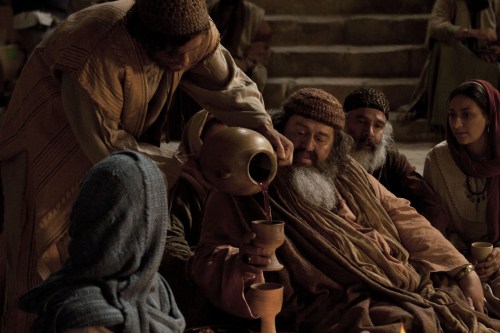
“Jesus saith unto them, Fill the waterpots with water. And they filled them up to the brim. And he saith unto them, Draw out now, and bear unto the governor of the feast. And they bare it” (John 2:7-8). One must note that Jesus said no “magic words.” He did not get up and walk over to the water pots or come anywhere near their vicinity. He made no special gestures. Once the pots were full, He merely instructed the servants to draw some out and take it to the host. Only by His thought was the water transformed into wine. For God, this is no feat. On the first day of creation, He called all things into existence only by speaking the words, “Let there be,” and it was so.

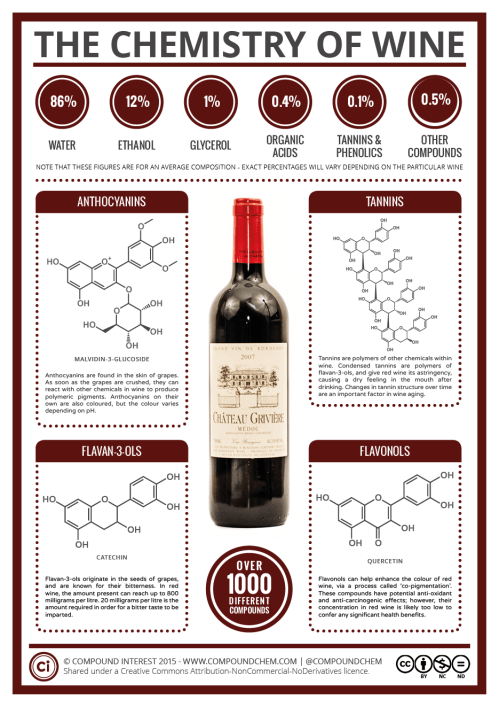
Jesus demonstrates His deity by creating something new. Water is a simple compound composed of two Hydrogen atoms and one Oxygen atom. Wine, on the other hand, contains over 1000 different compounds as demonstrated in the image below.[3] the-chemistry-of-wine-2015 Where did all those different compounds come from? They do not occur naturally in fresh water. Even if that water had a high mineral content, those minerals would not exist in the proper proportions to combine into wine. No, this was an entirely new creation by the One who created it all in the first place (John 1:3).
The skeptic cannot explain this away. He might say that after three days of celebration, the host and guests were too drunk to tell the difference. If that is so, how can he explain the host’s reaction? “… the governor of the feast called the bridegroom, And saith unto him, Every man at the beginning doth set forth good wine; and when men have well drunk, then that which is worse: but thou hast kept the good wine until now” (John 2:9-10). No, this wine was better than the “good wine” served at the beginning of the festivities. Whatever God does always exceeds what man can do.

John reports, “This beginning of miracles did Jesus in Cana of Galilee, and manifested forth his glory; and his disciples believed on him” (John 2:11).  This first of Seven Signs recorded by John exclude some of Jesus’ greatest miracles: Creation, His incarnation, His own resurrection, but perhaps the greatest of all, He creates a new life in the heart of every believer. “But as many as received him, to them gave he power to become the sons of God, even to them that believe on his name: Which were born, not of blood, nor of the will of the flesh, nor of the will of man, but of God” (John 1:12-13).

Notes:


[1]  Eli Lizorkin-Eyzenberg, The Jewish Gospel of John: Discovering Jesus, King of Israel, (Jewish Studies for Christians, Tel Aviv, Israel, 2015), 25.

[2]  Leon Morris, The Gospel According to John, Revised, (Wm. B. Eerdmans Publishing Company, Grand Rapids, MI, 1995), 158.

[3]  A common distraction arises around this miracle over the alcohol content of the wine. Was the wine simple grape juice, did it contain a low level of alcohol, or was it fully fermented with heavy alcohol content? The question is irrelevant for two reasons. First, the host – the “governor of the feast” – proclaimed that it was better than what had been served at the beginning of the feast. Second, regardless of the inclusion or exclusion of alcohol, the end product was a thousand times more complex than the initial water, and that is precisely the point that should not be overlooked.


Comments Off on Jesus’ Seven Signs in John (1)

Filed under Apologetics, Christianity, Creation, Evangelism, Gospel, Religion, Salvation, Theology

Jesus’ Seven ‘I AM’ Statements in John (7)

I am the vine, ye are the branches: He that abideth in me, and I in him, the same bringeth forth much fruit: for without me ye can do nothing.  (John 15:5)

A large sycamore tree grows in my front yard. Its large palmate leaves provide ample shade from the hot Texas sun, but that same Texas heat stresses the tree so that it drops many of its leaves in mid-summer, long before autumn when trees normally defoliate. It also drops limbs constantly making it a self-pruning tree that creates a lot of extra work for me. One thing I have noticed is that the leaves and branches that detach from the tree die. Even though they fall on fertile ground, they do not rejuvenate. Even if I “plant” them in the ground, feed, and water them, they will not take root. They remain dead. They only remain alive while attached to the tree.

Jesus had this image in mind in this seventh and final I AM statement recorded by John. He said, “I AM the vine.” When we think of a vine, we picture the entire plant: trunk or main stalk, limbs, branches, leaves, and (eventually) fruit. However, here Jesus refers to Himself as the trunk or main stalk of the plant. We do not need an advanced horticultural degree to know that the main stalk supports and provides nourishment for the entire plant. Part of the trunk is the taproot that reaches deep into the earth to draw nourishment for distribution to other parts of the plant. Jesus compares Himself to this vital part of the plant.

Next, He says, “ye are the branches.” I like the KJV use of “ye” that distinguishes the second person pronoun as plural as it appears in the Greek. Therefore, in speaking to His disciples, Jesus includes all believers. “You ALL are the branches.” He establishes a vital relationship here. The branches receive their sustenance from the trunk, i.e., “the vine.” The branches cannot live apart from the vine; detached from the vine, they die. Furthermore, the branch attached to the vine has the vine attached to it: “He that abideth in me, and I in him, the same bringeth forth much fruit” (emphasis mine). In a plant, it is easy to see a branch abiding on a vine, but a vine abiding in the branch is not so obvious. Vein-like vessels made up of xylem cells in the vine grow into the branch from the vine carrying the essential nutrients to maintain the branch alive, so in effect, the vine abides in the branches. Through this mutual attachment, the branches produce “much fruit.” I might be wrong, but only branches produced fruit, never the trunk of the plant; but without the trunk, the branches cannot live to produce fruit: “for without me ye can do nothing.”

Thus, Jesus invites us, the branches, to attach ourselves to Him, The Vine. “Abide in me, and I in you. As the branch cannot bear fruit of itself, except it abide in the vine; no more can ye, except ye abide in me” (John 15:4, emphasis mine). What kind of fruit should a branch of The Vine produce? The Apostle Paul lists several. “But the fruit of the Spirit is love, joy, peace, longsuffering, gentleness, goodness, faith, Meekness, temperance …” (Galatians 5:22-23), and add to that “righteousness and truth” (Ephesians 5:9, emphasis mine). “Against such there is no law” (Galatians 5:23). We cannot produce such fruit unless we are firmly abiding in and drawing nourishment from The Vine.

As I walk around my front yard picking up dead branches from my living sycamore tree, I gather those branches up and throw into the trash. If I lived outside of the city, I would throw them into the fire. In the same way, Jesus said, “If a man abide not in me, he is cast forth as a branch, and is withered; and men gather them, and cast them into the fire, and they are burned” (John 15:6, emphasis mine). Here Jesus refers to the final judgment where those who reject Him will be cast into hell for eternity (Revelation 20:14-15). In His sixth I AM statement, Jesus said He was The Life. By this, He meant “eternal life.” Apart from The Vine, there is no life, and Jesus said, “I AM The Vine.”

1 Comment

Filed under Apologetics, Christianity, Death, Evangelism, Gospel, Hell, Salvation, Theology

Jesus’ Seven ‘I AM’ Statements in John (6)

narrow-way

Jesus saith unto him, I am the way, the truth, and the life: no man cometh unto the Father, but by me.  (John 14:6)

Many today reject exclusivity when it comes to God and the heavenly realm. “If” God exists, and “if” heaven exists, then any “good” person, who “sincerely” believes, regardless of what they believe, should gain entrance into heaven. So, a sincere Muslim, Hindu, Buddhist, Sikh, Tao, Jew, or Christian can go to heaven as long as they are good and sincere in their belief. The only problem with that is that everyone defines “good” differently.

The idea that everyone (except for really “bad” people) goes to heaven is known as “universalism.” This popular belief attracts many because it relieves one of any obligation, responsibility or guilt.  Even the current pope, Pope Francis, publically embraces “universalism.” In his position, he can simply declare all religions under the umbrella of the Catholic Church. Bingo! Everyone goes to heaven, so now let us all just try to get along. The problem with this (besides the fact that it is unbiblical) is that it strips God of His authority and places that authority in the hands of fickle men. Furthermore, it insults God’s wisdom in determining man’s fate, and ultimately creates God in man’s image.

Today, anyone who does not buy into the Universalist “group think” gets labeled as intolerant, narrow-minded, a xenophobe, a hater, or all of the above. If Jesus walked the earth today, He would fall into this same category. No doubt that Jesus died for ALL, Indeed, the Bible clearly teaches: “For God so loved the world, that he gave his only begotten Son, that whosoever believeth in him should not perish, but have everlasting life” (John 3:16, emphasis mine). “Whosoever” includes ALL – “the world” – and excludes NONE. However, one may be tempted to overlook the “qualifier” – belief in Him, i.e., Jesus, the One who was “lifted up” (John 3:14) for the sins of “the world.” “Belief” is the prerequisite. “He that believeth on him is not condemned: but he that believeth not is condemned already, because he hath not believed in the name of the only begotten Son of God” (John 3:18, emphasis mine). The Pope can pontificate all he wants, but he cannot abrogate the Word of God.

In His sixth I AM statement, Jesus said, “I AM the way, the truth, and the life: no man cometh unto the Father, but by me” (John 14:6, emphasis mine). As the Creator God, the I AM of Creation, Jesus emphatically imposes extreme exclusivity for access to the Father. No one comes to the Father except through The Door that is the Lord Jesus Christ. No other options are provided. That makes Jesus’ claim anathema to Universalists.

Note that Jesus makes this I AM statement threefold. First, Jesus is The Way. The “way” may be thought of as a “method” to achieve a goal or destination. The “way” is a “road” – the conduit from one place to another; it is the conveyance from one place to another. Jesus is that way that leads to the Father. Jesus urged, “Enter ye in at the strait gate: for wide is the gate, and broad is the way, that leadeth to destruction, and many there be which go in thereat: Because strait is the gate, and narrow is the way, which leadeth unto life, and few there be that find it” (Matthew 7:13-14, emphasis mine). Quite clearly, Jesus narrows “the way” to the few that find it. On the “broad way” that “leadeth to destruction” can be found many Universalists proclaiming to know “The Way,” but Jesus says, “Not every one that saith unto me, Lord, Lord, shall enter into the kingdom of heaven; but he that doeth the will of my Father which is in heaven” (Matthew 7:21, emphasis mine). The Way is exclusive!

Second, Jesus is The Truth. He is not “relative truth;” He is unequivocal truth. Not only that, but the definite article assures us that He is the “only” truth. At His trial, “Pilate therefore said unto him, Art thou a king then? Jesus answered, Thou sayest that I am a king. To this end was I born, and for this cause came I into the world, that I should bear witness unto the truth. Every one that is of the truth heareth my voice” (John 18:37, emphasis mine). Pilate, perhaps waxing philosophical, retorted, “What is truth?” (John 18:37), when The Truth was standing before him. The incarnate I AM, the eternal Word of God (John 1:1), cannot lie (Titus 1:2). All truth abides in Him, and outside of Him, there is no truth. Apart from The Truth, God is unknowable.

Third, Jesus is The Life. As Creator, I AM authors life. “All things were made by him; and without him was not any thing made that was made. In him was life; and the life was the light of men” (John 1:3-4, emphasis mine). The Life offers more than bios, i.e. biological functionality. The Life gives zōē, the essence of life eternal. In the Garden of Eden, when “the LORD God formed man of the dust of the ground” He “breathed into his nostrils the breath of life; and man became a living soul” (Genesis 2:7, emphasis mine). On final inspection of His creation, God looked upon His finished work “and, behold, it was very good” (Genesis 1:31). Death had no part in God’s “very good” creation. Man was created to live eternally until he broke God’s one and only commandment (Genesis 2:17). At that point death entered into the world (Romans 5:12), and man began to die (Genesis 3:19). Death opposes The Life. It has no place in the presence of The Life, subsequently death cannot enter into the presence of the Father. Only The Life can reverse the curse of death. Jesus is The Life.

I AM The Way, The Truth and The Life.” There is no other access into the presence of the Father and eternal life except through the Lord Jesus Christ. Universalists may not like that idea, but they do not get to make the rules. Only the Creator owns the right to make the rules. In the Garden of Eden, there was only one tree from which man could not eat. Now, after Eden, there is only one way to eternal life. Jesus is the only way. It is up to you to choose wisely.


2 Comments

Filed under Apologetics, Christianity, Creation, Evangelism, Gospel, Heaven, Salvation

Jesus’ Seven ‘I AM’ Statements in John (5)

resurrection-and-life

Jesus said unto her, I am the resurrection, and the life… (John 11:25)

“And it came to pass, when the time was come that he should be received up, he stedfastly set his face to go to Jerusalem” (Luke 9:51). Jesus knew that the culmination of His earthly mission had arrived, and He was determined to see it through to the end. His journey up to Jerusalem took Him by way of Jericho where He healed the blind man, Bartimaeus (Luke 18:35-43), and “saved” the publican (tax collector), Zacchaeus (Luke 19:1-10).

While there, possibly in Zaccheaus’ home, Jesus received word that His good friend, Lazarus, had fallen deathly ill. “Therefore his sisters sent unto him, saying, Lord, behold, he whom thou lovest is sick” (John 11:3). Bethany (John 11:1), where Lazarus and his sisters, Mary and Martha, lived, was just up the road from Jericho about a day’s walk. Answering the call would not have distracted Jesus from His determination to face the cross. Bethany was on the way up to Jerusalem, but “When he had heard therefore that he was sick, he abode two days still in the same place where he was” (John 11:6, emphasis mine). That seems like a strange reaction for the compassionate Jesus to take with regard to a “friend.”

“When Jesus heard that, he said, This sickness is not unto death, but for the glory of God, that the Son of God might be glorified thereby” (John 11:4). In reality, Lazarus probably died shortly after the delegation departed Bethany. It took them a day to arrive in Jericho. Jesus remained another two days before making trip up to Bethany, plus the day to travel there – four days. When Jesus arrived in Bethany, He was informed that Lazarus had been dead four days (John 11:39). Did Jesus err in His assessment that “This sickness is not unto death”? No, Jesus, in His omniscience, knew the situation perfectly. The delay would glorify the Son and bring glory to God. John points out that “Jesus loved Martha, and her sister [Mary], and Lazarus” (John 11:5), yet He delayed His departure.

When the day came to depart, Jesus’ disciples, vaguely knowing what awaited Him, tried to dissuade Him from going up to Jerusalem. “His disciples say unto him, Master, the Jews of late sought to stone thee; and goest thou thither again?” (John 11:8), but Jesus knew what He was doing. “Our friend Lazarus sleepeth; but I go, that I may awake him out of sleep” (John 11:11). The disciples took this as a good sign. “Then said Jesus unto them plainly, Lazarus is dead” (John 11:14).

As He approached Bethany, Martha rushed out to meet Him. “Then said Martha unto Jesus, Lord, if thou hadst been here, my brother had not died” (John 11:21, emphasis mine). How many times have similar sentiments been expressed at the death of a loved one? When the Twin Towers fell on September 11, 2001, many demanded to know, “Where was God?” He was where He has always been – on His throne and in command. Even so, Martha expressed remarkable faith. “But I know, that even now, whatsoever thou wilt ask of God, God will give it thee.” (John 11:22, emphasis mine). What could she have been thinking? Did she indeed believe that Jesus could raise her brother from the dead? This would not be something new. Jesus had raised the dead before: a widow’s only son (Luke 7:12-14), Jairus’s daughter (Matthew 9:18-26; Mark 5:22-43; Luke 8:41-56),  and unnamed others. Nevertheless, this was different. Lazarus had been dead four days “when it was believed that resurrection was no longer possible.”[1]

“Jesus saith unto her, Thy brother shall rise again. Martha saith unto him, I know that he shall rise again in the resurrection at the last day” (John 11:23-24). Sure Lazarus would rise again, but not today. After all, he had been dead four days; his spirit had long departed. The resurrections Jesus had performed before where shortly after the victim had died. Common thought was that the person’s spirit lingered around a few days before finally departing. Raising the dead shortly after death was consistent with their tradition, but after three days, the spirit departed, and Lazarus had been dead four days. Sure he’ll rise again – at the resurrection!

I AM the resurrection, and the life” (John 11:25, emphasis mine). Ego Eimi. I, I AM. As explained in recent “I Am” articles,[2] this phrase expresses the deity of Christ. Jesus was saying, “I, Yahweh, am the resurrection and the life.” The Greek word translated “resurrection” is anastasis and it means to “stand up again,” and “life” is the Greek word zōē meaning the very essence of life – that animating energy or force that goes beyond biological function. It is that “breath of life” given to man by God at the moment of creation (Genesis 2:7). That Jesus incorporated both “resurrection” and “life” recalls Ezekiel’s vision of the valley of dry bones (Ezekiel 37). He preached to the dry bones and they came together. Flesh and skin formed upon their frame, but they did not stand until the breath of life came upon them, and they stood up.

Jesus, the Creator (John 1:1-3) not only has the power to create biological life, but He gives the very essence of life. All of it comes from the Great I AM. Because He is “the resurrection and the life,” “he that believeth in me, though he were dead, yet shall he live: And whosoever liveth and believeth in me shall never die. Believest thou this?” (John 11:26, emphasis mine). “Never die?” Jesus here referred to eternal life. We all will die physically as a result of the curse (Genesis 3:19; 1 Corinthians 15:22); however our “life” will continue in one of two destinations, either with God or apart from God. “And death and hell were cast into the lake of fire. This is the second death” (Revelation 20:14, emphasis mine). There are two deaths: one we all experience as physical death; the other death is eternal life in hell, apart from God. Those who believe in the Great I AM, will never experience that second death, i.e. “never die.” “But the fearful, and unbelieving, and the abominable, and murderers, and whoremongers, and sorcerers, and idolaters, and all liars, shall have their part in the lake which burneth with fire and brimstone: which is the second death” (Revelation 21:8, emphasis mine).

Jesus is “the resurrection and the life.” “In him was life; and the life was the light of men …  He was in the world, and the world was made by him, and the world knew him not … But as many as received him, to them gave he power to become the sons of God, even to them that believe on his name” (John 1:4, 10, 12, emphasis mine), and they shall never die.

Notes:


[1]  Eli Lizorkin-Eyzenberg, The Jewish Gospel of John: Discovering Jesus, King of All Israel, (Tel Aviv, Israel, Jewish Studies for Christians, 2015), 190.

[2]  See esp. the 3rd paragraph of https://erniecarrasco.com/2016/08/28/jesus-seven-i-am-statements-in-john-1/

Comments Off on Jesus’ Seven ‘I AM’ Statements in John (5)

Filed under Apologetics, Bible, Christianity, Evangelism, Gospel, Hell, Religion, Resurrection, Salvation

Jesus’ Seven ‘I AM’ Statements in John (4)

psalm23

I am the good shepherd: the good shepherd giveth his life for the sheep. (John 10:11)

In the last “I AM” statement, Jesus said He was “the door” – the only way into the sheepfold. We also learned that a porter guarded the door by physically placing himself across the entrance (John 10:3). In essence, the porter became “the door.” In the absence of a porter, the shepherd himself would perform this task making himself the door (John 10:9).

Now Jesus identifies Himself as the “Good Shepherd.” Previously, Jesus pointed out some general characteristics of a shepherd. The shepherd has rightful access to the sheep (John 10:2) because they belong to him. The shepherd knows each of his sheep by name, and the sheep know the voice of the shepherd, and they follow him as he leads them (John 10:3-4).

As the Good Shepherd, Jesus is also the Door of the sheepfold. The word picture presented here provides greater insight into His task as the Good Shepherd. As a shepherd cares for his sheep, he defends them with his very life. Any predator seeking to harm the sheep will do so only over the shepherd’s dead body. Jesus’ hearers may have recalled the account of King David:

And David said unto Saul, Thy servant kept his father’s sheep, and there came a lion, and a bear, and took a lamb out of the flock: And I went out after him, and smote him, and delivered it out of his mouth: and when he arose against me, I caught him by his beard, and smote him, and slew him. Thy servant slew both the lion and the bear: and this uncircumcised Philistine shall be as one of them, seeing he hath defied the armies of the living God. (1 Samuel 17:34-36)

Likewise, Jesus says, “the good shepherd giveth his life for the sheep” (John 10:11).

On the contrary, a hired hand has nothing invested in the sheep. When danger arises, he runs for his life caring nothing for the sheep (John 10:12-13). The Good Shepherd defends the sheep with His life because He cares for His sheep, knowing each one by name (John 10:14). As in verse 3, this assertion emphasizes the relationship between the Good Shepherd and His sheep. Indeed, it is likened to the relationship between the Father and the Son. “As the Father knoweth me, even so know I the Father: and I lay down my life for the sheep” (John 10:15).

By now the reader should recognize that “sheep” are analogous to God’s people. “For thus saith the Lord GOD; Behold, I, even I, will both search my sheep, and seek them out. As a shepherd seeketh out his flock in the day that he is among his sheep that are scattered; so will I seek out my sheep, and will deliver them out of all places where they have been scattered in the cloudy and dark day” (Ezekiel 34:11-12, emphasis mine). On another occasion, Jesus said:

What man of you, having an hundred sheep, if he lose one of them, doth not leave the ninety and nine in the wilderness, and go after that which is lost, until he find it? And when he hath found it, he layeth it on his shoulders, rejoicing. And when he cometh home, he calleth together his friends and neighbours, saying unto them, Rejoice with me; for I have found my sheep which was lost. I say unto you, that likewise joy shall be in heaven over one sinner that repenteth, more than over ninety and nine just persons, which need no repentance. (Luke 15:4-7, emphasis mine)

The Good Shepherd gives up His life for His sheep.

Jesus addressed a Jewish audience who readily identified themselves with the Good Shepherd’s sheep, but then Jesus added another twist. “And other sheep I have, which are not of this fold: them also I must bring, and they shall hear my voice; and there shall be one fold, and one shepherd” (John 10:16, emphasis mine). This must have confused Jesus’ hearers, but in retrospect, we understand that Jesus referred to the Gentile Christians that would be included later, after His resurrection and ascension. “They” would hear His voice through the work of the Holy Spirit and the preaching of the Apostles (John 15:26; 17:20-21).

For all of these the Good Shepherd gave up His life. All those within His fold can confidently say:

The LORD is my shepherd; I shall not want.

He maketh me to lie down in green pastures: he leadeth me beside the still waters.

He restoreth my soul: he leadeth me in the paths of righteousness for his name’s sake.

Yea, though I walk through the valley of the shadow of death, I will fear no evil: for thou art with me; thy rod and thy staff they comfort me.

Thou preparest a table before me in the presence of mine enemies: thou anointest my head with oil; my cup runneth over.

Surely goodness and mercy shall follow me all the days of my life: and I will dwell in the house of the LORD for ever. (Psalm 23:1-6)

There is security in the Good Shepherd’s fold.

My sheep hear my voice, and I know them, and they follow me: And I give unto them eternal life; and they shall never perish, neither shall any man pluck them out of my hand. My Father, which gave them me, is greater than all; and no man is able to pluck them out of my Father’s hand. (John 10:27-29, emphasis mine)

Then, just in case the “I AM” statement was not clear enough, Jesus said, “I and my Father are one” (John 10:30). Jesus declared Himself equal to God. Indeed, He is God (John 1:1) To the Pharisees (and to many modern ears) such a claim was blasphemous. “Then the Jews took up stones again to stone him” (John 10:31). “This parable spake Jesus unto them: but they understood not what things they were which he spake unto them” (John 10:6). Not included in the Good Shepherd’s fold, they remained in their blindness (John 9:39-41), and failed to recognized that they were in the presence of the Great I AM, the Good Shepherd.

If you want entrance into the fold, you need to get to know the Good Shepherd.

Comments Off on Jesus’ Seven ‘I AM’ Statements in John (4)

Filed under Apologetics, Christianity, Evangelism, Gospel, Religion, Salvation, Theology