Tag Archives: theology

Is Salem Jerusalem?

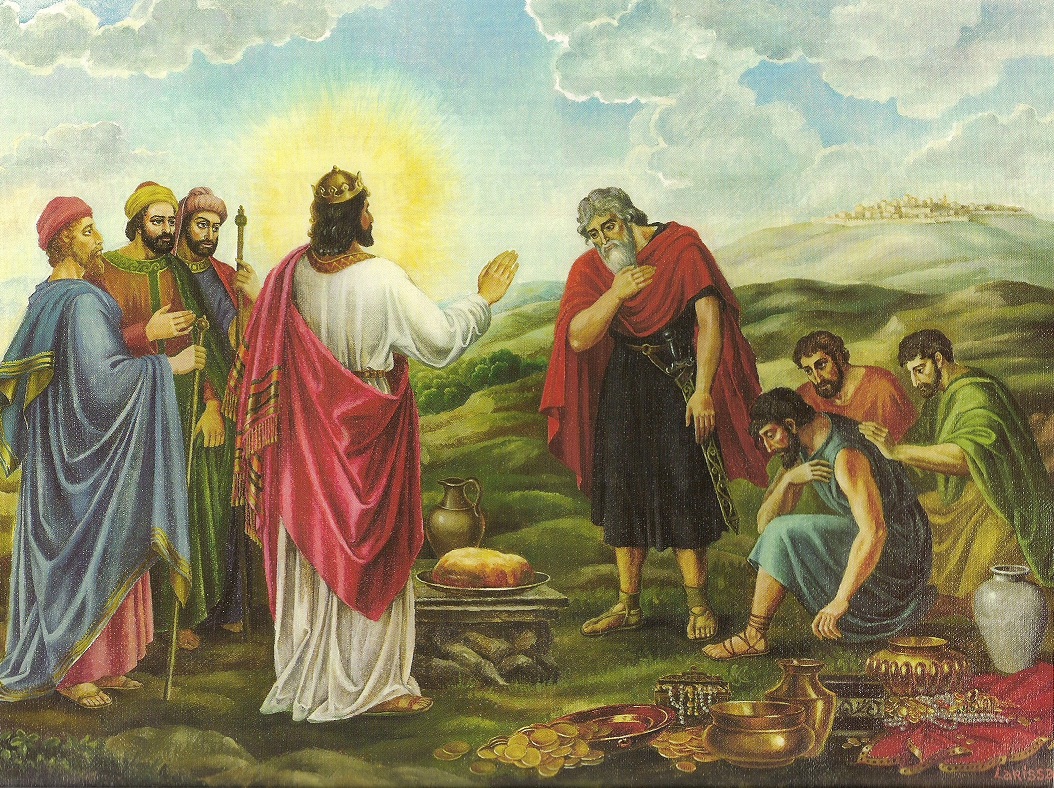
Melchizedek_Abraham

And Melchizedek king of Salem brought forth bread and wine: and he was the priest of the most high God. (Genesis 14:18)

Melchizedek is one of the most mysterious characters recorded in the Bible. He makes his debut in Genesis 14, and the totality of information provided about him is encapsulated within three brief verses (Genesis 14:18-20). It is interesting that the “Book of Beginnings,” which meticulously records all the “begets” of who’s who of important personages of early history, completely ignores the lineage of this apparently most significant person. The New Testament letter to the Hebrews does no better at identifying the parentage of this mysterious figure. Of Melchizedek, the writer of the book of Hebrew writes: “Without father, without mother, without descent, having neither beginning of days, nor end of life; but made like unto the Son of God; abideth a priest continually” (Hebrews 7:3, emphasis mine).

Some believe that Melchizedek was a real person, king of the city-state of Salem. However, Salem is only associated with Melchizedek in the Bible.[1],[2] Nowhere is it listed with the other cities in Canaan, and it is given no significance other than its association with Melchizedek. Some have suggested that Salem was the former name of Jerusalem. They attribute this to clay tablets found at the Tell el Amarna site, dated at 1400 B.C., identifying Urusalim as an early name for Jerusalem. They conclude that “Salem” is just an abbreviated form of Urusalim, and is therefore the same as Jerusalem.

I see several problems with that conclusion. First of all, the date of the Tell el Amarna tablets is about 800 years after Abraham’s encounter with Melchizedek. Israel’s entry into Canaan and the period of the Judges occurred around 1400 B.C. At that time, Jerusalem was known by that name (Jerusalem) and also by the name of Jebus.[3] The Bible identifies Jebus as the city of the Jebusites, and the Jebusites dwelt in the land at the time of Abraham (Genesis 15:18-21). It seems unlikely that the Holy Spirit would refer to the city of Melchizedek as Salem, if He was referring to Jebus (or Jerusalem), and if in fact, Jerusalem existed at that time.

Another problem arises when God commands Abraham to sacrifice Isaac (Genesis 22). God instructed Abraham, “And he said, Take now thy son, thine only son Isaac, whom thou lovest, and get thee into the land of Moriah; and offer him there for a burnt offering upon one of the mountains which I will tell thee of” (Genesis 22:2, emphasis mine). It is widely accepted by Jews, Christians and Muslims, that the place where Abraham offered up his son (Muslims say it was Ishmael) was on Mount Moriah, the place currently occupied by the Dome of the Rock in Jerusalem. If Salem were the same place as Jerusalem, why then did God not clearly say, “Go up to Salem and sacrifice Isaac there”? A close inspection of the text gives the impression that the place to where Abraham was directed was uninhabited.  Note that God directs Abraham to “one of the mountains which I will tell thee.” This was a private matter among God, Abraham and Isaac. It seems unlikely that God would direct Abraham to a population center.

Is Salem Jerusalem? I think not. Jebus, a.k.a. Jerusalem, probably did not exist during Abraham’s lifetime. This would be consistent with the dates of the archaeological finds. So, if Salem is not Jerusalem, then what happened to Melchizedek’s city-state? The validity of the question relies on whether Melchizedek was a flesh-and-blood human being, and whether Salem was a physical place.

I contend that Melchizedek was a Theophany – a preincarnate manifestation of the Lord Jesus Christ. I arrive at this conclusion from the description provided in Genesis 14:18-20 and Hebrews 7:1-4.  As noted earlier, he is described as having no parentage, no beginning, and no end. Only God claims those qualifications. Furthermore, the book of Hebrews notes that he blesses Abraham, and the greater always blesses the lesser. Finally, Abraham offers a tithe (a tenth) of the spoils to Melchizedek. Everywhere else in Scripture, tithes are always associated with service to God, never to men.

His name is more of a title. Melchizedek is a combination of two Hebrew words: melek (king) and tsedeq (righteousness). Combined they render “King of Righteousness” or “Righteous King.” And he is the King of Shalem (peace). His full title could then be rendered as “Righteous King of Peace.” Who does that sound like?

Salem is not Jerusalem. Salem is not a physical place. And Melchizedek is none other than the Lord Jesus Christ, our King of Peace.

Notes:


[1]  See: Genesis 14:18; Hebrews 7:1-2

[2]  Psalm 76:2 associates Salem with Zion – the dwelling place of God.

[3]  See: Judges 19:10-11; 1 Chronicles 11:4-5

2 Comments

Filed under Apologetics, Bible, Religion, Theology

Living Sacrifices

Living Sacrifice

I beseech you therefore, brethren, by the mercies of God, that ye present your bodies a living sacrifice, holy, acceptable unto God, which is your reasonable service.  (Romans 12:1)

Someone said that, “The problem with living sacrifices is that they keep crawling off the altar.” The image of a sacrifice recurs numerous times throughout the pages of the Bible, and in every instance, save for maybe one, the victim dies. The first sacrifice was offered by our Lord to cover the nakedness of Adam and Eve (Genesis 3:21). The pre-incarnate Christ[1] had to slay innocent animals (most likely sheep) in order to atone (cover) for the sin of the first couple. After this, the practice was repeated as is seen by the examples of Abel’s sacrifice (Genesis 4:4) and Noah’s sacrifice following the Flood (Genesis 8:20-21). More than a thousand years later God codified the practice through the Mosaic Law. Jesus offered the ultimate sacrifice with His death on the cross. That event ended the death requirement for the sacrifice.

The one instance where the victim was spared was in the case of Abraham sacrificing Isaac (Genesis 22). In his heart, Abraham sacrificed Isaac in obedience to God. “By faith Abraham, when he was tried, offered up Isaac … Accounting that God was able to raise him up, even from the dead; from whence also he received him in a figure” (Hebrews 11:17, 19). Even though Isaac was spared, a substitute took his place (Genesis 22:11-13); someone or thing had to die. However, “it is not possible that the blood of bulls and of goats should take away sins” (Hebrews 10:4). At last, the blood of Jesus offered the final solution to sin so that neither death, nor the shedding of blood remains as the debt requirement for sin. As the old hymn says, “Jesus paid it all; all to Him I owe.” Even so, sacrifice, for the believer, still remains.

The English word “sacrifice” translates various Hebrew and Greek words each with differing shades of meaning. The first occurrence of the English word “sacrifice” is found in Genesis 31:54 where it translates the Hebrew word zebach meaning slaughter. In Exodus 23:18 it translates the Hebrew word chag meaning festival or victim. In 1 Kings 18:29 it translates the Hebrew word minchah meaning offering or present. As used in our beginning verse, the Greek word is thusia which is the same as the Hebrew zebach meaning slaughter.

Paul calls us (brethren) to present our physical bodies as “living sacrifices” – slaughtered lives. That seems oxymoronic. How can a slaughtered person live? To the Galatians Paul writes, “I am crucified with Christ: nevertheless I live” (Galatians 2:20). Again, how can one crucified live? Obviously Paul cannot be referring to physical death. Elsewhere he explains: “that he [Jesus] died for all, that they which live should not henceforth live unto themselves, but unto him which died for them, and rose again” (2 Corinthians 5:15). Hence we die to “self.” “For if ye live after the flesh [i.e. “self”], ye shall die: but if ye through the Spirit do mortify the deeds of the body, ye shall live” (Romans 8:13). The Greek word translated “mortify” is thanatoō meaning “to kill,” or, in keeping with our theme, “sacrifice.” Note also that the means by which this is accomplished is “through the Spirit.” That source of power comes about by only one way. “Therefore if any man be in Christ, he is a new creature: old things are passed away; behold, all things are become new” (2 Corinthians 5:17). This newness is that of which Jesus spoke when He said, “Marvel not that I said unto thee, Ye must be born again” (John 3:7).

Through the rebirth and by the power of the Spirit, the Christian can put to death the old self and present his body as a living sacrifice that is “holy.” That does not mean sinless or perfect. “Holy” means to be set apart, consecrated, or dedicated to God. Holiness is an attribute of God that sets Him apart and above all of His creation. This is why God cannot abide sin and why He must judge and ultimately punish sin. Although we cannot obtain holiness that approaches the holiness of God, yet God demands holiness from His children. “But as he which hath called you is holy, so be ye holy in all manner of conversation; Because it is written, Be ye holy; for I am holy” (1 Peter 1:15-16). Lamentably, Christians these days fail to understand the meaning of holiness. Many think that just because God’s invitation is “Just As I Am” that nothing needs to change. Perhaps they “walked the aisle” to the words of that old hymn, shook the pastor’s hand, and got dunked in the baptistery at some point in their life, and they presume they are okay. They continue living “just as I am.” But God demands holiness.

How does one achieve holiness? In the following verse Paul says, “And be not conformed to this world: but be ye transformed by the renewing of your mind” (Romans 12:2). In other words, do not allow the world to shape you into its mold. Someone once asked, “If you were accused of being a Christian, would there be enough evidence to convict you?” Sadly when one looks at Christians they are indistinguishable from non-Christians. They dress the same as non-Christians. They talk the same as non-Christians. They indulge themselves as non-Christians. There are absolutely no distinguishing characteristics. God says, “do not be conformed to this world.” Rather we should be “transformed.” Here again is the idea of being “born again.” The Greek word translated “transformed” is metamorphoō from which we get our English word metamorphosis. “Metamorphosis to the adult stage is nothing less than a biological miracle. Complex molecules called enzymes are released, that literally digest the caterpillar while it is ensconced in the chrysalis, converting it into a rich soup of disjointed tissues and cells—which after four days becomes an adult butterfly.”[2] In a manner of speaking, the caterpillar dies, and its liquefied self is “transformed” into a beautiful butterfly. In similar manner, when the person is born again, there is a spiritual transformation that takes place so that the old self is sacrificed and the “new creation” is set apart, dedicated as an acceptable offering to God. That acceptable offering is “your reasonable [logical] service” to God. The Greek word translated “service” is latreia meaning ministration or worship of God. This suggests that all of your life should be conducted as an act of worship to God. It has nothing to do with going to church on Sunday and lifting your hands while you sway to the “worship music.” Your acceptable worship to God is your life – all of it.

Here is where the “living sacrifices” crawl off of the altar. Too many Christians think of worship as what they do on Sunday mornings. Then on Monday, it’s back to conforming to the world. In order for the metamorphosis to become at least semi-permanent, there must be a “renewing of the mind.” That can only take place when the Christian spends time in daily prayer and Bible reading. Instead of reading worldly books, read books by excellent Bible teachers that will build you up. Instead of wasting a lot of time watching worthless, or, worse, harmful television programs, watch and listen to great Bible teachers on TV, DVD or the internet. In other words, fill your mind with the things of God. That will give you a godly perspective on life and the world, and it will change the way that you think. When your thinking changes, the way that you conduct your life will change also. When that happens, you will be set apart – holy – a living sacrifice, acceptable to God.

Notes:


[1] See: https://erniecarrasco.com/2014/02/16/the-first-sacrifice/

[2] Frank Sherwin, “Butterflies vs. Macroevolution” http://www.icr.org/article/butterflies-vs-macroevolution/

2 Comments

Filed under Christianity, Religion, Theology, Worship

Mad At God

Mad at God

And Asa did that which was good and right in the eyes of the LORD his God (2 Chronicles 14:2)

Have you ever been mad at God or do you know someone who is, or has at some time been mad at God? People get mad at God for various reasons, all of which are unjustified, but more on that later. Some are angry at God, and therefore doubt His existence, because they see evil in the world, and they hold God responsible for allowing it to go on. They reason that either God does not exist, or if He does exist, He is either indifferent to evil or impotent to do anything about it. Others are angry with God because at some point God did not answer a specific request in the specific way they requested. Some are mad at God because after years of faithful service God disciplines them for some sin they commit.

That was the case with Asa, the fourth king of Judah since David. David was not perfect, but he had a heart that sought after God.[1] Solomon started out strong seeking wisdom from God rather than riches,[2] but in the end his weakness for women sucked him into paganism and idolatry.[3] Rehoboam listened to his friends rather than the advice of the old men, and his lack of wisdom divided the kingdom.[4] “And he did evil, because he prepared not his heart to seek the LORD” (2 Chronicles 12:14). What was that evil?

And Judah did evil in the sight of the LORD, and they provoked him to jealousy with their sins which they had committed, above all that their fathers had done. For they also built them high places, and images, and groves, on every high hill, and under every green tree. And there were also sodomites in the land: and they did according to all the abominations of the nations which the LORD cast out before the children of Israel. (1 Kings 14:22-24)

Abijah, Asa’s father, only ruled for three years. Even though God had given him victory over Israel (the northern kingdom),[5] Abijah followed in the godless steps of his father. “And he walked in all the sins of his father, which he had done before him: and his heart was not perfect with the LORD his God, as the heart of David his father” (1 Kings 15:3).

Asa followed the example of his great-grandfather, David, rather than in the steps of his father and grandfather. He “did that which was right in the eyes of the LORD, as did David his father” (1 Kings 15:11). Consider some of Asa’s accomplishments:

  • He took away the sodomites out of the land, and removed all the idols that his fathers had made (1 Kings 15:12; 2 Chronicles 14:3)
  • And also Maachah his mother, even her he removed from being queen, because she had made an idol in a grove; and Asa destroyed her idol, and burnt it by the brook Kidron. (1 Kings 15:13; 2 Chronicles 15:16)
  • And commanded Judah to seek the LORD God of their fathers, and to do the law and the commandment. (2 Chronicles 14:4)
  • And they entered into a covenant to seek the LORD God of their fathers with all their heart and with all their soul; That whosoever would not seek the LORD God of Israel should be put to death, whether small or great, whether man or woman. (2 Chronicles 15:12-13)
  • But the high places were not taken away out of Israel: nevertheless the heart of Asa was perfect all his days. (2 Chronicles 15:17, emphasis mine)

One might think that Asa was a pretty good king. In fact, the Bible records that He “did that which was right in the eyes of the LORD.” Asa probably felt pretty sure of his standing before God, and there he failed. “When pride cometh, then cometh shame” (Proverbs 11:2). “Pride goeth before destruction, and an haughty spirit before a fall (Proverbs 16:18).

Syria had been menacing Israel up north and Asa, wishing to stave off any trouble took it upon himself to take some of the Temple treasure and give it to Benhadad, king of Syria, to buy him off.[6]  It was not so much the misuse of the Temple treasure that angered God, but the fact that Asa failed to consult God first. “Because thou hast relied on the king of Syria, and not relied on the LORD thy God, therefore is the host of the king of Syria escaped out of thine hand.” (2 Chronicles 16:7, emphasis mine). God reminded him, “Were not the Ethiopians and the Lubims a huge host, with very many chariots and horsemen? yet, because thou didst rely on the LORD, he delivered them into thine hand” (2 Chronicles 16:8, emphasis mine). Then God gives Asa a lesson in Theology 101: “For the eyes of the LORD run to and fro throughout the whole earth, to shew himself strong in the behalf of them whose heart is perfect toward him” (2 Chronicles 16:9). The consequence of that lesson was this: “Herein thou hast done foolishly: therefore from henceforth thou shalt have wars.”

“Then Asa was wroth with the seer, and put him in a prison house; for he was in a rage with him because of this thing. And Asa oppressed some of the people the same time” (2 Chronicles 16:9). Asa was angry at God and rather than accept responsibility for his actions, he took his anger out on the messenger and anyone else who might be around. But God did not abandon Asa. He afflicted him with a disease of the feet that “was exceeding great” (2 Chronicles 16:13). The disease was likely intended to bring Asa to his knees in repentance, but instead “he sought not to the LORD, but to the physicians.”

So died Asa – a good king even in the sight of the Lord, but his pride and lack of repentance in the end destroyed the fellowship he had with the God he loved and the God that loved him.

It is understandable to get mad at God sometimes. It’s okay. He has big shoulders, and He can take it. He understands our heart. But God is God, and we very rarely understand what He is doing in our lives. We need to understand and accept that everything that He does is right. He is never wrong, and He is never unjust. We, as His children, need to trust that He is working everything for good in our lives (Romans 8:28). So, the next time you find yourself mad at God, talk to Him about it, and even if He doesn’t give you the answer you want to hear, keep in mind that He is God, and you are not.

NOTES:


[1] See: 1 Samuel 13:14; Acts 13:22

[2] See: 2 Chronicles 1:11; 2 Kings 4:29-30

[3] See: 1 Kings 11:3-11

[4] See: 2 Kings 12:1-19

[5] See: 2 Chronicles 13:3-20; 2 Kings 15:4-5

[6]  See: 2 Chronicles 16:1-6; 1 Kings 15:16-22

Comments Off on Mad At God

Filed under Bible, Christianity, Religion, Theology

Cain’s Wife

Cain and Abel, ivory panel from the cathedral of Salerno, ca. 1084. Image source: https://commons.wikimedia.org/wiki/File:Ivory_Cain_Abel_Louvre_AO4052.jpg

Cain and Abel, ivory panel from the cathedral of Salerno, ca. 1084. Image source: https://commons.wikimedia.org/wiki/File:Ivory_Cain_Abel_Louvre_AO4052.jpg

And Cain went out from the presence of the LORD, and dwelt in the land of Nod, on the east of Eden. And Cain knew his wife; and she conceived, and bare Enoch … (Genesis 4:16-17)

The question of Cain’s wife comes up often with both serious students of the Bible and skeptics. The low hanging fruit tempts the skeptic to ridicule the Bible for the omission of important details. After all, the Bible only speaks of Cain and Abel; no others siblings are mentioned. If the skeptic adheres to evolutionary/atheistic thinking, he may use this to support his perspective by claiming there were many hominids around before the mythical first couple came around. Cain must have gotten his wife from one of the many available to him.

The Bible student may find himself without a defense because the skeptic is clearly correct – there are no other people mentioned at this point. Genesis 4 records the first family, which includes Adam, Eve, Cain and Abel; no others are mentioned. So where did Cain get his wife? Is the skeptic correct?

This can pose a serious problem even to a seminary trained “professional” because there seems to be no clear-cut answer. But here I want to direct my attention directly to those who claim to believe in the infallibility and inerrancy of Scripture. If you are reading this now, and have doubts about the veracity of the Bible, you are welcome to check it out now.

If we believe that the Bible is the inspired Word of God, that it is without error and it is true in every respect – infallible, than we must accept it for what it says – period. Starting from the beginning, God created one man and one woman (Genesis 1:26-27; Genesis 2:7, 21-22). That was all; no other “hominid kind” were created. “And God blessed them, and God said unto them, Be fruitful, and multiply” (Genesis 1:28). In Genesis 4:1 Cain is born and in the next verse we are introduced to Abel. “And in process of time it came to pass” (Genesis 4:3) that a long period of time transpires and the boys are fully grown. The Bible gives no indication as to how much time elapsed between the first and second sentence of verse 2. Seth, the son to replace the murdered Abel, is born 130 years from Adam’s creation (Genesis 5:3), which means Cain and Abel could have been anywhere from around 30 to 129 years old. That said, “the days of Adam after he had begotten Seth were eight hundred years: and he begat sons and daughters” (Genesis 5:4, emphasis mine). It seems unlikely that in that span of time between the birth of Abel and the birth of Seth, Adam and Eve abstained from procreative activity. It is quite likely that they had a plethora of boys and girls – one every two to three years is not unreasonable.

At this point, the serious student of the Bible must conclude that Cain’s wife was one of his sisters. Did I hear a collective “Yuck!” out there? Suddenly someone recalls the biblical prohibition against marrying a close relative (Leviticus 18:6-20), so Cain cannot take a sister for his wife because that is prohibited by God’s Law. Here, science can aid our understanding of Scripture.

Let us first examine the time frame between creation and the time the Law was given to Moses. From Creation to the Flood was about 1656 years (Genesis 5). From the Flood to birth of Abraham was another 290 years (Genesis 11)[1]. From the birth of Abraham (Abram) until Israel went into Egypt was another 218, and Israel was in Egypt 430 before the Exodus and then another 40 years of wandering in the wilderness. So, from Creation to the Law was between 2594 years and 2604 years. This means that marrying within the family was not legally prohibited and Cain could indeed marry his sister. Remember that Abraham, Isaac and Jacob all three married close relatives.

Now, for Cain to marry his sister presented no biological problem either, because Adam and Eve were created perfectly – their DNA was perfect. Harmful mutations had not corrupted their DNA, so close family marriages did not present a problem.[2] It took about 2600 years before the genetic load became significant enough for God to intervene by giving the prohibition not to marry a close relative.

Where did Cain get his wife? From his parents; he married his sister. This posed no problem biblically or biologically.

Notes:


[1] James J.S. Johnson, “How Young Is the Earth? Applying Simple Math to Data Provided in Genesis,” http://www.icr.org/article/how-young-earth-applying-simple-math-data-provided/, accessed July 17, 2015.

[2] Ken Ham, “Cain’s Wife: It Really Does Matter!” http://www.icr.org/article/cains-wife-it-really-does-matter, accessed July 17, 2015.

1 Comment

Filed under Apologetics, Bible, Evolution, Origins, Poetry, Religion, Science, Theology

Too Late

And like unto him was there no king before him, that turned to the LORD with all his heart … Notwithstanding the LORD turned not from the fierceness of his great wrath, wherewith his anger was kindled against Judah …  (2 Kings 23:25-26)

I hear many well-intentioned Christians exhorting us to pray for our nation and for our leaders. The call seems to have increased in intensity since the recent foolish ruling by the United States Supreme Court declaring same-sex marriage a constitutional right. Such a ruling places this nation in the death throes of social order described in Romans 1:32 “Who knowing the judgment of God, that they which commit such things are worthy of death, not only do the same, but have pleasure in them that do them.” At this juncture our nation finds itself near the bottom of the sucking vortex that will end its days, and no plea to God for restoration will be heeded. Such was the case for the nation of Judah in her final days.

King Josiah was a good king. He began his reign at the age of eight, and despite the poor example set for him by his father Amon and grandfather Manasseh, “he did that which was right in the sight of the LORD, and walked in all the way of David his father, and turned not aside to the right hand or to the left” (2 Kings 22:2). By the time of his ascendency, the northern kingdom of Israel, whose kings all earned the comment, “he did evil in the sight of the LORD,” no longer existed as a nation having been conquered and repatriated by Shalmaneser king of Assyria (2 Kings 17). Failing to learn the lesson of her sister, Judah followed the same path of destruction. Of Manasseh, the Bible says that “he built up again the high places which Hezekiah his father had destroyed; and he reared up altars for Baal, and made a grove [an image of the Phoenician goddess Astarte] … he built altars [for pagan gods] in the house of the LORD … he made his son pass through the fire [i.e., he sacrificed his children to the god Molech], and observed times, and used enchantments, and dealt with familiar spirits [demons] and wizards … he set a graven image of the grove [Astarte] that he had made in the house [the Temple] … Manasseh seduced them [Judah] to do more evil than did the nations whom the LORD destroyed before the children of Israel” (2 Kings 21:3-9). Manasseh was so bad that the Bible says he “hath done wickedly above all that the Amorites did, which were before him, and hath made Judah also to sin with his idols” (2 Kings 21:11). For comparison, the Amorites were included in the list of nations living in the Promised Land that God instructed Joshua to wipe out in the conquest of the land because of their depravity. As bad as the Amorites were, Manasseh had exceeded their depravity in God’s eyes. To top that, Manasseh’s son (Josiah’s father), Amon, though his reign was brief, “forsook the LORD God of his fathers, and walked not in the way of the LORD” (2 Kings 21:22).  This was the young Josiah’s inheritance.

In his eighteenth year on the throne, Josiah, now 26, ordered that the Temple, which had fallen into disrepair, be restored. In the process of restoring the Temple, Hilkiah the high priest found a copy of the Torah (the book of the law). Obviously the Torah, like many of our Bibles, had been put away and not read in a long time. The find was so significant that Hilkiah sent it by way of Shaphan, the king’s scribe, to Josiah. Shaphan read the scroll to King Josiah, “And it came to pass, when the king had heard the words of the book of the law, that he rent his clothes” (2 Kings 22:11). So convicted was Josiah by God’s Word that he immediately started a campaign of reformation in the land. “And the king sent, and they gathered unto him all the elders of Judah and of Jerusalem. And the king went up into the house of the LORD, and all the men of Judah and all the inhabitants of Jerusalem with him, and the priests, and the prophets, and all the people, both small and great: and he read in their ears all the words of the book of the covenant which was found in the house of the LORD” (2 Kings 23:1-2, emphasis mine). Notice that the king initiated the revival; he assumed the responsibility to lead his nation under God. Furthermore, he completely removed every vestige of idol worship from Judah more than any other king before him. More than that, he reinstituted the practice of keeping the Feasts of the Lord. “And the king commanded all the people, saying, Keep the passover unto the LORD your God, as it is written in the book of this covenant. Surely there was not holden such a passover from the days of the judges that judged Israel, nor in all the days of the kings of Israel, nor of the kings of Judah” (2 Kings 23:22, emphasis mine). It is hard to imagine, but not even the “man after God’s own heart,” King David, had kept the Passover. Now it might be argued that the phrase “such a Passover” implies that perhaps it had never been done to this extent before, but the fact remains that prior to this passage, the last time a celebration of the Passover is recorded is in Joshua 5:10-11 after the children of Israel crossed the Jordan into the Promised Land.

Josiah was arguably the most righteous king that Judah ever had. His reforms exceeded any king before or after him. “And like unto him was there no king before him, that turned to the LORD with all his heart, and with all his soul, and with all his might, according to all the law of Moses; neither after him arose there any like him” (2 Kings 23:25). One would think that such a “great awakening” and “revival” of God’s people would alter God’s plan. Yet, “Notwithstanding the LORD turned not from the fierceness of his great wrath, wherewith his anger was kindled against Judah, because of all the provocations that Manasseh had provoked him withal. And the LORD said, I will remove Judah also out of my sight, as I have removed Israel, and will cast off this city Jerusalem which I have chosen, and the house of which I said, My name shall be there.” (2 Kings 23:26-27, emphasis mine).

Josiah died and was succeeded by his son Jehoahaz, “And he did that which was evil in the sight of the LORD” (2 Kings 23:32). He ruled for only three months and was succeeded by Eliakim (a.k.a. Jehoiakim), another son of Josiah. Jehoiakim ruled 11 years, “And he did that which was evil in the sight of the LORD” (2 Kings 23:37). That was the end of Judah. “In his days Nebuchadnezzar king of Babylon came up, and Jehoiakim became his servant three years: then he turned and rebelled against him. And the LORD sent against him bands of the Chaldees, and bands of the Syrians, and bands of the Moabites, and bands of the children of Ammon, and sent them against Judah to destroy it, according to the word of the LORD, which he spake by his servants the prophets” (2 Kings 24:1-2).

All the good Josiah had done was for naught, and while it stayed the hand of God during his reign, eventually – in less than 11 years – God’s judgment fell on Judah anyway. Friends, that is where America stands right now. As a nation, we stand under God’s judgment, and there is nothing that will stay His hand from executing His judgment on our nation. As a nation we have banned Him from our schools. We have rejected His Word. We have sacrificed our children at the altar of convenience and self-gratification. We have destroyed God’s design for the family through easy divorce. We have replaced the worship of our God for the idols of self and pleasure. And to top it off, we have called what is evil good and what is good evil with this repugnant ruling by our Supreme Court legitimizing sodomy. And the leader of the free world, our President, celebrates the decision by bathing the White House – the “People’s House” – in the colors of the perverts’ banner.

It is already too late to pray for the nation and for our leaders. God has already given us too many chances to repent, and all we have done is thumb our noses in His face. It is too late! As it was with Judah in her last days, so it is with America today.

And now, because ye have done all these works, saith the LORD, and I spake unto you, rising up early and speaking, but ye heard not; and I called you, but ye answered not; Therefore will I do unto this house, which is called by my name, wherein ye trust, and unto the place which I gave to you and to your fathers, as I have done to Shiloh. And I will cast you out of my sight, as I have cast out all your brethren, even the whole seed of Ephraim. Therefore pray not thou for this people, neither lift up cry nor prayer for them, neither make intercession to me: for I will not hear thee. (Jeremiah 7:14-16, emphasis mine)

Christian, don’t pray for this country and for our leaders, except that God judge righteously. Pray instead for His Kingdom where our true allegiance lies. Pray instead for His Church that her light might shine brighter in the growing darkness. Pray instead for your brothers and sisters in Christ that they will remain strong in the Faith and bold in the face of the persecution that is sure to come. This is no time for cowards. The King is coming! May He find us faithful when He returns. But for America, it’s too late!

P.S.

Although I have no hope for a reversal in America’s increasingly rapid decline, I will continue to participate in the democratic process. I will continue to support those running for political offices who hold to strict conservative and Judeo-Christian values. As long as we have the level of freedom that we currently enjoy, it is important that Christians continue to engage in the political process. That is our right, our responsibility, and our obligation under God. It is the right thing to do, but do not be under the delusion that it will change the downward course of America. Our primary focus should be God’s kingdom, God’s Church and God’s people. God will remain when America is long gone.

13 Comments

Filed under Bible, Christianity, Current Events, End Times, Politics, Prayer, Religion, Second Coming of Christ, Theology