Tag Archives: theology

The Rainbow

I do set my bow in the cloud, and it shall be for a token of a covenant between me and the earth.  (Genesis 9:13)

From the beginning of time Satan has attempted to pervert everything that God created and called “very good” (Genesis 1:31). A prime example is revealed in last week’s ruling by the Supreme Court of the United States that homosexual cohabitation should be regarded as “marriage” and protected as a legal right under the Constitution of the United States. Such a ruling stains the bounds of reason considering that the same protection finds no haven in the Constitution for heterosexual unions. The lack of understanding demonstrated by five out of the nine justices illuminates the depths of depravity to which our nation has declined. The court’s decision prompted exhibitions of jubilation from what used to be the White House (now bathed in the colors of the rainbow) down to the streets of America. Local news media fight to maintain objectivity in reporting the atrocity as the grins on news anchors’ faces betray their accord with the order.

Regardless of the decision handed down by these black-robed oligarchs, “marriage” was defined by God at Creation. “So God created man in his own image, in the image of God created he him; male and female created he them” (Genesis 1:27). Out of the side of man, God created the woman (Genesis 2:21) “And the rib, which the LORD God had taken from man, made he a woman, and brought her unto the man” (Genesis 2:22, emphasis mine). In doing so, God effectively performed the first marriage ceremony. Marriage is not a human institution, it is a Divine institution, so much so that the relationship between Christ and His church is described as a marriage (Matthew 22:2-14; John 3:29; Ephesians 5:23; Revelation 18:23; Revelation 19:7). So, aside from the lawlessness of this act by this Supreme Court, it is the height of arrogance for mere man to redefine what God has already established. But, that is nothing new!

So, what does this have to do with the rainbow, you might ask. The rainbow has been adopted by the sodomites as a symbol of their perverted cause. Like the devil, who I imagine is reveling in his presumed victory; they have taken a sign of God’s promise not to destroy the earth by water again, and have used it as a banner to flaunt the kind of perversion that brought about God’s wrath in the first place (Genesis 6:5; Genesis 19:1-9).  Franklin Graham, son of famed evangelist Billy Graham and founder of Samaritan’s Purse, said, “God is the one who gave the rainbow, and it was associated with His judgment. God sent a flood to wipe out the entire world because mankind had become so wicked and violent.”[1]

Note that God identifies the rainbow as His bow: “I do set my bow in the cloud” (Genesis 9:13, emphasis mine). Indeed, the rainbow in the Bible is always associated with the throne of God. The prophet Ezekiel’s description of God’s throne (Ezekiel 1) defies human explanation, but one of the features is the rainbow that surrounds the throne.

And above the firmament that was over their heads was the likeness of a throne, as the appearance of a sapphire stone: and upon the likeness of the throne was the likeness as the appearance of a man above upon it. And I saw as the colour of amber, as the appearance of fire round about within it, from the appearance of his loins even upward, and from the appearance of his loins even downward, I saw as it were the appearance of fire, and it had brightness round about. As the appearance of the bow that is in the cloud in the day of rain, so was the appearance of the brightness round about. This was the appearance of the likeness of the glory of the LORD. And when I saw it, I fell upon my face, and I heard a voice of one that spake. (Ezekiel 1:26-28, emphasis mine)

A similar description of the rainbow surrounding God’s throne appears again in Revelation.

And immediately I was in the spirit: and, behold, a throne was set in heaven, and one sat on the throne. And he that sat was to look upon like a jasper and a sardine stone: and there was a rainbow round about the throne, in sight like unto an emerald. (Revelation 4:2-3, emphasis mine)

And I saw another mighty angel come down from heaven, clothed with a cloud: and a rainbow was upon his head, and his face was as it were the sun, and his feet as pillars of fire: (Revelation 10:1, emphasis mine)

God’s throne is also his “judgment seat.” The Greek word translated “judgment seat” is bēma, and it is translated as throne in Acts 12:21, “And upon a set day Herod, arrayed in royal apparel, sat upon his throne, and made an oration unto them” (emphasis mine). This brings us back around to the rainbow surrounding the throne of God from where He sits in judgment.  “But why dost thou judge thy brother? or why dost thou set at nought thy brother? for we shall all stand before the judgment seat of Christ” (Romans 14:10). “For we must all appear before the judgment seat of Christ; that every one may receive the things done in his body, according to that he hath done, whether it be good or bad” (2 Corinthians 5:10).

The poor misguided souls who celebrate their perversion beneath the colors of the rainbow call down upon themselves the judgment of God. The foolhardy President of the United States who bathes the People’s House in the colors of the rainbow in celebration of the Supreme Court’s foolish ruling unwittingly calls God’s judgment down upon our nation. This may well be the final nail in the coffin that America has built for itself

I see dark days ahead for our nation, but if you are a born-again follower of the King of Kings and Lord of Lords, a brighter day is coming, and it may come sooner than you think. In the meantime, Jesus said, “Occupy till I come” (Luke 19:13). “Ye are the light of the world. A city that is set on an hill cannot be hid … Let your light so shine before men, that they may see your good works, and glorify your Father which is in heaven” (Matthew 5:14, 16). This is not the time for passivity.

Notes:


[1] World News Daily, “Franklin Graham: ‘Gay’ Rainbow Ends Badly,” http://www.wnd.com/2015/07/franklin-graham-gay-rainbow-ends-badly/, accessed July 2, 2015.

4 Comments

Filed under Apologetics, Bible, Christianity, Creation, Current Events, End Times, Evangelism, Gospel, Heaven, Politics, Religion, Second Coming of Christ, Theology

When Faith Makes No Sense

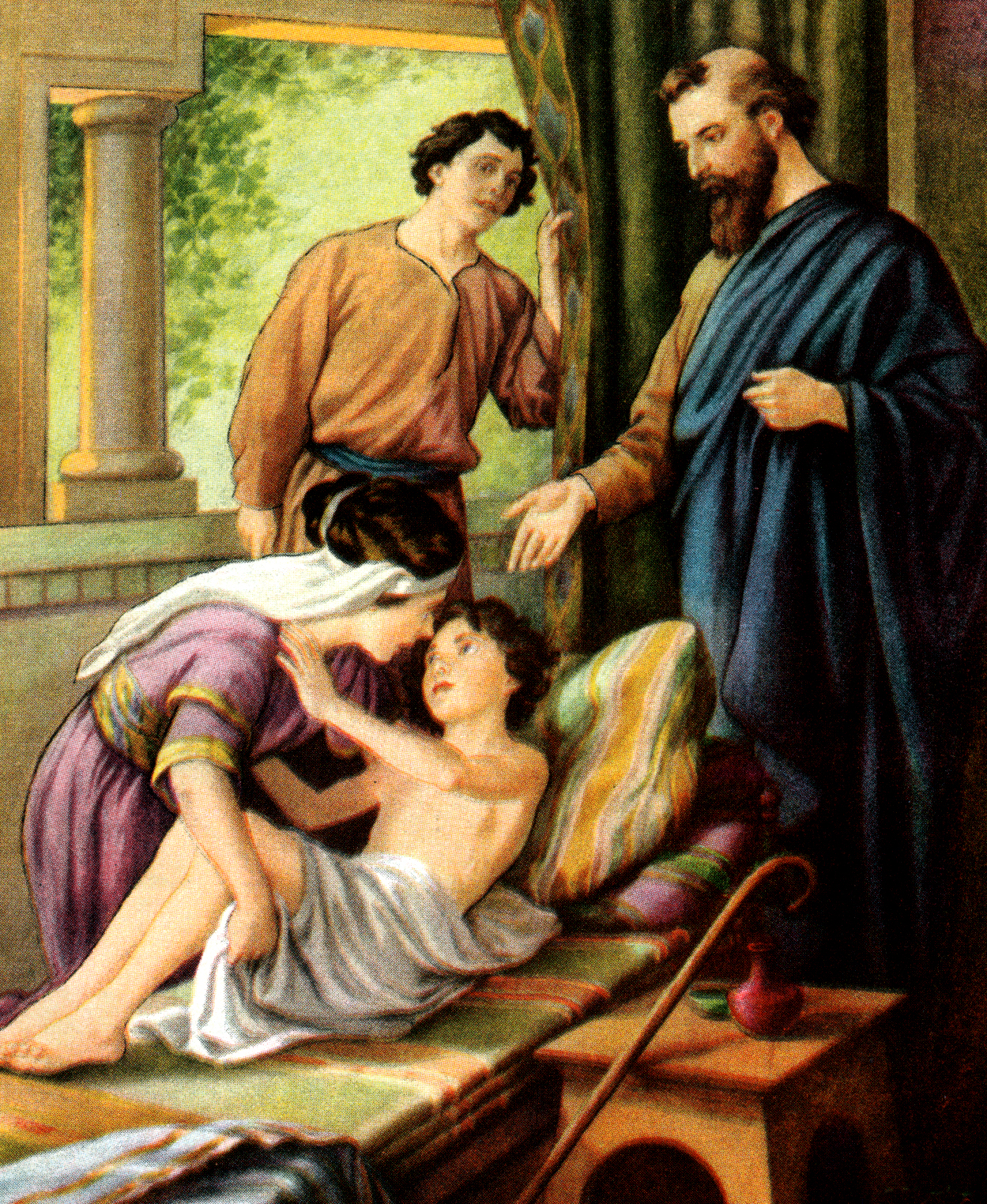
Elisha heals the child.

Behold, his soul which is lifted up is not upright in him: but the just shall live by his faith.  (Habakkuk 2:4)

Those who subject themselves to circumstances criticize those who live by faith, assuming a false pride in their own determination to react to whatever life may throw their way. Their pride forces them to deny that, for the most part, circumstances usually fail to land in their favor, and when circumstances favor them, they behave as if they had something to do with it.

On Father’s Day I wrote about my Dad, and how I learned to trust in God from him. The writer of the book of Hebrews says, “Now faith is the substance of things hoped for, the evidence of things not seen” (Hebrews 11:1). The Greek word translated “substance” is hupostasis, a compound word meaning “under” (hupo) “support” (stasis). “Stasis” in English is a state of equilibrium where things are consistent and unchanging. Faith, then, is immovable, and it is not “blind.” It is the “evidence of things not seen.” The Greek word translated “evidence” is elegchos meaning “proof.”

Well, how can one prove what cannot be seen? One way is experience. As I tried to relate in last week’s article, God showed Himself faithful in providing for our family in times of serious need.

In reading my Bible this past week, I once again came upon the account of the Shunammite in 2 Kings 4:8-37. According to the account, Elisha the prophet often passed through the town of Shunem on his way to and from Mt. Carmel. A certain woman there (we are not told her name) would invite him to stay in her home and would prepare a meal for him. Recognizing that he as “a man of God,” she suggested to her husband that they should build a room for the prophet to stay in as he traveled back and forth. This they did and Elisha, wishing to repay the kindness, asked what he could do for her. She refused to make a request, but Elisha still wished to bless her in some way. He consulted with his assistant, Gehazi, to see if there was any need that might be met. Gehazi noticed that the couple had no children, so Elisha had Gehazi called her. “And he said, About this season, according to the time of life, thou shalt embrace a son” (2 Kings 4:16). Now, the Bible says that she was a “great woman” (v. 8). The Hebrew word there is gâdôl which can also be translated “older.” On top of that, Gehazi, reported that “her husband is old” (v. 14) – Hebrew word zâqên meaning “elderly.” Not surprisingly, she responded, “Nay, my lord, thou man of God, do not lie unto thine handmaid” (v. 16). Despite her misgivings, her faith was rewarded, and she delivered a boy the following year as promised by the prophet.

Life continued as normal for the family of three, and then one day as the boy, now a young teenager, helped his father in the field, he started complaining of a headache (v. 19) and was taken home to his mother. As she cared for him, the boy eventually died the same day (v. 20). The narrative gives no sign of panic on her part. Instead, she carried him up to the prophet’s chamber and laid him on the prophet’s bed (v. 21). Then she made arrangements to go get Elisha. Even though her son was dead, she knew that the prophet could make things right; “And she said, It shall be well” (v. 23). Elisha recognized her as she approached his abode at Mr. Carmel, and dispatched Gehazi inquire as to her wellbeing. To all of his questions she replied, “It is well” (v. 26), but when she came to Elisha, her desperation came through. “And when she came to the man of God to the hill, she caught him by the feet: but Gehazi came near to thrust her away. And the man of God said, Let her alone; for her soul is vexed within her: and the LORD hath hid it from me, and hath not told me. Then she said, Did I desire a son of my lord? did I not say, Do not deceive me?” (2 Kings 4:27-28, emphasis mine). She had not abandoned hope. Her faith was intact. Her question was not one of doubt, but rather one of reminder that a promise had been made by the man of God, speaking for God, and God is faithful to His promise.

Elisha dispatched Gehazi with his staff and with instructions to place the staff on the boy’s body. The commentator, Matthew Henry, suggests that “He wished to teach the Shunammite, who obviously placed too great dependence upon him, a memorable lesson to look to God. By sending his servant forward to lay his staff on the child, he raised [the Shunammite’s] expectations, but, at the same time, taught her that his own help was unavailing.” Laying the staff on the boy’s body had no effect. When Elisha and the Shunammite woman arrived, the boy was still dead (v.32). What follows has been interpreted by some as mouth-to-mouth resuscitation, but that is a silly notion considering that the boy had been in that condition for at least 24 hours and perhaps more. The Bible says that Elisha “went up, and lay upon the child, and put his mouth upon his mouth, and his eyes upon his eyes, and his hands upon his hands: and he stretched himself upon the child; and the flesh of the child waxed warm. Then he returned, and walked in the house to and fro; and went up, and stretched himself upon him: and the child sneezed seven times, and the child opened his eyes” (2 Kings 4:34-35). Anyone knowing CPR knows that, given the condition described in the Bible, CPR would have been ineffective. The Bible definitively states that they boy was dead (vv. 20, 32). The boy was resurrected, not resuscitated and the Shunammite woman’s faith was confirmed.

This is not the last we hear about this woman. In 2 Kings 8:1-6 she reappears. This time Elisha warns her of a seven-year famine coming to the land where she lived. He instructs her simply to leave that place and “and sojourn wheresoever thou canst sojourn. And the woman arose, and did after the saying of the man of God: and she went with her household, and sojourned in the land of the Philistines seven years.” (2 Kings 8:1-2). At the end of seven years she returned to find that apparently her land had been unlawfully taken. She took her complaint before the king of Israel, and it happened that Gehazi was conversing with the king relating the account of the Shunammite’s son when the woman came before the king. “And when the king asked the woman, she told him. So the king appointed unto her a certain officer, saying, Restore all that was hers, and all the fruits of the field since the day that she left the land, even until now” (2 Kings 8:6).

In both of these instances, the Shunammite woman had no way of knowing what the future held, but she trusted in the unseen evidence of God’s Word for her provision.  Some may read this biblical account and say, “That’s just a Bible story,” but I have witnessed God’s hand in and throughout all of my life and in the life of my family as I was growing up. One somewhat recent confirmation happened about 24 years ago when my wife June and I purchased our first home together. We did not have a lot of money to put down on a home, and I had a bankruptcy on my record resulting from a divorce; so our options were very limited. We started looking at HUD repossessions, and to make a long story short, bid on a house which was outside of our desired price range. As a result, we made a low offer, and, to our amazement, God gave us the house with the low bid. We scheduled to close on the house on August 15, 1991, and on August 8, 1991, I was laid off from my job. June and I were faced with a faith challenge. Should we back out of the deal? That was a viable and honorable option. Or, should we trust in God’s provision? We decided that since God worked it out for us to win the bid, surely He would provide for the rest of it. We went through with the closure. The house needed some work – part of the deal included the “as is” condition of the house. We had to be out of our apartment by September 1, so I had plenty of free time to get the house ready. In the mean time I made one phone call that landed me a job in Dallas starting the first of September. We completed the work needed on the house, moved in, and I started work right after that. Friends, I do not believe in luck. That was all God.

I realize that the faith examples I have given here may seem a little on the materialistic side. They are not. These are all “needs” that God has met. Jesus said, “Therefore I say unto you, Take no thought for your life, what ye shall eat, or what ye shall drink; nor yet for your body, what ye shall put on. Is not the life more than meat, and the body than raiment? Behold the fowls of the air: for they sow not, neither do they reap, nor gather into barns; yet your heavenly Father feedeth them. Are ye not much better than they?” (Matthew 6:25-26). God cares about our every need, and as we learn to trust Him in the little things, He will prove Himself faithful in the greater things. And if He provides our material needs, how much more will He provide for our spiritual needs! And if He is faithful to His promise for our material well being, how much more will He be faithful to keep all of His Word?

Faith is the evidence of things unseen. Even when faith makes no sense, we can trust God because He has a proven track record – He has always been faithful.

2 Comments

Filed under Apologetics, Bible, Christianity, Religion, Resurrection, Theology

The Curse of Death

And as it is appointed unto men once to die, but after this the judgment (Hebrews 9:27)

And as it is appointed unto men once to die, but after this the judgment (Hebrews 9:27)

But of the tree of the knowledge of good and evil, thou shalt not eat of it: for in the day that thou eatest thereof thou shalt surely die.  (Genesis 2:17)

This week a young man, who labeled himself an agnostic, wrote in with a very good question concerning the curse of death. His question was posed as follows:

Genesis 2:17 says, “in the day that thou eatest thereof, thou shalt surely die.” Assuming that day equals 24 hours (big assumption, but Gen 2 is still part of the creation account) then the death must be spiritual or non-literal, since Adam lived to be 930 years – Gen 5:5. If the death resulting from sin is not literal, what is the relationship between sin and physical death? Is there any relation at all? Could physical death have occurred before sin? If sin and physical death are not related, why would Jesus have to rise from the dead? Is a bodily resurrection necessary for salvation? Why? Does any of the apostle Paul’s teaching of Christ conflict with a spiritual interpretation of death and sin? (I Cor 15:12-22)

Alternately, if the term “day” in Genesis 2:17 is not 24 hours, but instead an unspecified length of time equalling [sic] at least 930 years, most of the same questions about the relationship between sin and physical death would still apply.

His question is a very good one, and one of the key points in our biblical apologetics. The “death” described in Genesis 2:17 must be taken in context with the entire account of creation and the Fall, and in light of the rest of Scripture. Genesis 1 and 2 both narrate the creation account. Genesis 1:1-2:4 is God’s account of creation, and it gives a broad overview of the creation week. (For more details, see the notes on Genesis 1 and Genesis 2:1-4). Genesis 2:5 begins Adam’s account, and the focus is on Day Six and the creation of man. Allow me to regress and point out that chapter and verse divisions are not inspired. The original text was a continual reading with no breaks. This can sometimes be an obstacle, if one does not recognize that fact.

Another point that needs to be clarified is that the 24-hour day is not an “assumption” as he suggests. The Hebrew word used is yom, and it almost always means a normal 24-hour day in the Bible. When it is not a 24-hour day, such as in the “day of the Lord” (yom laYahweh) it is referring to a specific time, but never an extended period of time. Furthermore, God clearly defines the meaning of “day” with the phrase “evening and morning were the nth day” (Genesis 1:5, 8, 13, 19, 23).

At the end of the sixth day, God declared His creation not only “good” as in the previous five days, but “very good” (Genesis 1:31). Keep in mind that this assessment comes from an ultimately perfect being. So, if death existed before the fall, can death be considered a very good thing? If we say death is good, then how can death be a curse? And if death cannot be a curse, then why should Jesus die to pay the curse (the wages) of sin? If death was just a “spiritual” death, then, again, why should Jesus die a “physical” death to atone for a “spiritual” death? That really does throw a huge wrench in the works of the Gospel.

But “physical” death is NOT good. The Bible calls death the “enemy” (1 Corinthians 15:26). In the end, “death and hell (Greek hades “the grave”)” are cast into “the lake of fire” (Revelation 20:14). So, physical death cannot be part of a “very good” creation, if the Creator counts it as an enemy and something to be abolished. When God issued the command “thou shalt not eat of it: for in the day that thou eatest thereof thou shalt surely die” (Genesis 2:17), He was speaking of physical death. “Spiritual” death, i.e., separation from God, was a necessary consequence of that disobedience because He is the source of life (Job 33:4; Psalm 36:9; John 1:4; 5:26; 6:48; 10:28; 11:25; 14:6, et al). So, the death was both physical and spiritual. To further emphasize the point, Adam and Eve, since they had never experienced or observed death (keeping in mind that this all occurred shortly after creation – probably within a week or so), God (in the form of the pre-incarnate Christ – my opinion) sacrificed two (or more) innocent animals (probably sheep) in order to “cover” (atone for) their sin (Genesis 3:21). This was the first physical death of anything to this point, but on the spiritual side, man had already lost that intimate relationship with their Creator (Genesis 3:8).

This young man observed that Adam lived 930 years and concludes that the death curse must not have been physical but only spiritual, because they did not die immediately. One needs only to read Chapter 5 of Genesis and count how often the phrase “and he died” is repeated. Adam and Eve did not die instantly when they ate of the fruit, but they initiated the dying process. The phrase “you shall surely die” (Hebrew: mot tamot) would be better translated “dying you shall die.” Furthermore, the couple was denied access to the “tree of life” (Genesis 3:22) because apparently it had properties that would extend their life forever. The fact that they lived the long ages that they did is attributable to near perfect DNA (with the exception of the death mutation), and a near perfect environment. You may want to note the steady decline in longevity following the Global flood (Genesis 11:11-32).

Paul’s argument in 1 Corinthians 15:12-22 confirms that the curse of death is both physical and spiritual – physical in that our bodies degenerate to the point that they cease to function (we die), and spiritual in that our sin separates us from God (as physical death separates our spirit from our body). Jesus was sinless, like the first lambs sacrificed for Adam and Eve. Paul tells us that the “wages of sin is death” (Romans 6:23); here we are speaking of that spiritual death that separates us from God. Jesus’ death on the cross was the only sacrifice suitable to pay that debt of sin that separates us from God for all of mankind. “For it is not possible that the blood of bulls and of goats should take away sins” (Hebrews 10:4). Then when He rose again, He conquered the curse of physical death so that we can have eternal life. The choice, however, remains with us. From beginning to end, God has provided the way to restore that broken relationship and to enjoy eternal life with our Creator. We can either accept His offer, or reject it. “He came unto his own [not only the Jews, but mankind in general], and his own received him not. But as many as received him, to them gave he power to become the sons of God, even to them that believe on his name” (John 1:11-12).

3 Comments

Filed under Apologetics, Bible, Christianity, Creation, Death, Evangelism, Gospel, Origins, Religion, Salvation, Theology

He That Is Without Sin

19-Kids-and-Countings

So when they continued asking him, he lifted up himself, and said unto them, He that is without sin among you, let him first cast a stone at her.  (John 8:7)

This week the story grabbing the headlines exposes the past sins that of Josh Duggar, eldest son of Jim Bob and Michelle Duggar of “19 Kids and Counting.” Josh resigned as Executive Director of the FRC Action, an arm of the Family Research Council, after previously sealed court records were exposed by “In Touch Weekly” magazine. The records contained several incidents of molestation when Josh was between 14 and 15 years of age. It is not clear how many “victims” were involved from news reports, but his two oldest sisters (younger than Josh) were definitely two of those molested.

I watched an hour-long interview with the parents, Jim Bob and Michelle, by Megan Kelly of Fox News Channel, and their explanation seemed reasonable to me. First of all, let us not forget that at the time of the incidents, Josh was a pubescent boy full of raging hormones. I dare any man to deny what that is like. That aside, what Josh did was wrong. No one denies that. In fact, according to the Duggars, the boy, riddled with guilt over his actions, confessed his deeds to his parents even though they and his “victims” would have been none the wiser, if he had kept his mouth shut. At this point let me interject that from the Fall of man, God expects and waits for man to confess his sin and ask for forgiveness. That truth is evident throughout the Bible. That is exactly what Josh did. He confessed, repented and asked forgiveness of God, his parents and his sisters. But, hormones being what they are, Josh repeated the offense on other occasions prompting the family to seek counsel. (By the way, per the Duggars, the molestation amounted to inappropriate touching above the clothing while the “victims” were asleep and unaware of what was happening.) Eventually, Josh turned himself over to law enforcement, and had professional counseling.  After that, there were no other incidents reported.

Personally, I do not understand why a family would put themselves on display like they do on their television show – to each his own – but in that position, especially since they promote Christian family values, they have set themselves up for a direct demonic assault. And that is exactly what they have gotten this week. The God haters are calling them hypocrites because they speak out against the LGBT movement while hiding their own “dirty little secret.”

The “left” excels in redefining words, which to me makes them illiterate and not quite as intelligent as they pretend. A hypocrite is someone who is one thing, but pretends to be another. Let us apply that definition to the Duggars. Megan Kelly asked the couple, having this “skeleton” in the closet, why would they not disclose that before going on with the show? They responded that the problem had been resolved five years prior to the show starting. Josh had confessed, had been forgiven, and truly repented (turned away) from his sin. It was over and done – water under the bridge. No one, seriously, no one dredges up past family problems that have been resolved – no one. Does that make one a hypocrite? Now, since these media dumpster divers found the dirt (which should never have been released to media) the Duggars are forced to discuss it. That is exactly what they have done openly and transparently. They do not make excuses for Josh’s behavior as an adolescent. They confess that his actions were sinful. They admit they may have made some errors in judgment in the handling of the offense, but, like for any parent, our kids do not come with an instruction manual. A parent can only do the best they can. By the way, there are some that admit that, given the circumstances, the Duggars actually did a very commendable job at taking care of the problem. So, in embarking on the “reality” show, “19 Kids and Counting” they entered the endeavor with a clear conscience. There is no hypocrisy in that.

The true hypocrites are the voices shouting, “Stone them!” for exposing sin for what it is. They wish to silence the voices of those who oppose their sinful and depraved lifestyles, yet they claim the freedom to spew their filth over all society. These are the hypocrites. The Duggars, when they speak out against abortion and same-sex marriage, do not make personal attacks; they do not name names. The God haters have not made a general charge against Christians, or Christian beliefs; they have made their attack personal. These are the hypocrites. They are not without sin, and they should not cast stones.

The Duggar family needs our prayers.

7 Comments

Filed under Christianity, Current Events, Religion, Theology

A Special Kind of Stupid

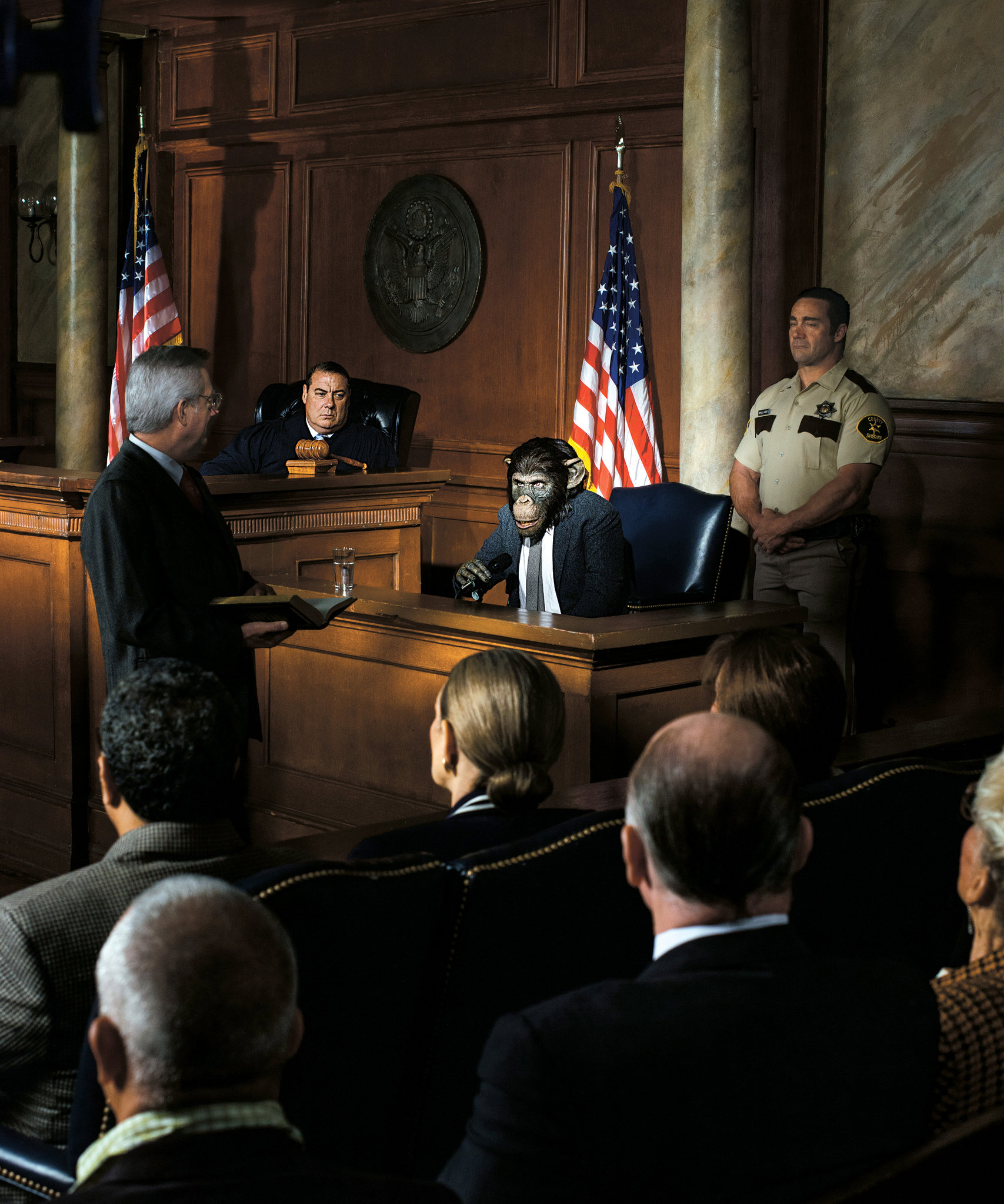
Image Credit: The Greanville Post, http://www.greanvillepost.com/2014/04/29/his-day-in-court-a-chimpanzee-makes-legal-history/

Image Credit: The Greanville Post: “His day in Court—A Chimpanzee Makes Legal History

And God said, Let us make man in our image, after our likeness: and let them have dominion over the fish of the sea, and over the fowl of the air, and over the cattle, and over all the earth, and over every creeping thing that creepeth upon the earth.  (Genesis 1:26)

This week “Two research chimps got their day in court … Steven Wise, an attorney with the Nonhuman Rights Project, told Manhattan Supreme Court Judge Barbara Jaffe that Hercules and Leo, the 8-year-old research chimps at Stony Brook University on Long Island, are ‘autonomous and self-determining beings’ who should be granted a writ of habeas corpus, which would effectively recognize them as legal persons. The chimps, he argued, should be moved from the university to a sanctuary in Florida”[1] (emphasis mine).

Well, what can one expect! For years now evolutionists have been claiming that chimpanzee DNA is 98% the same as that of humans. If that is so, then it stands to reason that they should at least be considered 98% persons. Is that not so? However, the DNA findings exaggerate the similarity in a narrow segment of the genome and deemphasize the vast differences that clearly separate chimps from humans. Biologist Dr. Jeffrey P. Tomkins, Research Associate in Life Sciences for the Institute for Creation Research, researches these claims made by the evolutionists. In comparing 40,000 chimpanzee genomic sequences against the human genome, Tomkins found “that reported levels of human-chimp DNA similarity were significantly lower than commonly reported … For the chimp autosomes, the amount of optimally aligned DNA sequence provided similarities between 66 and 76 percent, depending on the chromosome. Only 69 percent of the chimpanzee X chromosome was similar to human and only 43 percent of the Y chromosome. Genome-wide, only 70% of the chimpanzee DNA was similar to human under the most optimal alignment conditions.”[2] The 28% (give or take) variance may seem small, but in genomics, it is huge. “While, chimpanzees and humans share many localized protein-coding regions of high similarity, the overall extreme discontinuity between the two genomes defies evolutionary timescales and dogmatic presuppositions about a common ancestor.”[3]

I am no scientist, but even without getting into the coded information contained in DNA, the differences between chimps and humans seem obvious to me. To make an evaluation, one needs only to ask a few simple questions.  Aside from some basic similarities like: chimps have hands, humans have hands; chimps have feet, humans have feet (albeit chimps have “thumbs” on their feet and humans have a big toe); chimps have faces, humans have faces; chimps express emotions, humans express emotions; chimps nurture their young; humans nurture their young; chimps live in communities, humans live in communities; chimps communicate (as do most other animals), humans communicate; chimps make “tools,” humans make tools. There may be other similarities, but basically, it ends there. The questions reveal the differences.

Chimpanzees can make simple “tools,” but can they replicate a tool or mass produce it? Do they teach their tool making techniques to others in their community? Do they improve their tools to make them more functional or employ their tools for a variety of different purposes? Chimpanzees can build shelters, but can they build permanent structures? Do they employ aesthetic design in their building efforts or are their shelters simply utilitarian? For that matter, do chips create anything – paintings, sculptures, music, etc.? What is the extent of their creative abilities, if any, and how do they compare to those of humans? Can chimpanzees do even simple math? Do they develop economic systems or practice even the most basic exchange systems? We know that chimps can communicate in some rudimentary ways, but have they developed a language? Do they exchange ideas, and if so, how is that accomplished? Have they ever developed a system of writing, and if they have, do they value it enough to preserve it? Do chimps study chimpanzee anatomy in order to “doctor” on one another? Do they research in order to find cures for chimpanzee diseases? Along the same lines, do chimps study other animals to learn their habits and habitats? Do they observe the stars at night and dream about visiting other worlds? Chimps play, but do they develop games with rules and teach the game to others in order to stimulate healthy competition?

The comparisons are endless, but the more questions one considers, it becomes all the more obvious that chimpanzees fall far short of human achievements and capabilities. Sure chimps have greater strength than humans. They can swing from tree to tree even using their feet to grasp branches; but they do not have the manual dexterity to play a flamenco guitar, harp, piano, or violin; or the grace to match the agility of a gymnast or to dance a ballet or to figure skate.

The evolutionists claim that humans and chimps originated from a common ancestor. If that is the case, then why have chimpanzees not advanced even to the level of the most primitive human tribes? Supposedly they have had the same 100,000 years as humans (according to evolutionists) to evolve beyond their lowly “animal” status. So why are they stuck at the point of their origin? The fact is that they are animals and humans are, well, humans. Chimps were created by the spoken word of God (Genesis 1:24-25); humans were formed (Hebrew yâtsar meaning form or mold) in the image of God (Genesis 2:7; 1:26-27). The difference in creation between beast and man is so distinct, from the Creator’s point of view as recorded in Scripture, that one would really have to be some special kind of stupid to attribute personhood to an animal on par with that of a human being. But, this should really not surprise us. The Bible teaches that those who profess such things have “changed the truth of God into a lie, and worshipped and served the creature more than the Creator, who is blessed for ever” (Romans 1:25, emphasis mine).

So, if these chimps really are “legal persons” – the “autonomous and self-determining beings” their lawyers claim – they should go out and hire their own lawyers!


 Notes:

[1] Krishnadev Calamur, “Research Chimps Get Their Day in Court in New York,” (http://www.npr.org/sections/thetwo-way/2015/05/27/410058029/research-chimps-get-their-day-in-court-in-new-york). Accessed May 28, 2015.

[2] Jeffery Tomkins, “New Research Evaluating Similarities Between Human and Chimpanzee DNA,” (http://www.icr.org/i/pdf/technical/Research-Evaluating-Similarities-Human-Chimp-DNA.pdf). Accessed May 28, 2015.

[3] Ibid.

2 Comments

Filed under Apologetics, Creation, Current Events, Evolution, Origins, Science, Theology