Category Archives: Apologetics

Artificial Fertilization

For the bread of God is he which cometh down from heaven, and giveth life unto the world. (John 6:33)

I received the following question last week, and, even though this is not the kind of question I typically respond to, I thought I should at least make an effort to give an answer. The inquirer asked:

Is Artificial Insemination right or wrong? Are there scriptures that can be used to either support or be against it? As Africa is working on catching up with the west, these are some of the Issues so foreign in our culture, but we have to deal with, much more deal with rightly especially for those who profess to be followers of Christ.

Although this individual asked specifically about artificial insemination, there are several methods for treating infertility problems. The writer seemed concerned for those who are followers of Christ, so my response assumed the context of a married, heterosexual, couple. There are moral issues for homosexual couples using these methods to produce children that I do not care to address since I have covered those matters in previous posts. [1],[2],[3],[4]  Therefore, my response addresses Christian concerns.

The most common method of artificial fertilization is intrauterine insemination. This method takes sperm from the husband, by a variety of means, and injects it into the wife’s uterus when she is ovulating. Except for the fact that this circumvents God’s design for childbearing, the redeeming factor is that the couple is husband and wife. Sometimes, for one reason or another, the husband cannot produce sperm. In this case, the couple may be tempted to find a sperm donor. Finding a donor who is not the husband, I think, goes far beyond the will of God, as I will explain later.

The Bible does not have anything to say about artificial fertilization. Obviously, such techniques did not exist when the Bible was written. However, there are principles taught in the Bible that should guide the believer (through the help and guidance of the Holy Spirit) in determining what is right or wrong about this procedure. Ultimately, it is a matter of conscience for the individuals undergoing the procedure.

A second method of artificial fertilization is in vitro fertilization. This method takes ovum from the wife, and the technicians inject them with sperm from the husband resulting in several fertilized eggs – zygotes. This procedure is often used because, for one reason or another, the wife has trouble getting pregnant. The technicians then place the fertilized eggs in the mother’s uterus in hopes that at least one will “take.”

Some things a Christian couple should think about when considering undergoing any of these procedures. (1) The Bible repeatedly asserts that God is the One who gives life. Only God gives life, so the life resulting from artificial fertilization is God-given albeit through human intervention. Humans cannot give or create life – only God does that. (2) Often, in the process of in vitro fertilization, extra embryos are created in the procedure for use at a later time, if the first attempt fails. Sometimes the procedure results in multiple births. Often, not all of the embryos resulting from the procedure are used, and the question arises of what to do with the unused embryos. At some point, someone must decide what to do with the remaining embryos – either keep them or destroy them. Here is where the real problem arises. Those embryos are tiny, not-fully-formed yet 100%, human beings. They are life that God has created; therefore, only God has the right to take that life. When that life is destroyed by man, the act, from God’s perspective, is murder (Genesis 9:5-6; Exodus 20:13).

From my perspective, the problem of infertility should be left to God. We have many examples in Scripture where couples were infertile for many years until the time God chose, so that He might be glorified. Some examples are Abraham and Sara (Genesis 21), Isaac and Rebekah (Genesis 25:21), Jacob and Rachel (Genesis 30), Manoah and wife (parents of Samson – Judges 13), the Shunammite woman and her husband (2 Kings 4), Zacharias and Elisabeth (parents of John the Baptist – Luke 1:5-25). Therefore, I think it best to leave the matter in God’s hands. He is the One that “gives” children (Psalm 127:3). He has His reasons for giving or withholding children from a couple, and ultimately, He knows best.

I do not believe that we should meddle in God’s business. However, a Christian couple struggling with infertility needs to take the matter before the Lord before making such a serious, life-altering decision. Remember the trouble that resulted when Abraham and Sara tried to help God out by using Hagar to produce an heir. The problems from that failed plan plague Israel to this very day! Rachel tried to solve her infertility problem by giving her handmaid to Jacob, then Leah followed suit and did the same. When we examine Jacob’s life, it is anything but blissful! Things usually do not turn out well when we presume to help God out in matters that rightly belong to Him. It is always best to leave such things up to God. God has His reason for blessing some couples with children and not blessing others. The matter is best left to His discretion.

Notes:


[1]  “Born Gay” https://erniecarrasco.com/2018/07/15/born-gay/

[2]  “Reclaiming the Rainbow” https://erniecarrasco.com/2017/07/23/reclaiming-the-rainbow/

[3]  “The Rainbow”  https://erniecarrasco.com/2015/07/05/the-rainbow/

[4]  “Adam & Steve or Bev & Eve?”  https://erniecarrasco.com/2015/05/03/adam-steve-or-bev-eve/

6 Comments

Filed under Apologetics, Christianity, Creation, Current Events, Pro-life, Science, Theology

Merit-Based Salvation

For God shall bring every work into judgment, with every secret thing, whether it be good, or whether it be evil. (Ecclesiastes 12:14)

There exists a common misconception among non-Christians and, sadly, even among some Christians, that when it comes time to meet our Maker that we can gain entrance into the celestial realm based on our merits. As our lead verse suggests, “God shall bring every work into judgment … whether it be good, or whether it be evil.” If challenged, those who hold that view almost always see themselves as better than most. They may admit to “small” sins like telling a “white lie” now and then, stealing a pack of gum, failing to correct a cashier when given too much change, or something equally innocuous. By their estimation, their “good” works will outweigh their “evil” works on the cosmic scales, and God will say, “Good enough!”

To some extent, it seems that the Bible teaches merit-based salvation. Our lead verse teaches that God looks at every work, both good and evil. Superficially, one may get the impression that He weighs the two – good on one side, evil on the other. First Peter 1:17 says that “the Father, who without respect of persons judgeth according to every man’s work…” (emphasis mine). Indeed, at the end of time when Christ’s millennial reign on earth has ended, a scene unfolds where all who ever lived appear before the judgment seat of Christ. “And the sea gave up the dead which were in it; and death and hell delivered up the dead which were in them: and they were judged every man according to their works” (Revelation 20:13).

It indeed appears that people will be judged according to their works. Should this be cause for hope for those counting on their own goodness? Taking a closer look at our leading verse, note that God scrutinizes “every work” and determines whether it is good or evil based on His standard of goodness. God made man in His image (Genesis 1:27), and for that reason, God deemed man “very good” (Genesis 1:31), but man messed that up in the Garden of Eden (Genesis 3). Beginning with fig leaves (Genesis 3:7), man’s attempt at covering up his sin always falls short of the perfection he possessed before the Fall. Only perfection qualifies for entry into the presence of God. “And there shall in no wise enter into it any thing that defileth, neither whatsoever worketh abomination, or maketh a lie: but they which are written in the Lamb’s book of life” (Revelation 21:27, emphasis mine). Interestingly, I cannot find the word “sin” in the book of Revelation, but there are several synonyms: anything that defiles, whatever works abomination or makes a lie. All of that is sin, so whether one has a little sin or a lot of sin, one is disqualified from entering heaven.

The Great White Throne Judgment scene in Revelation sees “books” opened, and the “dead” judged by the content of the books “according to their works” (Revelation 20:12). Evidently, there are “ledger books” recording both the good and evil deeds of every person that has ever lived. Since NOTHING that defiles “shall in no wise enter,” no one qualifies. “As it is written, There is none righteous, no, not one … For all have sinned, and come short of the glory of God” (Romans 3:10, 23). However, “The Lord is not slack concerning his promise, as some men count slackness; but is longsuffering to us-ward, not willing that any should perish, but that all should come to repentance” (2 Peter 3:9). There the guilty sinner stands before the Righteous Judge, “and another book was opened, which is the book of life … And whosoever was not found written in the book of life was cast into the lake of fire” (Revelation 20:15).

Reader, is your name written in the Book of Life? Do not think you are good enough – that your sins are minor compared to someone else. Only perfection gains entry into heaven and no one qualifies. However, there is a way. Please read my page on “Securing Eternal Life.”

Comments Off on Merit-Based Salvation

Filed under Apologetics, Christianity, Evangelism, Gospel, Religion, Salvation, Theology

Being Gods

Jesus answered them, Is it not written in your law, I said, Ye are gods?       (John 10:34)

When Satan met Eve in the Garden of Eden, he charged that by His prohibition against eating the fruit of the tree of knowledge of good and evil, God denied Adam and Eve of something good. “For God doth know that in the day ye eat thereof, then your eyes shall be opened, and ye shall be as gods, knowing good and evil” (Genesis 3:5, emphasis mine).

Being gods remains mankind’s greatest desire. We all want to have complete, unfettered control of our lives with no one telling us what to do; and we want, as much as possible, to exert influence and control over others. The latter becomes more apparent daily as we witness the radical left’s efforts to alter the course of our nation. The strong desire to force upon our society their radical agenda manifests itself in unprecedented violence across our land. They want to be the gods that dictate what we all should do.

However, this is not a new phenomenon. History records the rise and fall of numerous demagogues. Bringing it closer to home, we might be tempted to deflect the guilt to them and deny that we harbor the same desire to make our own rules and impose them on others. We all like being gods to one extent or another.

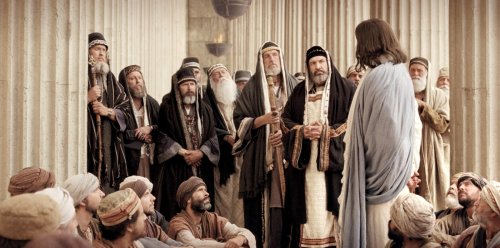
In Jesus’ day, the religious leaders wanted to be gods, although they would never admit to that. They were the keepers of God’s law, and from their self-perceived superior position, they sought to impose their perception of God’s law on others. They enjoyed their position of control. They were being gods without knowing it. However, they met their match with Jesus. Him they could not control, so they sought to destroy Him.

It was the winter before His crucifixion around the time of Hanukkah (John 10:22). The Jewish religious leaders surrounded Jesus with the hope of finding something with which to accuse Him of a capital offense. “Then came the Jews round about him, and said unto him, How long dost thou make us to doubt? If thou be the Christ, tell us plainly” (John 10:24). Jesus referred to His countless miracles, of which no doubt they were familiar, in His defense. Nevertheless, the clear evidence escaped these “blind guides” (Matthew 23:16, 24). Their incapacity to perceive the truth centered on the question of ownership. They were not Jesus’ sheep (John 10:26-27); they were their own “gods;” therefore they could not recognize His authority or submit to His direction.

Since the clear evidence eluded them, Jesus plainly told them what they wanted to hear, “I and [the][1] Father are one” (John 10:30). That was plain enough. Jesus made it clear that not only is He equal to God (the Father), He is the same as the Father. The message came through loud and clear. “Then the Jews took up stones again to stone him” (John 10:31). They got what they were after. He deserved to be stoned “for blasphemy; and because that thou, being a man, makest thyself God” (John 10:33).

Jesus then quoted from Psalm 82, “Is it not written in your law, I said, Ye are gods?” (John 10:34). The psalm begins with this declaration: “God standeth in the congregation of the mighty; he judgeth among the gods” (Psalm 82:1). Considering the parallelism of Hebrew poetry, “the mighty” and “the gods” are the same.[2] To “the mighty” and “the gods” God challenges, “How long will ye judge unjustly, and accept the persons of the wicked?” (Psalm 82:2). Then He charges, “Defend the poor and fatherless: do justice to the afflicted and needy. Deliver the poor and needy: rid them out of the hand of the wicked” (Psalm 82:3-4). These mighty gods are none other than the leaders of the people – ordinary men in extraordinary positions of power and authority. Yet, according to the psalm, they are ignorant of God’s laws and supplant them with laws of their own devices, so that “all the foundations of the earth are out of course” (Psalm 82:5). To these demigods, God says, “I have said, Ye are gods; and all of you are children of the most High. But ye shall die like men, and fall like one of the princes” (Psalm 8:6-7). God confers the appellation of “gods” on these rulers in that they are “children” of God. As such, they are God’s representatives on the earth, “princes” to carry out God’s will on earth. However, they are not more special than other men. They will die just like every other man.

The psalm ends with a cry for God to, “Arise, O God, judge the earth: for thou shalt inherit all nations” (Psalm 82:8). In the end, the One true God will reign over all the earth, and here He was standing before the Jewish leaders. God accused of blasphemy by the little gods.

Solomon rightly lamented, “The thing that hath been, it is that which shall be; and that which is done is that which shall be done: and there is no new thing under the sun” (Ecclesiastes 1:9, emphasis mine). We still try to be our own gods – set our own rules and impose our will on others. Since the Garden of Eden, we continue being gods, even if only in our minds. The sooner we learn to let God be God, the sooner we can enjoy the peace and rest that only God can give. To all who are tired of being gods, Jesus says, “Come unto me, all ye that labour [at being gods] and are heavy laden, and I will give you rest” (Matthew 11:28).

Notes:


[1]  The KJV inserts “my” in italics where the Greek text (Textus Receptus) used the definite article “the” before “Father.”  εγω και ο πατηρ εν εσμεν

[2]  Michael S. Heiser, in his book The Unseen Realm, suggests that the elohim (gods) in this psalm refers to the “congregation” of the bene elohim (sons of God) that make up the council of God.  These include both God’s angels and Satan’s angels as seen in Job 1. That idea is not implausible, however, based on Jesus’ reference to it, it can also apply to mankind.

1 Comment

Filed under Apologetics, Christianity, Gospel, Religion, Satan

Only Eight Saved

Noah, a Preacher of Righteousness

For Christ also hath once suffered for sins, the just for the unjust, that he might bring us to God, being put to death in the flesh, but quickened by the Spirit: By which also he went and preached unto the spirits in prison; Which sometime were disobedient, when once the longsuffering of God waited in the days of Noah, while the ark was a preparing, wherein few, that is, eight souls were saved by water. (1 Peter 3:18-20)

One of the many attributes of God is that He is longsuffering. The English word first appears in Exodus. “And the LORD passed by before him, and proclaimed, The LORD, The LORD God, merciful and gracious, longsuffering, and abundant in goodness and truth, Keeping mercy for thousands, forgiving iniquity and transgression and sin, and that will by no means clear the guilty; visiting the iniquity of the fathers upon the children, and upon the children’s children, unto the third and to the fourth generation (Exodus 34:6-7). The word “longsuffering” translates two Hebrew words: ‘ârêk meaning long or patient and ‘aph meaning nose or nostril, hence the face. Together they picture the face of God as He patiently looks on His wayward children. The word appears three other times in the Old Testament: Numbers 14:18; Psalm 86:15; Jeremiah 15:15.

In the New Testament, “longsuffering” appears 13 times. It appears first in Romans 2:4, “Or despisest thou the riches of his goodness and forbearance and longsuffering; not knowing that the goodness of God leadeth thee to repentance?” In the New Testament, “longsuffering” translates the Greek compound word, makrothumiamakrós meaning “long” and thymós meaning “passion, anger.” Together they render “long-passion,” i.e., waiting a long time before expressing anger.

God’s longsuffering can be misconstrued as indulgence, leniency, or indifference. On the extreme side, some interpret God’s apparent laxness in punishing evil to mean that God does not exist. However, that is not what the Bible teaches. “The Lord is not slack concerning his promise, as some men count slackness; but is longsuffering to us-ward, not willing that any should perish, but that all should come to repentance” (2 Peter 3:9). God patiently waits a long time giving sinners sufficient opportunity to repent. He does this for individuals and for mankind in general.

Not long after God created Adam and Eve and placed them in the Garden of Eden, the couple disobeyed God’s only command, which brought death – separation between God, the Creator, and man, the creature – to all their posterity (Genesis 3). Adam and Eve had many sons and daughters (Genesis 5:4). Cain was born first (Genesis 4:1), and Abel came sometime after (Genesis 4:2). As the narrative unfolds, we learn that Cain rebelled in his offering to God, while Abel sacrificed according to God’s prescription. God accepted Abel’s sacrifice and rejected Cain’s, and this incited Cain to jealousy and anger. Eventually, Cain murdered his brother, and God banished him from the rest of the family. [1] Cain’s progeny followed their father’s rebellious attitude to the point that murder was a bragging right. “And Lamech said unto his wives, Adah and Zillah, Hear my voice; ye wives of Lamech, hearken unto my speech: for I have slain a man to my wounding, and a young man to my hurt. If Cain shall be avenged sevenfold, truly Lamech seventy and sevenfold” (Genesis 4:23-24).

God’s longsuffering produced in Adam and Eve a son in the place of godly Abel. “And Adam knew his wife again; and she bare a son, and called his name Seth: For God, said she, hath appointed me another seed instead of Abel, whom Cain slew” (Genesis 4:25). Over the next 1500 years or so, the human population of earth exploded and became perverse. “And GOD saw that the wickedness of man was great in the earth and that every imagination of the thoughts of his heart was only evil continually. And it repented the LORD that he had made man on the earth, and it grieved him at his heart” (Genesis 6:5-6). Even God’s longsuffering has its limits.

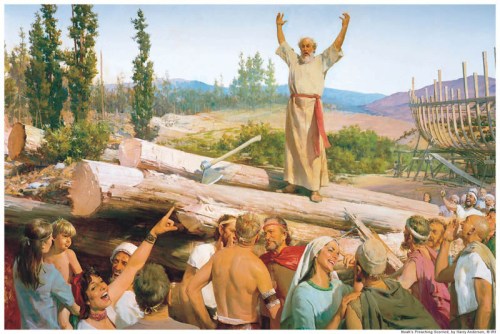
Seth’s line, however, remained pure to the end. “And the LORD said, I will destroy man whom I have created from the face of the earth; both man, and beast, and the creeping thing, and the fowls of the air; for it repenteth me that I have made them. But Noah found grace in the eyes of the LORD” (Genesis 6:7-8). God instructed Noah to build a massive barge, 450’ x 75’ x 45’,[2] large enough to carry all who would be saved. It took Noah less than 100 years to complete his task.[3] In that time, Noah did all that he could to warn the people of the coming Flood. Peter describes Noah as “a preacher of righteousness” (2 Peter 2:5) demonstrating God’s longsuffering in providing a warning to an ungodly world.

The Ark had sufficient space to save many besides Noah and his family. The “kinds”[4] of animals onboard probably took up less than half of the available space. At one time, I calculated that the Ark could have carried more than 2400 human passengers,[5] yet only eight were saved. I wonder whether God would have sent the Flood if 2400 had listened to Noah’s preaching and repented. It reminds me of Abraham interceding for Sodom and Gomorrah (Genesis 18:23-33). He pleaded for 50, then 45, then 40, 30, 20, and finally 10. God, “not willing that any should perish,” would spare the cities for ten righteous people. Alas, only Lot, his wife, and two daughters were the only ones saved, and even they were dragged out by the angels (Genesis 19:16).

The Old Testament is a history of God’s longsuffering. The book of Judges, in particular, ends with the sad refrain, “In those days there was no king in Israel: every man did that which was right in his own eyes” (Judges 21:25, emphasis mine). Two thousand years from Abraham, Messiah came as promised and His own rejected Him (John 1:11). Jesus died on a Roman cross to pay our sin debt. They buried Him in a borrowed tomb, and He rose again on the third day. Forty days later, He ascended to His throne in heaven of which He said, “In my Father’s house are many mansions: if it were not so, I would have told you. I go to prepare a place for you. And if I go and prepare a place for you, I will come again, and receive you unto myself; that where I am, there ye may be also” (John 14:2-3).

It has been more than 2000 years – six millennia since the Creation. God is longsuffering, not willing that any should perish, but the time of the Sabbath rest is drawing near. There is a limit to God’s longsuffering. The voices of the prophets sound from every corner of the world. God is not willing that any should perish. The old hymn says, “There’s room at the cross for you,” but just as only eight were saved in the Ark, and only four saved from Sodom and Gomorrah, only a few will be saved from the wrath that is coming. Jesus said, “Because strait is the gate, and narrow is the way, which leadeth unto life, and few there be that find it” (Matthew 7:14, emphasis mine). Don’t miss the boat. Jesus will come very soon. Don’t get left behind. If you have not given your life to Him, read my page on “Securing Eternal Life.”

Notes:


[1]  Genesis 4:1-16

[2]  Genesis 6:15 – 300 cubits x 50 cubits x 30 cubits. The dimensions are calculated based on an 18” cubit.

[3]  Noah’s sons were born when he was 500 years old (Genesis 5:32), and they entered the completed Ark when Noah was 600 years old (Genesis 7:11). We are not given Noah’s age at the time God gave him the task to build the Ark, but we can infer that it was after his sons were old enough to help.

[4]  The biblical “kinds” equates to taxonomical “families” in modern terms. The Ark did not carry every species of air-breathing land animals. It only carried the basic families from which all other variations would derive.

[5]  The Ark’s passenger capacity is based on 2/3 of the total available square footage (96,750 sq. ft.) of the Ark or 64,500 sq. ft.  Taking 25% of the remaining space for stores leaves 48,375 sq. ft. for passengers.  Allowing 80 sq. ft. per a family of four, or 20 sq. ft. per person (the average size of an 8×10 2-man prison cell), and dividing 48,375 by 80 yields about 605 living spaces.  At 4 people per space, that comes to 2420 total passengers.  More could have been accommodated if needed.

3 Comments

Filed under Apologetics, Christianity, Creation, End Times, Evangelism, Gospel, Salvation, Second Coming of Christ, Theology

Three Fingers Back

Behold, how good and how pleasant it is for brethren to dwell together in unity! (Psalm 133:1)

I often hear the charge, “that’s not very Christian” coming from non-Christians when a Christian acts or speaks in a manner which the non-Christian deems inappropriate for a Christian (as if they would know what is or is not appropriate for a Christian). I get that. They make those judgments based on their humanistic worldview that determines right or wrong according to their contrived values. It is a relativistic worldview that authorizes the individual to make value judgments as he sees fit. “Every man did that which was right in his own eyes” (Judges 21:25). Everyone has his/her own value system. Everyone has his/her own “truth.” One can say or do whatever one wishes as long as it is legal and “it does not hurt anyone else.” That rule applies to everyone – except for Christians. Christians are judged by a different measure. That measure is the subjective preconception of how a Christian ought to behave.

While I understand the source of the non-Christian’s warped perspective of how a Christian should behave, I am really taken aback when I hear the exact criticism coming from another Christian. What is up with that! One would think that all Christians should present a united front. That was Jesus’ desire for us. “Neither pray I for these alone, but for them also which shall believe on me through their word [that be us]; That they all may be one; as thou, Father, art in me, and I in thee, that they also may be one in us: that the world may believe that thou hast sent me” (John 17:20-21, emphasis mine).

Now when the Mormons come knocking on your door, this is one fault they like to point out. “Why are there so many religions when Jesus wanted us all to be one?” When someone asks me that question, I quickly agree and say, “I think we should all be Baptists!” I am joking, of course. I understand most of the denominational differences, but as Christians, we should all have one thing in common that unifies us. Salvation is through Grace alone, through Faith in Christ alone. “For by grace are ye saved through faith; and that not of yourselves: it is the gift of God: Not of works, lest any man should boast” (Ephesians 2:8-9). We can discuss our differences on how we view baptism, communion, predestination vs. free will, glossolalia (speaking in tongues), eschatology (end times), creation, etc. We can even debate over those issues – in love. However, we must keep those discussions based on Scripture, not on personal opinion or the opinions of others. What does the Bible – God’s Word – have to say about it? There is nothing wrong with that, and there is much right about that. “Iron sharpeneth iron; so a man sharpeneth the countenance of his friend” (Proverbs 27:17).

However, questioning the Christianity of another Christian – especially in a public forum like Facebook – is wholly inappropriate. That very act is “un-Christian.” The familiar axiom – “When you point the finger at someone else, you have three fingers point back at you” – is true. Jesus said, “Judge not, that ye be not judged” (Matthew 7:1). However, in saying that, He was not prohibiting value judgments. In context (Matthew 7:1-6), Jesus referred to making a condemning judgment against someone else. The Greek word translated “judge” is krinō, which means to condemn. Only Jesus can properly judge an individual because only He knows the heart and the motives of the person. We do not possess that ability. We can, however, judge actions – what can actually be seen – and determine whether those actions are right or wrong from the rubric of God’s Word. We can determine if a brother’s actions are not in keeping with God’s Word, but we have no right to accuse him of not being a Christian. We know neither his heart nor his motives.

Jesus makes it clear that we must make judgments. In the same passage, He said, “Give not that which is holy unto the dogs, neither cast ye your pearls before swine, lest they trample them under their feet, and turn again and rend you” (Matthew 7:6). Determining who the “dogs” and “swine” are demands a judgment. “That which is holy” and “your pearls” is the Gospel message we have to offer. Some people will reject the message and treat it as a dog treats a rag toy. The message will offend others to the point that they will attack you – either verbally or physically. Either way, their actions determine whether you continue to share the Gospel with them or not. When that happens, Jesus said to “shake off the dust under your feet for a testimony against them” (Mark 6:11). You have made a judgment.

Jesus later offers another example. He said, “Beware of false prophets, which come to you in sheep’s clothing, but inwardly they are ravening wolves. Ye shall know them by their fruits. Do men gather grapes of thorns, or figs of thistles?” (Matthew 7:15-16). How does one recognize a false prophet without making a judgment? One must judge! By what standard do we make that judgment? We make that judgment based on the Word of God. When the prophet speaks, do his words match up with the Word of God? You have to make a judgment! Jesus further points to the actions – fruit – of the false prophet. If that prophet talks like a Christian but behaves like the devil, then perhaps you are right to point at the “bad fruit.” If the prophet’s message is inconsistent with the Word of God, then he should be called out for his false teaching but be sure you are standing on firm, biblical ground. Also, be prepared to take on fire.

Again, we cannot judge the heart or the motives of another believer, or anyone for that matter. It is possible, though doubtful, that the false prophet is a Christian. I have known false prophets who spoke the truth, right out of God’s Word, but their lives told a different story. The truth of God’s Word remains, though the messenger may be faulty. Here is where we must be careful in making judgments. The false prophet may or may not be a true believer. I have heard testimonies of pastors that preached behind pulpits for many years before realizing their own lost condition and turning to Christ for salvation. It can happen! Jesus cautioned, “And why beholdest thou the mote that is in thy brother’s eye, but considerest not the beam that is in thine own eye? … Thou hypocrite, first cast out the beam out of thine own eye; and then shalt thou see clearly to cast out the mote out of thy brother’s eye” (Matthew 7:3, 5).

Before accusing a fellow believer of not being Christian, we must examine ourselves – critically – to make sure we are not at fault. Moreover, I cannot emphasize it strongly enough; our judgment – even our self-examination – must be based on Scripture, not personal (or “expert”) opinion. We should be willing to judge ourselves more strictly than we do the errant brother. Then, with our conscience cleared by the Holy Spirit, we can judge the “actions” of that brother – never, never the heart or motives. When we find a brother in err, Jesus said, “Moreover if thy brother shall trespass against thee, go and tell him his fault between thee and him alone: if he shall hear thee, thou hast gained thy brother” (Matthew 18:15). What if he will not listen? Read the rest of the passage.

There is another danger in Christians accusing Christians of non-Christian behavior. If you do this, you are playing for the wrong team. There is one who constantly brings charges against Christians before God. He is known as “the accuser of our brethren” (Revelation 12:10). Scripture first introduces him to us in that role in the account Job’s life (Job 1:6-7). His name is Lucifer (Isaiah 14:12), but his title is Satan – accuser. Of this one, Jesus said, “He was a murderer from the beginning, and abode not in the truth, because there is no truth in him. When he speaketh a lie, he speaketh of his own: for he is a liar, and the father of it” (John 8:44). When we wrongly judge another Christian – especially in a public way – we are guilty of slander. Another word for slander is character assassination, i.e., murder. When you do that, you are doing the devil’s work for him. Do you really want to go there?

Judge, but judge with righteous judgment. Jesus said, “Judge not according to the appearance, but judge righteous judgment” (John 7:24). The only way to carry out righteous judgment is by the standard of God’s Word – not your feelings, not your opinions, not the opinions of “experts,” and especially not by the ever-changing standards of the world. God’s Word is the only measure by which to judge righteously. When you feel tempted to judge a fellow believer, take a very close look at yourself and “first cast out the beam out of thine own eye.” You may find that you are the one in the wrong, not your brother. If your brother is in the wrong, take him aside and lovingly help him see his error from Scripture. Don’t point out his error on Facebook or some other public forum; that is what Satan would have you do because Satan’s goal is to destroy the Christian witness however he can. Don’t help him; he does a good job of that on his own. Remember, when you point the finger, three are pointing back at you.

Comments Off on Three Fingers Back

Filed under Apologetics, Bible, Christianity, Religion