Category Archives: Apologetics

End of the World

Tares – a kind of darnel, resembling wheat

The Son of man shall send forth his angels, and they shall gather out of his kingdom all things that offend, and them which do iniquity; (Matthew 13:41)

In the thirteenth chapter of the Gospel of Matthew, Jesus relates several parables illustrating the “kingdom of heaven.” Beginning with verse 24, He compares the kingdom of heaven to a field that a farmer sowed with wheat (“good seed”). Then at night, while the farmer slept, an enemy came and sowed tares in the same field. The tares to which Jesus referred were probably some kind of darnel that looks much like wheat before it matures. Once it matures the difference becomes obvious.

The farmer’s hired hands detected the tares early on and reported their discovery to the farmer. “So the servants of the householder came and said unto him, Sir, didst not thou sow good seed in thy field? from whence then hath it tares?” (Matthew 13:27). They suggested pulling out the tares to keep the wheat from being stunted. The farmer wisely told the workers to leave them alone lest they accidentally pull up some of the wheat. Once the crop matured, the wheat would be separated from the tares and the tares would be burned.

Jesus compared the field to the world. He, “the Son of Man,” is the field owner that sowed the good seed. One commentator suggested that the “good seed” is the Word of God and the “bad seed” – the tares – is false doctrine sown by Satan, the enemy. There is an element of truth in that interpretation; however, it is not interpretation Jesus gave. Jesus said, “the good seed are the children of the kingdom; but the tares are the children of the wicked one” (Matthew 13:38). The enemy is the devil who sowed the tares – products of his false doctrine no doubt – and the reapers are the angels (Matthew 13:39).

Jesus portrays the image of the world where His “seed” and Satan’s seed exist together.[1] Often, and sadly, they are indistinguishable from one another. Jesus says that “the harvest is the end of the world” (Matthew 13:39). This cannot be the Second Coming of Christ, because when He comes again, He will set up His kingdom on earth (Revelation 19:11-16), and He will reign for 1000 years (Revelation 20:4).

The “end of the world” comes after the 1000-year reign of Christ on earth. “But the rest of the dead [the tares that died prior to Jesus’ Second Coming or were killed in the battle of Armageddon] lived not again until the thousand years were finished. This is the first resurrection” (Revelation 20:5, emphasis mine). “And when the thousand years are expired, Satan shall be loosed out of his prison” (Revelation 20:7, emphasis mine). Satan then incites many on earth to rebel against the rule of Christ, but the insurrection ends quickly (Revelation 20:9).

The tares – “the rest of the dead” – are raised and brought before “a great white throne” (Revelation 20:11) to be judged. Many today hope that on “judgment day” their good deeds will outweigh their bad deeds on the great cosmic scales. Indeed, good and bad will be judged.  “And I saw the dead, small and great, stand before God; and the books were opened: and another book was opened, which is the book of life: and the dead were judged out of those things which were written in the books, according to their works” (Revelation 20:12, emphasis mine). “The books” contain the life record of every individual that ever lived – both good deeds and bad deeds. “The dead,” i.e. the “tares,” are judged by the content of their books. Note that the “good seed,” i.e. the “wheat,” are not being judged. They were “gathered up” before the 1000-year reign and ruled with Christ for the 1000 years (Revelation 20:4).

James says that “whosoever shall keep the whole law, and yet offend in one point, he is guilty of all” (James 2:10). “And the sea gave up the dead which were in it; and death and hell [sheol – “the grave] delivered up the dead which were in them: and they were judged every man according to their works” (Revelation 20:13, emphasis mine). No one will be found guiltless. “For all have sinned, and come short of the glory of God” (Romans 3:23). To be fair, none of us can live up to such strict standards, so “the tares” are given one final test. Their names are checked against the Book of Life,[2] “And whosoever was not found written in the book of life was cast into the lake of fire” (Revelation 20:15, emphasis mine).

That is the end of the world, but it is not the end. “And I saw a new heaven and a new earth: for the first heaven and the first earth were passed away; and there was no more sea. And I John saw the holy city, new Jerusalem, coming down from God out of heaven, prepared as a bride adorned for her husband. And I heard a great voice out of heaven saying, Behold, the tabernacle of God is with men, and he will dwell with them, and they shall be his people, and God himself shall be with them, and be their God. And God shall wipe away all tears from their eyes; and there shall be no more death, neither sorrow, nor crying, neither shall there be any more pain: for the former things are passed away” (Revelation 21:1-4).

Reader, is your name recorded in the Lamb’s Book of Life? Has Satan filled your mind with false teachings and turned you into a tare? While there is breath in your body, you can alter your destiny and secure your name in the Book of Life. Call on Jesus; He alone can save you. “For whosoever shall call upon the name of the Lord shall be saved” (Romans 10:13). For more information, read my page on Heaven from the tab at the top of this page.

Notes:


[1]  “Tares Among the Wheat” – https://erniecarrasco.com/2013/05/19/tares-among-the-wheat/

[2]  “The Book of Life” – https://erniecarrasco.com/2014/02/03/the-book-of-life/

Comments Off on End of the World

Filed under Apologetics, Christianity, End Times, Evangelism, Gospel, Heaven, Hell, Religion, Resurrection, Salvation, Satan, Second Coming of Christ

What’s The Rush!

Typical “Las Posadas” Celebration

And so it was, that, while they were there, the days were accomplished that she should be delivered. (Luke 2:6)

Many Christmas traditions come from a fundamental misunderstanding or outright ignorance of Scripture. Such is the case of Joseph and Mary finding nowhere to stay in Bethlehem.

One of my favorite recent movies this time of year is The Nativity Story because it portrays a very realistic account of the birth of Christ, but even it resorts to unfounded tradition in its representation of the account. One of the most flagrant is the final tableau depicting the nativity scene complete with shepherds and wise men together on the night of the birth. It makes a pretty scene, but it is scripturally inaccurate.

Another error I discovered just recently is the scene when the Joseph and Mary arrive in Bethlehem. They arrive just when it starts to get dark. Suddenly, Mary starts having contractions and she pleads with Joseph to quickly find a place because the baby is coming. Frantically, Joseph runs from house to house banging on doors and pleading for someone to give them refuge in their desperate hour of need. No one has room to offer. Finally, one man offers a grotto where he shelters his animals. As the saying goes, “any port in a storm.” They take the offer and Mary gives birth to baby Jesus.

This tradition has been played out through the centuries. In Mexico and other Latin American countries, they observe Las Posadas (“the inns”) where a young girl and boy are selected to play the part of Mary and Joseph. They go from house to house in town followed by all the town’s people seeking refuge. Finally, they get to the last house where they are given posada, and the whole town enjoys a time of celebration.

Such traditions are neither good nor bad in themselves except that they have no basis in Scripture. Dr. Luke gives no indication that Joseph and Mary arrived in Bethlehem on the very night that Jesus was born. He does record that “there was no room for them in the inn” (Luke 2:7), but he gives a reasonable explanation for this.  Caesar Augustus had issued a census requiring everyone to go to his ancestral home of origin to be counted (Luke 2:1-3). Joseph and Mary both were descendants of King David whose birthplace was Bethlehem. Therefore, they were required to travel from Nazareth, their home, to Bethlehem in order to comply with Caesar’s decree. They arrived in Bethlehem. Visitors from all over Judea and Samaria overran the place so that every house in town was full. Joseph and Mary took the only place available – a shelter for animals.

They made the best of their accommodations. “And so it was, that, while they were there, the days were accomplished that she should be delivered” (Luke 2:6, emphasis mine). Luke gives no indication that they were in panic mode as tradition has taught. “Silent Night” makes more sense in a setting of peace rather than desperation. Yes, it was a stable, and yes, baby Jesus’ crib was a feeding trough for animals, but God, not desperation was in control.

After the crowd departed and returned to their homes, Joseph and Mary remained in Bethlehem for some time. With the excess population gone, they were able to find suitable lodging in a house. Matthew records that “wise men from the east” (Matthew 2:1) came in search of “he that is born King of the Jews” (Matthew 2:2).  “And when they were come into the house, they saw the young child with Mary his mother, and fell down, and worshipped him: and when they had opened their treasures, they presented unto him gifts; gold, and frankincense, and myrrh” (Matthew 2:11, emphasis mine). By this time, Jesus was no longer a “babe” (Luke 2:12) but a “young child” under two years of age (Matthew 2:16).

We often attach too much sentimentality to this event that may obscure of the real wonder of God’s entrance into the world of His creation. God became man, to live as a man – from conception to death – so that He could redeem His fallen creation from the curse of death by His own death, burial, and resurrection. Remove all the fluff from Christmas traditions, and what remains is staggeringly awesome!

Comments Off on What’s The Rush!

Filed under Apologetics, Christianity, Christmas, Holidays, Religion, Salvation, Theology

What A Thing!

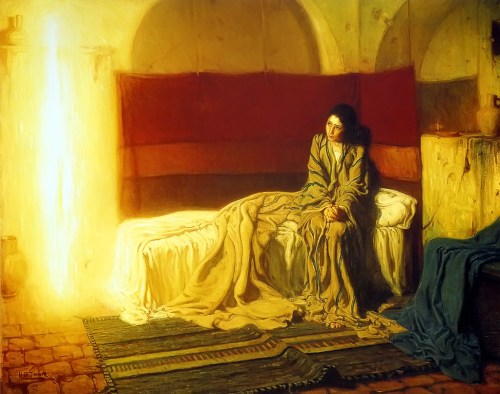
Annunciation by Henry Ossawa Tanner

… Christ Jesus: Who, being in the form of God, thought it not robbery to be equal with God: But made himself of no reputation, and took upon him the form of a servant, and was made in the likeness of men: (Philippians 2:5-7)

The Christmas season is upon us once again, and once more, I sense the dilemma of mixing the commercialization of the season by the world with the celebration of the First Advent. Any Christian well taught in Scripture recognizes that Jesus was not born on December 25, but thanks to the Catholics, we are stuck with that date. Regardless of how one feels about that, it is appropriate to set aside a special time to contemplate the magnitude of the miracle that is the Incarnation[1] – God becoming a man.

Consider our leading verse. No other religion[2] in the world makes the claim that their gods willingly depose themselves of all divine powers to assume the life of a human. Then, to top it off, offer themselves as a blood sacrifice in order to save the lowly human race. However, contemplate seriously the significance of these words of Scripture.

“Christ Jesus” – the anointed Savior (meaning of the name) – “who being in the form of God.” The Greek word translated “form” is morphē, and it means “shape” or “nature.” The Apostle John calls Jesus “the Word.” He wrote, “In the beginning was the Word, and the Word was with God, and the Word was God: (John 1:1, emphasis mine). In the Greek, the phrase “the Word was God” literally reads, “God was the Word” — θεος ην ο λογος. What a thing!

Though He was in every way, in very nature, God, He “Thought it not robbery to be equal with God.” Verse 8 clarifies this phrase when it explains that Jesus “humbled Himself.” He did not regard it robbery to lay aside His Divine nature and assume human form in order to redeem fallen humanity. What a Thing!

“He made Himself of no reputation.” This entire phrase is summed up in one Greek word, εκενωσεν (hekenoōsen), which means, “He emptied Himself” without any sense of deprivation. In exchange, “He took upon Himself the morphē (see above) of a servant” – doulos – a “slave.” He “was made in the likeness of men.” The Greek word translated “likeness” is homoiōma meaning “resemblance.” So, not only did He take on the “nature” of man, He “looked” like any other man. There was no halo around Him to distinguish Him from any other man. Of Him Isaiah the prophet said, “he hath no form nor comeliness; and when we shall see him, there is no beauty that we should desire him” (Isaiah 53:2, emphasis mine). The Hebrew word translated “comeliness” is hâdâr meaning “magnificence,” and “beauty” is the Hebrew word mar-eh’ meaning a “handsome appearance.” So much for those soft-faced images of Jesus, we are so used to seeing! It was not enough that He condescended from His Divine nature to assume the nature of an ordinary, common-looking man, but He took the form of the lowliest kind of man – a slave. Not only did He come as a slave, but He chose a peasant girl for a mother and a stable for His birthplace.[3] What a THING!

The passage goes on to say, “And being found in fashion as a man, he humbled himself, and became obedient unto death, even the death of the cross” (Philippians 2:8, emphasis mine). “Fashion” is the Greek word, schēma and it means the “mode, circumstance, or external condition.” The Bible tells us that “the wages of sin is death” (Romans 6:23). Man must die eternally to pay the penalty for sin. Unless some sinless one can be found to serve as a suitable sacrifice for all of mankind, every one of us must pay “the wages of sin.”[4] Who could qualify as a suitable sacrifice? “As it is written, There is none righteous, no, not one … For all have sinned, and come short of the glory of God” (Romans 3:10, 23). Therefore, God clad Himself in human flesh and took the penalty for universal sin upon Himself. However, His death was not enough. He conquered death when He rose from the grave on the third day. He paid the sin debt that we owe and broke the curse of death[5] with His resurrection. WHAT A THING!

This Christmas, regardless of the commercialization of the season and regardless of the fact that Jesus was not born on December 25, God’s gift of salvation freely offered to all who will accept it, is worthy of commemoration and celebration. “This is a faithful saying, and worthy of all acceptation, that Christ Jesus came into the world to save sinners; of whom I am chief” (1 Timothy 1:15, emphasis mine). WHAT A THING!!

Merry Christmas!

Notes:


[1] “Miracle of the Incarnation” – https://erniecarrasco.com/2012/12/24/miracle-of-the-incarnation/

[2]  “False Religion” – https://erniecarrasco.com/2014/07/27/false-religion/

[3]  “Extreme Measures” – https://erniecarrasco.com/2016/12/11/extreme-measures/

[4]  “Eternal Sacrifice” – https://erniecarrasco.com/2012/09/30/eternal-sacrifice/

[5]  “Why Jesus?” – https://erniecarrasco.com/2015/12/13/why-jesus/

5 Comments

Filed under Apologetics, Bible, Christianity, Christmas, Evangelism, Gospel, Holidays, Religion, Theology

Light From Afar

… he made the stars also. (Genesis 1:16)

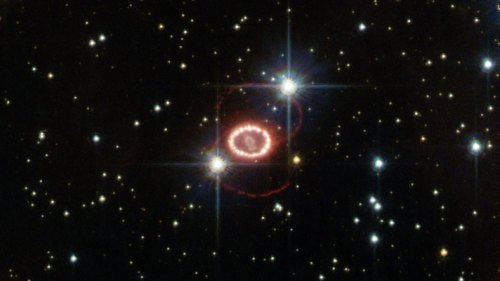
The question about the age of the universe is certainly a hotly debated question among both young earth and old earth creationists. Young earth creationists affirm and accept the literal account recorded in Genesis.[1] Old earth creationists accept that God is Creator, but they accommodate long ages because they are convinced that “science” has “proven” that the universe is old. They arrive at this conclusion because we see light from stars and galaxies that are billions of lightyears away from us. The “proof” is questionable, but that is a separate matter.

If one considers God’s account of creation recorded in the first chapter of Genesis, one notes that all things, plants, sea creatures, avian life, land creatures and even humans were all created fully mature and immediately able to reproduce (“the seed is in itself”). The earth itself was created, formed, and organized in the first three days of creation (Genesis 1:1-13). The Bible gives no indication that these were long periods of time.[2] When God records the day (Hebrew yom), He uses the word normally understood as a 24-hour day. By assigning an ordinal number to modify the day (first day, second day, third day, etc.), He further qualifies the day as a normal 24-hour day. If that is not enough, He further defines the day by “evening and morning” indicating a normal 24-hour day.

Some may want to argue that, but their argument is against God’s Word, and that is reminiscent of the first words from the tempter’s mouth: “Yea, hath God said…?” (Genesis 3:1).

With all of that in mind, look again at Genesis 1:14-19, Day Four of creation. In God’s account of creation, God created the earth first, then the other heavenly bodies beginning with the sun and moon and finally He “created the stars also” (v. 16). This in itself contradicts the notion of a Big Bang. Verse 15 establishes the purpose for the heavenly bodies: Lit. “to light over the earth.” In the KJV verse 17 reads: “And God set them [the stars] in the firmament of the heaven to give light upon the earth.” The Hebrew word translated “set” is nâthan, which means “to give.” A strict translation of the verse would read: “God gave them in the expanse of the heavens to light over the earth.” As with all of God’s creation, the light of the stars upon the earth was created in place and fully mature. This eliminates any discussion about how long it takes for light from distant stars to arrive on earth. It makes the argument irrelevant. Whatever is now is not what it was in the beginning.

Notes:


[1]  “The Universe is Young” https://erniecarrasco.com/2017/05/21/the-universe-is-young/

[2]  “The Bible Says” https://erniecarrasco.com/2016/04/03/the-bible-says/

1 Comment

Filed under Apologetics, Creation, Origins, Religion, Science

Creation Ex Nihilo

A Picture of Nothing

In the beginning God created the heaven and the earth. (Genesis 1:1)

It seems strange to me when people readily accept the origin of the universe from a Big Bang, yet balk at the suggestion that God created the universe out of nothing – ex nihilo – simply by speaking it into existence. Even Christians who claim to believe that every word of the Bible as inerrant and infallible fall prey to the notion that God somehow initiated and used the Big Bang to create over billions of years of time.

Recently the Institute for Creation Research (ICR) published an article,[1] which raised questions in one reader’s mind. He wrote:

Since God is omnipotent, omniscient, and omnipresent, doesn’t it make more sense to think that either…

  • God first created nothingness?
  • He created time at the same time as nothingness?
  • As He was everything, from within Himself He created everything?

Another question I have regards the space/time/matter continuum. While our human minds at present can’t conceive of the three dimensions going on into infinity in both directions, doesn’t it stand to reason to think that the universe and its three dimensions is endless in both directions?

I am not sure what he meant by his last question. He affirms (at least by our understanding) a three-dimensional universe, but then he questions the three-dimensional universe being infinite (endless) in “both directions.” That suggests only two dimensions. He seems confused, as often happens when we “over think” things that are beyond our understanding.

Our problem in a question like this is that we tend to think of God from our limited human perspective. As theologians like to describe God, He is totally “other,” i.e., He is nothing like us, and we have nothing outside of His Word with which to compare Him. This is why His second commandment prohibits that we make an image of Him (Exodus 20:4). It would be impossible for any image to accurately depict God in His fullness.

When we say God is eternal,[2] we sometimes view “eternity”[3] with some kind of cosmic clock[4] in mind, but that would confine God to time. God is timeless. He has no past, present or future; He simply “is.” That is why when Moses asked His name, He responded, “I AM” (Exodus 3:11). He is the All-Existent One. His omnipresence means more than He is everywhere at all times; it means that He exists IN all times, i.e., He is in our past, present and future all at once. This explains why He knows the future before it happens. This is also why our sin bears eternal consequences. Our sin is an infinite offense to God.

When we understand that, we can look at Genesis 1:1 and see that “In the beginning (time) God created (bara – only used in reference to God creating) the heavens (space) and the earth (matter/energy),” ergo, the universe. God created time. There would be no universe without time – i.e., the space-time continuum to which the writer referred. The universe, like God, is a trinity; time, space and matter/energy must all exist simultaneously for the universe to exist. Remove any one of the three components, and the universe ceases. God created time “in the beginning.”

The Bible does not specifically say that God created out of nothing (“ex nihilo” is the theological term we use to describe God’s creation), but the implication that there was nothing before verse 1 of Genesis is certainly there. When God confronts Job’s questions, He responds, “Where wast thou when I laid the foundations of the earth? declare, if thou hast understanding” (Job 38:4). What are “the foundations of the earth,” if not the basic elements of the universe? Obviously, we have no way of knowing precisely “how” God did it. The Bible encourages us to rest in the fact that God brought it all about “In the beginning.” “The secret things belong unto the LORD our God: but those things which are revealed belong unto us and to our children for ever, that we may do all the words of this law” (Deuteronomy 29:29).

On the final question, the universe is not infinite for the very reason that it was created. Nothing that is created can be infinite. Only God is infinite; everything else is finite.

When we think on that, “What is man, that thou art mindful of him? and the son of man, that thou visitest him?” (Psalm 8:4). Yes, as immeasurably great as God is, He took on human form and condescended to us, His creation, to dwell among us, take on the eternal offense of our sin, and pay for it with His death on the cross so that we might share eternity with Him. After all He has done for us, “How shall we escape, if we neglect so great salvation” (Hebrews 2:3)? Thank God for His infinite love!

Notes:


[1]  “The Universe Out of Nothing” – https://www.icr.org/article/10286

[2]  “The Eternality of God” – https://erniecarrasco.com/2017/06/04/the-eternality-of-god/

[3]  “Time Confusion” – https://erniecarrasco.com/2016/07/31/time-confusion/

[4]  “No Time Like the Present” – https://erniecarrasco.com/2015/01/18/no-time-like-the-present/

2 Comments

Filed under Apologetics, Christianity, Creation, Evolution, Gospel, Origins, Religion, Salvation, Theology