Category Archives: Apologetics

Is the Law Sin?

The Law

What shall we say then? Is the law sin? (Romans 7:7)

In recent years I have heard Christians reject the Old Testament as if it no longer applies. One young man tattooed the inside of his left arm with: ουδεν αρα νυν κατακριμα τοις εν χριστω ιησου. In case you do not read Koine Greek, it says, “Therefore there is now no condemnation for those who are in Christ Jesus.” (Romans 8:1, NASB). This reading is translated from the liberal Westcott-Hort Greek New Testament. That text omits the phrase: μη κατα σαρκα περιπατουσιν αλλα κατα πνευμα – “who walk not after the flesh, but after the Spirit” (Romans 8:1, KJV). This additional phrase is included in the Textus Receptus Greek New Testament from which the KJV is translated. (Bear with me; there is a point to this.) When I pointed out the biblical prohibition against tattoos (Leviticus 19:28) to this young man, a seminary student at the time, he lashed out at me pointing out that we are not under Law, but under Grace. Then when I pointed out the missing phrase in his tattoo, he lashed out against the King James Bible. Hmm! The missing phrase “who walk not after the flesh, but after the Spirit” suddenly takes on greater significance. Perhaps the compilers of the Westcott-Hort Greek New Testament did not like that phrase either.

So Paul asks an important question: “Is the Law Sin?” Judging from this seminary student’s reaction the answer must be, “Yes!” But what does Paul say? “God forbid. Nay, I had not known sin, but by the law: for I had not known lust, except the law had said, Thou shalt not covet” (Romans 7:7, emphasis added). So, where do we get the idea that we are to disregard the Law contained in the Old Testament? Jesus quoted from the Old Testament exclusively. Of course, that was all that existed at the time, but He never gave any indication that it no longer applied. In like manner, all the New Testament writers referred constantly to the Old Testament and never hinted that it was passé. In writing to Timothy, Paul affirms that “All scripture is given by inspiration of God, and is profitable for doctrine, for reproof, for correction, for instruction in righteousness” (2 Timothy 3:16, emphasis added). When he penned these words, there was no New Testament, only the Old. Instead of rejecting the Law, Paul says that “the law is holy, and the commandment holy, and just, and good” (Romans 7:12).

Salvation does not come through the keeping of the Law. That is impossible. “For whosoever shall keep the whole law, and yet offend in one point, he is guilty of all” (James 2:10). We know that “by grace are ye saved through faith; and that not of yourselves: it is the gift of God: Not of works [of the law], lest any man should boast” (Ephesian 2:8-9, emphasis added). So, does the Law serve any purpose? Paul seems to think so. “Was then that which is good made death unto me? God forbid. But sin, that it might appear sin, working death in me by that which is good; that sin by the commandment might become exceeding sinful” (Romans 7:13, emphasis added). The purpose of the law is to shine a spotlight on what is sin.

The Christian is saved by Grace, not by attempting to keep the Law (which is impossible to do), but the Law should be to the Christian a guide as to what God regards as sinful. God wants His children to be holy – set apart from the world, and the Law guides us to what pleases God. Can we keep the law flawlessly? Probably not, but we have the assurance that “If we confess our sins, he is faithful and just to forgive us our sins, and to cleanse us from all unrighteousness” (1 John 1:9). But how can we confess, if we do not know that we sinned? The Law helps us see that.

That young seminary student thought his tattoo would be a great witnessing tool. I venture to say (although I do not know for sure) that his tattoo has not helped him lead a single person to Christ. Perhaps, if he had taken to heart the omitted qualifying phrase in Romans 8:1 – “who walk not after the flesh, but after the Spirit” – he would not have violated the commandment against tattoos. I do not question the young man’s salvation, and I fully understand his motive however misguided; but when Paul said, “I am made all things to all men, that I might by all means save some” (1 Corinthians 9:22), I doubt that he meant for us to go out and get tattoos in order to win over tattooed people.

Is the Law sin? No, but it serves to show us what sin is and what we should avoid. God does not change (Malachi 3:6), and He has always expected holiness from His people. “But as he which hath called you is holy, so be ye holy in all manner of conversation; Because it is written, Be ye holy; for I am holy” (1 Peter 1:15-16). The Law is not sin; it reveals sin. The Law should be heeded, not disregarded.


3 Comments

Filed under Apologetics, Christianity, Evangelism, Gospel, Religion, Salvation, Theology

Be Ye Holy

Image Credit: Rob Birkbeck

Image Credit: Rob Birkbeck

Sanctify yourselves therefore, and be ye holy: for I am the LORD your God. (Leviticus 20:7)

First of all, I need to emphasize that I believe in salvation by grace alone, through faith alone apart from any works of the flesh (Ephesians 2:8-9; Romans 3:20; 11:6; Galatians 2:16; Titus 3:5). In addition, salvation cannot be maintained through any effort on our part, but it is dependent on the object of our faith, the Lord Jesus Christ, and His ability and faithfulness to keep His promises. Jesus said, “My sheep hear my voice, and I know them, and they follow me: And I give unto them eternal life; and they shall never perish, neither shall any man pluck them out of my hand. My Father, which gave them me, is greater than all; and no man is able to pluck them out of my Father’s hand” (John 10:27-29, emphasis added). Paul asks, “Who shall separate us from the love of Christ?” (Romans 8:3). Then he provides a long list of possibilities before answering, “Nay, in all these things we are more than conquerors through him that loved us. For I am persuaded, that neither death, nor life, nor angels, nor principalities, nor powers, nor things present, nor things to come, Nor height, nor depth, nor any other creature, shall be able to separate us from the love of God, which is in Christ Jesus our Lord” (Romans 8:37-39).

That said, as His children, God still expects us to live “holy” lives. Our opening verse comes from the Old Testament law, and it was directed at the Children of Israel. Many Christians will object: “That’s Old Testament! We are ‘New Testament’ Christians. We are not under the Law; we are under Grace!” Well, what does the New Testament say? Jesus said, “If ye love me, keep my commandmentsHe that hath my commandments, and keepeth them, he it is that loveth me: and he that loveth me shall be loved of my Father, and I will love him, and will manifest myself to him” (John 14:15, 21, emphasis added). Then He makes Himself our example: “If ye keep my commandments, ye shall abide in my love; even as I have kept my Father’s commandments, and abide in his love” (John 15:10). Peter also echoes the words of the Old Testament when he says, “But as he [Jesus] which hath called you is holy, so be ye holy in all manner of conversation [i.e., “manner of life” or “life conduct”]; Because it is written, Be ye holy; for I am holy” (1 Peter 1:15-16). James, the brother of Jesus, puts it very plainly, “faith, if it hath not works, is dead, being alone” (James 2:17). James is not preaching a salvation of works, but rather calls for a practical, visible manifestation of the faith we claim. He explains: “Yea, a man may say, Thou hast faith, and I have works: shew me thy faith without thy works, and I will shew thee my faith by my works” (James 2:18). A very simple illustration of James’ premise is this: To convince my wife to marry me, I told her that I loved her. But once we are married, I never take her out, I never help her at home, I never pay any attention to her or listen to her; I go out and spend time with my friends and leave her at home alone. I stay out late at night and use our home as sort of a “flop house.” Could an outside observer testify that I really love my wife? That is the point James is making. True faith demonstrates some sort evidence to the genuineness of that faith.

So what does it mean to be “holy”? Does it mean living a sinless life? If that were even possible, what purpose would Christ’s death on the cross serve? Of all our godly examples from Scripture, not one lived a sinless life, except for Jesus Christ our Lord. Paul lamented, “O wretched man that I am! who shall deliver me from the body of this death?” (Romans 7:24). So, being “holy” does not equate to being “sinless.”

The word “holy” means to be set apart. When God commanded the Children of Israel to be holy, He intended them to be distinct from the nations that surrounded them. Modern Christians often make light of the Old Testament laws and reject them as not applicable to New Testament saints. But, other than the sacrificial laws which were done away with the sacrifice of Christ, many of those laws were put in place for the sole purpose of distinguishing the people of God from the people of the world. Take for example, the prohibition against piercings and tattoos: “Ye shall not make any cuttings in your flesh for the dead, nor print any marks upon you: I am the LORD” (Leviticus 19:28). Piercings, cuttings of the skin, tattoos, etc. were all common practices of the pagan nations that surrounded Israel. These kinds of markings are still considered “beautiful” with many primitive people today. God wanted His people to be different. I selected this one example because it is one of the most obvious that I see among Christians today – they are hard to hide. To me what this says is “I can make my body more beautiful than the one God made for me.” That aside, the point is that we have a lost generation out there that needs a Savior, and this is what they do. Christians, rather than set themselves “apart,” fall right in line with the rest of the lost world, and yet, God still calls His people to be “holy.”

“Holy” also means to be “sanctified” or “consecrated,” i.e., to be “dedicated” to the service of the Lord. That does not mean that we put on our “holy” garments on Sunday for worship and live the rest of the week serving ourselves – in whatever form that takes. “I beseech you therefore, brethren, by the mercies of God, that ye present your bodies a living sacrifice, holy, acceptable unto God, which is your reasonable service. And be not conformed to this world: but be ye transformed by the renewing of your mind, that ye may prove what is that good, and acceptable, and perfect, will of God” (Romans 12:1-2, emphasis added). A “living sacrifice” is a daily thing. Note that it is “holy” – distinct from the world around us. Our lives should not be conformed to the passing fads of this world, but rather our thinking should be “transformed” according to the pattern of our Savior. Our lifestyle, distinct and set apart from this world, will prove to the world, as James pointed out, “what is that good, and acceptable, and perfect, will of God.” For that Christian who thinks this cannot be done, you are correct. It cannot be done through your own strength, but by the Grace that comes from the indwelling Holy Spirit in our lives. Be ye holy.

1 Comment

Filed under Apologetics, Christianity, Evangelism, Gospel, Religion, Salvation, Theology

33. Evidence for God – Design Convinces Scientists 16 – Ben Carson 4 | Bible-Science Guy

Not ALL scientists believe in evolution!

33. Evidence for God – Design Convinces Scientists 16 – Ben Carson 4 | Bible-Science Guy.

Comments Off on 33. Evidence for God – Design Convinces Scientists 16 – Ben Carson 4 | Bible-Science Guy

Filed under Apologetics, Christianity, Creation, Evolution, Origins, Religion, Science

How Art Thou Fallen!

Angel of Light

How art thou fallen from heaven, O Lucifer, son of the morning! how art thou cut down to the ground, which didst weaken the nations! (Isaiah 14:12)

God deniers often challenge believers with the question of evil in the world. “If God is so good, why is there so much evil in the world?” Another closely linked question is “Why did God create Satan?” and “When did God create Satan?” My attempt to answer these questions follows.

God created Satan (his name is Lucifer) when He created the other angels. Angels were created early on during the week of creation (Genesis 1) – probably Day One or Day Two of creation. We get this from God’s response to Job’s questioning concerning the calamity that had befallen him. God asks Job:

Where wast thou when I laid the foundations of the earth? … When the morning stars sang together, and all the sons of God shouted for joy? (Job 38:4, 7, emphasis added)

“The morning stars” is used synonymously with “the sons of God” – Hebrew bene Elohim, which is used only in regard to angels in the Old Testament. From this we gather that the angels witnessed creation. Satan is included with “the sons of God.”

Now there was a day when the sons of God came to present themselves before the LORD, and Satan came also among them. (Job 1:6, emphasis added)

Again there was a day when the sons of God came to present themselves before the LORD, and Satan came also among them to present himself before the LORD. (Job 2:1, emphasis added)

Apparently by this time Satan, which means “accuser,” had already fallen, and he was actively attacking man. However, notice Who still has the final say – Satan still needed to get permission from God to attack Job. But when did Satan Fall? The Bible does not provide specific answers to this question, but we can at least conclude that it happened after creation was completed because we have God’s assessment of His finished product:

And God saw every thing that he had made, and, behold, it was very good. (Genesis 1:31, emphasis added).

God’s creation would not have been “very good,” if there were rebellion in the camp, and to suppose that perhaps God was unaware of a rebellion would be to deny God’s omniscience. So, sometime between God’s conclusion of creation and the Fall of man (Genesis 3), Satan rebelled against God. That brings up the question: Why would Satan rebel against God? We are given some hints in the books of Isaiah and Ezekiel.

How art thou fallen from heaven, O Lucifer, son of the morning! how art thou cut down to the ground, which didst weaken the nations! For thou hast said in thine heart, I will ascend into heaven, I will exalt my throne above the stars of God: I will sit also upon the mount of the congregation, in the sides of the north: I will ascend above the heights of the clouds; I will be like the most High. (Isaiah 14:12-14, emphasis added)

Thou [“king of Tyrus,” i.e., Satan] hast been in Eden the garden of God; every precious stone was thy covering, the sardius, topaz, and the diamond, the beryl, the onyx, and the jasper, the sapphire, the emerald, and the carbuncle, and gold: the workmanship of thy tabrets and of thy pipes was prepared in thee in the day that thou wast created. Thou art the anointed cherub that covereth; and I have set thee so: thou wast upon the holy mountain of God; thou hast walked up and down in the midst of the stones of fire. Thou wast perfect in thy ways from the day that thou wast created, till iniquity was found in thee. By the multitude of thy merchandise they have filled the midst of thee with violence, and thou hast sinned: therefore I will cast thee as profane out of the mountain of God: and I will destroy thee, O covering cherub, from the midst of the stones of fire. Thine heart was lifted up because of thy beauty, thou hast corrupted thy wisdom by reason of thy brightness: I will cast thee to the ground, I will lay thee before kings, that they may behold thee. (Ezekiel 28:13-17, emphasis added)

From this, especially from the Ezekiel passage, we can infer that Lucifer (“the king of Tyrus” i.e., Satan) was a high ranking angel – very likely an archangel. He was obviously very beautiful as his “covering” is described as beautiful gem stones. His name, Lucifer, means “shining one” or “day star,” therefore he must have been quite dazzling – very unlike the images of Satan we see depicted today. Notice also that his “sin” was the same sin with which he tempted Eve in the Garden: “ye shall be as gods, knowing good and evil” (Genesis 3:5).

Only three angels are named in the Bible: Lucifer, Michael, and Gabriel. Since these are the only three named, it is quite possible that these are the only archangels that God created. I arrive at this conclusion from what we read of the fall of Satan (the “old dragon”) found in Revelation 12:

And there appeared another wonder in heaven; and behold a great red dragon, having seven heads and ten horns, and seven crowns upon his heads. And his tail drew the third part of the stars of heaven, and did cast them to the earth: and the dragon stood before the woman which was ready to be delivered, for to devour her child as soon as it was born. (Revelation 12:3-4, emphasis added)

As noted in the Job passages above, angels are sometimes referred to as “stars.” That Satan drew “the third part of the stars of heaven” along with him indicates to me that these were the angels that were under his command, leaving the remaining two-thirds under the command of Michael and Gabriel.

It is conjecture on my part, but I believe the reason Satan rebelled was because he became jealous of man who was created in the image of God and given dominion over God’s creation.

And God said, Let us make man in our image, after our likeness: and let them have dominion over the fish of the sea, and over the fowl of the air, and over the cattle, and over all the earth, and over every creeping thing that creepeth upon the earth. So God created man in his own image, in the image of God created he him; male and female created he them. And God blessed them, and God said unto them, Be fruitful, and multiply, and replenish the earth, and subdue it: and have dominion over the fish of the sea, and over the fowl of the air, and over every living thing that moveth upon the earth. (Genesis 1:26-28, emphasis added)

Angels were not created in the image of God, nor were they given charge over God’s creation. That distinction was given to man; therefore Satan became jealous and plotted to cause man to fall. He thought “of himself more highly than he ought to think” (Romans 12:3) as described in the Isaiah and Ezekiel passages above. His sin was not in his thought, but in acting upon his thought and carrying out his plan to cause man to sin. This is probably where Satan fell.

There is evil in the world because of sin – rebellion – which was first birthed in the mind of Satan and brought to full fruition through man’s disobedience. Some may object that God should not have given man occasion to disobey by placing the tree of the knowledge good and evil in the garden, but love is a choice. God also provided another tree on a hill called Calvary. From that tree we are free to partake, “For God so loved the world, that he gave his only begotten Son, that whosoever believeth in him should not perish, but have everlasting life” (John 3:16). Love is a choice.

Comments Off on How Art Thou Fallen!

Filed under Apologetics, Atheism, Christianity, Creation, Evangelism, Gospel, Heaven, Hell, Origins, Religion, Salvation, Satan, Theology

The Invisible, Visible God

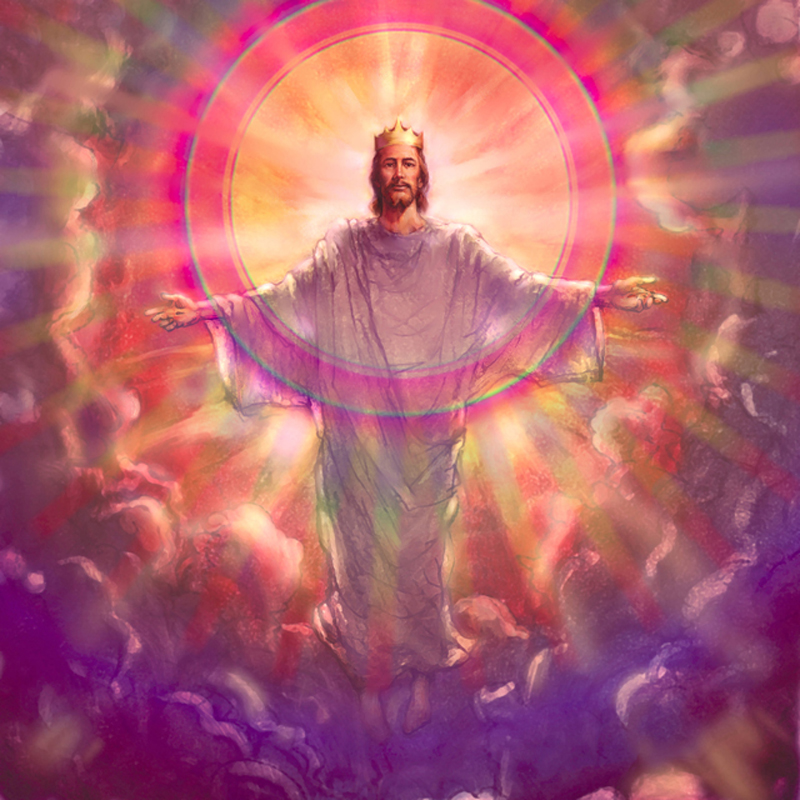
The Glorified Christ

Who is the image of the invisible God, the firstborn of every creature (Colossians 1:15)

The Trinity, or the triune nature of God, is a difficult concept to grasp even for Christians. It is no wonder that Jehovah’s Witnesses and Muslims accuse Trinitarian Christians of polytheism. While we believe in one God manifested in three persons, in our conversations we treat the three persons as three separate entities, but they (He) are (is) not.

God created man “in our image, after our likeness” (Genesis 1:26, emphasis added). Man has a triune nature composed of mind, spirit/soul, body, as does God, but we do not think of ourselves as three separate entities. This thought occurred in my mind, my spirit motivated me to write it down, and my fingers, i.e., my body, carried out the will of my mind, yet I am the one writing this.

To the woman at the well, Jesus said, “God is a Spirit: and they that worship him must worship him in spirit and in truth” (John 4:24, emphasis added). A spirit is invisible. Likewise, you might be able to dissect my body and inspect my brains, but you can’t see my mind. John says, “No man hath seen God at any time; the only begotten Son, which is in the bosom of the Father, he hath declared him” (John 1:18). “Declared” translates the Greek word exegeomai from which we get our word “exegete,” and it means to explain, make known, or reveal. In His last hours before His crucifixion, one of His disciples, Philip, asked Jesus, “Lord, shew us the Father, and it sufficeth us. Jesus saith unto him, Have I been so long time with you, and yet hast thou not known me, Philip? he that hath seen me hath seen the Father; and how sayest thou then, Shew us the Father?” (John 14:8-9, emphasis added). The two, actually the three, are inseparable. Were someone to ask me, “Show me your mind.” If they were someone with whom I was well acquainted, I might reply, “As long as you have been around me, you know how I think, you know how I act – if you have seen me, you have seen my mind!” As our leading verse expresses, Jesus is the very image of God.

As I consider this, I recall that many in the Old Testament saw God, beginning with Adam and Eve. In Genesis 3, after the first couple disobeyed God, “And they heard the voice of the LORD God walking in the garden in the cool of the day: and Adam and his wife hid themselves from the presence of the LORD God amongst the trees of the garden” (Genesis 3:8, emphasis added). Would a “spirit” make any kind of sound while walking or would a spirit have the need to “walk”? Possibly, but probably not. I conjecture that God in this case appeared as the pre-incarnate Christ. There are some who suggest that the first humans were clothed in “light” and that when they ate of the fruit, the light was extinguished and they saw their naked bodies for the first time. The Bible often describes God as surrounded by dazzling light. It makes sense, therefore, that the couple felt shame because they were no longer clothed as their maker. I further conjecture that in order for God (Christ) to clothe the couple, He personally, in physical form, had to slay the animals that would be used to cover His fallen creatures. (As an aside: He didn’t do the same for Satan when he rebelled.) This pattern of “sacrifice” would be followed by Adam and his descendants from then on. (See the sacrifices of Cain and Abel in Genesis 4:3-5.) Later, Abraham had personal encounters with the pre-incarnate Christ: Genesis 12:7; Melchizedek in Genesis 14:17-20; the “angel” in Genesis 18, etc.

There are many more examples of this in the Old Testament that would take an entire study, but as I continued to ponder this, I was reminded of Isaiah’s encounter with God. “In the year that king Uzziah died I saw also the Lord sitting upon a throne, high and lifted up, and his train filled the temple” (Isaiah 6:1, emphasis added). Did Isaiah see a spirit? Does a spirit sit on a throne? Does a spirit wear a kingly robe with a long train? These are physical attributes. I think Isaiah saw the physical manifestation of God, i.e., Christ. Ezekiel saw a similar manifestation of God. Ezekiel describes a most unusual craft that transports the spirit (Ezekiel 1:20-21) of God. But upon closer inspection, this “spirit” has physical attributes. Ezekiel reports, “And above the firmament that was over their heads was the likeness of a throne, as the appearance of a sapphire stone: and upon the likeness of the throne was the likeness as the appearance of a man above upon it. And I saw as the colour of amber, as the appearance of fire round about within it, from the appearance of his loins even upward, and from the appearance of his loins even downward, I saw as it were the appearance of fire, and it had brightness round about. As the appearance of the bow that is in the cloud in the day of rain, so was the appearance of the brightness round about. This was the appearance of the likeness of the glory of the LORD. And when I saw it, I fell upon my face, and I heard a voice of one that spake” (Ezekiel 1:26-28, emphasis added). (Just as an aside (again), it is interesting that whenever the Lord is seen displaying His glory, men fall down on their faces to worship – no raising hands and swaying bodies – for whatever that is worth.) The Apostle John describes a similar scene at his first view of the resurrected Christ (Revelation 1), and his first view of heaven (Revelation 4).

In each instance, God is given physical attributes. But how can a spirit have physical attributes? It cannot. Jesus is the embodiment of the Godhead. The three, Father, Son and Holy Spirit are manifested in the One, the Lord Jesus Christ in whose image we are made. Jesus is the invisible, visible God.

Comments Off on The Invisible, Visible God

Filed under Apologetics, Christianity, Religion, Theology