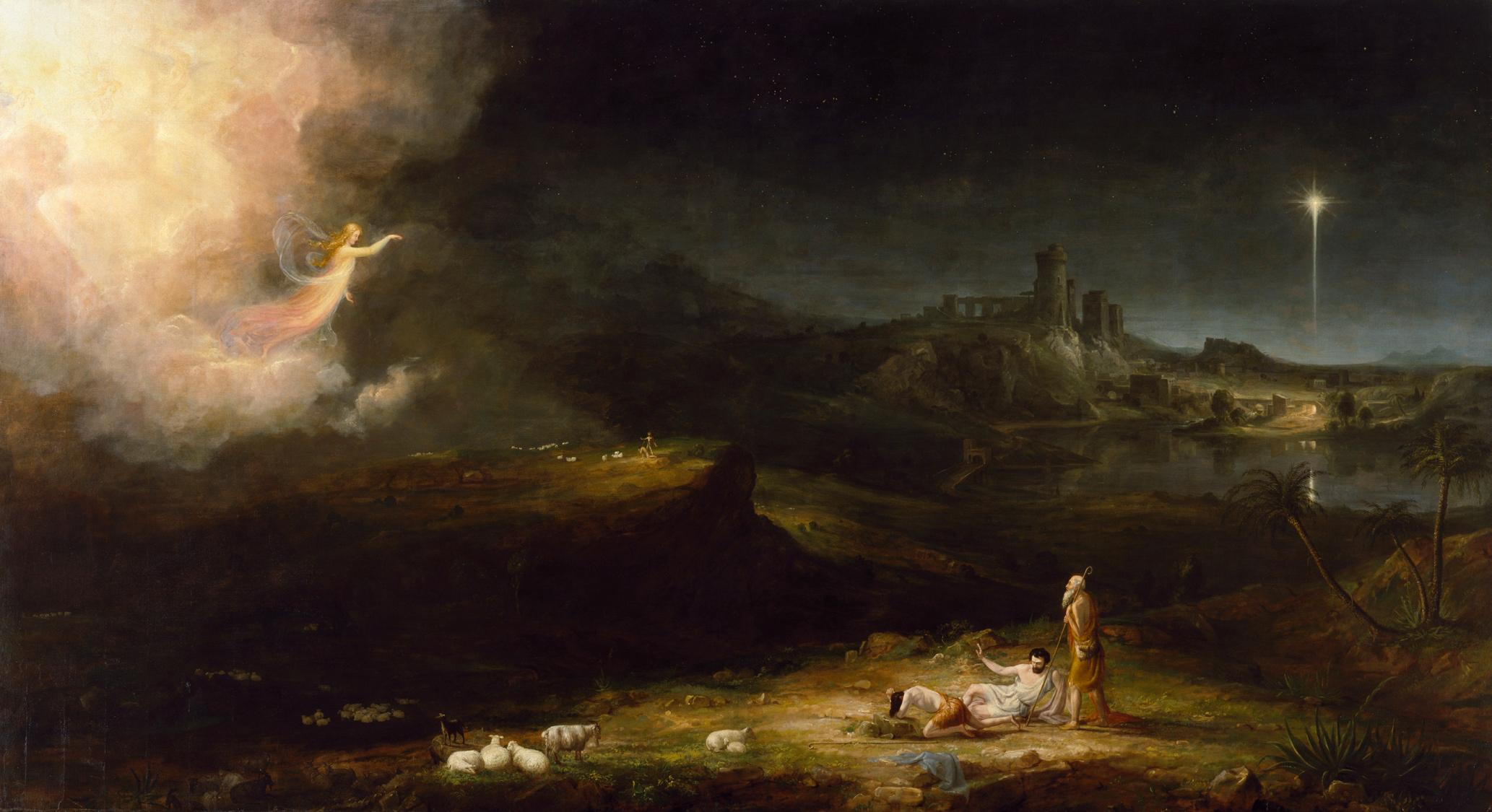
Glory to God in the highest, and on earth peace, good will toward men. (Luke 2:14)
I grew up listening to the Christmas account in the Gospel of Luke (Luke 2) in the language of the King James Version of the Holy Bible. Well, that is not entirely true. My first memories of the reading were from the Reina-Valera Spanish translation, but from the time I entered school in the first grade, it was the good old King James Bible. To this day, when I hear the reading from any other translation, it just does not sound the same. It loses something of the cadence and the poetic flow. I do not care; I just like the sound of the King James better.
I always pay close attention when Scripture is read, and lately, the reading of Luke 2:14 has troubled me. Here are some examples from modern translations. I will emphasize the portion that bothers me.
“Glory to God in the highest heaven, and on earth peace to those on whom his favor rests.” (NIV)
“Glory to God in the highest and on earth peace to those on whom his favor rests.” (NABRE)
“Glory to God in highest heaven, and peace on earth to those with whom God is pleased.” (NLT)
“Glory to God in the highest heaven, and on earth peace among those whom he favors!” (NRSVUE)
“Give glory to God in heaven, and on earth let there be peace among the people who please God.” (NCV)
“Glory to God in the highest, and on earth peace among those with whom he is pleased!” (ESV)
Above are just some of the more popular modern translations. I did not quote the New King James Version (NKJV) because it reads pretty much like the KJV on this verse. So, what is the problem? Notice the phrases I emphasized. All of these seem to offer peace only to those whom God has favored. Wait a minute! What about all the others that fall outside of those boundaries? Is God’s favor withheld from some and lavished only on a select few that for whatever reason known only to God meet certain criteria?
As quoted above, the KJV (and the NKJV) read, “Glory to God in the highest, and on earth peace, good will toward men.” There are no exceptions. God’s peace and His goodwill are meant for all men, not just those who have found special favor with Him. All men!
Those who would defend the modern translations will say that those translations have been translated from “older and better (Greek) texts.” Most of us accept such statements as factual because they come from well-studied “scholars” – experts. We take it for granted that they are right. But, are they? The only way to know for certain is to look at the original language.
Here is Luke 2:14 in the original Greek: δοξα εν υψιστοις θεω και επι γης ειρηνη εν ανθρωποις ευδοκια. I know most of my readers do not read Greek, so I will translate.
There you have it. The news, the peace, and the goodwill are not only for a select, favored few, but to all mankind. The KJV has it right, the other translations have added to Scripture, a practice that is strongly condemned in Scripture.
The good news of Christmas is for all mankind. Do you know the Peace of Christmas? If not, please read my page on “Securing Eternal Life.”
Pray for the peace of Jerusalem: they shall prosper that love thee. (Psalm 122:6)
In Sunday School, our pastor is leading us through a study from John Owen’s book, Rules for Walking in Fellowship.
Owen was by common consent the weightiest Puritan theologian, and many would bracket him with Jonathan Edwards as one of the greatest Reformed theologians of all time. Born in 1616, he entered Queen’s College, Oxford, at the age of twelve and secured his M.A. in 1635, when he was nineteen. In his early twenties, conviction of sin threw him into such turmoil that for three months he could scarcely utter a coherent word on anything; but slowly he learned to trust Christ, and so found peace. In 1637 he became a pastor; in the 1640s he was chaplain to Oliver Cromwell, and in 1651 he was made Dean of Christ Church, Oxford’s largest college. In 1652 he was given the additional post of Vice-Chancellor of the University, which he then reorganized with conspicuous success. After 1660 he led the Independents through the bitter years of persecution till his death in 1683. —J. I. Packer[1]
In our pastor’s absence, I was asked to bring this Sunday’s lesson from the book. It is indeed a very good lesson entitled “Bearing One Another’s Burdens,” which is the 15th chapter in Owens’ book. At the end of the lesson, Owens gives directions on how to apply the principles in the lesson. For the first direction, Owens says, “A proper valuing, strong desire, and high esteem of the church’s prosperity, in every member of it (Ps. 122:6)” – (emphasis mine).
I do not know a lot about John Owens other than he was and is a highly regarded reformed theologian and Puritan preacher. I do not know what his views were on eschatology (the study of end times), however, in the quote above, his use of Psalm 122:6 in connection to the church is misapplied.
I do not want to disparage such a great man of God as John Owen, but the verse, when taken literally as it should be, is speaking of Jerusalem not the Church. A parallel between Jerusalem and the church can certainly be drawn here in the form of allegory, but to make a direct connection cannot be supported if one takes the words of Scripture literally. Jerusalem/Israel is not the Church, nor is the Church Jerusalem/Israel.
In Owens’ defense, he was living at a time when Israel did not exist and had not existed for over 1500 years. Many theologians of that time believed that God had rejected Israel for their rejection of their Messiah and that the Church had replaced Israel. However, not all theologians took that position. Those that did not hold to that “replacement theology” believed that God would restore Israel in the end times. They came to this conclusion from the clear, literal teaching of the Old Testament prophets. I do not know to which camp Owens belonged, so I will withhold judgement.
I will, however, attempt to point out the error in “replacement theology” as concisely as possible. When one studies the Old Testament prophets, one quickly finds God’s repeated promises to (1) scatter Israel to the four corners of the earth, (2) to draw them back into their own land, (3) to restore the nation of Israel once again, and (4) to save the remanent of Israel in the “latter days.” The following is just a small sample of God’s promises to Israel.
And the LORD shall scatter you [Israel] among the nations, and ye shall be left few in number among the heathen, whither the LORD shall lead you. (Deuteronomy 4:27)
And it shall come to pass, that as the LORD rejoiced over you [Israel] to do you good, and to multiply you; so the LORD will rejoice over you to destroy you, and to bring you to nought; and ye shall be plucked from off the land whither thou goest to possess it. And the LORD shall scatter thee among all people, from the one end of the earth even unto the other; and there thou shalt serve other gods, which neither thou nor thy fathers have known, even wood and stone. And among these nations shalt thou find no ease, neither shall the sole of thy foot have rest: but the LORD shall give thee there a trembling heart, and failing of eyes, and sorrow of mind: And thy life shall hang in doubt before thee; and thou shalt fear day and night, and shalt have none assurance of thy life: In the morning thou shalt say, Would God it were even! and at even thou shalt say, Would God it were morning! for the fear of thine heart wherewith thou shalt fear, and for the sight of thine eyes which thou shalt see. (Deuteronomy 28:63-67)
And it shall come to pass, when all these things are come upon thee, the blessing and the curse, which I have set before thee, and thou shalt call them to mind among all the nations, whither the LORD thy God hath driven thee, And shalt return unto the LORD thy God, and shalt obey his voice according to all that I command thee this day, thou and thy children, with all thine heart, and with all thy soul; That then the LORD thy God will turn thy captivity, and have compassion upon thee, and will return and gather thee from all the nations, whither the LORD thy God hath scattered thee. If any of thine be driven out unto the outmost parts of heaven, from thence will the LORD thy God gather thee, and from thence will he fetch thee: And the LORD thy God will bring thee into the land which thy fathers possessed, and thou shalt possess it; and he will do thee good, and multiply thee above thy fathers. And the LORD thy God will circumcise thine heart, and the heart of thy seed, to love the LORD thy God with all thine heart, and with all thy soul, that thou mayest live. (Deuteronomy 30:1-6)
And it shall come to pass in the last days, that the mountain of the LORD’S house shall be established in the top of the mountains, and shall be exalted above the hills; and all nations shall flow unto it. And many people shall go and say, Come ye, and let us go up to the mountain of the LORD, to the house of the God of Jacob; and he will teach us of his ways, and we will walk in his paths: for out of Zion shall go forth the law, and the word of the LORD from Jerusalem. And he shall judge among the nations, and shall rebuke many people: and they shall beat their swords into plowshares, and their spears into pruninghooks: nation shall not lift up sword against nation, neither shall they learn war any more. (Isaiah 2:2-4)
The remnant shall return, even the remnant of Jacob, unto the mighty God. For though thy people Israel be as the sand of the sea, yet a remnant of them shall return: the consumption decreed shall overflow with righteousness. (Isaiah 10:21-22)
Fear not: for I am with thee: I will bring thy seed from the east, and gather thee from the west; I will say to the north, Give up; and to the south, Keep not back: bring my sons from far, and my daughters from the ends of the earth; Even every one that is called by my name: for I have created him for my glory, I have formed him; yea, I have made him. (Isaiah 43:5-7)
Behold, these shall come from far: and, lo, these from the north and from the west; and these from the land of Sinim. Sing, O heavens; and be joyful, O earth; and break forth into singing, O mountains: for the LORD hath comforted his people, and will have mercy upon his afflicted. But Zion said, The LORD hath forsaken me, and my Lord hath forgotten me. Can a woman forget her sucking child, that she should not have compassion on the son of her womb? yea, they may forget, yet will I not forget thee. Behold, I have graven thee upon the palms of my hands; thy walls are continually before me. (Isaiah 49:12-16)
No weapon that is formed against thee shall prosper; and every tongue that shall rise against thee in judgment thou shalt condemn. This is the heritage of the servants of the LORD, and their righteousness is of me, saith the LORD. (Isaiah 54:17)
And they shall build the old wastes, they shall raise up the former desolations, and they shall repair the waste cities, the desolations of many generations. And strangers shall stand and feed your flocks, and the sons of the alien shall be your plowmen and your vinedressers. But ye shall be named the Priests of the LORD: men shall call you the Ministers of our God: ye shall eat the riches of the Gentiles, and in their glory shall ye boast yourselves. (Isaiah 61:4-6)
Who hath heard such a thing? who hath seen such things? Shall the earth be made to bring forth in one day? or shall a nation be born at once? for as soon as Zion travailed, she brought forth her children. Shall I bring to the birth, and not cause to bring forth? saith the LORD: shall I cause to bring forth, and shut the womb? saith thy God. Rejoice ye with Jerusalem, and be glad with her, all ye that love her: rejoice for joy with her, all ye that mourn for her: (Isaiah 66:8-10)
At that time they shall call Jerusalem the throne of the LORD; and all the nations shall be gathered unto it, to the name of the LORD, to Jerusalem: neither shall they walk any more after the imagination of their evil heart. In those days the house of Judah shall walk with the house of Israel, and they shall come together out of the land of the north to the land that I have given for an inheritance unto your fathers. (Jeremiah 3:17-18)
I will scatter them also among the heathen, whom neither they nor their fathers have known: and I will send a sword after them, till I have consumed them. (Jeremiah 9:16)
And I will gather the remnant of my flock out of all countries whither I have driven them, and will bring them again to their folds; and they shall be fruitful and increase. And I will set up shepherds over them which shall feed them: and they shall fear no more, nor be dismayed, neither shall they be lacking, saith the LORD … Therefore, behold, the days come, saith the LORD, that they shall no more say, The LORD liveth, which brought up the children of Israel out of the land of Egypt; But, The LORD liveth, which brought up and which led the seed of the house of Israel out of the north country, and from all countries whither I had driven them; and they shall dwell in their own land. (Jeremiah 23:3-4; 7-8)
There are more. Ezekiel 36 speaks of the scattering and regathering of Israel to and from the nations. Ezekiel 37 presents Israel as a valley of dry bones that God brings together and raises up into a mighty army. In that chapter, God also promises that the “two sticks” (Judah and Israel, the divided kingdoms) will reunite as one.
All of these prophecies deal with the nation of Israel, not the Church. Why is this important? It is important because the integrity of God is at stake. If God can break His covenant with Israel, what guarantee is there that He will keep His promises to the Church? Face it, the “Church” these days these days is not a pristine virgin!
Therefore, because God is faithful, He will keep His promises to Israel and to the Church as well. Israel and the Church are two separate entities, but salvation is the same for both. When the psalmist, David, says “Pray for the peace of Jerusalem,” there is only One Peace that can effectively apply and that is the Prince of Peace, the Lord Jesus Christ.[2]
So, in a way, Owens was correct in applying the psalm to the Church by way of allegory, but not in a literal sense. We are to pray for the “Peace of Jerusalem” because only He can bring true peace to the world. When we pray for the “Peace of Jerusalem,” we pray that the Lord will soon come and set up His kingdom on earth. “Thy kingdom come. Thy will be done in earth, as it is in heaven” (Matthew 6:10). As for the Church, the kingdom, in part, has already come and dwells within the heart of every believer and the Church as a whole by way of the Holy Spirit who gives us peace. Then, one day, perhaps very soon, we will enjoy His physical kingdom here on earth along with our Lord and Savior Jesus Christ. I can hardly wait!
Dear reader, do you know the Prince of Peace? If not, please read my page on “Securing Eternal Life.”
I beseech you therefore, brethren, by the mercies of God, that ye present your bodies a living sacrifice, holy, acceptable unto God, which is your reasonable service. And be not conformed to this world: but be ye transformed by the renewing of your mind, that ye may prove what is that good, and acceptable, and perfect, will of God. (Romans 12:1-2)
As our world grows continually darker, it becomes more and more difficult to distinguish between Christians and non-believers. Surely one can find “Christians” in church, but how about outside the walls of the church? Can you spot them? Very often, no clear distinction exists. Christians, by and large, behave much like unbelievers and often one will find non-believers doing “Christian” good deeds.
Vladimir Putin mounted his righteous steed and recently criticized the “west” – mainly the United States – for the immorality it was exporting to the rest of the world: homosexuality, pedophilia, pornography, gender dysphoria, abortion, etc. These sins provoke his hatred for the west, and he wants to protect Russia from such evil. His strong talk makes one think Putin is a righteous man and perhaps a strong Christian. His speech really puts us to shame. However, do not let his righteous blather fool you. Putin is a cold-blooded killer who has no regard for human life and has no problem killing innocent people.
One cannot judge the condition of a man’s heart by the words that exit his lips. On the other hand, one cannot necessarily judge a man’s heart by his “good” deeds “for by the works of the law shall no flesh be justified” (Galatians 2:16).
Yet, for the Christian, God has a standard of conduct that He expects from His children. “But ye are a chosen generation, a royal priesthood, an holy nation, a peculiar people; that ye should shew forth the praises of him who hath called you out of darkness into his marvellous light” (1 Peter 2:9, emphasis mine). Royalty carries with it certain expectations. “But as he which hath called you is holy, so be ye holy in all manner of conversation [i.e., “life conduct”]; Because it is written, Be ye holy; for I am holy” (1 Peter 1:15-16, emphasis mine). To be “holy” simply means to be set apart from the world; to be “consecrated,” i.e., set aside for the service of God.
So, there should be a clear distinction between a Christian and a non-believer. We may dress like the world – hopefully in modesty and not in a way to call attention to ourselves. However, the likeness should stop there. A Christian should not exhibit fear because of world conditions knowing that our Lord and our Redemption is very near; that should be a cause for joy, not dread. Our faces should express deep joy and peace. Our speech should be pure and free of profanity. “Finally, be ye all of one mind, having compassion one of another, love as brethren, be pitiful [i.e., “full of pit/compassion”], be courteous: Not rendering evil for evil, or railing for railing: but contrariwise blessing; knowing that ye are thereunto called, that ye should inherit a blessing” (1 Peter 3:8-9). More could be added to the list, but this should make the point.
How does one accomplish such a feat? Certainly not in our own strength or by our own efforts. Paul gives us the simple formula in our starting verses (Romans 12:1-2). Paul says to “present” your bodies. The word in the Greek means “to place a person or thing at one’s disposal.” Your body is that thing that transports your soul from place to place and is often the thing that carries you into sin by “the lust of the flesh” (1 John 2:16). We need to place our bodies at God’s disposal.
Your body needs to be a “living sacrifice.” Normally, a sacrifice must die. Paul says, “For I through the law am dead to the law, that I might live unto God. I am crucified with Christ: nevertheless I live; yet not I, but Christ liveth in me: and the life which I now live in the flesh I live by the faith of the Son of God, who loved me, and gave himself for me” (Galatians 2:19-20, emphasis mine). We are dead to sin and the law, but we are alive through faith in Christ who died for us. Hence, our sacrifice is a “living” one, and a “holy” one that is set apart for God.
Understanding what Jesus did on our behalf, it is logical (“reasonable”) that we should render our service or “worship” to God, and this is a pleasing and “acceptable” sacrifice or offering to Him.
In order to offer God an “acceptable” sacrifice, we must not “conform” or take the shape of this world. “World” translates the Greek word aiōn, meaning “an age.” “The word used here properly denotes an age, or generation of people.”[1] Do not allow this age, this world in which we live, to mold you into its form. Rather, be “transformed,” (i.e., metamorphosed) by the renewing of your mind. There is a new adage for the computer age that says “garbage in, garbage out.” What you put into your mind affects much of what you think and do. So, the opposite is also true: good things in/ good things out. That comes through the constant feeding on God’s Word and prayer. When you do this, you will “prove” (i.e., “test”) “what is that good, and acceptable, and perfect, will of God”
What is the “will of God”? “For whom [God] did foreknow [i.e., “His children], he also did predestinate to be conformed to the image of his Son, that he might be the firstborn among many brethren” (Romans 8:29, emphasis mine). Do you want to know what God’s will is for your life? There it is! His will is that you be “conformed,” not to this world, but to the “image of His Son.”
What shape have you taken on, that of the world or that of Christ? Please read my page on “Securing Eternal Life” and make sure you are in the right shape.
And I will establish my covenant with you; neither shall all flesh be cut off any more by the waters of a flood; neither shall there any more be a flood to destroy the earth. (Genesis 9:11)
Twenty-one years ago, the world gazed in shock as they watched endless replays of passenger jets flying into the Twin Towers in New York City. If that was not horrific enough, not much later another passenger jet flew into the Pentagon in Washington, DC. A fourth plane, destined either to the White House or the US Capitol building, crashed in a field near Shanksville, PA as a brave group of passengers fought to wrest control of the airplane from hijackers. The actions of those brave passengers cost them their lives and the lives of the others onboard, but it prevented a much worse outcome if the terrorists had succeeded.
Today we remember the events of that fateful day we have come to call 9-11. For a very brief time following those events, our nation was united as never before since at least World War II. For a while, Americans filled the pews of churches and for a moment, there was a feeling of revival. However, the revival was short-lived, and our nation quickly followed the path of the rest of the world into the depths of sin and depravity as this nation has never seen.
The list of sins is long and putrid, but the one that captured my mind was spot-lighted by 9-1-1; it is the sin of nature or earth worship. By earth-worship, I am referring to the Globalists’ agenda to “save the planet” from man-made climate change. The plan to save the planet is Satanic. From the beginning of creation, Satan has wanted to destroy the human race who was created in the image of God. Satan hates God, and he hates God’s most prized creation – the human race.
Globalists are not so much interested in saving the planet as they are in eliminating the majority of the human race and controlling those who remain. If they were serious about their concern for the planet, they would set the example by riding their bicycles rather than flying in private jets, and they would build their carbon-hogging mansions as far away from the sea coasts as possible in case the ocean levels really rise as they claim. However, climate change or global warming is not really their concern. They fancy themselves as the ruling elites, and they desire to lord it over a few peasants that they can control. They no longer hide their intentions. If anyone is interested in knowing their plans, they have published it freely on the website of the World Economic Forum.
For the child of God, this should not cause fear; rather it should cause us to watch and give us hope in the promises of God.
Genesis 9 records the end of the Global Flood where God destroyed all air-breathing land-dwelling creatures on earth, animals and humans. The flood waters receded from the land surface of the earth and Noah and his family and all the animals onboard the Ark came out to walk on dry land for the first time in over a year (371 days). The first thing Noah did when he came out was to build an altar and offer burnt sacrifices to the Lord.[1] “And the LORD smelled a sweet savour; and the LORD said in his heart, I will not again curse the ground any more for man’s sake; for the imagination of man’s heart is evil from his youth; neither will I again smite any more every thing living, as I have done. While the earth remaineth, seedtime and harvest, and cold and heat, and summer and winter, and day and night shall not cease” (Genesis 8:21-22, emphasis mine).
The Globalists seek to stoke the flames of fear with their predictions of global catastrophe (which, by the way, they are causing by their draconian measures) due to climate change – increased carbon dioxide (CO2) in the atmosphere causing global warming, drastic weather changes bringing about crop failures, famines, and disease. However, note the promise of God – while the earth remains the weather will not change. God, not man, controls the weather.
Globalists also predict that rising global temperatures will cause the ice caps to melt. As a result, the ocean levels will rise and flood all the coastlands. Skeptics often ask, “If there was really a global flood, where did all the water go?” “We now know, of course, that the earth has plenty of water to launch a global flood. It has been calculated that if the earth’s surface were completely flat, with no high mountains and no deep ocean basins, that water would cover the earth to a depth of about 8,000 feet.”[2]
The Globalists’ problem is that they do not know the Creator God who controls the elements and keeps His promises. “And I will establish my covenant with you; neither shall all flesh be cut off any more by the waters of a flood; neither shall there any more be a flood to destroy the earth” (Genesis 9:11). Granted, the earth has experienced many devastating floods but never has there been a planet-covering, earth-destroying flood like the one recorded in Scripture.[3]
The destruction of this planet is yet future, but it will not be from ocean levels rising or by warming or cooling temperatures. There will be famines and pandemics, and people will die as a result of wars.[4] However, the world will end according to God’s plan, not by human mismanagement of the environment. “But the day of the Lord will come as a thief in the night; in the which the heavens shall pass away with a great noise, and the elements shall melt with fervent heat, the earth also and the works that are therein shall be burned up … Looking for and hasting unto the coming of the day of God, wherein the heavens being on fire shall be dissolved, and the elements shall melt with fervent heat?” (2 Peter 3:10, 12).
Once again, those who have placed their trust in Christ need not worry. “Nevertheless we, according to his promise, look for new heavens and a new earth, wherein dwelleth righteousness” (2 Peter 3:13). That time is nearer today than ever before. We have God’s Word on it.
Reader, Jesus is coming soon. Are you prepared to meet Him? If you are not a member of His body, you will miss Him when He comes. Don’t do that! Please read my page on “Securing Eternal Life.”
Back in the ’80s, the Wendy’s ® fast-food chain offered the anti-slogan, “Parts is parts” for their chicken sandwich. The slogan sent the message that all other chicken vendors used chicken parts indiscriminately in their processed chicken sandwiches, while Wendy’s ® only used the very best parts. One commercial had the customer questioning the content of the chicken and the attendant explaining that they used different parts of the chicken, and after all, “parts is parts.”[1]
Obviously, the parts do matter when ordering a chicken sandwich. One expects to get a tender chicken breast fillet in one’s chicken sandwich, and not an amalgamation of assorted chicken parts like the liver, gizzard, heart, skin, eyes, combs, intestines, etc. “Parts is parts,” but not all parts are suitable for consumption – at least, not in our minds.
Paul offered a similar idea in his first epistle to the Corinthians.[2] He compared the Church to our physical bodies. Our bodies are made up of large body parts that are readily observable – head, eyes, ears, nose, mouth, neck, shoulders, arms, hands, fingers, legs, feet, toes, etc. We also have literally trillions of microscopic parts beneath the skin that play major roles in keeping us alive – our cardio-vascular system, respiratory system, digestive system, endocrine system, neurological system, skeletal system, etc. All of these parts serve their own functions and are vital to our lives, even those that are not seen. Paul points out the obvious. We cannot exist as a hand alone, or a foot alone, or an eye alone, or an ear alone. We need all of our parts functioning harmoniously in union performing their individual roles as part of the whole body.
Apparently, from the tone of Paul’s letter, the Corinthians were having trouble in this department (and others as well). The Church functions as one body comprised of many members (parts). He sums this idea up like this, “Now ye are the body of Christ, and members in particular” (1 Corinthians 12:27). Each member of the body is “particular.” “Particular” translates the Greek word, meros, which means “one of the constituent parts of a whole.”[3]
Like the human body, the “Body of Christ,” the Church, has many members and each member serves a unique purpose in the body. We cannot all be preachers. We cannot all teach, or sing, or play musical instruments, but we all have a purpose. There are needed tasks in the church that seem “menial,” but serve a great need in the church – caring for children in the nursery, keeping the morning coffee going before services, greeting people as they come in the door, or just smiling and saying “Hi” to one another. Every member is important to the Body of Christ, and there is not one function that is more or less important than another. “Parts is NOT parts” The parts are all one in Christ, but we all serve our own unique, God-given purpose.
Reader, Jesus is coming soon. Are you prepared to meet Him? If you are not a member of His body, you will miss Him when He comes. Don’t do that! Please read my page on “Securing Eternal Life.”





 Ernie's Musings