Category Archives: Bible

The Bible 101

I will worship toward thy holy temple, and praise thy name for thy lovingkindness and for thy truth: for thou hast magnified thy word above all thy name. (Psalm 138:2)

I recently took a volunteer position teaching Bible to third to sixth graders in a local Christian school. My first time meeting with these students was Friday, and rather than jump right into the curriculum, I determined to get to know the students and see what their level of understanding was of the Bible. As I expected, their knowledge about the Bible was pretty rudimentary, but still far and above children of the same age who know nothing about the Bible.

For that reason, I prepared a lesson so they might get a glimpse of what the Bible has to say about the Bible. Most Christians (I hope) know some basic facts about the Bible. These students did as well. The Bible is the Word of God. God is the ultimate Author of the Bible. It was written by men inspired by God, the Holy Spirit. It has 66 books, 39 in the Old Testament and 27 in the New Testament. So, what does the Bible have to say about itself?

The Bible is Unfailing

In other words, what God had recorded in the Bible will come to pass without fail. In commissioning Jeremiah, God gave him a vision. Jeremiah records, “Moreover the word of the LORD came unto me, saying, Jeremiah, what seest thou? And I said, I see a rod of an almond tree. Then said the LORD unto me, Thou hast well seen: for I will hasten my word to perform it” (Jeremiah 1:11-12, emphasis mine). The Hebrew words translated “hasten” in the KJV are shâqad ‛al which literally means, “I will keep watch of, be wakeful over on account of My Word.” God will not allow any of His word to “fall through the cracks.”

To Isaiah, God said the same thing using different words. “For as the rain cometh down, and the snow from heaven, and returneth not thither, but watereth the earth, and maketh it bring forth and bud, that it may give seed to the sower, and bread to the eater: So shall my word be that goeth forth out of my mouth: it shall not return unto me void, but it shall accomplish that which I please, and it shall prosper in the thing whereto I sent it” (Isaiah 55:10-11, emphasis mine). The people in Noah’s day laughed at his ark-building project because they had never seen it rain. Even though Noah preached God’s Word to them, they refused to listen choosing rather to rely on their own experience; but they were wrong and God’s Word proved right. “And [God] spared not the old world, but saved Noah the eighth person, a preacher of righteousness, bringing in the flood upon the world of the ungodly” (2 Peter 2:5, emphasis mine). God does not speak carelessly.

Jesus emphasized that the smallest detail of Scripture would remain forever without fail. “For verily I say unto you, Till heaven and earth pass, one jot or one tittle shall in no wise pass from the law, till all be fulfilled” (Matthew 5:18, emphasis mine). The “jot” is the smallest Hebrew letter “yod” (י) and the “tittle” is the smallest mark distinguishing one letter from another similar-looking letter as in the difference between the resh (ר) and the dalet (ד). Some today see things in the Bible and say those things no longer apply because that is not the way our culture functions now. For example, many churches today employ women as senior pastors of churches even though the Bible speaks against it. “Let the woman learn in silence with all subjection. But I suffer not a woman to teach, nor to usurp authority over the man, but to be in silence.” (1 Timothy 2:11-12, emphasis mine). Many will argue about this point, but the plain reading of the text is clear enough. In the Church, a woman is not to have authority over a man, and that is exactly what a woman does when she is placed in the position of senior pastor. That alteration of Scripture goes beyond changing a jot or tittle!

Peter quotes Isaiah 40:6-8 when he says, “For all flesh is as grass, and all the glory of man as the flower of grass. The grass withereth, and the flower thereof falleth away: But the word of the Lord endureth for ever. And this is the word which by the gospel is preached unto you” (1 Peter 1:24-25, emphasis mine). The Word of God, the Holy Bible, will never fail.

The Bible is Trustworthy

You can trust the Bible and apply its teachings to your life and know that what it says is true. The psalmist says, “The law of the LORD is perfect, converting the soul: the testimony of the LORD is sure, making wise the simple” (Psalm 19:7). The Hebrew word translated “perfect” is tâmı̂ym and it means “complete, whole, entire, sound.” The Hebrew word translated “sure” is ‘âman and it means “to be established, be faithful, be carried, make firm.” Look what it does. It “converts” the soul or causes the soul to “return” (by implication) to God. It gives wisdom to the foolish (who will heed what it says).

Before going to the cross, in His high priestly prayer, Jesus prayed to the Father for us saying, “Sanctify them through thy truth: thy word is truth” (John 17:17, emphasis mine). “Sanctify” means to “set apart” specifically for the service of God. I find it interesting that “the word” may have a dual meaning. At first sight, we understand that “thy word” refers to the Scriptures. However, at the beginning of John’s Gospel, we are introduced to “The Word” (John 1:1-3) and instructed that “And the Word was made flesh, and dwelt among us, (and we beheld his glory, the glory as of the only begotten of the Father,) full of grace and truth” (John 1:14, emphasis mine). So, the spoken/written Word of God became the living Word of God in Jesus Christ in whom we who have placed our trust in Him, are “sanctified.”

Then, just as light makes our way sure in the dark and we trust the light to keep us from stumbling, so the Word of God is a light for us in an ever-darkening world. The psalmist said it this way, “Thy word is a lamp unto my feet, and a light unto my path” (Psalm 119:105, emphasis mine). It will shine its light in a dark world!

God Values His Word

Scripture teaches us not to take the name of God lightly or speak His name carelessly. “Thou shalt not take the name of the LORD thy God in vain; for the LORD will not hold him guiltless that taketh his name in vain” (Exodus 20:7, emphasis mine). “And ye shall not swear by my name falsely, neither shalt thou profane the name of thy God: I am the LORD” (Leviticus 19:12, emphasis mine). It appears that God takes His name very seriously, and He expects us to do the same. Even so, the psalmist records, “I will worship toward thy holy temple, and praise thy name for thy lovingkindness and for thy truth: for thou hast magnified thy word above all thy name” (Psalm 138:2, emphasis mine). As highly as God regards His name, He regards His Word, the Bible, above His own name. What does that say to us? Should we not have the same regard for God’s Word?

The Bible Is Not Man’s Invention

Many critics of the Bible argue that it was the work of men throughout history, just like any other work of fiction or religious literature. Although at least 40 penned the words of Scripture, the Bible claims divine authorship for every word. In his final letter to his young protégé, Timothy, the Apostle Paul writes, “All scripture is given by inspiration of God…” (2 Timothy 3:16, emphasis mine). The phrase “inspiration of God” is one compound word in the Greek: theopneustos, meaning “God-breathed” or “breathed out by God.” So, the Bible is not a human concoction. Consider the miracle of the Bible. Written down by over 40 men, most of them separated by hundreds of years over almost 2000 years, and yet there is consistency and cohesion throughout the entire text – Old and New Testaments. One cannot say that about the Quran, which supposedly had only one author, or the Book of Mormon, which was supposedly given by the angel Moroni to a single man, John Smith. Reading these books can make one’s head spin, but not the Bible. It makes perfect sense through and through, and the more one reads it, the more sense it makes.

The Apostle Peter contradicted the notion that the Bible was of human origin. He argued from the point of his personal witness. He spent three years of his life in close contact with Jesus. He witnessed all of Jesus’ miracles firsthand. He saw Jesus walk on the stormy waters, and he himself walked on the water at Jesus’ bidding. Peter was on Mount Herman when Jesus was transfigured into His glorious divine nature as He spoke with Moses and Elijah. Peter witnessed all of that firsthand; he did not dream it up. Yet, with all of that Peter says, “We have also a more sure word of prophecy [i.e., Scripture]; whereunto ye do well that ye take heed, as unto a light that shineth in a dark place, until the day dawn, and the day star arise in your hearts: Knowing this first, that no prophecy of the scripture is of any private interpretation. For the prophecy came not in old time by the will of man: but holy men of God spake as they were moved by the Holy Ghost” (2 Peter 1:19-21, emphasis mine). Peter says that the written Word of God is more reliable than his own eyewitness account.

The Bible Prepares Us

Finally, God gives us His Word to prepare us for the conflicts that come into our lives and to give us the resource for witnessing about Him, not from our own opinions, but from His Word. The psalmist puts it this way. “Let thy mercies come also unto me, O LORD, even thy salvation, according to thy word. So shall I have wherewith to answer him that reproacheth me: for I trust in thy word” (Psalm 119:41-42, emphasis mine). As Christians, we often suffer “reproach” from non-believers. Here the psalmist pleads for salvation “according to God’s Word” so that he may respond to those who find fault (reproach). Notice that he puts his trust in the Word of God, not his own resources. Likewise, when we are challenged about our faith, rather than answering from our own opinions, our response should be “according to God’s Word.” We can fail, but God’s Word never fails.

Again, Paul instructs Timothy, “Study to shew thyself approved unto God, a workman that needeth not to be ashamed, rightly dividing the word of truth” (2 Timothy 2:15, emphasis mine). “Study” does not mean “scan” the Bible looking for your favorite verses, nor does it mean to read it casually. The Greek word is spoudazō and it means “to exert one’s self, endeavor, give diligence.” All of this is for the purpose of being a “workman that needeth not to be ashamed.” Christian, you do realize that God has you here on earth to be a “workman” in His kingdom, don’t you? Included in that “study” involves the “rightly dividing the word of truth,” i.e., handling God’s Word correctly, not inserting your own interpretation, adding to the Word, or taking away from the Word. Remember what was said earlier, God “magnifies His Word above His own name”! We should handle it carefully and with reverence.

We need to always be prepared and ready to give a response. Peter says, “But sanctify the Lord God in your hearts: and be ready always to give an answer to every man that asketh you a reason of the hope that is in you with meekness and fear” (1 Peter 3:15, emphasis mine). First of all, we begin by giving God His proper place in our hearts. That puts us in the right relationship with Him. When we do that, we should be ready always to give a response to anyone who asks us about the hope that we have. A lost and dying world should be able to look to the Christian and see hope there. And when they ask why we have peace when the world is falling down around us, we should have a ready answer with “meekness” and “fear” (i.e., reverence).

Reader, do you know the Author of this wonderful Book? If not, please read my page on “Securing Eternal Life.”

Comments Off on The Bible 101

Filed under Apologetics, Bible, Christianity, Theology

Time Confusion

Time Spiral

Where wast thou when I laid the foundations of the earth? declare, if thou hast understanding. (Job 38:4)

“Yea, hath God said” (Genesis 3:1) remains Satan’s first line of attack on the Word of God, so it is not surprising when I get questions like the following:

I know that you believe in a young earth, but it seems to me God was around before He did His creation of earth and us. The Bible says He framed the worlds! So my question is: how old is the universe, and how long ago before creation was it when the devil and his fallen angels were kicked out of heaven? I’m confused because it seems that the devil was in the Garden of Eden, so when did he arrive on earth?

The question stems from a very superficial understanding of Scripture. Note that the appeal to Scripture was taken out of context, quoted only in part, and then misapplied in much the same way as Satan did when he tempted Eve in the Garden of Eden.

So what does the Scripture really say? “Through faith we understand that the worlds were framed by the word of God, so that things which are seen were not made of things which do appear” (Hebrews 11:3). The Greek word translated “worlds” is aiōn, and it properly means “ages;” so this is not speaking of other planets, stars or galaxies, which were not created until Day Four of Creation (Genesis 1:14-19). The writer of the book of Hebrews referred to the predetermined “ages” in God’s plan from the beginning of Creation to the culmination in the New Heavens and the New Earth (Revelation 21:1).

God is eternal; He has no beginning and no end. God is not confined to time; He “created” time: “In the beginning” (Genesis 1:1), God started time; therefore He is not constrained by time. God says, “I AM THAT I AM” (Exodus 3:14) – the Self-existing One. God’s eternal nature is a difficult concept for us, who are bound by time, to fathom. Nothing existed before time except God. God existed before time in the measureless realm of “eternity,” and He will exist when time ends in eternity. God is present in the past, present and future all at once, but He has revealed Himself to us in time through His Creation, through His Word (the Holy Bible), and through The Word (Logos), Jesus Christ – God incarnate. These things, as Hebrews 11:3 says, must be accepted “through faith,” “But without faith it is impossible to please him: for he that cometh to God must believe that he is, and that he is a rewarder of them that diligently seek him” (Hebrews 11:6).

 We should not worry, if we cannot understand everything about God. Some things we cannot possibly know, because they are beyond our ability to comprehend. “The secret things belong unto the LORD our God: but those things which are revealed belong unto us and to our children for ever, that we may do all the words of this law” (Deuteronomy 29:29). Through His Creation, His Word, and The WORD, God has revealed all that we need to know to have an effective relationship with Him.

 God created time “In the beginning” around 6000 years ago. The Bible does not explain exactly at what point in Creation God created Satan and the other angels, but we can infer from other passages in Scripture that it was early enough in the six-day creation week that they witnessed Creation. For example, in God’s response to Job we read, “Where wast thou when I laid the foundations of the earth? … When the morning stars sang together, and all the sons of God shouted for joy?” (Job 38:4, 7). “Morning stars” and “sons of God” are metonyms often used in the Old Testament to refer to angels. From that, we can infer that Satan was created before Day Six on which day man was created, and he had free access to the Garden of Eden.

For other articles about God’s eternal nature and the creation of Satan see the following:

“No Time Like the Present” https://erniecarrasco.com/2015/01/18/no-time-like-the-present/

“Time for Pride to Grow” https://erniecarrasco.com/2013/12/01/time-for-pride-to-grow/

“How Art Thou Fallen” https://erniecarrasco.com/2014/05/04/how-art-thou-fallen/

“Why Satan?” https://erniecarrasco.com/2014/11/02/why-satan/

Comments Off on Time Confusion

Filed under Apologetics, Bible, Christianity, Creation, Origins, Religion, Satan, Theology

Magog, Tubal, and Persia

Thou shalt ascend and come like a storm, thou shalt be like a cloud to cover the land, thou, and all thy bands, and many people with thee. (Ezekiel 38:9)

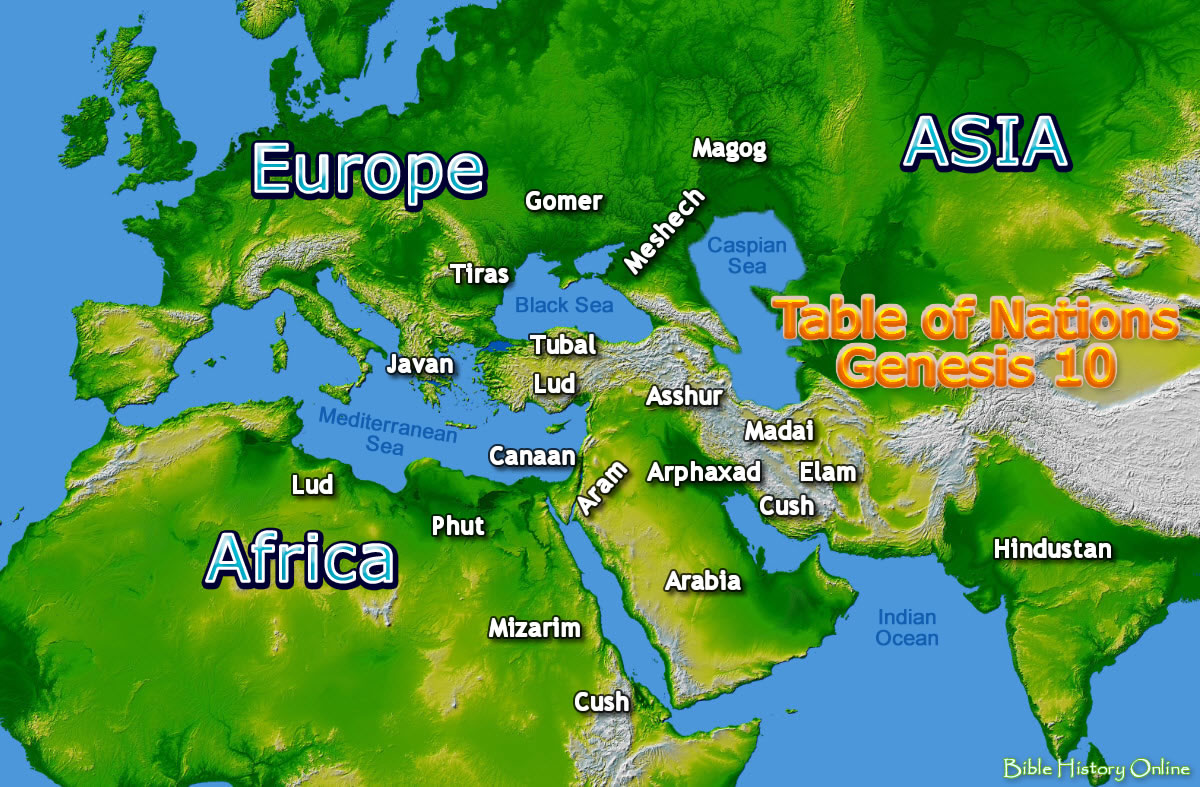
The prophet Ezekiel speaks of a time “in the latter years”[1] when a coalition of nations will come against Israel. The prophecy names the nations by their names assigned at time of the dispersion at the Tower of Babel.[2] The names are listed in the Table of Nations[3] and illustrated in the map above. Since that time, the names of these nations have changed many times over so that we no longer recognize them as those named by the prophet. However, God does not lose track, and He does not forget.

So, as we study Ezekiel’s prophecy in Chapters 38 and 39, it requires that we look at a map depicting where these nations ended up when they were originally dispersed. Let us examine Ezekiel’s list and compare it to the map above. I will emphasis the significant names.

And the word of the LORD came unto me, saying, Son of man, set thy face against Gog, the land of Magog, the chief prince of Meshech and Tubal, and prophesy against him, And say, Thus saith the Lord GOD; Behold, I am against thee, O Gog, the chief prince of Meshech and Tubal: And I will turn thee back, and put hooks into thy jaws, and I will bring thee forth, and all thine army, horses and horsemen, all of them clothed with all sorts of armour, even a great company with bucklers and shields, all of them handling swords: Persia, Ethiopia, and Libya with them; all of them with shield and helmet: Gomer, and all his bands; the house of Togarmah of the north quarters, and all his bands: and many people with thee. (Ezekiel 38:1-6)

Note, first of all, that “Gog” is a person, not a nation. He is a “chief prince” from the nation of Magog. When we look at the map (above), we find that Magog, Meshech, and Gomer are in the region we recognize as Russia.

Tubal we recognize as modern-day Turkey. The “house of Togarmah” (not shown on this map) is also in the “north quarters” of Turkey and also in modern-day Georgia (Russia). Persia was known as Elam prior to Ezekiel’s time, and we find it on the map in the area of modern-day Iran.

Ezekiel lists the lands of Cush and Lud (from Genesis 10) as Ethiopia and Libya. As we look at the map, we observe that Cush is further south than modern-day Ethiopia and corresponds more closely to modern-day Somalia.

It is worth noting that all of these nations are Islamic nations with the exception of Russia, and even Russia has a high Muslim population.

Bringing Ezekiel’s prophecy forward to our day and time, we find that the prophecy speaks of a coalition of three main nations: Russia, Turkey, and Iran with Libya and Somalia in alliance. God says to these nations, “I will turn thee back, and put hooks into thy jaws, and I will bring thee forth” (Ezekiel 38:4, emphasis mine). “Thou shalt ascend and come like a storm, thou shalt be like a cloud to cover the land [Israel], thou, and all thy bands, and many people with thee. Thus saith the Lord GOD; It shall also come to pass, that at the same time shall things come into thy mind, and thou shalt think an evil thought: And thou shalt say, I will go up to the land of unwalled villages; I will go to them that are at rest, that dwell safely, all of them dwelling without walls, and having neither bars nor gates, To take a spoil, and to take a prey; to turn thine hand upon the desolate places that are now inhabited, and upon the people that are gathered out of the nations, which have gotten cattle and goods, that dwell in the midst of the land” (Ezekiel 38:9-12, emphasis mine).

According to Ezekiel’s prophecy, Russia, Turkey, Iran, and their allies will invade Israel “to take spoil and to take prey.” Will this take place before or after the Rapture of the Church? Prophecy experts differ in opinion about this point. However, it appears that the stage is being set for that event.

On Friday of this week, July 22, 2022, the leaders of Russia, Turkey, and Iran met for the purpose of forming an alliance.[4] We have long known of the animosity Iran has toward Israel. Turkey has not necessarily been a friend to Israel. Lately, Russia’s relationship with Israel has cooled over Israel’s support for Ukraine. Additionally, Russia has stopped the migration of Jews from Russia to Israel. To top it off, Israel is on the verge of exporting its natural gas to Europe, which has the potential of cutting into Russia’s profits. The three nations are not happy with Israel and neither are their allies, Libya and Somalia.

It seems that it is only a matter of time before the “Gog of Magog” invasion takes place. Will the Bride of Christ witness this event? I do not know. What I do know is that the invasion will fail.

And it shall come to pass at the same time when Gog shall come against the land of Israel, saith the Lord GOD, that my fury shall come up in my face. For in my jealousy and in the fire of my wrath have I spoken, Surely in that day there shall be a great shaking in the land of Israel; So that the fishes of the sea, and the fowls of the heaven, and the beasts of the field, and all creeping things that creep upon the earth, and all the men that are upon the face of the earth, shall shake at my presence, and the mountains shall be thrown down, and the steep places shall fall, and every wall shall fall to the ground. And I will call for a sword against him throughout all my mountains, saith the Lord GOD: every man’s sword shall be against his brother. And I will plead against him with pestilence and with blood; and I will rain upon him, and upon his bands, and upon the many people that are with him, an overflowing rain, and great hailstones, fire, and brimstone. Thus will I magnify myself, and sanctify myself; and I will be known in the eyes of many nations, and they shall know that I am the LORD. (Ezekiel 38:18-23, emphasis mine)

God will intervene for Israel – not because Israel is a Godly nation, but because God is faithful to His promise. He said He would do it, and He will do it. And His purpose in doing so is so that Israel and all the world will witness Israel’s miraculous deliverance. “Thus will I magnify myself, and sanctify myself; and I will be known in the eyes of many nations, and they shall know that I am the LORD” (Ezekiel 38:23, emphasis mine).

For the Christian, this should be encouraging news. We are seeing prophecy being fulfilled right before our eyes, and that means our Lord’s return to call us home is very near. Are you prepared to meet Him? If you do not know Jesus as your personal Lord and Savior, please read my page on “Securing Eternal Life.”

Notes:


[1]  Ezekiel 38:8

[2]  Genesis 11:1-9

[3]  Genesis 10

[4]  “Russia, Iran, and Turkey Forming a Biblical Alliance” — https://gospelnewsnetwork.org/2022/07/22/russia-iran-and-turkey-forming-a-biblical-alliance/

Comments Off on Magog, Tubal, and Persia

Filed under Apologetics, Bible, Christianity, Current Events, End Times, Eschatology, Rapture, Second Coming of Christ, Theology

Emotions

For my thoughts are not your thoughts, neither are your ways my ways, saith the LORD. For as the heavens are higher than the earth, so are my ways higher than your ways, and my thoughts than your thoughts. (Isaiah 55:8-9)

Emotions are “an affective state of consciousness in which joy, sorrow, fear, hate, or the like, is experienced, as distinguished from cognitive and volitional states of consciousness; any of the feelings of joy, sorrow, fear, hate, love, etc.; any strong agitation of the feelings actuated by experiencing love, hate, fear, etc., and usually accompanied by certain physiological changes, as increased heartbeat or respiration, and often overt manifestation, as crying or shaking” [or shouting] (emphasis mine).[1]

“Emotions are reactions that human beings experience in response to events or situations. The type of emotion a person experiences is determined by the circumstance that triggers the emotion. For instance, a person experiences joy when they receive good news. A person experiences fear when they are threatened … In their book Discovering Psychology, authors Don Hockenbury and Sandra E. Hockenbury suggest that an emotion is a complex psychological state that involves three distinct components: a subjective experience, a physiological response, and a behavioral or expressive response.”[2]

Emotions are either good or bad depending on how they affect us. The “feeling” of “love” can lead to a bad decision in a mate. or it can inspire selfless acts toward others regardless of personal benefit. Anger over injustice can prompt action to right a wrong or it can drive someone toward violent vindication.

Emotions become problematic when they control our actions. I know and have known emotional people that direct their lives based on their “feelings.” They are irrational, i.e., they do not “think” about their actions – they just react based on what they feel. They do not consider the possible consequences of their actions. They do not think about how their actions may affect others. They just respond to the feeling. Does it make them happy? Does venting their anger and frustration bring relief?

There was a saying in the 60s and 70s: “If it feels good, do it.” That axiom still prevails in our society bringing our nation into such a state of confusion that anything one may say will offend someone about something, and nobody is happy.

Last week, the supreme court struck down Roe v. Wade. It was the right decision[3] based on our Constitution. It turned the abortion question back to the states where it belongs. It did not make abortion illegal. However, the decision angered many who protested (often violently) that it took away women’s rights. They argued that many “poor” women would lose access to “safe” abortions, and that they might have to resort to “back-alley” abortions or worse – do-it-yourself coat hanger abortions. Their arguments founded on pure emotion found no substance in reality. They were completely irrational. I heard no argument offered by them that gave a reasonable defense for their position – it was all emotion.

Sadly, even some Christians got sucked into the mindless arguments of the abortion defenders. One argument I heard from a “pro-lifer” defended abortion in the case of rape or incest. That is an emotional response stemming from a feeling of “compassion” for the victimized woman. (Only women can get pregnant. If that offends you, get over it!) “A 1996 study found a national rape-related pregnancy rate of 5% per rape among victims between the ages of 12 and 45.”[4] Setting aside the emotional aspect of this argument, the chances of pregnancy resulting from rape are low to begin with. Even in a healthy marital relationship, pregnancy resulting from sexual intercourse is not a given. Many married couples live years enjoying sexual intimacy without ever conceiving.

The Bible makes clear Who controls pregnancy. “Lo, children are an heritage of the LORD: and the fruit of the womb is his reward” (Psalm 127:3). Pregnancy resulting from rape can be viewed emotionally as a tragedy, but who will charge God with error? He created that life in the womb of the rape victim, and only He has the right to take away that life. The rape victim may not have had a say in the pregnancy (married couples have no say in theirs either), but that life was put there by God. God has denied children to many married couples. (Only He knows why.) Such couples would do anything to have a child they can raise, and the child of a rape victim may be an answer to their prayer. Then too, the rape victim may in time grow to love the child within her and choose to raise it on her own. However, for a Christian to argue that such a child should be aborted comes from the heart of a fallen, emotional human being, and not from the Word or the heart of God.

As Christians, what we see going on in the world should not come as a surprise. Consider the words of Paul:

This know also, that in the last days perilous times shall come. For men shall be lovers of their own selves, covetous, boasters, proud, blasphemers, disobedient to parents, unthankful, unholy, Without natural affection, trucebreakers, false accusers, incontinent, fierce, despisers of those that are good, Traitors, heady, highminded, lovers of pleasures more than lovers of God; Having a form of godliness, but denying the power thereof: from such turn away. (2 Timothy 3:1-5, emphasis mine)

Notice how so many of the characteristics listed are emotionally based. Note also the phrase, “having a form of godliness.” In context, Paul warns Timothy (and us) of the attitudes within the Church in the last days. Paul uses similar language in his letter to the church in Rome as he describes the moral decline of mankind. After listing the characteristics of the moral decline, in his final assessment he says, “Without understanding, covenantbreakers, without natural affection, implacable, unmerciful: Who knowing the judgment of God, that they which commit such things are worthy of death, not only do the same, but have pleasure in them that do them” (Romans 1:31-32, emphasis mine). Again, these characteristics describe those who direct their lives by their emotions. Sadly, there are “Christians” who guide their lives by what they feel or think regardless of what the Word of God says.

There are other issues where emotions come to play, but the Christian needs to check those emotions against the Word of God. His thoughts are far above our own, as our starting verse states. He is perfect in righteousness and holiness. We are unrighteous and fallen creatures. We need His guidance not that of our emotions.

The mess we see in our country (and the world) right now is a sign that Jesus is coming soon, and His reward is with Him. The signs of His appearing are increasing in intensity and frequency. Are you prepared to meet Him? If you do not know Jesus as your personal Lord and Savior, please read my page on “Securing Eternal Life.”

Notes:


[1]  “Emotion” — https://www.dictionary.com/browse/emotion

[2]  “Emotions and Types of Emotional Responses” – https://www.verywellmind.com/what-are-emotions-2795178

[3]  “The Right Decision” – https://erniecarrasco.com/2022/06/26/the-right-decision/

[4]  “18 Profound Statistics of Rape Victims Getting Pregnant” – https://healthresearchfunding.org/18-profound-statistics-rape-victims-getting-pregnant/

1 Comment

Filed under Apologetics, Bible, Christianity, Current Events, Pro-life, Theology

When You’re In the Hole, Stop Digging

A wise man feareth, and departeth from evil: but the fool rageth, and is confident. (Proverbs 14:16)

I have heard it said that insanity is repeating the same mistakes and expecting different results. The nation of Judah exemplifies that notion, and I see the same pattern in our nation today.

Toward the end of the sixth century B.C., Judah rebelled against God and followed the gods of the pagan nations around them. Jeremiah prophesied during these final years of the nation and suffered severe persecution because of it. Judah knew the law of God and continued to practice the rituals, but their zeal was for the gods that are “no gods.” “Hath a nation changed their gods, which are yet no gods? but my people have changed their glory for that which doth not profit” (Jeremiah 2:11).

The surrounding nations were faithful to their “gods,” yet Judah, who knew the true God, abandoned Him for the false gods. Not that God can be surprised by the actions of humans, but in human terms, their actions were perplexing. Despite numerous warnings and pleas, Judah refused to repent, until God finally had enough of their unfaithfulness. “How shall I pardon thee for this? thy children have forsaken me, and sworn by them that are no gods: when I had fed them to the full, they then committed adultery, and assembled themselves by troops in the harlots’ houses” (Jeremiah 5:7).

Johoiachin, a.k.a. Coniah,[1]a.k.a. Jeconiah,[2] a.k.a. Jechonias,[3] reigned as the final king of the sovereign nation of Judah. He was the third wicked successor of good king Josiah. By the time of his reign, Judah plunged to the depths of her depravity. To him God instructed Jeremiah to “Take thee a roll of a book, and write therein all the words that I have spoken unto thee against Israel, and against Judah, and against all the nations, from the day I spake unto thee, from the days of Josiah, even unto this day” (Jeremiah 36:2, emphasis mine). God wanted to make clear the warnings He had given in the recent past. This book was the written Word of God. However, rather than heed God’s Word, Johoiachin discarded the Word of God as rubbish to be burned. “And it came to pass, that when Jehudi had read three or four leaves, [Jehoiachin] cut it with the penknife, and cast it into the fire that was on the hearth, until all the roll was consumed in the fire that was on the hearth” (Jeremiah 36:23). The other national leaders in the audience did no better. “Yet they were not afraid, nor rent their garments, neither the king, nor any of his servants that heard all these words” (Jeremiah 36:24). As a result, God allowed the Babylonians to invade and conquer Judah and Jerusalem.[4] This was the first time Nebuchadnezzar took away captives from Jerusalem. The prophet Daniel went into captivity at this time.

In many ways, Nebuchadnezzar showed kindness to Judah by installing Mattaniah, a.k.a. Zedekiah,[5] as king to govern the conquered province. One might think that Judah learned her lesson. “But neither [Zedekiah], nor his servants, nor the people of the land, did hearken unto the words of the LORD, which he spake by the prophet Jeremiah” (Jeremiah 37:2). “And [Zedekiah] did that which was evil in the sight of the LORD, according to all that Jehoiakim had done. For through the anger of the LORD it came to pass in Jerusalem and Judah, until he had cast them out from his presence, that Zedekiah rebelled against the king of Babylon” (2 Kings 24:19-20).[6]

Zedekiah was not alone in his rebellion against God. “Moreover all the chief of the priests, and the people, transgressed very much after all the abominations of the heathen; and polluted the house of the LORD which he had hallowed in Jerusalem. And the LORD God of their fathers sent to them by his messengers, rising up betimes, and sending; because he had compassion on his people, and on his dwelling place” (2 Chronicles 36:14-15, emphasis mine). One of those messengers through whom God showed compassion was Jeremiah. He suffered beatings and imprisonment for speaking God’s Word. Yet the people refused to listen. “But they mocked the messengers of God, and despised his words, and misused his prophets, until the wrath of the LORD arose against his people, till there was no remedy” (2 Chronicles 36:16).

“And it came to pass in the ninth year of his reign, in the tenth month, in the tenth day of the month, that Nebuchadnezzar king of Babylon came, he, and all his host, against Jerusalem, and pitched against it; and they built forts against it round about. And the city was besieged unto the eleventh year of king Zedekiah” (2 Kings 25:1-2). With Jerusalem under siege for more than two years, starvation and sickness plagued the city until they could not withstand the armies of Babylon. Jerusalem fell once again and Zedekiah and many others were taken captive for the second time. This time, Nebuchadnezzar was not so nice. He had Zedekiah’s sons killed as he watched and then had his eyes put out so that was the last thing Zedekiah saw.[7]

Jerusalem and the Temple were burned[8] and the Temple treasures were carried off to Babylon. Even with that, the people remained unrepentant until a third and final invasion took the last of the able-bodied.

Judah fell into a deep hole of depravity, but despite all of God’s pleading through His prophets, Judah just kept digging the hole deeper. It got to the point where God would not even entertain prayers on their behalf. God told Jeremiah to stop praying for these people.[9]

As I contemplate the state of our nation, the USA, and compare it to Judah, I see a perfect parallel, except for one thing. The nation of Israel has the promise of God for her preservation; the USA does not. God gave us a great land, godly founders, and a constitution founded on the Word of God. Throughout the years, God has provided great “prophets” proclaiming the Word of God, and for most of our history, we have listened to those prophets. No more! We have, as a nation, cast aside and trampled the Word of God. We embrace wickedness and call it inclusion. We bow at the altar of Gaia and call it “the Green New Deal.” We celebrate infanticide and call it women’s rights. We idolize celebrities in all their different venues – movies, sports, and even religion – while those that preach and teach the true Word of God are held in contempt. We have dug a deep hole for ourselves, and we only keep digging it deeper. Stop digging!

When Solomon dedicated the first Temple, he prayed that God would bless it. God answered, “If my people, which are called by my name, shall humble themselves, and pray, and seek my face, and turn from their wicked ways; then will I hear from heaven, and will forgive their sin, and will heal their land” (2 Chronicles 7:14); but that promise was for them. Many well-meaning pastors urge their people to pray for our nation and claim this promise in hopes that it will turn around. However, that promise was not made to the USA. If anything, I hear God saying, “pray no more for this people.” The hope for this nation, and the world in general, is for Christ’s return to establish His righteous kingdom on earth. Our prayer, then, should be, “Come quickly, Lord Jesus.”

Jesus is coming soon. The signs for His appearing are increasing in intensity and frequency. Are you prepared to meet Him? If you do not know Jesus as your personal Lord and Savior, please read my page on “Securing Eternal Life.”


Notes:

[1]  Jeremiah 22:24, 28; 37:1

[2]  Jeremiah 24:1

[3]  Matthew 1:11

[4]  2 Kings 24:10-12; Jeremiah 36:29-30

[5]  2 Kings 24:17; Jeremiah 37:1

[6]  2 Chronicles 36:13

[7]  2 Kings 25:3-7

[8]  2 Kings 25:8-10

[9]  Jeremiah 7:16; 11:14; 14:11

1 Comment

Filed under Apologetics, Bible, Christianity, Second Coming of Christ, Theology