Category Archives: Bible

Missed One!

And there came two angels to Sodom at even; and Lot sat in the gate of Sodom: and Lot seeing them rose up to meet them; and he bowed himself with his face toward the ground; (Genesis 19:1)

Anyone who has spent any time in the Bible has experienced reading a familiar passage and all of a sudden, something new appears in the text. Well, it is not really new; it has been there all along, but for the first time, the Spirit gives new insight into that familiar passage.

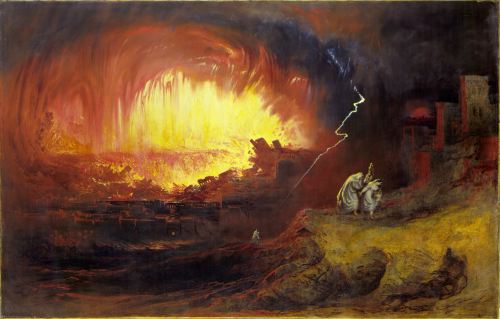
Recently I started reading the Book of Genesis for the nth time and came to Chapter 19 where two angels come to drag Lot out of Sodom before God destroyed it. Lot ranks at the bottom of my list of Bible characters. Lot was the son of Abram’s brother, Haran,[1] making him Abram’s (Abraham) nephew. Haran died, and when God called Abram to “Get thee out of thy country, and from thy kindred, and from thy father’s house, unto a land that I will shew thee” (Genesis 12:1), Lot followed his uncle.[2] Later on, as their wealth increased, Abram’s and Lot’s shepherds started quarreling over grazing land for their sheep.[3] So Abram decided that they should split up in order to avoid further conflict. Abram gave Lot the choice of grazing land,[4] and Lot chose what he thought was the best grazing land.[5] The Bible describes the land Lot chose as “well watered every where … as the garden of the LORD” (Genesis 13:10). The land he selected lies in a valley on the east shore of the Dead Sea, so it strikes me odd that the Bible says that “Lot lifted up his eyes and beheld all the plain of Jordan” (v. 10). Why would one “lift up his eyes” to see a valley that is below. That makes no sense to me unless his eyes were “lifted up” in pride. After all, he chose the best for himself leaving the least desirable land for his uncle.

Then Lot moved near the “cities of the plain,” two of which were Sodom and Gomorrah, but he “pitched his tent toward Sodom.”[6] “But the men of Sodom were wicked and sinners before the LORD exceedingly” (Genesis 13:13). Scripture clearly indicates the direction Lot was headed, and it was not a good place. Later we learn that Lot left his tent and moved into Sodom[7] and even became a city leader sitting “in the gate of Sodom”[8] – the place of judgment.

Lot does not make it into the “Faith Hall of Fame” (Hebrews 11), but the Apostle Peter calls Lot “just.” “[God] turning the cities of Sodom and Gomorrha into ashes condemned them with an overthrow, making them an ensample unto those that after should live ungodly; And delivered just Lot, vexed with the filthy conversation [i.e., lifestyle] of the wicked” (2 Peter 2:6-7, emphasis mine). Except for the inspiration of the Holy Spirit, I fail to see how Peter arrives at that conclusion. However, the Greek word translated “just” is dikaios and it means “equitable,” so perhaps as a judge, Lot dealt fairly with all.

Yet, had he faced his tent a different direction and stayed out there with his sheep, he may have averted the troubles that came with living in Sodom. He was kidnapped by marauding kings and his uncle had to rescue him,[9] and then God sent fire and brimstone to destroy all the cities of the plain for their wickedness.

I may be wrong (it would not be the first time), but it seems to me that Lot got sucked into the “city life,” perhaps not all the way, but just on the edge – at the gate. We do that too. We want Jesus, but we want to have a little of what the world offers too. I see Lot this way. Peter says that Lot was “vexed with the filthy conversation” of the city, but when the men of the city came to his house demanding that Lot give over his two male guests so they could have sex with them, Lot offered them his virgin daughters to do with them as they pleased.[10] What kind of “righteous” man does that! Later, as the angels tried to get Lot to leave the city before they destroyed it, “he lingered” and “the men laid hold upon his hand, and upon the hand of his wife, and upon the hand of his two daughters; the LORD being merciful unto him: and they brought him forth, and set him without the city” (Genesis 19:16). Lot had to be dragged out of the city for his own good!

We might think this story ends happily. No, it gets worse. After being saved from destruction, Lot’s daughters, who had been raised in the “conversation” of Sodom, became concerned that they had no man to get them pregnant, so they get their father drunk and have sex with him and have sons that become enemy nations of Israel – Moab (the Moabites) and Ammon (the Ammonites).[11]

Perhaps you can see why Lot is at the bottom of my Bible hero list, and I am disgusted every time I read this account. However, here is what I have missed all these times I’ve read this passage. It really begins in Chapter 18 when three angels come and speak to Abraham. After the angels finish the meal Abraham prepared for them, they get up to leave in the direction of Sodom, but one stays behind to inform Abraham of what He is going to do. We learn throughout the passage that this “angel” is actually the LORD. Theologically, this is known as a “theophany,” or better yet, a “Christophany” because these are appearances of the pre-incarnate Christ in the Old Testament. Jesus said, “Your father Abraham rejoiced to see my day: and he saw it, and was glad” (John 8:56).

So Abraham intercedes on behalf of Sodom with the LORD. “That be far from thee to do after this manner, to slay the righteous with the wicked: and that the righteous should be as the wicked, that be far from thee: Shall not the Judge of all the earth do right?” (Genesis 18:25). What if there are 50 righteous in the city? What if there are 45, 40, 30, 20, 10? The LORD agrees that for 10 righteous, He will spare the city. Then in Chapter 19, we see two angels enter the city. I always assumed these where the two angels that went ahead while the LORD stayed behind to speak with Abraham, but I saw something different this time.

Eight years ago, I wrote a thesis entitled Images of Christ in Genesis where I discuss ways in which Christ appears in the Book of Genesis. These include typology and theophany, but the one I missed was the one that appears in this encounter with Lot. One way to recognize a theophany is when the angel is referred to as “the angel of the LORD.” However, the best way to recognize that the angel is actually “the LORD” is that He takes credit for what the LORD does or will do. Rather than say, “the LORD will …” the angel says, “I will …”

So we have two angels enter the city (we know the account), and they try to evacuate Lot, his wife, and two daughters. The first hint that this is “the LORD” appears in Verse 16 where it says that the angels took them by the hands to drag them out of the city, and it makes this comment: “the LORD being merciful unto them.” Then, once they are out of the city one of the angels commands Lot to escape for his life and not look back. Lot protests and addresses Him as “my Lord” (‘ădônây) and pleads, “Behold now, thy servant hath found grace in thy sight, and thou hast magnified thy mercy, which thou hast shewed unto me in saving my life; and I cannot escape to the mountain, lest some evil take me, and I die” (Genesis 19:19). Lot pleads to be allowed to go to Zoar, and the angel says, “See, I have accepted thee concerning this thing also, that I will not overthrow this city, for the which thou hast spoken” (Genesis 19:21).

Zoar was one of the cities of the plain, and the angel unilaterally granted Lot’s request and spared the city. Matters of life and death belong to God alone. Angels cannot act in opposition to God’s directive. Even Satan is subject to God’s authority. Because this angel acted in response to Lot’s request, we know that either he acted against God’s wishes (to destroy Zoar) or He indeed is God and within His rights to grant the request. “Then the LORD rained upon Sodom and upon Gomorrah brimstone and fire from the LORD out of heaven … And it came to pass, when God destroyed the cities of the plain, that God remembered Abraham, and sent Lot out of the midst of the overthrow, when he overthrew the cities in the which Lot dwelt” (Genesis 19:24, 29).

All the times I read this passage and I missed it. However, it shows how God cares for His own, and that He will protect them even when they are not living according to His will. I know it to be true in my life. But just because God protects His children when they are outside His will, there are often consequences to pay. Consider Lot’s incestuous daughters. Life is so much better if we stick close to Him. I speak from experience.


Notes:


[1]  Genesis 11:27

[2]  Genesis 12:4

[3]  Genesis 13:7

[4]  Genesis 13:8-9

[5]  Genesis 13:10-11

[6]  Genesis 13:12

[7]  Genesis 14:12

[8]  Genesis 19:1

[9]  Genesis 14:12, 14-16

[10]  Genesis 19:4-8

[11]  Genesis 19:30-38

Comments Off on Missed One!

Filed under Apologetics, Bible, Christianity, Theology

Watch!

Photo by Giovanni Triggiani

Behold, I come as a thief. Blessed is he that watcheth, and keepeth his garments, lest he walk naked, and they see his shame. (Revelation 16:15)

Situated in the middle of John’s description of the “bowl” or “vile” judgments and the final battle of Armageddon, this parenthetical verse commends those who watch and keep, i.e., “guard,” their garments. Garments cover our nakedness and offer protection against the elements. The picture here reminds us of the clothing with which Christians must be clothed. “Wherefore take unto you the whole armour of God, that ye may be able to withstand in the evil day, and having done all, to stand” (Ephesians 6:13).

The Lord Jesus Christ offers this word of encouragement to the “Tribulation Saints” that, due to their prior unbelief, missed the Rapture[1] and now must endure the horrors of the Tribulation. That Jesus will come “as a thief” is not a warning for these saints who by now should know the “game plan” as laid out in Scripture. Rather, He will come suddenly and unexpectedly for those who reject Christ and “upon the men which had the mark of the beast, and upon them which worshipped his image” (Revelation 16:2). Jesus promises that the “Tribulation Saints” who watch, for His return will be blessed. At this point in the Tribulation, according to the Revelation account, the wait will not be long.

What about Christians today? Often pastors, Bible teachers, and other Christians discourage us from watching. They remind us that, “ye know neither the day nor the hour wherein the Son of man cometh” (Matthew 25:13). They omit the imperative phrase that precedes that statement. In context, Jesus made this statement as “the moral” to the parable of the Ten Virgins[2] who fell asleep waiting for the bridegroom to come for them. The virgins represent the Church and the bridegroom represents the Lord Jesus Christ, who has left to prepare a place[3] for His Bride, but whose return for His Bride depends on the Father’s approval of the bride chamber. At midnight, when the virgins least expected, a trumpet sounds to announce the Bridegroom is coming. Five of the virgins have prepared extra oil (representative of the Holy Spirit) for their lamps and are ready to be taken by the Bridegroom. The remaining five imprudent virgins get left behind. Jesus said, “Watch therefore, for ye know neither the day nor the hour wherein the Son of man cometh” (emphasis mine).

While it is true that we cannot know the day nor the hour when the Lord will return for His Bride, the Church, we are still instructed to WATCH! For what are we to watch? Jesus gave the signs for which to watch prior to His return.[4] The admonition advises us to look for these signs coming together to let us know that the time is near.

Waiting is hard. Watching is tiring. Many have become discouraged and “leave their posts” choosing rather to invest their time on the things of this world – sports, entertainment, and all sorts of distractions and diversions. Some even become critical of those who are watching. Such scoffing and criticism should not surprise us. “Knowing this first, that there shall come in the last days scoffers, walking after their own lusts, And saying, Where is the promise of his coming? for since the fathers fell asleep, all things continue as they were from the beginning of the creation” (2 Peter 3:3-4, emphasis mine). Sadly, these scoffers are “Christians.”

Sometimes these scoffers will compare the “watchers” to the “boy who cried wolf.” What they forget is that in the story, when the villagers stopped responding to the boy’s cries, the wolf did indeed come.

Jesus’ second coming is near. His return to “snatch up” His Bride is even nearer. “Therefore let us not sleep, as do others; but let us watch and be sober” (1 Thessalonians 5:6, emphasis mine). “But the end of all things is at hand: be ye therefore sober, and watch unto prayer” (1 Peter 4:7, emphasis mine). “Remember therefore how thou hast received and heard, and hold fast, and repent. If therefore thou shalt not watch, I will come on thee as a thief, and thou shalt not know what hour I will come upon thee” (Revelation 3:3, emphasis mine). “Watch ye therefore, and pray always, that ye may be accounted worthy to escape all these things that shall come to pass, and to stand before the Son of man” (Luke 21:36, emphasis mine).

WATCH!

Notes:


[1]  1 Corinthians 15:50-53; 1 Thessalonians 4:15-18

[2]  Matthew 25:1-13

[3]  John 14:3

[4]  Matthew 24:4-44; Mark 13:5-37; Luke 21:8-38

Comments Off on Watch!

Filed under Bible, Christianity, End Times, Gospel, Salvation, Second Coming of Christ, Theology

The Gap – Not the Store

In the beginning God created the heaven and the earth. And the earth was without form, and void; and darkness was upon the face of the deep. And the Spirit of God moved upon the face of the waters. (Genesis 1:1-2)

For almost 200 years, well-meaning theologians have attempted to defend the veracity of the Bible against the current scientific discoveries that cast doubt on the truth of God’s word. Rather than taking a firm stand for what the Bible plainly teaches, they try to find ways to reconcile what the Bible says with what scientists say by way of compromises. One such popular compromise is known as the Gap Theory.

Because many theologians have been duped into believing that scientists have proven that the earth is billions of years old (4.5 billion to be precise), they need to find a place in Scripture to account for that vast amount of time. They recognize that biblical chronology only accounts for approximately 6000 years of earth history. They face a dilemma. How do they remain faithful to a literal interpretation of biblical creation and still maintain good rapport with the scientific community? They solve the problem by placing a gap of unknown time between verses one and two of Genesis 1.

However, with what does one fill a gap of billions of years while maintaining some credible ties to Scripture? According to Hugh Ross (who has his own issues with a young earth), “A few Bible scholars of the seventeenth century, wishing to establish the timing of Satan’s fall and the angels’ rebellion, had proposed a narrative gap (hence, a time gap of unspecified duration) between the creation of the universe (“the heavens and the earth” of Genesis 1:1) and the events of the creation week (Genesis 1:3-27) … Eighteenth century advocates of this view placed the gap precisely between Genesis 1:1 and Genesis 1:2, suggesting that Earth began, perhaps eons ago, as the abode of angels who ravaged and ruined it when they fell.”[1]

Genesis 1:1 refers to God’s initial perfect creation. Everything that God made was beautiful, there was no sin anywhere. Verse two, on the other hand, assumes that a great catastrophe occurred that caused the earth to become in a chaotic state through the judgment of God. According to the Gap Theory, the formless and void state, as recorded in Genesis 1:2, is in direct contrast to the perfect initial creation. Something happened between the first two verses of Genesis to cause the earth to become desolate and uninhabitable after having been made perfect. Those holding the Gap Theory contend that this state of ruin could have possibly lasted millions of years … The judgment is usually spoken of as a flood because of the statement of Genesis 1:2 – the earth was covered by water. This judgment is also known as the Luciferic flood named after the angel who became the devil. The cause for the judgment is usually given as the rebellion of Satan or some pre-Adamic race that sinned. All of the inhabitants of the earth were judged by God, leaving behind fossil remains.”[2]

When one reads the text of Genesis 1:1-2 and following verses giving the words their normal meaning in their normal context, it becomes obvious that much imaginative speculation must take place to insert millions or billions of years between verses one and two. From where did these ideas originate?

According to Dr. John D. Morris, “This particular compromise didn’t just appear; it’s been around at least since the early 1800s when old-Earth ideas were floated by James Hutton and Charles Lyell. Many theologians, under the mistaken impression that scientists had proved it, rushed to incorporate an old Earth into Scripture, hoping to maintain credibility with secular scientists”[3]

Sir Charles Lyell (1797-1876) “was a Scottish geologist who demonstrated the power of existing natural causes in explaining Earth history. He is best known as the author of Principles of Geology (1830-33 and later editions), which presented for a wide public audience the idea that the Earth was shaped by the same natural processes still in operation today, operating at similar intensities … The combination of evidence and eloquence in Principles convinced a wide range of readers of the significance of ‘deep time’ for understanding the Earth and environment … Building on the innovative work of James Hutton and his follower John Playfair, Lyell favoured an indefinitely long age for the Earth, despite evidence suggesting an old but finite age.”[4]

Confronted with such “evidence,” theologians quickly came to the Bible’s rescue. “Gap creationism became increasingly attractive near the end of the 18th and first half of the 19th centuries, because the newly established science of geology had determined that the Earth was far older than common interpretations of Genesis and the Bible-based flood geology would allow. Gap creation allowed religious geologists (who composed the majority of the geological community at the time) to reconcile their faith in the Bible with the new authority of science … From 1814, gap creationism was popularized by Thomas Chalmers, who attributed the concept to the 17th-century Dutch Arminian theologian Simon Episcopius.”[5] Chalmers’ “view was popularized by the Plymouth Brethren writer G. H. Pember in his book Earth’s Earliest Ages in 1876.”[6] “It gained widespread attention when a ‘second creative act’ was discussed prominently in the reference notes for Genesis in the influential 1917 Scofield Reference Bible.”[7]

Others came along later like Harry Rimmer (1890-1952). Rimmer “was an American evangelist and creationist. He is most prominent as a defender of creationism in the United States, a fundamentalist leader and writer of anti-evolution publications. He was the founder and President of the Science Research Bureau, Incorporated, a corporation set in Los Angeles, California, whose purpose he established as to prove the veracity of the Bible through studies of biology, paleontology and anthropology.”[8]

Surprisingly, many who profess to defend the inerrancy and infallibility of the Bible still hold to the Gap Theory and an old earth. One that I closely follow for his teachings on end-times prophecy is Gary Stearman of “Prophecy Watchers” based in Norman, Oklahoma.[9] In all other respects, Stearman is an excellent Bible teacher, but in this one area, he stumbles. He is not the only one. Dr. Arnold G. Fruchtenbaum founder of Ariel Ministrires[10] and excellent O.T. scholar says,

I do believe there is a gap of time between verses 1 and 2, but we must be very careful not to ascribe a gap there for the wrong reasons as people have done so often. They have also used it as a convenient place to fit in such things as the geological ages, the fossil record, dinosaur space, and the like. I do not believe the gap allows for dinosaur space because the Bible teaches that there was not any kind of physical death until Adam’s Fall. Rather, the gap is there for only one reason, the fall of Satan that will, in turn, account for the chaos described in verse 2. Hence, the gap need not be very long at all.[11]

Since so many respected theologians defend the Gap Theory, is there any biblical support for their position? As stated before, those who hold to the Gap Theory have been convinced by secular geologists that the earth is billions of years old based on their interpretation of the geologic column, the fossil record, and radiometric dating. Another factor that often comes into play is the distant starlight problem. Faced with these challenges, their inability to respond intellectually, and their strong conviction of the inerrancy and infallibility of God’s Word, they try to accommodate God’s Word to fit what the secular scientists are saying. In a word, they compromise.

Genesis 1 records creation in six 24-hour days and Gap theorists defend this position. However, biblical chronology, beginning with Genesis 5, limits the age of the earth to only about 6000 years. So how does one account for the 4.5 billion year age of the earth that secular scientists claim? Gap theorists found a way to squeeze billions of years between verse one and verse two of Genesis 1.

Genesis 1:2 says, “And the earth was without form, and void…” The Hebrew word translated “was” is hâyâh. Strong’s defines hâyâh as to exist, that is, be or become, come to pass (always emphatic, and not a mere copula or auxiliary). Gap theorists interpret hâyâh as “became;” therefore, “And the earth became formless and void.” Furthermore, the Hebrew words translated “without form and void” are tôhû (to lie waste; a desolation, formlessness, confusion, unreality) and bôhû (emptiness, void, waste, or ruin). According to the Gap Theory, “In the beginning God created the heaven and the earth” (Genesis 1:1), for an unspecified length of time and then the earth became tôhû and bôhû. God created a perfect world, and then the earth became tôhû and bôhû. What happened?

Rather than to simply admit they do not know what happened, they look to Scripture to fill the Gap. Ken Ham quotes, Weston W. Fields in his book, Unformed and Unfilled (page 7), “In the far distant, dateless past God created a perfect heaven and perfect earth. Satan was ruler of the earth, which was peopled by a race of ‘men’ without any souls. Eventually, Satan, who dwelled in a Garden of Eden composed of minerals (Ezekiel 28), rebelled by desiring to become like God (Isaiah 14). Because of Satan’s fall, sin entered the universe and brought on the earth God’s judgment in the form of a flood (indicated by the wafer of 1:2), and then a global ice age when the light and heat from the sun were somehow removed. All the plant, animal, and human fossils upon the earth today date from this ‘Lucifer’s Flood’ and do not bear any genetic relationship with the plants, animals and fossils living upon the earth today.”[12]

They had to fill the gap with something, but all their attempts to reconcile Scripture to science amount to nothing more than conjecture and speculation.  For example, the idea of “soulless men” is inconsistent with God’s character and the notion of “Lucifer’s Flood” finds no biblical support. Their appeal to Scripture with regard to Isaiah 14:12-15 and Ezekiel 28:12-19 does have some merit as they do speak of Satan’s fall. However, neither of these passages gives any hint of time, other than to imply that Satan’s fall occurred early on after Creation. “Thou hast been in Eden the garden of God…” (Ezekiel 28:13) According to Genesis 2:8, God planted the Garden of Eden on Day Six for Adam’s habitation; therefore this cannot refer to some unknown past.

One major hermeneutical problem with the Gap Theory is with the translation of the Hebrew verb hâyâh. “When this word [be] is printed in italics in the common English version, there is no corresponding word in the original text; when it occurs in common type [i.e., not italicized], it is generally the representative of hayah, havah, hava, “to be” in Hebrew.”[13] Sometimes hâyâh is translated “become or became” for ease of reading more than anything else. For example, Genesis 2:7 “And the LORD God formed man of the dust of the ground, and breathed into his nostrils the breath of life; and man became a living soul” (Genesis 2:7). In this case, “became” could just as easily be translated “was” and it would still make perfect sense. As soon as God breathed the breath of life into his nostrils, the man was a living soul. So the Gap theorists do not have a Hebraic leg to stand on in translating hâyâh as “became.”

Another problem with the theory is that the conjunction at the beginning of the sentence (Hebrew vav or waw) is an indication of the continuation of what came before. Had the Author (God) desired to show a break in events, He could have used the conjunction ‘âz (“then”) as in Genesis 4:26, “And to Seth, to him also there was born a son; and he called his name Enos: then began men to call upon the name of the LORD.” The grammar in Genesis 1:2 gives no indication of a break in thought. There is no grammatical “gap.”[14]

Then comes the matter of the earth being “without form and void” – tôhû and bôhû. We have seen that the earth did not “become” tôhû and bôhû, but rather that it “was” tôhû and bôhû. In Verse 1, God created the universe with all its elements: time (the beginning), space (the heavens), and matter/energy (the earth). At this point, the “earth” (matter/energy) was formless and empty. God had not shaped it into anything yet. The second half of Verse 2 informs us that God at this point started shaping the raw materials. We find no hint of destruction and reconstruction in these verses.

In spite of their well-intentioned effort to reconcile the Genesis creation account with modern science, Gap theorists unwittingly create some serious theological problems. First of all, the Gap Theory calls God’s integrity into question. God’s assessment of His finished work would have to be found faulty. “And God saw every thing that he had made, and, behold, it was very good. And the evening and the morning were the sixth day” (Genesis 1:31). Sin, death, and destruction in some unknown past do not qualify as a good creation, much less a “very good” creation.

Secondly, sin did not enter the world through Adam as the Bible claims (Romans 5:12) because it was present at Satan’s fall. Furthermore, death could not be the result of sin if death was already in the world.

Thirdly, the death penalty for (Romans 6:23) sin makes no sense when death preceded Adam’s sin.

Fourthly, if sin and death preceded Adam, then Jesus dying to pay the wages of sin for man seems pointless.

I grew up as a poor preacher’s kid. The greatest lesson my dad ever taught me was that the Bible was true and faithful even when it is difficult to understand. Whether we understand it completely or not, we can trust it to be true. God’s Word does not need to be reconciled to man’s way of thinking. Man’s thinking needs to be reconciled to God’s Word. “For my thoughts are not your thoughts, neither are your ways my ways, saith the LORD. For as the heavens are higher than the earth, so are my ways higher than your ways, and my thoughts than your thoughts” (Isaiah 55:8-9). Later on, the Apostle Paul says something very similar. “Because the foolishness of God is wiser than men; and the weakness of God is stronger than men” (1 Corinthians 1:25). Gap theorists forget this principle; they sway to the “strength” of fallen men rather than hold fast to the “foolishness” of the pure Word of God.

Notes:


[1]  Hugh Ross, “Closing the Gap: A Scientist’s Response to the Gap Theory” – https://www.reasons.org/explore/publications/facts-for-faith/read/facts-for-faith/2001/01/01/closing-the-gap-a-scientist-s-response-to-the-gap-theory

[2]  Don Stewart, “What Is the Gap Theory? (The Ruin and Reconstruction Theory?)” – https://www.blueletterbible.org/faq/don_stewart/don_stewart_654.cfm

[3]  John D. Morris, Ph.D., “How Does Old Earth Thinking Affect One’s View of Scripture’s Reliability?” – https://www.icr.org/article/how-does-old-earth-thinking-affect-ones-view-scrip

[4]  “Charles Lyell” – https://en.wikipedia.org/wiki/Charles_Lyell

[5]  “Gap Creationism” – https://en.wikipedia.org/wiki/Gap_creationism

[6]  Hank Hanegraaff, “The Gap Theory of Genesis 1:2 by Lee Irons” – https://www.oneplace.com/ministries/bible-answer-man/read/articles/the-gap-theory-of-genesis-12-by-lee-irons-16836.html

[7]  “Gap Creationism” – Wikipedia

[8]  “Harry Rimmer” – https://en.wikipedia.org/wiki/Harry_Rimmer

[9]  Gary Stearman, Prophecy Wathers – https://prophecywatchers.com/gary-stearman/

[10]  http://www.Ariel.org/

[11]  Arnold Fructenbaum, “THE SEVEN DAYS OF CREATION: GENESIS 1:1 – 2:3”, p.10, article available in PDF format from the Ariel Ministries website.

[12]  Kenneth Ham, “Closing the Gap” – https://www.icr.org/article/closing-gap

[13]  Robert Young,  Young’s Analytical Concordance to the Bible, (Grand Rapids, Eerdmans Publishing, 1970), 73.

[14]  Ernesto E. Carrasco, “No Gap” – https://erniecarrasco.com/2015/10/18/no-gap/

3 Comments

Filed under Apologetics, Bible, Christianity, Creation, Origins, Religion, Satan, Science, Theology

On A Hill Far Away…

And Other Biblical Misconceptions

 And he bearing his cross went forth into a place called the place of a skull, which is called in the Hebrew Golgotha: (John 19:17)

With the forthcoming opening of the ICR Discovery Center for Science and Earth History, I and a co-laborer (whom I cannot name because I did not request his permission) have been honored with the task of creating the scenery for the Life of Christ Diorama that will reside across from the Empty Tomb exhibit. An ICR benefactor donated the diorama for exhibition in the Discovery Center. The set contains thousands of pieces – buildings, tents, people, animals, furnishings, etc. – fabricated mostly by an Italian company. The extensive collection cannot all fit in the space allotted, so our leaders determined only to display pivotal scenes in the life of Christ.

Not to give away all the details of the diorama, I want to focus on the crucifixion scene. Where to position the crucifixion scene came into question. Should it be elevated on top of a hill or should it be placed on a lower level between the road and the hill? As Christians, we know the familiar words of the old hymn, “The Old Rugged Cross.” The lyrics say, “On a hill far away, stood an old rugged cross…” I do not know if it is due to the lyrics of the beloved hymn or due to some other handed down tradition, but we all imagine that Jesus was crucified at the top of Mount Calvary. However, musical lyrics or timeless tradition should not be the basis for what we believe. What does the Bible say?

And when they were come unto a place called Golgotha, that is to say, a place of a skull… (Matthew 27:33)

And they bring him unto the place Golgotha, which is, being interpreted, The place of a skull. (Mark 15:22)

And when they were come to the place, which is called Calvary, there they crucified him, and the malefactors, one on the right hand, and the other on the left. (Luke 23:33)

And he bearing his cross went forth into a place called the place of a skull, which is called in the Hebrew Golgotha: (John 19:17) (Emphasis mine)

The Bible does not often provide specific detail of events, but very often it does. The language of the Gospels is Greek. The Greek word for “hill” is either oros or bounos; the latter used only in Luke 3:5, and the former used in several passages in the N.T.[1] Furthermore, Greek prepositions indicate precise positions. The Greek preposition for “on” or “upon” is epi. It means “superimposition,” that is, to be “over” or “upon.” None of the four Gospels give any indication that the crucifixion took place “on a hill called Mount Calvary”[2] regardless of what the song lyrics say. Furthermore, the public spectacle of crucifixion[3] intended as a deterrent against lawlessness took place in the most public of places, usually, a busy roadside where passersby could get a close look at the suffering victims.

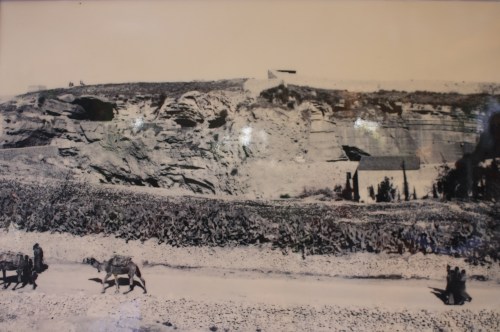
I researched, albeit not extensively, information about the location of the crucifixion. Most of the information[4] argues about three possible “places,” and most shy away from making dogmatic statements. The possible locations offered are, The Church of the Holy Sepulcher (which supposedly houses both the crucifixion and burial sites), The Garden Tomb[5] area (which is very near a limestone formation whose face features two prominent grottos that look like the eye sockets of a human skull), or just some unknown place outside of the Old City (of Jerusalem) designated by the Romans for public executions. All of these resources spoke of the “place” but none ventured to suggest whether the crucifixion took place “on” the hill or “by” the hill, but all agreed that it was “at” Golgotha/Calvary.

The “experts” fail to commit to “on” or “by”, but all four Gospels omit the preposition epi (on). To me that says that Jesus was crucified “at” Calvary, not “on” Calvary. My conclusion led me to determine that the diorama will feature the crucifixion scene near the road with a skull-shaped hill in the background. Besides scriptural reasons, there are practical reasons for my decision. A crucifixion on top of a hill, while it might be visible to all, could easily be ignored by passersby thus defeating the deterrent factor of the event. To get a close-up view – and who would want to – would require extra effort making it a disincentive for gathering a crowd, thus defeating the intended purpose of the Romans. However, if the crucifixion took place on a busy road, the only way to avoid the spectacle would be to take the long way around to enter the city. A roadside crucifixion makes more sense to me.

What does that have to do with salvation? Nothing. Jesus dying for you and me on the cross and rising again on the third day matters more than the place or the position. However, there are many non-believers who will find fault with any perceived discrepancy in Scripture. As Christians, we need to “be ready always to give an answer to every man that asketh you a reason of the hope that is in you with meekness and fear” (1 Peter 3:15). Controversies like these will come up. For example: “Jesus said He would be in the grave three days and three nights.[6] There are not three days and three nights between Friday and Sunday. The Bible is wrong!” Another example is the anointing of Jesus. “All the Gospels give accounts of Jesus’ anointing, but they are all different”[7] How would you respond to this challenge? A careful study of Scripture will reveal that there were three separate anointings; Matthew and Mark refer to one before the crucifixion, Luke recounts one before the Transfiguration, and John records one by Mary after Jesus raised her brother Lazarus after four days dead.

Other examples can be cited, but the point is that we need to “Study to shew thyself approved unto God, a workman that needeth not to be ashamed, rightly dividing the word of truth,” (2 Timothy 2:15) rather than relying on song lyrics, traditions, or human scholarship. Do not just read your Bible, study it!

Notes:


[1]  Matthew 5:14; Luke 1:36, 65; 3:5; 4:29; 9:37

[2]  “I Believe In A Hill Called Mount Calvary” – https://www.youtube.com/watch?time_continue=12&v=OPByLTzkctc

[3]  “Crucifixion” – https://en.wikipedia.org/wiki/Crucifixion

[4]  “Where Was Jesus Crucified? – Golgotha ‘the Place of the Skull’” – https://www.biblestudytools.com/bible-study/topical-studies/where-was-jesus-crucified.html

[5] “Jesus’ crucifixion site? (A ‘Skull’, Garden & Tomb)” – https://www.youtube.com/watch?time_continue=7&v=-7fHnnqre1o

[6]  “Three Days, Three Nights” – https://erniecarrasco.com/2014/07/13/three-days-three-nights/

[7]  “Jesus Last Days” – https://erniecarrasco.com/2018/03/25/jesus-last-days/

Comments Off on On A Hill Far Away…

Filed under Apologetics, Bible, Christianity, Religion, Salvation

It Does Matter

For as Jonas was three days and three nights in the whale’s belly; so shall the Son of man be three days and three nights in the heart of the earth. (Matthew 12:40)

Recently I listened to a message on the crucifixion. The message excelled in many respects by providing insight into that fateful day of our Lord’s life. However, one part of the message troubled me. The messenger commented that some theologians believe Jesus was crucified on Friday, while others say He was crucified on Thursday. I know that; I’ve heard those arguments before. That is not what troubled me. What troubled me was his comment that the day on which the crucifixion took place does not really matter. The fact of the crucifixion is what really matters.

WOAH!

It does matter! Jesus said very specifically that “the Son of man [shall] be three days and three nights in the heart of the earth” (Matthew 12:40). That is three full days and three full nights.[1] You cannot get three full days and three full nights from a Friday crucifixion even if you allow for partial days and nights. Why does that matter?

One reason it matters is that “according to one Jewish tradition, the soul hovered about the body for three days in hope of reentering it.”[2] If it were not three full days and nights, then, as some have asserted, He could have resuscitated in the coolness of the tomb and walked out. (There are many problems with that idea, but that rabbit can be chased another day.)

Jesus raised Lazarus four days after his death. Lazarus was so dead that “by this time he stinketh: for he hath been dead four days” (John 11:39). Decomposition had already set in. That being the case, would it have been better for Jesus to remain in the tomb four days rather than three? No, because Scripture predicted that Jesus’ body would not decompose: “For thou wilt not leave my soul in hell; neither wilt thou suffer thine Holy One to see corruption” (Psalm 16:10). For that reason, it needed to be three full days and three full nights – long enough for the spirit to depart (in the estimation of the Jews), yet not long enough for decomposition to set in.

Another argument against a Friday crucifixion finds its basis in history. Most theologians hold the opinion that Jesus was crucified in A.D. 30. Passover, the day on which Jesus was crucified, always falls on Nissan 14 – the fourteenth day of the first month of the year.[3] Nissan 14, 30 A.D. fell on a Wednesday, not a Friday.[4] A Wednesday crucifixion allows for three full nights and three full days, meaning that Jesus would have risen anytime after 6:00 PM on Saturday evening, the first day of the week by Jewish reckoning – the day begins after sundown.

I believe those are good arguments against a Friday crucifixion, but they are not the best argument. The best argument is Jesus’ own words. He very specifically said that He would be in the heart of the earth, i.e., the grave, for three days and three nights. Anything less than that makes Jesus a liar. Do you really want to go there! If we believe God’s Word is inerrant – and Jesus IS God – then we must accept what HE said, and reject what errant men say. It Does Matter!

HE IS RISEN INDEED!

Notes:


[1]  “Three Days, Three Nights” – https://erniecarrasco.com/2014/07/13/three-days-three-nights/

[2]  Herschel Hobbs, The Illustrated Life of Jesus, (Nashville, Holman Bible Publishers, 2000), 183.

[3]  Leviticus 23:5

[4]  http://www.cgsf.org/dbeattie/calendar/?roman=30

2 Comments

Filed under Apologetics, Bible, Christianity, Easter, Gospel, Religion, Resurrection, Theology