Category Archives: Bible

Jesus’ Seven Signs in John (4)

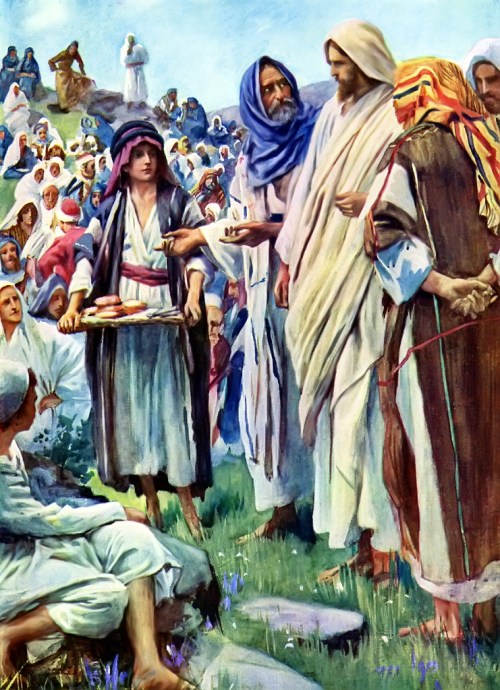
john6_9_boywithloavesandfishes

And a great multitude followed him, because they saw his miracles which he did on them that were diseased. (John 6:2)

            The synoptic Gospel writers also recorded this fourth miracle selected by John. So impressive was this miracle, that the others recorded a second very much like it. Just as when Jesus turned the water into wine, Jesus took something simple and multiplied it into more than enough. I am talking about the time that Jesus took five barley loaves and two small fish and turned it into enough fish and chips to feed a crowd of over 5000 – and that was just counting men.

            “After these things Jesus went over the sea of Galilee, which is the sea of Tiberias” (John 6:1). “After these things” places this event between the end of Purim[1] and the beginning of the second Passover recorded by John. “And the passover, a feast of the Jews, was nigh” (John 6:4). In the interim, Jesus left Jerusalem and returned to the region around the Sea of Galilee. John records that “Jesus went up into a mountain, and there he sat with his disciples” (John 6:3). Matthew and Mark point out that this was after Jesus heard of the beheading of John the Baptist (Matthew 14:10-13). Luke tells us that Herod the Tetrarch heard about what Jesus was doing and wondered if this was John the Baptist reincarnated (Luke 9:7-9). The news seems to have troubled Jesus, because all four Gospels record that he wanted to get away and spend time alone with His apostles. “And Jesus went up into a mountain, and there he sat with his disciples” (John 6:3).

            However, He could not shake the crowds. They sought Him out, but one senses that they sought Him out for selfish motives. Mark indicates that Jesus and His disciples were so busy ministering that they had no down time (Mark 6:31). “And a great multitude followed him, because they saw his miracles which he did on them that were diseased” (John 6:2, emphasis mine). Sometimes we tend to be that way. We follow Jesus because we expect to get something out of it, and then when we don’t get what we want, we abandon Him. Regardless, “Jesus went forth, and saw a great multitude, and was moved with compassion toward them, and he healed their sick” (Matthew 14:14, emphasis mine). How often Jesus meets our needs even though we are undeserving!

            Jesus spent the day teaching and healing their sick until very late in the day (Matthew 14:15).  The Gospels tell us that the place they were was very remote, and apparently, no one thought to bring any food for the day.  The Synoptic Gospels tell us that the disciples came to Jesus to express concern about the lateness of the day and the need to send the people away so they could get something to eat (Matthew 14:15; Mark 6:35-36; Luke 9:12). They agree that Jesus told them, “You feed them” (Matthew 14:16; Mark 6:37; Luke 9:13). John, though, says that Jesus presented the challenge to Philip. “When Jesus then lifted up his eyes, and saw a great company come unto him, he saith unto Philip, Whence shall we buy bread, that these may eat? And this he said to prove him: for he himself knew what he would do” (John 6:5-6, emphasis mine).

John belonged to Jesus’ inner circle of three: Peter, James and John. He never names himself in his Gospel, but rather refers to himself as “the disciple whom Jesus loved” (John 13:23; 20:2; 21:7; 21:30). By his own account, he was very close to Jesus. He probably stayed close at Jesus’ side all the time. Therefore, it seems that he had a special vantage point that Matthew and the others did not have. Some think that Mark got his account from Peter, and Luke received his account second hand by interviewing eyewitnesses; but John was right there. So, it seems that Jesus presented the challenge to Philip first. “Philip answered him, Two hundred pennyworth of bread is not sufficient for them, that every one of them may take a little” (John 6:7). We often do the same when God asks something from us (knowing Himself what He will do), and the first thing that pops into our mind is “What’s it going to cost?” followed by, “We don’t have enough!”

Philip probably consulted with the other disciples, and they collectively came up with the great idea of sending them away so they could go buy their own food. Thus we have the account presented by the other Gospel writers. They also agree that someone had five barley loaves and two small fish, but it is John that records, that “One of his disciples, Andrew, Simon Peter’s brother, saith unto him, There is a lad here, which hath five barley loaves, and two small fishes: but what are they among so many?” (John 6:8-9, emphasis mine). Andrew must have felt that Jesus might be able to do something with the small offering. Otherwise, why would he even bring the boy to Jesus? Even so, the task was inconceivable.

According to Mark (who got it from Peter) Jesus had the disciples sit the people in groups of fifties and hundreds (Mark 6:40). “And Jesus took the loaves; and when he had given thanks, he distributed to the disciples, and the disciples to them that were set down; and likewise of the fishes as much as they would” (John 6:11). Jesus, the Creator God, took that small amount and multiplied over and over again, and all ate “as much as they would.” So abundantly did He provide that there were leftovers. “When they were filled, he said unto his disciples, Gather up the fragments that remain, that nothing be lost. Therefore they gathered them together, and filled twelve baskets with the fragments of the five barley loaves, which remained over and above unto them that had eaten” (John 6:12-13, emphasis mine). Some have suggested, and I think it is true, that twelve baskets where gathered so that each disciple would have a tangible witness of Jesus’ divine, creative power.

How often do we bring our can’t-be-done attitude to Lord when He has asked us to do something for Him? We may think we have little or nothing to offer, but God never asks us for great gifts or talents in order to accomplish great things. He asks us to bring the little that we have so that He can accomplish great things through it. When we are willing to trust Him with our little, He can do much, and He, not we, gets the glory. Give your five loaves and two fish to Jesus and let Him multiply them!
NOTES:


[1]  “Jesus’ Seven Signs in John (3)”

Comments Off on Jesus’ Seven Signs in John (4)

Filed under Apologetics, Bible, Christianity, Creation, Religion, Theology

Jesus’ Seven ‘I AM’ Statements in John (5)

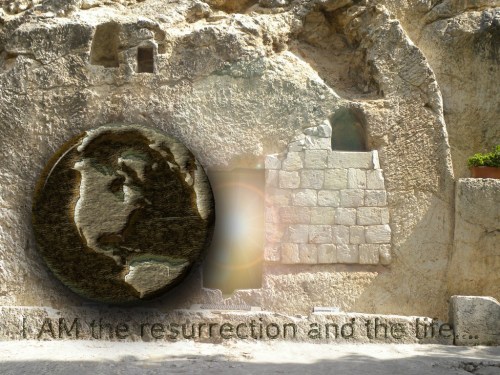
resurrection-and-life

Jesus said unto her, I am the resurrection, and the life… (John 11:25)

“And it came to pass, when the time was come that he should be received up, he stedfastly set his face to go to Jerusalem” (Luke 9:51). Jesus knew that the culmination of His earthly mission had arrived, and He was determined to see it through to the end. His journey up to Jerusalem took Him by way of Jericho where He healed the blind man, Bartimaeus (Luke 18:35-43), and “saved” the publican (tax collector), Zacchaeus (Luke 19:1-10).

While there, possibly in Zaccheaus’ home, Jesus received word that His good friend, Lazarus, had fallen deathly ill. “Therefore his sisters sent unto him, saying, Lord, behold, he whom thou lovest is sick” (John 11:3). Bethany (John 11:1), where Lazarus and his sisters, Mary and Martha, lived, was just up the road from Jericho about a day’s walk. Answering the call would not have distracted Jesus from His determination to face the cross. Bethany was on the way up to Jerusalem, but “When he had heard therefore that he was sick, he abode two days still in the same place where he was” (John 11:6, emphasis mine). That seems like a strange reaction for the compassionate Jesus to take with regard to a “friend.”

“When Jesus heard that, he said, This sickness is not unto death, but for the glory of God, that the Son of God might be glorified thereby” (John 11:4). In reality, Lazarus probably died shortly after the delegation departed Bethany. It took them a day to arrive in Jericho. Jesus remained another two days before making trip up to Bethany, plus the day to travel there – four days. When Jesus arrived in Bethany, He was informed that Lazarus had been dead four days (John 11:39). Did Jesus err in His assessment that “This sickness is not unto death”? No, Jesus, in His omniscience, knew the situation perfectly. The delay would glorify the Son and bring glory to God. John points out that “Jesus loved Martha, and her sister [Mary], and Lazarus” (John 11:5), yet He delayed His departure.

When the day came to depart, Jesus’ disciples, vaguely knowing what awaited Him, tried to dissuade Him from going up to Jerusalem. “His disciples say unto him, Master, the Jews of late sought to stone thee; and goest thou thither again?” (John 11:8), but Jesus knew what He was doing. “Our friend Lazarus sleepeth; but I go, that I may awake him out of sleep” (John 11:11). The disciples took this as a good sign. “Then said Jesus unto them plainly, Lazarus is dead” (John 11:14).

As He approached Bethany, Martha rushed out to meet Him. “Then said Martha unto Jesus, Lord, if thou hadst been here, my brother had not died” (John 11:21, emphasis mine). How many times have similar sentiments been expressed at the death of a loved one? When the Twin Towers fell on September 11, 2001, many demanded to know, “Where was God?” He was where He has always been – on His throne and in command. Even so, Martha expressed remarkable faith. “But I know, that even now, whatsoever thou wilt ask of God, God will give it thee.” (John 11:22, emphasis mine). What could she have been thinking? Did she indeed believe that Jesus could raise her brother from the dead? This would not be something new. Jesus had raised the dead before: a widow’s only son (Luke 7:12-14), Jairus’s daughter (Matthew 9:18-26; Mark 5:22-43; Luke 8:41-56),  and unnamed others. Nevertheless, this was different. Lazarus had been dead four days “when it was believed that resurrection was no longer possible.”[1]

“Jesus saith unto her, Thy brother shall rise again. Martha saith unto him, I know that he shall rise again in the resurrection at the last day” (John 11:23-24). Sure Lazarus would rise again, but not today. After all, he had been dead four days; his spirit had long departed. The resurrections Jesus had performed before where shortly after the victim had died. Common thought was that the person’s spirit lingered around a few days before finally departing. Raising the dead shortly after death was consistent with their tradition, but after three days, the spirit departed, and Lazarus had been dead four days. Sure he’ll rise again – at the resurrection!

I AM the resurrection, and the life” (John 11:25, emphasis mine). Ego Eimi. I, I AM. As explained in recent “I Am” articles,[2] this phrase expresses the deity of Christ. Jesus was saying, “I, Yahweh, am the resurrection and the life.” The Greek word translated “resurrection” is anastasis and it means to “stand up again,” and “life” is the Greek word zōē meaning the very essence of life – that animating energy or force that goes beyond biological function. It is that “breath of life” given to man by God at the moment of creation (Genesis 2:7). That Jesus incorporated both “resurrection” and “life” recalls Ezekiel’s vision of the valley of dry bones (Ezekiel 37). He preached to the dry bones and they came together. Flesh and skin formed upon their frame, but they did not stand until the breath of life came upon them, and they stood up.

Jesus, the Creator (John 1:1-3) not only has the power to create biological life, but He gives the very essence of life. All of it comes from the Great I AM. Because He is “the resurrection and the life,” “he that believeth in me, though he were dead, yet shall he live: And whosoever liveth and believeth in me shall never die. Believest thou this?” (John 11:26, emphasis mine). “Never die?” Jesus here referred to eternal life. We all will die physically as a result of the curse (Genesis 3:19; 1 Corinthians 15:22); however our “life” will continue in one of two destinations, either with God or apart from God. “And death and hell were cast into the lake of fire. This is the second death” (Revelation 20:14, emphasis mine). There are two deaths: one we all experience as physical death; the other death is eternal life in hell, apart from God. Those who believe in the Great I AM, will never experience that second death, i.e. “never die.” “But the fearful, and unbelieving, and the abominable, and murderers, and whoremongers, and sorcerers, and idolaters, and all liars, shall have their part in the lake which burneth with fire and brimstone: which is the second death” (Revelation 21:8, emphasis mine).

Jesus is “the resurrection and the life.” “In him was life; and the life was the light of men …  He was in the world, and the world was made by him, and the world knew him not … But as many as received him, to them gave he power to become the sons of God, even to them that believe on his name” (John 1:4, 10, 12, emphasis mine), and they shall never die.

Notes:


[1]  Eli Lizorkin-Eyzenberg, The Jewish Gospel of John: Discovering Jesus, King of All Israel, (Tel Aviv, Israel, Jewish Studies for Christians, 2015), 190.

[2]  See esp. the 3rd paragraph of https://erniecarrasco.com/2016/08/28/jesus-seven-i-am-statements-in-john-1/

Comments Off on Jesus’ Seven ‘I AM’ Statements in John (5)

Filed under Apologetics, Bible, Christianity, Evangelism, Gospel, Hell, Religion, Resurrection, Salvation

If My People

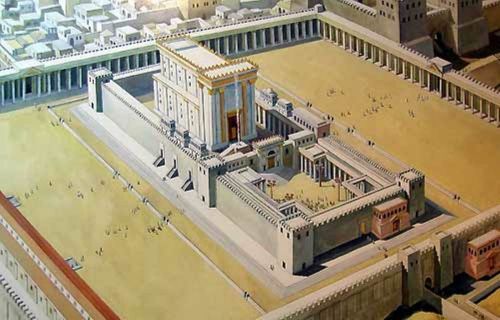
solomons-temple

If my people, which are called by my name, shall humble themselves, and pray, and seek my face, and turn from their wicked ways; then will I hear from heaven, and will forgive their sin, and will heal their land. (2 Chronicles 7:14)

Fear hangs like a dark, menacing storm cloud over our nation. Insecurity saps the courage of our people to venture into the unknown. Anger and hostility ignite flames of anarchy in our streets and everyone yearns for a savior. Our nation is deeply troubled. Anyone with any sense of awareness can see it. Many feel helpless to stem the tide, while many others tenaciously cling to the hope that the downward spiral can be arrested and reversed through a spiritual awakening and revival. The latter frequently quote, “If my people, which are called by my name, shall humble themselves, and pray, and seek my face, and turn from their wicked ways; then will I hear from heaven, and will forgive their sin, and will heal their land” (2 Chronicles 7:14, emphasis mine).

The passage quoted intends for “God’s people” to collectively storm the gates of heaven petitioning God on behalf of our wicked and sinful nation. The petition is conditional and incumbent upon “God’s people,” not the general populous, but who are God’s people and where are they?

Before I respond to that question, I need to restate what have emphasized in the past concerning this particular verse in Second Chronicles that is so often quoted. Regarding the United States of America, the verse is taken out of context and misapplied. The Second Chronicles begins with Solomon’s ascension to the throne of Israel and the building of the first temple in Jerusalem. At the completion of Temple, the priests placed the Ark of the Covenant in its place in the Holy of Holies (2 Chronicles 5:1-12) and “the glory of God” in the form of a cloud that filled the temple in such a way that the priests could not minister in the place (vv. 13-14). As the dedication service continued, Solomon prayed and asked God to “Hearken therefore unto the supplications of thy servant, and of thy people Israel, which they shall make toward this place: hear thou from thy dwelling place, even from heaven; and when thou hearest, forgive” (2 Chronicles 6:21, emphasis mine). Solomon’s plea for God’s forgiveness goes beyond individual sins and extends to the sins of nation collectively.

And if thy people Israel be put to the worse before the enemy, because they have sinned against thee; and shall return and confess thy name, and pray and make supplication before thee in this house; Then hear thou from the heavens, and forgive the sin of thy people Israel, and bring them again unto the land which thou gavest to them and to their fathers. When the heaven is shut up, and there is no rain, because they have sinned against thee; yet if they pray toward this place, and confess thy name, and turn from their sin, when thou dost afflict them; Then hear thou from heaven, and forgive the sin of thy servants, and of thy people Israel, when thou hast taught them the good way, wherein they should walk; and send rain upon thy land, which thou hast given unto thy people for an inheritance … If they return to thee with all their heart and with all their soul in the land of their captivity, whither they have carried them captives, and pray toward their land, which thou gavest unto their fathers, and toward the city which thou hast chosen, and toward the house which I have built for thy name: Then hear thou from the heavens, even from thy dwelling place, their prayer and their supplications, and maintain their cause, and forgive thy people which have sinned against thee. (2 Chronicles 6:24-27, 38-39, emphasis mine)

Notice that Solomon’s request specifies God’s people (Israel), the Temple (this house), Jerusalem (the city), and the nation (their land). “Now when Solomon had made an end of praying, the fire came down from heaven, and consumed the burnt offering and the sacrifices; and the glory of the LORD filled the house. And the priests could not enter into the house of the LORD, because the glory of the LORD had filled the LORD’S house. And when all the children of Israel saw how the fire came down, and the glory of the LORD upon the house, they bowed themselves with their faces to the ground upon the pavement, and worshipped, and praised the LORD, saying, For he is good; for his mercy endureth for ever” (2 Chronicles 7:1-3, emphasis mine).

Obviously, God approved of the Temple and the offerings presented there. The dedication of the Temple took place in the midst of the Fall Feasts. Scripture tells us that it was “in the seventh month” (2 Chronicles 5:3). The Feast of Trumpets (Rosh Ha Shanna) was celebrated on the first day of the seventh month (Leviticus 23:24). Then on the tenth day of the month, they observed the Day of Atonement (Yom Kippur – Leviticus 23:27). That was followed by the Feast of Tabernacles (Succoth) fifteen days later (Leviticus 23:34), which was celebrated for seven days. Solomon dedicated the Temple on the eighth day (2 Chronicles 7:9), and the celebration lasted through the Day of Atonement for seven days. The dedication ended in time to celebrate the Feast of Tabernacles, which lasted an additional seven days (1 Kings 8:65-66). “And on the three and twentieth day of the seventh month he sent the people away into their tents, glad and merry in heart for the goodness that the LORD had shewed unto David, and to Solomon, and to Israel his people.” (2 Chronicles 7:10).

It is in this context that God responds.

And the LORD appeared to Solomon by night, and said unto him, I have heard thy prayer, and have chosen this place to myself for an house of sacrifice. If I shut up heaven that there be no rain, or if I command the locusts to devour the land, or if I send pestilence among my people; If my people, which are called by my name, shall humble themselves, and pray, and seek my face, and turn from their wicked ways; then will I hear from heaven, and will forgive their sin, and will heal their land. Now mine eyes shall be open, and mine ears attent unto the prayer that is made in this place. For now have I chosen and sanctified this house, that my name may be there for ever: and mine eyes and mine heart shall be there perpetually.  (2 Chronicles 7:12-16, emphasis mine)

As specific as Solomon’s prayer was, so was God’s response. Note that God is responding to Solomon’s prayer: “I have heard thy prayer.” Solomon’s prayer request focused on the Temple, Jerusalem, and the “nation” of Israel as noted above. In response, God says that He has “chosen this place to myself.” His people which are called by His name is the nation of Israel collectively. If they sin, which they did and which resulted in expatriation for the northern  kingdom and Babylonian captivity for Judah, and they humble themselves, repent and seek God, then He will heal their land. Note also that the prayer must either originate in that place or be directed toward that place. We see this exact scenario when Daniel recognizes that the 70-year captivity had been met (Daniel 9:1-19).

Christians these days have adopted 2 Chronicles 7:14 as their own and applied it to what is currently going on in the United States of America. They rightly claim we are “God’s people.” You will not arouse an argument from me on that point. The New Testament repeatedly teaches that we are the children of God. “But as many as received him, to them gave he power to become the sons of God, even to them that believe on his name” (John 1:12). However, the claim ends right there. Where is God’s Temple right now? “Know ye not that ye are the temple of God, and that the Spirit of God dwelleth in you?” (1 Corinthians 3:16, emphasis mine). What borders mark the land of God’s people? Americans claim the United States. Are there no Christians in Australia, Canada, China, France, Great Britain, etc.? What of all the Christians being martyred in the Middle East and Africa, are thy not God’s people, and do they not have the right to intercede on behalf of their land?  God’s “grafted in” people have no land here on earth. “For our conversation [i.e. citizenship] is in heaven; from whence also we look for the Saviour, the Lord Jesus Christ” (Philippians 3:20).

It seems somewhat hypocritical that many Christians today want to reject the Old Testament Law claiming that we are “under grace” – those things no longer apply – and yet will take this verse, completely out of context and force it apply to 21st Century America. Sorry, folks, it will not work. There is still a nation of Israel with whom God is dealing. To date, the majority of Israelis are secular. Many are agnostics or atheists. There exists a small minority of “completed Jews” in the land, but with laws against proselytizing, their numbers remain small. Israel exists to show God’s faithfulness to His promises, and in the end, those who survive the Great Tribulation that is coming, “they shall look upon me whom they have pierced, and they shall mourn for him, as one mourneth for his only son, and shall be in bitterness for him, as one that is in bitterness for his firstborn” (Zechariah 12:10), and they will be saved.

So, what can the Christian get out of 2 Chronicles 7:14? Taken in context, we can rest in the assurance that God does hear the prayers of His people, and He does answer according to His will.

2 Comments

Filed under Apologetics, Bible, Christianity, Current Events, End Times, Prayer, Second Coming of Christ, Theology

Alpha And Omega

Alpha Omega Bible

I am Alpha and Omega, the beginning and the ending, saith the Lord, which is, and which was, and which is to come, the Almighty.  (Revelation 1:8)

These words recorded by the Apostle John, the one “whom Jesus loved” (John 13:23; 20:2; 21:7, 20), introduce the One who would “reveal” the details of the final events of world history. At this time, John was an old man probably in his nineties, exiled on the island of Patmos “for the word of God, and for the testimony of Jesus Christ” (Revelation 1:9). It was Sunday, “the Lord’s Day,” and John was “in the Spirit” (Revelation 1:10).  John does not say, but I imagine that he was reading and meditating on Daniel’s prophecy and praying. John earned the nickname “Camel Knees” (so I am told) for the calluses he developed from hours on his knees in prayer. While in that posture, “a great voice, as of a trumpet” interrupted his meditation, and the resurrected Lord introduced Himself as “Alpha and Omega, the first and the last” (Revelation 1:10-11).

John recognized Him, although he had never seen Him like this before – “clothed with a garment down to the foot, and girt about the paps with a golden girdle. His head and his hairs were white like wool, as white as snow; and his eyes were as a flame of fire; And his feet like unto fine brass, as if they burned in a furnace; and his voice as the sound of many waters” (Revelation 1:13-15). John, in the company of Peter and James, witnessed Jesus transfigured on the mountain (Luke 9:28-36) in the days of Jesus’ short ministry on earth. That experience left the disciples awestruck, but it was nothing compared to this appearance.

Alpha, the first letter in the Greek alphabet, represents the beginning of the Word. In his Gospel, John wrote, “In the beginning was the Word, and the Word was with God, and the Word was God. The same was in the beginning with God. All things were made by him; and without him was not any thing made that was made” (John 1:1-3, emphasis mine). The Word of God, the Holy Bible, opens with the same phrase: “In the beginning God created the heaven and the earth” (Genesis 1:1, emphasis mine). God, the “uni-plural” Elohim, created the universe – all things – through His spoken Word: “And God said, Let there be light: and there was light. And God saw the light, that it was good: and God divided the light from the darkness” (Genesis 1:3-4, emphasis mine). John says, “In him [the Word] was life; and the life was the light of men. And the light shineth in darkness; and the darkness comprehended it not” (John 1:4-5, emphasis mine).

The Alpha of the Bible goes on to describe the six-day creation acts of God. On the sixth day, the Elohim created all the land-dwelling animals, and at last, He created man. “And God said, Let us make man in our image, after our likeness: and let them have dominion over the fish of the sea, and over the fowl of the air, and over the cattle, and over all the earth, and over every creeping thing that creepeth upon the earth. So God created man in his own image, in the image of God created he him; male and female created he them” (Genesis 1:26-27, emphasis mine). The switch between the plural (us/our) and the singular (his/he) provides the first insight (in English) to the triune nature of God, which is developed later in Scripture. However, in the original language of Hebrew, that insight appears in the very first verse. God (Elohim) is the plural form of the noun for god (el); however, the verb “created” (bara) appears in the singular form, which under other circumstances would be a grammatical booboo in Hebrew.

So, God creates man in His own image, which among other things, implies that man too is triune in nature. One aspect of that triune nature involves the physical form that animates and transports “the soul” of man. “And the LORD God formed man of the dust of the ground, and breathed into his nostrils the breath of life; and man became a living soul” (Genesis 2:7, emphasis mine). What physical shape would reflect “the image of God”? The Hebrew word translated “formed,” yâtsar, describes the work of a potter molding and shaping a lump of clay into a useful vessel. The Word, by whom “all things were made,” molded and shaped the kind of body He would one day inhabit. “And the Word was made flesh, and dwelt among us, (and we beheld his glory, the glory as of the only begotten of the Father,) full of grace and truth” (John 1:14, emphasis mine).

God took His image bearer “And the LORD God planted a garden eastward in Eden; and there he put the man whom he had formed” (Genesis 2:8). There God provided for man’s every need. The Garden of Eden provided an abundance of food and water (Genesis 2:9-10) with a perfect climate (Genesis 2:5-6). Best of all, sickness and death did not exist. God gave His stamp of approval on His perfect creation. “And God saw every thing that he had made, and, behold, it was very good. And the evening and the morning were the sixth day” (Genesis 1:31, emphasis mine). Death could not exist in a “very good” creation because the Bible says that death is “the last enemy” (1 Corinthians 15:26).

God and His image enjoyed intimate fellowship as God walked “in the garden in the cool of the day” (Genesis 3:8). However, love coerced is not love. Love must be a willful choice, and God allowed for the choice. “And the LORD God commanded the man, saying, Of every tree of the garden thou mayest freely eat: But of the tree of the knowledge of good and evil, thou shalt not eat of it: for in the day that thou eatest thereof [dying] thou shalt surely die” (Genesis 2:16-17, emphasis mine). Death did not exist in the Garden of Eden, but the potential did exist. Man had the choice, and man made the wrong choice. “And when the woman saw that the tree was good for food, and that it was pleasant to the eyes, and a tree to be desired to make one wise, she took of the fruit thereof, and did eat, and gave also unto her husband with her; and he did eat” (Genesis 3:6, emphasis mine). Man made the choice, and death entered God’s perfect creation.

The remainder of the Bible tells the story of God’s work in restoring fellowship with His fallen and dying creation. Only the blood of a perfect and innocent victim could make amends or reparation for the perpetual infraction. “For the life of the flesh is in the blood: and I have given it to you upon the altar to make an atonement for your souls: for it is the blood that maketh an atonement for the soul” (Leviticus 17:11, emphasis mine). The blood of animals fell short of the requirement because it was man, not animals, that sinned. “For it is not possible that the blood of bulls and of goats should take away sins” (Hebrews 10:4). The atoning blood-sacrifice must be that of a perfect, innocent man; nothing less would do. However, no man fit the bill, for “As it is written, There is none righteous, no, not one” (Romans 3:10). No human solution could be found. Therefore, “the Word was made flesh, and dwelt among us” (John 1:14, emphasis mine). “But [the Word] made himself of no reputation, and took upon him the form of a servant, and was made in the likeness of men: And being found in fashion as a man, he humbled himself, and became obedient unto death, even the death of the cross” (Philippians 2:7-8, emphasis mine). “But this man [the Word], after he had offered one sacrifice for sins for ever, sat down on the right hand of God” (Hebrews 10:12, emphasis mine). The debt is paid in full, and God offers the pardon as a gift to whoever will accept it. A choice must still be made – accept the gift or reject it. Love is not coerced.

Omega is the final letter in the Greek alphabet. Just as Alpha opens the book with God’s perfect image bearers in the pristine Garden of Eden, Omega closes the final book in a new heaven and new earth (Revelation 21:1) – Eden restored. There, the fellowship between Creator and creature is renewed (Revelation 21:3). Death and the grave no longer exist (Revelation 20:14), neither do tears, sorrow or pain (Revelation 21:4). The Tree of Life is there (Revelation 22:2), but not the Tree of the Knowledge of Good and Evil. The residents of the new heaven and new earth chose God’s free pardon during their time on earth. They chose to love God of their own volition; therefore there is no longer any curse, nor the option to choose evil (Revelation 22:3), “and they shall see His face” (Revelation 22 4) – the One who started it all. “I am Alpha and Omega, the beginning and the end, the first and the last” (Revelation 22:13).

2 Comments

Filed under Bible, Christianity, Creation, End Times, Evangelism, Gospel, Heaven, Origins, Religion, Salvation, Theology

Dad

Left to right: Dad, Me, Ednoi, Eli and Esther

Left to right: Dad, Me, Ednoi, Eli and Esther

Behold, I have taught you statutes and judgments, even as the LORD my God commanded me…  (Deuteronomy 4:5)

He came to the United States from Mexico in 1943 with false papers under an assumed name and started working for the railroad. Not long after, his work brought him to the West Texas town of Monahans where his eye fell upon the lovely Elena, and his life changed forever. Elena was one of five children of store owner and Baptist lay preacher, Porfírio Enriquez. Elena was hard to get, especially since her father wanted her to have nothing to do with the “mojado” (“wetback”), especially since he was not a Christian. But, eventually Elena fell prey to his boyish charm and the couple soon married – he was 20, she was 18.

The “unequally yoked” couple (2 Corinthians 6:14) soon experienced struggle over religious differences. Chale (Chah-leh), as he was known to his friends, was a non-practicing Catholic, so “church” mattered little to him. In fact, he found the practice of praying to inanimate images silly and pointless, so church to him was a waste of time. Chale also loved to party, and he loved to dance, much to the chagrin of the good Southern Baptist girl he had married. But Elena was not without recourse. On Saturday nights when Chale wanted to go dancing, Elena promised to go with him, if he would come to church with her on Sunday. Chale would dance all night with all the other ladies while Elena sat patiently by and watched. She would later say that he looked like a little demon dancing around through the haze of cigarette smoke. That arrangement worked well. Chale honored his promise to attend church with her on Sunday, and before long Chale surrendered his life to the Lord, gave up his partying ways, and took after his father-in-law as a lay preacher.

Shortly after Chale surrendered his life to the Lord, Elena became pregnant with me. At that time, Chale still resided in the US under an assumed name and false documentation. His new “tenderized” conscience started to bother him not only because of his illegal status, but also because he did not want his son given some stranger’s name. Determined to set the record straight, he returned to Mexico to earn the right to return to the United States legally. Wenceslao Carrasco de Cortez (his legal name) was required to spend two years in the Mexican Army Reserves to fulfill his military obligation to that nation, while at the same time working with a Mexican lawyer to legally come to America. While in Juarez, Chihuahua, Mexico, he served as assistant pastor in a Baptist church in that city.

I was born in Monahans in 1950, and when I was about one year old, Elena, Mom, took me with her to be with Dad in Juarez. We lived there a year until Dad got all his legal matters resolved and fulfilled his military obligation to Mexico. We returned in 1952, and the following year I was blessed with a baby brother, Ednoi.

Dad continued to work on the railroad, and soon his work carried us to Odessa, Texas where, in 1955, another baby brother came along – Eliseo (Eli). Around this time Dad felt called of God to go into full-time ministry, and soon we moved to San Antonio, Texas for Dad to train for the ministry. W.C., as English speakers referred to him, was not well educated. He got as far as the third grade in Mexico where he learned reading, writing, and arithmetic, but the needs of his father’s ranch were of higher priority than education, and school fell by the wayside. Study at the Instituto Biblico Mexicano proved difficult for Dad, not to mention the burden of a family that needed provision. There were times when we had no food and no money for food. Mom told me of a time when she sent me to school with the last bit of beans folded in a flour tortilla (a bean taco), and after that no food was left for the rest of the family. That day, Dad was in the school chapel crying out to God; Mom was at home on her knees in prayer, when a knock came at the door, and some ladies from an Anglo church showed up, completely unaware of our need, with a month’s worth of groceries. In the meantime, the president of the school overheard Dad crying out to God and came to see what was troubling him. When he discovered the need, he reprimanded Dad for failing to make his need known, and promptly wrote him out a check for $100. In 1957, that was a lot of money! Dad couldn’t wait to come home to give Mom the news, and when he arrived, he found her in tears of joy for how God had provided.

I could relate many more stories just like that, but what I experienced in my young life taught me that God is real. His love is real, and He really does care about our every need, and He will provide exactly what we need, exactly when we need it.

W.C. spent five years in school preparing for the ministry. In the end, he left the school without having completed his training. Our family moved to Cotton Center, Texas in 1960 where Dad was ordained as a Baptist minister, and where he pastored his first mission church in that capacity. Many mission churches followed. In 1963 we moved to Raton, New Mexico where Dad served as pastor of his first non-mission church. In 1965, God blessed us with our baby sister, Esther. I only got to know her the first five years of her life, and then I was off to the Navy and a life of my own.

Dad taught me many things. He taught me to read and write in Spanish. He taught me how to play baseball and throw a curve ball. He taught me how to drive; in fact, at 10 years old, when we were living in Cotton Center, he would send me, by my 10-year-old self, in our 1956 Ford Victoria to pick up kids for Sunday school. By the time I was old enough for my driver’s permit, I was already the most experienced driver in my Driver’s Ed class! Dad taught me the value of hard work. And even though he was not yet a naturalized citizen of the United States, he taught me patriotism, love of my country, love of my flag, and respect for authority. Dad taught me to take responsibility for myself and to never shy away from a challenge. He would always say, “Si está hecho por hombres, yo también lo puedo hacer.” (If it’s done by man, I can do it too!). But the greatest thing Dad ever taught me was the love of God and the love of God’s Word. The lessons learned from that have kept me from drifting to the left or to the right knowing that God does not change, and God’s Word never changes. Some have thought me insensitive, or unmoving, but although Dad taught me to love, and God’s Word teaches me to love, I also know that some things, from God’s perspective, are non-negotiable, so I do not easily yield to compromise even when “love” comes into play. The love of God must always supersede all others.

Dad was always strong – a trait I greatly admired in him, and one that I tried to emulate. He almost always had a cheerful disposition. He loved life, and he loved people – something else I admired in him. And he sang (or hummed) incessantly – to the point of annoyance – oblivious to anyone around him. But even that I admired in him – there was always a song – usually a hymn – in his heart. The world could be falling apart all around us, but one would never know it around Dad.

After Mom went to be with Jesus in December 2001, he, now 75, continued on with life as before, only without his lifelong partner. Shortly after we buried Mom, he took the pastorate of a small dwindling church in Brady, Texas, and served and ministered to them the remaining years of his life. His knees gave him trouble since his late 60’s, but the fear of knee replacement surgery kept him from taking care of the problem. It finally got to the point where he could hardly get around, and that interfered with his ministry, which to him was a high priority. So he finally conceded to replace his knees, first the right one followed by the left the next year. Dad got a new lease on life with his new knees, and it was hard to slow him down at age 85. I found out through the grapevine that he helped a family put a new roof on their house. He was climbing ladders with bundles of shingles on his shoulder, and down on his new knees nailing shingles to the roof. He even outworked two much younger men that were helping him. I had to give him a good scolding for that, but that was just Dad. He would make the four and a half hour drive from Brady to Dallas and mix it up in Dallas traffic to make his doctors’ appointments.

He was an incredible man, my dad. As I watched him live his life – full-bore, filled with joy, loving the Lord with all of his heart and soul – I dreaded the thought of his decline into helplessness in later life. That would not have suited Dad at all, and I prayed and asked God not to allow my dad to decline physically or mentally, but rather that when his time came, that God would just take him. God answered my prayer on August 26, 2014. Dad got up that morning with respiratory issues (he had developed asthma late in life) and collapsed in the kitchen of his Brady home. My brother Ednoi, who was living with him, called emergency services, but by the time they arrived, Dad’s brain had been deprived of oxygen too long. The EMTs worked on him, got him to the Brady hospital, and then on a Care Flight to San Angelo. Dad lingered on a ventilator long enough for all of us kids, grandkids and some of his siblings to come and say goodbye. His body was functioning with the help of the ventilator, but he was not there. On August 28, 2014, we had the ventilator removed, and in a short seventeen minutes all life-functions stopped. Dad went to be with Jesus and to celebrate his 64th wedding anniversary with Mom the following day. Dad was exactly one month shy of his 88th birthday when he went to be with our Lord, but because of the greatest thing he taught me, I KNOW I will see him again, and maybe some time very soon.

This year (2015) marks the first year that I celebrate Father’s Day without my dad, but it will not be a time for sorrow. Rather it will be a time to thank God for the father He gave me, and for the instrument that he was in my life to instruct and guide me in the ways of God. It will be a time of joy knowing that soon I will be together with him again forever because God is faithful, and His Word is true. That is not hope. That is assurance! Happy Father’s Day, Dad! Thank you for all you meant to me, to our family, and to everyone whose life you touched. See you soon!

11 Comments

Filed under Bible, Christianity, Current Events, Death, End Times, Holidays, Prayer, Religion, Salvation