Category Archives: Creation

Articles that emphasize biblical six-day, young earth creation.

Jesus’ Seven Signs in John (4)

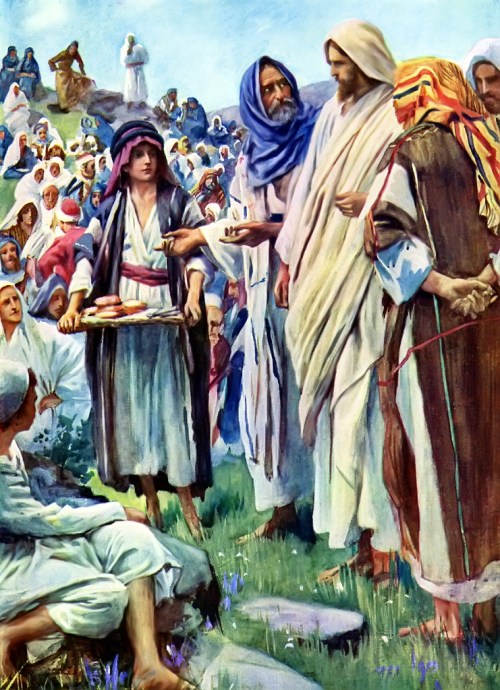
john6_9_boywithloavesandfishes

And a great multitude followed him, because they saw his miracles which he did on them that were diseased. (John 6:2)

            The synoptic Gospel writers also recorded this fourth miracle selected by John. So impressive was this miracle, that the others recorded a second very much like it. Just as when Jesus turned the water into wine, Jesus took something simple and multiplied it into more than enough. I am talking about the time that Jesus took five barley loaves and two small fish and turned it into enough fish and chips to feed a crowd of over 5000 – and that was just counting men.

            “After these things Jesus went over the sea of Galilee, which is the sea of Tiberias” (John 6:1). “After these things” places this event between the end of Purim[1] and the beginning of the second Passover recorded by John. “And the passover, a feast of the Jews, was nigh” (John 6:4). In the interim, Jesus left Jerusalem and returned to the region around the Sea of Galilee. John records that “Jesus went up into a mountain, and there he sat with his disciples” (John 6:3). Matthew and Mark point out that this was after Jesus heard of the beheading of John the Baptist (Matthew 14:10-13). Luke tells us that Herod the Tetrarch heard about what Jesus was doing and wondered if this was John the Baptist reincarnated (Luke 9:7-9). The news seems to have troubled Jesus, because all four Gospels record that he wanted to get away and spend time alone with His apostles. “And Jesus went up into a mountain, and there he sat with his disciples” (John 6:3).

            However, He could not shake the crowds. They sought Him out, but one senses that they sought Him out for selfish motives. Mark indicates that Jesus and His disciples were so busy ministering that they had no down time (Mark 6:31). “And a great multitude followed him, because they saw his miracles which he did on them that were diseased” (John 6:2, emphasis mine). Sometimes we tend to be that way. We follow Jesus because we expect to get something out of it, and then when we don’t get what we want, we abandon Him. Regardless, “Jesus went forth, and saw a great multitude, and was moved with compassion toward them, and he healed their sick” (Matthew 14:14, emphasis mine). How often Jesus meets our needs even though we are undeserving!

            Jesus spent the day teaching and healing their sick until very late in the day (Matthew 14:15).  The Gospels tell us that the place they were was very remote, and apparently, no one thought to bring any food for the day.  The Synoptic Gospels tell us that the disciples came to Jesus to express concern about the lateness of the day and the need to send the people away so they could get something to eat (Matthew 14:15; Mark 6:35-36; Luke 9:12). They agree that Jesus told them, “You feed them” (Matthew 14:16; Mark 6:37; Luke 9:13). John, though, says that Jesus presented the challenge to Philip. “When Jesus then lifted up his eyes, and saw a great company come unto him, he saith unto Philip, Whence shall we buy bread, that these may eat? And this he said to prove him: for he himself knew what he would do” (John 6:5-6, emphasis mine).

John belonged to Jesus’ inner circle of three: Peter, James and John. He never names himself in his Gospel, but rather refers to himself as “the disciple whom Jesus loved” (John 13:23; 20:2; 21:7; 21:30). By his own account, he was very close to Jesus. He probably stayed close at Jesus’ side all the time. Therefore, it seems that he had a special vantage point that Matthew and the others did not have. Some think that Mark got his account from Peter, and Luke received his account second hand by interviewing eyewitnesses; but John was right there. So, it seems that Jesus presented the challenge to Philip first. “Philip answered him, Two hundred pennyworth of bread is not sufficient for them, that every one of them may take a little” (John 6:7). We often do the same when God asks something from us (knowing Himself what He will do), and the first thing that pops into our mind is “What’s it going to cost?” followed by, “We don’t have enough!”

Philip probably consulted with the other disciples, and they collectively came up with the great idea of sending them away so they could go buy their own food. Thus we have the account presented by the other Gospel writers. They also agree that someone had five barley loaves and two small fish, but it is John that records, that “One of his disciples, Andrew, Simon Peter’s brother, saith unto him, There is a lad here, which hath five barley loaves, and two small fishes: but what are they among so many?” (John 6:8-9, emphasis mine). Andrew must have felt that Jesus might be able to do something with the small offering. Otherwise, why would he even bring the boy to Jesus? Even so, the task was inconceivable.

According to Mark (who got it from Peter) Jesus had the disciples sit the people in groups of fifties and hundreds (Mark 6:40). “And Jesus took the loaves; and when he had given thanks, he distributed to the disciples, and the disciples to them that were set down; and likewise of the fishes as much as they would” (John 6:11). Jesus, the Creator God, took that small amount and multiplied over and over again, and all ate “as much as they would.” So abundantly did He provide that there were leftovers. “When they were filled, he said unto his disciples, Gather up the fragments that remain, that nothing be lost. Therefore they gathered them together, and filled twelve baskets with the fragments of the five barley loaves, which remained over and above unto them that had eaten” (John 6:12-13, emphasis mine). Some have suggested, and I think it is true, that twelve baskets where gathered so that each disciple would have a tangible witness of Jesus’ divine, creative power.

How often do we bring our can’t-be-done attitude to Lord when He has asked us to do something for Him? We may think we have little or nothing to offer, but God never asks us for great gifts or talents in order to accomplish great things. He asks us to bring the little that we have so that He can accomplish great things through it. When we are willing to trust Him with our little, He can do much, and He, not we, gets the glory. Give your five loaves and two fish to Jesus and let Him multiply them!

NOTES:


[1]  “Jesus’ Seven Signs in John (3)”

Comments Off on Jesus’ Seven Signs in John (4)

Filed under Apologetics, Bible, Christianity, Creation, Religion, Theology

Jesus’ Seven Signs in John (2)

Then enquired he of them the hour when he began to amend. And they said unto him, Yesterday at the seventh hour the fever left him. (John 4:52)

Then enquired he of them the hour when he began to amend. And they said unto him, Yesterday at the seventh hour the fever left him. (John 4:52)

This is again the second miracle that Jesus did, when he was come out of Judaea into Galilee.  (John 4:54)

Men often boast about their abilities, but when it comes time to show what they can do, they fall far short of even their own expectations. Jesus not only demonstrated His deity by His claims, but He performed inexplicable acts attributable only to supernatural power. In the previous post, we looked at Jesus’ first sign – that of turning simple drinking water into a highly complex solution i.e. wine.[1] The low-key act called no attention to Himself, and He accomplished it by the will of His divine mind. He simply thought it, and it was done.

Jesus performed His second sign in much the same way. His first sign demonstrated His power over matter. The second sign demonstrated His power over life itself.

After the wedding in Cana where Jesus turned water into wine, Jesus went down to Jerusalem to celebrate the Passover (John 2:13). This was the first Passover celebrated during His three-year ministry. John, unlike the Synoptic Gospels, records the first time that Jesus “cleansed” the Temple by chasing out the merchants and money changers (John 2:14-17). While there, Jesus intrigued a Pharisee named Nicodemus. Knowing that Jesus was sent from God, “for no man can do these miracles that thou doest, except God be with him” (John 3:2), Nicodemus met with Jesus in secret to learn what He had to say. Jesus gave him the greatest lesson that anyone has ever heard, “Verily, verily, I say unto thee, Except a man be born again, he cannot see the kingdom of God” (John 3:3, emphasis mine).

When the Passover concluded, Jesus returned to the region of Galilee by way of Samaria. There He met with a Samaritan woman by Jacob’s well (John 4:12), and He gave her “living water” (John 4:10) that became in her “a well of water springing up into everlasting life” (John 4:14). She was “born again” and became an instant evangelist taking the “good news” to her village (John 4:28-30). “And many of the Samaritans of that city believed on him for the saying of the woman, which testified, He told me all that ever I did” (John 4:39).

Jesus remained with the Samaritans two days before returning to Cana of Galilee (John 4:43). There a “certain nobleman” met Him with an urgent request (John 4:46). That he was a “nobleman” indicates that he probably served as a “courtier” or officer in the king’s court. The Greek word translated “nobleman” is basilikos, which means, “belonging to, or befitting the sovereign.” At any rate, he was not of the “common” folk.

His son was deathly ill, and “When he heard that Jesus was come out of Judaea into Galilee, he went unto him, and besought him that he would come down, and heal his son: for he was at the point of death” (John 4:47). At first glance, Jesus seems somewhat annoyed with the request. “Then said Jesus unto him, Except ye see signs and wonders, ye will not believe” (John 4:48). Although Jesus addressed the nobleman’s request, His response was not directed at the man. After all, the he came a long way from Capernaum down to Cana only because “he heard Jesus was come out of Judaea into Galilee,” and he believed only Jesus could save his son from certain death.

One of the reasons I appreciate the “old” King James Bible is for the distinction it makes between the singular and plural second person personal pronouns – thee, thou, thine and you, ye, your – as expressed in the original languages (Hebrew and Greek). All the latest modern translations simply use “you” which can be either singular or plural, which adds ambiguity to the text. The distinction is important here, because in responding to the nobleman’s request, Jesus does not address him directly otherwise the text would read, “Except thou seest signs and wonders, thou wilt not believe.” However, that is not what Jesus said. He said, “Except ye see signs and wonders, ye will not believe.” “Ye” – in Texas we would say “y’all.” Jesus addressed the crowd around Him.

John reported this as Jesus’ second miracle, but actually, Jesus had already performed many miraculous acts as recorded by the other Gospel writers. The curious crowd followed Jesus because He gave sight to the blind, opened deaf ears, healed the lame, cleansed the leprous, cast out demons, etc. It was in this same region that He entered the synagogue in Nazareth and announced, “The Spirit of the Lord is upon me, because he hath anointed me to preach the gospel to the poor; he hath sent me to heal the brokenhearted, to preach deliverance to the captives, and recovering of sight to the blind, to set at liberty them that are bruised, To preach the acceptable year of the Lord” (Luke 4:18-19). Applying the prophecy of Isaiah 61:1-2 to Himself, the incensed crowd attempted to throw him over a cliff (Luke 4:28-30). “You claim to be Messiah,” they probably thought, “show us what you can do!”

In spite of all He had done, they would not believe. Jesus knew this, but He was not there for their entertainment. The nobleman was not a curiosity seeker nor did he come to be entertained. He had a serious need that only Jesus could meet. He believed this. “The nobleman saith unto him, Sir, come down ere my child die” (John 4:49). Only Jesus could save his son’s life. “Jesus [desiring not to perform for the crowd] saith unto him, Go thy way; thy son liveth. And the man believed the word that Jesus had spoken unto him, and he went his way.” (John 4:50, emphasis mine). Unlike the crowd who need to “see signs and wonders” in order to believe, the unnamed nobleman took Jesus at His word, by faith, and returned to his home believing that his son would live.

Capernaum was a day’s journey north of Cana on foot. As the man neared his home, his servants ran out to meet him with the news that his son had recovered and was well. “Then enquired he of them the hour when he began to amend. And they said unto him, Yesterday at the seventh hour the fever left him. So the father knew that it was at the same hour, in the which Jesus said unto him, Thy son liveth: and himself believed, and his whole house” (John 4:52-53, emphasis mine). The “seventh hour” would have been around one o’clock in the afternoon.

Interestingly, John remarks that the nobleman “himself believed, and his whole house.” Is it that he was unbelieving until he witnessed firsthand his son’s recovery? Perhaps that was true for “his whole house,” but certainly not for him. In the first place, consider that he believed enough to seek Jesus out in the first place. In the second place, he took Jesus’ word that his son was healed, and he returned home without question. He did not need to “see” to believe. What I believe John is saying is that his faith was confirmed when he realized that his son was healed the very instant that Jesus said, “Thy son liveth.” His “whole house” believed due to his testimony.

John records this as “the second miracle that Jesus did, when he was come out of Judaea into Galilee” (John 4:54, emphasis added), but as noted above, that is not exactly true. What prompted John to make that statement? Dr. Henry M. Morris, founder of the Institute for Creation Research, offers an excellent explanation:

Jesus actually had done many miracles in or near Jerusalem (John 2:23; 3:2) since the miracle of turning the water into wine. This is called the second miracle, either because it was the second done in Galilee or else because John was specifically counting only the seven great signs (all of these being miracles of creation) described in detail in order to win men to Christ (John 20:30,31). [2] (Emphasis mine)

I believe the latter to be the case. John’s purpose in writing his Gospel was to testify that Jesus was God in the flesh. He opens his Gospel with, “In the beginning was the Word, and the Word was with God, and the Word was God … And the Word was made flesh, and dwelt among us, (and we beheld his glory, the glory as of the only begotten of the Father,) full of grace and truth” (John 1:1, 14).

As in the miracle of turning water into wine, Jesus performed this miraculous act telepathically, i.e. by the mere power of His mind He made it happen. All it took was for Him to say, “Thy son liveth,” and it was so, even though He was miles away from where the sick lad lay. However, this was a small thing compared to when He called Creation into being by the mere power of His Word, “Let there be … and it was so.” This second miracle was nothing less than an act of God – Jesus.

NOTES:


[1]  Jesus’ Seven Signs in John (1)

[2]  Henry M. Morris, Ph.D., The Henry Morris Study Bible, (Master Books, Green Forest, AR, 2012), 1577.

3 Comments

Filed under Apologetics, Christianity, Creation, Evangelism, Gospel, Religion, Salvation, Theology

Jesus’ Seven Signs in John (1)

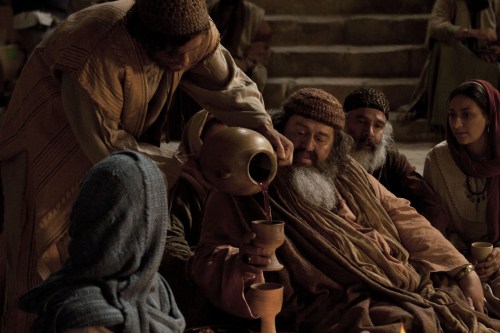
jesus-turns-water-into-wine

This beginning of miracles did Jesus in Cana of Galilee, and manifested forth his glory; and his disciples believed on him.  (John 2:11)

In the past few weeks, I highlighted the seven I AM statements spoken by Jesus as recorded in the Gospel of According to John.  These statements are significant because through them Jesus declared His divine nature. The reason John recorded seven (there may have been more, see John 20:30-31) was perhaps to show the completeness, or perfection of His deity. Seven is the biblical number for perfection or completeness.

Jesus not only proclaimed His deity verbally, He also demonstrated His deity by His “works.” “If I do not the works of my Father, believe me not. But if I do, though ye believe not me, believe the works: that ye may know, and believe, that the Father is in me, and I in him” (John 10:37-38). As in the seven I AM statements, John records seven major “signs” demonstrating Jesus’ deity. In truth, Jesus performed many miracles, so many, in fact, that John says, “And there are also many other things which Jesus did, the which, if they should be written every one, I suppose that even the world itself could not contain the books that should be written. Amen” (John 21:25, emphasis mine). These “works” or “signs” defy natural explanation and are “creative” in nature.

Dictionary.com defines a miracle as “an effect or extraordinary event in the physical world that surpasses all known human or natural powers and is ascribed to a supernatural cause” (emphasis mine). Those who choose to reject God attempt to explain away miraculous events by natural means. When natural means fail to explain the miracle, they simply relegate it to myth. “Pretend it is not real, and maybe it will go away,” they think. Creation is a miracle. John tells us that “All things were made [created] by him [Jesus, the Word]; and without him was not any thing made that was made” (John 1:3). Arguably, this was the greatest of all miracles, but it is not included in the Seven Signs. Most likely this is due to the fact that no one witnessed this event. The Seven Signs recorded by John specifically testified to Jesus’ deity to those who witnessed Him during His earthly ministry. “Every one of the miracles shows how the created order submitted itself to Jesus’ authority.”[1]

According to John, the first sign Jesus performed was to turn ordinary drinking water into very fine wine (John 2:11). By this time in His ministry, Jesus had overcome Satan’s temptation in the wilderness recorded in the Synoptic Gospels and chosen His twelve apostles. He traveled up to Galilee to begin His mission. There in Cana of Galilee (distinct from Cana of Ephraim), Jesus attended a wedding probably by invitation of His mother who helped host the party (John 2:1-5). Jewish wedding feasts lasted seven days, and this one was now into its third day (John 2:1). Either due to poor planning or over indulgence of the wine, a terrible faux pas took place; the wine ran out. “The lack of wine involved another embarrassment, in that it rendered the bridegroom’s family liable to a lawsuit. They were legally required to provide a feast of a certain standard.”[2]

Jesus’ mother jumped into action. She knew Jesus could take care of the situation, “And when they wanted wine, the mother of Jesus saith unto him, They have no wine” (John 2:3). Jesus’ response at first seems terse and somewhat lacking in the normal affection between a mother and son. “Jesus saith unto her, Woman, what have I to do with thee? mine hour is not yet come” (John 2:4, emphasis mine). While He did not call her “Mom,” the term “woman” was one of respect in the same way that we might say “Madam” or “Ma’am.” Jesus used same term when addressing other women like Mary Magdalene, the Samaritan woman, the woman caught in adultery, and others. However, it is noteworthy that He did not address her as “Mētēr” (Mother). As Son of God and Son of Man, and as her Creator and Savior, her place was now subordinate to Him.

Recognizing her proper place, “His mother saith unto the servants, Whatsoever he saith unto you, do it” (John 2:5). Jesus instructed the servants to fill six stone water pots with water. Each water pot held two or three firkins apiece (John 2:6).  A firkin equals to about seven and a half gallons, therefore, each water pot contained between 15 and 22 ½ gallons each. If we assume three of each size (two and three firkins), the total capacity would be around 113 gallons. That’s a lot of hooch!

“Jesus saith unto them, Fill the waterpots with water. And they filled them up to the brim. And he saith unto them, Draw out now, and bear unto the governor of the feast. And they bare it” (John 2:7-8). One must note that Jesus said no “magic words.” He did not get up and walk over to the water pots or come anywhere near their vicinity. He made no special gestures. Once the pots were full, He merely instructed the servants to draw some out and take it to the host. Only by His thought was the water transformed into wine. For God, this is no feat. On the first day of creation, He called all things into existence only by speaking the words, “Let there be,” and it was so.

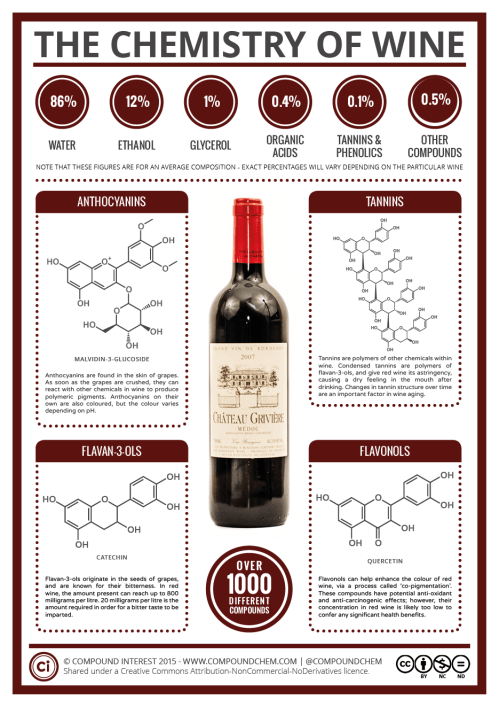
Jesus demonstrates His deity by creating something new. Water is a simple compound composed of two Hydrogen atoms and one Oxygen atom. Wine, on the other hand, contains over 1000 different compounds as demonstrated in the image below.[3] the-chemistry-of-wine-2015 Where did all those different compounds come from? They do not occur naturally in fresh water. Even if that water had a high mineral content, those minerals would not exist in the proper proportions to combine into wine. No, this was an entirely new creation by the One who created it all in the first place (John 1:3).

The skeptic cannot explain this away. He might say that after three days of celebration, the host and guests were too drunk to tell the difference. If that is so, how can he explain the host’s reaction? “… the governor of the feast called the bridegroom, And saith unto him, Every man at the beginning doth set forth good wine; and when men have well drunk, then that which is worse: but thou hast kept the good wine until now” (John 2:9-10). No, this wine was better than the “good wine” served at the beginning of the festivities. Whatever God does always exceeds what man can do.

John reports, “This beginning of miracles did Jesus in Cana of Galilee, and manifested forth his glory; and his disciples believed on him” (John 2:11).  This first of Seven Signs recorded by John exclude some of Jesus’ greatest miracles: Creation, His incarnation, His own resurrection, but perhaps the greatest of all, He creates a new life in the heart of every believer. “But as many as received him, to them gave he power to become the sons of God, even to them that believe on his name: Which were born, not of blood, nor of the will of the flesh, nor of the will of man, but of God” (John 1:12-13).

Notes:


[1]  Eli Lizorkin-Eyzenberg, The Jewish Gospel of John: Discovering Jesus, King of Israel, (Jewish Studies for Christians, Tel Aviv, Israel, 2015), 25.

[2]  Leon Morris, The Gospel According to John, Revised, (Wm. B. Eerdmans Publishing Company, Grand Rapids, MI, 1995), 158.

[3]  A common distraction arises around this miracle over the alcohol content of the wine. Was the wine simple grape juice, did it contain a low level of alcohol, or was it fully fermented with heavy alcohol content? The question is irrelevant for two reasons. First, the host – the “governor of the feast” – proclaimed that it was better than what had been served at the beginning of the feast. Second, regardless of the inclusion or exclusion of alcohol, the end product was a thousand times more complex than the initial water, and that is precisely the point that should not be overlooked.

Comments Off on Jesus’ Seven Signs in John (1)

Filed under Apologetics, Christianity, Creation, Evangelism, Gospel, Religion, Salvation, Theology

Jesus’ Seven ‘I AM’ Statements in John (6)

narrow-way

Jesus saith unto him, I am the way, the truth, and the life: no man cometh unto the Father, but by me.  (John 14:6)

Many today reject exclusivity when it comes to God and the heavenly realm. “If” God exists, and “if” heaven exists, then any “good” person, who “sincerely” believes, regardless of what they believe, should gain entrance into heaven. So, a sincere Muslim, Hindu, Buddhist, Sikh, Tao, Jew, or Christian can go to heaven as long as they are good and sincere in their belief. The only problem with that is that everyone defines “good” differently.

The idea that everyone (except for really “bad” people) goes to heaven is known as “universalism.” This popular belief attracts many because it relieves one of any obligation, responsibility or guilt.  Even the current pope, Pope Francis, publically embraces “universalism.” In his position, he can simply declare all religions under the umbrella of the Catholic Church. Bingo! Everyone goes to heaven, so now let us all just try to get along. The problem with this (besides the fact that it is unbiblical) is that it strips God of His authority and places that authority in the hands of fickle men. Furthermore, it insults God’s wisdom in determining man’s fate, and ultimately creates God in man’s image.

Today, anyone who does not buy into the Universalist “group think” gets labeled as intolerant, narrow-minded, a xenophobe, a hater, or all of the above. If Jesus walked the earth today, He would fall into this same category. No doubt that Jesus died for ALL, Indeed, the Bible clearly teaches: “For God so loved the world, that he gave his only begotten Son, that whosoever believeth in him should not perish, but have everlasting life” (John 3:16, emphasis mine). “Whosoever” includes ALL – “the world” – and excludes NONE. However, one may be tempted to overlook the “qualifier” – belief in Him, i.e., Jesus, the One who was “lifted up” (John 3:14) for the sins of “the world.” “Belief” is the prerequisite. “He that believeth on him is not condemned: but he that believeth not is condemned already, because he hath not believed in the name of the only begotten Son of God” (John 3:18, emphasis mine). The Pope can pontificate all he wants, but he cannot abrogate the Word of God.

In His sixth I AM statement, Jesus said, “I AM the way, the truth, and the life: no man cometh unto the Father, but by me” (John 14:6, emphasis mine). As the Creator God, the I AM of Creation, Jesus emphatically imposes extreme exclusivity for access to the Father. No one comes to the Father except through The Door that is the Lord Jesus Christ. No other options are provided. That makes Jesus’ claim anathema to Universalists.

Note that Jesus makes this I AM statement threefold. First, Jesus is The Way. The “way” may be thought of as a “method” to achieve a goal or destination. The “way” is a “road” – the conduit from one place to another; it is the conveyance from one place to another. Jesus is that way that leads to the Father. Jesus urged, “Enter ye in at the strait gate: for wide is the gate, and broad is the way, that leadeth to destruction, and many there be which go in thereat: Because strait is the gate, and narrow is the way, which leadeth unto life, and few there be that find it” (Matthew 7:13-14, emphasis mine). Quite clearly, Jesus narrows “the way” to the few that find it. On the “broad way” that “leadeth to destruction” can be found many Universalists proclaiming to know “The Way,” but Jesus says, “Not every one that saith unto me, Lord, Lord, shall enter into the kingdom of heaven; but he that doeth the will of my Father which is in heaven” (Matthew 7:21, emphasis mine). The Way is exclusive!

Second, Jesus is The Truth. He is not “relative truth;” He is unequivocal truth. Not only that, but the definite article assures us that He is the “only” truth. At His trial, “Pilate therefore said unto him, Art thou a king then? Jesus answered, Thou sayest that I am a king. To this end was I born, and for this cause came I into the world, that I should bear witness unto the truth. Every one that is of the truth heareth my voice” (John 18:37, emphasis mine). Pilate, perhaps waxing philosophical, retorted, “What is truth?” (John 18:37), when The Truth was standing before him. The incarnate I AM, the eternal Word of God (John 1:1), cannot lie (Titus 1:2). All truth abides in Him, and outside of Him, there is no truth. Apart from The Truth, God is unknowable.

Third, Jesus is The Life. As Creator, I AM authors life. “All things were made by him; and without him was not any thing made that was made. In him was life; and the life was the light of men” (John 1:3-4, emphasis mine). The Life offers more than bios, i.e. biological functionality. The Life gives zōē, the essence of life eternal. In the Garden of Eden, when “the LORD God formed man of the dust of the ground” He “breathed into his nostrils the breath of life; and man became a living soul” (Genesis 2:7, emphasis mine). On final inspection of His creation, God looked upon His finished work “and, behold, it was very good” (Genesis 1:31). Death had no part in God’s “very good” creation. Man was created to live eternally until he broke God’s one and only commandment (Genesis 2:17). At that point death entered into the world (Romans 5:12), and man began to die (Genesis 3:19). Death opposes The Life. It has no place in the presence of The Life, subsequently death cannot enter into the presence of the Father. Only The Life can reverse the curse of death. Jesus is The Life.

I AM The Way, The Truth and The Life.” There is no other access into the presence of the Father and eternal life except through the Lord Jesus Christ. Universalists may not like that idea, but they do not get to make the rules. Only the Creator owns the right to make the rules. In the Garden of Eden, there was only one tree from which man could not eat. Now, after Eden, there is only one way to eternal life. Jesus is the only way. It is up to you to choose wisely.


2 Comments

Filed under Apologetics, Christianity, Creation, Evangelism, Gospel, Heaven, Salvation

The Garden of Eden

Garden of Eden

And the LORD God planted a garden eastward in Eden; and there he put the man whom he had formed. (Genesis 2:8)

The location of the biblical Garden of Eden remains a mystery that intrigues many. Recently I received an email from someone who thought he had it figured out. He writes:

I’ve been looking around the area of Iraq in the area where the Tigris and Euphrates river are and I found an area I wonder if it was maybe where the Garden of Eden was or where the Tree of life was. If you think of a garden it would be relatively small and it says that an Angel stood guard at the entrance. If it was here in this picture there is water surrounding the area except for one spot to go in and out of. Please tell me me what you think either way.

 The Euphrates and Pison (possibly the Tigris) are only two of four rivers named whose source was the Garden of Eden (Genesis 2:11-14). This is reminiscent of the two rivers described by Ezekiel as flowing from the Millennial Temple (Ezekiel 47:1-10 ff.), or the river that flows from the throne of God described in Revelation 22:1.

The Garden of Eden was the place where God met and enjoyed fellowship with man. Throughout Scripture, we see images of similar places, e.g. Mt. Moriah where Abraham offered up Isaac (Genesis 22), which later became the site of Solomon’s Temple, Mt. Sinai where God met with Moses and later gave the Law, Mt. Zion where the Temple was built and where the final Temple will be built, i.e. the Temple Mount in Jerusalem.

Keeping this in mind, it is very possible that the Garden of Eden was actually in the area of Jerusalem. Throughout Scripture, God names Jerusalem as His special place (1 Kings 11:36; 2 Chronicles 6:6; Nehemiah 1:9). It is also noteworthy that Jerusalem is near the geographical center of all the land mass of earth.[1] Prior to the Global Flood (Genesis 6-9), it is thought that only one super continent (Pangea) existed, and it seems reasonable to think that the Garden of Eden was at the center of the land mass – again, keeping it in the general location of where Jerusalem now stands.

We must also keep in mind that the Global Flood radically changed the topography of the pre-Flood world. Therefore, what existed before, no longer exists. In other words, the rivers mentioned in Genesis 2 are not the same rivers that exist now. The current Tigris and Euphrates rivers were named from the memories that the Ark passengers carried from the previous world. The bottom line is that we cannot know with certainty the location of the Garden of Eden. I suspect that the Garden of Eden was where Jerusalem now is, but I would not bet my next paycheck on it.

Notes:


[1]  Henry M. Morris, Ph.D., “The Center of the Earth” http://www.icr.org/article/50.

3 Comments

Filed under Apologetics, Christianity, Creation, Origins, Religion, Theology