Category Archives: Current Events

No Harm Done

They shall take up serpents; and if they drink any deadly thing, it shall not hurt them; they shall lay hands on the sick, and they shall recover. (Mark 16:18)

The final verses of Mark’s Gospel instigate controversy among Bible “scholars,” and many modern translations preface the passage with a warning that “The most reliable early manuscripts and other ancient witnesses do not have Mark 16:9-20.[1] The NIV Study Bible further notes that “Serious doubt exists as to whether these verses belong to the Gospel of Mark. They are absent from important early manuscripts and display certain peculiarities of vocabulary, style and theological content that are unlike the rest of Mark. His Gospel probably ended at 16:8, or its original ending has been lost.”[2]

“Scholars” are the reason we have so many different translations and so much disagreement on which translation is best. I am not averse to higher education. Personally, I enjoy learning and research, especially on matters of the Bible. However, it seems to me that many that achieve the higher degrees lose their grip on reality and rely on the wisdom of man more than the wisdom of God.

When I consider Mark 16:9-20, after having ready Mark’s entire Gospel, I do find the ending somewhat abrupt. It is almost as if Mark completed his Gospel and needed to “wrap it up” in order to get if off to print. (I know. I know! There were no printers in those days.) Most scholars believe that Mark’s was the first Gospel in circulation. The church at the time of the writing was probably no more than 15-30 years old, growing and spreading throughout the Middle East, Asia Minor, and Europe, and there was no written record of the ministry of Christ. As we read Mark’s Gospel, we get the sense that he is moving from one event to the next in the ministry of Jesus. Mark’s is also the shortest of the four Gospels, so the abrupt ending does not surprise me.

The fact that the last 12 verses appear in the text tell me that “The Author,” the Holy Spirit, wanted them there – something the scholars seem to forget. When God says, “For as the rain cometh down, and the snow from heaven, and returneth not thither, but watereth the earth, and maketh it bring forth and bud, that it may give seed to the sower, and bread to the eater: So shall my word be that goeth forth out of my mouth: it shall not return unto me void, but it shall accomplish that which I please, and it shall prosper in the thing whereto I sent it” (Isaiah 55:10-11, emphasis mine). Similarly, Jesus said, “Heaven and earth shall pass away, but my words shall not pass away” (Matthew 24:35). And to answer those who might say that perhaps these were not God’s or Jesus’ words but added later by some human editor, consider the following: “Ye shall not add unto the word which I command you, neither shall ye diminish ought from it, that ye may keep the commandments of the LORD your God which I command you” (Deuteronomy 4:2, emphasis mine). Also, “What thing soever I command you, observe to do it: thou shalt not add thereto, nor diminish from it” (Deuteronomy 12:32) In addition we find, “For I testify unto every man that heareth the words of the prophecy of this book, If any man shall add unto these things, God shall add unto him the plagues that are written in this book: And if any man shall take away from the words of the book of this prophecy, God shall take away his part out of the book of life, and out of the holy city, and from the things which are written in this book” (Revelation 22:18-19, emphasis mine).

Considering God’s solemn charge not to tamper with His word, I find it difficult to conceive that a human editor, who reverences the Word of God, would take it upon himself to “enhance” it of his own volition. As for those “more reliable early manuscripts,” they come from texts that were rejected by the early church due to their Gnostic origins.[3] They were found in “very good” condition because they were not used.

I have a point to make in defending Mark 16:9-20 and specifically as it relates to verse 18, our opening verse. Concerning “them that believe in me” (v. 17) Jesus says (according to Mark), that “They shall take up serpents; and if they drink any deadly thing, it shall not hurt them” (emphasis mine). Paul proved this after his shipwreck on the island of Melita.[4] In gathering wood for a fire, a viper, attracted to the heat of the fire, attached itself to Paul’s hand. Paul shook the snake into the fire and suffered no harm from the snakebite to the astonishment of the inhabitants of Melita.

Based on Mark 16:18, I believe God protects His children from harm due to no act of their own. Even when we knowingly place ourselves in harmful positions, God will sometimes intervene to protect us, but all according to His purpose for our lives. I strongly advise against acting stupidly just to test God; He may just let you suffer the consequences.

Lately, for obvious reasons, I have been thinking about the hype surrounding the COVID-19 vaccines. I refuse to take the vaccine for several reasons. First of all, I believe God designed our bodies to fight of dangerous pathogens. I also believe that God has our days numbered, and we cannot die until our time comes for God to call us home. There are hundreds of ways to die that do not involve COVID-19, and it is up to God to choose which method He wants to use to take us home.

Those are the foremost reasons I have for not taking the vaccine. Another reason that rates highly is the fact that they are derived from a cell line that came from aborted human fetuses. Most Christians claim to be “pro-life” and are against abortion, and I believe that if they really understood the source of the vaccines, they would not take them. However, I can excuse them due to ignorance. Yet another reason that I will not take the vaccine is that it modifies the recipient’s DNA – God’s programming code that makes you who you are. I do not believe man has arrived at the level of intelligence required to modify God’s programming code.

The reader can investigate these things for himself, but many doctors, virologists, warn that the mRNA vaccine will “disable” a human’s natural immune system rendering them vulnerable to other diseases for which we were once immune. So, in effect, the vaccine is a poison. (Again, I realize my explanation is rather simplistic, but I do not have the space nor the desire to cover it in this article. The information is out there, if you want to look.) Many Christians are happily taking this poison through the ignorance induced by the propaganda put out by our government and the media. I believe, based on Mark 16:18, that Christians taking this poison through ignorance will not be harmed by it. However, those who take it with full knowledge of what it is may suffer the consequences later. Time will tell.

Notes:


[1]  The NIV Study Bible, (Zondervan Corporation, 1985), p. 1530.

[2]  Ibid.

[3]  “Thees, Thous, and Wot Nots” – https://erniecarrasco.com/2016/05/01/thees-thous-and-wot-nots/ (See especially my response to Dwayne Cartwright’s comment.


[4]  Acts 28:1-6

1 Comment

Filed under Apologetics, Bible, Christianity, Current Events, Gospel, Holy Spirit, Pro-life, Science, Theology

The Barley Harvest

Therefore they gathered them together, and filled twelve baskets with the fragments of the five barley loaves, which remained over and above unto them that had eaten. (John 6:13)

On the eve of this posting, May 16, 2021, Jews begin the observance of Shavu’ot, the Feast of Pentecost. The Christian calendar, which does not follow the Jewish calendar, observes Pentecost next Sunday, May 23, 2021.

Pentecost interests me, because of the possible prophetic implications associated with it. I wrote about this topic before, and I believe I gave explanation of its significance in an article titled “Pentecost,”[1] so I will not rehash that material here. Briefly, there are seven Feasts of the Lord,[2] three in the spring (Passover, Unleavened Bread, and First Fruits), three feasts in the fall (Trumpets, Atonement, and Tabernacles) with Pentecost in the middle, separated by a space of time between the others. Pentecost was one of three convocations where all males over the age of 20 were required to attend. The other two times were for the spring and fall feasts.

Pentecost celebrates the barley harvest. Some Bible teachers have mistakenly associated the Feast of First Fruits with the barley harvest, but barley, according to the sources I have checked say that barley does not ripen until around mid May – too late for First Fruits. Again, I explain this in the articles I have cited in the notes below.

Barley is often associated with gentile nations, probably because it is more coarse and less desirable than wheat. Wheat, on the other hand, because it is finer and more desirable represents Israel.

On Pentecost, following Jesus’ resurrection and ascension, The Holy Spirit fell upon the 120 disciples gathered in the upper room.[3] There were in Jerusalem on that day “Jews and proselytes” from many nations present for the required convocation, and they heard the disciples preaching in their own languages. That day, about three thousand souls were saved[4] giving birth to the Church. For this reason, Pentecost is associated with the Church, and because it is separated from the other Jewish feasts, many have seen this as the Feasts of the Lord specifically meant for the Church.

Looking at this prophetically, Jesus fulfilled the first three spring feasts by His death (Passover), His burial (Unleavened Bread – He was sinless), and His resurrection (First Fruits). He then ascended to heaven with the promise to send His Holy Spirit and physically return at some later time. So, the Holy Spirit came at Pentecost and gave birth to the Church. Then there is a long period of time before the fall feasts, which Jesus has yet to fulfill. The long period of time can be likened to the Church Age in which we have lived for the last 1,991 years. At a time known only to God, Jesus will return to earth, possibly on the Feast of Trumpets, fulfill the Atonement, and set up His Tabernacle here on earth. We know this as the “Second Coming.”

Prior to Jesus’ return, the world will experience the full wrath of God for seven years. This is known as the Tribulation. Now (just musing here), there is much support for the crucifixion occurring in 30 A.D. According to the Bible, Creation is about 6000 years old and biblical chronology can be roughly divided into three segments of 2000 years each. We can add the final 2000 years to 30 A.D. and come up with the year 2030. Subtract seven years from that and we arrive at the year 2023 to start the Tribulation.

However, the “wrath” of God is for the “world” not for His Church. The Church will be taken out of the world prior to the start of the Tribulation. “For this we say unto you by the word of the Lord, that we which are alive and remain unto the coming of the Lord shall not prevent them which are asleep. For the Lord himself shall descend from heaven with a shout, with the voice of the archangel, and with the trump of God: and the dead in Christ shall rise first: Then we which are alive and remain shall be caught up together with them in the clouds, to meet the Lord in the air: and so shall we ever be with the Lord” (1 Thessalonians 4:15-17).

We have many “signs” to prepare us for the Second Coming, but we have no signs to prepare the Church for the “catching up,” a.k.a. the “Rapture.” “Behold, I shew you a mystery; We shall not all sleep, but we shall all be changed, In a moment, in the twinkling of an eye, at the last trump: for the trumpet shall sound, and the dead shall be raised incorruptible, and we shall be changed” (1 Corinthians 15:51-52).

The event will be sudden, but it should not be unexpected for the Christian. The “signs” of His Second Coming are everywhere and becoming more pronounced and more frequent. Therefore, we know that His Second Coming is close, and if His Second Coming is close, the Rapture is closer. Jesus said, “All these are the beginning of sorrows … Watch therefore: for ye know not what hour your Lord doth come.” (Matthew 24:8, 42)

Just musing again, if we, the Church, are the barley, and the barley harvest is ready, could this be the day that the Lord harvests us into His barn? Just so you know, the start of the Tribulation does not depend on the Rapture of the Church. The Church could get taken out today and the Tribulation will not begin in earnest until the year 2023. Consider this; our world economy is in freefall. The globalists already have detailed plans for implementing a “one-world” government.[5] Consider the impact of millions of people, especially here in the US, disappearing instantly, all at once, from the face of the earth. Consider the added chaos that would bring to a world already reeling with social, economic and geopolitical trouble. In that event, the one-world system will be put in place and a great one-world leader will arise to bring “peace” to the earth, “And he shall confirm the covenant with many for one week [seven years]” (Daniel 9:27). That will kick off the Tribulation.

The barley harvest is ready. I hope this will be the day, but if not, we must occupy until He comes.[6] Are you ready? If not, please read my page on “Securing Eternal Life.”

Notes:


[1]  “Pentecost” — https://erniecarrasco.com/2017/05/28/pentecost/

[2]  “Rosh HaShanah” — https://erniecarrasco.com/2016/10/03/rosh-hashanah/

[3]  Acts 2:1-13

[4]  Acts 2:41

[5]  World Economic Forum — https://www.weforum.org/

[6]  Luke 19:13

Comments Off on The Barley Harvest

Filed under Apologetics, Christianity, Current Events, End Times, Eschatology, Feasts of the Lord, Heaven, Holy Spirit, Rapture, Resurrection, Salvation, Second Coming of Christ, Theology

Son Against Father

The father shall be divided against the son, and the son against the father; the mother against the daughter, and the daughter against the mother; the mother in law against her daughter in law, and the daughter in law against her mother in law. (Luke 12:53)

I celebrated my 71st year of life this past week, and I must admit that it was the worst birthday of my life. It ended with a decision I have mulled over for many years, but only now have I decided to follow through with it. I decided to sever communications between my sons and myself in order to (hopefully) relieve myself of the heartache of strained relationships and the knowledge that my sons are lost and, unless the Lord intervenes, bound for eternal damnation.

Some may criticize my decision and think of me weak as both a father and a Christian for not persevering in prayer for my lost sons. Those that think that may be right; however, I would ask that you not be too quick to judge without knowing that with which I have contended for over 25 years. This was not a snap decision done in a moment of anger, but one that has been carefully weighed over many years. It should also be understood that I am not closed to the possibility of reconciliation later on, if the Lord delays His coming. I have not “disowned” my sons. How could I? They carry my DNA. I have only decided to break off any further contact with them and turn them over to the Lord and let Him deal with them.

I do not want to go into detail as to what brought this to a head. Basically it had to do with a post I made on Facebook with which they vehemently disagreed. They both seized the opportunity to berate, disrespect, and humiliate me on social media. It is not the first time this has occurred, but in past times the offense was easily overlooked considering the source. Not this time.

In the process of making my decision, I remembered our Lord’s account of the Prodigal Son[1] who disrespected his father and separated himself from him. It occurred to me that the father did not chase after the son, but rather waited patiently for the son to “come to himself” and return of his own volition. That is what I have decided to do.

I know many Christian parents these days are experiencing the same thing. We are living in the “last days” as we wait for Jesus’ return to take us home. Jesus predicted this would happen. “Suppose ye that I am come to give peace on earth? I tell you, Nay; but rather division: For from henceforth there shall be five in one house divided, three against two, and two against three. The father shall be divided against the son, and the son against the father; the mother against the daughter, and the daughter against the mother; the mother in law against her daughter in law, and the daughter in law against her mother in law” (Luke 12:51-53). Certainly, many can relate.

Mark records Jesus’ words in the Olivet Discourse like this: “Now the brother shall betray the brother to death, and the father the son; and children shall rise up against their parents, and shall cause them to be put to death. And ye shall be hated of all men for my name’s sake: but he that shall endure unto the end, the same shall be saved” (Mark 13:12-13, emphasis mine). Of course, Jesus referred to the time of Tribulation, but what we see now is the beginning of these things.

The Apostle Paul predicted the general character of people in the last days. “This know also, that in the last days perilous times shall come. For men shall be lovers of their own selves, covetous, boasters, proud, blasphemers, disobedient to parents, unthankful, unholy, Without natural affection, trucebreakers, false accusers, [without self-control], fierce, despisers of those that are good, Traitors, heady, highminded, lovers of pleasures more than lovers of God; Having a form of godliness, but denying the power thereof: from such turn away. For of this sort are they which creep into houses, and lead captive silly women laden with sins, led away with divers lusts, Ever learning, and never able to come to the knowledge of the truth” (2 Timothy 3:1-7, emphasis mine). Those characteristics that I emphasized describe my sons. That last sentence especially fits them to a tee. My oldest son graduated from Southwestern Baptist Theological Seminary with a Masters Degree in Family Counseling, and later declared himself to be an atheist. My youngest son dropped out of high school but is self-educated; he is actually highly intelligent, and he considers himself quite the intellectual. Both of them consider me a rube for taking the Bible seriously and for my faith in God. Although I never push religion on them, they know where I stand and they resent that I will not move from my opinions. Truthfully, I am very flexible in my opinions, but God’s Word is not my opinion, and that is what they do not seem to understand.

As I said, I am not alone in this dilemma – torn between the love of God and the love of children – but I decided long ago to heed the words of Jesus. “And a man’s foes shall be they of his own household. He that loveth father or mother more than me is not worthy of me: and he that loveth son or daughter more than me is not worthy of me. And he that taketh not his cross, and followeth after me, is not worthy of me. He that findeth his life shall lose it: and he that loseth his life for my sake shall find it” (Matthew 10:36-39, emphasis mine). Personally, I prefer to be worthy of Jesus even if it means losing my sons. Sadly, that includes grandchildren too.

The time is short. Jesus may come for His Church – His Bride – at any moment. There is no time or place for divided loyalties. I choose Christ!

Notes:


[1]  Luke 15:11-24

3 Comments

Filed under Apologetics, Bible, Christianity, Current Events, End Times, Second Coming of Christ

Victorious Entrance

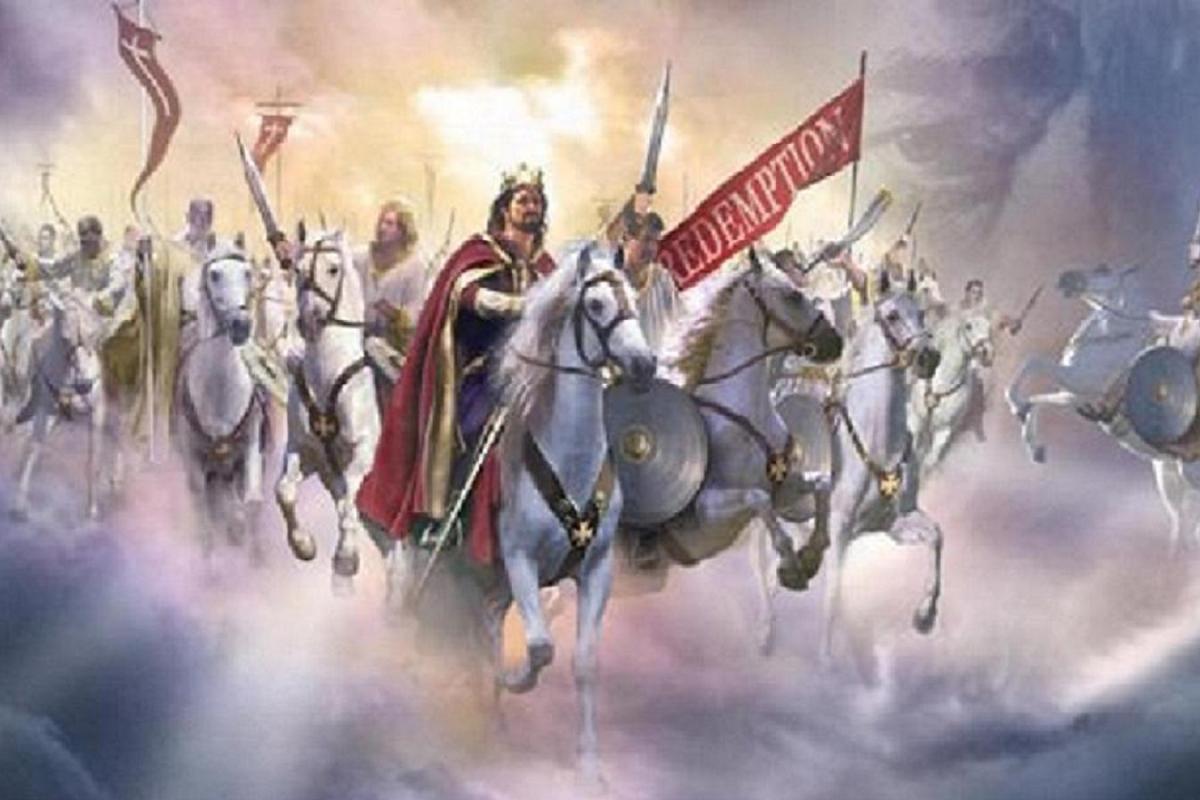
And I saw heaven opened, and behold a white horse; and he that sat upon him was called Faithful and True, and in righteousness he doth judge and make war. His eyes were as a flame of fire, and on his head were many crowns; and he had a name written, that no man knew, but he himself. And he was clothed with a vesture dipped in blood: and his name is called The Word of God. And the armies which were in heaven followed him upon white horses, clothed in fine linen, white and clean. And out of his mouth goeth a sharp sword, that with it he should smite the nations: and he shall rule them with a rod of iron: and he treadeth the winepress of the fierceness and wrath of Almighty God. And he hath on his vesture and on his thigh a name written, KING OF KINGS, AND LORD OF LORDS. (Revelation 19:11-16)

This Sunday, March 28, celebrates Palm Sunday when we commemorate Jesus’ entry into Jerusalem in the final week of His earthly ministry. We term this event as the “Triumphal Entry,” but in many respects, the term is a misnomer.

Daniel predicted the event to the very day of its occurrence. “Seventy weeks [70 x 7 years, or 490 years] are determined upon thy people [Israel or the Jews] and upon thy holy city [Jerusalem], to finish the transgression, and to make an end of sins, and to make reconciliation for iniquity, and to bring in everlasting righteousness [beginning with the Millennial reign of Messiah], and to seal up the vision and prophecy, and to anoint the most Holy [Messiah]. Know therefore and understand, that from the going forth of the commandment to restore and to build Jerusalem [decreed by Artaxerxes Longimanus, 444 BC] unto the Messiah the Prince shall be seven weeks [7 x 7 or 49 years], and [plus] threescore and two weeks [62 x 7 or 434 years; 49 + 434 = 483 years]: the street shall be built again, and the wall, even in troublous times. And after threescore and two weeks shall Messiah be cut off, but not for himself: and the people of the prince that shall come shall destroy the city and the sanctuary; and the end thereof shall be with a flood, and unto the end of the war desolations are determined” (Daniel 9:24-26, emphasis mine). Daniel divides the 490 years (70 weeks) into three segments of 49, 434, and 7 years. The first segment began when Artaxerxes Longimanus issued the fourth decree to rebuild Jerusalem with its walls in 444 BC, and ended in 395 BC when the project was completed – 49 years.[1] The next segment encompassed the 400+ “silent years” until Jesus, Messiah, entered into Jerusalem. Four hundred eighty three (483) years were fulfilled at that time and the final segment of seven years remains to be fulfilled. At the end of the 483 years, to the very day, Jesus, Messiah, was “cut off” at the cross.

The prophet, Zechariah, predicted that the Messiah would present Himself riding on a donkey. “Rejoice greatly, O daughter of Zion; shout, O daughter of Jerusalem: behold, thy King cometh unto thee: he is just, and having salvation; lowly, and riding upon an ass, and upon a colt the foal of an ass” (Zechariah 9:9, emphasis mine). All four Gospel writers record this event from their unique perspectives.[2] Most Bibles that use sub-title divisions of chapters title this event as the “Triumphal Entry.” However, Jesus did not enter Jerusalem as conquering king. He presented Himself as the Melek Shâlêm, the King of Peace. A conquering king would have presented himself with great pomp and ceremony,[3] riding on a white charger followed by his conquering armies, parading the spoils of his conquests.

Jesus entered humbly as the King of Peace. His week would end with a tortuous, humiliating death on a Roman cross. From a human perspective, that hardly qualifies as a triumph. However, the following Sunday, the earth shook[4] as Jesus ripped apart the chains of death and conquered man’s final enemy.[5] “O death, where is thy sting? O grave, where is thy victory? The sting of death is sin; and the strength of sin is the law. But thanks be to God, which giveth us the victory through our Lord Jesus Christ” (1 Corinthians 15:55-57). Yet, we still die physically, but our spirit lives on. “We are confident, I say, and willing rather to be absent from the body, and to be present with the Lord” (2 Corinthians 5:8). One day, even physical death will be lost even to the memory. “And death and hell were cast into the lake of fire. This is the second death” (Revelation 20:14). Our present bodies (whether alive or dead) will be transformed into eternal bodies like the body of the resurrected Christ. “Now this I say, brethren, that flesh and blood cannot inherit the kingdom of God; neither doth corruption inherit incorruption. Behold, I shew you a mystery; We shall not all sleep, but we shall all be changed, In a moment, in the twinkling of an eye, at the last trump: for the trumpet shall sound, and the dead shall be raised incorruptible, and we [who are living at the time] shall be changed. For this corruptible must put on incorruption, and this mortal must put on immortality” (1 Corinthians 15:50-53, emphasis mine).

Jesus conquered death at His resurrection, but He has yet to enter Jerusalem in triumph. Our starting verse above, Revelation 19:11-16, describes His real Triumphal Entry. He will enter Jerusalem from His departure point on the Mount of Olives riding on a white horse – not a donkey this time. He will be followed by His heavenly hosts (angelic armies) and by the spoils of His victory, His saints, all riding white horses and dressed in white robes – no weapons in hand. When His foot touches Earth, the Mount of Olives will split in two,[6] half to the north and half to the south. From there He will travel north to the Jezreel Valley, for the Battle of Armageddon. That too is a misnomer, because it will be no battle at all. “And out of his mouth goeth a sharp sword, that with it he should smite the nations: and he shall rule them with a rod of iron: and he treadeth the winepress of the fierceness and wrath of Almighty God” (Revelation 19:15, emphasis mine). That “sword” out of His mouth is His Word. He will speak and the “battle” will be over. “And the LORD shall be king over all the earth: in that day shall there be one LORD, and his name one” (Zechariah 14:9).

Now, that is a Triumphal Entry!

The current events of our world signal that the time of Jesus’ Victorious Entrance is soon approaching. He will come for His Bride, the Church, at any moment; although we do not know when. However, if the signs indicate that His return is near, that means the catching up of His Bride is even closer. Soon after that, Daniel’s final week, the last seven years known as the Tribulation, will begin. Those who are not snatched away by Jesus will remain on earth to suffer through the judgments of God like at no other time in world history. If you are not sure where you stand with Jesus, you can escape that awful time by putting your trust in Him as your Savior. Read my page on “Securing Eternal Life.”

Notes:


[1]  John F Walvoord and Roy B. Zuck, The Bible Knowledge Commentary- Old Testament, (SP Publications, 1985), p.1363.

[2]  Matthew 21:1-11; Mark 11:1-11; Luke 19:28-44; John 12:12-19

[3]  “The Triumphal Entry,” — https://erniecarrasco.com/2019/04/14/the-triumphal-entry/

[4]  Matthew 28:2

[5]  1 Corinthians 15:26

[6]  Zechariah 14:4

Comments Off on Victorious Entrance

Filed under Apologetics, Bible, Christianity, Current Events, Death, Easter, End Times, Evangelism, Gospel, Heaven, Hell, Holidays, Resurrection, Salvation, Second Coming of Christ, Theology

Peace

These things I have spoken unto you, that in me ye might have peace. In the world ye shall have tribulation: but be of good cheer; I have overcome the world. (John 16:33)

What images enter your mind’s eye when you hear the word “peace”? Do you picture cloudless blue skies over a quiet deserted palm-lined tropical beach disturbed only by the lapping of the rising tide, the whisper of the ocean breeze, and the occasional caw of a soaring seagull? Or, do you imagine a silent stony perch atop a tall Rocky Mountain overlooking a thick pine and aspen forest below alternately lighted and shaded by passing puffy clouds? Is your idea of peace a serene humble home on five or ten acres of land far, far away from the rush and bustle of urban life? Do you think of a world without crime, without war, without pestilence and hunger, and without hate?

All those visions of peace exist only in the imagination, and if by experience, they are only temporary. The quiet beach will soon fill with noisy sunbathers. The silent mountain scene gets interrupted by an unpredicted thunderstorm. The endless chores disturb the serene little farm house. As for peace in the world, you can forget that.

As Jesus faced the cross, He tried to prepare His disciples for what lay ahead. “Peace I leave with you, my peace I give unto you: not as the world giveth, give I unto you. Let not your heart be troubled, neither let it be afraid” (John 14:27). He offered His peace, unlike the peace that the world can give. We personally enjoy quiet peaceful moments in this life, but they are temporary and fleeting. The world knows no peace. The interval between World War I, “the war to end all wars,” lasted less than 21 years before World War II flared up. Since then the United States prosecuted wars in Korea, Viet Nam, Iraq, Afghanistan, along with several “peace-keeping” skirmishes here and there. Meanwhile, the Middle East experiences fighting periodically and consistently throughout the Muslim world. If that were not enough, rioting breaks out in almost every country all the time. Now the entire world lives in fear of a man-made global pandemic. The world knows no peace.

Yet Jesus said, “My peace I give unto you.” To whom was this gift directed? Jesus addressed a very specific audience, His disciples. His peace is not for the world. It is for His disciples only. On that night, He spoke only to the twelve, but He intends all of His disciples to have the gift, that means you and me if we are truly His disciples – believers, followers of Jesus. In His high-priestly prayer He said, “I pray for them: I pray not for the world, but for them which thou hast given me; for they are thine” (John 17:9, emphasis mine). Then, so as not to exclude those that would follow, He said, “Neither pray I for these alone, but for them also which shall believe on me through their word” (John 17:20, emphasis mine).

The peace Jesus gives silences the most tempestuous storms of life, allays the deepest fear, and quiets the troubled mind. His supernatural peace confounds any false peace the world can offer. “These things I have spoken unto you, that in me ye might have peace. In the world ye shall have tribulation: but be of good cheer; I have overcome the world” (John 16:33, emphasis mine). His peace does not exempt us from the affliction, pressure, persecution, tribulation, or trouble that comes as part and parcel with life in this world. Indeed, He requested, “I pray not that thou shouldest take them out of the world, but that thou shouldest keep them from the evil [one]” (John 17:15, emphasis mine). Our peace comes from knowing that “[We] are not of the world, even as I am not of the world” (John 17:16). “For our [citizenship] is in heaven; from whence also we look for the Saviour, the Lord Jesus Christ” (Philippians 3:20).

The world labors in vain for peace. The world alters language to stifle hate. The world blames the weather for rioting in the streets, so it implements draconian measures to curtail carbon emissions. The world cries, “Peace, peace; when there is no peace” (Jeremiah 6:14; 8:11). The world knows no peace, but the believer in Jesus can know peace. As the axiom makes clear, “No Jesus, no peace; know Jesus, know peace.” One day soon, the world will know peace, but not now.

Every true believer, every Christian should know peace. If not, there can only be two reasons that a Christian does not have peace. Either they have not been “born again” and do not know Jesus personally, or they have momentarily taken their eyes off of Him like Peter did when he tried to walk on the water (Matthew 14:22-32). If you do not know Jesus, but you want to know peace, see my page on “Securing Eternal Life.”

2 Comments

Filed under Apologetics, Christianity, Current Events, Evangelism, Gospel, Religion, Salvation, Second Coming of Christ, Theology