Category Archives: Gospel

How Long, O Lord?

And they cried with a loud voice, saying, How long, O Lord, holy and true, dost thou not judge and avenge our blood on them that dwell on the earth?  (Revelation 6:10)

This scene in heaven takes place shortly after Jesus opens the fifth seal of the seven-sealed scroll.[1] The Tribulation is just beginning. The first seal releases the white horse rider[2] that carries a bow but no arrows. He has a crown and he goes “forth conquering, and to conquer.” Most end-times prophecy teachers believe this one is Antichrist that appears at the beginning of the Tribulation. That he has no arrows for his bow suggests that he conquers through diplomacy. Further confirmation of this comes from the statement that “a crown was given unto him;” he does not take it by force. The Prophet Daniel describes him as the “fourth beast/kingdom”[3] whose kingdom will be unlike any before, and it “shall devour the whole earth.” Daniel’s “beast” – the “little horn” – a.k.a. Antichrist, will “speak great words against the Most High.” Daniel says that he will “wear out the saints,” i.e., the Jews for three and one half years. This will take place at the final three and one half years of the seven-year Tribulation.

In a later vision, Daniel predicts the appearance of Antichrist. “And he [Antichrist] shall confirm the covenant with many for one week [seven years]: and in the midst of the week [after 3 ½ years] he shall cause the sacrifice and the oblation to cease, and for the overspreading of abominations he shall make it desolate, even until the consummation [when Christ returns], and that determined shall be poured upon the desolate” (Daniel 9:27, emphasis mine). Of him the Apostle Paul says, “Let no man deceive you by any means: for that day shall not come, except there come a falling away first, and that man of sin be revealed, the son of perdition [i.e., Antichrist]; Who opposeth and exalteth himself above all that is called God, or that is worshipped; so that he as God sitteth in the temple of God, shewing himself that he is God.” (2 Thessalonians 2:3-4, emphasis mine). Jesus also warned, “When ye therefore shall see the abomination of desolation, spoken of by Daniel the prophet, stand in the holy place, (whoso readeth, let him understand:) Then let them which be in Judaea flee into the mountains” (Matthew 24:15-16).

So, to recapitulate, Antichrist, the rider on the white horse, comes on the scene and obtains world renown and power by diplomatic means (“speaking great words”). He confirms a peace agreement with Israel (and “with many”), which probably allows for the construction of the third temple (which needs to exist since he is going to desecrate it).[4] This act will begin the seven-year Tribulation. After 3 ½ years, he breaks the covenant, he enters the Temple declaring himself to be god, and initiates what will be the worst persecution of Jews the world has ever known. By the way, this persecution will also include Gentiles that come to faith in Christ during the Tribulation.

The next riders also show up at the beginning of the Tribulation, the first 3 ½ years. The rider on the red horse[5] removes peace from the earth. The rider on the black horse[6] brings global economic collapse. The rider on the pale (green) horse brings famine, plague, and death. The four horse riders represent the first four seals of the seven-seal scroll.

“And when he had opened the fifth seal, I saw under the altar the souls of them that were slain for the word of God, and for the testimony which they held: And they cried with a loud voice, saying, How long, O Lord, holy and true, dost thou not judge and avenge our blood on them that dwell on the earth?” (Revelation 6:9-10, emphasis mine). These are the “Tribulation Saints” that come to faith Christ after the Rapture (the “snatching away”) of the Church. Being a follower of Christ during the Tribulation will come at a high cost and many will pay with their lives. Now their souls are with the Savior, but they also see their brothers and sisters in Christ suffering the horrors of the Tribulation on earth. So, they cry, “How long, O Lord, holy and true, dost thou not judge and avenge our blood on them that dwell on the earth?” And, the Tribulation has only just begun.

We are beginning to see the “signs” of the end-times. Israel, the focal point of end-times prophecy, is ready to institute an unstable government. The players in the Gog and Magog[7] war are staging for battle. Through vaccine and mask mandates for the Wuhan Bug, the world population is being conditioned to blindly obey all orders that come from “above.” The US Government spends money that does not exist in the treasury and justify their foolishness by simply printing more. The “woke cancel culture” systematically undermines or destroys all social norms. Even language has lost all meaning. Violence among people groups is increasing all over the world. The downward spiral of our moral decay removes any trace of hope for a rational thinking person.

It seems that I find myself on a daily basis crying out, “How long, O Lord will You allow things to continue as they are?” Anyone who places their faith and trust in Jesus sees the light at the end of this dark tunnel. That light is the hope of Jesus’ soon coming for His Bride. “For the Lord himself shall descend from heaven with a shout, with the voice of the archangel, and with the trump of God: and the dead in Christ shall rise first: Then we which are alive and remain shall be caught up together with them in the clouds, to meet the Lord in the air: and so shall we ever be with the Lord.” (1 Thessalonians 4:16-17, emphasis mine). After that comes the seven-year Tribulation, which culminates with the return of Christ to set up His 1000-year reign on earth.[8]

I feel bad for those that will not come to Christ until after the Rapture. Life will be unimaginably difficult for Christians (Jews and Gentiles) living in the Tribulation, if they are not martyred early on. However, Jesus’ reign on earth is the only fix for this sick and broken world. I can only plead to anyone reading this if you do not know Jesus as your Lord and Savior, you need to settle that right now. Please read my page on “Securing Eternal Life” and meet Jesus at the Rapture rather than at His Second Coming.

Notes:


[1]  Revelation 5:1

[2]  Revelation 6:2

[3]  Daniel 7:23-25

[4]  Israeli religious leaders claim they have everything they need to build the Third Temple. All they need is the “go ahead” in order to start construction. They claim they can have it built in a matter of months.

[5]  Revelation 6:4

[6]  Revelation 6:5-6

[7]  Ezekiel 38-39

[8]  Revelation 19:11-20:10

Comments Off on How Long, O Lord?

Filed under Bible, Christianity, Current Events, End Times, Eschatology, Gospel, Prayer, Rapture, Salvation, Second Coming of Christ, Theology

No Harm Done

They shall take up serpents; and if they drink any deadly thing, it shall not hurt them; they shall lay hands on the sick, and they shall recover. (Mark 16:18)

The final verses of Mark’s Gospel instigate controversy among Bible “scholars,” and many modern translations preface the passage with a warning that “The most reliable early manuscripts and other ancient witnesses do not have Mark 16:9-20.[1] The NIV Study Bible further notes that “Serious doubt exists as to whether these verses belong to the Gospel of Mark. They are absent from important early manuscripts and display certain peculiarities of vocabulary, style and theological content that are unlike the rest of Mark. His Gospel probably ended at 16:8, or its original ending has been lost.”[2]

“Scholars” are the reason we have so many different translations and so much disagreement on which translation is best. I am not averse to higher education. Personally, I enjoy learning and research, especially on matters of the Bible. However, it seems to me that many that achieve the higher degrees lose their grip on reality and rely on the wisdom of man more than the wisdom of God.

When I consider Mark 16:9-20, after having ready Mark’s entire Gospel, I do find the ending somewhat abrupt. It is almost as if Mark completed his Gospel and needed to “wrap it up” in order to get if off to print. (I know. I know! There were no printers in those days.) Most scholars believe that Mark’s was the first Gospel in circulation. The church at the time of the writing was probably no more than 15-30 years old, growing and spreading throughout the Middle East, Asia Minor, and Europe, and there was no written record of the ministry of Christ. As we read Mark’s Gospel, we get the sense that he is moving from one event to the next in the ministry of Jesus. Mark’s is also the shortest of the four Gospels, so the abrupt ending does not surprise me.

The fact that the last 12 verses appear in the text tell me that “The Author,” the Holy Spirit, wanted them there – something the scholars seem to forget. When God says, “For as the rain cometh down, and the snow from heaven, and returneth not thither, but watereth the earth, and maketh it bring forth and bud, that it may give seed to the sower, and bread to the eater: So shall my word be that goeth forth out of my mouth: it shall not return unto me void, but it shall accomplish that which I please, and it shall prosper in the thing whereto I sent it” (Isaiah 55:10-11, emphasis mine). Similarly, Jesus said, “Heaven and earth shall pass away, but my words shall not pass away” (Matthew 24:35). And to answer those who might say that perhaps these were not God’s or Jesus’ words but added later by some human editor, consider the following: “Ye shall not add unto the word which I command you, neither shall ye diminish ought from it, that ye may keep the commandments of the LORD your God which I command you” (Deuteronomy 4:2, emphasis mine). Also, “What thing soever I command you, observe to do it: thou shalt not add thereto, nor diminish from it” (Deuteronomy 12:32) In addition we find, “For I testify unto every man that heareth the words of the prophecy of this book, If any man shall add unto these things, God shall add unto him the plagues that are written in this book: And if any man shall take away from the words of the book of this prophecy, God shall take away his part out of the book of life, and out of the holy city, and from the things which are written in this book” (Revelation 22:18-19, emphasis mine).

Considering God’s solemn charge not to tamper with His word, I find it difficult to conceive that a human editor, who reverences the Word of God, would take it upon himself to “enhance” it of his own volition. As for those “more reliable early manuscripts,” they come from texts that were rejected by the early church due to their Gnostic origins.[3] They were found in “very good” condition because they were not used.

I have a point to make in defending Mark 16:9-20 and specifically as it relates to verse 18, our opening verse. Concerning “them that believe in me” (v. 17) Jesus says (according to Mark), that “They shall take up serpents; and if they drink any deadly thing, it shall not hurt them” (emphasis mine). Paul proved this after his shipwreck on the island of Melita.[4] In gathering wood for a fire, a viper, attracted to the heat of the fire, attached itself to Paul’s hand. Paul shook the snake into the fire and suffered no harm from the snakebite to the astonishment of the inhabitants of Melita.

Based on Mark 16:18, I believe God protects His children from harm due to no act of their own. Even when we knowingly place ourselves in harmful positions, God will sometimes intervene to protect us, but all according to His purpose for our lives. I strongly advise against acting stupidly just to test God; He may just let you suffer the consequences.

Lately, for obvious reasons, I have been thinking about the hype surrounding the COVID-19 vaccines. I refuse to take the vaccine for several reasons. First of all, I believe God designed our bodies to fight of dangerous pathogens. I also believe that God has our days numbered, and we cannot die until our time comes for God to call us home. There are hundreds of ways to die that do not involve COVID-19, and it is up to God to choose which method He wants to use to take us home.

Those are the foremost reasons I have for not taking the vaccine. Another reason that rates highly is the fact that they are derived from a cell line that came from aborted human fetuses. Most Christians claim to be “pro-life” and are against abortion, and I believe that if they really understood the source of the vaccines, they would not take them. However, I can excuse them due to ignorance. Yet another reason that I will not take the vaccine is that it modifies the recipient’s DNA – God’s programming code that makes you who you are. I do not believe man has arrived at the level of intelligence required to modify God’s programming code.

The reader can investigate these things for himself, but many doctors, virologists, warn that the mRNA vaccine will “disable” a human’s natural immune system rendering them vulnerable to other diseases for which we were once immune. So, in effect, the vaccine is a poison. (Again, I realize my explanation is rather simplistic, but I do not have the space nor the desire to cover it in this article. The information is out there, if you want to look.) Many Christians are happily taking this poison through the ignorance induced by the propaganda put out by our government and the media. I believe, based on Mark 16:18, that Christians taking this poison through ignorance will not be harmed by it. However, those who take it with full knowledge of what it is may suffer the consequences later. Time will tell.

Notes:


[1]  The NIV Study Bible, (Zondervan Corporation, 1985), p. 1530.

[2]  Ibid.

[3]  “Thees, Thous, and Wot Nots” – https://erniecarrasco.com/2016/05/01/thees-thous-and-wot-nots/ (See especially my response to Dwayne Cartwright’s comment.

[4]  Acts 28:1-6

1 Comment

Filed under Apologetics, Bible, Christianity, Current Events, Gospel, Holy Spirit, Pro-life, Science, Theology

Eternal Hell

But he that shall blaspheme against the Holy Ghost hath never forgiveness, but is in danger of eternal damnation: (Mark 3:29)

Hell seldom comes up as a topic of interest. The notion of hell congers up unpleasant images of souls tortured by unquenchable flames and taunted by merciless devils with pitchforks. Heaven makes a more pleasant topic of conversation. I cannot wait to get there!

So, when a social media contact posted his take on a less-than-eternal nature of hell, I could not help (against my better judgment) to try and briefly correct his erroneous conclusions. I tried to keep it brief, but after his second response, I thought it best to conclude the discussion, and take Paul’s advice to “strive not about words to no profit, but to the subverting of the hearers” (2 Timothy 2:14). These kinds of discussions usually remain unresolved and provide a poor witness to bystanders. (On social media, one can never tell who is “listening.”)

Anyway, this gentleman (I’ll call him Aloysius (“famous warrior”) or Al for short) has apparently labored intensely on the subject of hell and arrived at the conclusion that hell is not eternal. He based his conclusion on the Hebrew word ‛ôlâm and the Greek word aiōnios, both of which are often translated as “forever” or “everlasting.” Al correctly pointed out that both of these words have several shades of meaning. Depending on the context, ‛ôlâm can mean “concealed, vanishing point, eternity, always, or perpetual,” according to Strong’s. Brown-Driver-Briggs’ defines it as “long duration, antiquity, forever, ever, everlasting, evermore, or perpetual.” As for  aiōnios, Strong’s defines it as “perpetual, eternal, everlasting, or forever.” Thayer’s Greek Definitions renders it, “without beginning, without end, never to cease, everlasting.”

Al failed to see the inconsistency in his argument. He defined ‛ôlâm and aiōnios as “eternal” when applied to God or heaven, but temporal when applied to hell. He did not reject the concept of hell, just the idea of an eternal hell. I did not pursue the question as to how he arrived at that conclusion, but perhaps his revulsion to the notion of an eternal damnation conflicted with his idea of a loving God. I understand why someone would feel that way, but we are not in a place to make that decision for God.

The Bible clearly teaches that heaven and hell are real places and they are eternal. All humans will end up in one place or the other for eternity. One verse from Jesus’ own lips easily exposes the contradiction in Al’s argument. In His discourse concerning the separation of the sheep and the goats,[1] Jesus sums up the destiny of both. “And these [goats] shall go away into everlasting punishment: but the righteous [sheep] into life eternal” (Matthew 25:46, emphasis mine). In this verse, aiōnios defines the duration of “punishment” (i.e., hell) and “life.” Seeing that the same word is applied to both, they must mean the same thing. If hell is not eternal then neither is life (i.e., heaven). If heaven is eternal, then so must be hell. Keep in mind that this verse is in the same context, so the word cannot have different meanings.

Related to aiōnios is the Greek word aiōn, which means “an age, perpetuity, continuing, or everlasting.” This word is often translated as “for ever” in the King James Version (KJV). When rendered as such, aiōn is usually preceded by the preposition eis, which means “to or into.” Together, eis aiōn could be translated “into the ages,” “into perpetuity,” or “to eternity.”

The Book of the Revelation explains the eternal nature of hell. In the Fourteenth Chapter, those that take the Mark of the Beast are condemned to eternal hell.[2] “And the smoke of their torment ascendeth up for ever and ever: and they have no rest day nor night, who worship the beast and his image, and whosoever receiveth the mark of his name” (Revelation 14:11, emphasis mine). The repletion is emphatic, εις αιωνας αιωνων – “into the ages of the ages.” Satan, the Beast (Antichrist), and the False Prophet earn the same reward. “And the devil that deceived them was cast into the lake of fire and brimstone, where the beast and the false prophet are, and shall be tormented day and night for ever and ever” (Revelation 20:10, emphasis mine). Again, the eternal nature of hell is described: εις αιωνας αιωνων – “into the ages of the ages.” Then those who reject Christ will be judged at the Great White Throne.[3] “And whosoever was not found written in the book of life was cast into the lake of fire” (Revelation 20:15, emphasis mine).

I understand Al’s desire that hell be temporary. That those who go there stay just long enough to pay their debt and get vaporized. I do not cherish the thought of anyone going to that place even for one minute. The Bible tells us that “God is love,”[4] and that “The Lord is not slack concerning his promise, as some men count slackness; but is longsuffering to us-ward, not willing that any should perish, but that all should come to repentance” (2 Peter 3:9, emphasis mine). However, God is eternal – without beginning and without end. Therefore, when we offend the eternal God, we offend Him eternally, and the punishment, therefore, must be of eternal consequences.

The Bible says that we have all offended God. “As it is written, There is none righteous, no, not one … For all have sinned, and come short of the glory of God” (Romans 3:10, 23). However, “For God so loved the world, that he gave his only begotten Son, that whosoever believeth in him should not perish, but have everlasting life” (John 3:16, emphasis mine). The eternal God took on human flesh[5] and shed His precious, perfect blood to cover our sins. His sacrifice provides for us the eternal atonement, covering, to satisfy our eternal offense against Eternal God. But we have the choice to believe or disbelieve, to accept or reject. “For whosoever shall call upon the name of the Lord shall be saved” (Romans 10:13).

Al is wrong. Hell is eternal. Please do not go there. Read my page on “Securing Eternal Life.”

Notes:


[1]  Matthew 25:31-46

[2]  Revelation 14:9-11

[3]  Revelation 20:11-15

[4]  1 John 4:8

[5]  John 1:14; Philippians 2:5-11

3 Comments

Filed under Apologetics, Bible, Christianity, Death, Gospel, Heaven, Hell

Why the Resurrection Matters

He is not here, but is risen: remember how he spake unto you when he was yet in Galilee, (Luke 24:6)

Christmas and Easter (I prefer “Resurrection Day”) are the two most important days on the Christian calendar with Resurrection Day being, arguably, the most important of the two. One might argue that we could not have the Resurrection without the Birth, but the Birth without the Resurrection would render both insignificant.

Jesus’ birth came like the birth of any other baby. The Gospel writer Luke records the event taking place in a humble animal shelter visited only by lowly shepherds. However, Luke points out an important fact that is summarily overlooked by most readers. Luke says that, “while they were there, the days were accomplished that she should be delivered” (Luke 2:6, emphasis mine). So, apparently, Joseph and Mary had been in Bethlehem a few days before the time of her delivery. Luke does not say, but it seems reasonable that in Bethlehem there were ladies who, seeing a young woman ready to give birth, would have offered their services as midwives. That is the way they did it in those days. Regardless, the birth was no different than any other. The conception nine months prior was the “miracle.” At that time, God planted His seed in Mary’s womb without human aid.

So Jesus came into the world and “dwelt among us”[1] and “increased in wisdom and stature, and in favour with God and man” (Luke 2:52). He grew up like any other Jewish boy and probably learned carpentry from His earthly father, Joseph. At the age of 30,[2] the age at which priests enter service,[3] Jesus started His three-year earthly ministry. We know from the four Gospel accounts that His ministry ended with His death on the cross. He was buried in a borrowed tomb and rose on the third day.

But what if the resurrection never happened? Paul put it quite succinctly when he said, “if Christ be not raised, your faith is vain; ye are yet in your sins” (1 Corinthians 15:17). If Jesus did not rise from the grave, His death for our sins is of no avail. We have no hope of eternal life, and, worse, our destiny is in hell. That explains why unbelievers live for this life alone because, for them, this life is all there is. They reject the concept of hell and prefer the idea that death ends it all, or that it begins a new cycle through reincarnation.

Many arguments against the resurrection of Jesus exist that have a long history from the very beginning. Some say that Jesus did not die on the cross but only “swooned” and revived in the cool dampness of the tomb, rolled the two-ton stone away and walked out. That is a silly theory when one considers the beating, torture, and flogging Jesus received before being nailed to the cross. Also the Roman soldiers who crucified Him were expert executioners and were familiar with death. Had they suspected that He “swooned,” they would have broken His legs like they did with the other two victims.[4] These were professionals; they knew death. Then, to ensure His death, one of the soldiers ran his spear into his side and punctured the pericardium.[5]  

Let us say, for argument’s sake, that this one they failed to recognize and Jesus did indeed pass out. Even if He did revive in the cool tomb, the loss of blood from the beatings and flogging, not to mention the puncturing of his heart sac, would have left Him too weak roll away the heavy stone – one that took several men to move – by Himself.

Another argument suggests that Jesus’ disciples overpowered the Roman guard posted at the tomb.[6] This too is a silly argument. All four Gospels record how the disciples went into hiding at Jesus’ arrest. They feared for their lives. It seems unlikely that these frightened men, most of them fishermen and at least one un-calloused tax collector, would dare to take on battle-hardened professional Roman soldiers. However, this fabrication spread from the very beginning. Matthew records that an angel came to roll back the stone and the soldiers on watch were scared stiff.[7] The soldiers, knowing the consequence (death) for failing in their responsibility to keep the tomb secure, went to the chief priests, rather than their leaders, hoping to get a sympathetic hearing about the empty tomb. They made a good choice as the Jewish religious leaders paid them off and covered for them as long as they would spread the lie that the disciples had stolen the body.[8]

Still another argument insists that the women that went to the tomb on Sunday morning were so grief-stricken that they failed to recognize Jesus’ tomb and went to the wrong sepulcher which was empty. This argument simply rejects what Scripture clearly reports. Three of the four Gospels record that the women witnessed the tomb where Jesus was laid.[9] John, who was present at the crucifixion along with Jesus’ mother and the other women, does not say, but it stands to reason that he would have accompanied them to the tomb.

Jesus rose from the dead. If that were not true, the Jews, because of their hatred for Him, only needed to exhume the body and present it to the world, but they had no body. Men have tried and failed to show Jesus’ remains, but they cannot.

Jesus rose from the dead. He conquered death, and because He conquered death, we have the assurance that our sins are covered and we have eternal life with him. “If in this life only we have hope in Christ, we are of all men most miserable. But now is Christ risen from the dead, and become the firstfruits of them that slept [died]. For since by man came death, by man came also the resurrection of the dead. For as in Adam all die, even so in Christ shall all be made alive” (1 Corinthians 15:19-22, emphasis mine). “For if by one man’s [Adam] offence death reigned by one; much more they which receive abundance of grace and of the gift of righteousness shall reign in life by one, Jesus Christ.) Therefore as by the offence of one [Adam] judgment came upon all men to condemnation; even so by the righteousness of one [Jesus] the free gift came upon all men unto justification of life. For as by one man’s [Adam] disobedience many were made sinners, so by the obedience of one [Jesus] shall many be made righteous” (Romans 5:17-19, emphasis mine).

Because Jesus conquered death, we can have the assurance of eternal life with Him. That is why the resurrection matters. If you are not sure where you stand before Jesus, please read my page on “Securing Eternal Life.”

Notes:


[1]  John 1:14

[2]  Luke 3:23

[3]  Numbers 4:3

[4]  John 19:32-33

[5]  John 19:34

[6]  Matthew 27:65-66

[7]  Matthew 28:2-4

[8]  Matthew 28:11-15

[9]  Matthew 27:61; Mark 15:47; Luke 23:55

Comments Off on Why the Resurrection Matters

Filed under Apologetics, Bible, Christianity, Christmas, Easter, Evangelism, Gospel, Heaven, Hell, Holidays, Religion, Resurrection, Salvation, Theology

Victorious Entrance

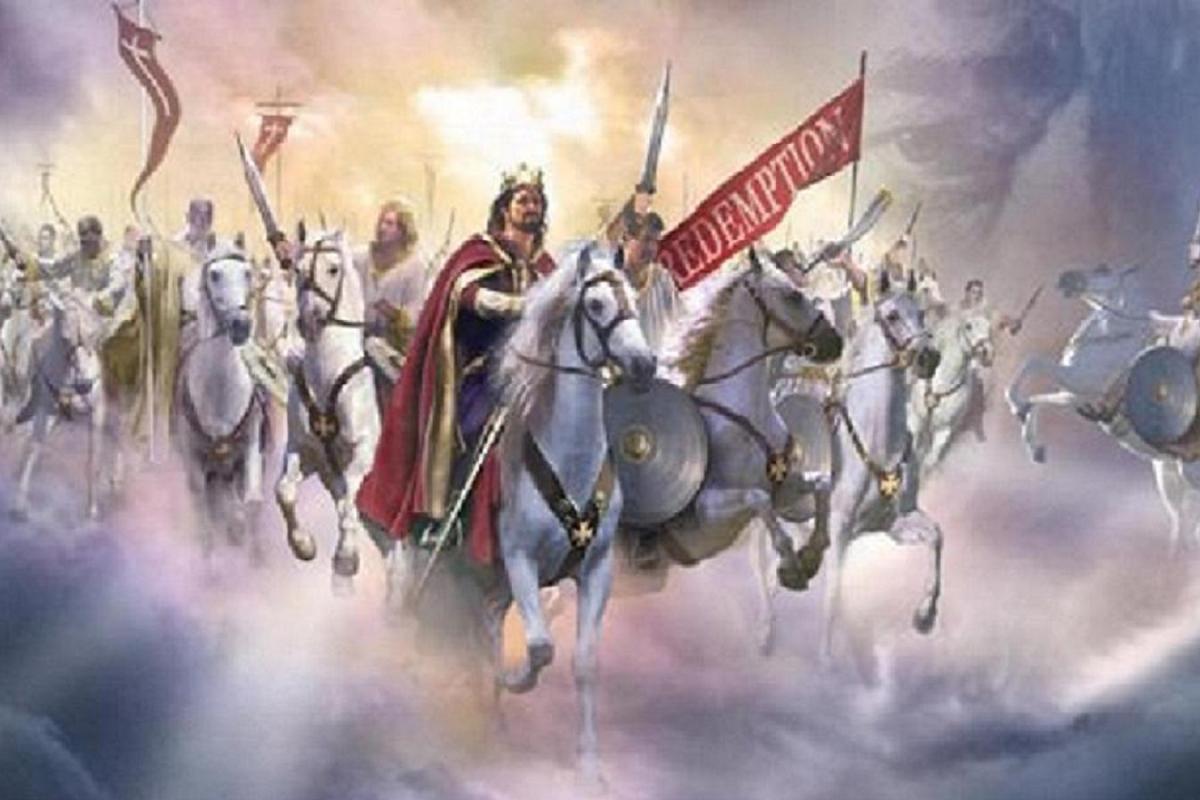
And I saw heaven opened, and behold a white horse; and he that sat upon him was called Faithful and True, and in righteousness he doth judge and make war. His eyes were as a flame of fire, and on his head were many crowns; and he had a name written, that no man knew, but he himself. And he was clothed with a vesture dipped in blood: and his name is called The Word of God. And the armies which were in heaven followed him upon white horses, clothed in fine linen, white and clean. And out of his mouth goeth a sharp sword, that with it he should smite the nations: and he shall rule them with a rod of iron: and he treadeth the winepress of the fierceness and wrath of Almighty God. And he hath on his vesture and on his thigh a name written, KING OF KINGS, AND LORD OF LORDS. (Revelation 19:11-16)

This Sunday, March 28, celebrates Palm Sunday when we commemorate Jesus’ entry into Jerusalem in the final week of His earthly ministry. We term this event as the “Triumphal Entry,” but in many respects, the term is a misnomer.

Daniel predicted the event to the very day of its occurrence. “Seventy weeks [70 x 7 years, or 490 years] are determined upon thy people [Israel or the Jews] and upon thy holy city [Jerusalem], to finish the transgression, and to make an end of sins, and to make reconciliation for iniquity, and to bring in everlasting righteousness [beginning with the Millennial reign of Messiah], and to seal up the vision and prophecy, and to anoint the most Holy [Messiah]. Know therefore and understand, that from the going forth of the commandment to restore and to build Jerusalem [decreed by Artaxerxes Longimanus, 444 BC] unto the Messiah the Prince shall be seven weeks [7 x 7 or 49 years], and [plus] threescore and two weeks [62 x 7 or 434 years; 49 + 434 = 483 years]: the street shall be built again, and the wall, even in troublous times. And after threescore and two weeks shall Messiah be cut off, but not for himself: and the people of the prince that shall come shall destroy the city and the sanctuary; and the end thereof shall be with a flood, and unto the end of the war desolations are determined” (Daniel 9:24-26, emphasis mine). Daniel divides the 490 years (70 weeks) into three segments of 49, 434, and 7 years. The first segment began when Artaxerxes Longimanus issued the fourth decree to rebuild Jerusalem with its walls in 444 BC, and ended in 395 BC when the project was completed – 49 years.[1] The next segment encompassed the 400+ “silent years” until Jesus, Messiah, entered into Jerusalem. Four hundred eighty three (483) years were fulfilled at that time and the final segment of seven years remains to be fulfilled. At the end of the 483 years, to the very day, Jesus, Messiah, was “cut off” at the cross.

The prophet, Zechariah, predicted that the Messiah would present Himself riding on a donkey. “Rejoice greatly, O daughter of Zion; shout, O daughter of Jerusalem: behold, thy King cometh unto thee: he is just, and having salvation; lowly, and riding upon an ass, and upon a colt the foal of an ass” (Zechariah 9:9, emphasis mine). All four Gospel writers record this event from their unique perspectives.[2] Most Bibles that use sub-title divisions of chapters title this event as the “Triumphal Entry.” However, Jesus did not enter Jerusalem as conquering king. He presented Himself as the Melek Shâlêm, the King of Peace. A conquering king would have presented himself with great pomp and ceremony,[3] riding on a white charger followed by his conquering armies, parading the spoils of his conquests.

Jesus entered humbly as the King of Peace. His week would end with a tortuous, humiliating death on a Roman cross. From a human perspective, that hardly qualifies as a triumph. However, the following Sunday, the earth shook[4] as Jesus ripped apart the chains of death and conquered man’s final enemy.[5] “O death, where is thy sting? O grave, where is thy victory? The sting of death is sin; and the strength of sin is the law. But thanks be to God, which giveth us the victory through our Lord Jesus Christ” (1 Corinthians 15:55-57). Yet, we still die physically, but our spirit lives on. “We are confident, I say, and willing rather to be absent from the body, and to be present with the Lord” (2 Corinthians 5:8). One day, even physical death will be lost even to the memory. “And death and hell were cast into the lake of fire. This is the second death” (Revelation 20:14). Our present bodies (whether alive or dead) will be transformed into eternal bodies like the body of the resurrected Christ. “Now this I say, brethren, that flesh and blood cannot inherit the kingdom of God; neither doth corruption inherit incorruption. Behold, I shew you a mystery; We shall not all sleep, but we shall all be changed, In a moment, in the twinkling of an eye, at the last trump: for the trumpet shall sound, and the dead shall be raised incorruptible, and we [who are living at the time] shall be changed. For this corruptible must put on incorruption, and this mortal must put on immortality” (1 Corinthians 15:50-53, emphasis mine).

Jesus conquered death at His resurrection, but He has yet to enter Jerusalem in triumph. Our starting verse above, Revelation 19:11-16, describes His real Triumphal Entry. He will enter Jerusalem from His departure point on the Mount of Olives riding on a white horse – not a donkey this time. He will be followed by His heavenly hosts (angelic armies) and by the spoils of His victory, His saints, all riding white horses and dressed in white robes – no weapons in hand. When His foot touches Earth, the Mount of Olives will split in two,[6] half to the north and half to the south. From there He will travel north to the Jezreel Valley, for the Battle of Armageddon. That too is a misnomer, because it will be no battle at all. “And out of his mouth goeth a sharp sword, that with it he should smite the nations: and he shall rule them with a rod of iron: and he treadeth the winepress of the fierceness and wrath of Almighty God” (Revelation 19:15, emphasis mine). That “sword” out of His mouth is His Word. He will speak and the “battle” will be over. “And the LORD shall be king over all the earth: in that day shall there be one LORD, and his name one” (Zechariah 14:9).

Now, that is a Triumphal Entry!

The current events of our world signal that the time of Jesus’ Victorious Entrance is soon approaching. He will come for His Bride, the Church, at any moment; although we do not know when. However, if the signs indicate that His return is near, that means the catching up of His Bride is even closer. Soon after that, Daniel’s final week, the last seven years known as the Tribulation, will begin. Those who are not snatched away by Jesus will remain on earth to suffer through the judgments of God like at no other time in world history. If you are not sure where you stand with Jesus, you can escape that awful time by putting your trust in Him as your Savior. Read my page on “Securing Eternal Life.”

Notes:


[1]  John F Walvoord and Roy B. Zuck, The Bible Knowledge Commentary- Old Testament, (SP Publications, 1985), p.1363.

[2]  Matthew 21:1-11; Mark 11:1-11; Luke 19:28-44; John 12:12-19

[3]  “The Triumphal Entry,” — https://erniecarrasco.com/2019/04/14/the-triumphal-entry/

[4]  Matthew 28:2

[5]  1 Corinthians 15:26

[6]  Zechariah 14:4

Comments Off on Victorious Entrance

Filed under Apologetics, Bible, Christianity, Current Events, Death, Easter, End Times, Evangelism, Gospel, Heaven, Hell, Holidays, Resurrection, Salvation, Second Coming of Christ, Theology