Category Archives: Gospel

The Church

And I say also unto thee, That thou art Peter, and upon this rock I will build my church; and the gates of hell shall not prevail against it. (Matthew 16:18)

Today is Sunday, and June and I just got out of “church.” We enjoyed a wonderful time of worshiping God our Savior, Jesus Christ, and listening to the Word of God exposited by our “under shepherd,” our pastor. Then we gathered in our Sunday school classroom to enjoy family time by fellowshipping with our brothers and sisters and enjoying a time of deeper study into the Word of God. Currently, we are studying the book of Isaiah. We have been in the book of Isaiah for nearly a year, and we are only halfway through the book. I really appreciate our Bible teacher and his dedication to the careful study of God’s Word.

I have said this before, and it is still true. I love church! But what is church? Some people think of a building where people meet on Sundays for some unknown reason. Others have a vague notion that people gather there to sing and listen to some preacher talk. Many Christians consider church attendance as some kind of obligation. It’s just something one does.

Before going into what “church” is, perhaps we should understand what it is not.

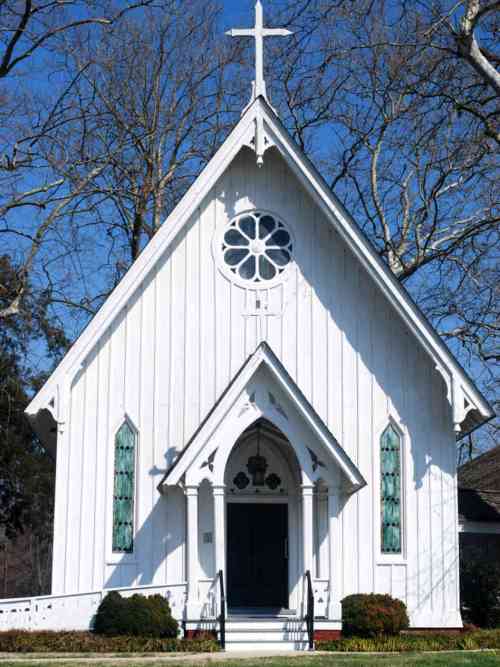
“Church” is not a building. The first definition of “church” found at Dictionary.Com says that it is “a building for public Christian worship.”[1] While that may be the modern, accepted understanding of the word, it is nonetheless in error. The second definition says that a church is a “public worship of God or a religious service in such a building.” That comes closer to a correct understanding; however, it is still false.

Some people who attend church services select their place of “worship” based on the style of music that is played. They want to hear stirring music that stimulates the emotions and elevates their spirits to euphoric heights. Many church leaders are keenly aware of this “need” and they go to great expense and effort to tailor music that attracts the most number of attendees. Many “worship” services employ loud, screaming guitars, jungle-beating percussion sets, laser-light shows, and even smoke machines to stimulate the emotions. After 45 minutes or so of ear-splitting, pulse-raising “music,” the speaker comes up to give a 15-minute motivational speech specifically intended to maintain the hearer in a happy state – no talk of sin and the need for the Savior, or the prospect of hell; only talk about God’s love and how He loves you just the way you are (a partial truth originating from the “father of lies”).[2]

No, the church is not a place to be entertained, emotionally elevated, or encouraged in your sin. Even churches that still sing the “tired old hymns” can degenerate into places where we can go to just feel good about ourselves. That is not what church is. Neither is the church intended to attract unbelievers, which the modern “church growth” movement emphasizes.

The word translated “church” in the Bible is the Greek word ekklēsia, and it could be translated the “called out ones.” Immediately we notice that the definition precludes a building of any kind. So, the “church” is not a building. The church is people, and not just people, they are people that have been “called out.” The question that immediately comes to mind is, “called out of what?” Simply put, the church is an assembly of people who have been “called out” of the world. To use a “churchy” term, the church is a body of those who have been “saved” out of the world, out of sin, and out of an eternity in hell.

Jesus said, “Ye have not chosen me, but I have chosen you, and ordained you, that ye should go and bring forth fruit, and that your fruit should remain …” (John 15:16, emphasis mine). The Greek word translated “ordained” means “to place” or “to set.” In other words, Jesus has “chosen,” i.e. “called out,” His church and set it in a place to do His work on earth – to “bring forth fruit.” “Bringing forth fruit” does not necessarily mean increasing the number of attendees in a particular church body. Indeed, Jesus said, “For many are called, but few are chosen” (Matthew 22:14). The “call” goes out to all, but only a few will respond. “Because strait is the gate, and narrow is the way, which leadeth unto life, and few there be that find it” (Matthew 7:14, emphasis mine).

Jesus said these things before the church was established at Pentecost.[3] The church, therefore, consists of individuals who are “called out” by Christ through the Holy Spirit, regardless of man-made “branding” – Baptist, Methodist, Presbyterian, Catholic, etc. The unifying theme of the Church is a belief in the saving work of Jesus Christ on the cross in payment for our sin, His resurrection from the grave (after three days), His ascension into heaven and His soon return as King of Kings and Lord of Lords. “Neither is there salvation in any other: for there is none other name under heaven given among men, whereby we must be saved” (Acts 4:12, emphasis mine). If one trusts simply in that, that one is included in “the Church.” If, on the other hand, one is trusting in the practices observed by their church, they are probably not included in “the Church.”[4]

The Bible refers to the body of all true believers, the “called out ones,” i.e. “the Church,” as “the Bride of Christ.”[5] This is the Church – not a building or a particular “Christian” denomination. The Church is a body of “called out” individuals who join together to worship God, to “feed” on His Word, to grow and mature in the Spirit, to rejoice with those who rejoice and weep with those who weep, to fellowship and encourage one another, and to work together to “bring forth fruit,” i.e., bring others to Christ.

The purpose of the local church is to build up the body – the Church – for the work of the kingdom. It is not to entertain, nor is it to gain numbers for the sake of numbers. The Church is not confined to a single building; however, the smaller gathering that meets in a “church” building plays a major role as part of the “greater” Church. Therefore, “… let us consider one another to provoke unto love and to good works: Not forsaking the assembling of ourselves together, as the manner of some is; but exhorting one another: and so much the more, as ye see the day approaching” (Hebrews 10:24-25).

One day soon the Church will gather together from all parts of the earth in one great assembly forever to be united with our Bridegroom, the Lord Jesus Christ. I so yearn for that day! In the meantime, I enjoy the little piece of Heaven God has provided here on earth in my local church with my brothers and sisters in Christ.

Notes:


[1]  Church – https://www.dictionary.com/browse/church?s=t

[2]  John 8:44

[3]  Acts 2

[4]  See my articles on “False Religion”

[5]  Matthew 25:1-13; Revelation 19:7-9

2 Comments

Filed under Apologetics, Christianity, End Times, Gospel, Hell, Religion, Salvation, Second Coming of Christ, Theology, Worship

Building Up the Temple

And Jesus went into the temple of God, and cast out all them that sold and bought in the temple, and overthrew the tables of the moneychangers, and the seats of them that sold doves, (Matthew 21:12)

Last week I wrote about a special assignment[1] I was given for the ICR Discovery Center for Science and Earth History. An ICR benefactor donated a Life of Christ diorama for exhibition in the Discovery Center. The set contains thousands of pieces – buildings, tents, people, animals, furnishings, etc. – fabricated mostly by an Italian company, and it often hints of Catholic influence.

One of the scenes will be of Jesus cleansing the Temple before His crucifixion. The “temple” that came with the set is patterned after Greco-Roman architecture. It in no way represents the Temple that Jesus would have known. Perhaps visitors to the Discovery Center will not notice the discrepancy, but others, like me, will see the flaw. That bothers me. We cannot allow anything to distract from the Gospel message.

Determined to correct the error, I took the dimensions of the Temple given in the Bible[2] and converted the cubits to feet and the feet to inches.  Then I measured the width of the set “temple” to get the scale the footprint for the model I would build of the Temple. As it turned out, a scale model would be 58 inches tall and would probably cause a greater distraction than the building that came with the diorama. So, I scrapped my idea and resolved to use the incorrect building that came with the set.

When I told Henry, (the MIC) of my decision, he encouraged me to follow through with my idea. He reminded me that the Temple model did not need to be an exact scale; it just needs to “look” like the Temple of Jesus’ day. Pictured above is the beginning of what will be the Temple model. To see the completed model, you will need to visit the ICR Discovery Center for Science and Earth History when it opens this September (2019).

Jewish religious life revolved around the Temple and Jesus, being an observant Jew, followed all the laws regarding it. When He was just eight days old, His earthly parents presented Him along with the required sacrifice to the priests at the Temple.[3] He had His bar mitzvah in the Temple at the age of 12,[4] and as Scripture points out, He went to the Temple each year for the Passover.

In His final week of life, He exercised the practice of ridding His house of “leaven” in preparation for the Passover by cleansing the Temple of the illegal trade that took place there. “And [He] said unto them, It is written, My house shall be called the house of prayer; but ye have made it a den of thieves. (Matthew 21:13, emphasis mine). The Temple was His house.

The Temple bears the shape of a cross. At the foot of the cross is the altar where the sacrifices are burned. Jesus gave His life as our eternal sacrifice. Beyond the altar resides the laver or mikvah where the priests would wash before entering the Temple. Jesus is the “living water” that cleanses us from all sin.[5] The Temple has only one door through which the priests can enter. Jesus said, “I am the door: by me if any man enter in, he shall be saved, and shall go in and out, and find pasture” (John 10:9, emphasis mine). Jesus saith unto him, I am the way, the truth, and the life: no man cometh unto the Father, but by me” (John 14:6, emphasis mine). As one enters through the door of the Temple, on the left stands a seven-branch menorah. Jesus said, “I am the light of the world: he that followeth me shall not walk in darkness, but shall have the light of life” (John 8:12, emphasis mine). On the right is the table of the “showbread.” Jesus said, “I am the bread of life: he that cometh to me shall never hunger; and he that believeth on me shall never thirst,” (John 6:13, emphasis mine). Directly ahead stands the altar of incense which represents the prayers of the people going up to God. Jesus said, “And whatsoever ye shall ask in my name, that will I do, that the Father may be glorified in the Son” (John 14:13).

Beyond the altar of incense rises a heavy curtain from floor to ceiling that separates this holy place from the Holy of Holies where the very presence of God resides. Inside that sanctum resided the Ark of the Covenant, covered by the Mercy Seat upon which the sacrificial blood was spilled on behalf of all the people. This place was so holy that only the high priest could enter and then only once a year on the Day of Atonement,[6] Yom Kippur.  When Jesus died on the cross, He carried His own blood into the heavenly Holy of Holies spilling it on God’s mercy seat. “And, behold, the veil [the curtain] of the temple was rent in twain from the top to the bottom; and the earth did quake, and the rocks rent” (Matthew 27:51, emphasis mine), and the way into the presence of God was opened for us.

Today every true believer is the Temple of God[7] because we have His presence within us.[8] The model temple I am building is a simple replica of the one that used to be. But the real Temple is me and anyone else who has invited the Lord to save them and take up residence within. I want to build an excellent model for visitors to the Discovery Center to enjoy, but even more important is the maintenance of the Temple in which God now resides.

If what I am saying sounds strange, visit my page on Securing Eternal Life.

Notes:


[1]  “On a Hill Far Away” – https://erniecarrasco.com/2019/05/12/on-a-hill-far-away/

[2]  1 Kings 6:2

[3]  Luke 2:22-24

[4]  Luke 2:41-52

[5]  1 John 1:7

[6]  “Rosh HaShanah” – https://erniecarrasco.com/2016/10/03/rosh-hashanah/

[7]  Living Temples – https://erniecarrasco.com/2018/03/18/living-temples/

[8]  1 Corinthians 3:16

3 Comments

Filed under Apologetics, Christianity, Evangelism, Gospel, Random Musings, Religion, Salvation, Theology

It Does Matter

For as Jonas was three days and three nights in the whale’s belly; so shall the Son of man be three days and three nights in the heart of the earth. (Matthew 12:40)

Recently I listened to a message on the crucifixion. The message excelled in many respects by providing insight into that fateful day of our Lord’s life. However, one part of the message troubled me. The messenger commented that some theologians believe Jesus was crucified on Friday, while others say He was crucified on Thursday. I know that; I’ve heard those arguments before. That is not what troubled me. What troubled me was his comment that the day on which the crucifixion took place does not really matter. The fact of the crucifixion is what really matters.

WOAH!

It does matter! Jesus said very specifically that “the Son of man [shall] be three days and three nights in the heart of the earth” (Matthew 12:40). That is three full days and three full nights.[1] You cannot get three full days and three full nights from a Friday crucifixion even if you allow for partial days and nights. Why does that matter?

One reason it matters is that “according to one Jewish tradition, the soul hovered about the body for three days in hope of reentering it.”[2] If it were not three full days and nights, then, as some have asserted, He could have resuscitated in the coolness of the tomb and walked out. (There are many problems with that idea, but that rabbit can be chased another day.)

Jesus raised Lazarus four days after his death. Lazarus was so dead that “by this time he stinketh: for he hath been dead four days” (John 11:39). Decomposition had already set in. That being the case, would it have been better for Jesus to remain in the tomb four days rather than three? No, because Scripture predicted that Jesus’ body would not decompose: “For thou wilt not leave my soul in hell; neither wilt thou suffer thine Holy One to see corruption” (Psalm 16:10). For that reason, it needed to be three full days and three full nights – long enough for the spirit to depart (in the estimation of the Jews), yet not long enough for decomposition to set in.

Another argument against a Friday crucifixion finds its basis in history. Most theologians hold the opinion that Jesus was crucified in A.D. 30. Passover, the day on which Jesus was crucified, always falls on Nissan 14 – the fourteenth day of the first month of the year.[3] Nissan 14, 30 A.D. fell on a Wednesday, not a Friday.[4] A Wednesday crucifixion allows for three full nights and three full days, meaning that Jesus would have risen anytime after 6:00 PM on Saturday evening, the first day of the week by Jewish reckoning – the day begins after sundown.

I believe those are good arguments against a Friday crucifixion, but they are not the best argument. The best argument is Jesus’ own words. He very specifically said that He would be in the heart of the earth, i.e., the grave, for three days and three nights. Anything less than that makes Jesus a liar. Do you really want to go there! If we believe God’s Word is inerrant – and Jesus IS God – then we must accept what HE said, and reject what errant men say. It Does Matter!

HE IS RISEN INDEED!

Notes:


[1]  “Three Days, Three Nights” – https://erniecarrasco.com/2014/07/13/three-days-three-nights/

[2]  Herschel Hobbs, The Illustrated Life of Jesus, (Nashville, Holman Bible Publishers, 2000), 183.

[3]  Leviticus 23:5

[4]  http://www.cgsf.org/dbeattie/calendar/?roman=30

2 Comments

Filed under Apologetics, Bible, Christianity, Easter, Gospel, Religion, Resurrection, Theology

April Fools’ Day

The fool hath said in his heart, There is no God. They are corrupt, they have done abominable works, there is none that doeth good. (Psalm 14:1)

We recognize the first day of April as April Fools’ Day. It “is an annual (primarily) Western celebration commemorated on April 1 by playing practical jokes and spreading hoaxes. The jokes and their victims are called April fools. People playing April Fool jokes often expose their prank by shouting ‘April fool(s)’ at the unfortunate victim(s). Some newspapers, magazines and other published media report fake stories, which are usually explained the next day or below the news section in smaller letters. Although popular since the 19th century, the day is not a public holiday in every country. Little is known about the origins of this tradition.”[1]

Victims of harmless pranks can hardly be called “fools.” Anyone is susceptible to deception at the hands of someone they trust. If that is a fool, then we all qualify.

The Bible has a much harsher view of a fool. The epithet is so severe that Jesus said, “whosoever shall say to his brother, Raca, shall be in danger of the council: but whosoever shall say, Thou fool, shall be in danger of hell fire” (Matthew 5:22, emphasis mine). The word “Raca” is of Chaldean origin and it means, “empty or worthless one.” A fool, on the other hand, is one who is “impious[2] or “godless.” Strong’s defines such a one as “dull, stupid or heedless.” The Greek word is mōros, from which we get our word “moron.” It is interesting that Jesus should offer such a severe condemnation as “hell fire” for the offense of calling someone a fool.

Jesus’ prohibition of the application of that word against another person comes at the beginning of His Sermon on the Mount. In the same sermon, He later said, “Judge not, that ye be not judged. For with what judgment ye judge, ye shall be judged: and with what measure ye mete, it shall be measured to you again” (Matthew 7:1-2). This verse gets misquoted and misunderstood often as meaning that we are never to exercise rational discernment about someone’s actions. However, that is not at all what Jesus was saying as subsequent verses reveal. The Greek words translated as “judge” and “judgment” are krinō and krima respectively. Both have to do with making a judgment that results in condemnation and punishment. We get our English words “crime” and “criminal” from these Greek words. The kind of judgment Jesus is describing is reserved for God alone. Therefore, if judging someone as “fool” condemns the one judging to “hell fire,” then the punishment for being a “fool” must also be “hell fire.” We deduce this from Jesus’ words, “with what measure ye mete, it shall be measured to you again.” In other words, because the punishment for being a fool is “hell fire,” then the one judging the fool will receive the same judgment because only God can make that judgment.

The English word “fool” appears often in the Bible translating other Greek or Hebrew words, but the strong word Jesus used, mōros, appears only a few times and always in the context of strong condemnation. For example, in Matthew 7:26 Jesus uses it to describe the “foolish man” who built his house on a foundation of sand. Jesus likens those hear His Word and ignore it to the fool who builds his house on sand. In Matthew 25:1-13, Jesus tells the Parable of the Ten Virgins and He calls the five unprepared virgins “foolish” because they were not ready to meet the bridegroom. The condemnation is they are not allowed into the wedding. Paul warns his young protégés, Timothy and Titus to avoid “foolish” (moronic) questions because they are unprofitable and vain and they only lead to strife.[3]

Our lead verse appears again in Psalm 53:1, “The fool hath said in his heart, There is no God. Corrupt are they, and have done abominable iniquity: there is none that doeth good.” The Hebrew word translated “fool” is nâbâl, and like mōros, it means stupid, wicked, (especially impious). Someone who does not believe in God, or rejects God is a fool. God condemns such a person to “hell fire,” which is why Jesus admonishes us not to make that judgment.

Paul describes how one sinks to that condition:

For the wrath of God is revealed from heaven against all ungodliness and unrighteousness of men, who hold the truth in unrighteousness; Because that which may be known of God is manifest in them; for God hath shewed it unto them. For the invisible things of him from the creation of the world are clearly seen, being understood by the things that are made, even his eternal power and Godhead; so that they are without excuse: Because that, when they knew God, they glorified him not as God, neither were thankful; but became vain in their imaginations, and their foolish heart was darkened. Professing themselves to be wise, they became fools” (Romans 1:18-22, emphasis mine).

By examining this passage more closely, we see that “the wrath of God” – His anger, i.e., “hell fire” – is revealed “against all ungodliness and unrighteousness of men,” i.e., “foolishness.” It is doubtful that “true” atheists exist because here we see that God reveals Himself through His creation. The “invisible things,” like viruses, bacteria, atoms, quarks, etc., clearly testify to the greatness of God. Every human being on earth can see the magnificence of God’s creation so that no one has an excuse for not acknowledging God. Everyone, even the atheist, knows that God exists, but they reject Him and refuse to glorify Him choosing rather to follow their own unintelligent (i.e., foolish) imaginations. As a result, their heart is darkened. This progressive condition results in a “reprobate mind,”[4] i.e., a mind that has lost its ability to properly reason. They think they are wise when in fact they have become fools.

“The fool hath said in his heart, There is no God” (Psalm 14:1; 53:1). And “The way of a fool is right in his own eyes” (Proverbs 12:15). “Every way of a man is right in his own eyes: but the LORD pondereth the hearts” (Proverbs 21:2). We are all fools at some time in our lives. “As it is written, There is none righteous, no, not one: There is none that understandeth, there is none that seeketh after God” (Romans 3:10-11, emphasis mine). We may all start out as fools, but we do not need to remain in that condition. If you do not know the Lord, please read my page on “Securing Eternal Life.” Don’t be an April Fool!

Notes:


[1] Wikipedia, “April Fool’s Day” – https://en.wikipedia.org/wiki/April_Fools%27_Day

[2]  “not pious or religious; lacking reverence for God, religious practices, etc.; irreligious; ungodly” Dictionary.Com definition – https://www.dictionary.com/browse/impious?s=t

[3]  2 Timothy 2:23; Titus 3:9

[4]  Romans 1:28

5 Comments

Filed under Apologetics, Atheism, Christianity, Creation, Current Events, Evangelism, Gospel, Hell, Theology

Why Christmas?

For God sent not his Son into the world to condemn the world; but that the world through him might be saved. (John 3:17)

It is said that “familiarity breeds contempt.” One need look no further than the season of Christmas to see the truth of this axiom. Forget about the lost world that has no concept of the true meaning of Christmas. Christians, who should possess at least a rudimentary understanding of the significance of the season, too often get caught up in the madness associated with “the holidays” right along with those who know no better.

In all the cacophony of TV and radio commercials, traffic noise, buzzing shopping malls, clanging Salvation Army bells, and “holiday” music at every turn, does the question even come up? Why Christmas? Why all the fuss? In spite of all the warm sentiments intoned by joyful holiday songs, the season carries with it an increase in stress, depression and even suicide. So much for “Happy Holidays!” Why bother?

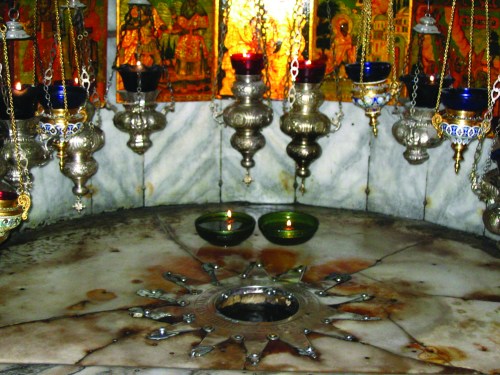
Church of the Nativity, Bethlehem, Israel

I remember visiting the Church of the Nativity in Bethlem, Israel last year. We stood for two and a half painful hours on hard, uneven limestone floors waiting to see the supposed place of Jesus’ birth. When we finally crouched through the constricted cave opening, we found a small alcove adorned with a plethora of lighted candles illuminating a gold 14-pointed star in the center of a polished marble floor. A hole in the center of the star marked the very spot where Mary gave birth to the baby Jesus. The garish display rendered the prolonged anticipation anticlimactic. Perhaps in a similar fashion, the significance of Christmas has been long lost to the millennia of ostentatious trappings and traditions we have attached to it.

So, why Christmas? Stop! Silence the noise! Trash the shiny paper and bright bows and ribbons! Douse the twinkling lights! Be still and think!

We, humans, suffer from a terminal condition called death. We inherited this terminal condition from our original parents, Adam and Eve (Genesis 3). They were originally created to live forever, but their disobedience to God’s only command brought upon them the death penalty. Did I mention that they were created to live forever? The death penalty, therefore, comes in two phases: physical death and spiritual death. Because of Adam’s sin, we all die physically. “And as it is appointed unto men once to die, but after this the judgment” (Hebrews 9:27). However, the spirit continues through eternity. Spiritual death is eternal separation from the Creator; the Bible calls that the “second death.” “And death and hell were cast into the lake of fire. This is the second death” (Revelation 20:14).

Because of Adam’s sin, all humans suffer the same fate. “Wherefore, as by one man sin entered into the world, and death by sin; and so death passed upon all men, for that all have sinned” (Romans 5:12). No one is excluded from the death sentence, and all must pay the price. “For the wages of sin is death …” (Romans 6:23).

However, God made a temporary provision for covering the sins of man. It was the blood sacrifice of an innocent animal, but that was not a permanent fix. “For it is not possible that the blood of bulls and of goats should take away sins” (Hebrews 10:4). The fact remains that sin is humanity’s problem. Animals do not sin; they are innocent. Therefore, the “wages of sin” must be paid by man, not animals, but that is the problem. No human is innocent, i.e., sinless. “All have sinned, and come short of the glory of God” (Romans 3:23).

The Bible teaches God loves us, even though we are all sinners. However, God is holy and just, and He cannot and will not allow sin to go unpunished. “The Lord is not slack concerning his promise, as some men count slackness; but is longsuffering to us-ward, not willing that any should perish, but that all should come to repentance” (2 Peter 3:9, emphasis mine). God does not want us to be eternally separated from Him, but the sin debt must be paid.

Therefore God became a man born of a virgin untouched by any man so that He could be born completely free from the curse of sin. He grew up like any other man but without sin. “For we have not an high priest [Jesus Christ] which cannot be touched with the feeling of our infirmities; but was in all points tempted like as we are, yet without sin” (Hebrews 4:15, emphasis mine). “Let this mind be in you, which was also in Christ Jesus: Who, being in the form of God, thought it not robbery to be equal with God: But made himself of no reputation, and took upon him the form of a servant, and was made in the likeness of men: And being found in fashion as a man, he humbled himself, and became obedient unto death, even the death of the cross” (Philippians 2:5-8, emphasis mine). “For Christ also hath once suffered for sins, the just for the unjust, that he might bring us to God, being put to death in the flesh, but quickened by the Spirit” (1 Peter 3:18).

Why Christmas? “For God so loved the world, that he gave his only begotten Son, that whosoever believeth in him should not perish, but have everlasting life” (John 3:16, emphasis mine). There’s your Christmas present! God became a man to be the perfect sacrifice to pay the wages of sin in our stead so that we will not have to be eternally separated from Him. He offers us our redemption as a gift if we choose to accept it. That’s why Christmas.

7 Comments

Filed under Christianity, Christmas, Evangelism, Gospel, Holidays, Salvation, Theology