Category Archives: Gospel

Extreme Measures

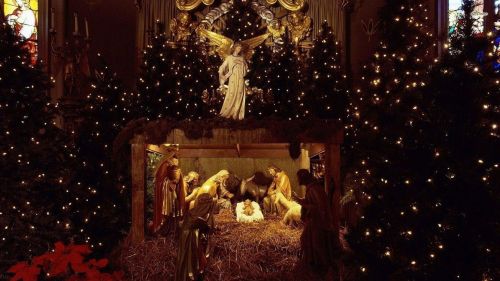
nativity-scene

And the Word was made flesh, and dwelt among us, (and we beheld his glory, the glory as of the only begotten of the Father,) full of grace and truth. (John 1:14)

The baby in the feeding trough, surrounded by smelly farm animals and adored by a small crowd including a soft-faced young mother, strong bewildered father, common shepherds and majestic kings makes for a sweet, albeit often overlooked, tableau. If noticed at all, its significance evaporates in clouds of sentimentality. How precious!

Do you not see! The Creator of heaven and earth reduced to a helpless, needy, human infant boy. The Owner and Master of all Creation presented to the world through the birth canal of a young virgin girl. The conception itself made an object of ridicule and shame; conceived outside the “knowledge” of a poor carpenter willing to accept the ridicule of the town’s people, and adopt someone else’s child. The engineer and designer of a finely tuned universe born in a dirty cave allotted to animals rather than a fine palace suitable for the King of the Universe. Rather than a reception by kings, dignitaries, and nobles, the first to greet Him were the low-class, detestable shepherds that kept the sheep for the Temple sacrifices.

This was “God With Us,” Emmanuel. God wrapped up in human flesh. Who could conceive of such a thing! The Jews expected a Messiah to turn Israel into a superpower; but Messiah was a man, not God in the flesh even though Isaiah had predicted, “Therefore the Lord himself shall give you a sign; Behold, a virgin shall conceive, and bear a son, and shall call his name Immanuel” (Isaiah 7:14). “And he shall pass through Judah; he shall overflow and go over, he shall reach even to the neck; and the stretching out of his wings shall fill the breadth of thy land, O Immanuel” (Isaiah 8:8).

No religion in the world envisions a god condescending to the level of mankind. The Greek gods occasionally mated with humans to produce demigods, yet they remained aloof from humanity. Islam has a god that demands absolute submission of his creation and even perfection (if that were possible) is subject to rejection according to his whim. Eastern religions like Buddhism and Hinduism picture god as some nebulous ether of which all the universe is made and of which we are all part, and the human must achieve an unknowable level of perfection in order to be joined to that undefinable “oneness.”

Only the Bible – both Old and New Testaments – brings the Creator down to the lowest level of humankind in order to elevate humanity to a place near equal to God Himself. (The created thing can NEVER be equal to its creator.) The thought is incomprehensible. The method seems too extreme. If God is so great – omniscient, omnipotent, omnipresent, etc. – could He not come up with a more sensible plan? Surely, some kind of merit system to earn a place at His side would be more appropriate. At least, that is what every other world religion offers. Man must do certain things – pray five times a day while facing Mecca, crawl ten miles over sharp rocks to light a candle for a saint, disassociate oneself from all worldly things, etc. – to appease the gods. However, that is not what the God of the Bible does (or did). He took extreme measures to rescue His fallen creation.

Man severed the intimate bond he had with his Creator at the Garden of Eden (Genesis 3:6-7). Love is an act of the will. It is always an act of the will. It cannot be imposed. It cannot be coerced. It must be offered and accepted freely and willingly, otherwise it is not love. Therefore, God placed only one stipulation on the man He created. “And the LORD God commanded the man, saying, Of every tree of the garden thou mayest freely eat: But of the tree of the knowledge of good and evil, thou shalt not eat of it: for in the day that thou eatest thereof thou shalt surely die (Genesis 2:16-17, emphasis mine). The man chose wrongly, and all of mankind, along with the whole of creation, suffered the curse of that choice. God introduced temporary measures to cover for human shortcomings – He shed the blood of innocent animals to cover (atone) their nakedness (Genesis 3:21), He accepted the sacrifice of innocent animals for the sins of man (Genesis 4:4; 8:20-21), and He institutionalized the sacrificial system shedding innocent animal blood to atone for sins (Exodus 12) – but this was insufficient. “For it is not possible that the blood of bulls and of goats should take away sins” (Hebrews 10:4). Animals, while innocent of any wrongdoing, are not responsible for the fall of man. The sentence for the infraction was death for the guilty party – the man. Therefore, the only reasonable and adequate sacrifice must be that of an innocent man, but there are none. “For all have sinned, and come short of the glory of God” (Romans 3:23).

What then! God took extreme measures to resolve the problem. God, Himself, put on human flesh. Through an act possible only for the omniscient, omnipotent, Creator God created a single-cell human zygote, in the pure virgin womb of a young Jewish maiden that developed as a normal human embryo. “But when the fulness of the time was come, God sent forth his Son, made of a woman, made under the law” (Galatians 4:4). God was born like any normal human baby. “Behold the Lamb of God, which taketh away the sin of the world” (John 1:29). “Christ Jesus: Who, being in the form of God, thought it not robbery to be equal with God: But made himself of no reputation, and took upon him the form of a servant, and was made in the likeness of men: And being found in fashion as a man, he humbled himself, and became obedient unto death, even the death of the cross” (Philippians 2:5-8, emphasis mine).

Only the blood of a perfectly sinless, innocent man could suffice to pay the “wages of sin” (Romans 6:23). God took extreme measures to buy back His fallen creation. There was no other way to solve the sin problem. Jesus said, “I am the way, the truth, and the life: no man cometh unto the Father, but by me” (John 14:6, emphasis mine).

The next time you view a nativity scene, look beyond the sweet baby in the manger and see the cross. Two trees still grow in God’s garden, the Tree of Life, i.e. the Cross of Christ, and the worldly tree of man’s perverted “knowledge of good and evil.” One tree gives eternal life, the other eternal death, i.e. eternal separation from the Creator. The choice is yours.
Comments Off on Extreme Measures

Filed under Christianity, Christmas, Evangelism, Gospel, Holidays, Religion, Salvation, Theology

Jesus’ Seven Signs in John (7)

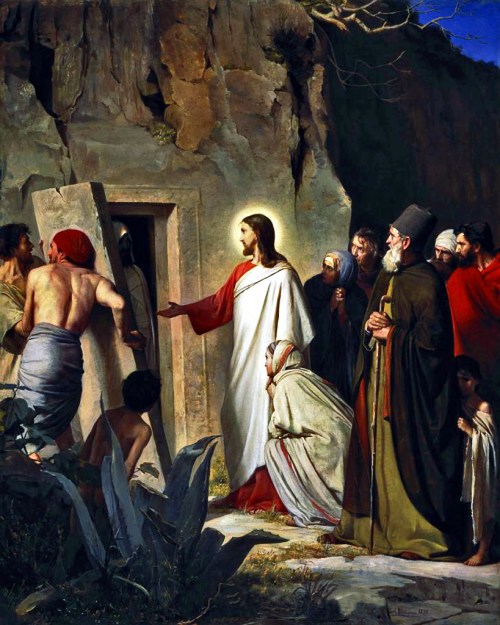
john11_1_raising_lazarus_bloch

Jesus saith unto her, Said I not unto thee, that, if thou wouldest believe, thou shouldest see the glory of God? (John 11:40)

The events surrounding this seventh sign were previously covered in the discussion of Jesus’ fifth I AM statement:[1] “Jesus said unto her, I am the resurrection, and the life: he that believeth in me, though he were dead, yet shall he live: And whosoever liveth and believeth in me shall never die. Believest thou this?” (John 11:25-26, emphasis mine).

Jesus “stedfastly set his face to go to Jerusalem” (Luke 9:51) as He made a stopover in Jericho along the way. The cross loomed ominous – less than two weeks away – when He received word from Bethany, “Lord, behold, he whom thou lovest is sick” (John 11:3). It was Lazarus. The content of the message did not convey the gravity of the matter. “When Jesus heard that, he said, This sickness is not unto death, but for the glory of God, that the Son of God might be glorified thereby” (John 11:4, emphasis mine).

However, it was “unto death,” and the Lord knew it. “When he had heard therefore that he was sick, he abode two days still in the same place where he was” (John 11:6, emphasis). After the two-day delay, Jesus “saith he to his disciples, Let us go into Judaea again … Our friend Lazarus sleepeth; but I go, that I may awake him out of sleep.” (John 11:7, 11). Sleep, for someone who is sick, helps the healing process. The disciples understood this. They also understood that Jesus’ life was in peril in Jerusalem. “His disciples say unto him, Master, the Jews of late sought to stone thee; and goest thou thither again? … Then said his disciples, Lord, if he sleep, he shall do well” (John 11:8, 12, emphasis mine). Jesus completely knew and understood the situation although the euphemism escaped the disciples’ conscious thought, so to clarify, “Then said Jesus unto them plainly, Lazarus is dead” (John 11:14, emphasis mine).

The small village of Bethany was about a day’s walk from Jericho. Lazarus probably died shortly after the messengers departed to Jericho. The travel took a day. Jesus delayed two days before leaving for Bethany and He took another day to arrive – four days total.

When Jesus arrived in Bethany, Martha met Him with the “news” that Lazarus had died (John 11:20). Mary followed Martha. “Then when Mary was come where Jesus was, and saw him, she fell down at his feet, saying unto him, Lord, if thou hadst been here, my brother had not died” (John 11:32). Both Martha and Mary believed that Jesus could heal the sick. They had probably witnessed many of His healing miracles, and perhaps they heard about or witnessed Jesus restoring life to the dead.[2] Those other resurrections Jesus performed involved someone who was dead just a matter of hours. However, it had been FOUR DAYS! They also believed that Jesus could raise the dead “at the resurrection” (John 11:24), but that was future. “Then when Jesus came, he found that he had lain in the grave four days already” (John 11:17, emphasis mine). FOUR DAYS! – “There is a tradition in Judaism (that still exists today), that the soul after death does not immediately depart the deceased, but hovers over the body for a period of three days, during which time resurrection is possible.”[3]

In the minds of Martha and Mary, Lazarus was too far gone for a resurrection now. They were resigned to wait until the resurrection at the end of time.

Jesus asked to see the grave (John 11:34), and to their shock, Jesus asked for the stone to be rolled away from the opening. “Martha, the sister of him that was dead, saith unto him, Lord, by this time he stinketh: for he hath been dead four days” (John 11:39, emphasis mine). What was He doing? Did Jesus want a private viewing? By now, the process of decomposition would have caused the body to reek. Surely, Jesus could not bring life to a decaying body! “Jesus saith unto [Martha], Said I not unto thee, that, if thou wouldest believe, thou shouldest see the glory of God? … And when he thus had spoken, he cried with a loud voice, Lazarus, come forth” (John 11:40, 43). The dead man responded, and though bound in grave clothes, walked out of the cave.

Jesus demonstrated His power over death. He said, “I AM the resurrection and the life” (John 11:25, emphasis mine), and He proved it by giving life to one for whom consensus offered no hope. FOUR DAYS dead and Jesus brought Lazarus back to the land of the living. From the beginning, Jesus knew what He would do. “When Jesus heard that, he said, This sickness is not unto death, but for the glory of God, that the Son of God might be glorified thereby” (John 11:4, emphasis mine). Then before the skeptical crowd that included that included some of His harshest opponents (John 11:45-53) Jesus prayed, “Father, I thank thee that thou hast heard me. And I knew that thou hearest me always: but because of the people which stand by I said it, that they may believe that thou hast sent me” (John 11:41-42, emphasis mine).

Luke relays an account given by Jesus of a rich man that died and went to hell and a beggar by the name of Lazarus (different person) who also died and was carried by the angels to Abraham’s bosom (Luke 16:19-31). The rich man in hell could see Lazarus enjoying paradise with Abraham. After failing get relief for himself, he requested that Lazarus be sent back to the world of the living and evangelize his brothers, for he thought, “if one went unto them from the dead, they will repent” (Luke 16:30). The brothers had the Law and the Prophets, i.e., the Bible. In other words, they had all they needed to avoid the same fate. Abraham’s response settled the matter. “And he said unto him, If they hear not Moses and the prophets, neither will they be persuaded, though one rose from the dead” (Luke 16:31, emphasis mine).  The truth of this assertion could not be better illustrated than in the reaction of the religious leaders that witnessed “one that rose from the dead.” Rather than believe in Jesus, who raised the dead, they sought to kill Him. “Then from that day forth they took counsel together for to put him to death” (John 11:53). Not only that, but now Lazarus was a liability. “But the chief priests consulted that they might put Lazarus also to death; Because that by reason of him many of the Jews went away, and believed on Jesus” (John 12:10-11, emphasis mine).

Truth is offensive. “Jesus saith unto him, I am the way, the truth, and the life: no man cometh unto the Father, but by me” (John 14:6, emphasis mine). Many would rather destroy the Truth than submit to Him, but the Truth will not die. “And the Jews’ passover was nigh at hand: and many went out of the country up to Jerusalem before the passover, to purify themselves” (John 11:55). In a few days, Jesus would be put to death, but after three days, He would do an even greater miracle than raising Lazarus. Jesus Himself would conquer death and rise from the grave. Yet, many are not “persuaded, though one rose from the dead.” – Jesus Himself.

Do you believe? You have the Bible. You have the voices of thousands of “prophets” declaring the Word of the Lord. Jesus is not in the grave. What more do you need? This life you have been given is the only opportunity you will ever have to make that choice. Tomorrow is not guaranteed. “While it is said, To day if ye will hear his voice, harden not your hearts” (Hebrews 3:15). After this life, there are no more chances. Jesus rose from the dead and lives forever to give us eternal life. “Believe on the Lord Jesus Christ, and thou shalt be saved” (Acts 16:31), and you will not end up like the rich man being tortured in the flames (Luke 16:24) with no escape.

 Notes:


[1]  See: https://erniecarrasco.com/2016/10/02/jesus-seven-i-am-statements-in-john-5/

[2]  See Matthew 9:18-26; Mark 5:21-43; Luke 8:40-56; Luke 7:11-16.

[3]  Eli Lizorkin-Eyzenberg, The Jewish Gospel of John: Discovering Jesus, King of All Israel, (Jewish Studies for Christians, Tel Aviv, Israel, 2015), 184.

Comments Off on Jesus’ Seven Signs in John (7)

Filed under Bible, Christianity, Death, Evangelism, Gospel, Heaven, Hell, Religion, Resurrection, Salvation, Theology

Jesus’ Seven Signs in John (6)

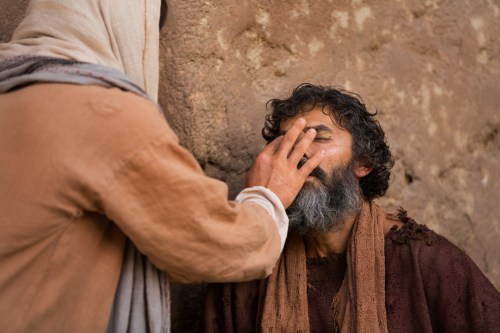
jesus-annoints-a-man-born-blind

I must work the works of him that sent me, while it is day: the night cometh, when no man can work. (John 9:4)

Why does God allow suffering? That question usually comes from God deniers uninterested in finding truth, but more interested in challenging the faith of those who claim to know the truth. Of course, the fundamental answer to the question fails to satisfy the skeptic, that is, that the origin of human suffering, and all other forms of evil, is due to the fall of man (Genesis 3). However, regardless of that fact, the doubter thinks, “There has to be something more to it than that!”

The disciples were no different. Popular thought at the time said that human suffering, i.e. illness, poverty, calamity, etc., was the result of personal sin, while good health, wealth, good fortune, etc., were signs of God’s favor on a righteous individual.

Jesus went to Jerusalem to celebrate the Feast of Tabernacles (John 7:2), a 21-day long celebration which started on Tishri 1 with the Feast of Trumpets, included the Day of Atonement, and culminated Feast of Tabernacles. The latter lasted eight days. The timing of this event in the ninth chapter of John’s Gospel is not clear from John’s account, and the other Gospels are silent about this time – perhaps because Jesus went to Jerusalem alone (John 7:10) – but John records the events in Chapters 7 through 9 sequentially as if they all transpired during this feast time. How John came by these details is uncertain, but perhaps he accompanied Jesus alone.

Regardless, the events of Chapters 7 and 8 include several encounters with the Pharisees. In one very memorable event, the Pharisees brought to Jesus a woman caught “in the very act” (John 8:4) of adultery so that He could pronounce judgement on her. After this, Jesus made His second I AM statement, “I am the light of the world” (John 8:12).[1] More emphatic than that was His outright proclamation: “Verily, verily, I say unto you, Before Abraham was, I am” (John 8:58, emphasis mine). They clearly understood His point. “Then took they up stones to cast at him: but Jesus hid himself, and went out of the temple, going through the midst of them, and so passed by” (John 8:59, emphasis mine).

Evidently, His disciples discovered that He was in Jerusalem and joined Him. “And as Jesus passed by, he saw a man which was blind from his birth. And his disciples asked him, saying, Master, who did sin, this man, or his parents, that he was born blind?” (John 9:1-2, emphasis mine). In their way of thinking, someone sinned resulting in total blindness for this man from birth. “There were grave difficulties in seeing how a man could have sinned before his birth. And it is not much easier to think that a man should bear such a terrible punishment for the sin of his parents. So the disciples put the matter to Jesus.”[2]

“Jesus answered, Neither hath this man sinned, nor his parents: but that the works of God should be made manifest in him” (John 9:3). Jesus made it clear that human suffering is not necessarily the result of sin. The account of Job exemplifies the opposite (Job 1-2). Job was righteous before God, yet God allowed Satan to bring calamity into his life. In the end, God restored to Job all that he had lost and more. However, that is not always the case. Sin does have consequences. Think of David’s sin with Bathsheba (2 Samuel 11-12). Even though God forgave David, the baby that resulted from the affair died, and David’s house knew nothing but conflict the remainder of his life. Then there was the one Jesus healed at the Pool of Bethesda.[3] After he was healed, Jesus cautioned him, “Behold, thou art made whole: sin no more, lest a worse thing come unto thee” (John 5:14, emphasis mine). Apparently, his malady resulted from sin, but that was not the case with the blind man. “Neither hath this man sinned, nor his parents.” (Only God could know that!) This blindness could not be explained other than the result of a fallen world, and “that the works of God should be made manifest in him.”

The day before, following the incident with the woman caught in adultery, Jesus made His second I AM statement: “I am the light of the world” (John 8:12). This day He encounters a man who has never experienced “the light of the world,” and He reiterates, “As long as I am in the world, I am the light of the world” (John 9:5, emphasis mine). John said as much at the beginning of his Gospel: “In him [Jesus] was life; and the life was the light of men. And the light shineth in darkness; and the darkness comprehended it not” (John 1:4-5, emphasis mine). Such an idea is rather abstract, but now Jesus would manifest it in a physical way.

“When he had thus spoken, he spat on the ground, and made clay of the spittle, and he anointed the eyes of the blind man with the clay” (John 9:6). Unlike other healings performed by Jesus where His word sufficed to accomplish the miracle, here the Creator actually did something. The act of making clay with His spittle reminds us of His initial creation of man where “the LORD God formed man of the dust of the ground, and breathed into his nostrils the breath of life; and man became a living soul” (Genesis 2:7). The man, having been “born blind,” possibly had no eyeballs. By forming clay to anoint the eyes, Jesus many have been going back to the original “specs” to create an entire new set for the man. The Bible does not say, but that is “my guess.”

This blind man had not asked for healing, as others had (e.g., Mark 10:46-52), and thus had not yet exhibited any kind of trust in Jesus. This is probably why Jesus used a process, rather than merely a word, to heal on this occasion. The man whose eyes had been anointed with the clay still had to exhibit faith by washing in the pool of Siloam before he could see.[4]

“And said unto him, Go, wash in the pool of Siloam, (which is by interpretation, Sent.) He went his way therefore, and washed, and came seeing” (John 9:7, emphasis mine). Oh, did I mention? “And it was the sabbath day when Jesus made the clay, and opened his eyes” (John 9:14, emphasis mine). The blind Pharisees concerned themselves more with a breach of their protocol than they did for the man’s suffering, and they completely missed the creation miracle by “the Lord of the Sabbath” (Mark 2:28; Luke 6:5).  Sometimes the answer to suffering is so that Jesus can be glorified.

Notes:


[1]  See https://erniecarrasco.com/2016/09/04/jesus-seven-i-am-statements-in-john-2/

[2]  Leon Morris, The New International Commentary on the New Testament: The Gospel According to John, Revised, (Wm. B. Eerdmans Publishing Co., Grand Rapids, MI, 1995), 425.

[3]  See https://erniecarrasco.com/2016/11/06/jesus-seven-signs-in-john-3/

[4]  Henry M. Morris, The Henry Morris Study Bible, (Master Books, Green Forest, AR, 2012), 1591.

Comments Off on Jesus’ Seven Signs in John (6)

Filed under Apologetics, Bible, Creation, Gospel, Origins, Religion, Theology

Jesus’ Seven Signs in John (5)

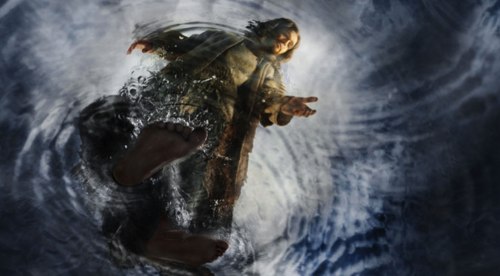
jesus-walking-on-waterBut he saith unto them, It is I; be not afraid. (John 6:20)
            After feeding the 5000[1], a group of partakers (John 6:14) thought it would be a great idea to have a king that could provide them a free lunch (not unlike many in our country today). “When Jesus therefore perceived that they would come and take him by force, to make him a king, he departed again into a mountain himself alone” (John 6:15). I pointed out in last week’s article that throngs of people sought after Jesus, “but one senses that they sought Him out for selfish motives.”[2] They came either to see what He could do, or to seek a remedy to their personal maladies. The kingdom of God did not even register as a priority with them. Jesus saw that, but He “was moved with compassion toward them” (Matthew 14:14) anyway. He saw them as “sheep not having a shepherd” (Mark 6:34).

            It comes as no surprise that they would make Him – one that could heal diseases and produce food out of thin air – their king, but He would have no part of that. Jesus did not come to be an earthly king, at least not at this time. “For the Son of man is come to seek and to save that which was lost” (Luke 19:10). So, before they could carry out their plan, Jesus secreted Himself away into the higher elevations of the mountain.

            The different perspectives of the Gospel writers often lend themselves to criticism from the unlearned skeptics who purposefully strive to find error in Scripture. Such is the case in this account. Matthew and Mark say that “Jesus constrained [made] his disciples to get into a ship, and to go before him unto the other side, while he sent the multitudes away” (Matthew 14:22; Mark 6:45). John indicates that this was a unilateral decision by the disciples. “When Jesus therefore perceived that they would come and take him by force, to make him a king, he departed again into a mountain himself alone. And when even was now come, his disciples went down unto the sea” (John 6:15-16, emphasis mine). Matthew and Mark say nothing about some of the men wanting to make Jesus king; only John records that bit of information. As stated in my last article,[3] because of John’s close relationship with Jesus, his proximity to Him afforded him a closer perspective that the others did not have. When Jesus instructed the disciples to get into the boat and go to the other side of the lake, they followed His instructions without question, but John knew the reason. Since John recorded the reason for Jesus’ separation from the crowd, the fact that He had given instruction to the disciples to leave was of no consequence. Therefore, he merely mentions that they “entered into a ship, and went over the sea toward Capernaum” (John 6:17).

            Off the disciples headed across the open waters of the Sea of Galilee. Because of the lake’s geographic location, cradled between two mountain ranges, winds funneling between the mountains frequently produce fierce storms. Without our modern weather forecasting technology, these storms were unpredictable to the sailors that ventured out on the lake. Thus, the disciples were caught up in a terrible windstorm. John records that “they had rowed about five and twenty [25] or thirty furlongs” (John 6:19) – only about three or four miles. They fought the wind all night. Matthew and Mark report that the wind was contrary, i.e. against them (Matthew 14:24; Mark 6:48). It was now about the “fourth watch” (by Roman standards) of the night making it between three and six o’clock in the morning. Fearful for their lives, and weary from battling the relentless wind “they see Jesus walking on the sea, and drawing nigh unto the ship: and they were afraid” (John 6:19).

            Mark remarks that “he cometh unto them, walking upon the sea, and would have passed by them” (Mark 6:48, emphasis mine). Perhaps not apparent to the harried crew on the battered boat, Jesus was on more solid footing than they were. He could have just kept on walking. The sight frightened the already exhausted disciples. These men were not rocket scientists, but experience instructed them that men do not walk on water. Therefore, this apparition must be a ghost (Greek: phantasma)!

            Perceiving their terror, Jesus called out to assuage their fears. “εγω ειμι μη φοβεισθε” – “I, I AM. Do not be afraid,” (Matthew 14:27; Mark 6:50; John 6:20). Not included as one of the seven-I AM statements, all three Gospels record the exact phrase (in Greek), once again asserting His deity. Unique to Matthew’s account is Peter’s request. “And Peter answered him and said, Lord, if it be thou, bid me come unto thee on the water” (Matthew 14:28).  Considering the circumstances, Peter made a bold request. He demonstrated even more chutzpah when he got out of the boat and started walking toward Jesus! “But when he saw the wind boisterous, he was afraid; and beginning to sink, he cried, saying, Lord, save me” (Matthew 14:30). The lesson there is “never take your eyes off Jesus!”

            Perhaps because Mark’s Gospel is Peter’s account (as considered by many scholars), that detail was omitted. Peter had a way “talking big,” but then falling short of his boasts. This may have been one of those times he would rather put out of his memory. Peter really did walk on the water, but even after several steps of water-walking, he placed his faith in nature, rather than in the Creator of nature – and he sank.

            John may have been too busy battling the storm to have noticed Peter’s audacious attempt to walk on water. He seemed more impressed by their instant arrival on land as soon as Jesus entered the boat. “Then they willingly received him into the ship: and immediately the ship was at the land whither they went” (John 6:21, emphasis mine).

            Two aspects of this “sign” stand out as demonstrations of Jesus’ deity. The first is Jesus’ power over the physical laws of nature. Humans cannot walk on water. Peter proved that when he focused on the natural elements rather than on the God-Man, Jesus. Second, Jesus demonstrated power over time and space. The disciples had struggled all night and only covered about a fourth of the distance to their destination. However, as soon as Jesus came onboard, the storm ceased, and they arrived instantly at their destination.

Although the distance was still sizable, approximately 20 kilometers (or 10 miles) to reach Kfar Nahum (Capernaum), the boat immediately and safely touched the stony beach. This may sound like an unconnected-to-anything incident, but we will be at theological fault if we do not recognize that the distance and time are also, as is all creation, under the sole lordship of God himself [sic]. He alone lives outside of time and outside of distance, and as such, he [sic] is eternal and omnipresent. Therefore, this curious occurrence is actually very important because it shows that when the God-Man Jesus (Jn. 1:1,14) is in the boat with the disciples, the boat is able to disappear from one place on the map and re-appear in another in an instant.[4]

One other important point must be made if we are to take the connection between this Gospel and the Torah of Moses seriously, as we should. One of the key stories in the Torah is Noah’s ark. It glides over the waters of judgment, saving people. Jesus does the same. The parallels are obvious (perhaps too obvious) and ironically can be easily missed.[5]

            No man can walk on water, but Jesus can, and, even for a moment, Peter did. How was that possible? Consider the fact that Jesus is the Creator. He established the laws of physics. He initiated the laws of physics; therefore, He has power over them. No created thing is greater than its creator. God-Jesus, exercises power over the physical laws He put into place and can suspend them at will. When He does, it is a supernatural act. We call that a miracle. Similarly, humans, at this point in time, cannot “teleport” themselves from one location to another. It makes for good science fiction, but otherwise it is impossible. God is not confined to time and space. Matthew and Peter were so overwhelmed by Jesus’ walk on the water that they completely overlooked what John keenly observed – they covered the remainder of the distance in no time at all. Only God can span time and space instantaneously. Jesus performed an “act of God” demonstrating once again that He is indeed God.

            There are no storms in your life that He cannot calm, and when you feel that you are drowning at sea, simply cry out, “Lord, save me!” (Matthew 14:30).  His hand will be there to pull you up. When the winds of life blow contrary, invite Jesus into your boat, and He will get you to your destination, safe and sound.

Notes:


[1]  “Jesus’s Seven Signs in John (4),” https://erniecarrasco.com/2016/11/13/jesus-seven-signs-in-john-4/

[2]  Ibid.

[3]  Ibid.

[4]  Eli Lizorkin-Eyzenberg, The Jewish Gospel of John: Discovering Jesus, King of All Israeli, (Jewish Studies for Christians, Tel Aviv, Israel, 2015), 96.

[5]  Ibid.

Comments Off on Jesus’ Seven Signs in John (5)

Filed under Apologetics, Christianity, Gospel, Religion, Science, Theology

Jesus’ Seven Signs in John (3)


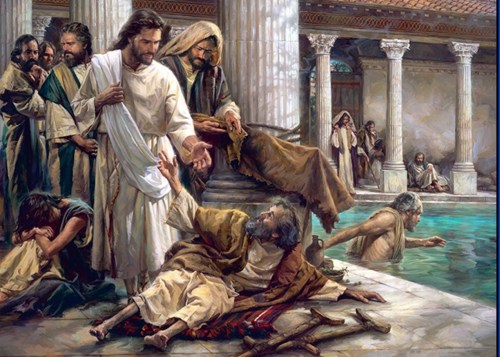
pool-of-bethesda

When Jesus saw him lie, and knew that he had been now a long time in that case, he saith unto him, Wilt thou be made whole? (John 5:6)

            John opens this next section with the phrase “After this.” The second “sign” highlighted by John was the healing of the nobleman’s son (John 4:46-54), and “After this there was a feast of the Jews; and Jesus went up to Jerusalem” (John 5:1, emphasis mine). John does not identify the particular feast. Jesus was careful to observe all of the feast days according to the Law. “Think not that I am come to destroy the law, or the prophets: I am not come to destroy, but to fulfil” (Matthew 5:17). Except for His run-ins with the Pharisees over “breaking the Sabbath,” He did not fail a single commandment.

John is the only Gospel writer to record three Passovers that Jesus observed during His three-year ministry: John 2:13; 6:4; and 13:1. The Jews celebrated Passover in the spring along with Unleavened Bread, First Fruits, and Pentecost. In the fall they celebrated the Feast of Trumpets, the Day of Atonement, and the Feast of Tabernacles. John mentions Jesus going up to Jerusalem to celebrate the Feast of Tabernacles (John 7:2). The fall feasts (as well as the spring feasts) were celebrated concurrently, so when John mentions the Feast of Tabernacles, it is understood that the other two are included.

Jesus also observed festivals that came long after the giving of the Law. Jesus traveled to Jerusalem to celebrate the Feast of the Dedication (John 10:22), what we call Chanukah[1] (Hanukah) today. The feast mentioned in the fifth chapter of John probably had an even older tradition. This too was a celebration not prescribed in the Old Testament Law. Although John does not name it, it was probably the Feast of Purim, which takes place on the 14th of Adar – around mid March. I arrive at this conclusion because in the next chapter, Jesus returns to Jerusalem to celebrate the Passover for the second time.

As Jesus walks around the Temple compound, He sees a man lying by the Pool of Bethesda.[2] “Bethesda” is Aramaic and it means “House of Kindness,” or “House of Mercy.” Besides this man, there were many others, but Jesus was drawn to this man. Why? John does not record his malady. Whatever his ailment, John reports that he suffered with it for 38 years (John 5:5). Perhaps the end of the account provides greater insight. After being healed, the man sought out Jesus. “Afterward Jesus findeth him in the temple, and said unto him, Behold, thou art made whole: sin no more, lest a worse thing come unto thee.” (John 5:14, emphasis mine). “For the Son of man is come to seek and to save that which was lost” (Luke 19:10, emphasis mine). If Jesus’ purpose was simply to heal, there were many others there He could have also helped, but Jesus chose this man. “[For] the LORD seeth not as man seeth; for man looketh on the outward appearance, but the LORD looketh on the heart” (1 Samuel 16:7).

What was this man’s sin that caused Jesus to single him out? Eli Lizorkin-Eyzenberg commenting on this passage offers some interesting insight. Recent archeological discoveries have associated the Pool of Bethesda with the cult of Asclepion.[3] Asclepius was the Greco-Roman god of healing and wellbeing. If this is the case, the man had placed his faith and hope on a false god for 38 years. No wonder he was disheartened!

“When Jesus saw him lie, and knew that he had been now a long time in that case, he saith unto him, Wilt thou be made whole?” (John 5:6) Jesus knew that he had been there a long time. As God, Jesus demonstrated His omniscience. He knew everything about this man. So, why did He ask such a seemingly obvious question? Rather than respond with a simple “yes,” note the man’s response (I can almost hear the whining!). “The impotent man answered him, Sir, I have no man, when the water is troubled, to put me into the pool: but while I am coming, another steppeth down before me” (John 5:7). Jesus did not allow for his excuses. “Jesus saith unto him, Rise, take up thy bed, and walk” (John 5:8).

As in the previous miracles recorded by John, there was no fanfare with this act. Jesus did not so much as extended hand to help him up. “And immediately the man was made whole, and took up his bed, and walked: and on the same day was the sabbath” (John 5:9, emphasis mine). We do not know if the man was a cripple. Were that the case, I am sure John would have let us know. Instead, all we know is that he had an “infirmity.” Whatever it was left him too weak to walk, but immediately his health was restored. Just like Jesus knew that this invalid had waited for healing by the pool for 38 years, He also knew exactly the nature of his malady. Like a bolt of lightning, the man must have felt the power of God surge through his body so that without hesitation, he stood up, picked up his bed and walked.

Not long after his healing, he was spotted carrying his bedroll by the Pharisees. “The Jews therefore said unto him that was cured, It is the sabbath day: it is not lawful for thee to carry thy bed” (John 5:10). “He answered them, He that made me whole, the same said unto me, Take up thy bed, and walk” (John 5:11). The man was so excited about having his health restored that he failed to thank or even take notice of Jesus. When he eventually found Jesus, he pointed Him out to them and they sought to kill Him because He healed on the Sabbath. Jesus then affirmed His deity. But Jesus answered them, My Father worketh hitherto, and I work” (John 5:17). That enraged them even more because He claimed equality with God. “[The] Son of man is Lord also of the sabbath” (Mark 2:28; Luke 6:5).

The Lord Jesus Christ knows each of is intimately. He still heals, and He can do so any time He pleases, not only on the Sabbath, but every day of the week.

NOTES:


[1]  “Happy Chanukah” https://erniecarrasco.com/category/christmas/

[2]  “Sick and Tired” https://erniecarrasco.com/2012/07/15/sick-and-tired/

[3]  Eli Lizorkin-Eyzenberg, The Jewish Gospel of John: Discovering Jesus, King of All Israel, (Jewish Studies for Christians, Tel Aviv, Israel, 2015), 70-71.

Comments Off on Jesus’ Seven Signs in John (3)

Filed under Apologetics, Christianity, Evangelism, Gospel, Religion, Salvation, Theology