Category Archives: Gospel

The Curse of Death

And as it is appointed unto men once to die, but after this the judgment (Hebrews 9:27)

And as it is appointed unto men once to die, but after this the judgment (Hebrews 9:27)

But of the tree of the knowledge of good and evil, thou shalt not eat of it: for in the day that thou eatest thereof thou shalt surely die.  (Genesis 2:17)

This week a young man, who labeled himself an agnostic, wrote in with a very good question concerning the curse of death. His question was posed as follows:

Genesis 2:17 says, “in the day that thou eatest thereof, thou shalt surely die.” Assuming that day equals 24 hours (big assumption, but Gen 2 is still part of the creation account) then the death must be spiritual or non-literal, since Adam lived to be 930 years – Gen 5:5. If the death resulting from sin is not literal, what is the relationship between sin and physical death? Is there any relation at all? Could physical death have occurred before sin? If sin and physical death are not related, why would Jesus have to rise from the dead? Is a bodily resurrection necessary for salvation? Why? Does any of the apostle Paul’s teaching of Christ conflict with a spiritual interpretation of death and sin? (I Cor 15:12-22)

Alternately, if the term “day” in Genesis 2:17 is not 24 hours, but instead an unspecified length of time equalling [sic] at least 930 years, most of the same questions about the relationship between sin and physical death would still apply.

His question is a very good one, and one of the key points in our biblical apologetics. The “death” described in Genesis 2:17 must be taken in context with the entire account of creation and the Fall, and in light of the rest of Scripture. Genesis 1 and 2 both narrate the creation account. Genesis 1:1-2:4 is God’s account of creation, and it gives a broad overview of the creation week. (For more details, see the notes on Genesis 1 and Genesis 2:1-4). Genesis 2:5 begins Adam’s account, and the focus is on Day Six and the creation of man. Allow me to regress and point out that chapter and verse divisions are not inspired. The original text was a continual reading with no breaks. This can sometimes be an obstacle, if one does not recognize that fact.

Another point that needs to be clarified is that the 24-hour day is not an “assumption” as he suggests. The Hebrew word used is yom, and it almost always means a normal 24-hour day in the Bible. When it is not a 24-hour day, such as in the “day of the Lord” (yom laYahweh) it is referring to a specific time, but never an extended period of time. Furthermore, God clearly defines the meaning of “day” with the phrase “evening and morning were the nth day” (Genesis 1:5, 8, 13, 19, 23).

At the end of the sixth day, God declared His creation not only “good” as in the previous five days, but “very good” (Genesis 1:31). Keep in mind that this assessment comes from an ultimately perfect being. So, if death existed before the fall, can death be considered a very good thing? If we say death is good, then how can death be a curse? And if death cannot be a curse, then why should Jesus die to pay the curse (the wages) of sin? If death was just a “spiritual” death, then, again, why should Jesus die a “physical” death to atone for a “spiritual” death? That really does throw a huge wrench in the works of the Gospel.

But “physical” death is NOT good. The Bible calls death the “enemy” (1 Corinthians 15:26). In the end, “death and hell (Greek hades “the grave”)” are cast into “the lake of fire” (Revelation 20:14). So, physical death cannot be part of a “very good” creation, if the Creator counts it as an enemy and something to be abolished. When God issued the command “thou shalt not eat of it: for in the day that thou eatest thereof thou shalt surely die” (Genesis 2:17), He was speaking of physical death. “Spiritual” death, i.e., separation from God, was a necessary consequence of that disobedience because He is the source of life (Job 33:4; Psalm 36:9; John 1:4; 5:26; 6:48; 10:28; 11:25; 14:6, et al). So, the death was both physical and spiritual. To further emphasize the point, Adam and Eve, since they had never experienced or observed death (keeping in mind that this all occurred shortly after creation – probably within a week or so), God (in the form of the pre-incarnate Christ – my opinion) sacrificed two (or more) innocent animals (probably sheep) in order to “cover” (atone for) their sin (Genesis 3:21). This was the first physical death of anything to this point, but on the spiritual side, man had already lost that intimate relationship with their Creator (Genesis 3:8).

This young man observed that Adam lived 930 years and concludes that the death curse must not have been physical but only spiritual, because they did not die immediately. One needs only to read Chapter 5 of Genesis and count how often the phrase “and he died” is repeated. Adam and Eve did not die instantly when they ate of the fruit, but they initiated the dying process. The phrase “you shall surely die” (Hebrew: mot tamot) would be better translated “dying you shall die.” Furthermore, the couple was denied access to the “tree of life” (Genesis 3:22) because apparently it had properties that would extend their life forever. The fact that they lived the long ages that they did is attributable to near perfect DNA (with the exception of the death mutation), and a near perfect environment. You may want to note the steady decline in longevity following the Global flood (Genesis 11:11-32).

Paul’s argument in 1 Corinthians 15:12-22 confirms that the curse of death is both physical and spiritual – physical in that our bodies degenerate to the point that they cease to function (we die), and spiritual in that our sin separates us from God (as physical death separates our spirit from our body). Jesus was sinless, like the first lambs sacrificed for Adam and Eve. Paul tells us that the “wages of sin is death” (Romans 6:23); here we are speaking of that spiritual death that separates us from God. Jesus’ death on the cross was the only sacrifice suitable to pay that debt of sin that separates us from God for all of mankind. “For it is not possible that the blood of bulls and of goats should take away sins” (Hebrews 10:4). Then when He rose again, He conquered the curse of physical death so that we can have eternal life. The choice, however, remains with us. From beginning to end, God has provided the way to restore that broken relationship and to enjoy eternal life with our Creator. We can either accept His offer, or reject it. “He came unto his own [not only the Jews, but mankind in general], and his own received him not. But as many as received him, to them gave he power to become the sons of God, even to them that believe on his name” (John 1:11-12).


3 Comments

Filed under Apologetics, Bible, Christianity, Creation, Death, Evangelism, Gospel, Origins, Religion, Salvation, Theology

The Unifying Theme

holy-bible

For all have sinned, and come short of the glory of God;  (Romans 3:23)

Critics of the Bible abound even among so-called mainline “Christian” denominations, but when examined closely, the criticisms always fail to stand up to the truth of God’s Word. As the Apostle Paul said, “let God be true, but every man a liar” (Romans 3:4). So it is.

Perhaps the greatest testament to the veracity of the Bible is the unifying theme that it carries throughout its pages. There exists no other so-called “holy” writing that compares with the Bible in clarity and unity of thought, even though it was penned by over 40 different authors (most of which did not know one another so that they could collaborate) over a period of about 1500 to 2000 years. Compare that to the Qur’an which was written by one man over a period of about 22 years (610-632 AD) and compiled over a period of only three years (653-656 AD). Or compare the Book of Mormon written by John Smith. It was produced in only two years between 1827 and 1829. Neither of the “holy” books compares to the Bible in unity of thought even though they were composed by one man each. Yet the Bible, with all of its various human writers over a very long period of time maintains a consistent theme. What is that theme?

The God of the Bible is unique among all other gods. All the gods devised by man demand that man lay down his life for them. The God of the Bible laid down His life for man. The gods devised by man demand that man earn their favor. The God of the Bible completed all the work of redemption, offers it as a free gift, and “asks” man to accept His gift. Let us examine how that plays out.

“In the beginning God created the heaven and the earth” (Genesis 1:1). From the very start, we are introduced to God as Creator. The verses that follow detail His work of creation and we are awestruck at His omniscience and omnipotence. So great is He that one must immediately decide whether to believe or reject the account of His creation, and therein lie the trappings of disbelief. As we continue in our reading we discover that God’s final and most cherished creation is man. “And God said, Let us make man in our image, after our likeness … So God created man in his own image, in the image of God created he him; male and female created he them” (Genesis 1:26, 27). Man bears the image of God. It is no wonder that God’s first command for human government was “Whoso sheddeth man’s blood, by man shall his blood be shed: for in the image of God made he man” (Genesis 9:6). The creation of man was the cherry on top of God’s cake, “And God saw every thing that he had made, and, behold, it was very good” (Genesis 1:31). “Very good” in God’s economy is flawless.

So far, so good, but then all that fell apart when man disobeyed God’s only command, “But of the tree of the knowledge of good and evil, thou shalt not eat of it: for in the day that thou eatest thereof thou shalt surely die” (Genesis 2:17). Adam and Eve disobeyed God’s only command (Genesis 3). They sinned. Some attempt to blunt the edge of the word “sin” by suggesting that it means to “miss the mark.” They arrive at this by quoting a passage from the book of Judges describing the accuracy of the Benjamites with a sling. “Among all this people there were seven hundred chosen men lefthanded; every one could sling stones at an hair breadth, and not miss” (Judges 20:16).   The Hebrew word translated “miss” is châṭâ’, which is often translated “sin.” It could be said that the Benjamites sling a stone without “sinning.” But sin is not so much like taking aim at a target, and missing the bull’s eye. Accurately hitting a target is a product of our own efforts. Sometimes we hit; sometimes we miss. Oh, well! “Sin” cannot be taken so lightly. Paul, quoting Psalm 14:1-3, tells us that, “As it is written, There is none righteous, no, not one: There is none that understandeth, there is none that seeketh after God” (Romans 3:10-11). To suggest that sin is “missing the mark” implies that the sinner is trying to “hit the mark,” Scripture suggests otherwise – there is none that seek to “hit the mark,” at least not the mark that God has set. No, sin is more egregious than, “Oops! I missed!”

Sin is outright rebellion against God. More than that, it is man’s attempt to usurp God’s rightful place. Note Satan’s threefold assault on Eve. First, he cast doubt on the Word of God: “Yea, hath God said …?” (Genesis 3:1). Second, he denies the truth of God’s Word: “Ye shall not surely die” (3:4). Finally, he accuses God of keeping something better from them: “For God doth know that in the day ye eat thereof, then your eyes shall be opened, and ye shall be as gods, knowing good and evil” (3:5, emphasis mine). And that, boys and girls, is the basis for all sin. Man desires to be his own god and determine good and evil for himself. This truth repeats itself over and over in a variety of different scenarios throughout Scripture. But look what God does.

After Adam and Eve sinned, God gave opportunity for redemption. Notice Who looks for who. “And the LORD God called unto Adam, and said unto him, Where art thou?” (Genesis 3:9). Does anyone really think that the omniscient and omnipresent God did not know where they were hiding? God gave Adam and Eve the opportunity to confess their sin and ask forgiveness. “If we confess our sins, he is faithful and just to forgive us our sins, and to cleanse us from all unrighteousness” (1 John 1:9).  But rather than confess, they started making excuses and refusing to take responsibility for their own actions – much like people do today. In His patience, God continued to probe, “And he said, Who told thee that thou wast naked? Hast thou eaten of the tree, whereof I commanded thee that thou shouldest not eat?” (Genesis 3:11).  Again, rather than accept responsibility and confess their sin, the couple made excuses. You can read the results for yourself. I want to highlight what God did.

The couple did not die instantly, but their sin set in motion the physical dying process. It has been said that from the moment of our birth, we all start dying. That is so true, but more than that, their sin disconnected them from their source of eternal life. “The Spirit of God hath made me, and the breath of the Almighty hath given me life” (Job 33:4). The penalty of their sin was death, “For the wages of sin is death” (Romans 6:23). Someone or something had to die to pay the penalty for their sin, but it could not be the man or the woman, for they were now corrupt, and their death could not satisfy Holy God. So God Himself intervened. “Unto Adam also and to his wife did the LORD God make coats of skins, and clothed them” (Genesis 3:21). In order to make “coats of skins,” innocent, perfect animals, probably sheep, were slaughtered to make coverings (atonement) for the naked pair. I believe that the preincarnate Christ performed the sacrifice before them to set the pattern that they would follow from then on. On an altar of stone the Lamb of God, shed innocent blood to atone for the sin of man.

That set the pattern for millions of similar blood sacrifices to follow. In the succeeding chapter we find righteous Abel continuing the practice handed down from God Himself (Genesis 4:4). Older brother Cain chose to sacrifice in a way not prescribed by God; he chose to do things his own way and bring the fruits of his own labor (Genesis 4:3). His offering may seem more “humane” in that no blood was shed, but it was what God demanded. “And the LORD had respect unto Abel and to his offering: But unto Cain and to his offering he had not respect. And Cain was very wroth, and his countenance fell” (Genesis 4:4-5). Like many people today, Cain thought his own efforts done in his own way should be acceptable to God, but God does not see it that way. Like people today, Cain thought that all ways lead to God, but for God, there is only one way and that is through the blood. “For the life of the flesh is in the blood: and I have given it to you upon the altar to make an atonement for your souls: for it is the blood that maketh an atonement for the soul” (Leviticus 17:11).

From the beginning, it has always been the shedding of innocent blood that made atonement (a covering) for sin. The sacrificial system was codified in the Mosaic Law and practiced throughout Old Testament history.  But, “it is not possible that the blood of bulls and of goats should take away sins” (Hebrews 10:4).  Something more permanent needed to be put in place. “But when the fulness of the time was come, God sent forth his Son, made of a woman, made under the law, To redeem them that were under the law, that we might receive the adoption of sons” (Galatians 4:4-5). “Christ Jesus: Who, being in the form of God, thought it not robbery to be equal with God: But made himself of no reputation, and took upon him the form of a servant, and was made in the likeness of men: And being found in fashion as a man, he humbled himself, and became obedient unto death, even the death of the cross” (Philippians 2:5-8).

In short, the unifying theme of the Bible is that Holy God created man in His image. Man sinned against God and earned the penalty of sin which is death, both physical and spiritual. God intervened on man’s behalf initially by substituting innocent animal blood to atone for sin, but ultimately He took on human form and as a sinless (innocent) man, shed His own blood on the cross for our sin. “By the which will we are sanctified through the offering of the body of Jesus Christ once for all” (Hebrews 10:10). There is no other “holy” book that makes such a claim. There is no other God that does for His creation, what the God of the Bible did for us.

Comments Off on The Unifying Theme

Filed under Apologetics, Bible, Christianity, Creation, Death, Evangelism, Gospel, Religion, Salvation, Theology

Too Rich for Heaven

camel-needle

And when he heard this, he was very sorrowful: for he was very rich.  (Luke 18:23)

Let’s face it. With the possible exception of the homeless, many of whom are in that condition by choice, poverty – the third-world kind of poverty where people live on one bowl of rice a day, have only one change of clothes, no shoes and live in cardboard houses – in the United States does not exist. I have visited in homes of the “poor” here in America and found giant-screen TVs in their living rooms with play stations for their kids. They might not have the best food – usually as a result poor choices – but they are a long way from starvation. They may be “low income,” but they are not poor in comparison to third-world nations. They own several changes of clothes and shoes, and many of their vehicles sport shiny custom “rims.”

Affluence often erects an insurmountable obstacle to the Gospel here in America. Many people here in the U.S. are self-sufficient enough that they do not perceive their need for God. They get along fine without Him, so why should they give up their lifestyle to follow Christ who asks them to change their way of living?

Our verse above is taken from an account recorded in the three synoptic Gospels: Matthew 19:16-26, Mark 10:17-27, and Luke 18:18-27. Matthew points out that the man was young (Matthew 19:20, 22). Luke notes that he is a “ruler” (Luke 18:18), perhaps indicating that he significantly, or even solely supported the local synagogue. Such support would place him in a position of high leadership in the synagogue and in the local community. Jairus whose daughter Jesus raised from the dead is such an example (Matthew 9:23-26; Mark 5:35-43; Luke 8:49-56). Mark omits his youth and position, but focuses on his, perhaps, feigned homage in kneeling before Christ.

However, all three Gospel writers point out that the man was rich. In that culture, wealth indicated God’s favor, and was a source of false pride by those so blessed. Jesus often berated the religious leaders for overt exhibition of opulence in their giving of alms and offerings at the temple to be “seen of men” (Matthew 6:5; 23:5). No doubt this “rich young ruler” approached Jesus in a similar hypocritical, arrogant and prideful manner “saying, Good Master, what shall I do to inherit eternal life?” (Luke 18:18) Jesus saw right through him. By “good,” he meant “good like I am good.” “And Jesus said unto him, Why callest thou me good? none is good, save one, that is, God” (v. 19). In Texanese, what Jesus said was, “Boy, you ain’t so good. Only God is good.” Jesus went on to ask him if he “knew” the commandments (v. 20). “And he said, All these have I kept from my youth up” (v. 21, emphasis mine). He lied. No one can keep all of the commandments perfectly! James says, “For whosoever shall keep the whole law, and yet offend in one point, he is guilty of all” (James 2:10).

Jesus then gets to the heart of the matter. So, you really are good! “Yet lackest thou one thing: sell all that thou hast, and distribute unto the poor, and thou shalt have treasure in heaven: and come, follow me” (v. 22). The hidden sins kept the rich young ruler away from that which he sought – eternal life: the sin of pride, the sin of hypocrisy, the sin of selfishness, the sin of covetousness.  “But when the young man heard that saying, he went away sorrowful: for he had great possessions” (Matthew 19:22). He valued his stuff more than the riches of heaven.

In America, we suffer from the fatal disease of “affluenza.” “Fatal” because in many cases it resists the very source of eternal life. Affluenza blinds the victim from seeing “the way, the truth and the life” (John 14:6). Affluenza deafens the victim from hearing the Savior’s words, “I am come that they might have life, and that they might have it more abundantly” (John 10:10).

As Jesus watched the dejected young man walk away He said, “How hardly shall they that have riches enter into the kingdom of God! For it is easier for a camel to go through a needle’s eye, than for a rich man to enter into the kingdom of God” (Luke 18:24-25). Some suggest that a “needle’s eye” was a small opening in the bulwark of a city that would allow a camel to crawl through once the city gates were closed. I don’t think that is what Jesus meant here. If there were such openings in the in the city walls, a camel could enter even with difficulty, but so could attackers. No, I believe Jesus meant the eye of a “sewing” needle. That would indeed require a miracle for a camel to pass.

If your stuff matters more to you than following Jesus, then you are too rich for heaven.

Comments Off on Too Rich for Heaven

Filed under Apologetics, Bible, Christianity, Evangelism, Gospel, Heaven, Religion, Salvation

Thou Fool!

lightstock_80572_xsmall_ernie

But God said unto him, Thou fool, this night thy soul shall be required of thee: then whose shall those things be, which thou hast provided? (Luke 12:20)

That seems like a rather harsh assessment considering that Jesus Himself said, “but whosoever shall say, Thou fool, shall be in danger of hell fire” (Matthew 5:22). What would cause God to look upon an individual and make such an assessment? What qualifies as a fool in the eyes of God?

To begin with, “The fool hath said in his heart, There is no God” (Psalm 14:1, 53:1). Actually the words “there is” have been inserted in the English for readability, but they are not found in the original Hebrew. Therefore, the strict literal translation would be: “The fool has said in his heart, ‘No God.’” This implies more than just denial. It is outright rejection. The Bible teaches that there are no true atheists, i.e., someone who truly believes there is no higher power, i.e. God; “Because that which may be known of God is manifest in them; for God hath shewed it unto them” (Romans 1:19). Every person knows that God, or some “higher power” exists. So when the fool says, “No God,” he is not simply in denial, or ignorant; he is in rebellion. And when one considers against Whom he is rebelling, he really is a fool!

Fools display distinct characteristics. A fool prates; that is, he utters empty or foolish talk and talks excessively and pointlessly (Proverbs 10:8, 10). A fool utters slander (Proverbs 10:18). “The way of a fool is right in his own eyes” (Proverbs 12:15). “A fool’s wrath is presently known” (Proverbs 12:16). A fool readily displays his silliness (Proverbs 13:16). “A fool despiseth his father’s instruction” (Proverbs 15:5). A fool is hard-headed (Proverbs 17:10); he doesn’t learn (Proverbs 26:11). A fool is contentious and his mouth often gets him into trouble (Proverbs 18:6-7); he continually gets into arguments (Proverbs 20:3), and he is always happy and eager to speak his mind (Proverbs 29:11). A fool does not seek nor listen to advice (Proverbs 23:9). One can also recognize a fool by his self-centeredness or self-focus as seen in one of Jesus’ parables.

Our beginning verse concludes the parable Jesus told starting at verse 16. He recounted a story of a rich land owner who experienced a bumper crop one year, and rather than give thanks to God for the blessing, he took the credit for his success upon himself and planned on what to do with his profits. In the course of this short parable, the protagonist employs personal pronouns (I, me, my, mine) thirteen times in only three verses (vv. 17-19). Like any fool, he boasted of his own success. His plans for the future were “right in his own eyes,” and he had no qualms about taking all the credit for his gains.

God called him a fool. In all of his efforts he discounted God – the One who gave him the very basis for obtaining his wealth – his very life. Now, at the height of his self-perceived success, God comes to claim what belongs to Him – the fool’s life. And what about all of his stuff? “Then whose shall those things be?” What a fool! Jesus said, “So is he that layeth up treasure for himself, and is not rich toward God” (Luke 12:21). Jesus admonishes, “Lay not up for yourselves treasures upon earth, where moth and rust doth corrupt, and where thieves break through and steal: But lay up for yourselves treasures in heaven, where neither moth nor rust doth corrupt, and where thieves do not break through nor steal: For where your treasure is, there will your heart be also” (Matthew 6:19-21). The fool is self-focused rather than God-focused. The fool lives his life in either overt or covert rebellion against God. He behaves as though God does not exist, and presumptuously assumes credit for all of his achievements. How terrible it would be to hear God say, “Thou fool! Today your soul is required of you.” In the words of the Doxology: “Praise God from Whom all blessings flow,” and you may not hear those awful words, “thou fool !”

2 Comments

Filed under Apologetics, Christianity, Death, Evangelism, Gospel, Religion, Salvation, Theology

Seeing to Believe

"My Lord and my God."

“My Lord and my God.”

And I will pour upon the house of David, and upon the inhabitants of Jerusalem, the spirit of grace and of supplications: and they shall look upon me whom they have pierced, and they shall mourn for him, as one mourneth for his only son, and shall be in bitterness for him, as one that is in bitterness for his firstborn. (Zechariah 12:10)

My blog is titled “Ernie’s Musings” because I write about things that cross my mind – when I can remember them. So it was this last week as I was in the shower in an effort to wake up and start the day. These days I think a lot about the Lord’s return with great anticipation as well as some dread for loved ones that are not prepared for the event. As I thought about that great event, I recalled the Scripture passage above and imagined the scene described in Revelation 19:11-16:

And I saw heaven opened, and behold a white horse; and he that sat upon him was called Faithful and True, and in righteousness he doth judge and make war. His eyes were as a flame of fire, and on his head were many crowns; and he had a name written, that no man knew, but he himself. And he was clothed with a vesture dipped in blood: and his name is called The Word of God. And the armies which were in heaven followed him upon white horses, clothed in fine linen, white and clean. And out of his mouth goeth a sharp sword, that with it he should smite the nations: and he shall rule them with a rod of iron: and he treadeth the winepress of the fierceness and wrath of Almighty God. And he hath on his vesture and on his thigh a name written, KING OF KINGS, AND LORD OF LORDS.

God long ago selected Israel among all the other nations for a particular purpose:

For thou art an holy people unto the LORD thy God: the LORD thy God hath chosen thee to be a special people unto himself, above all people that are upon the face of the earth. The LORD did not set his love upon you, nor choose you, because ye were more in number than any people; for ye were the fewest of all people: But because the LORD loved you, and because he would keep the oath which he had sworn unto your fathers, hath the LORD brought you out with a mighty hand, and redeemed you out of the house of bondmen, from the hand of Pharaoh king of Egypt. (Deuteronomy 7:6-8, emphasis mine)

God chose Israel for the purpose of bringing Messiah into the world and identifying Him with an undeniable lineage so that He wouldn’t be missed (see Matthew 1:1-16; Luke 3:23-38). God also promised the land of Israel to Abraham as an eternal possession (see Genesis 13:14-15). “Know therefore that the LORD thy God, he is God, the faithful God, which keepeth covenant and mercy with them that love him and keep his commandments to a thousand generations” (Deuteronomy 7:9, emphasis mine).

The history of Israel, from the time of the Exodus to the Babylonian captivity and beyond has been one of rebellion against God. Even now the majority of Israelis practice Judaism more out of tradition than out of a sincere devotion to God. Indeed, Israel is primarily a secular nation. Salvation for Israel has never been a “done deal.” God’s salvation is for individuals, not nations. John the Baptist made this point when a group of Pharisees and Sadducees came to him to be baptized: “And think not to say within yourselves, We have Abraham to our father: for I say unto you, that God is able of these stones to raise up children unto Abraham” (Matthew 3:9).  Salvation is not a national right for Israel. Israel exists as a sign to the world and to give testimony of God’s faithfulness. “God is not a man, that he should lie; neither the son of man, that he should repent: hath he said, and shall he not do it? or hath he spoken, and shall he not make it good?” (Numbers 23:19) God, because of His mercy and faithfulness, will give Israel one final chance to repent, and when they see the Lord returning in the clouds, “they shall look upon me whom they have pierced, and they shall mourn for him, as one mourneth for his only son, and shall be in bitterness for him, as one that is in bitterness for his firstborn” (Zechariah 12:10), but each individually, not as a nation.

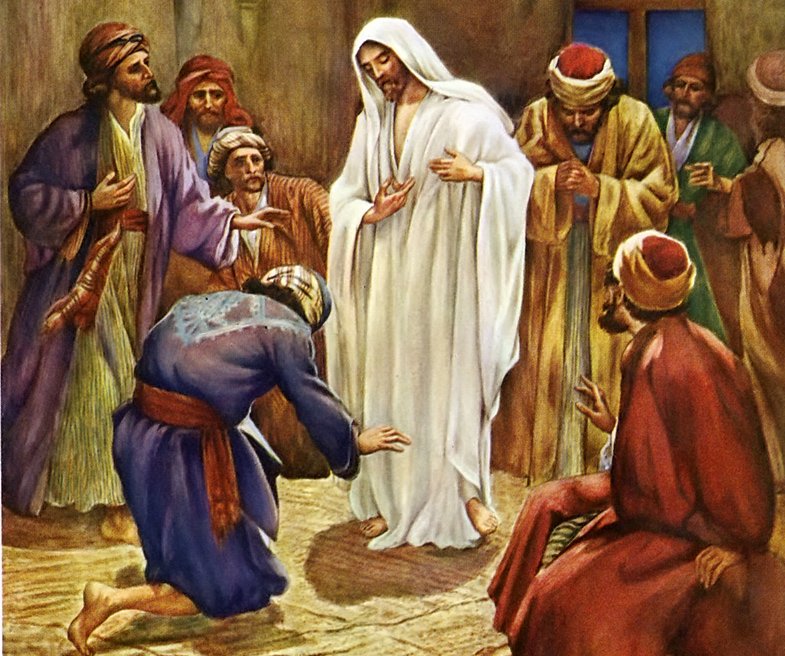
As I mused on this, I recalled John’s account of Thomas, the apostle, following the resurrection of Christ. Jesus was crucified during Passover and placed in a tomb where He laid for three nights and three days (John 19:38-42). Then early on the first day of the week (Sunday), He reclaimed His life and rose from the grave (John 20:1). There He was seen by Mary Magdalene who clung to Him when she saw Him. “Jesus saith unto her, Touch me not; for I am not yet ascended to my Father: but go to my brethren, and say unto them, I ascend unto my Father, and your Father; and to my God, and your God” (John 20:17). Apparently, His absence was brief. Mary Magdalene gave Jesus’ message to the disciples who were holed up in the upper room “for fear of the Jews” (John 20:19). It was the same day in the evening (prior to 6 PM), when “came Jesus and stood in the midst, and saith unto them, Peace be unto you” (v. 19). Thomas was not in the group. When the others gave Thomas the news, “he said unto them, Except I shall see in his hands the print of the nails, and put my finger into the print of the nails, and thrust my hand into his side, I will not believe” (John 20:25). The following Sunday, Jesus once again appeared to His disciples, and this time Thomas was with the group.

Then saith he to Thomas, Reach hither thy finger, and behold my hands; and reach hither thy hand, and thrust it into my side: and be not faithless, but believing. And Thomas answered and said unto him, My Lord and my God. Jesus saith unto him, Thomas, because thou hast seen me, thou hast believed: blessed are they that have not seen, and yet have believed. (John 20:27-29, emphasis mine)

I see a parallel here between this account of Jesus’ resurrection and His return at the last days. The day of Jesus’ resurrection is the presentation of the Gospel which the Apostles received upon seeing Him. Thomas was not there to witness the risen Christ, but the message was presented to him, and he rejected it. The period between the Sunday of Christ’s resurrection and the following Sunday can be compared to the “Church Age” where the Gospel – the good news – is proclaimed but the only evidence is the testimony of the messengers. Those who believe must do so by faith and the credibility of the message. The following week, Christ returns and this time Thomas sees Him in the flesh. This can be compared to the end of this age when the Lord returns to set up His millennial kingdom (Revelation 20). At that time many of the Jews who rejected Him by faith shall look upon Him “whom they have pierced, and they shall mourn for him, as one mourneth for his only son, and shall be in bitterness for him, as one that is in bitterness for his firstborn” (Zechariah 12:10). And Jesus will say, “because thou hast seen me, thou hast believed: blessed are they that have not seen, and yet have believed” (John 20:29, emphasis mine). Jesus will return very soon. Don’t wait to see Him in order to believe. It may be too late then.

2 Comments

Filed under Bible, Christianity, Easter, End Times, Evangelism, Gospel, Religion, Resurrection, Salvation, Second Coming of Christ, Theology