Category Archives: Gospel

The Star and the Cross

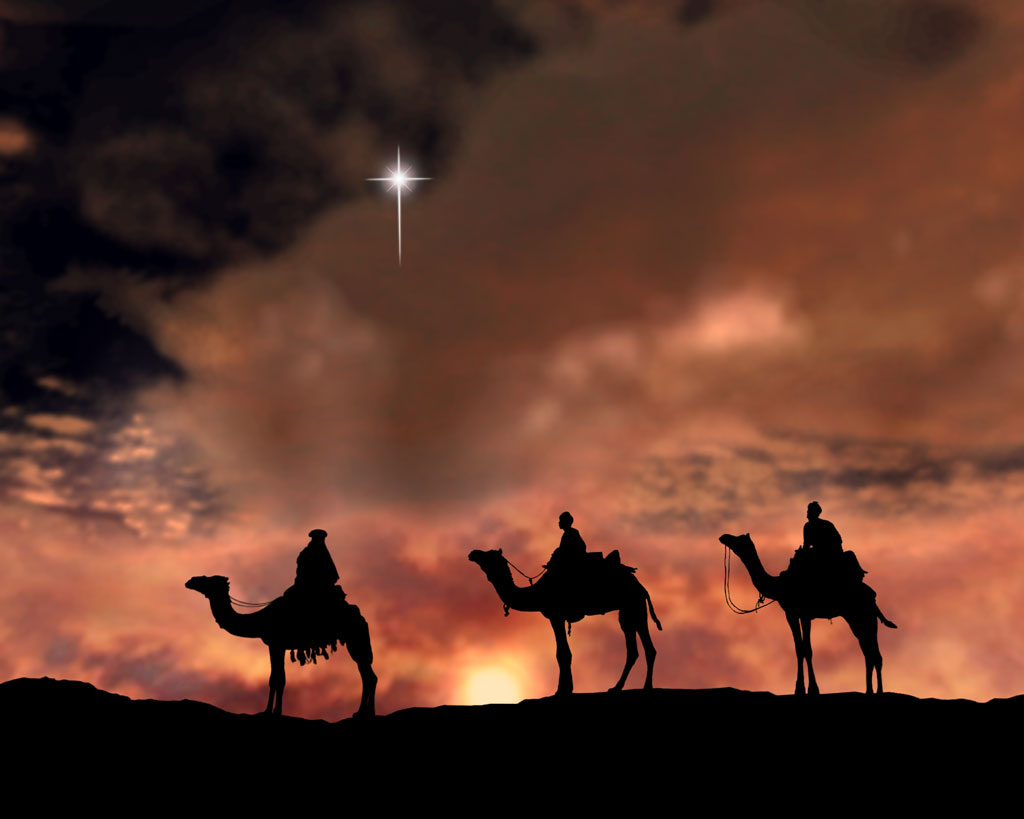
chasing-star-of-bethlehem-412624

When they saw the star, they rejoiced with exceeding great joy. (Matthew 2:10)

Black was the sky of the oriental night
Bejeweled as an empress displaying her might.
Lost in the tedium of nocturnal watch,
The wisest of wise appraised a new sight.
 
High in the heavens and brighter than most
A dazzling new object had joined the host.
The astrologers pondered and ventured a guess:
“A mighty new monarch this beacon does toast.”
 
Consulting their sources and making their plans
The seekers trekked westward across the hot sands.
They followed the beacon that showed them the way
To the City of David, and the Savior of man.
 
By day and by night they followed the trail
Of their guiding light with much travail,
For a curious sight its beams had revealed
— The form of a cross in full detail.
 
For two years they followed their stellar guide
Until it rested, and shown with pride
O’er a humble house and the family there
Who with the Mighty King did abide.
 
So they offered their gifts, their praise to assign
As the cross and the star continued to shine,
And knowing not why, their burden was lifted;
The child in the house did their sorrow consign.
 
Some thirty years later, on a cross made of wood
The child, now a young man, there hung in the nude,
And the bright Star of Bethlehem continued to blaze,
The King of all kings gave His life to conclude.


1 Comment

Filed under Christianity, Christmas, Evangelism, Gospel, Poetry, Religion, Salvation, Theology

Shepherd of Shepherds

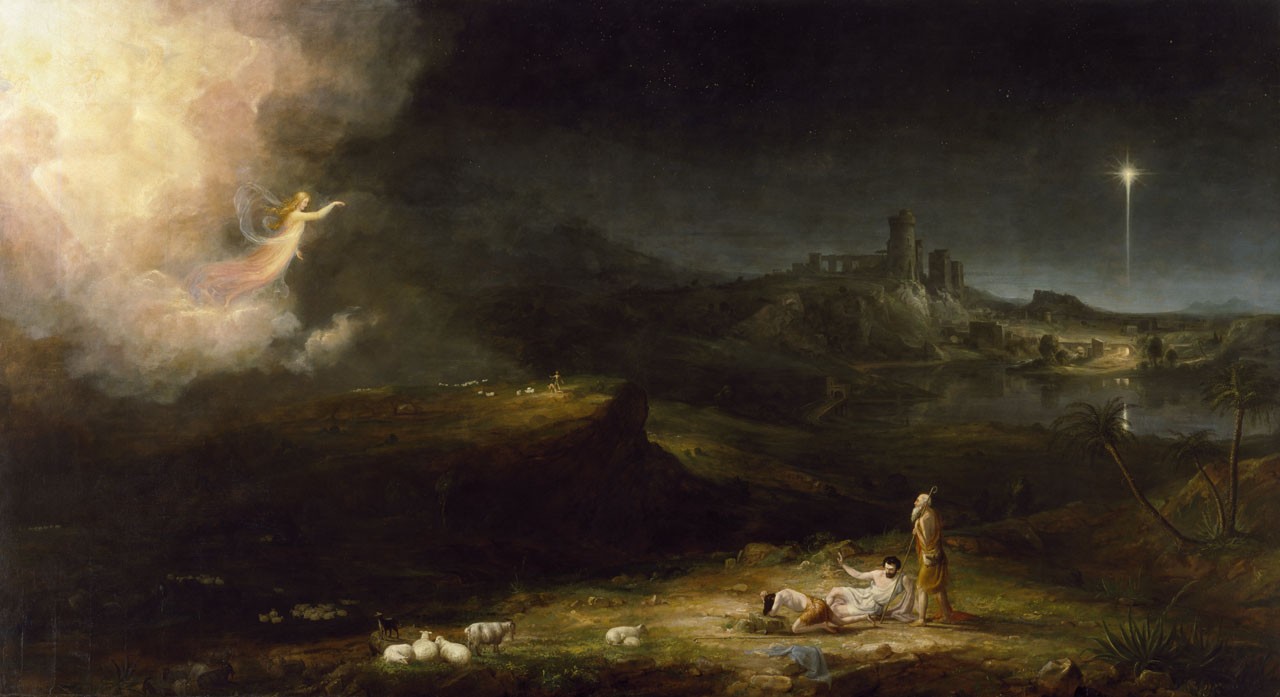
cole-angel-shepherds

“And there were in the same country shepherds abiding in the field, keeping watch over their flock by night.” (Luke 2:8)

One of the best arguments against the birth of Christ having taken place in late December is this fact recorded by Luke in his Gospel. There were shepherds out in the fields watching over their flocks. By late December, there is not sufficient grazing to sustain large flocks of sheep. Jerusalem is near the same latitude as Dallas, Texas where I live. By the middle to the end of November, there is not much left for cattle to graze on, so they need to be fed on hay or “cake.” So it seems very unlikely that shepherds would be out in the fields in the winter time.

The shepherds around Bethlehem generally kept the sheep and goats that were used for sacrifice in the Temple in nearby Jerusalem. Some have suggested that Jesus’ birth was around late September which coincides with the Jewish Fall Feasts: Feast of Trumpets (Rosh Hashanah), Day of Atonement (Yom Kippur) and Feast of Tabernacles (Sukkoths). These were feasts that required all Jewish men to make a pilgrimage to the Temple in Jerusalem. The fact that this requirement happened to coincide with the decree from Caesar Augustus for the census (Luke 2:1) may explain why “there was no room for them in the inn” (Luke 2:7) for the expectant couple. In fact, His birth may have occurred during the Feast of Tabernacles making John’s statement that “the Word was made flesh, and [tabernacled] among us” (John 1:14) even more significant. Interestingly, if one counts back nine months from the end of September, one arrives at a date sometime in late December. It could be that rather than celebrating Christ’s birth on December 25, we are actually celebrating His conception!

Regardless, it was to these simple shepherds that this paramount announcement was delivered. “For unto you is born this day in the city of David a Saviour, which is Christ the Lord” (Luke 2:11). To these shepherds who were known for feeding and protecting their flocks; who sought out the lost sheep, and rescued those that were attacked. It seems appropriate that to these the news of the arrival of the “Shepherd of Israel” should be first delivered. He who would later say, “I am the good shepherd: the good shepherd giveth his life for the sheep” (John 10:11) had come. So without hesitation they said, “Let us now go even unto Bethlehem, and see this thing which is come to pass, which the Lord hath made known unto us” (Luke 2:15). They came “with haste” Luke tells us, “and found Mary, and Joseph, and the [Lamb of God] lying in a manger” (Luke 2:16). His name was Jesus, “for he shall save his people from their sins” (Matthew 1:21). This little Lamb of God, who was to be the Shepherd of shepherds, had finally come to them.


1 Comment

Filed under Apologetics, Christianity, Christmas, Evangelism, Gospel, Religion, Salvation, Theology

Peace!

Christmas Bells

Glory to God in the highest, and on earth peace, good will toward men. (Luke 2:14)

Peace.  Such an elusive word.  So full of hope, and yet so seemingly unattainable.  The angels proclaimed “peace on earth, and good will toward men” as they announced the Savior’s birth that holy night.  There was no peace on earth at the time of that proclamation.  The Roman Empire was in control of a major part of the western world, and there was unrest in the land of Judea as one uprising after another was crushed by the heavy hand of the Roman legions.  Things then were not much different than what we see today – unrest in the Middle East, the constant threat of war, North Korea bent on becoming a nuclear power, China vamping up her navy and playing havoc with the American economy, Europe on the verge of economic collapse.  There is no peace on earth.

I heard the bells on Christmas day
Their old familiar carols play,
And wild and sweet the words repeat
Of peace on earth good will to men.
 
Then, in despair I bowed my head,
“There is no peace on earth,” I said,
“For hate is strong and mocks the song
Of peace on earth good will to men”
 

But the hope of peace is strong within man, and so the lowly shepherds to whom the announcement was made, left their flocks in hopes of catching a glimpse of the tiny Prince of Peace that had come into the world.  As a man, He would later say, “Peace I leave with you, my peace I give unto you: not as the world giveth, give I unto you.  Let not your heart be troubled, neither let it be afraid” (John 14:27).  Amidst all the trouble and chaos of the world, He still promises peace and encouragement: “Let not your heart be troubled, neither let it be afraid.”

Then peal the bells more loud and deep;
God is not dead, nor doth He sleep.
The wrong shall fail, the right prevail
With peace on earth good will to men.
 

A dear friend recently enlightened me to the fact that “Joy to the World” is not really a Christmas carol.  It is not about Christ’s first coming; it is about His second coming!  There will be no peace on earth until the King of Kings comes to reign over all of His creation.  At that time, it will be most appropriate to sing:

Joy to the world the Lord is come!
Let earth receive her king!
Let every heart prepare Him room,
And heaven and nature sing.
 
Joy to the earth! the Savior reigns!
Let men their songs employ;
While fields and floods, rocks, hills and plains
Repeat the sounding joy.
 
No more let sin and sorrow grow,
Or thorns infest the ground.
He comes to make His blessings flow
Far as the curse is found.
 
He rules the world with truth and grace,
And makes the nations prove
The glories of His righteousness,
And wonders of His love.
 

Writing almost 800 years before the first advent, the prophet Isaiah proclaims, “For unto us a child is born, unto us a son is given: and the government shall be upon his shoulder: and his name shall be called Wonderful, Counsellor, The mighty God, The everlasting Father, The Prince of Peace” (Isaiah 9:6).  The tiny babe Whose birth we celebrate this Christmas is the hope of peace for a troubled world and the realization of peace for those who know Him as Savior.  Let us find our peace in Him!

2 Comments

Filed under Christianity, Christmas, Current Events, End Times, Evangelism, Gospel, Religion, Salvation, Theology

Time for Pride to Grow

“. . . when the morning stars sang together, and all the sons of God shouted for joy?” (Job 38:7)

A common question that arises from time to time is, “When did God make the angels?” A corollary question to that is “Was there enough time for pride to grow in Satan and for the war in Heaven to occur within the first few days?”

In the Job passage quoted above, God is telling Job that the angels were there at the time when He formed the earth. As to whether there was sufficient time for Satan’s pride to grow, we must ask, “How much time does it take for pride to grow?” In our own experience, does it take a long time to develop pride, or does it just seem to flare up unexpectedly? I would say the latter. Pride is one of the most basic sins. Human beings are naturally selfish and self-centered. Recall that very shortly after Creation, Satan was able to tempt Eve with “the pride of life” (1 John 2:16): “ye shall be as gods, knowing good and evil” (Genesis 3:5). It does not take a great amount of time for pride to grow.

The angels probably were created on the first day of the creation week. We cannot be dogmatic about this. The Bible does not specify when the angels were created, but the above passage in Job indicates that they were at least around to see the creation taking place. The angels, therefore, were created before man. Perhaps the reason for not focusing more attention on angels is that the Bible focuses mainly on the relationship between God and man. Angels play a part, but they are not central to God’s redemptive plan. But what does God say about man? “Let us make man in our image, after our likeness: and let them have dominion over the fish of the sea, and over the fowl of the air, and over the cattle, and over all the earth, and over every creeping thing that creepeth upon the earth” (Genesis 1:26, emphasis added). Did God say that about the angels? Did God give dominion over His creation to the angels? Can you see anything there that would give rise to pride and jealousy?

It would not have taken a long time for Satan’s pride to grow. Having been created first and then given lower status than man, Satan said, “I will ascend into heaven, I will exalt my throne above the stars of God: I will sit also upon the mount of the congregation, in the sides of the north: I will ascend above the heights of the clouds; I will be like the most High” (Isaiah 14:13-14, emphasis added). Satan hates man because God has bestowed upon man greater status than the angels. “What is man, that thou art mindful of him? and the son of man, that thou visitest him? For thou hast made him a little lower than the angels, and hast crowned him with glory and honour. Thou madest him to have dominion over the works of thy hands; thou hast put all things under his feet” (Psalm 8:4-6, emphasis added). The English phrase “a little lower than the angels” is not an accurate translation. “Angels” is the Hebrew ‘ĕlôhîym referring to God rather than the normal word for angels mal’âkîm. This is a messianic passage describing the condescension of Christ in taking human form, but this also has a secondary meaning as applied to man. Having been created in the image of his Maker, man holds a higher status than the angels, and this infuriates Satan.

This being the case, Satan most likely rebelled on Day Six of creation or very shortly thereafter. Seeing that man was God’s prized creation, Satan turned his ire toward destroying man. Knowing that man was created in the image of God, he employed that fact to cause man’s demise: “ye shall be as gods” (Genesis 3:5). If one analyses the source of any sin, it all goes back to pride – man wants to be his own god. This has been true from the beginning when Satan witnessed the creation of man, and since the fall of man in the Garden (Genesis 3). It really takes no time for pride to develop. It is nothing that requires any nurturing. On the contrary, it is something must actively be suppressed, and this cannot be done through human strength. It requires the supernatural power that only comes from God through the Holy Spirit. Jesus promised, “ye shall receive power, after that the Holy Ghost is come upon you” (Acts 1:8), and it is in that power alone that pride can be conquered.

1 Comment

Filed under Apologetics, Christianity, Creation, Evolution, Gospel, Origins, Theology

Somewhere in the Middle

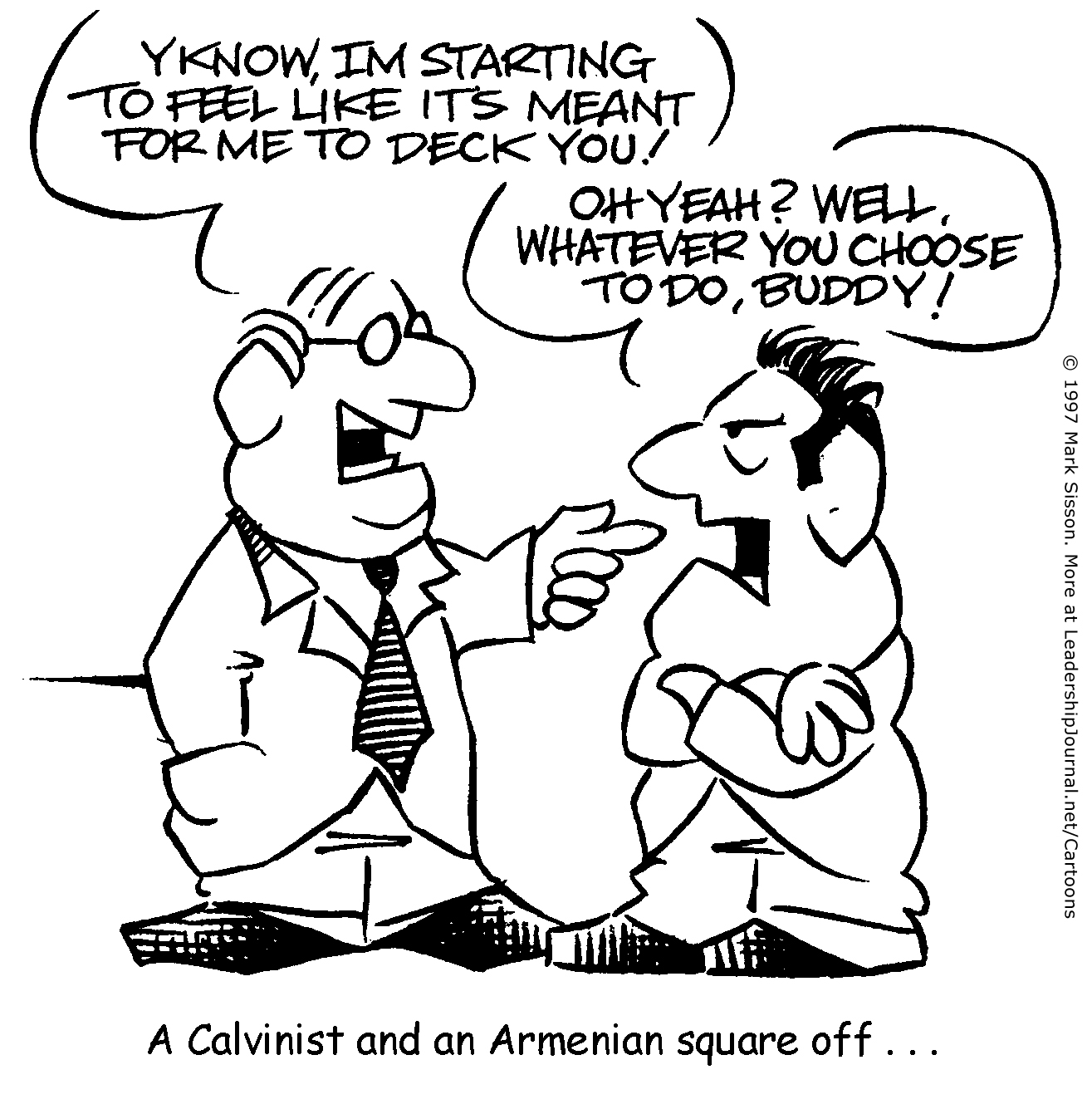
Calvinism-vs.-Arminianism-Cartoon2

For many are called, but few are chosen. (Matthew 22:14)

This past week I’ve had an online conversation with a fellow blogger on the topic of “limited atonement” and “total depravity.” Because of the nature of this topic, these discussions are usually fruitless and typically degenerate into “profane and vain babblings” (2 Timothy 2:16), which we should shun. At issue is the tension between the sovereignty of God and the free will of man. Calvinism (falsely attributed to the reformer, John Calvin) defends five points characterized by the acrostic TULIP: (1) Total Depravity, (2) Unconditional Election, (3) Limited Atonement, (4) Irresistible Grace, and (5) Perseverance of the Saints. Calvinism champions the complete sovereignty of God, and hyper-Calvinists go so far as to assert that God literally picks and chooses who will go to heaven and who will go to hell.

On the other side of the argument is Arminianism, attributed to the Dutch theologian Jacob Arminius. Arminianism counters Calvinism with eight points: (1) Universal Prevenient Grace, (2) Conditional Election, (3) Unlimited (or universal) Atonement, (4) Resistible Grace, (5) Uncertainty of Perseverance, (6) Libertarian Free Will, (7) Equal, Impartial, and Undifferentiated Love, (8) The Universal Call of Salvation.[1]

The conflict comes when one takes one position or the other. Both positions have scriptural support, and both have scriptural weaknesses. Contrast Calvinism’s “Total Depravity” with Arminianism’s “Universal Prevenient Grace.” The former considers individuals dead in sin so that they are incapable of choosing God’s free gift of salvation apart from God’s direct intervention on their behalf. This can be supported from Ephesians 2:8 where the Apostle Paul says in effect that the faith required to accept God’s Grace is in itself a gift of God. The latter acknowledges man’s fallen condition, but suggests that Grace “restores man’s free will which was impaired by the effects of original sin and enables him to choose or refuse the salvation offered by God in Jesus Christ.”[2] This too has scriptural support in “the Lamb slain from the foundation of the world” (Revelation 13:8). Or contrast Calvinism’s “Unconditional Election” with Arminianism’s “Conditional Election.” The former says that God picks who will be saved, the latter basically says that God “elects” or chooses those who choose Him. Both of these concepts find support in Scripture. Jesus said, “Ye have not chosen me, but I have chosen you” (John 15:16), but, of course, it could be argued that Jesus, in context, was speaking to His disciples, and as such it is not a blanket statement covering all believers. The Arminian challenge to this would be: “Then what do you do with all the ‘whosoever’ passages in the New Testament?” The Calvinist would then argue in a circle and say that all the “whosoevers” are the elect, but that also contradicts a lot of Scripture.

In Calvinism, “Unconditional Election” and “Limited Atonement” go hand in hand.  The former specifies God’s sovereignty in “electing” who will be saved and “Limited Atonement” explains that Christ’s sacrifice, while having universal application, is only efficient for those who are elect. They are really two sides of the same coin. Arminianism challenges that with “Unlimited Atonement.” Since Jesus died for all, then all have equal opportunity to respond to the Gospel by the exercise of their free will. Calvinism responds that those who respond to the Gospel do so because Grace, the “call of God,” is irresistible to the elect; they cannot help but respond to the Gospel message. The Arminian would retort that Grace certainly is resistible, as is frequently proven in evangelistic encounters. Anyone who has shared their faith with an unbeliever has experienced the disappointment of bringing someone to the point of conviction and then having them reject the invitation to accept Christ as Lord and Savior. Some say, “I’m not ready now.” Others will say, “Perhaps when I’m older.” Still others may say, “I don’t want to offend my family or my friends.” The offer of God’s grace certainly can be rejected. Of course the Calvinist would counter with, “That’s because they aren’t elect” – again arguing in a circle.

This discussion could go on and on, and countless reams of paper have been spent in defense of both sides. Both sides have good points, and both sides have weak points. The answer to the debate lies somewhere in the middle. Only God knows the real inner workings of His plan. “For my thoughts are not your thoughts, neither are your ways my ways, saith the LORD. For as the heavens are higher than the earth, so are my ways higher than your ways, and my thoughts than your thoughts” (Isaiah 55:8-9). In the end, both Calvinists and Arminians have to come to Christ in the same way: “Believe on the Lord Jesus Christ, and thou shalt be saved” (Acts 16:31). “That if thou shalt confess with thy mouth the Lord Jesus, and shalt believe in thine heart that God hath raised him from the dead, thou shalt be saved” (Romans 10:9).

There is one point where the Calvinists get it right and the Arminians get it wrong, and that is the fifth point of Calvinism: “Perseverance of the Saints” vs. the Arminian “Uncertainty of Perseverance.” “Perseverance of the Saints” is the idea of “once saved always saved.”[3] The Arminians object to this based on observation. They may observe someone who claims to be saved living as a pagan. First of all, I would remind the Arminian that “the LORD seeth not as man seeth; for man looketh on the outward appearance, but the LORD looketh on the heart” (1 Samuel 16:7). Secondly, if salvation is based on man’s own effort, however that may be defined, that “salvation” is not genuine. Ephesians 2:9 tells us that salvation is “Not of works, lest any man should boast.” But when Jesus does the saving He says, “My sheep hear my voice, and I know them, and they follow me: And I give unto them eternal life; and they shall never perish, neither shall any man pluck them out of my hand” (John 10:27-28). Yes, Christians can sin and not lose their salvation. The difference is that the one who is truly saved, cannot continue in willful sin. Either the Christian will readily recognize his sin and immediately repent and ask forgiveness, or the Lord will allow the Christian to continue in his sin until the consequences of his sin bring him to the recognition of his sin that brings about repentance. If the sinner never comes to that point, he has probably never been saved because Jesus says, “My sheep hear my voice.” Either he belongs to Christ or he does not.

So, as I tried to show, the true answer to the Calvinism vs. Arminianism controversy is somewhere in the middle, and only God knows the exact details of His plan. Our task is to present the simple Gospel message, allow the Holy Spirit to do His work, and leave the details of how God accomplishes His plan to God.

Endnotes: 


[3] See my post “Impossible” of September 2, 2012.

5 Comments

Filed under Apologetics, Christianity, Evangelism, Gospel, Religion, Salvation, Theology