
Category Archives: Gospel

Hell

And in hell he lift up his eyes, being in torments, and seeth Abraham afar off, and Lazarus in his bosom. (Luke 16:23)

No one wants to hear about hell, but someone needs to talk about it. Why not me? I do not write this blog to be popular or become famous. If anything, dealing with topics such as this may win my place in infamy. That is okay; I will take my chances.

Most people largely ignore hell. They ask, “How can a loving God send anyone to hell?” Indeed, God sends no one to hell. “The Lord is not slack concerning his promise, as some men count slackness; but is longsuffering to us-ward, not willing that any should perish, but that all should come to repentance” (2 Peter 3:9, emphasis mine). In fact, when God unleashes the full force of His wrath upon the world during the seven-year Tribulation, He provides 144,000 witnesses to preach the Gospel to all nations.[1] He brings two Old Testament prophets from the dead to preach repentance and perform miracles in Jerusalem.[2] If that is not enough, God sends an angel to proclaim the Gospel to all of the world.[3] God does not want to send anyone to hell. He gives mankind every opportunity to avoid that place. (That is the main purpose of this blog.) However, it is up to every individual to make that choice for themselves. God does not force His affection on anyone.

If hell is not real, why would God go to such extremes – like taking on human form[4] to die on a cross for our sins[5] – to keep us out of that place? The Bible speaks more about hell than it speaks about heaven. Yet, some scoffers foolishly mock claiming that they look forward to going to hell so that they can party with all of their friends. Little do they know that they will suffer hell alone. (More on that later.) Still others, while accepting the fact of hell, reject the eternal nature of hell. Obviously, they have misinterpreted the multiple times that Jesus referred to hell as a place of “everlasting fire.”[6] While some may acknowledge that hell is eternal, they believe a sentence to hell is not. They believe that those that go to hell will only spend enough time there to pay for their sins and then cease to exist. However, that amounts to a lot of wishful thinking with no basis in Scripture.

In the Old Testament, “hell” often translates the Hebrew word she’ôl, which is the abode of the dead. Sometimes it is translated as “the grave” or “the pit,” and it is a place of no return. It is not clear to me, but it seems that she’ôl refers to “life after death,” and it could be either bad or good. King David expressed this idea at the death of his son by Bathsheba.[7] When the child was sick, David fasted and prayed unto God for the child’s life, but when the child died, he washed, dressed in his kingly apparel, and ended his fast. When asked about this seemingly odd behavior, David said, “But now he [the child] is dead, wherefore should I fast? can I bring him back again? I shall go to him, but he shall not return to me” (2 Samuel 12:23, emphasis mine). David understood that there was life after death, and his anticipation of that event was not cause for dread; rather, David looked forward to that day.

She’ôl also has a not-so-pleasant side to it. In describing Israel’s reward for idolatry, Moses records God’s plan. “And he [God] said, I will hide my face from them [Israel], I will see what their end shall be: for they are a very froward generation, children in whom is no faith. They have moved me to jealousy with that which is not God; they have provoked me to anger with their vanities: and I will move them to jealousy with those which are not a people; I will provoke them to anger with a foolish nation. For a fire is kindled in mine anger, and shall burn unto the lowest hell, and shall consume the earth with her increase, and set on fire the foundations of the mountains. I will heap mischiefs upon them; I will spend mine arrows upon them” (Deuteronomy 32:20-23, emphasis mine). While the language may be figurative (I take it literally), it describes the extent of God’s wrath against sin, and it is not pretty.

We see, then, that she’ôl, the abode of the dead, has both a good and a bad side. Jesus confirmed this idea when He recounted the death of a rich man and Lazarus.[8] Some assume that this was one of Jesus’ parables, but a close inspection reveals that Jesus relayed this as an actual account. Lazarus died as did the unnamed rich man, but they ended up in two different locations. Lazarus died “and was carried by the angels into Abraham’s bosom: the rich man also died, and was buried” (Luke 16:22). Albert Barnes points out that “Burial was thought to be an honor, and funerals were, as they are now, often expensive, splendid, and ostentatious. This is said of the rich man to show that he had “every” earthly honor, and all that the world calls happy and desirable.”[9]

That the rich man was buried also expresses the finality of, at least, his earthly life. However, that was not his end. “And in hell he lift up his eyes, being in torments, and seeth Abraham afar off, and Lazarus in his bosom” (Luke 16:23, emphasis mine). “Hell” here translates the Greek word hadēs which is equivalent to the Hebrew she’ôl. Two regions of the abode of the dead are expressed here: “Abraham’s bosom” and “torments.”

“Torments” is what we normally understand as “hell.” Notice that the rich man possessed consciousness. He could see Abraham and Lazarus “afar off.” However, Lazarus seems to be unaware of the rich man’s suffering. It appears that part of the torture of those in hell is seeing those who are enjoying heaven. At the same time, those in heaven remain unaware of those suffering in hell. Heaven would not be so heavenly knowing the fate of friends and loved ones suffering in hell.

Jesus described the rich man’s end as a place of fire. “And he cried and said, Father Abraham, have mercy on me, and send Lazarus, that he may dip the tip of his finger in water, and cool my tongue; for I am tormented in this flame” (Luke 16:24, emphasis mine). Some deny the fire of hell, but Jesus never did.[10] Notice that the rich man retains his selfish nature in hell. He dares to ask Abraham to send Lazarus to relieve him of some of his suffering. Later, he asks that Lazarus be sent to preach to his five brothers (vv. 27-28). He does not care about the rest of the lost, only his brothers. Sinners in hell do not change their sinful ways.

Finally, Jesus does not mention others suffering along with the rich man. He appears to be alone and isolated. So much for those who think they will party in hell with their friends. When one rejects God’s free offer of salvation, that one alone bears the responsibility for that choice. It is important to point out that nothing in this account describes the rich man as a particularly wicked or sinful person. Nor does it portray Lazarus as a particularly upright man. However, by implication, the rich man took no thought about God, while Lazarus depended on no one else but God. The rich man counted on his riches and thereby rejected God – not overtly – he probably attended synagogue regularly – but in his attitude of self-sufficiency.

Hell is a real place and the final destination of many. Jesus said, “Enter ye in at the strait [i.e., “narrow”] gate: for wide is the gate, and broad is the way, that leadeth to destruction, and many there be which go in thereat: Because strait is the gate, and narrow is the way, which leadeth unto life, and few there be that find it” (Matthew 7:13-14, emphasis mine). Sadly, Jesus makes it clear that the majority of people will end up in hell.

Many believe that at “judgement day” their good deeds will outweigh the bad and they will gain access into heaven by their good works. They correctly conclude that their deeds will be judged, but the standard to which they will be evaluated is the perfect, sinless life of Jesus Christ, and all will fall short of that standard. Everyone’s life is recorded in the annals of heaven and everyone will give an account. John the Revelator writes, “And I saw the dead, small and great, stand before God; and the books were opened: and another book was opened, which is the book of life: and the dead were judged out of those things which were written in the books, according to their works … And death and hell [hadēs] were cast into the lake of fire. This is the second death. And whosoever was not found written in the book of life was cast into the lake of fire” (Revelation 20:12, 14-15, emphasis mine). “The lake of fire” is the place we understand as “hell,” and it is eternal.

The question remains. Which way do you choose, the broad way or the narrow way? Do you want to follow the majority on the way to hell or choose the narrow way that leads to eternal life? The choice is yours and yours alone. Jesus said, “I am the way, the truth, and the life: no man cometh unto the Father, but by me” (John 14:6, emphasis mine). Does that seem narrow? It is! If you are on the broad way with the majority, you can get off of that road to destruction. Please read my page on “Securing Eternal Life.”

Notes:


[1]  Revelation 7; 14:1-5

[2]  Revelation 11:1-14

[3]  Revelation 14:6-7

[4]  John 1:14

[5] Philippians 2:5-8

[6]  Matthew 18:8-9; 25:46; Mark 3:29; 9:43-48

[7]  2 Samuel 12:1-25

[8]  Luke 16:19-31

[9]  Albert Barnes’ Notes on the Bible (Published in 1847-85; public domain.)

[10]  Matthew 3:12; 5:22; 7:19; 13:40, 42, 50; 18:8-9; 25:41, et al
Comments Off on Hell

Filed under Apologetics, Christianity, Death, Gospel, Heaven, Hell, Salvation, Theology

Baby God

Behold, a virgin shall be with child, and shall bring forth a son, and they shall call his name Emmanuel, which being interpreted is, God with us. (Matthew 1:23)

To begin, allow me to clear up any misconceptions that my title may evoke about God having a beginning. That would be heresy. Let me emphatically state that God is eternal, without beginning or ending.[1] “Blessed be the LORD God of Israel from everlasting, and to everlasting. Amen, and Amen” (Psalm 41:13).

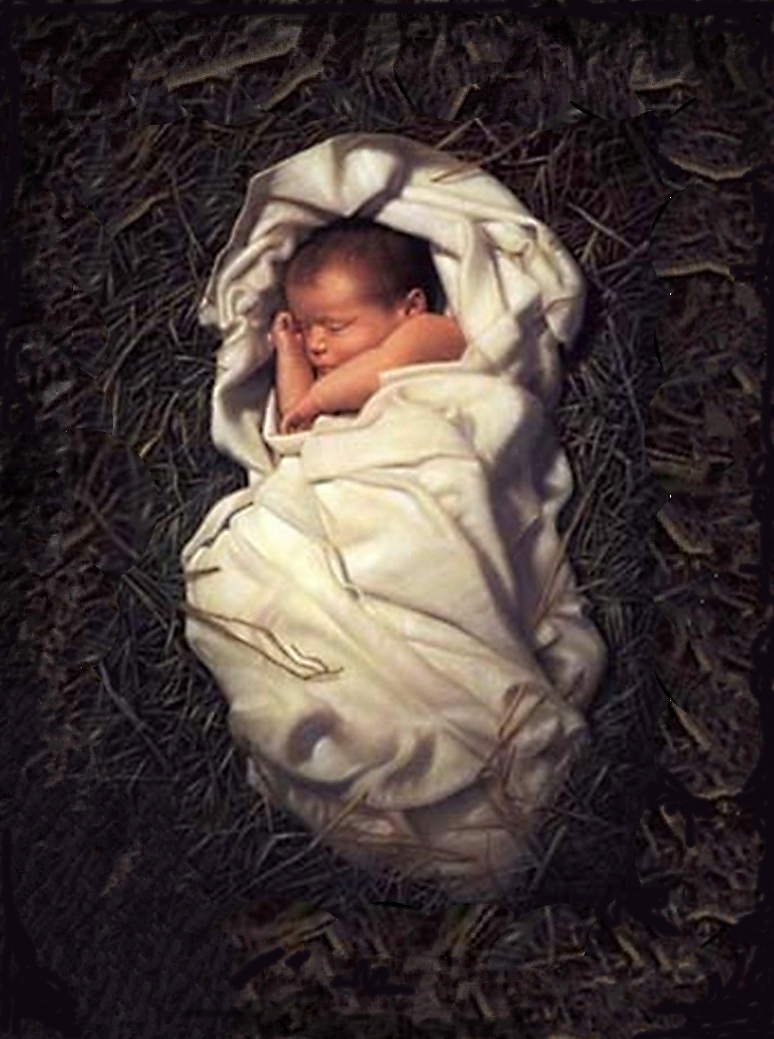
That said, at this time of year we celebrate the birth of baby Jesus – the Word made flesh come to “tabernacle” among us.[2] His birth was no more miraculous than the birth of any other baby. In many ways, His arrival took place in possibly the worst of circumstances – born in an animal shelter with a feeding trough as His first cradle. The Gospel writer, Luke, does not specify, but Mary probably had the assistance of midwives at the birth. An often-overlooked phrase in the account states that “while they were there, the days were accomplished that she should be delivered” (Luke 2:6, emphasis mine). Evidently, they were in Bethlehem at least a day or two before the birth. Bethlehem being a small town, the word of a newly arrived expectant mother would surely have come to the ears of competent midwives, and women being women, they would certainly have been willing to lend a hand.

So, the birth itself was nothing special. The conception that took place nine months earlier in Nazareth, that was the miracle![3] Now, here He was – Baby God! “In the beginning was the Word, and the Word was with God, and the Word was God. The same was in the beginning with God. All things were made by him; and without him was not any thing made that was made” (John 1:1-3, emphasis mine). Yet, here He was – God in the form of a helpless baby that needed to be fed, needed to have His diapers changed, needed to be carried, and needed to be protected. Baby God!

How is that possible? How can God be a helpless baby and Almighty God at the same time? Theologians have debated this question for millennia. Some suggest that Jesus was unaware of His deity until the time of His baptism when God announced, “This is my beloved Son, in whom I am well pleased” (Matthew 3:17). Some say that it was later in His ministry, perhaps at the time He knew His mission to go to the cross. Then there are the pseudo gospels that have the boy Jesus forming birds out of clay and making them come to life. We know nothing of Jesus’ childhood, but the Gospel writer, Luke, does record an account, perhaps at Jesus’ bar mitzva, when He baffled the religious teachers with His wisdom and knowledge.[4] When His earthly parents found Him in the Temple and chided Him for worrying them, He responded, “How is it that ye sought me? [did you not know] that I must be about my Father’s business?” (Luke 2:49, emphasis mine). It appears that Jesus knew His mission at least at the young age of twelve.

Theologians can debate all they want, but it seems clear to me from Scripture that this baby was God in the flesh. How was that possible? The answer is the same answer that the Angel Gabriel gave to Mary. “For with God nothing shall be impossible” (Luke 1:37). In our feeble minds, we want to know all the details of how God does what He does. Our finite minds cannot comprehend the infinite knowledge, wisdom, and power of Almighty God! Indeed, the Bible teaches that “The secret things belong unto the LORD our God: but those things which are revealed belong unto us and to our children for ever, that we may do all the words of this law” (Deuteronomy 29:29). The “secret thing” is how God accomplished such an awesome feat. The God of heaven, the Creator of all that exists, took on human flesh in the form of a helpless baby without giving up any of His “Godship.” We can never fully grasp that. However, the “things which are revealed” show us that “God so loved the world, that he gave his only begotten Son, that whosoever believeth in him should not perish, but have everlasting life” (John 3:16). “… Christ Jesus: Who, being in the form of God, thought it not robbery to be equal with God: But made himself of no reputation, and took upon him the form of a servant, and was made in the likeness of men: And being found in fashion as a man, he humbled himself, and became obedient unto death, even the death of the cross” (Philippians 2:5-8). He came as a baby – Baby God.

Notes:


[1]  “The Eternality of God” – https://erniecarrasco.com/2017/06/04/the-eternality-of-god/

[2]  John 1:14

[3]  “Miracle of the Incarnation” – https://erniecarrasco.com/2012/12/24/miracle-of-the-incarnation/

[4]  Luke 2:43-49

Comments Off on Baby God

Filed under Apologetics, Christianity, Christmas, Gospel, Holidays, Theology

Take No Thought

Therefore I say unto you, Take no thought for your life, what ye shall eat, or what ye shall drink; nor yet for your body, what ye shall put on. Is not the life more than meat, and the body than raiment? (Matthew 6:25)

Last week the Wuhan Bug arrived at our house. I felt it first. It came on me Saturday evening in the form of a low-grade fever. I felt my ears “burn” as I worked on a sermon that I was supposed to deliver the following day at an assisted living facility. I called Linda, the lady in charge of the services, to let her know the situation. At that time, I was not aware that I had been “bitten” by the bug, but knowing the precautions taken at the facility to keep the residents safe, I felt obligated to report my condition. Linda, our leader, was a little distraught because she did not have a substitute on such short notice. So, I promised that if my fever left, I would show up and fulfill my obligation. The next morning, I was ready to preach.

I battle allergies constantly, especially this time of the year. So, for me, what I experienced was “normal.” My wife June, on the other hand started feeling bad Monday. That evening, she took her temperature and it was over 100º. The next day she called in sick to work and made an appointment to see a doctor. She was tested and diagnosed with COVID-19. Naturally, when she tested positive, they called me in and I tested positive as well. Keep in mind that I was not “feeling” sick during all of this time, except for the low-grade fever on Saturday night. The doctor prescribed an infusion of monoclonal antibodies and a medical team came to our house on Wednesday to administer the infusion to us. Following the infusion, I experienced chills and high fever the next two days. June had a similar experience, but after that, we both felt much better.

Our experience with the Wuhan Bug was a mild one compared to some. God made each one of us unique. Each one of us has a one-of-a-kind genetic makeup so that viruses affect us differently. One of the reasons I oppose the COVID injection being pushed by our government is that it is designed to manipulate your DNA. In simple terms, the mRNA injected into your body is supposed to “train” your God-created DNA into fighting of the spike protein of the coronavirus. The scientists that developed this “gene therapy” are ignorant (compared to the Designer and Creator of DNA), fallen, humans who are trying to manipulate what God has created. We must remember that these scientists, for the most part, believe that humans evolved from some common ancestor with ape, therefore they have a low regard for the notion that we were created in the image of God. I could go on, but that is not the purpose of this article.

From the beginning of the “plandemic” June and I have rejected the fearmongering propaganda surrounding it. We decided from the onset that we would trust God rather than men. Some will argue that God gave men intelligence to develop medicines and vaccines to help improve the health of mankind. To a large extent, I agree. In the past, medicines and vaccines have been developed from substances God created in nature. Past remedies stemmed from men “thinking God’s thoughts after Him.” These new so-called mRNA vaccines are none of that. They are all developed from manmade substances which attempt to alter or manipulate what God designed and created. You are welcome to disagree, and you have every right to be wrong, but I digress.

In Jesus’ Sermon on the Mount He stressed, “Take no thought for your life, what ye shall eat, or what ye shall drink; nor yet for your body, what ye shall put on. Is not the life more than meat, and the body than raiment?” The Greek word translated “thought” is merimnaō and it means “to be anxious about” something. The word “anxious” carries the connotation of “sickening worry.” This Wuhan Bug has many people I know and love living in fear, too afraid to come out of their homes for fear of being infected. June and I refuse to live like that without presuming upon God for our safety. We understood that we could be infected, but we also trusted that God would see us through – and He did!

Jesus says to “take no thought for your life.” The Greek word translated “life” here is not the common Greek words translated as “life.” Rather, it is the Greek word, psuchē, which means “breath” or “spirit.” It carries the connotation of the “soul,” which is the very essence of one’s being and existence. A Christian, of all people, should not be worried or anxious about his life knowing that, as Paul said, “We are confident, I say, and willing rather to be absent from the body, and to be present with the Lord. (2 Corinthians 5:8, emphasis mine). If you claim to be a Christian and lack that confidence, then you may need to reassess your position before God.

Jesus goes on to list material things over which we should not worry, but He tied all these back to what He stated earlier. Note that He begins the verse with “Therefore I say unto you.” Anytime we see “therefore” in the Bible, we need to see what it’s “there for.” In this case, Jesus had spoken of storing up treasures in heaven.[1] He stressed the folly of accumulating treasures here on earth, because it decays or can be stolen. “Treasures” can be anything that we value – our home, material possessions, family, time, work, life, etc. These are all temporal in nature. Jesus instructed that we should “lay up for yourselves treasures in heaven, where neither moth nor rust doth corrupt, and where thieves do not break through nor steal” (Matthew 6:20).

I really long for the day when “the Lord himself shall descend from heaven with a shout, with the voice of the archangel, and with the trump of God: and the dead in Christ shall rise first: Then we which are alive and remain shall be caught up together with them in the clouds, to meet the Lord in the air: and so shall we ever be with the Lord” (1 Thessalonians 4:16-17, emphasis mine). I am shocked when I run into Christians that do not share my enthusiasm for the Lord’s return, and in fact, they hope that He does not return anytime soon because they have so many treasures here on earth that they are unwilling to turn loose. Jesus reminds us, “For where your treasure is, there will your heart be also” (Matthew 6:21). Where is your treasure?

Divided loyalties weaken the Christian and make him susceptible to fear and worry. Jesus said, “No man can serve two masters: for either he will hate the one, and love the other; or else he will hold to the one, and despise the other. Ye cannot serve God and mammon” (Matthew 6:24). You can either put your trust in and serve the things of this world (“mammon”) or you can place your trust in God for His provision knowing that your life, your psuchē, is in His strong and loving hands. If your trust is in Him, the Wuhan Bug should not scare you.

Notes:


[1]  Matthew 6:19-24

Comments Off on Take No Thought

Filed under Apologetics, Christianity, Creation, Current Events, Eschatology, Gospel, Origins, Random Musings, Rapture, Salvation, Science, Second Coming of Christ, Theology

Still Coming

… and said unto them, Occupy till I come.  (Luke 19:13)

As I wrote last week, “For many years now, I come to this time of year with a heightened sense of expectation.” More than ten years ago, I learned about the Feasts of the Lord.[1] By His death, burial and resurrection, Jesus fulfilled first three spring feasts, and Pentecost fulfilled the fourth feast. The last three fall feasts remain unfulfilled, and the Feast of Trumpets comes first in that series. The Feast of Trumpets is significant because it heralds the new year. It is also a holy convocation announced by the blowing of trumpets that summons the people to the Temple.

The connection with the Feast of Trumpets and the Rapture of the Church comes by way of deduction derived from 1 Corinthians 15:51-52; 1 Thessalonians 4:16-17; and Revelation 4:1. These passages speak of the sound of a trumpet preceding the Rapture of the Church, so it seems logical that the call could come at the first fall feast that remains unfulfilled.

Although it might seem like a reasonable conclusion, the fact remains that nothing in Scripture tells us when the Rapture will take place. The Bible gives no signs to signal the Rapture. Instead, the Bible (the New Testament) teaches that the Rapture is imminent; it can happen at any time without warning. Jesus said, “Therefore be ye also ready: for in such an hour as ye think not the Son of man cometh. Who then is a faithful and wise servant, whom his lord hath made ruler over his household, to give them meat in due season? Blessed is that servant, whom his lord when he cometh shall find so doing” (Matthew 24:44-46, emphasis mine).

In a different place, Jesus relayed a parable of a “A certain nobleman [representing Himself] went into a far country to receive for himself a kingdom, and to return. And he called his ten servants, and delivered them ten pounds, and said unto them, Occupy till I come” (Luke 19:12-13, emphasis mine). Our “nobleman,” Jesus Christ, has gone to receive His kingdom and He has promised to return (John 14:1-3). We do not know when. In the meantime, He has commanded, “Occupy till I come.”

Another Rosh HaShanah, the Feast of Trumpets, came and went again, and the trumpet did not sound to call us home, but Jesus did not tell us when He would return. He just told us to watch, wait, and occupy until He comes. When He does come for us, He expects to find us taking care of His business. What will He find us doing?

The Rapture is imminent. It comes without warning and without signs. However, the Second Coming does have signs, and we see many of the signs falling into place. The greatest of these signs is the miraculous rebirth of the nation of Israel. As the signs of the last days[2] increase in number and intensity, we know the time is near, and if the Second Coming of Christ is near, the Rapture is closer. Are you ready? Are you occupied in the task He has given you or are you distracted by the cares of the world? He did not come last Tuesday, or Wednesday, but He may come today. How will He find you?

Reader, if you do not know the Savior, please read my page on “Securing Eternal Life.”

Notes:


[1] “Rosh HaShanah” – https://erniecarrasco.com/2016/10/03/rosh-hashanah/

[2]  Matthew 24; Mark 13; Luke 21

1 Comment

Filed under Apologetics, Christianity, Current Events, End Times, Eschatology, Feasts of the Lord, Gospel, Rapture, Religion, Second Coming of Christ, Theology

I’ve Got A Mansion

In my Father’s house are many mansions: if it were not so, I would have told you. I go to prepare a place for you. And if I go and prepare a place for you, I will come again, and receive you unto myself; that where I am, there ye may be also. (John 14:2-3)

An old Gospel song that goes by the same title talks about “a mansion just over the hilltop in that bright land where we’ll never grow old.”[1] The singer dreams of having a “gold one that is silver lined.” Does that not seem somewhat esurient to covet the riches of heaven? I admit that the thought did not occur to me until recently.

When I think of a mansion, I imagine the $5 million (or more) homes of the super-rich or the palaces of royalty. Somehow, I do not think that is exactly to what Jesus referred when He spoke the words of our beginning verse above.

Consider this. “Heaven” as described in Revelation 21-22 enjoys a perfect environment much like that of the Garden of Eden[2] that God originally created. So perfect was that environment, that the first couple could run around naked[3] and not worry about getting sunburned, rained on, or frost bitten. Furthermore, all their nutritional needs were provided. It was a perfect place. Their only shelter were the stars above (and oh, how the stars must have sparkled at night in the pollution-free sky!). There was no need for any kind of building for shelter, much less a mansion.

Heaven will be like that, I think. No mansions of gold with silver trim. Before ending His earthly ministry, Jesus promised that in His Father’s house – only ONE house – are many mansions. That word in the Greek is monē, which means “a staying, abiding, dwelling, abode.” If Jesus meant some kind of building, He could have used the word “castle” – Greek parembolē meaning something like a fortress. Or, He could have used the word “palace” – Greek aulē, meaning “a yard (as open to the wind); by implication a mansion: – court, ([sheep-]) fold, hall, palace.”[4] However, Jesus used the word monē promising that we would have a place to stay and He has many places to stay and dwell for those who follow Him.

Sadly, we too often derive our “theology” from the songs we sing rather than from the Word of God. Next time you hear that old Gospel song, put that golden mansion out of your mind and be happy that Jesus has given you a place in His Father’s house.

Reader, if you are unsure of your eternal abode, please read my page on “Securing Eternal Life.” Jesus has a reservation for you in His Father’s house, but you have to take Him up on His invitation.

Notes:


[1]  “Mansion Over the Hilltop” by Ira Stanphill, 1949.

[2] Genesis 2:5-9

[3]  Genesis 2:25

[4]  Strong’s G833 definition.

Comments Off on I’ve Got A Mansion

Filed under Apologetics, Christianity, End Times, Eschatology, Evangelism, Gospel, Heaven, Rapture, Resurrection, Salvation, Second Coming of Christ, Theology