Category Archives: Hell

Why the Resurrection Matters

He is not here, but is risen: remember how he spake unto you when he was yet in Galilee, (Luke 24:6)

Christmas and Easter (I prefer “Resurrection Day”) are the two most important days on the Christian calendar with Resurrection Day being, arguably, the most important of the two. One might argue that we could not have the Resurrection without the Birth, but the Birth without the Resurrection would render both insignificant.

Jesus’ birth came like the birth of any other baby. The Gospel writer Luke records the event taking place in a humble animal shelter visited only by lowly shepherds. However, Luke points out an important fact that is summarily overlooked by most readers. Luke says that, “while they were there, the days were accomplished that she should be delivered” (Luke 2:6, emphasis mine). So, apparently, Joseph and Mary had been in Bethlehem a few days before the time of her delivery. Luke does not say, but it seems reasonable that in Bethlehem there were ladies who, seeing a young woman ready to give birth, would have offered their services as midwives. That is the way they did it in those days. Regardless, the birth was no different than any other. The conception nine months prior was the “miracle.” At that time, God planted His seed in Mary’s womb without human aid.

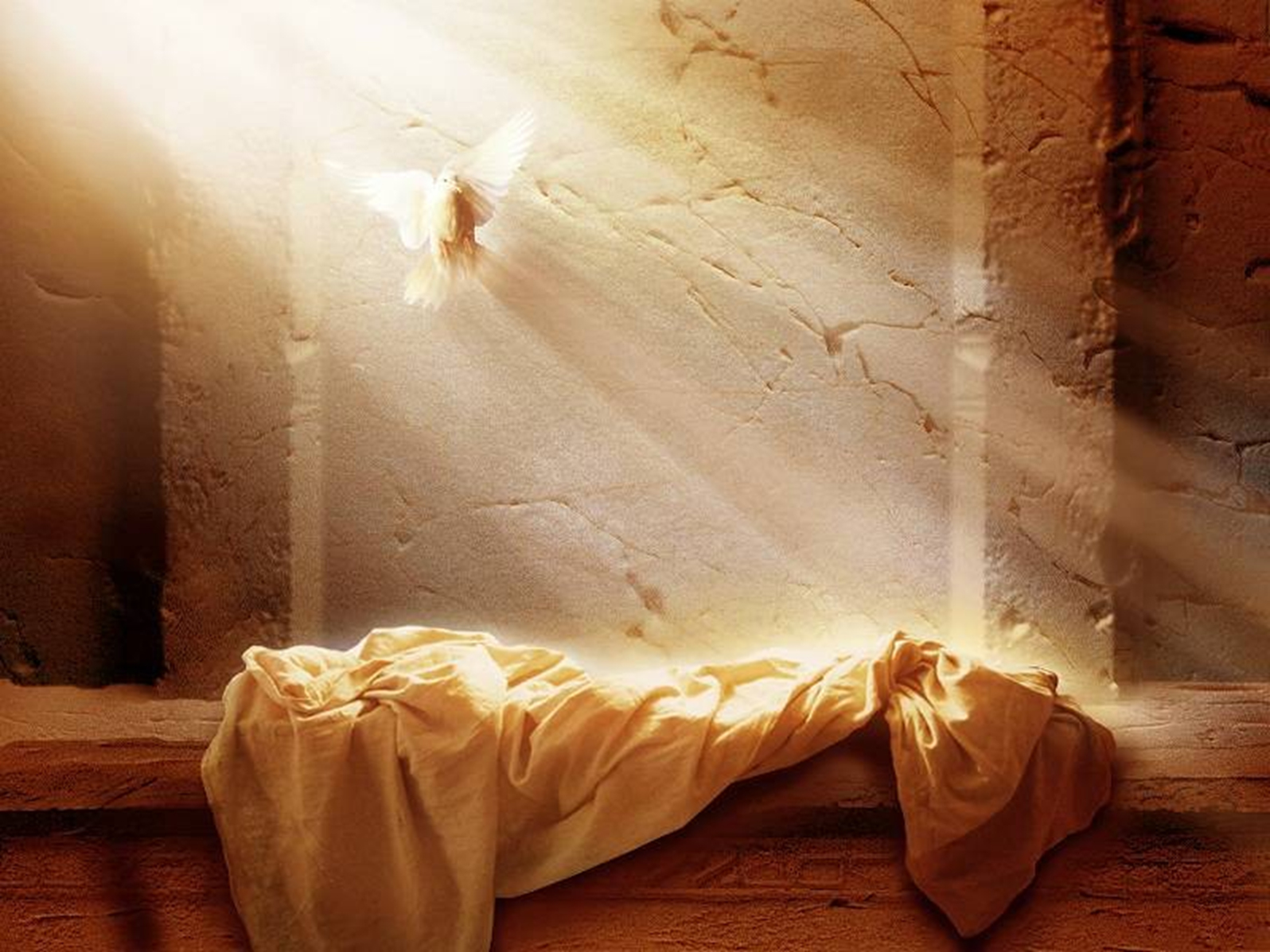
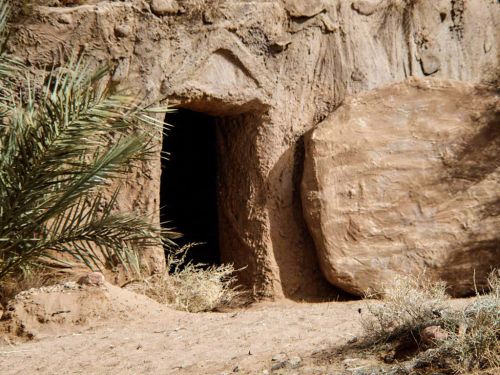
So Jesus came into the world and “dwelt among us”[1] and “increased in wisdom and stature, and in favour with God and man” (Luke 2:52). He grew up like any other Jewish boy and probably learned carpentry from His earthly father, Joseph. At the age of 30,[2] the age at which priests enter service,[3] Jesus started His three-year earthly ministry. We know from the four Gospel accounts that His ministry ended with His death on the cross. He was buried in a borrowed tomb and rose on the third day.

But what if the resurrection never happened? Paul put it quite succinctly when he said, “if Christ be not raised, your faith is vain; ye are yet in your sins” (1 Corinthians 15:17). If Jesus did not rise from the grave, His death for our sins is of no avail. We have no hope of eternal life, and, worse, our destiny is in hell. That explains why unbelievers live for this life alone because, for them, this life is all there is. They reject the concept of hell and prefer the idea that death ends it all, or that it begins a new cycle through reincarnation.

Many arguments against the resurrection of Jesus exist that have a long history from the very beginning. Some say that Jesus did not die on the cross but only “swooned” and revived in the cool dampness of the tomb, rolled the two-ton stone away and walked out. That is a silly theory when one considers the beating, torture, and flogging Jesus received before being nailed to the cross. Also the Roman soldiers who crucified Him were expert executioners and were familiar with death. Had they suspected that He “swooned,” they would have broken His legs like they did with the other two victims.[4] These were professionals; they knew death. Then, to ensure His death, one of the soldiers ran his spear into his side and punctured the pericardium.[5]  

Let us say, for argument’s sake, that this one they failed to recognize and Jesus did indeed pass out. Even if He did revive in the cool tomb, the loss of blood from the beatings and flogging, not to mention the puncturing of his heart sac, would have left Him too weak roll away the heavy stone – one that took several men to move – by Himself.

Another argument suggests that Jesus’ disciples overpowered the Roman guard posted at the tomb.[6] This too is a silly argument. All four Gospels record how the disciples went into hiding at Jesus’ arrest. They feared for their lives. It seems unlikely that these frightened men, most of them fishermen and at least one un-calloused tax collector, would dare to take on battle-hardened professional Roman soldiers. However, this fabrication spread from the very beginning. Matthew records that an angel came to roll back the stone and the soldiers on watch were scared stiff.[7] The soldiers, knowing the consequence (death) for failing in their responsibility to keep the tomb secure, went to the chief priests, rather than their leaders, hoping to get a sympathetic hearing about the empty tomb. They made a good choice as the Jewish religious leaders paid them off and covered for them as long as they would spread the lie that the disciples had stolen the body.[8]

Still another argument insists that the women that went to the tomb on Sunday morning were so grief-stricken that they failed to recognize Jesus’ tomb and went to the wrong sepulcher which was empty. This argument simply rejects what Scripture clearly reports. Three of the four Gospels record that the women witnessed the tomb where Jesus was laid.[9] John, who was present at the crucifixion along with Jesus’ mother and the other women, does not say, but it stands to reason that he would have accompanied them to the tomb.

Jesus rose from the dead. If that were not true, the Jews, because of their hatred for Him, only needed to exhume the body and present it to the world, but they had no body. Men have tried and failed to show Jesus’ remains, but they cannot.

Jesus rose from the dead. He conquered death, and because He conquered death, we have the assurance that our sins are covered and we have eternal life with him. “If in this life only we have hope in Christ, we are of all men most miserable. But now is Christ risen from the dead, and become the firstfruits of them that slept [died]. For since by man came death, by man came also the resurrection of the dead. For as in Adam all die, even so in Christ shall all be made alive” (1 Corinthians 15:19-22, emphasis mine). “For if by one man’s [Adam] offence death reigned by one; much more they which receive abundance of grace and of the gift of righteousness shall reign in life by one, Jesus Christ.) Therefore as by the offence of one [Adam] judgment came upon all men to condemnation; even so by the righteousness of one [Jesus] the free gift came upon all men unto justification of life. For as by one man’s [Adam] disobedience many were made sinners, so by the obedience of one [Jesus] shall many be made righteous” (Romans 5:17-19, emphasis mine).

Because Jesus conquered death, we can have the assurance of eternal life with Him. That is why the resurrection matters. If you are not sure where you stand before Jesus, please read my page on “Securing Eternal Life.”
Notes:


[1]  John 1:14

[2]  Luke 3:23

[3]  Numbers 4:3

[4]  John 19:32-33

[5]  John 19:34

[6]  Matthew 27:65-66

[7]  Matthew 28:2-4

[8]  Matthew 28:11-15

[9]  Matthew 27:61; Mark 15:47; Luke 23:55

Comments Off on Why the Resurrection Matters

Filed under Apologetics, Bible, Christianity, Christmas, Easter, Evangelism, Gospel, Heaven, Hell, Holidays, Religion, Resurrection, Salvation, Theology

Victorious Entrance

And I saw heaven opened, and behold a white horse; and he that sat upon him was called Faithful and True, and in righteousness he doth judge and make war. His eyes were as a flame of fire, and on his head were many crowns; and he had a name written, that no man knew, but he himself. And he was clothed with a vesture dipped in blood: and his name is called The Word of God. And the armies which were in heaven followed him upon white horses, clothed in fine linen, white and clean. And out of his mouth goeth a sharp sword, that with it he should smite the nations: and he shall rule them with a rod of iron: and he treadeth the winepress of the fierceness and wrath of Almighty God. And he hath on his vesture and on his thigh a name written, KING OF KINGS, AND LORD OF LORDS. (Revelation 19:11-16)

This Sunday, March 28, celebrates Palm Sunday when we commemorate Jesus’ entry into Jerusalem in the final week of His earthly ministry. We term this event as the “Triumphal Entry,” but in many respects, the term is a misnomer.

Daniel predicted the event to the very day of its occurrence. “Seventy weeks [70 x 7 years, or 490 years] are determined upon thy people [Israel or the Jews] and upon thy holy city [Jerusalem], to finish the transgression, and to make an end of sins, and to make reconciliation for iniquity, and to bring in everlasting righteousness [beginning with the Millennial reign of Messiah], and to seal up the vision and prophecy, and to anoint the most Holy [Messiah]. Know therefore and understand, that from the going forth of the commandment to restore and to build Jerusalem [decreed by Artaxerxes Longimanus, 444 BC] unto the Messiah the Prince shall be seven weeks [7 x 7 or 49 years], and [plus] threescore and two weeks [62 x 7 or 434 years; 49 + 434 = 483 years]: the street shall be built again, and the wall, even in troublous times. And after threescore and two weeks shall Messiah be cut off, but not for himself: and the people of the prince that shall come shall destroy the city and the sanctuary; and the end thereof shall be with a flood, and unto the end of the war desolations are determined” (Daniel 9:24-26, emphasis mine). Daniel divides the 490 years (70 weeks) into three segments of 49, 434, and 7 years. The first segment began when Artaxerxes Longimanus issued the fourth decree to rebuild Jerusalem with its walls in 444 BC, and ended in 395 BC when the project was completed – 49 years.[1] The next segment encompassed the 400+ “silent years” until Jesus, Messiah, entered into Jerusalem. Four hundred eighty three (483) years were fulfilled at that time and the final segment of seven years remains to be fulfilled. At the end of the 483 years, to the very day, Jesus, Messiah, was “cut off” at the cross.

The prophet, Zechariah, predicted that the Messiah would present Himself riding on a donkey. “Rejoice greatly, O daughter of Zion; shout, O daughter of Jerusalem: behold, thy King cometh unto thee: he is just, and having salvation; lowly, and riding upon an ass, and upon a colt the foal of an ass” (Zechariah 9:9, emphasis mine). All four Gospel writers record this event from their unique perspectives.[2] Most Bibles that use sub-title divisions of chapters title this event as the “Triumphal Entry.” However, Jesus did not enter Jerusalem as conquering king. He presented Himself as the Melek Shâlêm, the King of Peace. A conquering king would have presented himself with great pomp and ceremony,[3] riding on a white charger followed by his conquering armies, parading the spoils of his conquests.

Jesus entered humbly as the King of Peace. His week would end with a tortuous, humiliating death on a Roman cross. From a human perspective, that hardly qualifies as a triumph. However, the following Sunday, the earth shook[4] as Jesus ripped apart the chains of death and conquered man’s final enemy.[5] “O death, where is thy sting? O grave, where is thy victory? The sting of death is sin; and the strength of sin is the law. But thanks be to God, which giveth us the victory through our Lord Jesus Christ” (1 Corinthians 15:55-57). Yet, we still die physically, but our spirit lives on. “We are confident, I say, and willing rather to be absent from the body, and to be present with the Lord” (2 Corinthians 5:8). One day, even physical death will be lost even to the memory. “And death and hell were cast into the lake of fire. This is the second death” (Revelation 20:14). Our present bodies (whether alive or dead) will be transformed into eternal bodies like the body of the resurrected Christ. “Now this I say, brethren, that flesh and blood cannot inherit the kingdom of God; neither doth corruption inherit incorruption. Behold, I shew you a mystery; We shall not all sleep, but we shall all be changed, In a moment, in the twinkling of an eye, at the last trump: for the trumpet shall sound, and the dead shall be raised incorruptible, and we [who are living at the time] shall be changed. For this corruptible must put on incorruption, and this mortal must put on immortality” (1 Corinthians 15:50-53, emphasis mine).

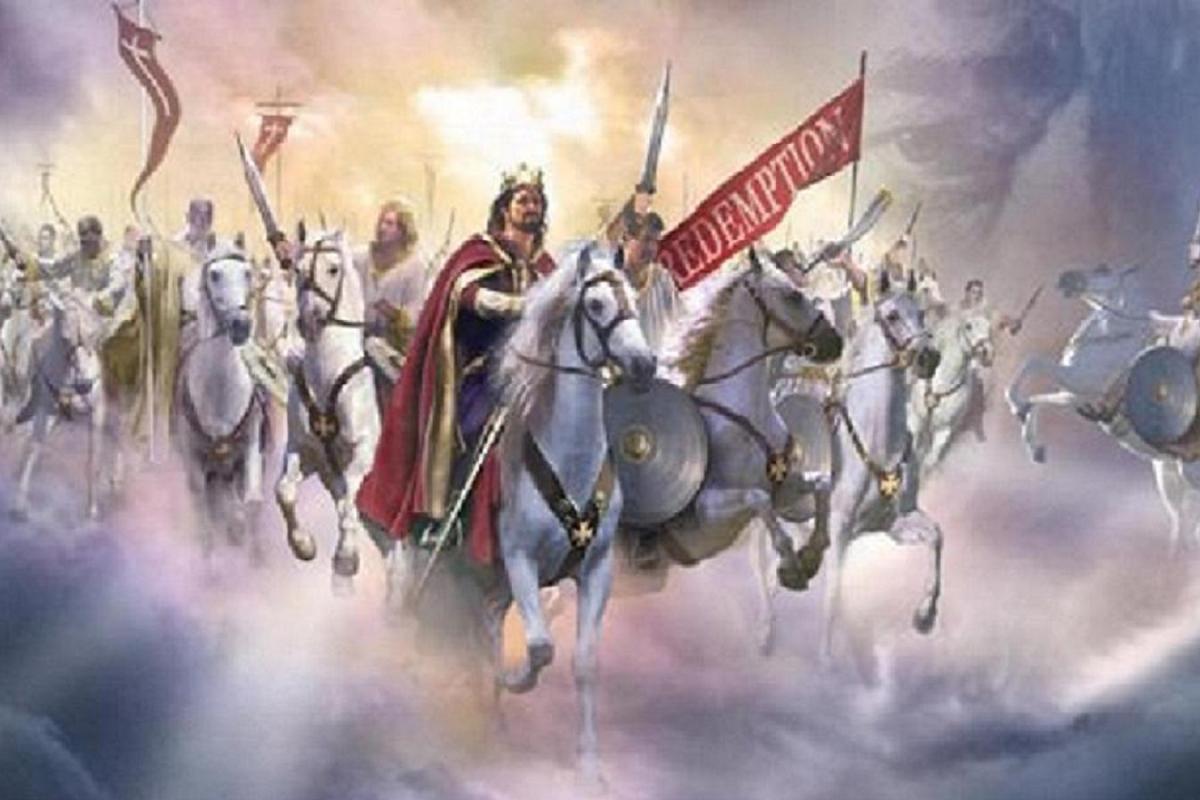
Jesus conquered death at His resurrection, but He has yet to enter Jerusalem in triumph. Our starting verse above, Revelation 19:11-16, describes His real Triumphal Entry. He will enter Jerusalem from His departure point on the Mount of Olives riding on a white horse – not a donkey this time. He will be followed by His heavenly hosts (angelic armies) and by the spoils of His victory, His saints, all riding white horses and dressed in white robes – no weapons in hand. When His foot touches Earth, the Mount of Olives will split in two,[6] half to the north and half to the south. From there He will travel north to the Jezreel Valley, for the Battle of Armageddon. That too is a misnomer, because it will be no battle at all. “And out of his mouth goeth a sharp sword, that with it he should smite the nations: and he shall rule them with a rod of iron: and he treadeth the winepress of the fierceness and wrath of Almighty God” (Revelation 19:15, emphasis mine). That “sword” out of His mouth is His Word. He will speak and the “battle” will be over. “And the LORD shall be king over all the earth: in that day shall there be one LORD, and his name one” (Zechariah 14:9).

Now, that is a Triumphal Entry!

The current events of our world signal that the time of Jesus’ Victorious Entrance is soon approaching. He will come for His Bride, the Church, at any moment; although we do not know when. However, if the signs indicate that His return is near, that means the catching up of His Bride is even closer. Soon after that, Daniel’s final week, the last seven years known as the Tribulation, will begin. Those who are not snatched away by Jesus will remain on earth to suffer through the judgments of God like at no other time in world history. If you are not sure where you stand with Jesus, you can escape that awful time by putting your trust in Him as your Savior. Read my page on “Securing Eternal Life.”

Notes:


[1]  John F Walvoord and Roy B. Zuck, The Bible Knowledge Commentary- Old Testament, (SP Publications, 1985), p.1363.

[2]  Matthew 21:1-11; Mark 11:1-11; Luke 19:28-44; John 12:12-19

[3]  “The Triumphal Entry,” — https://erniecarrasco.com/2019/04/14/the-triumphal-entry/

[4]  Matthew 28:2

[5]  1 Corinthians 15:26

[6]  Zechariah 14:4

Comments Off on Victorious Entrance

Filed under Apologetics, Bible, Christianity, Current Events, Death, Easter, End Times, Evangelism, Gospel, Heaven, Hell, Holidays, Resurrection, Salvation, Second Coming of Christ, Theology

The First Day of the Week

The first day of the week cometh Mary Magdalene early, when it was yet dark, unto the sepulchre, and seeth the stone taken away from the sepulchre. (John 20:1)

The unbelieving Pharisees sought a sign from Jesus proving His credentials. “But he answered and said unto them, An evil and adulterous generation seeketh after a sign; and there shall no sign be given to it, but the sign of the prophet Jonas [Jonah]: For as Jonas was three days and three nights in the whale’s belly; so shall the Son of man be three days and three nights in the heart of the earth” (Matthew 12:39-40).

Most of us know the historical account of Jonah the rebellious prophet of God who ran in the opposite direction of where God had sent him. God has a heart for the lost. The Bible tells us that “The Lord is not slack concerning his promise, as some men count slackness; but is longsuffering to us-ward, not willing that any should perish, but that all should come to repentance” (2 Peter 3:9, emphasis mine). So, God commanded Jonah to go preach to the wicked Assyrians, the mortal enemies of Israel, in Nineveh. These were mean people that tortured and abused their victims harshly. All the neighboring nations feared and hated them, and Israel was next on their menu. Jonah wanted nothing to do with them, and he especially did not want God to bless them in any way. So, rather than obey God’s command, Jonah boarded a ship bound for Spain (Tarshish).

You know the story. God sent a storm that put the ship in danger. Jonah confessed of his rebellion to the crew and they tossed him overboard to appease the Lord, quiet the storm, and calm the sea. The second chapter of Jonah describes the “sign” to which Jesus referred.

God prepared a great fish to swallow up Jonah. Much ink has been spilt in attempt to identify the creature that swallowed Jonah. Some think it could have been something like a whale shark; they certainly are large enough to swallow a man whole. Others propose it was a whale, but a whale is not a “fish” and the Hebrew uses another word for whale, tannı̂yn, which means “sea monster,” or any large sea animal like a dragon or sea serpent. But the Hebrew word used, dâg, means “fish.” If the scholars would just listen to me I can easily resolve the question. The “fish” resembled nothing that we might recognize because the Bible says that God “prepared” this fish specifically for this occasion. The Hebrew word “prepared” is mânâh and it also means “to weigh out; to allot; to appoint.” God designed this fish for an appointment with Jonah.

It is difficult to imagine any man surviving the ordeal of being in the belly of a fish for three days. It seems from Jonah’s prayer that perhaps he actually died. He says, “I cried by reason of mine affliction unto the LORD, and he heard me; out of the belly of hell cried I, and thou heardest my voice” (Jonah 2:2). The Hebrew word translated “hell” here is she’ôl, the “abode of the dead.” It was understood to be the place where the spirits of the dead resided. The Greek word for the same place is hadēs. Jesus referred to this place when He spoke of the rich man who died and went to “hell” (hadēs).[1] Jesus said that when the rich man arrived in this place, “…he lift up his eyes, being in torments, and seeth Abraham afar off, and Lazarus in his bosom. And he cried and said, Father Abraham, have mercy on me, and send Lazarus, that he may dip the tip of his finger in water, and cool my tongue; for I am tormented in this flame” (Luke 16:23-24). Obviously, the man, though he was physically dead, retained all of his senses.

Likewise, Jonah describes his experience in Sheol. He says, “For thou hadst cast me into the deep, in the midst of the seas; and the floods compassed me about: all thy billows and thy waves passed over me. Then I said, I am cast out of thy sight; yet I will look again toward thy holy temple” (Jonah 2:3-4, emphasis mine). Jonah sensed the separation, yet he maintained the hope that one day he would see the “holy temple.”

Jonah prophesied in Israel, the Northern Kingdom, which had no temple. The only Temple resided in Jerusalem, so it seems that Jonah referred to the Holy Temple in heaven of which the earthly Temple was modeled.

Jonah also hints of his death when he says, “I went down to the bottoms of the mountains; the earth with her bars was about me for ever: yet hast thou brought up my life from corruption, O LORD my God” (Jonah 2:6, emphasis mine). The word “corruption” (Hebrew: shachath) can also be translated “destruction.” Jonah continues, “When my soul fainted within me I remembered the LORD: and my prayer came in unto thee, into thine holy temple” (Jonah 2:7). Again, Jonah’s prayer ascended to God’s Holy Temple in heaven.

Jonah died in the belly of the fish, and God revived him after three days and three nights.[2] In like manner, Jesus said He would be in the heart of the earth three days and three nights and rise again.

Jesus died on the cross on Passover. He was our Passover Sacrifice.[3] His death paid the debt of our sins. They buried Him before sundown on Passover and rolled a heavy stone over His tomb. Pilate sealed the tomb with his official seal and posted a Roman guard to watch and ensure that no one tampered with the sepulcher.[4] Then, after three days and three nights in the grave, like Jonah, God raised Jesus from the grave on the first day of the week. Jonah died again eventually, but Jesus lives on. Forty days following His resurrection, Jesus ascended into heaven[5] where He awaits His return to this earth.

The “sign of Jonah” was for the unbelieving Pharisees, who, after His resurrection, continued in their unbelief. The validity of the sign continues even unto our generation. Christ has risen. The tomb is empty. Doubters continue in their rejection hoping that one day someone will find His bones and say, “Here He lies!” But they fail. One day, maybe soon, they will gaze into the sky and behold Him in all His glory “this same Jesus, which is taken up from you into heaven, shall so come in like manner as ye have seen him go into heaven” (Acts 1:11).

Reader, if you are not prepared for that day, please see my page “Securing Eternal Life” before it is too late for you. And as Jesus said, “be not faithless, but believing” (John 20:27).

Notes:


[1]  Luke 16:19-31

[2]  Jonah 1:17

[3]  1 Corinthians 5:7

[4]  Matthew 27:62-66

[5]  Acts 1:3

Comments Off on The First Day of the Week

Filed under Apologetics, Christianity, Easter, Heaven, Hell, Resurrection, Salvation, Second Coming of Christ, Theology

I’m Scared

Yea, though I walk through the valley of the shadow of death, I will fear no evil: for thou art with me; thy rod and thy staff they comfort me. (Psalm 23:4)

I went in search of toilet paper and found all the store shelves empty. I made several trips to different stores and came back empty-handed. The brilliant idea came to me to check Amazon.Com for toilet paper. Amazon.Com has everything, but they too were all out of toilet paper. Throughout my ventures, I found shelves empty of drinking water, disinfectants, hamburger meat, chicken, pork, eggs and other “essentials.” What I found were well-stocked shelves of snacks of all kinds, beer, wine, and soft drinks. In their panic, people are leaving all the non-essentials and hoarding the absolute necessities in preparation for Armageddon!  But that’s not what scares me.

In my visit to my doctors’ offices, I am asked whether I am experiencing fever, aches, and pains, or any kind of flu-like symptoms. I received a message from one of my doctors (I expect to get more) telling me to stay away if I have any flu-like symptoms, have traveled to a Coronavirus[1]-infected country, or have knowingly come in contact with someone who has. But that’s not what scares me.

Everywhere draconian measures have been put in place limiting gatherings of 10 or more people. The government advises citizens to remain in their homes except for essential necessities or health emergencies. Nursing homes are preventing families from visiting residents for fear of spreading infection. But that’s not what scares me.

People everywhere are losing their source of income because their places of employment are closing down. People cannot go out to eat in restaurants anymore because of the aforementioned edicts against gathering in public places. We cannot go to the movies or to the mall. All movement has been restricted. That said, airlines are losing money because no one is traveling and also because most passenger airplanes hold more than ten people. All of this impacts the economy. When people cannot work, they cannot earn money. If they cannot earn money, they cannot buy the things they need, much less the things they want. One thing affects another. It all ties together, and we see the markets plummet. But that’s not what scares me.

I am a student of end-times prophecy. I am not an expert, but I follow many who are. I am attuned not only to the Covid-19-saturated news in our country that largely ignores the rest of the world. I like to pay attention to the happenings in the Middle East, Israel, and the end-time players mentioned in the end-times prophecies recorded in the Bible. The Gog-Magog invasion of Israel mentioned in Ezekiel 38-39 is being staged. The desolation of Damascus mentioned in Isaiah 17:1 is almost complete. The signs Jesus gave in Matthew 24 – wars and rumors of wars, nation against nation (ethnic group against ethnic group), pestilences (like the Wuhan virus), famines, earthquakes in diverse places (we just had one in Utah), etc., are beginning to take place. As He said, “All these are [just] the beginning of sorrows” (Matthew 24:8). “Men’s hearts failing them for fear, and for looking after those things which are coming on the earth: for the powers of heaven shall be shaken” (Luke 21:26). Of course, Jesus’ prediction referred to the “Great Tribulation,”[2] but we see the precursors taking place right now. But that’s not what scares me.

I’m scared for my sons, my daughters-in-law, and my grandchildren who will not listen to my pleas that they turn to Jesus. When Jesus calls me home, they will experience the awful time of Tribulation. If the Tribulation does not change their minds and their hearts, then they face an eternity in hell. They do not like to hear that, and that scares me.

I know many people with whom I have shared the Gospel and they turned a deaf ear to my words. There are many who I do not know that reject the Gospel whether from a loving friend or a preacher on the radio. That scares me.

The end draws near. Jesus may call His church home at any moment. We see the previews of the coming Tribulation, so we know the time is close. I’m scared for all those I love and even those I don’t know who don’t know Christ. What they will face will be far worse than what we are experiencing now. I’m scared for them.

Reader, if you do not know Jesus as your personal Lord and Savior, you need to meet Him now, before you meet Him later. The Bible says that in the end every knee shall bow and every tongue shall confess that Jesus Christ is Lord,[3] but then it will be too late. Invite Jesus to be your Lord and Savior right now. Learn how at “Securing Eternal Life.”

Notes:


[1]  “Wuhan Bug” — https://erniecarrasco.com/2020/03/15/wuhan-bug/

[2]  Matthew 24:21

[3]  Philippians 2:10

4 Comments

Filed under Christianity, Current Events, End Times, Evangelism, Gospel, Hell, Random Musings, Salvation, Second Coming of Christ

A Soul

Behold, all souls are mine; as the soul of the father, so also the soul of the son is mine: the soul that sinneth, it shall die. (Ezekiel 18:4)

What comes to mind when you think of “a soul”? For most of my life, I imagined a soul as some ethereal, intangible, wispy inhabitant of our body that occupied our being that then departed when the physical body died. I suppose most people look at a soul in much the same way. Dictionary.com defines a soul as: (1) the principle of life, feeling, thought, and action in humans, regarded as a distinct entity separate from the body, and commonly held to be separable in existence from the body; the spiritual part of humans as distinct from the physical part; (2) the spiritual part of humans regarded in its moral aspect, or as believed to survive death and be subject to happiness or misery in a life to come; (3) the disembodied spirit of a deceased person; (4) the emotional part of human nature; the seat of the feelings or sentiments; (5) a human being; person (emphasis mine).[1]

That last definition, I think, is the biblical understanding of “a soul.” In the Genesis account of the creation of man, I envision God (Jesus, in His pre-incarnate form) bending over a mass of reddish clay molding the human form. Scripture records, “And the LORD God formed man of the dust of the ground” (Genesis 2:7, emphasis mine). The Hebrew word translated “formed” is yâtsar, and it carries the idea of squeezing something into shape; to mold into the desired shape as a potter molds and forms a clay vessel. The idea goes well considering the construction material used – dust.

With the body plan complete, God, “breathed into his nostrils the breath of life; and man became a living soul” (Genesis 2:7, emphasis mine). The Hebrew words translated “breathed” and “breath” are related. From the English translation, we can see that the former is a verb and the latter is a noun. The Hebrew words are nâphach and neshâmâh respectively and both mean “a puff.” The word “soul” is also related: nephesh. It means “living creature” and it can refer to either a human being or an animal. Yes, as defined here, animals have “souls” (nephesh); however, they do not possess that special neshâmâh of life “puffed” into humans by God.

This puff of life from God caused God’s mud sculpture to rise and become a living soul with a physical body, mind, and neshâmâh (breath/spirit of life). A triune creature created in the image of God[2] hitherto known as “a living soul.” God is triune in nature: Father, Son, and Holy Spirit. Collectively we just say, “God.” Man, made in the image of God, is triune in nature: mind, body, and spirit. Collectively, the Bible refers to the unit as “a soul.”

There are many examples where this becomes obvious, but I will keep the list brief. The first example following the creation account comes when Abraham travels to Egypt and tries to pass off Sarah, his wife, as his sister. He tells Sarah, “Say, I pray thee, thou art my sister: that it may be well with me for thy sake; and my soul shall live because of thee” (Genesis 12:13). “My soul” (nephesh) here does not refer to his “spirit.” Abraham feared for his life – his physical life.

Later, when God confirmed His covenant with Abraham, God required that he and all males within his household be circumcised.[3] Disobedience to this command carried a penalty. “And the uncircumcised man child whose flesh of his foreskin is not circumcised, that soul shall be cut off from his people; he hath broken my covenant” (Genesis 17:14). “That soul” (nephesh) refers to the whole person not just his spirit. Interestingly, in the account of Abraham rescuing his nephew Lot and others, the word nephesh is translated “persons” (Genesis 14:21).

Genesis 27 records the account of Jacob “stealing” his brother’s blessing by deceiving his father, Isaac. In the passage, “my soul” appears twice and “thy soul” shows up two times.[4] The meaning in each case is somewhat ambiguous; however it seems clear that its use refers to the whole person. More examples could be cited in Genesis, but other examples will help solidify my point.

Exodus records that “all the souls that came out of the loins of Jacob were seventy souls” (Exodus 1:5, emphasis mine). Obviously, this refers to people, not disembodied spirits. Then when God called Moses to lead Israel out of Egypt, God assured him that, “all the men are dead which sought thy life” (Exodus 4:19). The Hebrew word translated “thy life” is nephesh (soul). With regard to keeping the Sabbath, God said, “Ye shall keep the sabbath therefore; for it is holy unto you: every one that defileth it shall surely be put to death: for whosoever doeth any work therein, that soul shall be cut off from among his people” (Exodus 31:14, emphasis mine). Again we see that “a soul” is a person.

The book of Leviticus offers many examples where the word “soul” (nephesh) refers to an individual. Here is one example: “if a soul touch any unclean thing … he also shall be unclean, and guilty” (Leviticus 5:2). To touch requires a physical body. Regarding the prohibition against eating blood: “No soul of you shall eat blood, neither shall any stranger that sojourneth among you eat blood” (Leviticus 17:12). Again, it requires a physical body to eat blood.

There are 420 occurrences of the word “soul” in the Old Testament and nearly twice as many occurrences of the Hebrew word nephesh translated in other forms, for example, life, creature, persons, man, mind, et al. In the majority of occurrences, the word refers to the whole person. There is at least one instance in which the word seems to refer to the spirit of one who has died. Of Rachel’s death in childbirth, Scripture records, “And it came to pass, as her soul was in departing, (for she died) that she called his name Benoni: but his father called him Benjamin” (Genesis 35:18). However, we may infer that when the spirit of a person departs from the body, that person is no longer whole, and therefore no longer “a soul.” The “person” is gone; only the shell remains. The soul has departed.

My conclusion is that “a soul” is the entire person: mind, body, and spirit. According to our beginning verse, “the soul that sinneth, it shall die. (Ezekiel 18:4). We all die sooner or later; however, death, in this case, is not merely the cessation of life. This death separates the soul from the Source of Life for eternity. This is the “second death” spoken of in Revelation 20:14-15, “And death and hell were cast into the lake of fire. This is the second death. And whosoever was not found written in the book of life was cast into the lake of fire” (emphasis mine). Jesus warned, “And if thy right eye offend thee, pluck it out, and cast it from thee: for it is profitable for thee that one of thy members should perish, and not that thy whole body should be cast into hell. And if thy right hand offend thee, cut it off, and cast it from thee: for it is profitable for thee that one of thy members should perish, and not that thy whole body should be cast into hell” (Matthew 5:29-30, emphasis mine). The “soul” – the whole person, mind, body and spirit – that sins shall suffer the eternal consequences of “the second death.”

There is no loss of consciousness in the “second death.” That soul is very much alive and aware of his surroundings. Jesus spoke of such a one whose only sin was self-centeredness.[5] Of course, a self-centered person has no need for God, which is ultimately what landed him in hell. “And in hell he lift up his eyes, being in torments, and seeth Abraham afar off, and Lazarus in his bosom” (Luke 16:23, emphasis mine). Because the soul is the whole person, he could feel the flames of hell, and he could see what he had missed. Later on, he has a sense of concern for his five brothers who are still alive, and he requests that Lazarus be sent back to earth to go warn his brothers about this awful place. Hell apparently does nothing to change his self-centered, selfish ways. His concern is only for his brothers and not for the millions of souls in the same condition.

“The soul that sinneth, it shall die” (Ezekiel 18:4) – mind, body and spirit. In what condition is your soul today? If you are breathing, and reading this blog, and you really don’t know, there is hope, and you can settle it right now. Read my page on “Securing Eternal Life.”

Notes:


[1]  “Soul” – https://www.dictionary.com/browse/soul#

[2]  Genesis 1:27

[3]  Genesis 17:1-14

[4]  Genesis 27: 4, 19, 25, 31

[5]  Luke 16:19-31

3 Comments

Filed under Apologetics, Bible, Christianity, Death, Evangelism, Gospel, Heaven, Hell, Origins, Religion, Resurrection, Salvation, Theology