Category Archives: Holy Spirit

Unfounded Assumptions

Sanctify them through thy truth: thy word is truth. (John 17:17)

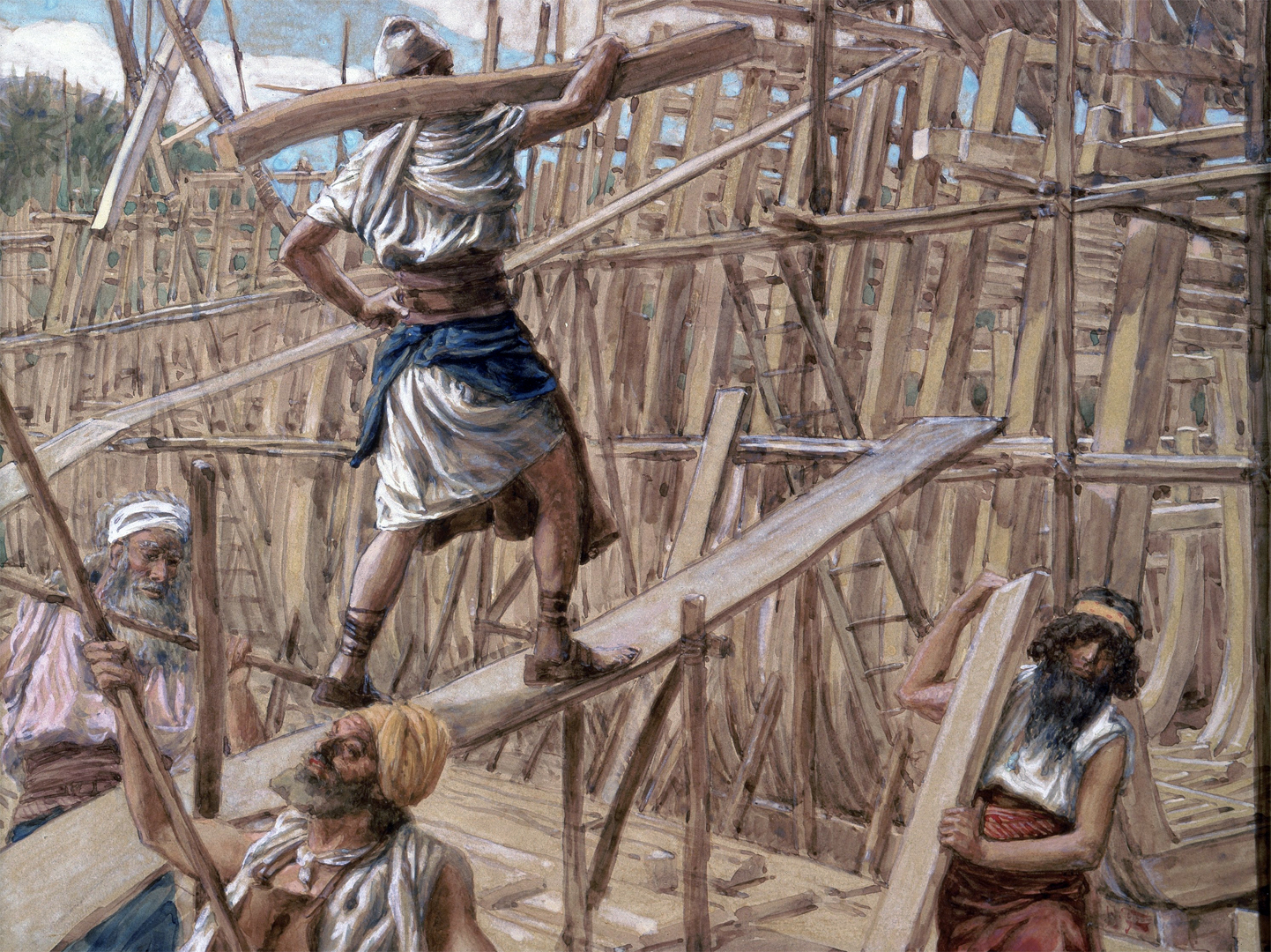
Recently, I watched a podcast that I follow. The podcaster (I’ll call him “Primate,” similar to his actual handle) is a Christian whom I respect for his knowledge of Scripture and end-times prophecy. He is also on top of current events taking place all around the world. In the podcast I watched, he discussed Noah’s Ark, suggesting that Noah could not have built the Ark without a lot of assistance. He correctly pointed out that we are not given precise details in the Bible on what was going in the world when God commissioned Noah to build the Ark. We are only given this: “And it came to pass, when men began to multiply on the face of the earth, and daughters were born unto them, That the sons of God saw the daughters of men that they were fair; and they took them wives of all which they chose … There were giants in the earth in those days; and also after that, when the sons of God came in unto the daughters of men, and they bare children to them, the same became mighty men which were of old, men of renown” (Genesis 6:1-2, 4). Biblical scholars have struggled with that over the years attempting to puzzle out what it really means instead of what it actually says, i.e., “the sons of God” (angelic beings) were messing around with human women and producing some kind of hybrids. However, the lack of detail leaves a lot of room for speculation, which is not usually the best way to study or interpret Scripture. Primate concluded that missing details like that were purposefully left out of the Bible by the compilers of our canon for our benefit, so as not to confuse us or perhaps to keep us from the temptation of experimentation in angelic arts.

Primate proposes that in order to fill in the blanks, we have other extrabiblical sources to clear things up for us, like the books of Enoch, Jubilees, Jasher, etc. I have read some of those books, and while some of their content may be true to some extent (and there is no way for us to know that for certain), I believe the Holy Spirit (the Author of our Bible) gave us all that we need to know in order to have a real and personal relationship with the Creator. The extrabiblical books are certainly interesting; however, they may or may not be factual. In any case, they are superfluous to the Bible alone.

However, that was not my main issue with the podcast. My main objection was to Primate’s comments on Noah, so I offered some alternative thoughts based on my several years of research on this particular topic. One of Primate’s arguments was that there were no trees in the place, supposedly the Middle East, where Noah built the Ark. Of course, he has no basis for that assumption. One must consider that the climate in Noah’s day was not like it is today. Genesis 2:5-6 tells us that it did not rain in those days, “But there went up a mist from the earth, and watered the whole face of the ground.” The fossil record confirms that the pre-flood Earth was tropical everywhere. There is fossil evidence that Antarctica had tropical forests growing.[1] Lush vegetation was everywhere, including in the area of Mesopotamia. Evidence for this are the rich oil fields in the Middle East, which result from the decomposition of plants. That means that Noah did not have to go far to find “gofer wood” to build the Ark. (No one really knows what gofer wood is. It could be some kind of extinct tree, or some think that it could have been a method of cross-laminating timbers to strengthen the hull.)

Primate also suggested that Noah and his sons could not have built the Ark by themselves. He based that idea on the current degraded physical condition of modern humans. We should consider this: God made Adam and Eve perfect human specimens – no physical defects – their DNA was perfect – no mutations, which is why Cain could marry his sister.[2] Even as far as Abraham, the DNA had not degraded enough so that Abraham could marry his half-sister, Sarah. Prohibitions against marriages between close relatives did not come around until Moses and the Law. That suggests that pre-flood people were superhuman, unlike modern mankind. In support of that, consider what Scripture says about Noah. “These are the generations of Noah: Noah was a just man and perfect in his generations, and Noah walked with God” (Genesis 6:9, emphasis mine). “Perfect” translates the Hebrew word “tâmı̂ym” which means “complete, whole, entire, sound.” “Generations” translates the Hebrew “dôr,” which can mean “generation (characterized by quality, condition, class of men).”[3] That suggests that Noah’s lineage had not been contaminated by the activities of the “sons of God.”[4] Primate suggested that because Noah was middle-aged at 500 years+, he could not have done the heavy work required to build the Ark. We should remember that Abraham was still fathering children at 145 years old[5] and Caleb was strong enough at 85 to conquer the hill country of Judah.[6] Primate’s assessment is based on the frailties of modern humans, but that does not apply to pre-flood humans.

Noah was 500 years old when is three sons were born[7] and 600 years old when the flood came[8]. He built the Ark in less than 100 years. John D. Morris, Ph.D., calculated that Noah and his sons could have built the Ark in just 65 years, without any help from angels.[9]

Another mistake people often make is thinking that the Middle East (all the Earth, for that matter) has always looked the same as it does now. Hence, they assume that the Euphrates River described in Genesis 2[10] is the same Euphrates River that we know today. Nothing could be further from the truth when one considers (and most geologists agree) that there used to be one supercontinent, Pangia, that broke up into the seven continents we have today. The Flood changed all of that! So, Earth’s topography was much different pre-flood than post-flood. We cannot assume that things then looked the same as they do today.

I completed the build of a 1:60 scale model of Noah’s Ark in December 2014 and delivered it to the Institute for Creation Research, where it now resides in the Discovery Center. The build took almost five years to complete, which gave me a lot of time to research and think about all that Noah might have included in the Ark. I wrote about that in an article entitled “Building the Ark.” That article covers more detail than what I covered here. It would do good if Christians would be more careful in their reading Scripture and not rely on baseless speculation. “Thy word is truth,” and that is all we need to rely on. Primate and others need to be more careful in how they handle the Word of God. It is sufficient – no need to speculate.

Notes:


[1] “Fossil Trees in Antarctica Preserve Ancient Proteins:” https://www.icr.org/article/fossil-trees-antarctica-preserve-ancient

[2]  Genesis 4:17

[3]  Brown-Driver-Briggs Hebrew Definitions (Published in 1906; public domain).

[4]  Genesis 6:2

[5]  Genesis 25:1-3

[6]  Joshua 14:10-12

[7]  Genesis 5:32

[8]  Genesis 7:6

[9]   “How Could Noah Have Built the Ark All By Himself?” https://www.icr.org/article/how-could-noah-have-built-ark-all-by-himself

[10]  Genesis 2:14

1 Comment

Filed under Apologetics, Bible, Christianity, Creation, Current Events, End Times, Geology, Holy Spirit

More On Election

For I have no pleasure in the death of him that dieth, saith the Lord GOD: wherefore turn yourselves, and live ye. (Ezekiel 18:32)

I could say that I have been a Baptist all of my life having been born on a Sunday morning at 10:00 AM, just in time for Sunday School. However, being a Baptist does not equate to eternal salvation; that happened to me six years later when I listened to and internalized the message that “all have sinned and come short of the glory of God” (Romans 3:23). That being the case, I understood that if my little six-year-old self were to die, I was bound for hell. I also understood that while “the wages of sin is death” (i.e., hell), “the gift of God is eternal life through Jesus Christ our Lord” (Romans 6:23). The only requirement to receive the “gift” was to “confess with thy mouth the Lord Jesus” and “believe in thine heart that God hath raised him from the dead, thou shalt be saved” (Romans 10:9). I was assured that “whosoever shall call upon the name of the Lord shall be saved” (Romans 10:13). I was a “whosoever,” and I had a choice to make. I could confess, believe, and call the name of the Lord and be saved, or continue on in my six-year-old ways and not believe. The choice was mine.

I thank God that His Holy Spirit convicted me of my need to call out to Him to be saved. I did not know then nor since that I was destined from before creation for salvation. That idea has always been foreign to me. I have witnessed to many and led some (I’m sure) to the Lord. In my testimony, I always assured my listener, that the choice was theirs alone.

As I said, I have been a Baptist (of the Southern Baptist variety) all of my life, and a born-again Christian for 68 of those years. In all of that time, the concept of “election” applied to those who were born-again by placing their faith and trust in Jesus Christ as Lord and Savior. I knew of the concept of election, i.e., “predestination” as taught by denominations with Calvinist leanings (like Presbyterians) and some “reformed” denominations, but not Baptists. All Baptists I’ve ever known – and here I am referring to pastors or Bible and theology professors – claimed to be either two or three-point Calvinists, which, when distilled, equate to 4-point Armenian with the exclusion of the possibility of “falling from grace.”

As I noted in my last article, “Chose or Chosen? (Rev. 1),” some Christian brothers believe and teach the concept of election/predestination as taught by Calvinists. They believe that God, before Creation, determined those who would be saved. While they will deny that God has predestined those that remain – the unelected ones – to hell, the outcome is the same, i.e., God predestines some to salvation and others to damnation. Not only is that on its face repugnant in light of a loving God who is “not willing that any should perish, but that all should come to repentance” (2 Peter 3:9), but it has no basis in Scripture.

In my article, I listed more than 80 New Testament verses supporting our free will in choosing to accept God’s free gift of salvation and only 15 verses that seem to support predestination. Of those 15 verses, half of them were speaking of the predestined purpose of those who were elect, i.e., to be conformed to the image of Christ.

The difference in view prompted me to seek answers in my systematic theology textbook.[1]There it became obvious that the early church fathers did not hold the doctrine of election in the sense of predestination. Polycarp and Ignatius, who were disciples of the last Apostle, John, and Irenaeus, a disciple of Polycarp, did not hold the doctrine of election. They taught that Jesus died for the sins of all mankind, however, only those who confess Jesus as Lord and Savior can be saved. Many of the later church fathers held the same view. It was not until a thousand years later (1509), when John Calvin came on the scene, that this doctrine of election/predestination took root. It seems to me that those in closer proximity to the apostles would have the best understanding of the atoning work of Christ than someone coming along a thousand years after.

The answer is clear to me; the Calvinist doctrine is flawed. I would not say these brothers are lost. They still teach that one must confess Jesus as Lord and Savior in order to be saved, and that belief is essential for salvation. They just have the curious idea that they were selected for salvation before time began.

I follow the teachings of a man on YouTube by the name of Ken Johnson, Th.D. He also has a website: BibleFacts.org. Ken has done extensive research on the Dead Sea Scrolls having translated many of them into English. His books are available on his website. Anyhow, as I listened in on one of his teachings dealing with the Essenes, a sect of Judaism that existed at the time of Christ, Ken talked about a group of Egyptian Essenes from which the gnostic doctrine of predestination sprang. Ken wrote a book on the topic, The Gnostic Origins of Calvinism.[2]

I wasted no time ordering and reading through the book (just over 100 pages). I learned that at the time of Jesus, there were actually two groups of Essenes: those who lived in the Qumran and who gave us the Dead Sea Scrolls, and a different group that lived in Egypt. The exact place where this second sect existed is not known for certain, however, it is thought to be at Canopus in Egypt.[3] “These Egyptian Essenes mixed many of the rites of magic and paganism into a Jewish context. Like most who deny the resurrection of the physical body, these Egyptian Essenes ended up believing in reincarnation, evolution, and predestination based on the doctrine of emanations” (emphasis mine).[4] Ken points out that Simon Magus – the Simon of Acts 8:9-24 who wanted to purchase the power of giving the Holy Spirit – according to Irenaeus, was the father of the Gnostic cults.

The Gnostics had many strange beliefs, but among them was the idea of predestination. “Gnosticism taught that there are thirty aeons (gods) that exist in the Pleroma, outside time and space.[5] Sophia, created the demiurge, a creator angel (the God of the Old Testament) who was a tyrant; and being unaware of the aeons, thought he was the only God. He created man; but Sophia gave man a spirit[6] … Gnostics have spirits that are emanations from Sophia. This makes them predestined to be saved. It is imposable [sic] for them to lose their salvation. It does not matter if their behavior is good or evil.”[7]

“The father of church history, Eusebius, mentions John Mark came to Alexandria, Egypt,[8] and established the first church there. As it began to grow, persecutions came and Mark was killed by pagans. Shortly thereafter, some of the Egyptian Essenes mixed strict Christan doctrine with their Jewish/pagan rites. These Gnostics called themselves the Therapeute.”[9] This doctrine of predestination has been around since the founding of the Church, but it was totally rejected by the early church fathers.

Fast forwarding to John Calvin (get Ken Johnson’s book to fill in the blanks), he “used his skill in law to find historical documents that might legally weaken Rome’s hold on the [Catholic] people. He found nothing until he went all the way back to the writings of Augustine. He understood that if he could remove the unpalatable Gnostic doctrines from the writings of Augustine, the Manicheans, and the Valentinian Gnostics, and just use their idea of predestination, it would destroy the Pope’s hold on the people. The Pope of Rome could not send anyone to hell or insure [sic] their salvation if they were already predestined for heaven or hell, especially if that predestination could never be changed. Calvin published his first edition of The Institutes of the Christian Religion  in AD 1536.”[10]

Here are just some quotations from the early church fathers cited by Ken Johnson:

God only blinds the minds of those who chose not to believe and have already rejected Him. In Romans [Chapter 1], those who would not retain God in their knowledge He gave over to a reprobate mine. In 2 Thessalonians [Chapter 2], to those who did not receive the love of the truth, strong delusion is sent to believe the lie. God knows the number of those who will not believe, since He foreknows all things, has given them over to unbelief. – Irenaeus, Against Heresies 4.29 (emphasis mine)

Man has the ability to distinguish good from evil. He has the power by his own free will to perform God’s commandments. This is taught in Romans [Chapter 2]. God does not compel people to salvation, so those who have apostatized have done so through their own fault. God allows them to blind themselves. – Irenaeus, against heresies 4.29 (emphasis mine)

The ability to freely choose salvation is a gift given by God. True faith produces repentance. – Clement of Alexandria, Stromata 2.4

Paul [Romans 3:10-18] refers to those Jews and Gentiles who blind themselves. No one is born this way. – Irenaeus, Against Heresies 1.19 (emphasis mine)

The church is being predestined to be conformed to the image of Christ. – Irenaeus, Against Heresies 4.37 (emphasis mine)

God made man a free agent from the beginning. This is the ancient law of human liberty, for there is no coercion with God. In man, as well as in angels, He has placed the power of choice. The Gnostic teaching that some men are born good and others are born bad is wrong. Everyone has the power to reject the gospel. God has free will and we do, too, because we are made in His image. God preserved the will of man free and under his own control. We will be brought to perfection in the resurrection. Irenaeus, Against Heresies 4.37 (emphasis mine)

Johnson lists many more citations, but these, I think, should suffice to make the point – the early church fathers did not agree with the Calvinist (Gnostic) view of predestination and held to the doctrine that human beings have a free will to choose or reject God’s free gift of salvation. They also taught that Jesus died for the sins of all mankind – past, present, and future – and that His sacrifice is sufficient for all, but efficient only for those who believe.

 As I said in the beginning, I have been a (Southern) Baptist all of my life. Ken pointed something out that may be the reason I am faced with this conflict between election and free will. “The Southern Baptist Convention was originally Calvinist. However, toward the beginning of the twentieth century it became Arminian (not Pelagian) in theology. There is a growing movement inside of the Southern Baptist Convention, however, pushing it to go back to Hyper-Calvinism.”[11] This is probably an overreaction to the growing liberalism within the Convention. Of course, most overreactions to correct one wrong usually move too far in the opposite direction and create a wrong in the other direction. As the old adage says, “Two wrongs don’t make a right.”

Let me reiterate, those who hold this skewed view of election are not lost themselves. They are not heretics.  They are my brothers in Christ. John Calvin was a good, godly man who was battling the heresies of the papacy and the Roman Catholic Church. He was a Reformer. However, neither he nor any other man who followed in his footsteps was or is infallible. Only the Word of God is infallible. As we study the works of any good, godly man, we need to carefully line up their words against the words of Scripture.

In his book, Dr. Ken Johnson provided a short list of high-profile Bible teachers who teach Calvinist doctrine: Alistair Begg, Al Mohler, C.J. Mahaney, J.I. Packer, John MacArthur, Jr., Mark Driscoll, Tim Keller, R.C. Sproul, Sr., Robert Schuller, Wayne Grudem.[12] I would not discourage anyone from reading the teachings of these men. I would only make you aware of their Calvinist leanings and encourage you to measure their teachings by the plumbline of God’s Holy Word.

Notes:


[1]  Gorden R. Lewis and Bruce A Demarest, Integrative Theology, Volume Two, (Zondervan Publishing House, Grand Rapids, 1990), pp. 371-382.

[2]  Ken Johnson, Th.D., The Gnostic Origins of Calvinism,  available on Amazon.

[3]  https://pubmed.ncbi.nlm.nih.gov/12557736/#:~:text=The%20Essenes%20were%2C%20allegedly%2C%20the,Lake%20Mareotis%20they%20were%20settled.

[4]  Johnson, p. 9. Ken’s note on “emanations” – This is the idea that a little piece of God is in each human being. It is found in the Kabbalah but denied by orthodox Jews and Christians.

[5]  Johnson, p. 14, citing Irenaeus, Against Heresies 1.1-3

[6]  Ibid, Against Heresies 1.5

[7]  Johnson, p. 14.

[8]  Alexandria, Egypt is one of the places from which the “older and better” Greek texts from which all modern Bibles are translated. These were Gnostic texts that the early church rejected. They are “older and better” because they were better preserved for their lack of use.

[9]  Johnson, p. 15.

[10]  Ibid, p. 27.

[11]  Ibid, p. 44

[12]  Ibid. p. 44-45

Comments Off on More On Election

Filed under Apologetics, Bible, Book Reviews, Christianity, Gospel, Heaven, Hell, Holy Spirit, Religion, Salvation, Theology

Chose or Chosen? (Rev. 1)

For many are called, but few are chosen. (Matthew 22:14)

Some Christian brothers have strong Calvinist leanings. I accept most of the five points of Calvinism to some degree – Total Depravity, Unconditional Election, Limited Atonement, Irresistible Grace, and Perseverance of the Saints (T.U.L.I.P.) – but I cannot fully embrace U, L, and I. I completely agree with T and P – the Total Depravity of man, and the Perseverance of the Saints, i.e., “once saved, always saved.”

As already noted, the points that give me the most grief are U and L. Unconditional Election says that God predetermined from the beginning of time who would be saved, and by default, who would be damned for eternity. The argument is that God is sovereign, and He can do exactly as He pleases (no argument there). A favorite verse used to make this point is Romans 9:15 “For he saith to Moses, I will have mercy on whom I will have mercy, and I will have compassion on whom I will have compassion.” Here Paul referred to the time when Moses wanted to “see” God’s glory and God responded, “And he said, I will make all my goodness pass before thee, and I will proclaim the name of the LORD before thee; and will be gracious to whom I will be gracious, and will shew mercy on whom I will shew mercy” (Exodus 33:19, emphasis mine). Clearly, God was not speaking in soteriological terms. Indeed, neither was Paul in making the reference to Moses. When taken in context, Paul was referring to God’s sovereignty in determining the course of salvation in general, not in particular.

Limited Atonement builds on Unconditional Election. Limited Atonement says that Jesus died only for those who were unconditionally elected for salvation. That eliminates all the “whosoever” verses beginning with John 3:16 “For God so loved the world, that he gave his only begotten Son, that whosoever believeth in him should not perish, but have everlasting life” (emphasis mine). Since the Bible is always true and does not contradict itself in any way, this verse alone should serve to debunk Limited Atonement.

To a limited degree, I also disagree with Irresistible Grace. That teaches that when the Holy Spirit, Who convicts the individual’s heart of sin (John 16:8) and convinces him of his need for the Savior, calls on the individual’s heart, that call cannot be rejected. The “call” is ubiquitous (Romans 1:20), however, it is felt more strongly in some than it is in others. Thus, it can indeed be resisted, and more resist the call than respond to it (Matthew 7:13-14).

The Bible speaks to both man’s freedom in choosing and God’s work of “election.” I maintain that the answer is “Somewhere in the Middle,” and neither side of the argument can hold his view dogmatically.

The debate continues. I have made my case and the other side made their case. Neither side convinced the other, which is usually the case. However, since this debate keeps coming up, I determined to “Search the Scriptures; for in them ye think ye have eternal life: and they are they which testify of me” (John 5:39). I looked in the New Testament for all the verses I could find related to salvation for the individual. I divided my findings into three categories: (1) Choice/Free Will, (2) Predestination/Election, and (3) verses that can apply to both sides. Here is what I found: for Category 1, there were more than 80 verses; for Category 2, there were 15 verses. Of those, seven, when read in context, suggest that the “predestination” is of “purpose” not of salvation; for Category 3 there were 17. Rather than argue one side or the other, I think it best to allow the Bible to speak for itself, and the reader can decide for himself.

Verses for Category 1: Matthew 7:13-14, 21-24; 10:32-33; 11:28-30; 12:31-32, 50; 16:24-26; 18:3-4, 14; Mark 3:28-29, 35; 8:34-38; 9:37; 10:15; 16:16; Luke 6:47; 9:23-26, 48; 12:8-10; 13:3, 5, 23-24; 17:33; 18:17; John 1:12-13; 3:3, 15-18, 36; 4:14; 5:24; 6:28-29, 35, 40, 45, 47, 51; 10:9-10; 11:25-26; 14:6; 20:29; Acts 2:21, 38; 10:43; Romans 1:16; 3:28; 4:5; 5:6, 8, 12; 10:9-13; 2 Corinthians 5:21; Galatians 1:3-4; 2:16; 3:6-7, 11, 22, 24-27; Ephesians 1:7; 2:4-9; Philippians 2:5-11; Colossians 1:14; 2:13-14; 1 Thessalonians 5:9-10; 1 Timothy 1:15; 2:3-4; 4:10; 2 Timothy 1:9; Titus 2:11; 3:5-7; Hebrews 3:7-8, 15; 7:25; 9:28; 11:6; 1 Peter 2:6; 3:18; 2 Peter 3:9; 1 John 2:2; 5:1, 10-12; Revelation 22:14.

Verses for Category 2: Luke 10:22; John 6:37, 44, 65; 17:24; Romans 8:33;* Ephesians 1:5, 11; 2:10;* Colossians 3:12; 2 Thessalonians 2:13; 2 Timothy 2:10;* Titus 1:1;* 1 Peter 1:2;* 2 John 1:1, 13. The passages marked with an asterisk (*) speak of predestination, but when examined closely, the predestination is a “Predestination of Purpose” not predestination for salvation. In other words, it is the predetermined plan God has for those who are “justified” having placed their faith in the atoning work of Christ on the cross. As I read these passages my conclusion is that those who are “elect” are “elected” by virtue of their faith in Christ for salvation and their “predestination” is to be conformed to the image of Christ.

Verses for Category 3: Matthew 9:13; 10:39; 20:28; 22:14; Luke 5:32; John 7:38-39; 10:27-29; 14:23; Acts 4:12; 15:11; Romans 6:23; 8:1; 2 Corinthians 5:17; Hebrews 4:3; 1 Peter 3:18; 1 John 4:9-10. These verses can apply equally to either Category 1 or 2.

The message of the Gospel is simple. The Lord Jesus Christ left His place in Glory, took on human flesh (John 1:14; Philippians 2:5-11), took the penalty of our sins upon Himself, and shed His own blood on the cross to pay our sin debt. He was buried in a borrowed tomb and rose again on the third day, conquering death and the grave on our behalf to win our salvation (1 Corinthians 15:1-8). He did that for “whosoever” will accept His free, “grace” gift of salvation by faith in His finished work. “For God so loved the world, that he gave his only begotten Son, that whosoever believeth in him should not perish, but have everlasting life” (John 3:16). “Whosoever” accepts His offer by “believing in Him” is “elected” for “everlasting life.” This is the whole message of Christmas.

When one reads the Bible’s plain teaching on the topic of salvation (soteriology), the overwhelming weight of evidence supports the truth that the individual has a choice – to accept or reject – God’s free gift of salvation. So, from where does this doctrine of “election” – that God predetermines who will be saved – come? It does not come from Scripture if one truly believes in “Sola Scriptura.” The question prompted me to blow the dust off of my systematic theology textbook and review the section on soteriology. The authors of my textbook ask, “For whom did Christ die? Did the Father send his [SIC] Son into the world to die for all persons or only for the elect?”[1]

In my reading, I learned that the early church fathers, by and large, did not hold to the doctrine of election, at least not in the way proposed by John Calvin. “The apostolic fathers advanced no single theory of the atonement, but articulated a number of biblical motifs.”[2]

“Irenaeus interpreted Christ’s death as a victory over sin, death and the Devil … Christ conquered Satan, thereby freeing believing (emphasis mine) sinners from his power and giving them eternal life.”[3] Given that believing is a prerequisite for salvation, it makes sense that Jesus died for believers; however, that does not imply election. “Athanasius taught that in order to solve the problem posed by human sin and condemnation God sent the divine Word into the world. In his [SIC] body the Son bore the penalty and paid the debt that sinners owed to God. Thus Christ offered ‘the sacrifice on behalf of all, surrendering his own temple [body] to death in place of all, to settle man’s account with death and free him from the primal transgression’” (emphasis mine).[4]

“Concerning the intent or purpose of the atonement, most patristic authorities held that Christ died for the sins of the world. Athanasius maintained that in the divine scheme of things ‘death there had to be, and death for all, so that the due of all might be paid.’ Cyril of Jerusalem affirmed that ‘Jesus truly suffered for all men.’ While not speaking clearly on the issue, Augustine seemed to suggest that Christ died for the world, although the cross is effectual only for those who believe[5] (emphasis mine).

Later, Anselm of Canterbury (1033-1109) said that “adequate satisfaction [for sin] must come from one who is divine, that is, from God himself [SIC]. On the other hand, satisfaction must be paid by one who genuinely represents humanity … the sinless Jesus Christ voluntarily suffered and died, thereby accruing more merit than needed to pay the debt humanity owed. God accepted the surplus of Christ’s passion, credited it to the account of the sinful race, and thus is disposed to restore fellowship all who trust Christ’s saving provision[6] (emphasis mine). “The English Reformer John Wycliffe also followed the main lines of the Anselmic satisfaction motif.”[7] That further supports the idea that Jesus’ sacrifice on the cross was sufficient for all mankind, but efficient only for those who believe. “Luther taught that Christ in his [SIC] life and death bore the sin, guilt, and punishment of a condemned race … As a result of his [SIC] propitiatory sacrifice, Christ frees trusting souls from the curse of the law; reconciles God and sinners; imparts perfect righteousness; and conquers sin, death and the Devil” (emphasis mine).[8]  

Later came Arminius and Calvin who developed their differing views on the atonement. In opposition to the Calvinist view of Limited Atonement, “Arminian theologians consistently uphold a universal atonement: Christ died for the purpose of providing salvation for the entire world. Thus Arminius succinctly affirmed: ‘Christ died for all men and for every individual.’… The Arminians press their position by asking how persons could be held guilty for refusing to believe what was not intended for them.”[9] In this regard, Arminians hold a more correct view of Christ’s work of atonement in my opinion.   

The authors of my text note that “As for John Calvin, several recent scholars believe that although Calvin held to double predestination he also taught a doctrine of unlimited atonement. In his Institutes Calvin wrote, ‘It is certain that the Lord offers us mercy and the pledge of his [SIC] grace both in his [SIC] Sacred Word and his [SIC] sacraments. But it is understood only by those who take Word and sacraments with sure faith, just as Christ is offered and held forth by the Father to all unto salvation, yet not all acknowledge and receive him.’ [SIC] In his later commentaries, Calvin more clearly postulates an unlimited atonement. With regard to Galatians 5:12 Calvin affirms: ‘God commends to us the salvation of all men without exception, even as Christ suffered for the sins of the whole world’” (emphasis mine).[10] Apparently, John Calvin was not all that “Calvinistic.”

“Scholastic Calvinism, however, narrowed the intent of the atonement and claimed that Christ died solely for the purpose of saving the elect, the exact number of whom are actually brought to salvation. Thus proponents argue that the design of the cross was not merely to provide salvation but to secure the salvation of those persons the Father gave to the Son. Christ allegedly died for all who were related to him [SIC], just as Adam sinned for all who were related to him … God purposed to save some persons and to condemn others, the high Calvinist claims that Christ died solely for those predestined to life”[11]

John Owen, a Puritan held in high regard by many who hold to this view of election, presents what to me is a ridiculous argument for the limited atonement of election. “If Christ dies for all and all are not saved, then Christ died ineffectively, which cannot be. If God loves all and not all are saved, then God loves ineffectually, which also cannot be. Thus Christ did not die for all, and God does not love all people. Says Owen: ‘We deny that all mankind are the object of that love of God which moved him [SIC] to send his [SIC] Son to die.’ God’s love is reflected in his [SIC] will to save the elect the heirs of the covenant of grace, for whose sins Christ made satisfaction on the cross. Owen concludes that if the death of Christ accomplishes all that the Father intended, ‘then died he only for those that are in the event sanctified, purged, redeemed, justified, freed from wrath and death, quickened, saved, etc.’ but that all are not thus sanctified, freed, etc., is most apparent: and, therefore they cannot be said to be the proper object of the death of Christ.’”[12] Owen’s conclusion, I believe, comes not from Scripture, but from his own feeble attempt at logic.

Against Scholastic Calvinism, Moses Amyraut, French theologian, proposed the theory of “hypothetical universalism.” “Amyraut insisted that God willed the salvation of all persons on the condition that they believe … Christ died for all persons sufficiently, but for the elect efficiently. Amyraut’s position was championed by later scholars such as Cameron of the Saumar Academy, Richard Baxter, John Bunyon, Samuel Hipkins, and Heinrich Heppe”[13] (emphasis mine).

I contend that the position of the “hyper-Calvinists” are the ideas of men – albeit well-meaning, godly men – and not necessarily the plain teaching of the Bible. Such a narrow soteriological position cannot be supported by “Sola Scriptura” as I attempted to demonstrate above with my list of biblical references in three categories. I encourage the reader to scrutinize those passages laying aside any preconceived ideas that you have been taught in the past. Allow the Bible to speak for itself without the aid of commentators or scholars of the past. The Word of God is perspicuous and perfectly able to speak for itself without outside influence.

Notes:


[1] Gordon R Lewis and Bruce A Demarest, Integrative Theology, Volume Two, (Zondervan Publishing House, Grand Rapids, Michigan, 1990), p. 372.

[2]  Ibid, p. 378.

[3]  Ibid, p. 373.

[4]  Ibid, p. 379.

[5]  Ibid, p. 380.

[6]  Ibid, p. 375.

[7]  Ibid.

[8]  Ibid, p. 379

[9]  Ibid, p. 376-377.

[10]  Ibid, p. 380.

[11]  Ibid, p. 381.

[12]  Ibid.

[13] Ibid, p.382.

1 Comment

Filed under Apologetics, Bible, Christianity, Evangelism, Gospel, Heaven, Hell, Holy Spirit, Salvation, Theology

The First Sight

Thou art worthy, O Lord, to receive glory and honour and power: for thou hast created all things, and for thy pleasure they are and were created. (Revelation 4:11)


The book of Revelation puzzles many who read it. It seems strange and sometimes bizarre. Many avoid the book because the contents elicit fear about the predictions of things to come. However, the book of Revelation is the only book of the Bible that promises a blessing to those who read, hear, and apply its contents. “Blessed is he that readeth, and they that hear the words of this prophecy, and keep those things which are written therein: for the time is at hand.” (Revelation 1:3).

Revelation opens with the last remaining apostle of Jesus, the Apostle John, “in the Spirit the Lord’s Day.”[1] The Roman government arrested and exiled John to the prison island of Patmos for preaching the disruptive Gospel of Jesus Christ.[2]

The initial recipients of the book were seven churches in Asia Minor: Ephesus, Smyrna, Pergamos, Thyatira, Sardis, Philadelphia, and Laodicea.[3] To these, the risen Christ addresses individual letters.[4] These churches existed in John’s day, but because of the commendations and reproofs Jesus gives to these churches, some have seen in them patterns of each throughout church history.

John then describes his first glimpse of Jesus as though in a vision. This is not the Jesus John remembers during His earthly ministry. This Jesus is awesome to behold. John says, “And I turned to see the voice that spake with me. And being turned, I saw seven golden candlesticks; And in the midst of the seven candlesticks one like unto the Son of man, clothed with a garment down to the foot, and girt about the paps with a golden girdle. His head and his hairs were white like wool, as white as snow; and his eyes were as a flame of fire; And his feet like unto fine brass, as if they burned in a furnace; and his voice as the sound of many waters. And he had in his right hand seven stars: and out of his mouth went a sharp twoedged sword: and his countenance was as the sun shineth in his strength” (Revelation 1:12-16). The dazzling sight caused John to fall at His feet in awestruck fear, but that tender, familiar voice reassured him of the One he loved. “… Fear not; I am the first and the last: I am he that liveth, and was dead; and, behold, I am alive for evermore, Amen; and have the keys of hell and of death” (Revelation 1:17-18).

John saw Jesus in the midst of seven lampstands holding seven stars in His right hand. Jesus explained to him that the seven lampstands represented the seven churches and the seven stars represented the seven angels, i.e., messengers or pastors, of the seven churches.[5] The image reminds us that Jesus dwells among His churches and that He keeps and protects the pastors of His churches in His right hand (a position of power). This should also serve as a warning to pastors. Just as Jesus’ right hand protects His messengers, He also has the power to crush the pastor that fails in his responsibility to Jesus’ Bride, the Church.

As noted earlier, Jesus dictates direct messages to each of the seven churches. Immediately following the last word to the church of Laodicea, John looks up and sees an open door in heaven and hears a sound (Greek: phōnē) like that of a trumpet that said, “Come up hither, and I will shew thee things which must be hereafter. And immediately I was in the spirit: and, behold, a throne was set in heaven, and one sat on the throne” (Revelation 4:1-2, emphasis mine).

Many see the Rapture of the Church in these verses. John is commanded to “come up here” and “immediately” he sees the throne of God for the first time. From this point forward, the Church no longer appears on earth until Christ returns with His saints in Chapter 19.

There are many who teach that the Rapture is not taught in the Bible. They correctly argue that the word “rapture” appears nowhere in the Bible. However, neither do the words bible or trinity, yet no one will argue that these concepts are not taught in the Bible. “Rapture” translates the Greek word harpazō into the Latin raptus meaning “to seize; to catch away or up; to pluck, pull, or take by force”. This is what happened to John. He was on the earth and “immediately” he was caught away into the throne room of God.

Jesus gave us the first promise of the Rapture before going to the cross. He said, “Let not your heart be troubled: ye believe in God, believe also in me. In my Father’s house are many mansions: if it were not so, I would have told you. I go to prepare a place for you. And if I go and prepare a place for you, I will come again, and receive you unto myself; that where I am, there ye may be also” (John 14:1-3, emphasis mine). Paul teaches of the time when the trumpet shall sound and our corrupt bodies will be changed in the twinkling of an eye. The dead in Christ will rise from their graves, and we who are alive will join them to meet Jesus in the air.[6]

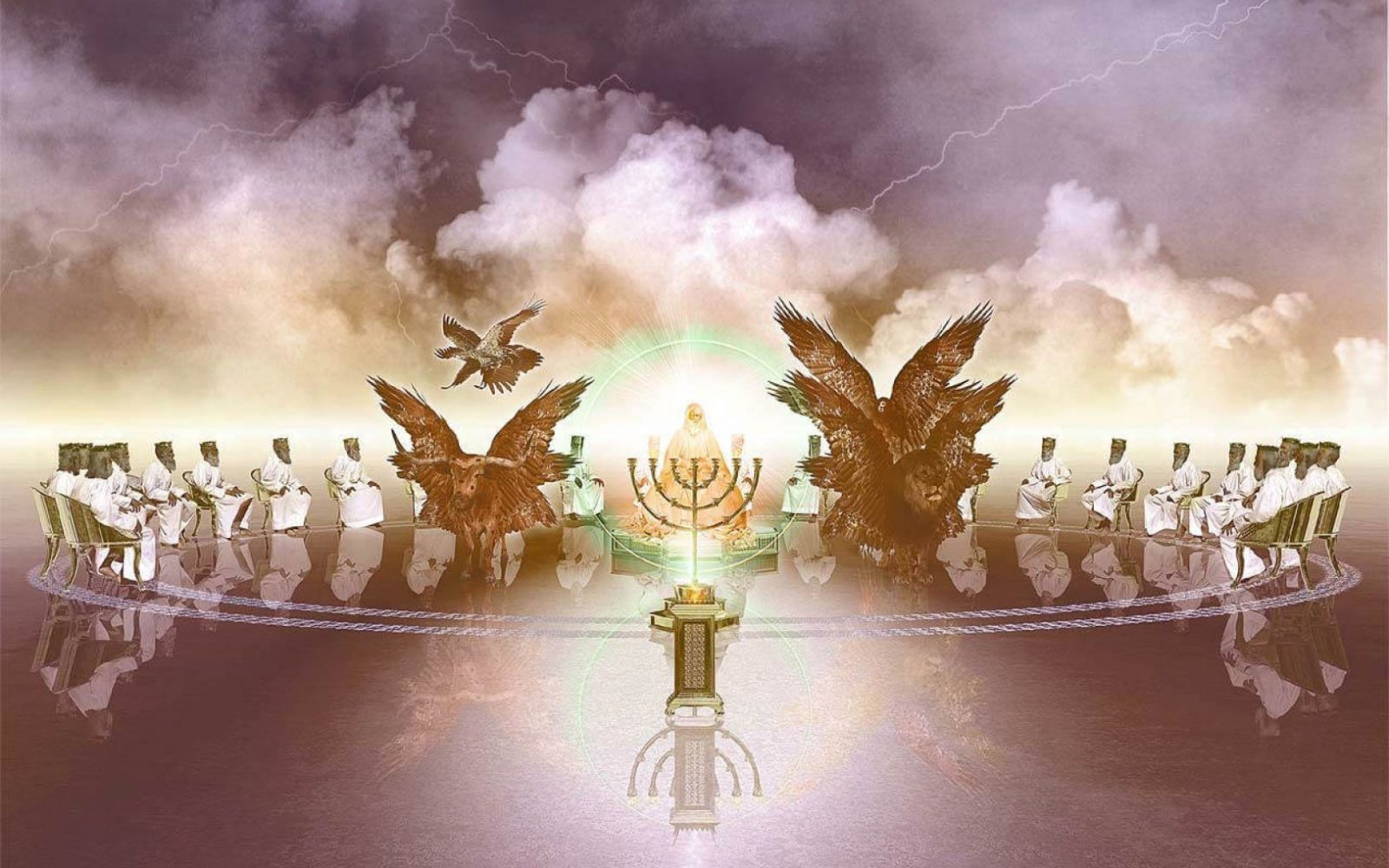
John enters the presence of God and his first sight is the throne of God. The person seated on the throne appears not as a human or any other creature, but rather as a glorious splendor. Of Him, John says, “And he that sat was to look upon like a jasper and a sardine stone: and there was a rainbow round about the throne, in sight like unto an emerald” (Revelation 4:3). The Bible teaches that God has no human form, except in the form of Jesus. Jesus said, “God is a Spirit: and they that worship him must worship him in spirit and in truth” (John 4:24, emphasis mine). John was given a privilege that even Moses (or anyone else for that matter) was denied. Moses, who spoke with God face-to-face as with a friend,[7] wanted to see God in His glory, but God denied his request, “And he said, Thou canst not see my face: for there shall no man see me, and live” (Exodus 33:20, emphasis mine). Yet, somehow John saw God in all of His glory and did not die. In our corrupt human bodies, we cannot withstand the glory of God’s presence. However, at the Rapture, our bodies will be transformed in such a way that we can be in the presence of God in His full glory and not be harmed, just like John.

The scene overwhelmed John. There were lightnings, thunders, and voices. Around the throne of God, John saw 24 thrones upon which seven elders sat wearing white robes and crowns of gold.[8] Some suppose these represent the twelve tribes of Israel and the twelve apostles. Others suggest that they merely represent believers of all the ages. In either case, the white robes represent the righteousness of Christ conferred on them. The golden crowns are stephanos, which are “victors crowns” awarded to them for conquering sin, not through their own righteousness, but through the blood of Christ.

John then sees seven lampstands around the throne defined as the “seven spirits of God” Some suggest that these seven lampstands represent seven attributes of the Holy Spirit as described by the prophet Isaiah. “And the spirit of the LORD shall rest upon him [i.e., Jesus], the spirit of wisdom and understanding, the spirit of counsel and might, the spirit of knowledge and of the fear of the LORD” (Isaiah 11:2, emphasis mine). We know that the Holy Spirit indwells believers and thereby indwells the Church. In the first chapter, John sees Jesus in the midst of seven lampstands, which represent the churches. Now, these same lampstands (i.e., churches) are seen around the throne of God. I see the lampstands representing both the Holy Spirit and the churches wherein the Holy Spirit resides. The attributes described by Isaiah certainly apply as well.

Around the throne is a crystal sea. It is difficult to know what John saw in this. It is all strange and wonderful and beyond words to describe. John could only relate what he saw by his limited earthly vocabulary. But then he sees four strange creatures full of eyes and with six wings each. One “beast” had the head of a lion, the second the head of a calf, the third the head of a man, and the fourth the head of an eagle.[9] The eyes represent the omniscience of God and the four different heads represent all of God’s creatures: wild animals, domestic animals, human beings, and avian life. All of God’s creation never ceasing to praise Him day or night “saying, Holy, holy, holy, Lord God Almighty, which was, and is, and is to come” (Revelation 4:8).

John then observed that when these praised God, the 24 elders prostrate themselves and cast their victor’s crowns before the throne saying, “Thou art worthy, O Lord, to receive glory and honour and power: for thou hast created all things, and for thy pleasure they are and were created” (Revelation 4:11).

With the focus on the throne, John spots something new. “And I saw in the right hand of him that sat on the throne a book written within and on the backside, sealed with seven seals” (Revelation 5:1, emphasis mine). By its description, we know that this “book” is actually a scroll – perhaps parchment – with writing on both sides, rolled up and secured with seven seals. Many suggest that this scroll represents the title dead to the earth and the kingdoms thereof. When God created the earth, He gave dominion over the earth to man whom He created in His image on the sixth day of creation.[10] However, man lost that dominion when he sinned in the Garden of Eden.[11] The dominion of earth transferred to Satan. Paul calls him the “god of this world.”[12] When Satan tempted Jesus, he offered Jesus the kingdoms of this world if He would only bow down and worship him. “And the devil said unto him, All this power will I give thee, and the glory of them: for that is delivered unto me; and to whomsoever I will I give it” (Luke 4:6, emphasis mine). However, his ownership is only temporary.

Then John saw and heard a strong angel proclaim, “Who is worthy to open the book, and to loose the seals thereof?” (Revelation 5:2). And no one in heaven, on earth, or under the earth was found worthy to take the scroll and break the seals. The situation was dire indeed. All of God’s creation hung in the balance and there was no one to come to the rescue. John says, “And I wept much, because no man was found worthy to open and to read the book, neither to look thereon” (Revelation 5:4).

John’s tears were soon assuaged. “And one of the elders saith unto me, Weep not: behold, the Lion of the tribe of Juda, the Root of David, hath prevailed to open the book, and to loose the seven seals thereof,” John says, “And I beheld, and, lo, in the midst of the throne and of the four beasts, and in the midst of the elders, stood a Lamb as it had been slain, having seven horns and seven eyes, which are the seven Spirits of God sent forth into all the earth” (Revelation 5:5-6). John the Baptist saw this Lamb come to him to be baptized in the Jordan and proclaimed, “Behold the Lamb of God, which taketh away the sin of the world” (John 1:29). He was slain on the cross, was buried in a borrowed tomb, and rose again on the third day.[13] Horns represent kingdoms and the Lamb has seven representing completion. All the kingdoms belong to Him. He is “KING OF KINGS, AND LORD OF LORDS” (Revelation 19:16). Seven eyes suggest omniscience with all the attributes of the seven Spirits of God.

Only the Lamb, by virtue of His sacrifice, is worthy to take and open the scroll. “And he came and took the book out of the right hand of him that sat upon the throne” (Revelation 5:7). When the Lamb took the scroll, a great celebration broke out in heaven. The four living creatures and the 24 elders prostrate themselves before the Lamb. “And they sung a new song, saying, Thou art worthy to take the book, and to open the seals thereof: for thou wast slain, and hast redeemed us to God by thy blood out of every kindred, and tongue, and people, and nation; And hast made us unto our God kings and priests: and we shall reign on the earth” (Revelation 5:9-10).

Then the rest of heaven breaks out in praise, “Saying with a loud voice, Worthy is the Lamb that was slain to receive power, and riches, and wisdom, and strength, and honour, and glory, and blessing. And every creature which is in heaven, and on the earth, and under the earth, and such as are in the sea, and all that are in them, heard I saying, Blessing, and honour, and glory, and power, be unto him that sitteth upon the throne, and unto the Lamb for ever and ever” (Revelation 5:12-13).

Worthy indeed! I cannot imagine how John must have felt at the first sight of heaven and the throne of God. I cannot wait to see it for myself!

The 14 chapters that follow bring us back to earth and the events that will transpire during the seven-year Tribulation. The scenes are horrific. However, the Church, the Bride of Christ, will not experience the horrors of the Tribulation. The Church, as we saw will be around the throne of God and not on earth. Will you be there or will you experience the horrors that are coming upon the earth? Your ticket out of here was purchased by Jesus more than 2000 years ago. All you have to do is accept it. Check out my page on “Securing Eternal Life.”

Notes:


[1]  Revelation 1:10

[2]  Revelation 1:9

[3]  Revelation 1:11

[4]  Revelation 2-3

[5]  Revelation 1:20

[6]  1 Corinthians 15:50-53; 1 Thessalonians 4:15-17

[7]  Exodus 33:11

[8]  Revelation 4:4

[9]  Revelation 4:6-8

[10]  Genesis 1:26-28

[11]  Genesis 3

[12]  2 Corinthians 4:4

[13]  1 Corinthians 15:3-4

Comments Off on The First Sight

Filed under Apologetics, Bible, Christianity, End Times, Eschatology, Gospel, Heaven, Holy Spirit, Origins, Rapture, Resurrection, Satan, Second Coming of Christ, Theology, Worship

Tisha B’Av

For the Lord himself shall descend from heaven with a shout, with the voice of the archangel, and with the trump of God: and the dead in Christ shall rise first: Then we which are alive and remain shall be caught up together with them in the clouds, to meet the Lord in the air: and so shall we ever be with the Lord.  (1 Thessalonians 4:16-17)

At the posting of this article, August 6-7, 2022, Jews everywhere solemnly observe Tisha B’Av or the Ninth of Av. Av is the fifth month on the Jewish calendar which begins with the month of Nissan. Christians, for the most part, are ignorant of Jewish observations and feasts; but the same God that gave observations to the Jews is not a God who does things arbitrarily or at random and without purpose, and He does not change. So, even though Christians are under a different “covenant” than the Jews, that does not render these observations meaningless. It behooves Christians to study and understand the Jewish feasts and observances because, while they may not directly apply to us, they have great significance in our understanding of our God.

Tisha B’Av, like Purim and Chanukah, was not given by God as one of His seven Feasts of the Lord.[1] These “observances” were started by the Jews as memorials to God’s intervention in the life of the nation. Purim looks back to God’s salvation of the Jews that were in Babylon from the hand of Haman.[2] Chanukah commemorated the miraculous preservation of the oil in the menorah for eight days at the cleansing of the Temple after it was desecrated by Antiochus Epiphanes.[3]  

Tisha B’Av, however, reminds the Jews of God’s judgments on the nation for one sin or another. These judgments always fell on the Ninth of Av beginning when 10 of the 12 spies sent to spy out the Promised Land returned with a bad report.[4] The website “Rapture Ready” lists 29 judgments against the Jews from Av 9, 1312 BC to Av 9, 2020 AD.[5]

Perhaps the most significant judgments to the Jews were those involving the Temple. The Babylonians razed Solomon’s Temple on Av 9, 586 BC. The Romans destroyed the second temple, Herod’s Temple, on Av 9, 70 AD. Pete Garcia, a graduate of Dallas Theological Seminary, suggests the possibility (not the inevitability) that the Rapture of the Church could take place this year on Tisha B’Av.[6] (I recommend that you read his article in the link provided below. He goes into much greater detail than I plan to go into here.) Pete got his idea from Greg Lauer,[7] another student and teacher of end-times prophecy. (I recommend that you read his lengthy article as well. He goes into great detail to develop his theory and he employs sound logic in doing so. You can find the link to his article in the endnotes below.)

In brief, here is the summary of the idea that the Rapture could take place on Tisha B’Av – perhaps even today, August 7, 2022. By way of disclaimer, allow me to emphasize that neither of these men are setting a date for the Rapture, which “of that day and hour knoweth no man, no, not the angels of heaven, but my Father only” (Matthew 24:36). We cannot know the exact day or the hour; however, we can observe the signs and the season so that we should be ready. Therefore, Jesus said, “Watch therefore, for ye know neither the day nor the hour wherein the Son of man cometh” (Matthew 25:13). How can we watch if we do not know what to watch for?

We already see many of the signs of which Jesus spoke[8] taking place: Israel reborn, wars and rumors of wars, famines, and pestilences, economic collapse, worldwide hatred of Israel, the formulation of the Gog of Magog alliance,[9] [10] etc. These “labor pains” are increasing in number and frequency alerting us to the soon return of Christ as King of Kings and Lord of Lords. However, before that happens, the Church must be removed, and that is where the idea of the Rapture on Tisha B’Av comes to play.

Here is the idea in a nutshell. When Solomon dedicated the first temple, the glory of God filled the Temple to the point that the priests could not minister in the Temple.[11] Several hundred years later, the Prophet Ezekiel records seeing the glory of God depart the Temple.[12] The Babylonians then entered Jerusalem and destroyed the Temple of God on Av 9, 586 BC.

After 70 years of captivity, the Medo-Persian Empire conquered Babylon and Cyrus allowed the Jews to return and rebuild Jerusalem and the Temple. There is no record that this second temple enjoyed the filling by the glory of God. It was not until the time of Christ that the Temple experienced the presence of God in the form of Jesus Christ. Recall how at the cleansing Jesus declared, “My house shall be called the house of prayer; but ye have made it a den of thieves” (Matthew 21:13, emphasis mine). Of course, we know what happened later. The Jews rejected and crucified their Messiah during Passover, 30 AD (or 33 AD, the exact year is debatable). As a result, the Romans destroyed the Temple on Av 9, 70 AD.

The First Temple enjoyed the presence of God the Father. The Second Temple enjoyed the presence of God the Son. There is yet a Third Temple that enjoys the presence of God the Holy Spirit. Where might that Temple be? “Know ye not that ye are the temple of God, and that the Spirit of God dwelleth in you?” (1 Corinthians 3:16). The Holy Spirit resides within believers, the Church, the Bride of Christ. This Temple restrains Satan’s forces on earth and must be removed in order for God’s judgment to come upon the God-rejecting world. “And now ye know what withholdeth that he might be revealed in his time. For the mystery of iniquity doth already work: only he who now [restrains] will [restrain], until he [i.e., the Holy Spirit] be taken out of the way. And then shall that Wicked be revealed, whom the Lord shall consume with the spirit of his mouth, and shall destroy with the brightness of his coming” (2 Thessalonians 2:6-8, emphasis mine). When the Holy Spirit is taken “out of the way,” He will take His Temple with Him. This is what we understand as “the Rapture” of the Church.

So, since God does not do things arbitrarily or at random, it makes sense that the “Third Temple,” belonging to the Holy Spirit should also be removed, like the first two, on Tisha B’Av. If not today, then next year, or the next.

No man knows the day or the hour when Jesus will call His Bride home. As His Bride, we should be prepared daily for Him to call us home. It does not necessarily have to be on Tisha B’Av. It could be on Rosh HaShanah, or perhaps on Pentecost or any day when we least expect it. The point is to be ready and watching daily. We have work to do, and when our Lord calls us home, we want Him to find us working to increase His kingdom.

Are you ready to meet Jesus? If not, please read my page on “Securing Eternal Life.”

Notes:


[1]  “Rosh HaShanah” — https://erniecarrasco.com/2016/10/03/rosh-hashanah/

[2]  Read the book of Esther.

[3]  Read the apocryphal books of the Maccabees.

[4]  Numbers13:25-14:12

[5]  https://www.raptureready.com/2021/07/15/the-ninth-of-av-tisha-bav-by-jeff-van-hatten/

[6]  “This B’Av Rapture?” — https://www.rev310.net/post/tish-b-av-rapture

[7]  “A Pattern with a Hole” — https://www.alittlestrength.com/articles/2022/2206-pattern.htm

[8]  Matthew 24

[9]  Ezekiel 38-39

[10]  “Magog, Tubal, and Persia” — https://erniecarrasco.com/2022/07/24/magog-tubal-and-persia/

[11]  2 Chronicles 5:11-14

[12]  Ezekiel 9:3; 10:18

Comments Off on Tisha B’Av

Filed under Apologetics, Christianity, Current Events, End Times, Eschatology, Feasts of the Lord, Gospel, Holy Spirit, Rapture, Salvation, Satan, Second Coming of Christ, Theology