Precious in the sight of the LORD is the death of his saints. (Psalm 116:15)
I did not know Charlie Kirk outside of his public persona. But one thing I knew about him is that his faith in Christ was real; it was genuine, and it was strong. How could I know that? We both have the same Holy Spirit dwelling in us that enables us to recognize those who are genuinely members of God’s family. Charlie Kirk was my brother.
This past Wednesday, September 10, 2025, I received a post on my Telegram app from Amir Tsarfati (Behold Israel) informing us that Charlie had been shot. That post was quickly followed by a graphic video showing Charlie’s neck being struck by the assassin’s bullet. A crimson fountain burst forth. Charlie slumped back in his chair and fell to the floor. I knew instantly that he would not survive in spite of the following reports saying that he was in critical condition. I knew that despite all the heroic efforts to save his life, he would not survive that shot. The bullet severed his carotid artery and probably his spinal cord. There was no way he could survive that shot. Sadly, I was right.
As I said, I did not know Charlie Kirk personally. He was a distant public figure that I admired for all the things for which he stood. So, I cannot explain the pain in my heart at the loss of this stranger’s life. As I continued to watch news reports (on the Fox News Channel), my throat tightened, my tears flowed, and my heart ached for the loss of this wonderful human being. “Why?” I asked myself. He is nothing to me. But that’s not true. He means a lot to me. He is my brother. He is part of my family – the family of God. That’s why I hurt.
Then the question that comes to all of us at one time or another: why did God allow this to happen to a young man who is arguably a mighty tool in God’s hand for the cause of Christ? Why didn’t God deflect the bullet? He could have. Why did God allow this deranged gunman, Tyler Robinson, to take the life of this young, godly man and leave his beautiful young bride, Erika Kirk, a widow and his two young children fatherless? Why? In times like these, I always lean on my anchor verse: “And we know that all things work together for good to them that love God, to them who are the called according to his purpose” (Romans 8:28). Erika cited that verse also.
What good can come of this senseless murder? Perhaps God is giving us a preview of things to come. Will we go forward with boldness or cower back and deny Christ? Perhaps God gave us an example of a courageous Christian for us to follow. Can we say with the Apostle Paul and with Saint Charlie Kirk, “For I am not ashamed of the gospel of Christ: for it is the power of God unto salvation to everyone that believeth …” (Romans 1:16). We may never know this side of Glory. One thing we can know for certain is that God knows exactly what He is doing, and He has a purpose in all that He does and all that He allows. Nothing catches Him by surprise. We just need to trust Him, as Erika does.
It is Friday night as I write this, and I just finished watching a brokenhearted but courageous young widow give a wonderful tribute to the love of her life, who is in the arms of his Savior, Jesus. You can watch her remarks here.
Reader, if you don’t know Charlie’s Savior, please read my page on Securing Eternal Life.
And fear not them which kill the body, but are not able to kill the soul: but rather fear him which is able to destroy both soul and body in hell. (Matthew 10:28)
Phobos is the Greek word from which we get the English word “phobia.” It means “fear, dread, terror; that which strikes terror.” One who fears enclosed spaces suffers from “claustrophobia.” One who fears spiders experiences “arachnophobia.” There are countless phobias which are “intense, persistent, irrational fear of a specific object, activity, situation, or person that manifests in physical symptoms such as sweating, trembling, rapid heartbeat, or shortness of breath, and that motivates avoidance behavior.”[1] A more current definition of phobia includes “an aversion toward, dislike of, or disrespect for a thing, idea, person, or group.”[2] The latter definition arose from the “woke” need to condemn and shame anyone who finds sinful actions offensive. For example, if one opposes homosexuality on biblical grounds, that person is a “homophobe” even though no irrational fear is involved. If one opposes the illegal invasion of our nation’s southern border by migrants from all over the world, especially those from countries that hate America, that person is deemed a “xenophobe.” Such labels are meant to shame and silence any rational opposition.
Some of these newer phobias will lead to the demise of our nation. However, there is one that is currently spreading like a cancer, and that is the invasion of Islamists from all over the Middle East. At the risk of being labeled an “Islamophobe,” I want to address the very real danger of Muslims and the Islamic invasion. I do not have an “irrational fear” of Muslims; however, I understand the “religion” and its demand that its adherents convert the world to Islam (which means “submission”). Those who will not convert must be put to death. Our news media do not cover it, but when Muslims invade, they kill Jews and Christians by the most horrific methods. I do not fear death (I know what awaits me on the other side), but I am not ignorant of their methods.
Why our media keep silent about these barbaric killings, I do not understand. In Europe – Germany, Great Britain, France, Spain, etc. – Muslims have overtaken large parts of those countries and have instituted Sharia Law in the areas they occupy, demanding that the citizens of those nations submit to their laws. That is coming to America. Dearborn, MI serves as a perfect example where Muslims have taken over to the exclusion of “infidels” – non-Muslims. Now, even in Texas, Muslims are gaining a foothold. In North Texas, just north of Dallas, Muslims plan to build an EPIC (East Plano Islamic Center) City[3] for Muslims only.
So, what is the big deal? Islam is a religion of peace. Right? Yes, it is peaceful if you subjugate yourself to Islam. However, even that is questionable. Right now, in Syria, the Shiite sect of Islam has taken control of that country and is slaughtering Alawites (an offshoot of Sunni Islam), Sunnis, and Druze along with Christians and Jews. In other words, even other sects of Muslims are killed if they do not conform to the dominant sect. This is the mentality of Islamists, and do not think that just because they are here in America, that they will behave differently. Take Europe, for example. Those countries thought the same, and they are living to regret it with rapes and murders perpetrated by Muslims.
I have written several articles on Islam[4] that I would encourage the reader to read. There, I expose the fallacy of the religion. However, I wrote those when I considered Islam just another religion. It is not. Rather, it is an ideology and governmental system disguised as a religion, and its aim is world domination. To achieve their goal, they infiltrate countries and reproduce like rabbits. They keep to themselves and refuse to assimilate into their host country. Once they have established a strong foothold, they become active in government. As they continue to increase in number, they begin demanding “Halal” diets and accommodations to their customs, which include demanding “respect” for their holy days. This is followed by acts of terrorism against the infidels, like driving cars into crowds of innocent people. They have the idea that such acts please their god.
Here is where I will get in trouble for expressing my strong opinion. In America, Islam must be declared a terrorist organization, and all Muslims should be deported back to their countries of origin. “But,” you say, “that violates the First Amendment of the Constitution that guarantees the freedom of religion.” As I have already stated, Islam is an ideology and governmental system in the guise of religion. Furthermore, the law of Islam, “Sharia,” violates the supreme law of our land, the Constitution. For example, Sharia law permits “honor killings.” It also permits polygamy. It allows marriage of grown men with minor girls. It encourages lying in order to gain an advantage over an infidel, therefore, their testimony in a court of law cannot be trusted. These are just some examples. As for the First Amendment, when our founding fathers included freedom of religion as our first right, they were thinking of the Christian religion with all its variants; they were not thinking of pagan religions. However, we do allow pagans to worship freely in our country, but Buddhists, Hare Krishnas, Hindus, Sikhs, etc., will not kill you for not converting to their religion.
So, call me Islamophobic if you want, but I do not have an irrational fear of Muslims. But I do understand their religion, and I know of what they are capable. Islam is demonic and we need to stand firmly against it or it will destroy our nation.
For thou shalt worship no other god: for the LORD, whose name is Jealous, is a jealous God: (Exodus 34:14)
Once again I have taken up the challenge to read through the entire Bible. I am using a chronological reading plan on a new, unmarked Bible. I like the chronological system because it helps me keep the historical events (especially through the historical books) in logical order.
My reading, so far, has taken me into the books of Exodus and Leviticus. The first twenty chapters of Exodus are interesting because they detail how God delivered the children of Israel out of Egyptian captivity with His awesome power demonstrated through miraculous plagues specifically aimed at all the Egyptian gods. The tenth and final plague was the death of the firstborn of all the Egyptians both children and cattle. However, the children of Israel were saved by the faith-act of painting their door frames with the blood of a sacrificial lamb.[1] After that, the Egyptians were more than happy to let God’s people go, and they even sent them away with treasures. By the time the children arrived at the Red Sea, Pharaoh changed his mind and he assembled his army to go after them. Trapped between the sea and Egypt’s army, God parted the waters of the Red Sea for the Israelites to cross over on dry land, while placing Himself as a pillar of fire between the Egyptian army and the children of Israel. Once the Israelites were across, God removed Himself so that Pharaoh’s troops could follow in pursuit. When the Egyptians were all in the middle of the Red Sea, God closed the waters in on them and drowned the entire army.[2]
God provided food and water for His people until they arrived at Mount Sinai. There God gave the Ten Commandments in the hearing of all the people. God’s voice terrified the people, and they begged Moses not to let God speak to them but that he intercede for them.[3] They promised they would do everything that God commanded. Not long after that, Moses went up into the mountain to receive the rest of God’s instructions and commandments. He was up on the mountain for forty days and forty nights, and when he descended, he found the people partying in “worship” to a golden calf they had made.[4]
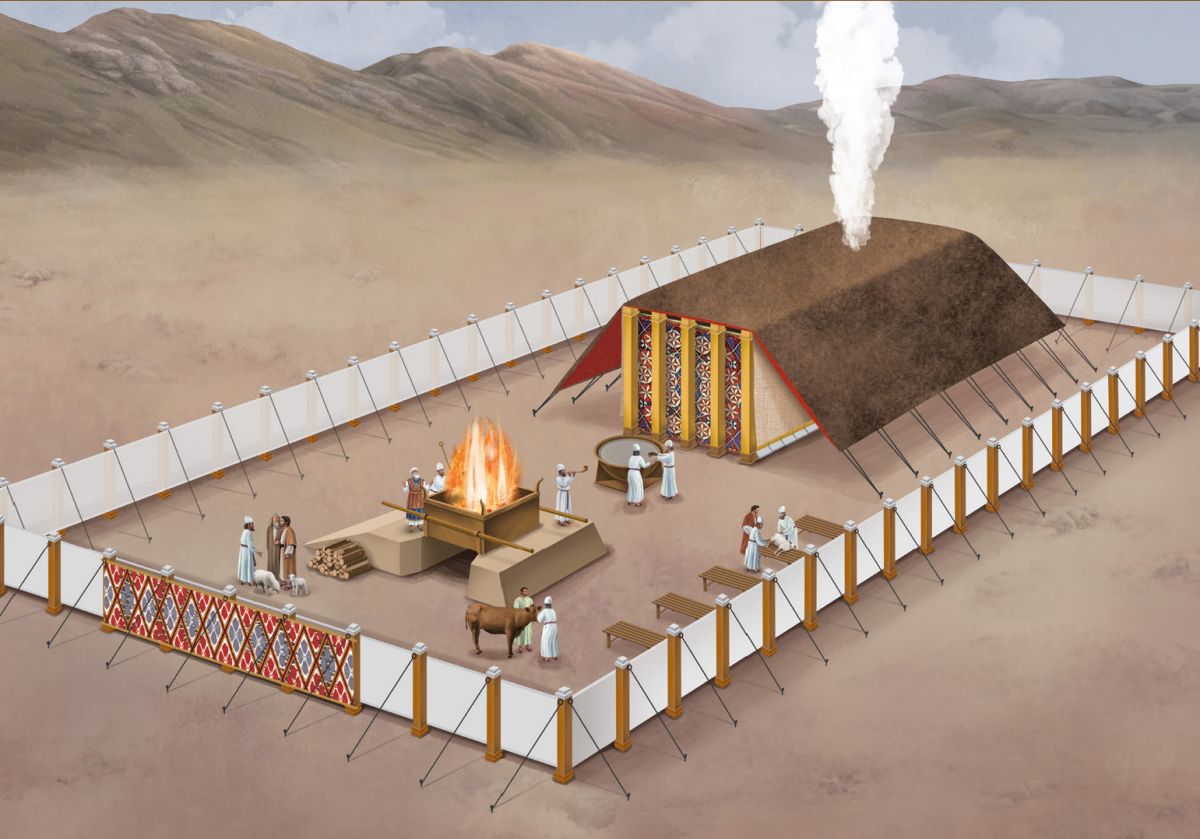
While Moses was up on the mountain, God gave him very specific commandments besides the initial ten. Besides the laws and commandments, God gave very detailed instructions on the construction of the Tabernacle and all implements and furnishings for use in the Tabernacle. These included the golden menorah, the altar of incense, the table of showbread, the Ark of the Covenant, the altar of burnt offering, etc. God specified the materials to be used in making the curtains inside the Tabernacle and the materials to be used in the construction of the outer court, down to how many rings were needed to hang the outer curtain. God gave the dimensions of every single item; no detail is omitted. Then God gave directions for the proper attire for the high priest and the other assistant priests.
The reading becomes very tedious at this point, and it continues on to Leviticus. One might wonder why God includes such minutia in the pages of Scripture. For those of us who are under grace, such detail has little meaning. We have no Tabernacle or Temple as described in which to worship. We do not offer animal sacrifices for every infraction we might commit. Our once-for-all sacrifice was that of Jesus on the cross.[5] We have no need for priests dressed in special apparel to offer sacrifices on our behalf or pray for the forgiveness of our sins. Jesus intercedes for us to the Father in heaven.[6] So, why should God include all those dry details for us to read? I could be wrong, but if you are like me, when you come to these pages, you skip right over them in order to get to the good stuff.
Well, I have not skipped these pages, and I have concluded that the reason God gave us all these minute details is precisely so that we understand that He takes the way we worship very seriously. As a matter of fact, at the end of Leviticus 9 and the beginning of Leviticus 10, He proves just how seriously He takes the way we worship. At this time, the Tabernacle had just been erected, and Aaron and his sons were consecrated as priests to minister before the LORD. They had done everything exactly as God had directed. “And Moses and Aaron went into the tabernacle of the congregation, and came out, and blessed the people: and the glory of the LORD appeared unto all the people. And there came a fire out from before the LORD, and consumed upon the altar the burnt offering and the fat: which when all the people saw, they shouted, and fell on their faces” (Leviticus 9:23-24, emphasis mine). This was God’s way of saying, “Good job!”
That was good, but what came next was shocking. “And Nadab and Abihu, the sons of Aaron, took either of them his censer, and put fire therein, and put incense thereon, and offered strange fire before the LORD, which he commanded them not. And there went out fire from the LORD, and devoured them, and they died before the LORD” (Leviticus 10:1-2, emphasis mine). What! After God gives them an “atta boy,” He kills them for offering “strange fire.” What is all that about?
God had given very specific instructions on the making of the incense which was to be burned on the altar of incense that stood before the holy of holies inside the Tabernacle. That special incense was not to be used for any other purpose. Duplicating the formula for personal use incurred capital punishment. The continuous burning of the incense before the holy of holies (where God’s presence resided) represented the prayers of the people going before the Lord. Furthermore, the incense could only be ignited by coals from the altar of burnt sacrifices that stood outside of the tabernacle. In this case, God had just ignited the burnt offering with His own fire from above.
These two clowns did not think it was such a big deal to get fire from somewhere else. After all, fire is just fire. Right? It was a big deal for God, and He struck them dead on the spot. This is really not much different than Cain’s offering.[7] Cain brought an offering that was not what God required, and God “had not respect” for Cain’s offering.
God takes the way we worship Him seriously. On this side of the cross, we are not obligated to follow any set of rigid “religious” rituals in order to come into the presence of God. However, too often we take our worship of God much too casually. It’s just something we do. It becomes habit; we do it without giving it a second thought. Mostly when we think about “worship,” we think about attending a “worship service” inside a church building. We sing worship songs and listen to a sermon, and then go home to watch a game on TV or go out for lunch.
Actually, worship is so much more than that. The Apostle Paul exhorts us, “I beseech you therefore, brethren, by the mercies of God, that ye present your bodies a living sacrifice, holy, acceptable unto God, which is your reasonable service. And be not conformed to this world: but be ye transformed by the renewing of your mind, that ye may prove what is that good, and acceptable, and perfect, will of God” (Romans 12:1-2, emphasis mine). The way we conduct our lives from day to day, moment by moment is our “reasonable service” (i.e., “logical worship”). How casually do you conduct your life without giving a second thought to how you are presenting your life to God? God may not strike you dead like Nadab and Abihu, but He does take it seriously.
So, how can we be a pleasing sacrifice to God? Well, for the Christian, that is easy because you have a big advantage. “Know ye not that ye are the temple of God, and that the Spirit of God dwelleth in you?” (1 Corinthians 3:16). You have the Spirit of God in you. So, each morning, when you awake, thank the Lord for a new day, and dedicate the day to Him and all that you do, do for His honor and glory. I promise you will falter and stumble, but you will instantly recognize your fault, you will ask forgiveness, and you will continue on. Paul says, “Pray without ceasing” (1 Thessalonians 5:17). Well, if you are down on your knees constantly praying, you would never get anything done! That is not what Paul is intending. What he means is that you need to be in a constant attitude of prayer. Talk to God about everything you are doing or plan on doing. He, because His dwelling place is in you, is your best and constant friend. But don’t take that for granted. He is God and you should never forget that. He takes your worship seriously and so should you.
Reader, if this made little sense to you, it is because, while you may know “about” God, you really do not know God. If you would like to know Him, I would encourage you to read my page on “Securing Eternal Life.”
For I have no pleasure in the death of him that dieth, saith the Lord GOD: wherefore turn yourselves, and live ye. (Ezekiel 18:32)
I could say that I have been a Baptist all of my life having been born on a Sunday morning at 10:00 AM, just in time for Sunday School. However, being a Baptist does not equate to eternal salvation; that happened to me six years later when I listened to and internalized the message that “all have sinned and come short of the glory of God” (Romans 3:23). That being the case, I understood that if my little six-year-old self were to die, I was bound for hell. I also understood that while “the wages of sin is death” (i.e., hell), “the gift of God is eternal life through Jesus Christ our Lord” (Romans 6:23). The only requirement to receive the “gift” was to “confess with thy mouth the Lord Jesus” and “believe in thine heart that God hath raised him from the dead, thou shalt be saved” (Romans 10:9). I was assured that “whosoever shall call upon the name of the Lord shall be saved” (Romans 10:13). I was a “whosoever,” and I had a choice to make. I could confess, believe, and call the name of the Lord and be saved, or continue on in my six-year-old ways and not believe. The choice was mine.
I thank God that His Holy Spirit convicted me of my need to call out to Him to be saved. I did not know then nor since that I was destined from before creation for salvation. That idea has always been foreign to me. I have witnessed to many and led some (I’m sure) to the Lord. In my testimony, I always assured my listener, that the choice was theirs alone.
As I said, I have been a Baptist (of the Southern Baptist variety) all of my life, and a born-again Christian for 68 of those years. In all of that time, the concept of “election” applied to those who were born-again by placing their faith and trust in Jesus Christ as Lord and Savior. I knew of the concept of election, i.e., “predestination” as taught by denominations with Calvinist leanings (like Presbyterians) and some “reformed” denominations, but not Baptists. All Baptists I’ve ever known – and here I am referring to pastors or Bible and theology professors – claimed to be either two or three-point Calvinists, which, when distilled, equate to 4-point Armenian with the exclusion of the possibility of “falling from grace.”
As I noted in my last article, “Chose or Chosen? (Rev. 1),” some Christian brothers believe and teach the concept of election/predestination as taught by Calvinists. They believe that God, before Creation, determined those who would be saved. While they will deny that God has predestined those that remain – the unelected ones – to hell, the outcome is the same, i.e., God predestines some to salvation and others to damnation. Not only is that on its face repugnant in light of a loving God who is “not willing that any should perish, but that all should come to repentance” (2 Peter 3:9), but it has no basis in Scripture.
In my article, I listed more than 80 New Testament verses supporting our free will in choosing to accept God’s free gift of salvation and only 15 verses that seem to support predestination. Of those 15 verses, half of them were speaking of the predestined purpose of those who were elect, i.e., to be conformed to the image of Christ.
The difference in view prompted me to seek answers in my systematic theology textbook.[1]There it became obvious that the early church fathers did not hold the doctrine of election in the sense of predestination. Polycarp and Ignatius, who were disciples of the last Apostle, John, and Irenaeus, a disciple of Polycarp, did not hold the doctrine of election. They taught that Jesus died for the sins of all mankind, however, only those who confess Jesus as Lord and Savior can be saved. Many of the later church fathers held the same view. It was not until a thousand years later (1509), when John Calvin came on the scene, that this doctrine of election/predestination took root. It seems to me that those in closer proximity to the apostles would have the best understanding of the atoning work of Christ than someone coming along a thousand years after.
The answer is clear to me; the Calvinist doctrine is flawed. I would not say these brothers are lost. They still teach that one must confess Jesus as Lord and Savior in order to be saved, and that belief is essential for salvation. They just have the curious idea that they were selected for salvation before time began.
I follow the teachings of a man on YouTube by the name of Ken Johnson, Th.D. He also has a website: BibleFacts.org. Ken has done extensive research on the Dead Sea Scrolls having translated many of them into English. His books are available on his website. Anyhow, as I listened in on one of his teachings dealing with the Essenes, a sect of Judaism that existed at the time of Christ, Ken talked about a group of Egyptian Essenes from which the gnostic doctrine of predestination sprang. Ken wrote a book on the topic, The Gnostic Origins of Calvinism.[2]
I wasted no time ordering and reading through the book (just over 100 pages). I learned that at the time of Jesus, there were actually two groups of Essenes: those who lived in the Qumran and who gave us the Dead Sea Scrolls, and a different group that lived in Egypt. The exact place where this second sect existed is not known for certain, however, it is thought to be at Canopus in Egypt.[3] “These Egyptian Essenes mixed many of the rites of magic and paganism into a Jewish context. Like most who deny the resurrection of the physical body, these Egyptian Essenes ended up believing in reincarnation, evolution, and predestination based on the doctrine of emanations” (emphasis mine).[4] Ken points out that Simon Magus – the Simon of Acts 8:9-24 who wanted to purchase the power of giving the Holy Spirit – according to Irenaeus, was the father of the Gnostic cults.
The Gnostics had many strange beliefs, but among them was the idea of predestination. “Gnosticism taught that there are thirty aeons (gods) that exist in the Pleroma, outside time and space.[5] Sophia, created the demiurge, a creator angel (the God of the Old Testament) who was a tyrant; and being unaware of the aeons, thought he was the only God. He created man; but Sophia gave man a spirit[6] … Gnostics have spirits that are emanations from Sophia. This makes them predestined to be saved. It is imposable [sic] for them to lose their salvation. It does not matter if their behavior is good or evil.”[7]
“The father of church history, Eusebius, mentions John Mark came to Alexandria, Egypt,[8] and established the first church there. As it began to grow, persecutions came and Mark was killed by pagans. Shortly thereafter, some of the Egyptian Essenes mixed strict Christan doctrine with their Jewish/pagan rites. These Gnostics called themselves the Therapeute.”[9] This doctrine of predestination has been around since the founding of the Church, but it was totally rejected by the early church fathers.
Fast forwarding to John Calvin (get Ken Johnson’s book to fill in the blanks), he “used his skill in law to find historical documents that might legally weaken Rome’s hold on the [Catholic] people. He found nothing until he went all the way back to the writings of Augustine. He understood that if he could remove the unpalatable Gnostic doctrines from the writings of Augustine, the Manicheans, and the Valentinian Gnostics, and just use their idea of predestination, it would destroy the Pope’s hold on the people. The Pope of Rome could not send anyone to hell or insure [sic] their salvation if they were already predestined for heaven or hell, especially if that predestination could never be changed. Calvin published his first edition of The Institutes of the Christian Religion in AD 1536.”[10]
Here are just some quotations from the early church fathers cited by Ken Johnson:
God only blinds the minds of those who chose not to believe and have already rejected Him. In Romans [Chapter 1], those who would not retain God in their knowledge He gave over to a reprobate mine. In 2 Thessalonians [Chapter 2], to those who did not receive the love of the truth, strong delusion is sent to believe the lie. God knows the number of those who will not believe, since He foreknows all things, has given them over to unbelief. – Irenaeus, Against Heresies 4.29 (emphasis mine)
Man has the ability to distinguish good from evil. He has the power by his own free will to perform God’s commandments. This is taught in Romans [Chapter 2]. God does not compel people to salvation, so those who have apostatized have done so through their own fault. God allows them to blind themselves. – Irenaeus, against heresies 4.29 (emphasis mine)
The ability to freely choose salvation is a gift given by God. True faith produces repentance. – Clement of Alexandria, Stromata 2.4
Paul [Romans 3:10-18] refers to those Jews and Gentiles who blind themselves. No one is born this way. – Irenaeus, Against Heresies 1.19 (emphasis mine)
The church is being predestined to be conformed to the image of Christ. – Irenaeus, Against Heresies 4.37 (emphasis mine)
God made man a free agent from the beginning. This is the ancient law of human liberty, for there is no coercion with God. In man, as well as in angels, He has placed the power of choice. The Gnostic teaching that some men are born good and others are born bad is wrong. Everyone has the power to reject the gospel. God has free will and we do, too, because we are made in His image. God preserved the will of man free and under his own control. We will be brought to perfection in the resurrection. Irenaeus, Against Heresies 4.37 (emphasis mine)
Johnson lists many more citations, but these, I think, should suffice to make the point – the early church fathers did not agree with the Calvinist (Gnostic) view of predestination and held to the doctrine that human beings have a free will to choose or reject God’s free gift of salvation. They also taught that Jesus died for the sins of all mankind – past, present, and future – and that His sacrifice is sufficient for all, but efficient only for those who believe.
As I said in the beginning, I have been a (Southern) Baptist all of my life. Ken pointed something out that may be the reason I am faced with this conflict between election and free will. “The Southern Baptist Convention was originally Calvinist. However, toward the beginning of the twentieth century it became Arminian (not Pelagian) in theology. There is a growing movement inside of the Southern Baptist Convention, however, pushing it to go back to Hyper-Calvinism.”[11] This is probably an overreaction to the growing liberalism within the Convention. Of course, most overreactions to correct one wrong usually move too far in the opposite direction and create a wrong in the other direction. As the old adage says, “Two wrongs don’t make a right.”
Let me reiterate, those who hold this skewed view of election are not lost themselves. They are not heretics. They are my brothers in Christ. John Calvin was a good, godly man who was battling the heresies of the papacy and the Roman Catholic Church. He was a Reformer. However, neither he nor any other man who followed in his footsteps was or is infallible. Only the Word of God is infallible. As we study the works of any good, godly man, we need to carefully line up their words against the words of Scripture.
In his book, Dr. Ken Johnson provided a short list of high-profile Bible teachers who teach Calvinist doctrine: Alistair Begg, Al Mohler, C.J. Mahaney, J.I. Packer, John MacArthur, Jr., Mark Driscoll, Tim Keller, R.C. Sproul, Sr., Robert Schuller, Wayne Grudem.[12] I would not discourage anyone from reading the teachings of these men. I would only make you aware of their Calvinist leanings and encourage you to measure their teachings by the plumbline of God’s Holy Word.
Notes:
[1] Gorden R. Lewis and Bruce A Demarest, Integrative Theology, Volume Two, (Zondervan Publishing House, Grand Rapids, 1990), pp. 371-382.
[2] Ken Johnson, Th.D., The Gnostic Origins of Calvinism, available on Amazon.
[4] Johnson, p. 9. Ken’s note on “emanations” – This is the idea that a little piece of God is in each human being. It is found in the Kabbalah but denied by orthodox Jews and Christians.
[5] Johnson, p. 14, citing Irenaeus, Against Heresies 1.1-3
[8] Alexandria, Egypt is one of the places from which the “older and better” Greek texts from which all modern Bibles are translated. These were Gnostic texts that the early church rejected. They are “older and better” because they were better preserved for their lack of use.
Lest there should be among you man, or woman, or family, or tribe, whose heart turneth away this day from the LORD our God, to go and serve the gods of these nations … The LORD will not spare him, but then the anger of the LORD and his jealousy shall smoke against that man, … and the LORD shall blot out his name from under heaven. And the LORD shall separate him unto evil out of all the tribes of Israel, according to all the curses of the covenant that are written in this book of the law: (Deuteronomy 29:18-21)
Dan was Jacob’s first son born to him by Bilhah, Rachel’s handmaid.[1] His name means “judge.” He was the fifth of Jacob’s sons. Before Jacob died, he blessed his sons. Of Dan, Israel said. “Dan shall judge his people, as one of the tribes of Israel. Dan shall be a serpent by the way, an adder in the path, that biteth the horse heels, so that his rider shall fall backward” (Genesis 49:16-17). Long after Dan had died and his “tribe” came out of Egypt, Moses declared of the tribe, “And of Dan he said, Dan is a lion’s whelp: he shall leap from Bashan” (Deuteronomy 33:22). “By this probably Moses intended to point out the strength and prowess of this tribe, that it should extend its territories, and live a sort of predatory life.”[2]
Among the tribes of Israel, Dan remains rather unremarkable. When one looks at a map displaying the original land allotments to the various tribes, Dan’s portion was rather small. It was only slightly larger than that allotted to Benjamin which bordered Dan on the east. Its eastern border extended from Kiriath-jearim on the south up to Beth-horon in Ephraim. From there it descended southeast to Gezer (Ephraim) and beyond. Then it turned north to Gath-rimmon to the Me Jarkin River, its northern boundary, and west to the Mediterranean Sea. Turning south along the coast for about 12 miles and then east and south again past Ekron and Timnah back to Kiriath-jearim. From its eastern border to the sea was about 25 miles, and its U-shaped width was about 12-13 miles wide at any point. The tribe of Dan did not have much land, and they were not satisfied with their little portion.
The Book of Joshua records the allocation of land once the land was conquered. “And the seventh lot came out for the tribe of the children of Dan according to their families … And the coast of the children of Dan went out too little for them: therefore the children of Dan went up to fight against Leshem, and took it, and smote it with the edge of the sword, and possessed it, and dwelt therein, and called Leshem, Dan, after the name of Dan their father” (Joshua 19:40, 47, emphasis mine). It seems that this detail was included after the fact (or it was prophetic). The Book of Judges details Dan’s conquest of land beyond their allotted borders.
The account unfolds beginning in Judges 17 after the death of Samson, when a man by the name of Micah, an Ephraimite, makes some idols of silver stolen from his mother. Not long after, he hired a wayward Levite to be his personal priest. “And Micah consecrated the Levite; and the young man became his priest, and was in the house of Micah. Then said Micah, Now know I that the LORD will do me good, seeing I have a Levite to my priest” (Judges 17:12-13). He was wrong about that, of course. It was at this time that the Danites[3] sought more land besides that which was allotted to them. They sent spies north to assess unconquered land to the north. Their route north took them through the land of Ephraim, and they came to Micah’s house which was on their way. There they saw Micah’s idols and his “priest.”[4]
The Danite spies accomplished their mission and brought back a positive report. “And they came unto their brethren to Zorah and Eshtaol: and their brethren said unto them, What say ye? And they said, Arise, that we may go up against them: for we have seen the land, and, behold, it is very good: and are ye still? be not slothful to go, and to enter to possess the land” (Judges 18:8-9). So the Danites mustered up a large army and headed north. Along the way, they stopped off at Micah’s house and took his idols and his priest. They convinced the Levite to go with them and be their priest – a job promotion. “And they said unto him, Hold thy peace, lay thine hand upon thy mouth, and go with us, and be to us a father and a priest: is it better for thee to be a priest unto the house of one man, or that thou be a priest unto a tribe and a family in Israel? And the priest’s heart was glad, and he took the ephod,[5] and the teraphim, and the graven image, and went in the midst of the people” (Judges 18:19-20).
So, the Danites took the idols and the “priest,” and after they conquered the land, they set up their own religion. They built a new city in the conquered land and named it after their patriarch, Dan. “And the children of Dan set up the graven image: and Jonathan, the son of Gershom, the son of Manasseh, he and his sons were priests to the tribe of Dan until the day of the captivity of the land.[6] And they set them up Micah’s graven image, which he made, all the time that the house of God was in Shiloh” (Judges 18:30-31, emphasis mine).
The story does not end there. At the end of the book (i.e., the Bible), the list of the tribes of Israel excludes Dan and Ephraim.[7] Granted, Israel, especially the northern kingdom, continually had problems with idolatry. However, there was always a faithful remnant. Not so with Ephraim and Dan. These two tribes were the first to wholeheartedly embrace it. Later, in the reign of Rehoboam, the northern ten tribes of Israel split off and formed their own kingdom under the reign of Jeroboam.[8] In order to prevent his subjects from going to Jerusalem to worship at the Temple, Jeroboam had two golden calves made and placed one in Bethel (in Ephraim) and the other in Dan,[9] and they were only too happy to take them. I cannot say with complete certainty, but their absence in the Revelation list seems to result from the warning God gave in our beginning passage above (Deuteronomy 29:18-21).
Neither Dan nor Ephraim are included in the list of the 144,000 witnesses, 12,000 from each of the 12 tribes of Israel.[10] This, of course, takes place during the seven-year Tribulation. However, it appears that they are restored during the Millennial Reign of Christ after the Tribulation. The Prophet Ezekiel describes the Temple that will exist during the Millennium.[11] Following that, he describes the division of the land of Israel at that time.[12] Remarkably, the first tribe listed is Dan. “Now these are the names of the tribes. From the north end to the coast of the way of Hethlon, as one goeth to Hamath, Hazarenan, the border of Damascus northward, to the coast of Hamath; for these are his sides east and west; a portion for Dan” (Ezekiel 48:1, emphasis mine).
Does this mean there is a contradiction in the Bible? Certainly not! God, speaking through the Prophet Ezekiel said, “For thus saith the Lord GOD; I will even deal with thee as thou hast done, which hast despised the oath in breaking the covenant. Nevertheless I will remember my covenant with thee in the days of thy youth, and I will establish unto thee an everlasting covenant” (Ezekiel 16:59-60, emphasis mine). God later responds to a rhetorical question. “Yet say ye, Why? doth not the son bear the iniquity of the father? When the son hath done that which is lawful and right, and hath kept all my statutes, and hath done them, he shall surely live. The soul that sinneth, it shall die. The son shall not bear the iniquity of the father, neither shall the father bear the iniquity of the son: the righteousness of the righteous shall be upon him, and the wickedness of the wicked shall be upon him” (Ezekiel 18:19-20, emphasis mine). God made an unconditional promise to Abraham,[13] and He will keep it. Although Dan and Ephraim sinned and lost the privilege of being represented among the 144,000 witnesses in Revelation, God remains faithful to His promise and Abraham’s descendants will inherit all of the land that He promised to Abraham.
Some may question the veracity of that statement. After all, the Jews, for the most part, have rejected Jesus as their Messiah. It is only through faith in Him that one can inherit eternal life (John 14:6). However, there are many Jews currently coming to Christ now, and when He returns, the Bible says that many Jews at that time will be saved in the same way. “And I will pour upon the house of David, and upon the inhabitants of Jerusalem, the spirit of grace and of supplications: and they shall look upon me whom they have pierced, and they shall mourn for him, as one mourneth for his only son, and shall be in bitterness for him, as one that is in bitterness for his firstborn” (Zechariah 12:10, emphasis mine). Notice that the same grace we receive when we place our trust in Christ will also be given to them at that time. As Christ returns in the clouds, they will recognize “Me” (God is speaking) and they will mourn for “Him” (speaking of Christ). They will recognize Him for Who He is and be saved.
The Prophet Amos uttered another prophecy regarding the restoration of the land to Israel. God says, “And I will bring again the captivity of my people of Israel, and they shall build the waste cities, and inhabit them; and they shall plant vineyards, and drink the wine thereof; they shall also make gardens, and eat the fruit of them. And I will plant them upon their land, and they shall no more be pulled up out of their land which I have given them, saith the LORD thy God” (Amos 9:14-15, emphasis mine). Of course, there are many other places where God reaffirms this promise, and we have witnessed in our present day the partial fulfillment of this promise. The Jews are back in their land, and God promises that they will never be removed again. Now, they do not yet possess all of the land God promised to Israel, but they will in the Millennium, and that includes Dan and Ephraim.
We can learn from this that God will keep all of His promises to us no matter how undeserving we may be. Israel has never been deserving. Dan and Ephraim were undeserving. Yet God remains faithful even when we are unfaithful. “For all have sinned, and come short of the glory of God … For the wages of sin is death; but the gift of God is eternal life through Jesus Christ our Lord” (Romans 3:23; 6:23). Neither we nor Israel deserve God’s grace. Aren’t we grateful that He is faithful even when we are unfaithful!
If you have not experienced God’s grace and His faithfulness, take time to read my page on “Securing Eternal Life.”