
Category Archives: Religion

Articles that deal with religions other than orthodox Christianity.

Trading Old For New

Replica of the Arch to the entrance to the temple of Baal erected in Washington DC

For God hath not called us unto uncleanness, but unto holiness. He therefore that despiseth, despiseth not man, but God, who hath also given unto us his holy Spirit. (1 Thessalonians 4:7-8)

Things get old and lose the attraction we once held for them. Certainly, this is obvious with material things like cars, houses, stuff that goes in houses, jewelry, gadgets, etc. There are few things more exciting than getting a new car – the new-car smell, the sparkling paint, the way that it handles on the road. After a few years, though, the interior smells of stale hamburgers, wet dog or baby vomit. The shine fades and obscures the dings, dents, and scratches from parking too close to the entrance at Walmart. Driving then becomes just a thing you do to get from here to there. That car we fell in love with is just a thing now, and we take it pretty much for granted.

We do the same with traditions and relationships. It is bad enough when we take human traditions and relationships for granted, but it is worse when we treat God and the things of God the same way. We find a good example of this in the account of Ahaz, king of Judah.

No doubt Ahaz was brought up in the traditions and ways of God. He came from good stock, beginning with King David. His father Jotham, his grandfather, Azariah (a.k.a. Uzziah), great-grandfather Amaziah, and great-great-grandfather Jehoash (a.k.a. Joash) were all “good” kings and “did that which was right in the sight of the LORD.”[1] However, even though these kings faithfully obeyed God for themselves, they failed to lead the nation in that regard by not removing “the high places” where the people followed pagan practices. By allowing idolatry to continue, rather than stoning idolaters to death,[2] God’s commandments were largely ignored or followed only by rote. The recommended capital punishment for idolatry may seem extreme to our liberal ears, but God’s reasoning is impeccable. “And all Israel shall hear, and fear, and shall do no more any such wickedness as this is among you” (Deuteronomy 13:11).

So, even though Ahaz had good, Godly fathers, what he observed around him caused him to regard the things of God of little value. Perhaps the pagan practices he observed looked like a lot more fun. He could enjoy all the sex he wanted, and if his promiscuous acts produced offspring, he could sacrifice those to Molech[3] – all the fun and none of the responsibility! (Sound familiar?)

During his short reign of 16 years,[4] the Assyrian Empire was rising up. At that time, Pekah, king of Israel, and Rezin, king of Syria joined forces to come against Jerusalem,[5] but they could not overcome the fortified city. Ahaz needed help, so rather than turning to God, he sought help from Tiglath-pileser, king of Assyria. In order to buy the help, Ahaz robbed the treasures of the Temple of God (which had been robbed in the past beginning with Rehoboam.[6]). When one reads the spare-no-expense details of the building of Solomon’s Temple, it is sad to think of what had become of the once “wonder of the world.” Now, it was just a rundown building useful only for buying alliances. It was of little value to Ahaz, and the LORD God was not better than any other god in Ahaz’s eyes.

After Tiglath-pileser defeated Rezin, king of Syria, and carried off all the Syrians, Ahaz paid a visit to Damascus, the capital of Syria. There he saw the temple of Baalshamin (Baal), and he was deeply impressed by the altar to Baal. Not having a cell phone with a camera, he sketched a drawing of the altar along with the exact dimensions and sent them to the Urijah the high priest with orders to build a replica in the Temple in Jerusalem.

When Ahaz returned from Damascus, he instructed Urijal to move the original brazen altar built by Solomon to the north side of the Temple. In its place on the east side before the entrance to the Temple, Ahaz erected the Baal altar and offered sacrifices to God on a pagan altar.[7] The brazen “sea” (it was a mikvah for the priests) that rested on the backs of twelve brass oxen was removed.[8] Ahaz was trading the old for the new. More than that, Ahaz erected other altars to pagan gods around the Temple. In his estimation, this new way of worship exceeded the way that had been around for hundreds of years.

Many churches these days follow Ahaz’s example. Oh, they don’t build altars to pagan gods. However, perhaps in some ways they do. Some “worship services” seem more like rock concerts. The house lights are dimmed while the “altar” is ablaze with stage lighting, spotlights, and strobe lights. As the “worship team” rocks out their worship tunes, the congregation stands with arms waving in the air swaying as if in a trance. This is new! The old way of singing hymns out hymn books accompanied by piano and organ is too old-school. We need something new and “vibrant” so that young people can “experience” worship. Too many sermons from such pulpits are designed to make the congregants “feel” encouraged. No need to talk about sin and hell, much less warn about Christ’s soon return. Talk like that might turn people off, and they might not come back, or worse, they may stop contributing to the church. Such churches sacrifice the Gospel (old) for the audience (new). The Laodicean Church[9] flourishes in our day.

Ahaz’s reign only lasted 16 years. His son Hezekiah, a “good” king, restored the Temple[10] and the Temple sacrifice. However, the Scripture does not record whether the altar Ahaz built was dismantled or not. We can assume that it was. We can be sure that sacrifices offered on a pagan altar would be unacceptable to God. Scripture notes that following the first Passover celebration in the restored Temple that “Then the priests the Levites arose and blessed the people: and their voice was heard, and their prayer came up to [God’s] holy dwelling place, even unto heaven” (2 Chronicles 30:27). That tells me the sacrifices were done properly and on the proper altar, the old fashioned way. Hezekiah did the opposite of his father; he traded the new for the old, and that pleased God.

I can only hope that we could learn that lesson before God “smites” our nation. Perhaps the smiting has begun. When governors boast that “we” have beaten this pandemic and chide that God had nothing to do with it, we may be beyond help. I hope not, but either way, my hope is in Christ. How about you?

Notes:


[1]  2 Kings 12:2; 14:3; 15:3,34

[2]  Deuteronomy 13:6-11

[3]  2 Kings 16:3

[4]  2 Kings 16:2

[5]  2 Kings 16:5

[6]  1 Kings 14:25-27

[7]  2 Kings 16:14-15

[8]  2 Kings 16:17

[9]  Revelation 3:14-22

[10]  2 Chronicles 29

Comments Off on Trading Old For New

Filed under Bible, Christianity, Current Events, Religion, Worship

A King In Israel

Rejoice greatly, O daughter of Zion; shout, O daughter of Jerusalem: behold, thy King cometh unto thee: he is just, and having salvation; lowly, and riding upon an ass, and upon a colt the foal of an ass. (Zechariah 9:9)

In my last article, I recounted the early history of Israel.[1] The period of the Judges lasted between 450 and 500 years (my estimation). The Book of Judges ends with this sad assessment: “In those days there was no king in Israel: every man did that which was right in his own eyes” (Judges 21:25). Israel finally got a king to rule over them. By popular consent, God allowed them to choose a king for themselves, Saul, a Benjamite.[2] But Saul was not the king God had in mind for them. From the time Israel entered Egypt and prior to their enslavement, God had already determined that the king would come from the tribe of Judah.[3] This king’s reign would be eternal. “The sceptre shall not depart from Judah, nor a lawgiver from between his feet, until Shiloh come; and unto him shall the gathering of the people be” (Genesis 49:10).

Saul was a miserable failure as king. Only two years into his reign, he disobeyed God by doing things his own way rather than waiting on God’s direction. God took the kingdom away from Saul, “For rebellion is as the sin of witchcraft, and stubbornness is as iniquity and idolatry. Because thou hast rejected the word of the LORD, he hath also rejected thee from being king” (1 Samuel 15:23).

Not long after, Samuel the prophet anointed God’s choice for Israel’s king, a young shepherd boy, a young man of the tribe of Judah and resident of Bethlehem, David, the son of Jesse.[4] During David’s reign, Israel followed the Lord and the Lord helped David conquer most of the land God had promised to Israel. After 40 years on the throne, David’s son Solomon became king, and the spiritual state of the nation slowly started to degenerate again, in part due to the king’s own practice of marrying pagan women and bringing their pagan worship into the land and even participating in their practices himself.[5] It is said of Solomon that he was the wisest man alive, but his behavior brings that into question. However, toward the end of his life, he finally did wise up. He wrote, “Vanity of vanities, saith the preacher; all is vanity … Let us hear the conclusion of the whole matter: Fear God, and keep his commandments: for this is the whole duty of man. For God shall bring every work into judgment, with every secret thing, whether it be good, or whether it be evil” (Ecclesiastes 12:8, 13-14).

Regardless, the damage was done. The leaven already permeated the loaf. Solomon’s son, Rehoboam, rejected the advice of his old advisors, listening rather to his young cronies. This ended up dividing the kingdom with ten tribes to the north and only Judah and Benjamin remaining of David’s kingdom.[6] Both kingdoms soon fell into idolatry once more, Israel (the Northern Kingdom) first followed by Judah (the Southern Kingdom) later. Israel was conquered by the Assyrians and displaced from the land never to return. Judah fell to the Babylonians and was carried away to Babylonian captivity. After 70 years in Babylonian captivity, the Medo-Persian Empire under Cyrus allowed the Jews to return to their land to rebuild Jerusalem and their Temple.[7] However, Israel never really became an independent state again. They were always under some other nation’s thumb. For over 400 years, they longed for their promised Messiah of whom Daniel foretold, “Know therefore and understand, that from the going forth of the commandment to restore and to build Jerusalem unto the Messiah the Prince shall be seven weeks, and threescore and two weeks: the street shall be built again, and the wall, even in troublous times” (Daniel 9:25). The day would come when their king would come and throw off the oppressive yoke of Gentile nations and make Israel great again, as in the days of David and Solomon.

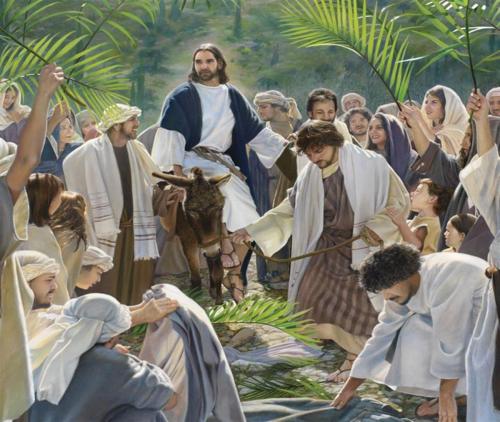
After 400 years, nothing had changed. Then one Sunday morning their long-awaited king made His entrance. However, they did not recognize Him. They were expecting a strong military general that would overthrow the Romans and set up a kingdom equal to or greater than that of Solomon. Perhaps the expected king would expand their borders to include all the lands God had promised.[8] But rather than ride in on a white stallion with a flashing sword and dazzling armor, Jesus rode in on an unbroken donkey’s colt.[9] Rather than the pomp and pageantry of a conqueror’s parade, Jesus was greeted by the cheers of the poor and downcast. “And the multitudes that went before, and that followed, cried, saying, Hosanna to the Son of David: Blessed is he that cometh in the name of the Lord; Hosanna in the highest” (Matthew 21:9); and “Saying, Blessed be the King that cometh in the name of the Lord: peace in heaven, and glory in the highest” (Luke 19:38). The religious leaders, those who should have recognized His presentation, considering the specificity of Daniel’s prophecy,[10] despised the thought of this lowly Galilean being king and rejected His claims to deity. “The Pharisees therefore said among themselves, Perceive ye how ye prevail nothing? behold, the world is gone after him” (John 12:19). “And some of the Pharisees from among the multitude said unto him, Master, rebuke thy disciples” (Luke 19:39). Had these kept silent, Jesus answered them, the very rocks would cry out in proclamation of His kingship.[11]

A few days later, their rejection would be complete as Pilate presented Jesus to them, “Behold your king!”[12] “But they cried out, Away with him, away with him, crucify him. Pilate saith unto them, Shall I crucify your King? The chief priests answered, We have no king but Caesar” (John 19:15, emphasis mine). Rejecting their true King, they preferred rather to remain under the thumb of their oppressors.

This came as no surprise to Jesus. Earlier He confided in His disciples, “Now is my soul troubled; and what shall I say? Father, save me from this hour: but for this cause came I unto this hour” (John 12:27, emphasis mine). His kingdom, at this time, was not an earthly one. His kingdom was not for the Jews alone, but “that whosoever believeth in him should not perish, but have everlasting life” (John 3:16). Before going to the cross, He made this promise. “Let not your heart be troubled: ye believe in God, believe also in me. In my Father’s house are many mansions: if it were not so, I would have told you. I go to prepare a place for you. And if I go and prepare a place for you, I will come again, and receive you unto myself; that where I am, there ye may be also” (John 14:1-3, emphasis mine).

His disciples were naturally curious as to when that time would be. “And as he sat upon the mount of Olives, the disciples came unto him privately, saying, Tell us, when shall these things be? and what shall be the sign of thy coming, and of the end of the world?” (Matthew 24:3, emphasis mine). Jesus gave many indicators of His return at “the end of the world,” but He cautioned, “All these are the beginning of sorrows” (Matthew 24:8). Jesus spoke of wars and rumors of wars, earthquakes in different places, famines, and pestilences.

All these things are taking place today. The naysayers point out that these things have occurred throughout history. Peter foresaw such “scoffers.” “Knowing this first, that there shall come in the last days scoffers, walking after their own lusts, And saying, Where is the promise of his coming? for since the fathers fell asleep, all things continue as they were from the beginning of the creation” (2 Peter 3:3-4). The truth is that these things have never occurred with such frequency and with such unity. The convergence of all of these signs is “unprecedented” (to borrow a term in frequent use these days). Consider the pestilence the world experiences today, the Wuhan virus. This bug has brought the world to a standstill and threatens not only the lives but the livelihoods of millions of people. The world’s economies are on the verge of collapse, and this is but one of the signs of which Jesus spoke.

The time is near. Soon there will be a King in Israel and His Kingdom is forever. Jesus will reign on earth for 1000 years.[13] The world seeks a one-world government ruled by fallible men. Jesus will bring a one-world government, “and he shall rule them with a rod of iron …” (Revelation 19:15). After that, in a recreated heaven and earth, He will reign forever in the “New Jerusalem.”[14]

Are you ready to live with King Jesus in His eternal kingdom? If you are not sure of your eternal destiny, read my page on “Securing Eternal Life.”

Notes:


[1]  “No King In Israel” – https://erniecarrasco.com/2020/04/01/no-king-in-israel/

[2]  1 Samuel 10

[3]  Genesis 49:8-12

[4]  1 Samuel 16

[5]  1 Kings 11:1-8

[6]  1 Kings 12

[7]  2 Chronicles 36:22-23

[8]  Genesis 15:18-21; Exodus 6:4; Numbers 34:1-15; Joshua 1:4

[9]  Mark 11:2

[10]  Daniel 9:24-26

[11]  Luke 19:40

[12]  John 19:14

[13]  Revelation 20

[14]  Revelation 21

Comments Off on A King In Israel

Filed under Christianity, Current Events, Easter, End Times, Gospel, Heaven, Holidays, Religion, Salvation, Second Coming of Christ, Theology

No King In Israel

In those days there was no king in Israel: every man did that which was right in his own eyes. (Judges 21:25)

Thirty years after entering the Promised Land, Joshua died[1] without having accomplished that task God assigned the children of Israel, i.e., to rid the land of all its inhabitants. Even though God promised, “Every place that the sole of your foot shall tread upon, that have I given unto you, as I said unto Moses. From the wilderness and this Lebanon even unto the great river, the river Euphrates, all the land of the Hittites, and unto the great sea toward the going down of the sun, shall be your coast” (Joshua 1:3-4). Before entering the Promised Land, Moses encouraged Joshua, “And the LORD, he it is that doth go before thee; he will be with thee, he will not fail thee, neither forsake thee: fear not, neither be dismayed” (Deuteronomy 31:8). Joshua further encouraged the people, “Remember the word which Moses the servant of the LORD commanded you, saying, The LORD your God hath given you rest, and hath given you this land” (Joshua 1:13). The land was theirs for that taking. God had given it to them. They had only to “be strong and of good courage; be not afraid, neither be dismayed: for the LORD thy God is with thee whithersoever thou goest” (Joshua 1:9).

Accounts differ about the time it took for the “conquest” of the land. Joshua 18-19 records the dividing of the “inheritance” which took place seven to eight years after they crossed the Jordan.[2] In the process of conquering the land, the children of Israel made some compromises that came back to bite them,[3] and they became battle-weary of fighting giants even though God did most of the fighting for them.

Joshua was getting old, and God told him so.[4] He was 40 years old when he first entered Canaan to spy out the land.[5] God punished the children of Israel for their rebellion and unbelief by making them wander in the desert for 40 years. So by the time he entered the Promised Land, Joshua was already 80 years old. At the end of his life, Joshua was 110 years old[6] making his time in the land 30 years. In all that time, Israel failed to take the land God had given them. In that time, they forgot God’s encouragement not to fear. Joshua’s own tribe, Ephraim, complained, “And the children of Joseph [Ephraim and Manasseh] said, The hill is not enough for us: and all the Canaanites that dwell in the land of the valley have chariots of iron, both they who are of Bethshean and her towns, and they who are of the valley of Jezreel” (Joshua 17:16). This was only seven or eight years after seeing all that God had done in the near past and now they feared the giants and their “chariots of iron”! And Joshua spake unto the house of Joseph, even to Ephraim and to Manasseh, saying, Thou art a great people, and hast great power: thou shalt not have one lot only: But the mountain shall be thine; for it is a wood, and thou shalt cut it down: and the outgoings of it shall be thine: for thou shalt drive out the Canaanites, though they have iron chariots, and though they be strong” (Joshua 17:17-18). However, they did not complete the task, choosing rather to live among the Canaanites.

Without taking inventory, much of the land God “gave” Israel remained unconquered and worse, they failed to dispel the Canaanites that lived in the land contented rather to dwell among the pagans, something God had warned against.[7]

Joshua died “And also all that generation were gathered unto their fathers: and there arose another generation after them, which knew not the LORD, nor yet the works which he had done for Israel. And the children of Israel did evil in the sight of the LORD, and served Baalim: And they forsook the LORD God of their fathers, which brought them out of the land of Egypt, and followed other gods, of the gods of the people that were round about them, and bowed themselves unto them, and provoked the LORD to anger” (Judges 2:10-12). It was not long, perhaps 40-70 years, and they forgot all about God.

By my estimation, the period of the Judges lasted about 467 years after the “conquest” of the land. In that time God would punish them for their idolatry by instigating their Canaanite neighbors against them. They would cry out to God, and God would send a “judge” to deliver them. Some of those “judges” were not all that upstanding. For example, Gideon, after defeating the Midianites, erected a golden ephod in his city, “and all Israel went thither a whoring after it: which thing became a snare unto Gideon, and to his house” (Judges 8:27). Then there was the womanizing Samson, a Nazarite,[8] who killed a lion with his bare hands and later ate honey out of the carcass of the animal and shared it with his parents.[9] Touching dead animals violated the Mosaic Law[10], especially for a Nazarite.

The Book of Judges is a tragic history of Israel’s constant fall into idolatry and their rejection of God. The history ends with a sad account of a Levite that traveled to Bethlehem to retrieve his concubine (not wife) that had been unfaithful to him.[11] The woman had fled to her father’s house and the father was happy to entertain the Levite for several days before dismissing him to return with his concubine. They left late in the afternoon arriving at Jebus (Jerusalem) as it was getting dark. A man offered them lodging for the night and while they were there, some “sons of Belial” (worthless fellows) of the tribe of Benjamin came asking for the traveler so they might have sex with him. The man of the house begged them not to do such a wicked thing and offered them rather his daughter and the Levite’s concubine. The men settled for the concubine and raped her all night long. In the morning, the Levite found her dead at the doorstep. In anger, he took up his concubine and carried her body home. When he got home, he cut her body up in twelve pieces and sent the dismembered body to all the tribes of Israel. That incited all the tribes of Israel to come against Benjamin to seek a settlement for the wrong done. However, Benjamin would not turn over the violators and refused to repent. The dispute ended in civil war and the near destruction of the tribe of Benjamin. Out of 25,100 fighting men of Benjamin, only 600 escaped alive. The rest of Israel mourned the desolation of Benjamin and the possibility of losing one of Israel’s tribes. The other tribes had sworn not to give any of their daughters to the Benjamites because of their wickedness, but their complete annihilation was inconceivable. Their resolution was to have something like a Sadie Hawkins dance where they permitted the Benjamites to come and kidnap their daughters. Sad, but true, and “In those days there was no king in Israel: every man did that which was right in his own eyes” (Judges 21:25).

Toward the end of the period of the Judges comes the account of Ruth, a young Moabitess that lost her husband, Malon (meaning “sickly”) and returned with her widowed mother-in-law, Naomi, to Bethlehem. There she met Boaz, who was Naomi’s “kinsman-redeemer.” By law and by custom, Boaz was obligated to marry Ruth and “raise up seed” to his deceased next of kin, Malon. This he willingly did. As we read the account, Boaz was smitten with Ruth when he first laid eyes on her. Anyway, Boaz married Ruth, and she became the great grandmother of King David.[12] More than that, she entered the lineage of King Jesus.

Israel’s history is one of constant rebellion against God, but it is also a tribute to God’s patience, faithfulness, and love in spite of our rebellion and rejection. Beginning with the Fall, God had a plan for man’s redemption.[13] I think about our nation. This year marks 400 years since the landing of the Pilgrims on Plymouth Rock. Are we any different than the Israelites? Think of all God has given us. Think of all His blessings to our nation, and think of how we have rejected Him. No, we are no different. The Wuhan bug that threatens our lives and our economy has us hiding in our dens afraid to come outside for fear of catching Covod-19. Some say this is a punishment from God. Some hope that it will bring revival to our land. However, I have serious doubts about that. Remember how church attendance spiked when many feared the end of the world from Y2K? Remember how church attendance jumped after 9-ll? Those “revivals” were short-lived. We cannot even attend church services now, yet I know attendance at “cyber church” is at an all-time high. Praise the Lord! Some are being saved, however, once this is all behind us, things will return to normal and our nation will return its own form of idolatry – professional sports, entertainment of all sorts, the worship of money and material things, etc.

We are no different than the children of Israel. However, our God, is the same God of Israel. He is patient, faithful, and loving, and His plan is nearing its completion. Consider the world-wide effect of this pestilence. Think about the increased number and intensity of earthquakes in different places on the planet. Have you heard about the swarms of locust devastating crops in Africa and moving north? These are just some of the signs Jesus gave concerning the “end of days.” Soon Jesus will return and Eden will be restored. Are you ready to meet King Jesus? If not, visit my page on “Securing Eternal Life.”

Notes:


[1]  Joshua 24:29

[2]  “The Conquest of Canaan” – https://www.thesacredcalendar.com/book-of-joshua-conquest-of-canaan/

[3]  Unsanctioned (by God) alliances (Joshua 9)

[4]  Joshua 13:1

[5]  Numbers 13:8,16

[6]  Joshua 24:29

[7]  Deuteronomy 7:2-4

[8]  Numbers 6:2

[9]  Judges 14:5-9

[10]  Leviticus 5:2

[11]  Judges 19-21

[12]  Ruth 4:17-22

[13]  Genesis 3:15

Comments Off on No King In Israel

Filed under Bible, Christianity, Current Events, End Times, Religion, Second Coming of Christ, Theology

Stewardship

The earth is the LORD’S, and the fulness thereof; the world, and they that dwell therein. (Psalm 24:1)

When the topic of stewardship comes up in church, it typically comes up around the time of funding the next year’s church budget. The pastor usually brings a sermon encouraging church members to faithfully tithe – give 10% of their income – to the church. However, stewardship has almost nothing to do with tithing, although tithing is certainly a part.

A “steward,” by definition is a person who manages another’s property or financial affairs; one who administers anything as the agent of another. A steward is also a person who has charge of the household of another, buying or obtaining food, directing the servants.

We find the first example of a steward in the Bible in Eliezer of Damascus (Genesis 15:2). He was steward of Abram’s household and heir apparent of Abram’s possessions since Abram at that time had no children. After Isaac, the promised son, came along and after Sarah died (Genesis 23:1-2), Abraham sent Eliezer to Mesopotamia to find a wife for his son, Isaac (Genesis 24). The responsibility was unimaginably great, and Abraham entrusted Eliezer with great wealth trusting that God would direct him to the perfect bride. This was no small trust!

The second example of a steward in the Bible is Joseph, who was sold into captivity by his brothers (Genesis 37:28). In Egypt, Pharaoh’s Captain of the Guard, Potiphar, bought Joseph (Genesis 37:36) as a household slave. Soon, Joseph showed his worth and Potiphar put him in charge of his entire household. “And it came to pass from the time that he [Potiphar] had made him overseer in his house, and over all that he had, that the LORD blessed the Egyptian’s house for Joseph’s sake; and the blessing of the LORD was upon all that he had in the house, and in the field” (Genesis 39:5, emphasis mine).

Jesus offered two examples of stewards. In one parable, the master gave differing amounts of money to his three stewards to manage (Matthew 25:14-30), and he went off on an extended journey. When he returned, the ones to whom he gave five and two talents respectively doubled their master’s money, but the one to whom he gave only one talent did nothing with the talent and returned to his master the original amount.

In the second example, a “nobleman” gave his ten stewards equal amounts of money (Luke 19:11-27) and left on an extended journey to claim his kingdom. Seven of the ten refused to accept him as king when he returned and paid for it with their lives. One steward took what his master entrusted to him and returned ten times the amount. A second took the “pound” he was given and return five times the amount. The third did nothing with his charge and lost his position as a steward.

From these examples, we learn that the steward possesses nothing of his own; rather, he manages the possessions of his master. More than that, the “good” steward makes a profit for his master and increased the master’s wealth.

In a similar sense, we are the stewards of all that God has put into our possession. We own nothing. It all belongs to God, and we are responsible for everything He has placed in our trust. This not only applies to our money, but it includes our time, our family, and material possessions. It also includes how we relate to those around us, our government, and our environment – God’s creation. Everything that God has placed in our realm of influence is our stewardship responsibility. One day, maybe very soon, the King will return from His extended journey, and He will expect an accounting of all that He has entrusted into our care. Will we respond like the unfaithful stewards and return to Him only what He gave us?

Now, in regard to the tithe and in light of what has been presented, giving 10% of our income back to God is a small thing. Consider that all that money you earn is not really your own. From where do your abilities to earn income come? Who ultimately provided you a job? Everything, according to our lead verse (Psalm 24:1), everything belongs to God. He could demand that you return everything to Him with interest, but He does not. He only asks for 10% to test your faithfulness and your trust in Him for your provision. This too is stewardship.

Comments Off on Stewardship

Filed under Apologetics, Christianity, Religion, Second Coming of Christ, Theology

A Soul

Behold, all souls are mine; as the soul of the father, so also the soul of the son is mine: the soul that sinneth, it shall die. (Ezekiel 18:4)

What comes to mind when you think of “a soul”? For most of my life, I imagined a soul as some ethereal, intangible, wispy inhabitant of our body that occupied our being that then departed when the physical body died. I suppose most people look at a soul in much the same way. Dictionary.com defines a soul as: (1) the principle of life, feeling, thought, and action in humans, regarded as a distinct entity separate from the body, and commonly held to be separable in existence from the body; the spiritual part of humans as distinct from the physical part; (2) the spiritual part of humans regarded in its moral aspect, or as believed to survive death and be subject to happiness or misery in a life to come; (3) the disembodied spirit of a deceased person; (4) the emotional part of human nature; the seat of the feelings or sentiments; (5) a human being; person (emphasis mine).[1]

That last definition, I think, is the biblical understanding of “a soul.” In the Genesis account of the creation of man, I envision God (Jesus, in His pre-incarnate form) bending over a mass of reddish clay molding the human form. Scripture records, “And the LORD God formed man of the dust of the ground” (Genesis 2:7, emphasis mine). The Hebrew word translated “formed” is yâtsar, and it carries the idea of squeezing something into shape; to mold into the desired shape as a potter molds and forms a clay vessel. The idea goes well considering the construction material used – dust.

With the body plan complete, God, “breathed into his nostrils the breath of life; and man became a living soul” (Genesis 2:7, emphasis mine). The Hebrew words translated “breathed” and “breath” are related. From the English translation, we can see that the former is a verb and the latter is a noun. The Hebrew words are nâphach and neshâmâh respectively and both mean “a puff.” The word “soul” is also related: nephesh. It means “living creature” and it can refer to either a human being or an animal. Yes, as defined here, animals have “souls” (nephesh); however, they do not possess that special neshâmâh of life “puffed” into humans by God.

This puff of life from God caused God’s mud sculpture to rise and become a living soul with a physical body, mind, and neshâmâh (breath/spirit of life). A triune creature created in the image of God[2] hitherto known as “a living soul.” God is triune in nature: Father, Son, and Holy Spirit. Collectively we just say, “God.” Man, made in the image of God, is triune in nature: mind, body, and spirit. Collectively, the Bible refers to the unit as “a soul.”

There are many examples where this becomes obvious, but I will keep the list brief. The first example following the creation account comes when Abraham travels to Egypt and tries to pass off Sarah, his wife, as his sister. He tells Sarah, “Say, I pray thee, thou art my sister: that it may be well with me for thy sake; and my soul shall live because of thee” (Genesis 12:13). “My soul” (nephesh) here does not refer to his “spirit.” Abraham feared for his life – his physical life.

Later, when God confirmed His covenant with Abraham, God required that he and all males within his household be circumcised.[3] Disobedience to this command carried a penalty. “And the uncircumcised man child whose flesh of his foreskin is not circumcised, that soul shall be cut off from his people; he hath broken my covenant” (Genesis 17:14). “That soul” (nephesh) refers to the whole person not just his spirit. Interestingly, in the account of Abraham rescuing his nephew Lot and others, the word nephesh is translated “persons” (Genesis 14:21).

Genesis 27 records the account of Jacob “stealing” his brother’s blessing by deceiving his father, Isaac. In the passage, “my soul” appears twice and “thy soul” shows up two times.[4] The meaning in each case is somewhat ambiguous; however it seems clear that its use refers to the whole person. More examples could be cited in Genesis, but other examples will help solidify my point.

Exodus records that “all the souls that came out of the loins of Jacob were seventy souls” (Exodus 1:5, emphasis mine). Obviously, this refers to people, not disembodied spirits. Then when God called Moses to lead Israel out of Egypt, God assured him that, “all the men are dead which sought thy life” (Exodus 4:19). The Hebrew word translated “thy life” is nephesh (soul). With regard to keeping the Sabbath, God said, “Ye shall keep the sabbath therefore; for it is holy unto you: every one that defileth it shall surely be put to death: for whosoever doeth any work therein, that soul shall be cut off from among his people” (Exodus 31:14, emphasis mine). Again we see that “a soul” is a person.

The book of Leviticus offers many examples where the word “soul” (nephesh) refers to an individual. Here is one example: “if a soul touch any unclean thing … he also shall be unclean, and guilty” (Leviticus 5:2). To touch requires a physical body. Regarding the prohibition against eating blood: “No soul of you shall eat blood, neither shall any stranger that sojourneth among you eat blood” (Leviticus 17:12). Again, it requires a physical body to eat blood.

There are 420 occurrences of the word “soul” in the Old Testament and nearly twice as many occurrences of the Hebrew word nephesh translated in other forms, for example, life, creature, persons, man, mind, et al. In the majority of occurrences, the word refers to the whole person. There is at least one instance in which the word seems to refer to the spirit of one who has died. Of Rachel’s death in childbirth, Scripture records, “And it came to pass, as her soul was in departing, (for she died) that she called his name Benoni: but his father called him Benjamin” (Genesis 35:18). However, we may infer that when the spirit of a person departs from the body, that person is no longer whole, and therefore no longer “a soul.” The “person” is gone; only the shell remains. The soul has departed.

My conclusion is that “a soul” is the entire person: mind, body, and spirit. According to our beginning verse, “the soul that sinneth, it shall die. (Ezekiel 18:4). We all die sooner or later; however, death, in this case, is not merely the cessation of life. This death separates the soul from the Source of Life for eternity. This is the “second death” spoken of in Revelation 20:14-15, “And death and hell were cast into the lake of fire. This is the second death. And whosoever was not found written in the book of life was cast into the lake of fire” (emphasis mine). Jesus warned, “And if thy right eye offend thee, pluck it out, and cast it from thee: for it is profitable for thee that one of thy members should perish, and not that thy whole body should be cast into hell. And if thy right hand offend thee, cut it off, and cast it from thee: for it is profitable for thee that one of thy members should perish, and not that thy whole body should be cast into hell” (Matthew 5:29-30, emphasis mine). The “soul” – the whole person, mind, body and spirit – that sins shall suffer the eternal consequences of “the second death.”

There is no loss of consciousness in the “second death.” That soul is very much alive and aware of his surroundings. Jesus spoke of such a one whose only sin was self-centeredness.[5] Of course, a self-centered person has no need for God, which is ultimately what landed him in hell. “And in hell he lift up his eyes, being in torments, and seeth Abraham afar off, and Lazarus in his bosom” (Luke 16:23, emphasis mine). Because the soul is the whole person, he could feel the flames of hell, and he could see what he had missed. Later on, he has a sense of concern for his five brothers who are still alive, and he requests that Lazarus be sent back to earth to go warn his brothers about this awful place. Hell apparently does nothing to change his self-centered, selfish ways. His concern is only for his brothers and not for the millions of souls in the same condition.

“The soul that sinneth, it shall die” (Ezekiel 18:4) – mind, body and spirit. In what condition is your soul today? If you are breathing, and reading this blog, and you really don’t know, there is hope, and you can settle it right now. Read my page on “Securing Eternal Life.”

Notes:


[1]  “Soul” – https://www.dictionary.com/browse/soul#

[2]  Genesis 1:27

[3]  Genesis 17:1-14

[4]  Genesis 27: 4, 19, 25, 31

[5]  Luke 16:19-31

3 Comments

Filed under Apologetics, Bible, Christianity, Death, Evangelism, Gospel, Heaven, Hell, Origins, Religion, Resurrection, Salvation, Theology