Category Archives: Religion

Articles that deal with religions other than orthodox Christianity.

Neither Good Nor Bad

And God made the firmament, and divided the waters which were under the firmament from the waters which were above the firmament: and it was so. And God called the firmament Heaven. And the evening and the morning were the second day. (Genesis 1:7-8)

Greg[1] pointed out to me last week something I had not stopped to consider. At the end of every day of creation, God assessed His work, “And God saw … that it was good.”[2] Genesis 1:4 is God’s assessment of the first day, specifically the light. In Genesis 1:10, 12, God gives approval of the third day’s work in separating the water from the land and bringing forth plant life. In Genesis 1:18, God is satisfied with His creation of the heavenly bodies on Day Four. On the fifth day, God gave His approval of the ocean creatures and the creatures that fly. He certified the “beasts of the field” created on the sixth day, and after He crowned His creation by creating man “in Our Image and after Our Likeness” on the sixth day, He declared His entire creation “very good” (Genesis 1:31). However, the second day, received no such assessment. Greg asked, “Why is that? Why did God have nothing to say about the second day?”

That is a very good question. I had to think about that. I consulted several commentaries on Genesis 1:6-8 and none made note of the absence of God’s evaluation of the second day. Not even The Henry Morris Study Bible had anything to say in this regard. Therefore I am left to puzzle this out on my own.

The best place to start, in context, is at the beginning. “In the beginning God created the heaven and the earth” (Genesis 1:1, emphasis mine). The Hebrew word translated “the earth” is ha’erets, and it can refer to earth as the planet, earth as land (either a parcel of land or as a country), or earth as ground (soil). Within the context of the first verse, the last option, ground (soil), probably fits best. In the first verse, God creates all the elements that comprise the universe: time, space, and matter/energy (the earth). Matter/energy occupies time and space. We call this the time-space continuum. So “earth” is the “stuff” from which all else is made.

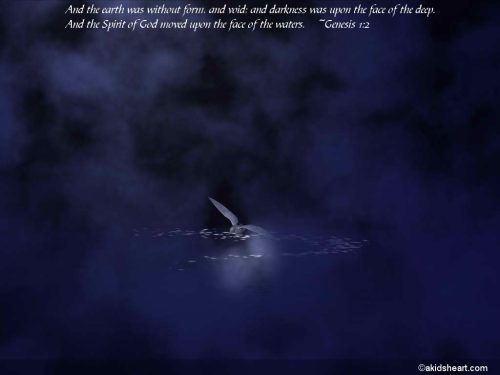
Genesis 1:2 informs us that all this “stuff” was “without form and void” (not that it “became without form and void” as Gap Theorists speculate).[3], [4], [5] It also says that “darkness was upon the face of the deep.” Then, “the Spirit of God moved upon the face of the waters.” The Hebrew word translated “moved” is râchaph and it means to “flutter, move or shake.” I interpret this to mean that the Spirit of God hovered over the entire glob of the mass of matter to energize all the ‘erets God had created. Part of that energy existed as light. “And God said, Let there be light: and there was light. And God saw the light, that it was good: and God divided the light from the darkness. And God called the light Day, and the darkness he called Night. And the evening and the morning were the first day” (Genesis 1:3-5, emphasis mine).

We arrive at the second day, and what we have is a massive blob of matter and energy within the time-space continuum. It is void and without form; it has yet to be “shaped” into anything. On the second day, God gets to work at molding all the stuff of creation. “And God said, Let there be a firmament in the midst of the waters, and let it divide the waters from the waters” (Genesis 1:6). The Hebrew word for “firmament” is râqı̂ya‛ meaning an “expanse” or the “visible arch of the sky.” Another dictionary[6] defines it as an “extended surface (solid).” The term seems to describe some sort of solid shell around this massive “earth” blob that fills the space of the universe – thus, the “firm” in firmament.[7] God installed this firmament “shell” between the waters to cause a separation from the waters from which He will form “Planet Earth” from the waters that will occupy the rest of space. I see this as the beginning of God “[stretching] out the heavens as a curtain, and [spreading] them out as a tent to dwell in” (Isaiah 40:22). “And God made the firmament, and divided the waters which were under the firmament from the waters which were above the firmament: and it was so” (Genesis 1:7, emphasis mine). From the waters “which are above the firmament” God will create “the stars also.”[8]

“And God called the firmament Heaven. And the evening and the morning were the second day” (Genesis 1:8, emphasis mine). What God has at this point is a watery blob in the midst of a greater watery blob separated by the “firmament.” He still has more work to do to form Planet Earth. Perhaps this is why God made no assessment of His work at this point. He was not done with this part yet. It was neither good nor bad; it was incomplete. The finished product comes on Day Three where God brings the landmasses out of the water and causes the ground to bring forth vegetation.[9] At the end of that day, God declares it “good.”

Notes:


[1]  Greg is a volunteer at the ICR Discovery Center for Science and Earth History, and he is a very careful student of the Bible, hence the question. I did not use his full name because I did not request permission to do so, If he reads this blog article, he will know.

[2]  Genesis 1:4, 10, 12, 18, 21, 25

[3]  “The Gap – Not the Store” – https://erniecarrasco.com/2019/08/04/the-gap-not-the-store/

[4]  “No Gap” – https://erniecarrasco.com/2015/10/18/no-gap/

[5]  “The Age of the Earth” – https://erniecarrasco.com/2018/10/14/age-of-the-earth-2/

[6]  Brown-Driver-Briggs’  Hebrew Definitions

[7]  “רקיע  rāqı̂ya‛, “expanse;” στερέωμα  stereōma, רקע  rāqa‛, “spread out by beating, as leaf gold.” This expanse was not understood to be solid, as the fowl is said to fly on the face of it Gen_1:21. It is also described as luminous Dan_12:3, and as a monument of divine power Psa_150:1,” Albert Barnes’ Notes on the Bible.

[8]  Genesis 1:16

[9]  Genesis 1:9-13

1 Comment

Filed under Apologetics, Bible, Christianity, Creation, Origins, Religion, Science, Theology

Ye of Little Faith

By faith Abraham, when he was tried, offered up Isaac: and he that had received the promises offered up his only begotten son, Of whom it was said, That in Isaac shall thy seed be called: Accounting that God was able to raise him up, even from the dead; from whence also he received him in a figure. (Hebrews 11:17-19)

The African impala can jump to a height of over ten feet and cover a distance of more than thirty feet (in the jump).  Yet these magnificent creatures can be securely contained in zoos with no more than a three-foot wall.  You see the animals will not jump unless they can see where their feet will fall.  Far too often, we are rendered useless to God because we are unwilling to trust Him with what is unknown (to us).  When He calls on us to take a leap of faith, we are unwilling to obey because we cannot see where our feet will fall.  In his many years of walking with God, Abraham had come to a place in his life where he could absolutely trust God no matter what God might ask of him — including sacrificing his only son.

Genesis 22 opens with the phrase “Now it came about after these things,” (v. 1).  After what things?  Beginning in Chapter 12 of Genesis, the story of Abraham unfolds.  At the age of 75, after being well established in the city of Ur, God told Abraham (Abram at that time) to pack up his belongings, leave his home and family and go to some undisclosed land with the promise that God would make of him a great nation.  So Abram trusted and obeyed God even though he had no idea where his feet would fall.  For ten more years Abram wandered the deserts of Canaan without ever finding a place that he could call his own, but he believed God would keep His word.  Then at the age of 85, God once again paid Abram a visit to reconfirm His promise to make of him a great nation.  This time, Abram just had to ask, “O Lord GOD, what wilt Thou give me, since I am childless, and the heir of my house is Eliezer of Damascus?” (Genesis 15:2).  Again, God assured him that he would indeed procreate and be the father of many nations. Then, in order to help God out with His plan a bit (and how many of us have ever been guilty of that?), Sarai (Sarah) considering the fact that she was no spring chicken and had been barren all these many years, proposed a solution.[1]  She offered her handmaid to Abram so that he might sire a child through her.  That makes sense, humanly speaking. We might have suggested the same thing today along with fertility drugs or in vitro fertilization.  We might even justify it by saying that we are putting “feet to our prayers.”  At any rate, it was a feeble attempt to help God out with His plan, but a surrogate mother was not what God had in mind.  So Abram waited another fourteen years and again God paid him a personal visit to reconfirm His promise.  By now, Abram is 99 years old and Sarai is 89.  God had promised, and Abram had waited.  He still had no homeland that he could call his own, no child “of promise” that would engender a nation, and he was getting really old!  Yet Abram believed God, and at the ripe old age of 100, God granted the old couple a son, Isaac – “laughter”!

“And it came to pass after these things, that God did tempt Abraham …” (Genesis 22:1).  Now, before we accuse God of child abuse or bloodthirstiness, please notice that this was a “test.”  It was only a test, but Abraham did not know that.  “And said unto him, Abraham: and he said, Behold, here I am.”  (Don’t you just love it when you call your son or your daughter by name and they answer immediately, “Yes, Dad!” or “Yes, Mom!”  Of course, just the opposite is true when you call them and there is a deliberate silence.)  “Here I am.”  Whatever God wanted, Abraham was ready.

“And [God] said, Take now thy son, thine only son Isaac, whom thou lovest, and get thee into the land of Moriah; and offer him there for a burnt offering upon one of the mountains which I will tell thee of” (Genesis 22:2). Wow!  Can you imagine!  By now Isaac was between 16 and 22 years old, and Abraham was between 116 and 122, and Sarah between 106 and 112.  And God had not missed the fact that Isaac was Abraham’s “only son” – the son whom he loved.  Oh, the pain that must have pierced the heart of Abraham!  In the movie, The Bible (1966), Abraham is portrayed as rebellious at first.  “No!  No!” he growls at God as he beats his fists into a desert rock, but ultimately he complies.  That is not how the Bible portrays Abraham.  Yes, his heart must have ached, but look at how he responds.  “And Abraham rose up early in the morning, and saddled his ass, and took two of his young men with him, and Isaac his son, and clave the wood for the burnt offering, and rose up, and went unto the place of which God had told him” (Genesis 22:3).  Abraham did not hesitate.  He did not question.  He just obeyed.  Again, at least for the second time in his life, Abraham was going to some undisclosed location – in the “land of Moriah … on one of the mountains of which I will tell you” – not knowing where his feet would fall – just because God told him to do it.

After a three-day’s journey, they arrived at the general vicinity of the sacrifice.  Abraham instructed his two servants to remain with the donkey and says, “I and the lad will go yonder and worship, and come again to you” (Genesis 22:5, emphasis mine).  What could Abraham have been thinking?  “We will come again to you?”  Was he forgetting something here?  Did God not tell him to offer Isaac up as a burnt offering?  Some have suggested that Abraham said this in order to conceal what he was about to do from his servants.  That makes sense.  Isaac, being the only son of Abraham, was probably the darling of the whole household.  Surely if Abraham had divulged his plans to his servants, he would have met with opposition.  But I think there is more to it than that.  The writer of the book of Hebrews says that Abraham “Accounting that God was able to raise him up, even from the dead; from whence also he received him in a figure.” (Hebrews 11:19).  “For what saith the scripture? Abraham believed God, and it was counted unto him for righteousness” (Romans 4:3). He could not see where his feet would fall, but he knew God was well in control.

As they traveled up the mountain, Isaac asked the obvious question, “And Isaac spake unto Abraham his father, and said, My father: and he said, Here am I, my son. And he said, Behold the fire and the wood: but where is the lamb for a burnt offering? And Abraham said, My son, God will provide himself a lamb for a burnt offering: so they went both of them together” (Genesis 22:7-8). Can you picture the scene?  There, Abraham leads the way with calm assurance and determination on his face, fully trusting his heavenly Father.  There, Isaac follows not knowing what lies ahead, but he too trusts his earthly father.  What a pair those two must have made!  “God will provide for Himself the lamb!”

Finally, they came to the place that God had designated, Mount Moriah.  The Bible tells us that this very place was the site upon which the Temple would be built.[2]  Oblivious to God’s plan and going only on what God had instructed him to do, Abraham built the altar, prepared the wood, bound his son, his only son, Isaac, and placed him on the altar.  Imagine this! Here was a strong young man who by now knew exactly what was about to happen, and yet he complied with his father’s will. Isaac could have very easily overpowered the 116-plus-year old Abraham and said, “No, sir!  I will not be roasted!”  This was a test of Abraham’s faith, but Isaac’s faith should not be discounted.  He willingly complied with his father’s wishes.  There he lay, on the stack of wood that he had carried up the mountain on his back, looking full into his father’s face as Abraham, knife in hand, raises his hand to strike the lethal blow.  Abraham, his eyes raised toward heaven, unable to look into his beloved son’s eyes, not knowing where his feet would fall, was fully committed to God and to His will.  In Abraham’s mind, the sacrifice was completed.  Isaac was God’s!

Two thousand years later on the same hill, another Father and another Son would replay the same scene, but this time, God intervened.  “And the angel of the LORD called unto him out of heaven, and said, Abraham, Abraham: and he said, Here am I” (Genesis 22:11).  Once again, Abraham was ready to obey his Lord’s command.  And Jesus said, “Lay not thine hand upon the lad, neither do thou any thing unto him: for now I know that thou fearest God, seeing thou hast not withheld thy son, thine only son from me” (Genesis 22:12).

Why do I say that this was Jesus speaking to Abraham?  For one thing, Abraham had received his orders directly from God, and no subordinate angel could have made him deviate from what God had told him to do directly; only God Himself could have changed Abraham’s orders.  Secondly, how could an ordinary angel say, “You have not withheld your son, your only son, from Me?”  Abraham was not offering Isaac up to an angel but to God.  And finally, Jesus would later remind the Jews, “Your father Abraham rejoiced to see my day: and he saw it, and was glad” (John 8:56).

So Jesus prevents Abraham from completing the physical act of sacrifice. Isaac was now fully offered both by his father and by himself.  The father yielded up his son, the son gave up his life; from both parties, as far as will and purpose could go, the sacrifice was complete.  There was no need for Abraham to endure the torture of running the knife through his son.  In his mind and in his heart, he had made the sacrifice.  And God said, “for now I know that thou fearest God” (Genesis 22:12).  Is it possible that God did not know that prior to the test?  Could the omniscient, the all-knowing, God, the God that searches the hearts and minds of men, have been ignorant of Abraham’s faith and devotion to Him?  Impossible!  God knew exactly what Abraham would do.  He knew that Abraham would do just as He commanded even to the point of giving up his only son.  God did not need any proof for Himself.  The test was for Abraham.  Abraham is the one that needed to know just how far he was willing to go for God.  Abraham was the one that needed to know that he could implicitly trust God to provide all of his needs “according to his riches in glory” (Philippians 4:19).  And Isaac, the heir to God’s promises needed to know that too, because neither Abraham nor Isaac would ever see the day when Abraham would become a great nation.  Neither one of them would ever see the fruit of the “seed” in which “all the nations of the earth” would be blessed (Genesis 22:18).  Neither one of them would ever see where their feet would fall, but they needed to know that God would keep His promises and that He would always provide.

So God provided a substitute. “And Abraham lifted up his eyes, and looked, and behold behind him a ram caught in a thicket by his horns: and Abraham went and took the ram, and offered him up for a burnt offering in the stead of his son. And Abraham called the name of that place Jehovahjireh: as it is said to this day, In the mount of the LORD it shall be seen” (Genesis 22:13-14).

Abraham learned that in all things God will provide.  Even when things are unclear, God will provide.  Even when the outcome is unsure, God will provide.  Even when we cannot understand, God will provide.  Even when we cannot see where our feet will fall, God will provide.

Then Jesus came to him again to reconfirm the promise. “And the angel of the LORD called unto Abraham out of heaven the second time, And said, By myself have I sworn, saith the LORD, for because thou hast done this thing, and hast not withheld thy son, thine only son: That in blessing I will bless thee, and in multiplying I will multiply thy seed as the stars of the heaven, and as the sand which is upon the sea shore; and thy seed shall possess the gate of his enemies; And in thy seed shall all the nations of the earth be blessed; because thou hast obeyed my voice” (Genesis 22:15-18).

“By Myself I have sworn, saith the LORD” (v. 16) because the writer of Hebrews tells us, “he could swear by no greater, he sware by himself” (Hebrews 6:13).  God’s promises are true.  God is faithful and He will do what He says.  Did Abraham ever see God’s promise fulfilled in his lifetime? Only in his dreams! Did God keep His promise to Abraham?  Absolutely! Why? “Because thou hast obeyed my voice” (v. 18).  Abraham did not know where his feet would fall, but he obeyed God anyway. “So Abraham returned unto his young men, and they rose up and went together to Beersheba; and Abraham dwelt at Beersheba” (Genesis 22:19).

Two thousand years later, the drama was replayed.  Only this time, the Son, the only Son, the beloved Son, and His Father were the players.  Once again, the Father and the Son walked up together to the summit of Mount Moriah, and there the Father offered up His Son.  The Son, knowing full well what was about to transpire, willingly carried on his back the wood upon which He would be offered.  Together, He and the Father walked up the lonely hill, both determined that this offering would take place.  This time, there was no “Angel of the Lord” to stay the hand of the Father because it was the “Angel of the Lord” that laid upon the wood.  And the Father strikes and the nails were driven into the hands and feet of the Son, and the spear pierced His side.  The Son dies, and the Father weeps.  This time there is no substitute.  This is the way it had to be.  The only Son of God the Father was offered up for your sins and mine.  Why?  So that you and I might have eternal life by taking a leap of faith and trusting in the sacrifice made on our behalf.  The Bible says, “But without faith it is impossible to please him: for he that cometh to God must believe that he is, and that he is a rewarder of them that diligently seek him” (Hebrews 11:6, emphasis mine).

God gave His one and only Son for you and for me. He has the absolute right to expect your obedience by trusting in the sacrifice of His Son. Are you unsure because you cannot see where your feet will fall? You may hesitate because you do not know how your friends or your spouse or your family will react if you give your life to Christ.  You may hesitate because you fear that you will have to give up a lifestyle of sin with which you have grown comfortable.  You may feel that you are doing alright on your own, and that you have no need for God in your life because you have everything under your control.  Besides all of that, you don’t know if your decision to trust Christ will ever pay off.  You cannot see where your feet will fall, so you would rather remain confined in a world that you can see rather than to obey God and trust Him with what you cannot see.  Let me assure you, you are not as safe and secure as you think you are.  Why not take that leap in faith by trusting Jesus as your personal Savior and Lord.  He alone holds the future and in Him you can find true security.

Perhaps you already know the Savior. You possess the assurance of an eternal future with Him in heaven, but you haven’t learned to trust Him with your present life.  Perhaps you are not serving Him as you should because you have too many other things that occupy your time.  Maybe you are not the witness for Him at school, at work, or at home that you ought to be because you worry that you might offend someone, or you may lose your job or your credibility or your relationships.  Jesus said, “Whosoever therefore shall be ashamed of me and of my words in this adulterous and sinful generation; of him also shall the Son of man be ashamed, when he cometh in the glory of his Father with the holy angels” (Mark 8:38).  Perhaps you haven’t trusted God with the giving of your tithe because you worry that you won’t have enough month left over at the end of your paycheck. Remember the words of Jesus: “Take no thought for your life, what ye shall eat, or what ye shall drink; nor yet for your body, what ye shall put on. Is not the life more than meat, and the body than raiment?” (Matthew 6:25).  He went on to say, “Therefore take no thought, saying, What shall we eat? or, What shall we drink? or, Wherewithal shall we be clothed? (For after all these things do the Gentiles seek:) for your heavenly Father knoweth that ye have need of all these things. But seek ye first the kingdom of God, and his righteousness; and all these things shall be added unto you” (Matthew 6:31-33).

God knows all of your needs, and He will meet them.  He doesn’t need your help to take care of you.  He can do just fine without you, if you will only trust Him to care for you as He promised.  Do not stay trapped by what you cannot see; “If the Son therefore shall make you free, ye shall be free indeed” (John 8:36).

Abraham could not see where his feet would fall, but he trusted God, and he obeyed.  “For what saith the scripture? Abraham believed God, and it was counted unto him for righteousness” (Romans 4:3).  Do not allow the cares of this world hold you captive like a three-foot wall keeps the African impala imprisoned. “Trust and obey for there’s no other way to be happy in Jesus, but to trust and obey.”[3]

Notes:


[1]  Genesis 16

[2]   2 Samuel 24:10-25; 2 Chronicles 3:1)

[3]  From the hymn, “Trust And Obey,”

1 Comment

Filed under Bible, Christianity, Evangelism, Religion, Salvation, Theology

Homesick

Be ye therefore ready also: for the Son of man cometh at an hour when ye think not. (Luke 12:40)

“Better to be seen than viewed” someone responds when greeted with, “Good to see you!” Sometimes the salutation of “How’re you doing” gets the retort, “Any day above ground is a good day!” Someone else might say, “Better than the alternative!”

Those are funny ways to say that it is good to be alive, but those who make such remarks have not given the “alternative” a lot of thought. In their mind they see death something to delay or avoid altogether. The truth is that no one gets out of this world alive.[1] “And as it is appointed unto men once to die, but after this the judgment” (Hebrews 9:27).

The Christian should welcome death “willing rather to be absent from the body, and to be present with the Lord” (2 Corinthians 5:8). Having circled the sun 69.33 times, the miles have taken their toll, and I feel the aches and pains that accompany the second law of thermodynamics. I have no fear of death, however, the process of dying does not appeal to me. When someone suggests that this life is better than the alternative, I quickly reply, “Oh no it’s not.”

I am homesick for my eternal home. My mother and father and many of my relatives wait for me there. I look forward to seeing friends that have gone ahead of me. I often wonder if I will recognize them. They will all be young – no wrinkles, no gray hair, no bald heads (yay!). “And God shall wipe away all tears from their eyes; and there shall be no more death, neither sorrow, nor crying, neither shall there be any more pain: for the former things are passed away” (Revelation 21:4). I have arthritic knees that prevent me from doing things I used to do; I do not bend as well as I used to. I have carpal tunnel syndrome that makes my hands tingle all the time, and I get these horrible leg cramps that wake me up in the middle of the night. I really look forward to “no more pain.”

Before going to the cross, Jesus promised, “In my Father’s house are many mansions: if it were not so, I would have told you. I go to prepare a place for you” (John 14:2, emphasis mine). From this translation, we get the crazy idea that Jesus will build us all palatial mansions in heaven. Reading this verse brings the words of the old gospel song to mind: “I’ve got a mansion just over the hilltop in that bright land where we’ll never grow old.” However, that minimizes what Jesus has in store for us. The word “mansion” is a poor translation for the Greek word monē which simply means “a staying, abiding, dwelling, abode.” Heaven will be our dwelling place, and from the description I read in the Bible, we will have no need for “shelter” there.

The dwelling place Jesus has prepared for us is the New Jerusalem.[2] The place is illuminated by the presence of God so that “the city had no need of the sun, neither of the moon, to shine in it” (Revelation 21:23). The river of life and the tree of life are there; all our physical needs will be met. “And there shall be no more curse…” (Revelation 22:3). “And there shall be no night there; and they need no candle, neither light of the sun; for the Lord God giveth them light: and they shall reign for ever and ever” (Revelation 22:5). What need is there for any mansion!

No pain. No tears. No sorrow. No death. No curse. No hunger or thirst. No night. No need for shelter in the perfect climate. The best part about heaven, the New Jerusalem, will be to dwell in the presence of our Creator and Savior, the Lord Jesus Christ.

An old friend from my distant past used to say, “Heaven is my home, but I’m not homesick for it yet.” Tommy was at least 15 years older than me when he said this. I have not heard from him in years. It is very possible that Tommy is experiencing heaven now and may be saying, “I am not homesick for heaven anymore.”

The longer I live in this fallen world that grows more wicked every day, the more homesick I get for my forever home. As I see the moral decline and the violence plaguing our land, the more I desire to go home. The signs of the times indicate that Jesus’ return is very near, but whether I cross the veil or meet Him in the air, I long to be home with my Lord. In the meantime, I will occupy until He comes.[3]

This world is not my home I’m just a passing through

My treasures are laid up somewhere beyond the blue

The angels beckon me from heaven’s open door

And I can’t feel at home in this world anymore

Oh lord you know I have no friend like you

If heaven’s not my home then Lord what will I do

The angels beckon me from heaven’s open door

And I can’t feel at home in this world anymore

Just over in gloryland we’ll live eternally

The saints on every hand are shouting victory

Their songs of sweetest praise drift back from heaven’s shore

And I can’t feel at home In this world anymore

Oh lord, you know I have no friend like you

If heaven’s not my home Then Lord what will I do

The angels beckon me From heaven’s open door

And I can’t feel at home In this world anymore[4]

Notes:


[1]  Actually, some will get out of this world alive (1 Corinthians 15:51-55).

[2]  Revelation 21:2, 10-25

[3]  Luke 19:13

[4]  “This World Is Not My Home” – Jim Reeves

2 Comments

Filed under Apologetics, Christianity, Death, End Times, Random Musings, Religion, Resurrection, Salvation, Second Coming of Christ, Theology

The Church

And I say also unto thee, That thou art Peter, and upon this rock I will build my church; and the gates of hell shall not prevail against it. (Matthew 16:18)

Today is Sunday, and June and I just got out of “church.” We enjoyed a wonderful time of worshiping God our Savior, Jesus Christ, and listening to the Word of God exposited by our “under shepherd,” our pastor. Then we gathered in our Sunday school classroom to enjoy family time by fellowshipping with our brothers and sisters and enjoying a time of deeper study into the Word of God. Currently, we are studying the book of Isaiah. We have been in the book of Isaiah for nearly a year, and we are only halfway through the book. I really appreciate our Bible teacher and his dedication to the careful study of God’s Word.

I have said this before, and it is still true. I love church! But what is church? Some people think of a building where people meet on Sundays for some unknown reason. Others have a vague notion that people gather there to sing and listen to some preacher talk. Many Christians consider church attendance as some kind of obligation. It’s just something one does.

Before going into what “church” is, perhaps we should understand what it is not.

“Church” is not a building. The first definition of “church” found at Dictionary.Com says that it is “a building for public Christian worship.”[1] While that may be the modern, accepted understanding of the word, it is nonetheless in error. The second definition says that a church is a “public worship of God or a religious service in such a building.” That comes closer to a correct understanding; however, it is still false.

Some people who attend church services select their place of “worship” based on the style of music that is played. They want to hear stirring music that stimulates the emotions and elevates their spirits to euphoric heights. Many church leaders are keenly aware of this “need” and they go to great expense and effort to tailor music that attracts the most number of attendees. Many “worship” services employ loud, screaming guitars, jungle-beating percussion sets, laser-light shows, and even smoke machines to stimulate the emotions. After 45 minutes or so of ear-splitting, pulse-raising “music,” the speaker comes up to give a 15-minute motivational speech specifically intended to maintain the hearer in a happy state – no talk of sin and the need for the Savior, or the prospect of hell; only talk about God’s love and how He loves you just the way you are (a partial truth originating from the “father of lies”).[2]

No, the church is not a place to be entertained, emotionally elevated, or encouraged in your sin. Even churches that still sing the “tired old hymns” can degenerate into places where we can go to just feel good about ourselves. That is not what church is. Neither is the church intended to attract unbelievers, which the modern “church growth” movement emphasizes.

The word translated “church” in the Bible is the Greek word ekklēsia, and it could be translated the “called out ones.” Immediately we notice that the definition precludes a building of any kind. So, the “church” is not a building. The church is people, and not just people, they are people that have been “called out.” The question that immediately comes to mind is, “called out of what?” Simply put, the church is an assembly of people who have been “called out” of the world. To use a “churchy” term, the church is a body of those who have been “saved” out of the world, out of sin, and out of an eternity in hell.

Jesus said, “Ye have not chosen me, but I have chosen you, and ordained you, that ye should go and bring forth fruit, and that your fruit should remain …” (John 15:16, emphasis mine). The Greek word translated “ordained” means “to place” or “to set.” In other words, Jesus has “chosen,” i.e. “called out,” His church and set it in a place to do His work on earth – to “bring forth fruit.” “Bringing forth fruit” does not necessarily mean increasing the number of attendees in a particular church body. Indeed, Jesus said, “For many are called, but few are chosen” (Matthew 22:14). The “call” goes out to all, but only a few will respond. “Because strait is the gate, and narrow is the way, which leadeth unto life, and few there be that find it” (Matthew 7:14, emphasis mine).

Jesus said these things before the church was established at Pentecost.[3] The church, therefore, consists of individuals who are “called out” by Christ through the Holy Spirit, regardless of man-made “branding” – Baptist, Methodist, Presbyterian, Catholic, etc. The unifying theme of the Church is a belief in the saving work of Jesus Christ on the cross in payment for our sin, His resurrection from the grave (after three days), His ascension into heaven and His soon return as King of Kings and Lord of Lords. “Neither is there salvation in any other: for there is none other name under heaven given among men, whereby we must be saved” (Acts 4:12, emphasis mine). If one trusts simply in that, that one is included in “the Church.” If, on the other hand, one is trusting in the practices observed by their church, they are probably not included in “the Church.”[4]

The Bible refers to the body of all true believers, the “called out ones,” i.e. “the Church,” as “the Bride of Christ.”[5] This is the Church – not a building or a particular “Christian” denomination. The Church is a body of “called out” individuals who join together to worship God, to “feed” on His Word, to grow and mature in the Spirit, to rejoice with those who rejoice and weep with those who weep, to fellowship and encourage one another, and to work together to “bring forth fruit,” i.e., bring others to Christ.

The purpose of the local church is to build up the body – the Church – for the work of the kingdom. It is not to entertain, nor is it to gain numbers for the sake of numbers. The Church is not confined to a single building; however, the smaller gathering that meets in a “church” building plays a major role as part of the “greater” Church. Therefore, “… let us consider one another to provoke unto love and to good works: Not forsaking the assembling of ourselves together, as the manner of some is; but exhorting one another: and so much the more, as ye see the day approaching” (Hebrews 10:24-25).

One day soon the Church will gather together from all parts of the earth in one great assembly forever to be united with our Bridegroom, the Lord Jesus Christ. I so yearn for that day! In the meantime, I enjoy the little piece of Heaven God has provided here on earth in my local church with my brothers and sisters in Christ.

Notes:


[1]  Church – https://www.dictionary.com/browse/church?s=t

[2]  John 8:44

[3]  Acts 2

[4]  See my articles on “False Religion”

[5]  Matthew 25:1-13; Revelation 19:7-9

2 Comments

Filed under Apologetics, Christianity, End Times, Gospel, Hell, Religion, Salvation, Second Coming of Christ, Theology, Worship

Criticism

Now there are diversities of gifts, but the same Spirit. (1 Corinthians 12:4)

Have you ever been around a critical person, one that seems to find fault in almost everything? A person like that can look at a beautiful work of art and notice only that the frame hangs off plumb. They may listen to a beautiful solo sung in church and notice only that the singer was slightly flat on some of her high notes, or perhaps her dress seemed inappropriate for performing before a church audience.

A critical person rarely offers any positive comments. When you encounter a critic, it does not take long before you begin to avoid that person. If forced by familial relationship to be around a critic you soon learn to keep quiet to avoid criticism. If you work with a critic or work for a critic you stop offering ideas or suggestions, and the critic will soon squelch all your creativity. We avoid critics. No one can put up with criticism for very long. Critics are not people we want to be around.

Criticism can be positive if the critic has your interest at heart. That kind of criticism is usually solicited. For example, when I write, I usually submit my writing to my editor, my wife, for review and critique. She usually offers some very helpful suggestions, which I gladly consider. Another example is when a researcher will submit a research paper for peer review to solicit critical input from his peers. “Iron sharpeneth iron; so a man sharpeneth the countenance of his friend” (Proverbs 27:17). That is not the kind of criticism I refer to here. The kind of criticism to which I refer serves only to bring others down, not to build them up.

Some Christians behave as though criticism is one of the “gifts of the Spirit.” They pride themselves in finding fault and conflate criticism with discernment – the ability to distinguish truth from error. When we examine the two, we find that they are not the same at all. One definition of “discernment” includes “discrimination; acuteness of judgment and understanding.”[1] Criticism, on the other hand, is “the act of passing judgment as to the merits of anything, or the act of passing severe judgment; censure; faultfinding.”[2] While both include “judgment,” discernment requires “understanding;” criticism does not.

The Apostle Paul provides a short list of the gifts of the Holy Spirit in his first letter to the church at Corinth.[3] These include administration, diversities of operation (different kinds of work, the ability to get things done), the word of wisdom, the word of knowledge, faith, healing, miracles, discerning of spirits, the ability to speak in other languages, and the interpretation of other languages.

In his letter to the Romans, Paul adds prophecy, ministry, teaching, exhortation, giving, and mercy.[4] To the Galatians, Paul gives a list of “fruits of the Spirit.” These include love, joy, peace, longsuffering, gentleness, goodness, faith, meekness, and temperance.[5]

Nowhere in the Bible is criticism seen as a good thing. Criticism may be a fruit of the spirit, but not of the Spirit of God. Looking back to the Garden of Eden, we hear the serpent criticizing God for withholding something good from the first couple. “And the serpent said unto the woman, Ye shall not surely die: For God doth know that in the day ye eat thereof, then your eyes shall be opened, and ye shall be as gods, knowing good and evil” (Genesis 3:4-5).

If you find yourself being critical, stop. Rather than finding fault, look for the good. Paul encourages the Philippians, “Finally, brethren, whatsoever things are true, whatsoever things are honest, whatsoever things are just, whatsoever things are pure, whatsoever things are lovely, whatsoever things are of good report; if there be any virtue, and if there be any praise, think on these things” (Philippians 4:8).

Instead of criticizing someone, look for the good in what they do and encourage/exhort (“build up”) that person. If they suffer due to the consequence of some sin, rather than criticize, show “mercy” and “minister” to that one. You may earn the right to “teach” that one by your example and through your words and by your “gentleness, goodness, and faith.” Criticism helps no one. Criticism is not a “gift of the Spirit,” but rather it is a “tool” of the devil. Don’t be a critic. Be an encourager instead.

Notes:


[1]  https://www.dictionary.com/browse/discernment

[2]  https://www.dictionary.com/browse/criticism?s=t

[3]  1 Corinthians 12:4-11

[4]  Romans 12:5-8

[5]  Galatians 5:22-23

2 Comments

Filed under Apologetics, Christianity, Religion