Category Archives: Religion

Articles that deal with religions other than orthodox Christianity.

Age of the Earth

“And the earth was without form and void” (Genesis 1:2)

For in six days the LORD made heaven and earth, the sea, and all that in them is, and rested the seventh day: wherefore the LORD blessed the sabbath day, and hallowed it. (Exodus 20:11)

Many Christians find it difficult to believe that the universe and the earth are only about 6000 years old. After decades of assault from all sides by evolutionists touting that billions of years of evolution are well-established scientific fact, Christian scholars, intimidated by the prospect of appearing uneducated while at the same time desiring to uphold the veracity of the Bible, seek compromises that attempt to “shoehorn” evolution into the simple text of the creation account recorded in Genesis.

Several of the compromises exist today even though solid biblical and scientific scholarship has shown them to be false. The Gap Theory,[1] for example, attempts to squeeze billions of years between Verse 1 and Verse 2 of Genesis 1 supported only by vivid imaginations and extra-biblical Jewish writings and traditions but offers zero biblical backup. The Day-Age Theory mistranslates the normal meaning of “day” into indefinitely long periods of time. The Day-Age Theory, when examined carefully and critically presents several problems. Then there is Theistic Evolution that makes out God to be some cosmic tinkerer or experimenter as if He could not get it right the first time.

Other compromises probably exist, but recently I heard a new one. Someone wrote in with the perfect solution to the age of the earth problem. He said:

I believe that the earth is young, 6000 years old, but when I look at Genesis 1: 9-10, I see that what God called the earth is DRY land, not the whole planet. In other words, it is the DRYNESS of the land that is sticking up above the surface of the seas that God had just made that is young or new or 6000 years old. This isn’t my opinion, the Bible describes this. So verses 1 and 2 plus Day 1 and Day 2 need to be interpreted using what Moses says the earth is. So you see trying use dates given by dating techniques to work out how old the ‘earth’ is a waste of time. I personally doubt that it would be possible to date the age of anything. This is because I think anything God makes would always be ‘as new’, until we get to when sin occurred here and then the flood. Using the context approach, entirely within chapter one, it is easy to see what ‘heaven’ is as well. The universe was made instantly by God’s word for sure, but that wasn’t Moses’ focus in Genesis. Another question to ask using the context approach is, ‘Why did God do what He did in Genesis One, the climax of which is Adam and Eve?

What the writer suggests is that the first two days were long periods of time – millions or billions of years, but the appearance of land on the third day is the starting point for counting the age of the earth. I can commend him for taking a hard look at Scripture, however, his disadvantage, it appears, is that he is relying strictly on the English translation of the Bible. The original language, Hebrew, makes things very clear. The Hebrew word for “day” is yôm. Yôm, in the Old Testament nearly always refers to a normal 24-hour day, especially when it is associated with an ordinal number: first day, second day, third day, etc. If that were not clear enough, God clearly defines what a day is: “And the evening and the morning were the first day” (Genesis 1:5). So, one cannot add extensive periods of time to the creation account without doing harm to the text.

Genesis 1:9-10 is another place where the English language fails to translate the Hebrew precisely. In my King James Bible, the word “land” is in italics meaning that the word was inserted in the text for clarity to the English reader. Literally, the phrase should read, “let the dry appear: and it was so. And God called the dry Earth.” (vv. 9-10). The Hebrew word translated “earth” is ‘erets, and it can mean soil, ground, land (as in a plot of land or as a region like “the land of Egypt), and in a greater sense, the planet Earth. Context determines the meaning, which makes me wonder why the translators capitalized the word “Earth” when the context is referring to the “dry land” and not to the entire planet. The conclusion that it is only the “dryness” that is 6000 years old contradicts the definition of yôm given in Verse 5 (and the rest of Scripture).

Reading in its normal context, giving the words their normal meaning, the creation account recorded in Genesis 1 clearly states that God created the universe, the earth, and everything upon the earth in six 24-hour days. One must either accept that or reject it, but woe to them who attempt to add to or take away from that Word to make it fit the whims of sinful men (Deuteronomy 12:32; Revelation 22:18).

Since the writer was convinced that the 6000-year age of the earth started with the appearance of dry land, I did not expound any further on the age of the earth. However, some of the readers of this blog may still doubt since “experts” in the field of anthropology place the beginning of human history between 8000 BC and 5000 BC with “civilization” beginning around 3000 BC. According to biblical chronology, creation happened around 4000 BC, and man was “civilized” from the beginning. Many biblical scholars question this date because they fear appearing ignorant among the “experts.” The Bible presents a straightforward chronology in the “begats” cited in Genesis 5. Biblical scholars that doubt the accuracy of this chronology suggest that there may be gaps of hundreds or even thousands of years in these generations. However, a careful examination of the text reveals no such gaps. The years recorded in Genesis 5 are from event to event – from the age of the father to the birth of that son. For example, Adam was 130 years old when Seth was born or conceived (Genesis 5:3); that is 130 years from Creation. Seth was 105 years old when Enos was born or conceived (Genesis 5:6); that adds up to 235 years from Creation. Enos was 90 years old when Cainan was born or conceived (Genesis 5:9); that adds up to 325 years from Creation and so on. The table below breaks down the timeline.
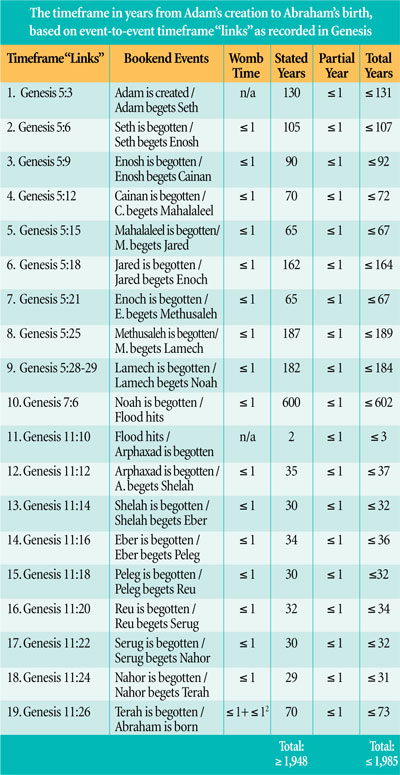
Image Credit: Institute for Creation Research

[2]

Add to these the genealogies recorded in Genesis 11 (included in the table above), and we learn that Abraham was born between 1,948 to 1,985 years after Creation or around 2018 BC. The year of Abraham’s birth is pretty well established +/- 100 years, so given the chronology recorded in Genesis, all of Creation is not much more than 6000 years old. Of course, many will argue that, but their argument is against Scripture. Personally, I would be careful about challenging God on the accuracy of His Word. To question what we do not understand is one thing. To deny the veracity of God’s Word is something else altogether. According to Scripture, the Earth is only about 6000 years old.

Notes:


[1]  “No Gap” https://erniecarrasco.com/2015/10/18/no-gap/

[2]  JAMES J. S. JOHNSON, J.D., TH.D, “How Young Is the Earth? Applying Simple Math to Data Provided in Genesis” – http://www.icr.org/article/how-young-earth-applying-simple-math-data-provided/


5 Comments

Filed under Apologetics, Bible, Christianity, Creation, Evolution, Religion, Theology

The Devil

Be sober, be vigilant; because your adversary the devil, as a roaring lion, walketh about, seeking whom he may devour: Whom resist stedfast in the faith, knowing that the same afflictions are accomplished in your brethren that are in the world. (1 Peter 5:8-9)

A 2003 Gallup poll concluded that 70% of Americans believe in the existence of the Devil.[1] A 2009 Barna survey stated, “A minority of Christians indicated that they believe Satan is real by disagreeing with the statement,”[2] i.e., that Satan is a real entity. I could not find a more recent survey, but my observation tells me that most either do not believe in the existence of the Devil or they are unaware or indifferent of his existence. On the darker side, there is a rise in Satan worship and the occult.[3]

Regardless of survey results or prevailing thought, Satan – the Devil, Lucifer, the Serpent the Dragon, the Accuser – exists. The Bible introduces him first as the conniving serpent in the Garden of Eden (Genesis 3:1).[4] The Book of Job identifies him as the Adversary (Job 1:6; 2:1) – “Satan” means “opponent or adversary.” Isaiah describes his pride and arrogance and his elevated position among God’s angels before his fall (Isaiah 14:12-15). The prophet Ezekiel offers a similar description (Ezekiel 28:11-19).

That the Devil is powerful is clear. However, his power is limited; he is not omnipotent (all-powerful) like God. He is not omniscient; therefore, he has to guess at what God will do. He knows the Bible better than most highly educated theologians do, but he cannot discern God’s ultimate plan; although he realizes his time is growing short.

The Devil is not omnipresent. He is a created being; therefore, he is constrained by time. God’s transcendence allows Him to exist both outside of time and at every point within time (past, present, future) simultaneously. The Devil cannot do that. The Devil must operate in the present, and he can only be in one place at a time. However, who knows how many demons he has working for him! To say, “The Devil made me do it” is probably a false accusation.

The Devil and his angels are immortal; therefore, they know a lot of “history” which is why they can reveal things about people in the past to “psychics.” However, they can only guess at the future.

All that said, the Devil is not to be trifled with. He hates God, and he hates God’s most prized creation – you and me. More than that, he hates God’s people – Christians and Jews – and he wants to do all he can to destroy them. He also thinks he can overthrow God. He thinks that by destroying God’s people, or by attempting to thwart God’s prophetic promises, that he can somehow subvert God. For such an intelligent creature, he really is stupid.

We need not fear the Devil. The Bible assures us that “greater is he that is in you, than he that is in the world” (1 John 4:4). Our leading verse reminds us that we must be “sober.” The Greek word nēphō means to “abstain from wine,” but it implies that we must keep a clear mind. There are many things besides drugs and alcohol that can cloud our thinking – anything that dominates our thoughts at the exclusion of God qualifies as insobriety. We must be “vigilant.” The Greek word there is grēgoreuō, and it means to be “watchful,” to be “on guard.” We are not watchful when the things of this world – things that are insignificant in the light of eternity – constantly and consistently distract us.

The Devil “walks around” (because he is not omnipresent) looking for whom he can devour. Christians cannot be eternally destroyed by the Devil, but he can surely make a mess of our lives if we let him. Therefore, we must be “sober” and “vigilant” and resist him when we remain “stedfast in the faith.” The Devil is a formidable opponent but not unbeatable. “Submit yourselves therefore to God. Resist the devil, and he will flee from you” (James 4:7, emphasis mine).

Notes:


[1] “The Devil and the Demographic Details”  https://news.gallup.com/poll/7858/devil-demographic-details.aspx

[2]  “Most American Christians Do Not Believe that Satan or the Holy Spirit Exist” https://www.barna.com/research/most-american-christians-do-not-believe-that-satan-or-the-holy-spirit-exist/

[3]  “What the Hell? Satan worship on rise in America” https://www.rt.com/op-ed/357523-what-hell-satan-worship-america/

[4]  “Why Satan?” https://erniecarrasco.com/2014/11/02/why-satan/

3 Comments

Filed under Apologetics, Christianity, Religion, Satan

How Long, O Lord?

And when he had opened the fifth seal, I saw under the altar the souls of them that were slain for the word of God, and for the testimony which they held: And they cried with a loud voice, saying, How long, O Lord, holy and true, dost thou not judge and avenge our blood on them that dwell on the earth? (Revelation 6:9-10)

I still have my head on my shoulders. I have not lost it or even had the threat of losing it over my faith in Christ. The verse above describes the Tribulation saints martyred for their faith. However, it makes me wonder about the many of our brethren that have died for their faith in other parts of the world. Are they asking the same question? “How long, O Lord do you not judge and avenge our blood?”

I have nothing about which to complain. I see persecution of Christians increasing in our nation, but it has not reached the level of imprisonments or beheadings – yet. Still, I wonder, “How long, O Lord?” How long must we wait for Jesus to come and call us home? How long until He returns to earth with His saints to set up His early kingdom for a thousand years? How long before we can experience true peace on earth? How long, O Lord?

The stage is set. Israel dwells in relative peace in her land of “unwalled villages” (Ezekiel 38:11). She has been there for 70 years. Because of her presence, the desert rejoices and blossoms as a rose” (Isaiah 35:1). Seventy Jubilees have passed since Moses received the commandment on Mt Sinai (Leviticus 25:10). Russia, Turkey, and Iran position themselves for the war described in Ezekiel 38-39. There have been “signs in the sun, and in the moon, and in the stars; and upon the earth distress of nations, with perplexity; the sea and the waves roaring” (Luke 21:25). In reality, not much else needs to be fulfilled. How long, O Lord?

Last week, the Feast of Trumpets came and went uneventfully. I really hoped to hear the Lord shout, “Come up hither” (Revelation 4:1), but nothing. Nothing says the Lord must come at the Feast of Trumpets or any other “special” time, for that matter. However, as I have written before, there is a good reason to consider these “high watch” days. This week brings the Day of Atonement (Leviticus 23:26-32) which is immediately followed by the Feast of Tabernacles (Leviticus 23:33-44). These are “Feasts of the Lord.” They are His divine appointments; therefore, it is not unreasonable to consider these days more likely than any others. However, we need to keep in mind Jesus’ words, “But of that day and hour knoweth no man, no, not the angels of heaven, but my Father only” (Matthew 24:36). Some debate about what that really means. The fact remains that we do not know. So, we wait. The time is near, but how long, O Lord?

4 Comments

Filed under Apologetics, Christianity, End Times, Religion, Second Coming of Christ

Still Listening Again

Behold, I shew you a mystery; We shall not all sleep, but we shall all be changed, In a moment, in the twinkling of an eye, at the last trump: for the trumpet shall sound, and the dead shall be raised incorruptible, and we shall be changed (1 Corinthians 15:51-52).

Every year for at least the last decade – ever since I learned about the Feasts of the Lord[1] – around this time of year, I start getting a little anxious with excitement wondering if this will be the year that Jesus will call His bride home.[2], [3], [4], [5], [6] This Monday, September 10, the Feast of Trumpets comes around again. For those of us who look forward to the Rapture of the Church, this is a “high watch” day. The reason for this, as I have explained in the past, is because this is the next Feast not fulfilled by Jesus’ First Advent. Therefore, it stands to reason that Rosh Hashanah (the Feast of Trumpets) would be a good time for Jesus to summon His Bride, the Church, home. Every year as I have waited, the day has come and gone, and we are still here. You might think that eventually I would experience “Rapture Fatigue” and give up on the whole idea. However, I still have oil in my lamp and even some extra! (Matthew 25:4)

Some will criticize and remind us that Jesus said, “But of that day and hour knoweth no man, no, not the angels of heaven, but my Father only” (Matthew 24:36). The Rapture is imminent. It could happen at any time, and we ought always to be ready. Nothing prophetically remains unfulfilled for this event to take place. Israel celebrated her 70th rebirthday this past May. We live in the generation that witnessed the “fig tree” bud (Matthew 24:32-33). This year wraps up the 70th Year of Jubilee since Moses gave the ordinance 3500 years ago. Israel is the focal point of end-times prophecy, so our attention must focus on current events in the Middle East. The stage is being set for what “prophecy watchers” call the “Ezekiel 38-39 War.” At the time of this writing, Russia, Turkey, and Iran are meeting concerning their involvement in Syria. Damascus almost resembles the ruinous heap described in Isaiah 17:1.

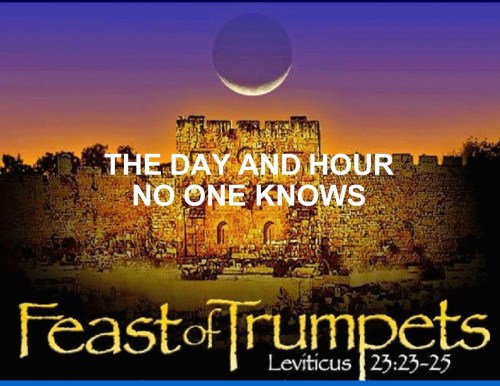
Will these things happen before or after the Rapture? We cannot tell. No man knows the day or the hour, but we sense that the time is near. Will the Rapture take place at the Feast of Trumpets? Perhaps. The Feast of Trumpets is celebrated over two days because it is based on the verified appearance of the new moon. Since the exact time of the appearance cannot be accurately predicted, the Feast of Trumpets is known as the feast of which “no man knows the day or the hour.” This year the watch is set for Monday and Tuesday, September 10 & 11 beginning at sundown on Sunday, September 9 (the date of this posting).

Will Jesus call for His Bride in the coming weeks? I do not know, but I hope so, and I am ready! How about you? If you are unsure, read my pages on “Securing Eternal Life” and on “Heaven.”

Notes:


[1]  “Rosh HaShanah” https://erniecarrasco.com/2016/10/03/rosh-hashanah/

[2]  “Still Waiting!” – https://erniecarrasco.com/2017/09/24/still-waiting/

[3]  “Now’s A Good Time!” https://erniecarrasco.com/2017/09/17/nows-a-good-time/

[4]  “Coming Soon!” https://erniecarrasco.com/2017/07/09/coming-soon/

[5]  “Rosh HaShanah”  https://erniecarrasco.com/2016/10/03/rosh-hashanah/

[6]  “Still Listening” https://erniecarrasco.com/2015/09/20/still-listening/

3 Comments

Filed under Apologetics, Christianity, Current Events, End Times, Evangelism, Gospel, Religion, Second Coming of Christ, Theology

Merit-Based Salvation

For God shall bring every work into judgment, with every secret thing, whether it be good, or whether it be evil. (Ecclesiastes 12:14)

There exists a common misconception among non-Christians and, sadly, even among some Christians, that when it comes time to meet our Maker that we can gain entrance into the celestial realm based on our merits. As our lead verse suggests, “God shall bring every work into judgment … whether it be good, or whether it be evil.” If challenged, those who hold that view almost always see themselves as better than most. They may admit to “small” sins like telling a “white lie” now and then, stealing a pack of gum, failing to correct a cashier when given too much change, or something equally innocuous. By their estimation, their “good” works will outweigh their “evil” works on the cosmic scales, and God will say, “Good enough!”

To some extent, it seems that the Bible teaches merit-based salvation. Our lead verse teaches that God looks at every work, both good and evil. Superficially, one may get the impression that He weighs the two – good on one side, evil on the other. First Peter 1:17 says that “the Father, who without respect of persons judgeth according to every man’s work…” (emphasis mine). Indeed, at the end of time when Christ’s millennial reign on earth has ended, a scene unfolds where all who ever lived appear before the judgment seat of Christ. “And the sea gave up the dead which were in it; and death and hell delivered up the dead which were in them: and they were judged every man according to their works” (Revelation 20:13).

It indeed appears that people will be judged according to their works. Should this be cause for hope for those counting on their own goodness? Taking a closer look at our leading verse, note that God scrutinizes “every work” and determines whether it is good or evil based on His standard of goodness. God made man in His image (Genesis 1:27), and for that reason, God deemed man “very good” (Genesis 1:31), but man messed that up in the Garden of Eden (Genesis 3). Beginning with fig leaves (Genesis 3:7), man’s attempt at covering up his sin always falls short of the perfection he possessed before the Fall. Only perfection qualifies for entry into the presence of God. “And there shall in no wise enter into it any thing that defileth, neither whatsoever worketh abomination, or maketh a lie: but they which are written in the Lamb’s book of life” (Revelation 21:27, emphasis mine). Interestingly, I cannot find the word “sin” in the book of Revelation, but there are several synonyms: anything that defiles, whatever works abomination or makes a lie. All of that is sin, so whether one has a little sin or a lot of sin, one is disqualified from entering heaven.

The Great White Throne Judgment scene in Revelation sees “books” opened, and the “dead” judged by the content of the books “according to their works” (Revelation 20:12). Evidently, there are “ledger books” recording both the good and evil deeds of every person that has ever lived. Since NOTHING that defiles “shall in no wise enter,” no one qualifies. “As it is written, There is none righteous, no, not one … For all have sinned, and come short of the glory of God” (Romans 3:10, 23). However, “The Lord is not slack concerning his promise, as some men count slackness; but is longsuffering to us-ward, not willing that any should perish, but that all should come to repentance” (2 Peter 3:9). There the guilty sinner stands before the Righteous Judge, “and another book was opened, which is the book of life … And whosoever was not found written in the book of life was cast into the lake of fire” (Revelation 20:15).

Reader, is your name written in the Book of Life? Do not think you are good enough – that your sins are minor compared to someone else. Only perfection gains entry into heaven and no one qualifies. However, there is a way. Please read my page on “Securing Eternal Life.”

Comments Off on Merit-Based Salvation

Filed under Apologetics, Christianity, Evangelism, Gospel, Religion, Salvation, Theology