Category Archives: Religion

Articles that deal with religions other than orthodox Christianity.

Being Gods

Jesus answered them, Is it not written in your law, I said, Ye are gods?       (John 10:34)

When Satan met Eve in the Garden of Eden, he charged that by His prohibition against eating the fruit of the tree of knowledge of good and evil, God denied Adam and Eve of something good. “For God doth know that in the day ye eat thereof, then your eyes shall be opened, and ye shall be as gods, knowing good and evil” (Genesis 3:5, emphasis mine).

Being gods remains mankind’s greatest desire. We all want to have complete, unfettered control of our lives with no one telling us what to do; and we want, as much as possible, to exert influence and control over others. The latter becomes more apparent daily as we witness the radical left’s efforts to alter the course of our nation. The strong desire to force upon our society their radical agenda manifests itself in unprecedented violence across our land. They want to be the gods that dictate what we all should do.

However, this is not a new phenomenon. History records the rise and fall of numerous demagogues. Bringing it closer to home, we might be tempted to deflect the guilt to them and deny that we harbor the same desire to make our own rules and impose them on others. We all like being gods to one extent or another.

In Jesus’ day, the religious leaders wanted to be gods, although they would never admit to that. They were the keepers of God’s law, and from their self-perceived superior position, they sought to impose their perception of God’s law on others. They enjoyed their position of control. They were being gods without knowing it. However, they met their match with Jesus. Him they could not control, so they sought to destroy Him.

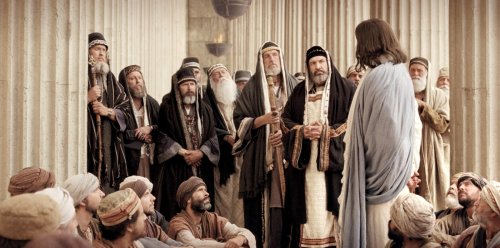
It was the winter before His crucifixion around the time of Hanukkah (John 10:22). The Jewish religious leaders surrounded Jesus with the hope of finding something with which to accuse Him of a capital offense. “Then came the Jews round about him, and said unto him, How long dost thou make us to doubt? If thou be the Christ, tell us plainly” (John 10:24). Jesus referred to His countless miracles, of which no doubt they were familiar, in His defense. Nevertheless, the clear evidence escaped these “blind guides” (Matthew 23:16, 24). Their incapacity to perceive the truth centered on the question of ownership. They were not Jesus’ sheep (John 10:26-27); they were their own “gods;” therefore they could not recognize His authority or submit to His direction.

Since the clear evidence eluded them, Jesus plainly told them what they wanted to hear, “I and [the][1] Father are one” (John 10:30). That was plain enough. Jesus made it clear that not only is He equal to God (the Father), He is the same as the Father. The message came through loud and clear. “Then the Jews took up stones again to stone him” (John 10:31). They got what they were after. He deserved to be stoned “for blasphemy; and because that thou, being a man, makest thyself God” (John 10:33).

Jesus then quoted from Psalm 82, “Is it not written in your law, I said, Ye are gods?” (John 10:34). The psalm begins with this declaration: “God standeth in the congregation of the mighty; he judgeth among the gods” (Psalm 82:1). Considering the parallelism of Hebrew poetry, “the mighty” and “the gods” are the same.[2] To “the mighty” and “the gods” God challenges, “How long will ye judge unjustly, and accept the persons of the wicked?” (Psalm 82:2). Then He charges, “Defend the poor and fatherless: do justice to the afflicted and needy. Deliver the poor and needy: rid them out of the hand of the wicked” (Psalm 82:3-4). These mighty gods are none other than the leaders of the people – ordinary men in extraordinary positions of power and authority. Yet, according to the psalm, they are ignorant of God’s laws and supplant them with laws of their own devices, so that “all the foundations of the earth are out of course” (Psalm 82:5). To these demigods, God says, “I have said, Ye are gods; and all of you are children of the most High. But ye shall die like men, and fall like one of the princes” (Psalm 8:6-7). God confers the appellation of “gods” on these rulers in that they are “children” of God. As such, they are God’s representatives on the earth, “princes” to carry out God’s will on earth. However, they are not more special than other men. They will die just like every other man.

The psalm ends with a cry for God to, “Arise, O God, judge the earth: for thou shalt inherit all nations” (Psalm 82:8). In the end, the One true God will reign over all the earth, and here He was standing before the Jewish leaders. God accused of blasphemy by the little gods.

Solomon rightly lamented, “The thing that hath been, it is that which shall be; and that which is done is that which shall be done: and there is no new thing under the sun” (Ecclesiastes 1:9, emphasis mine). We still try to be our own gods – set our own rules and impose our will on others. Since the Garden of Eden, we continue being gods, even if only in our minds. The sooner we learn to let God be God, the sooner we can enjoy the peace and rest that only God can give. To all who are tired of being gods, Jesus says, “Come unto me, all ye that labour [at being gods] and are heavy laden, and I will give you rest” (Matthew 11:28).

Notes:


[1]  The KJV inserts “my” in italics where the Greek text (Textus Receptus) used the definite article “the” before “Father.”  εγω και ο πατηρ εν εσμεν

[2]  Michael S. Heiser, in his book The Unseen Realm, suggests that the elohim (gods) in this psalm refers to the “congregation” of the bene elohim (sons of God) that make up the council of God.  These include both God’s angels and Satan’s angels as seen in Job 1. That idea is not implausible, however, based on Jesus’ reference to it, it can also apply to mankind.


1 Comment

Filed under Apologetics, Christianity, Gospel, Religion, Satan

Three Fingers Back

Behold, how good and how pleasant it is for brethren to dwell together in unity! (Psalm 133:1)

I often hear the charge, “that’s not very Christian” coming from non-Christians when a Christian acts or speaks in a manner which the non-Christian deems inappropriate for a Christian (as if they would know what is or is not appropriate for a Christian). I get that. They make those judgments based on their humanistic worldview that determines right or wrong according to their contrived values. It is a relativistic worldview that authorizes the individual to make value judgments as he sees fit. “Every man did that which was right in his own eyes” (Judges 21:25). Everyone has his/her own value system. Everyone has his/her own “truth.” One can say or do whatever one wishes as long as it is legal and “it does not hurt anyone else.” That rule applies to everyone – except for Christians. Christians are judged by a different measure. That measure is the subjective preconception of how a Christian ought to behave.

While I understand the source of the non-Christian’s warped perspective of how a Christian should behave, I am really taken aback when I hear the exact criticism coming from another Christian. What is up with that! One would think that all Christians should present a united front. That was Jesus’ desire for us. “Neither pray I for these alone, but for them also which shall believe on me through their word [that be us]; That they all may be one; as thou, Father, art in me, and I in thee, that they also may be one in us: that the world may believe that thou hast sent me” (John 17:20-21, emphasis mine).

Now when the Mormons come knocking on your door, this is one fault they like to point out. “Why are there so many religions when Jesus wanted us all to be one?” When someone asks me that question, I quickly agree and say, “I think we should all be Baptists!” I am joking, of course. I understand most of the denominational differences, but as Christians, we should all have one thing in common that unifies us. Salvation is through Grace alone, through Faith in Christ alone. “For by grace are ye saved through faith; and that not of yourselves: it is the gift of God: Not of works, lest any man should boast” (Ephesians 2:8-9). We can discuss our differences on how we view baptism, communion, predestination vs. free will, glossolalia (speaking in tongues), eschatology (end times), creation, etc. We can even debate over those issues – in love. However, we must keep those discussions based on Scripture, not on personal opinion or the opinions of others. What does the Bible – God’s Word – have to say about it? There is nothing wrong with that, and there is much right about that. “Iron sharpeneth iron; so a man sharpeneth the countenance of his friend” (Proverbs 27:17).

However, questioning the Christianity of another Christian – especially in a public forum like Facebook – is wholly inappropriate. That very act is “un-Christian.” The familiar axiom – “When you point the finger at someone else, you have three fingers point back at you” – is true. Jesus said, “Judge not, that ye be not judged” (Matthew 7:1). However, in saying that, He was not prohibiting value judgments. In context (Matthew 7:1-6), Jesus referred to making a condemning judgment against someone else. The Greek word translated “judge” is krinō, which means to condemn. Only Jesus can properly judge an individual because only He knows the heart and the motives of the person. We do not possess that ability. We can, however, judge actions – what can actually be seen – and determine whether those actions are right or wrong from the rubric of God’s Word. We can determine if a brother’s actions are not in keeping with God’s Word, but we have no right to accuse him of not being a Christian. We know neither his heart nor his motives.

Jesus makes it clear that we must make judgments. In the same passage, He said, “Give not that which is holy unto the dogs, neither cast ye your pearls before swine, lest they trample them under their feet, and turn again and rend you” (Matthew 7:6). Determining who the “dogs” and “swine” are demands a judgment. “That which is holy” and “your pearls” is the Gospel message we have to offer. Some people will reject the message and treat it as a dog treats a rag toy. The message will offend others to the point that they will attack you – either verbally or physically. Either way, their actions determine whether you continue to share the Gospel with them or not. When that happens, Jesus said to “shake off the dust under your feet for a testimony against them” (Mark 6:11). You have made a judgment.

Jesus later offers another example. He said, “Beware of false prophets, which come to you in sheep’s clothing, but inwardly they are ravening wolves. Ye shall know them by their fruits. Do men gather grapes of thorns, or figs of thistles?” (Matthew 7:15-16). How does one recognize a false prophet without making a judgment? One must judge! By what standard do we make that judgment? We make that judgment based on the Word of God. When the prophet speaks, do his words match up with the Word of God? You have to make a judgment! Jesus further points to the actions – fruit – of the false prophet. If that prophet talks like a Christian but behaves like the devil, then perhaps you are right to point at the “bad fruit.” If the prophet’s message is inconsistent with the Word of God, then he should be called out for his false teaching but be sure you are standing on firm, biblical ground. Also, be prepared to take on fire.

Again, we cannot judge the heart or the motives of another believer, or anyone for that matter. It is possible, though doubtful, that the false prophet is a Christian. I have known false prophets who spoke the truth, right out of God’s Word, but their lives told a different story. The truth of God’s Word remains, though the messenger may be faulty. Here is where we must be careful in making judgments. The false prophet may or may not be a true believer. I have heard testimonies of pastors that preached behind pulpits for many years before realizing their own lost condition and turning to Christ for salvation. It can happen! Jesus cautioned, “And why beholdest thou the mote that is in thy brother’s eye, but considerest not the beam that is in thine own eye? … Thou hypocrite, first cast out the beam out of thine own eye; and then shalt thou see clearly to cast out the mote out of thy brother’s eye” (Matthew 7:3, 5).

Before accusing a fellow believer of not being Christian, we must examine ourselves – critically – to make sure we are not at fault. Moreover, I cannot emphasize it strongly enough; our judgment – even our self-examination – must be based on Scripture, not personal (or “expert”) opinion. We should be willing to judge ourselves more strictly than we do the errant brother. Then, with our conscience cleared by the Holy Spirit, we can judge the “actions” of that brother – never, never the heart or motives. When we find a brother in err, Jesus said, “Moreover if thy brother shall trespass against thee, go and tell him his fault between thee and him alone: if he shall hear thee, thou hast gained thy brother” (Matthew 18:15). What if he will not listen? Read the rest of the passage.

There is another danger in Christians accusing Christians of non-Christian behavior. If you do this, you are playing for the wrong team. There is one who constantly brings charges against Christians before God. He is known as “the accuser of our brethren” (Revelation 12:10). Scripture first introduces him to us in that role in the account Job’s life (Job 1:6-7). His name is Lucifer (Isaiah 14:12), but his title is Satan – accuser. Of this one, Jesus said, “He was a murderer from the beginning, and abode not in the truth, because there is no truth in him. When he speaketh a lie, he speaketh of his own: for he is a liar, and the father of it” (John 8:44). When we wrongly judge another Christian – especially in a public way – we are guilty of slander. Another word for slander is character assassination, i.e., murder. When you do that, you are doing the devil’s work for him. Do you really want to go there?

Judge, but judge with righteous judgment. Jesus said, “Judge not according to the appearance, but judge righteous judgment” (John 7:24). The only way to carry out righteous judgment is by the standard of God’s Word – not your feelings, not your opinions, not the opinions of “experts,” and especially not by the ever-changing standards of the world. God’s Word is the only measure by which to judge righteously. When you feel tempted to judge a fellow believer, take a very close look at yourself and “first cast out the beam out of thine own eye.” You may find that you are the one in the wrong, not your brother. If your brother is in the wrong, take him aside and lovingly help him see his error from Scripture. Don’t point out his error on Facebook or some other public forum; that is what Satan would have you do because Satan’s goal is to destroy the Christian witness however he can. Don’t help him; he does a good job of that on his own. Remember, when you point the finger, three are pointing back at you.

Comments Off on Three Fingers Back

Filed under Apologetics, Bible, Christianity, Religion

Bad Copy

And God blessed them, and God said unto them, Be fruitful, and multiply, and replenish the earth, and subdue it: and have dominion over the fish of the sea, and over the fowl of the air, and over every living thing that moveth upon the earth. (Genesis 1:28)

In 1996, Michael Keaton starred in the movie “Multiplicity” where he plays the part of a man who never seems to have enough time to gets things done.  To resolve this problem, he is offered the opportunity to have himself duplicated, i.e., cloned.  The initial “copy” is pretty good except that he displays some character flaws that the “original” can normally keep under control.  Keaton assigns all the tasks he cannot manage to the copy, and soon the copy becomes overwhelmed and decides to have himself duplicated as well.  The second copy is a little more degraded than the first copy.  The second copy also has himself duplicated, then the third and then the fourth, and so on.  Each subsequent copy is more degraded than the previous until the final copy is a complete drooling imbecile.  The concept makes for a hilarious movie, but it is not that far from the truth.

Brian Thomas, science writer for the Institute for Creation Research, recently cited a study published in Science that compared detailed sequences of 202 genes in 14,002 people.  What they discovered was that many people have rare, individual differences in their gene sequences that were probably caused by mutations that arose over the last few thousand years.  What this implies is that these gene variants developed recently.  Mr. Thomas asks, “Why has all this population growth and mutational build up only just occurred, if humans have been on the planet for ‘at least 2.4 million years’?”

There are 60-200 new mutations (which are either neutral or detrimental, but rarely beneficial) added every generation.  If evolution were true, with the cumulative effects of 60-200 mutations per generation over 100,000 years (supposedly when modern man evolved), we should all end up like the final copy in Michael Keaton’s movie!  This is what J. S. Sanford, Ph.D. terms as “backwards evolution” (Genetic Entropy and the Mystery of the Genome).  But that is not what we see.  Instead, what we do see is that there is degeneration in the general gene pool.  Thomas adds, “Since there is no natural process that repairs these kinds of mutations faster than they accumulate, they continuously amass until organisms eventually can no longer tolerate the high level of genetic error” – and mankind would become extinct.  These findings present a problem for evolutionists, but they are not a problem for the biblical record which presents creation as young (about 6000 years old).

One of the questions that frequently comes up in a discussion of Genesis is “Where did Cain get his wife?”  The answer is simple, really; he married one of his sisters.  While the idea is repugnant to us, it really makes a lot of sense, if you think about it.  It was not until the time of Moses that God instituted laws against incest.  This was to minimize the degeneration process of passing on mutated genes.  When Adam and Eve were created, their DNA was perfect, so they passed on perfect DNA to their offspring.  In the process of time, mutations started creeping in, and the best way to minimize the negative effects of mutations was not to propagate them within a family.  Thomas says that, “The non-beneficial mutations always far outpace the beneficial, adding up relentlessly generation after generation and eventually leading to a catastrophic population collapse.”  But here we are!  The theory of evolution says that we should be improving, but that is not what the real evidence shows.

Will the human race eventually end up like the final clone in the Keaton movie?  Not hardly.  To those who belong to Him, Jesus said, “Let not your heart be troubled: ye believe in God, believe also in me. In my Father’s house are many mansions: if it were not so, I would have told you. I go to prepare a place for you.  And if I go and prepare a place for you, I will come again, and receive you unto myself; that where I am, there ye may be also” (John 14:1-3).  Furthermore, those who belong to Him will receive flawless bodies like His.  “[Jesus] shall change our vile body, that it may be fashioned like unto his glorious body, according to the working whereby he is able even to subdue all things unto himself” (Philippians 3:21).  Those who are not His will suffer an awful fate.  Jesus said, “If a man abide not in me, he is cast forth as a branch, and is withered; and men gather them, and cast them into the fire, and they are burned” (John 15:6).  “And whosoever was not found written in the book of life was cast into the lake of fire” (Revelation 20:15).  There will be no bad copies in heaven.  Will you be there?

References:

More Mutations Mean More Diseases, Less Evolution

The Human Mutation Clock is Ticking

New Genomes Project Indicate a Young Human Race

Cain’s Wife:  It Really Does Matter!

Image credit:  http://www.123rf.com/photo_11713544_chromosomes–genetic-engineering.html

2 Comments

Filed under Atheism, Christianity, Creation, Current Events, End Times, Evolution, Gospel, Religion, Theology

O Beautiful!

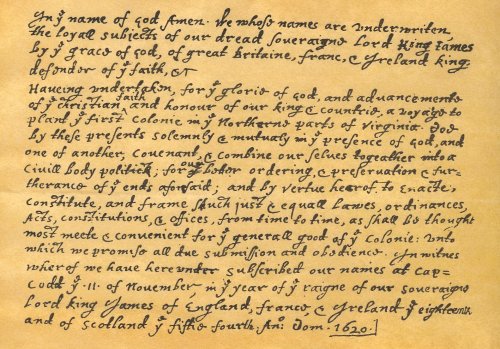
Mayflower Compact, Signed November 11, 1620

Blessed is the nation whose God is the LORD; and the people whom he hath chosen for his own inheritance. (Psalm 33:12)

President Obama insulted American Christians when he proclaimed to the world that America was not a Christian nation. He went on to announce that America was just as much of a Muslim, Hindu, Buddhist or any other religion of your choice nation. Christians rightly protested (without violence or destruction of public and private property) that America was indeed a Christian nation as enshrined in our founding documents.

Before setting foot on their “promised land” on November 11, 1620, the Pilgrims covenanted together “for the glory of God and the advancement of the Christian faith” to “combine” themselves “together into a civil body politic.” The Mayflower Compact later influenced the freedom pact declaring our nation’s independence on July 4, 1776, assuming “among the Powers of the Earth, the separate and equal Station to which the Laws of Nature and of Nature’s God entitle them.” The declaration went on to assert, “We hold these Truths to be self-evident, that all Men are created equal, and they are endowed by their Creator with certain unalienable Rights, that among these are Life, Liberty, and the Pursuit of Happiness.” After a long list of grievances, they made their appeal “to the Supreme Judge of the World” declaring their “firm Reliance on the Protection of divine Providence,” i.e., God.

The reliance on Divine Providence prompted the founders to include in the Bill of Rights of the US Constitution, the First Amendment protecting freedom of religion. “Congress shall make no law respecting an establishment of religion, or prohibiting the free exercise thereof.” The amendment also guaranteed freedom of speech, freedom of the press and “the right of the people to peaceably assemble, and to petition the Government for a redress of grievances.” This First Amendment (and the Second that secures it) is under assault on many fronts. A plain reading of the text makes it clear that the government cannot impose one religion over another. At the same time, the government cannot prohibit the free practice of a citizen’s religion. Conspicuously, no restrictions exist on the exercise of religious practice – no restriction for the free practice in public, public schools, public buildings, public events, or any other such restrictions. However, put up a Nativity Scene in the public square, or the Ten Commandments at the county courthouse or on the wall of a public school, or offer a prayer at the start of a high school sports activity, and the ACLU will be out in full force looking for someone to sue. On what grounds? The ACLU will argue that such religious activity violates the “separation of church and state,” a phrase found nowhere in the Constitution. With the aid of unscrupulous judges, the ACLU intimidates victims without the resources to fight the litigation so that they give up without a fight. Slowly, the ACLU has eroded away the concept of religious liberty.

Now, legislation in various states, California in particular, slowly chips away at what remains of the First Amendment by declaring that any denunciation of sodomites is “hate speech” and therefore illegal. That destroys free speech. It destroys freedom of the press, which might even make the Bible illegal because it has much to say about deviant sex acts. It could follow that the freedom to peaceably assemble in a church that teaches against sodomy will be declared illegal, and forget about petitioning the government over such a grievance. There goes the First Amendment. Without the Second Amendment, which is systematically being picked apart, how can the First Amendment be defended?

Barack Obama was right. Whatever America used to be, it is no longer a Christian nation. I hear many Christians express optimism that we can turn around this nation. Many hope for national revival (2 Chronicles 7:14 – taken way out of context). I must admit, I do not share that optimism. That ship has sailed. America is no longer a Christian nation, and it will never again be a Christian nation. Christians – genuine, born-again, Bible-believing, evangelical Christians – in America are rapidly becoming the “remnant.” We can voice our complaints until our tonsils bleed, and nothing will change, except perhaps for the worst.

I do not mean to be a Gloomy Gus, nor do I want to be a Pollyanna. I want to be realistic, and I want to be biblical. While the Bible teaches that we are to submit to our governing authorities (Romans 13:1-8) and that we should pray our leaders (1 Timothy 2:1-4), we must recognize that our primary citizenship is not of this world, but the kingdom of Jesus Christ. “For our [citizenship] is in heaven; from whence also we look for the Saviour, the Lord Jesus Christ” (Philippians 3:20). In His high priestly prayer, Jesus affirmed, “They are not of the world, even as I am not of the world” (John 17:16). While America is not “the beautiful,” innocent virgin she once was, we who have placed our trust in Christ, are children of the King, (John 1:12) and citizens of His realm. While we remain and while He delays His return, we must turn our focus and our efforts to His Kingdom. The things of this earth, including America the Beautiful, are passing away (1 John 2:17), but His Kingdom will last forever (Luke 1:33). “When ye shall see these things come to pass, know that it is nigh, even at the doors” (Mark 13:29).

O, Beautiful! I lament your demise, but I rejoice knowing that the Lord will soon return, and He will truly make America great again – better than ever! Not only America, but His reign on earth will make the whole earth better than before. Come quickly, Lord Jesus!

1 Comment

Filed under Apologetics, Christianity, Current Events, End Times, Holidays, Politics, Religion, Second Coming of Christ

Conversation

Whoso offereth praise glorifieth me: and to him that ordereth his conversation aright will I shew the salvation of God. (Psalm 50:23)

We engage in conversation on a daily basis. If there is no one around with whom to converse, we sometimes hold a conversation with ourselves or with the dog or cat. Conversation can be completely mindless or profound.

The modern dictionary defines “conversation” as: “informal interchange of thoughts, information, etc., by spoken words; oral communication between persons; talk; colloquy.” In addition, noted as “obsolete,” conversation can mean “behavior or manner of living.”[1] That “obsolete” definition is what we find throughout the King James Version (KJV) of the Bible; therefore, we must grasp this meaning of the word. Otherwise, Scripture, like the passage above, becomes confusing, and the deeper meaning of the text is lost.

Before considering the biblical application of the word, let us consider its etymology.

Conversation (n.) mid-14c., “place where one lives or dwells,” also “general course of actions or habits, manner of conducting oneself in the world,” both senses now obsolete; from Old French conversacion “behavior, life, way of life, monastic life,” and directly from Latin conversationem (nominative conversatio) “frequent use, frequent abode in a place, intercourse, conversation,” noun of action from past-participle stem of conversari “to live, dwell, live with, keep company with,” passive voice of conversare “to turn about, turn about with,” from assimilated form of com “with, together” (see con-) + versare, frequentative of vertere “to turn” (from PIE root *wer- (2) “to turn, bend”).[2]

Considering that the KJV was first published in 1611, the original meaning of the word should be applied in the reading. Basically, the word “conversation” in the Bible (and here I mean the KJV Bible) refers to the way one conducts one’s life. Our “conversation” is how we live, conduct, or carry on our lives. Each person’s conversation will differ and will reflect either who he/she really is or who he/she pretends to be. With that in mind, let us look at some passages from Scripture that provide instruction for our “conversation.”

The English word “conversation” appears 20 times in the KJV Bible, twice in the O.T. and 18 times in the N.T. In some instances, “conversation” may translate different Hebrew or Greek words and may obscure a deeper meaning. We shall see.

Both O.T. occurrences of the word appear in Psalms and translate the same Hebrew word, derek, which literally means a “road” or a “path.” By implication, it is the course of one’s life. Psalm 37:14 says that “the wicked” target those who live an “upright” or “righteous” life. “The wicked have drawn out the sword, and have bent their bow, to cast down the poor and needy, and to slay such as be of upright conversation.” That is not much incentive for living a godly life, however, Psalm 50:23 offers great encouragement from God. “Whoso offereth praise glorifieth me: and to him that ordereth his conversation aright will I shew the salvation of God.” (By the way, taking the “whole counsel” of God’s Word into account, simply living a “good life” will not earn anyone salvation. Ordering your “conversation aright” begins with trusting Jesus as your Lord and Savior.)[3]

As previously stated, “conversation” appears 18 times in the N.T., but it translates different Greek words. The most frequent Greek word translated is anastrophē, which means “behavior.” We find this first in Galatians 1:13. Here, Paul describes how he behaved before meeting the Lord Jesus. “For ye have heard of my conversation in time past in the Jews’ religion, how that beyond measure I persecuted the church of God, and wasted it.” Paul’s life changed radically after meeting Jesus face-to-face. He went from being a zealous persecutor of the Church to being persecuted for preaching the Gospel – equally as zealously. Thus he encourages believers to follow his example: “That ye put off concerning the former conversation the old man, which is corrupt according to the deceitful lusts; And be renewed in the spirit of your mind; And that ye put on the new man, which after God is created in righteousness and true holiness” (Ephesians 4:22-24). A “Christian” that continues in the sin of his/her former life does not carry on a new “conversation” indicating that no change has transpired in his/her life.

As followers of Christ, our lives should be examples to others as Paul encouraged Timothy. “Let no man despise thy youth; but be thou an example of the believers, in word, in conversation, in charity, in spirit, in faith, in purity” (1 Timothy 4:12). James says that our good behavior demonstrates “wisdom” and “knowledge.” “Who is a wise man and endued with knowledge among you? let him shew out of a good conversation his works with meekness of wisdom” (James 3:13).

Peter uses anastrophē eight times in his letters. Our behavior must be “holy,” i.e., “set apart” (for God’s use). “But as he which hath called you is holy, so be ye holy in all manner of conversation” (1 Peter 1:15). What God has done for us deserves our very best. “Forasmuch as ye know that ye were not redeemed with corruptible things, as silver and gold, from your vain conversation received by tradition from your fathers; But with the precious blood of Christ, as of a lamb without blemish and without spot: (1 Peter 1:18-19).

Relate to anastrophē is anastrepho, the verb form, which means “to overturn; also to return; by implication to busy oneself.” In other words, these are the “actions” one takes. This Greek verb is used twice in the N.T. by Paul. In 1 Corinthians 1:12, he refers to his “conversation in the world,” that is, the “work” he is doing. In Ephesians 2:3, Paul refers to the sinful activities in which we once participated. “Among whom also we all had our conversation in times past in the lusts of our flesh, fulfilling the desires of the flesh and of the mind; and were by nature the children of wrath, even as others.”

In the Epistle to the Philippians, “conversation” translates both the noun and verb form of politeuma (n.) meaning “a community” and abstractly referring to “citizenship.” “For our conversation [citizenship] is in heaven; from whence also we look for the Saviour, the Lord Jesus Christ” (Philippians 3:20). The verb form, politeuomai, means to “behave as a citizen.” When we come to Christ, we are no longer citizens of this world; we are “citizens” of heaven. Therefore, we ought to act the part.

Finally, “conversation” translates the Greek noun tropos meaning “a turn, that is, (by implication) mode or style. It is synonymous with anastrophē, and it refers to “deportment or character,” i.e., the way we conduct ourselves. We find this one-time use in Hebrews 13:5, “Let your conversation [deportment] be without covetousness; and be content with such things as ye have: for he hath said, I will never leave thee, nor forsake thee.”

Jesus paid a high price to give us eternal life. We who have placed our faith in Him are now “children of God” (John 1:12) and citizens of heaven; we are not of this world (John 17:16). Therefore, our “conversation” should reflect our status, not pridefully, but with humility and meekness, as children of the King and citizens of His Kingdom!

 Notes:


[1]  http://www.dictionary.com/browse/conversation?s=t

[2]  https://www.etymonline.com/word/conversation

[3]  “Securing Eternal Life” – https://erniecarrasco.com/securing-eternal-life/

1 Comment

Filed under Apologetics, Bible, Christianity, Religion