Category Archives: Resurrection

The First Day of the Week

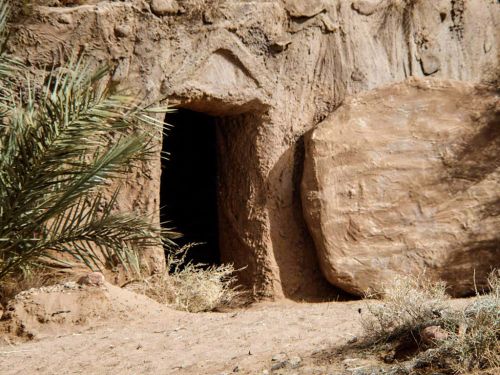
The first day of the week cometh Mary Magdalene early, when it was yet dark, unto the sepulchre, and seeth the stone taken away from the sepulchre. (John 20:1)

The unbelieving Pharisees sought a sign from Jesus proving His credentials. “But he answered and said unto them, An evil and adulterous generation seeketh after a sign; and there shall no sign be given to it, but the sign of the prophet Jonas [Jonah]: For as Jonas was three days and three nights in the whale’s belly; so shall the Son of man be three days and three nights in the heart of the earth” (Matthew 12:39-40).

Most of us know the historical account of Jonah the rebellious prophet of God who ran in the opposite direction of where God had sent him. God has a heart for the lost. The Bible tells us that “The Lord is not slack concerning his promise, as some men count slackness; but is longsuffering to us-ward, not willing that any should perish, but that all should come to repentance” (2 Peter 3:9, emphasis mine). So, God commanded Jonah to go preach to the wicked Assyrians, the mortal enemies of Israel, in Nineveh. These were mean people that tortured and abused their victims harshly. All the neighboring nations feared and hated them, and Israel was next on their menu. Jonah wanted nothing to do with them, and he especially did not want God to bless them in any way. So, rather than obey God’s command, Jonah boarded a ship bound for Spain (Tarshish).

You know the story. God sent a storm that put the ship in danger. Jonah confessed of his rebellion to the crew and they tossed him overboard to appease the Lord, quiet the storm, and calm the sea. The second chapter of Jonah describes the “sign” to which Jesus referred.

God prepared a great fish to swallow up Jonah. Much ink has been spilt in attempt to identify the creature that swallowed Jonah. Some think it could have been something like a whale shark; they certainly are large enough to swallow a man whole. Others propose it was a whale, but a whale is not a “fish” and the Hebrew uses another word for whale, tannı̂yn, which means “sea monster,” or any large sea animal like a dragon or sea serpent. But the Hebrew word used, dâg, means “fish.” If the scholars would just listen to me I can easily resolve the question. The “fish” resembled nothing that we might recognize because the Bible says that God “prepared” this fish specifically for this occasion. The Hebrew word “prepared” is mânâh and it also means “to weigh out; to allot; to appoint.” God designed this fish for an appointment with Jonah.

It is difficult to imagine any man surviving the ordeal of being in the belly of a fish for three days. It seems from Jonah’s prayer that perhaps he actually died. He says, “I cried by reason of mine affliction unto the LORD, and he heard me; out of the belly of hell cried I, and thou heardest my voice” (Jonah 2:2). The Hebrew word translated “hell” here is she’ôl, the “abode of the dead.” It was understood to be the place where the spirits of the dead resided. The Greek word for the same place is hadēs. Jesus referred to this place when He spoke of the rich man who died and went to “hell” (hadēs).[1] Jesus said that when the rich man arrived in this place, “…he lift up his eyes, being in torments, and seeth Abraham afar off, and Lazarus in his bosom. And he cried and said, Father Abraham, have mercy on me, and send Lazarus, that he may dip the tip of his finger in water, and cool my tongue; for I am tormented in this flame” (Luke 16:23-24). Obviously, the man, though he was physically dead, retained all of his senses.

Likewise, Jonah describes his experience in Sheol. He says, “For thou hadst cast me into the deep, in the midst of the seas; and the floods compassed me about: all thy billows and thy waves passed over me. Then I said, I am cast out of thy sight; yet I will look again toward thy holy temple” (Jonah 2:3-4, emphasis mine). Jonah sensed the separation, yet he maintained the hope that one day he would see the “holy temple.”

Jonah prophesied in Israel, the Northern Kingdom, which had no temple. The only Temple resided in Jerusalem, so it seems that Jonah referred to the Holy Temple in heaven of which the earthly Temple was modeled.

Jonah also hints of his death when he says, “I went down to the bottoms of the mountains; the earth with her bars was about me for ever: yet hast thou brought up my life from corruption, O LORD my God” (Jonah 2:6, emphasis mine). The word “corruption” (Hebrew: shachath) can also be translated “destruction.” Jonah continues, “When my soul fainted within me I remembered the LORD: and my prayer came in unto thee, into thine holy temple” (Jonah 2:7). Again, Jonah’s prayer ascended to God’s Holy Temple in heaven.

Jonah died in the belly of the fish, and God revived him after three days and three nights.[2] In like manner, Jesus said He would be in the heart of the earth three days and three nights and rise again.

Jesus died on the cross on Passover. He was our Passover Sacrifice.[3] His death paid the debt of our sins. They buried Him before sundown on Passover and rolled a heavy stone over His tomb. Pilate sealed the tomb with his official seal and posted a Roman guard to watch and ensure that no one tampered with the sepulcher.[4] Then, after three days and three nights in the grave, like Jonah, God raised Jesus from the grave on the first day of the week. Jonah died again eventually, but Jesus lives on. Forty days following His resurrection, Jesus ascended into heaven[5] where He awaits His return to this earth.

The “sign of Jonah” was for the unbelieving Pharisees, who, after His resurrection, continued in their unbelief. The validity of the sign continues even unto our generation. Christ has risen. The tomb is empty. Doubters continue in their rejection hoping that one day someone will find His bones and say, “Here He lies!” But they fail. One day, maybe soon, they will gaze into the sky and behold Him in all His glory “this same Jesus, which is taken up from you into heaven, shall so come in like manner as ye have seen him go into heaven” (Acts 1:11).

Reader, if you are not prepared for that day, please see my page “Securing Eternal Life” before it is too late for you. And as Jesus said, “be not faithless, but believing” (John 20:27).


Notes:


[1]  Luke 16:19-31

[2]  Jonah 1:17

[3]  1 Corinthians 5:7

[4]  Matthew 27:62-66

[5]  Acts 1:3

Comments Off on The First Day of the Week

Filed under Apologetics, Christianity, Easter, Heaven, Hell, Resurrection, Salvation, Second Coming of Christ, Theology

A Soul

Behold, all souls are mine; as the soul of the father, so also the soul of the son is mine: the soul that sinneth, it shall die. (Ezekiel 18:4)

What comes to mind when you think of “a soul”? For most of my life, I imagined a soul as some ethereal, intangible, wispy inhabitant of our body that occupied our being that then departed when the physical body died. I suppose most people look at a soul in much the same way. Dictionary.com defines a soul as: (1) the principle of life, feeling, thought, and action in humans, regarded as a distinct entity separate from the body, and commonly held to be separable in existence from the body; the spiritual part of humans as distinct from the physical part; (2) the spiritual part of humans regarded in its moral aspect, or as believed to survive death and be subject to happiness or misery in a life to come; (3) the disembodied spirit of a deceased person; (4) the emotional part of human nature; the seat of the feelings or sentiments; (5) a human being; person (emphasis mine).[1]

That last definition, I think, is the biblical understanding of “a soul.” In the Genesis account of the creation of man, I envision God (Jesus, in His pre-incarnate form) bending over a mass of reddish clay molding the human form. Scripture records, “And the LORD God formed man of the dust of the ground” (Genesis 2:7, emphasis mine). The Hebrew word translated “formed” is yâtsar, and it carries the idea of squeezing something into shape; to mold into the desired shape as a potter molds and forms a clay vessel. The idea goes well considering the construction material used – dust.

With the body plan complete, God, “breathed into his nostrils the breath of life; and man became a living soul” (Genesis 2:7, emphasis mine). The Hebrew words translated “breathed” and “breath” are related. From the English translation, we can see that the former is a verb and the latter is a noun. The Hebrew words are nâphach and neshâmâh respectively and both mean “a puff.” The word “soul” is also related: nephesh. It means “living creature” and it can refer to either a human being or an animal. Yes, as defined here, animals have “souls” (nephesh); however, they do not possess that special neshâmâh of life “puffed” into humans by God.

This puff of life from God caused God’s mud sculpture to rise and become a living soul with a physical body, mind, and neshâmâh (breath/spirit of life). A triune creature created in the image of God[2] hitherto known as “a living soul.” God is triune in nature: Father, Son, and Holy Spirit. Collectively we just say, “God.” Man, made in the image of God, is triune in nature: mind, body, and spirit. Collectively, the Bible refers to the unit as “a soul.”

There are many examples where this becomes obvious, but I will keep the list brief. The first example following the creation account comes when Abraham travels to Egypt and tries to pass off Sarah, his wife, as his sister. He tells Sarah, “Say, I pray thee, thou art my sister: that it may be well with me for thy sake; and my soul shall live because of thee” (Genesis 12:13). “My soul” (nephesh) here does not refer to his “spirit.” Abraham feared for his life – his physical life.

Later, when God confirmed His covenant with Abraham, God required that he and all males within his household be circumcised.[3] Disobedience to this command carried a penalty. “And the uncircumcised man child whose flesh of his foreskin is not circumcised, that soul shall be cut off from his people; he hath broken my covenant” (Genesis 17:14). “That soul” (nephesh) refers to the whole person not just his spirit. Interestingly, in the account of Abraham rescuing his nephew Lot and others, the word nephesh is translated “persons” (Genesis 14:21).

Genesis 27 records the account of Jacob “stealing” his brother’s blessing by deceiving his father, Isaac. In the passage, “my soul” appears twice and “thy soul” shows up two times.[4] The meaning in each case is somewhat ambiguous; however it seems clear that its use refers to the whole person. More examples could be cited in Genesis, but other examples will help solidify my point.

Exodus records that “all the souls that came out of the loins of Jacob were seventy souls” (Exodus 1:5, emphasis mine). Obviously, this refers to people, not disembodied spirits. Then when God called Moses to lead Israel out of Egypt, God assured him that, “all the men are dead which sought thy life” (Exodus 4:19). The Hebrew word translated “thy life” is nephesh (soul). With regard to keeping the Sabbath, God said, “Ye shall keep the sabbath therefore; for it is holy unto you: every one that defileth it shall surely be put to death: for whosoever doeth any work therein, that soul shall be cut off from among his people” (Exodus 31:14, emphasis mine). Again we see that “a soul” is a person.

The book of Leviticus offers many examples where the word “soul” (nephesh) refers to an individual. Here is one example: “if a soul touch any unclean thing … he also shall be unclean, and guilty” (Leviticus 5:2). To touch requires a physical body. Regarding the prohibition against eating blood: “No soul of you shall eat blood, neither shall any stranger that sojourneth among you eat blood” (Leviticus 17:12). Again, it requires a physical body to eat blood.

There are 420 occurrences of the word “soul” in the Old Testament and nearly twice as many occurrences of the Hebrew word nephesh translated in other forms, for example, life, creature, persons, man, mind, et al. In the majority of occurrences, the word refers to the whole person. There is at least one instance in which the word seems to refer to the spirit of one who has died. Of Rachel’s death in childbirth, Scripture records, “And it came to pass, as her soul was in departing, (for she died) that she called his name Benoni: but his father called him Benjamin” (Genesis 35:18). However, we may infer that when the spirit of a person departs from the body, that person is no longer whole, and therefore no longer “a soul.” The “person” is gone; only the shell remains. The soul has departed.

My conclusion is that “a soul” is the entire person: mind, body, and spirit. According to our beginning verse, “the soul that sinneth, it shall die. (Ezekiel 18:4). We all die sooner or later; however, death, in this case, is not merely the cessation of life. This death separates the soul from the Source of Life for eternity. This is the “second death” spoken of in Revelation 20:14-15, “And death and hell were cast into the lake of fire. This is the second death. And whosoever was not found written in the book of life was cast into the lake of fire” (emphasis mine). Jesus warned, “And if thy right eye offend thee, pluck it out, and cast it from thee: for it is profitable for thee that one of thy members should perish, and not that thy whole body should be cast into hell. And if thy right hand offend thee, cut it off, and cast it from thee: for it is profitable for thee that one of thy members should perish, and not that thy whole body should be cast into hell” (Matthew 5:29-30, emphasis mine). The “soul” – the whole person, mind, body and spirit – that sins shall suffer the eternal consequences of “the second death.”

There is no loss of consciousness in the “second death.” That soul is very much alive and aware of his surroundings. Jesus spoke of such a one whose only sin was self-centeredness.[5] Of course, a self-centered person has no need for God, which is ultimately what landed him in hell. “And in hell he lift up his eyes, being in torments, and seeth Abraham afar off, and Lazarus in his bosom” (Luke 16:23, emphasis mine). Because the soul is the whole person, he could feel the flames of hell, and he could see what he had missed. Later on, he has a sense of concern for his five brothers who are still alive, and he requests that Lazarus be sent back to earth to go warn his brothers about this awful place. Hell apparently does nothing to change his self-centered, selfish ways. His concern is only for his brothers and not for the millions of souls in the same condition.

“The soul that sinneth, it shall die” (Ezekiel 18:4) – mind, body and spirit. In what condition is your soul today? If you are breathing, and reading this blog, and you really don’t know, there is hope, and you can settle it right now. Read my page on “Securing Eternal Life.”

Notes:


[1]  “Soul” – https://www.dictionary.com/browse/soul#

[2]  Genesis 1:27

[3]  Genesis 17:1-14

[4]  Genesis 27: 4, 19, 25, 31

[5]  Luke 16:19-31

3 Comments

Filed under Apologetics, Bible, Christianity, Death, Evangelism, Gospel, Heaven, Hell, Origins, Religion, Resurrection, Salvation, Theology

Homesick

Be ye therefore ready also: for the Son of man cometh at an hour when ye think not. (Luke 12:40)

“Better to be seen than viewed” someone responds when greeted with, “Good to see you!” Sometimes the salutation of “How’re you doing” gets the retort, “Any day above ground is a good day!” Someone else might say, “Better than the alternative!”

Those are funny ways to say that it is good to be alive, but those who make such remarks have not given the “alternative” a lot of thought. In their mind they see death something to delay or avoid altogether. The truth is that no one gets out of this world alive.[1] “And as it is appointed unto men once to die, but after this the judgment” (Hebrews 9:27).

The Christian should welcome death “willing rather to be absent from the body, and to be present with the Lord” (2 Corinthians 5:8). Having circled the sun 69.33 times, the miles have taken their toll, and I feel the aches and pains that accompany the second law of thermodynamics. I have no fear of death, however, the process of dying does not appeal to me. When someone suggests that this life is better than the alternative, I quickly reply, “Oh no it’s not.”

I am homesick for my eternal home. My mother and father and many of my relatives wait for me there. I look forward to seeing friends that have gone ahead of me. I often wonder if I will recognize them. They will all be young – no wrinkles, no gray hair, no bald heads (yay!). “And God shall wipe away all tears from their eyes; and there shall be no more death, neither sorrow, nor crying, neither shall there be any more pain: for the former things are passed away” (Revelation 21:4). I have arthritic knees that prevent me from doing things I used to do; I do not bend as well as I used to. I have carpal tunnel syndrome that makes my hands tingle all the time, and I get these horrible leg cramps that wake me up in the middle of the night. I really look forward to “no more pain.”

Before going to the cross, Jesus promised, “In my Father’s house are many mansions: if it were not so, I would have told you. I go to prepare a place for you” (John 14:2, emphasis mine). From this translation, we get the crazy idea that Jesus will build us all palatial mansions in heaven. Reading this verse brings the words of the old gospel song to mind: “I’ve got a mansion just over the hilltop in that bright land where we’ll never grow old.” However, that minimizes what Jesus has in store for us. The word “mansion” is a poor translation for the Greek word monē which simply means “a staying, abiding, dwelling, abode.” Heaven will be our dwelling place, and from the description I read in the Bible, we will have no need for “shelter” there.

The dwelling place Jesus has prepared for us is the New Jerusalem.[2] The place is illuminated by the presence of God so that “the city had no need of the sun, neither of the moon, to shine in it” (Revelation 21:23). The river of life and the tree of life are there; all our physical needs will be met. “And there shall be no more curse…” (Revelation 22:3). “And there shall be no night there; and they need no candle, neither light of the sun; for the Lord God giveth them light: and they shall reign for ever and ever” (Revelation 22:5). What need is there for any mansion!

No pain. No tears. No sorrow. No death. No curse. No hunger or thirst. No night. No need for shelter in the perfect climate. The best part about heaven, the New Jerusalem, will be to dwell in the presence of our Creator and Savior, the Lord Jesus Christ.

An old friend from my distant past used to say, “Heaven is my home, but I’m not homesick for it yet.” Tommy was at least 15 years older than me when he said this. I have not heard from him in years. It is very possible that Tommy is experiencing heaven now and may be saying, “I am not homesick for heaven anymore.”

The longer I live in this fallen world that grows more wicked every day, the more homesick I get for my forever home. As I see the moral decline and the violence plaguing our land, the more I desire to go home. The signs of the times indicate that Jesus’ return is very near, but whether I cross the veil or meet Him in the air, I long to be home with my Lord. In the meantime, I will occupy until He comes.[3]

This world is not my home I’m just a passing through

My treasures are laid up somewhere beyond the blue

The angels beckon me from heaven’s open door

And I can’t feel at home in this world anymore

Oh lord you know I have no friend like you

If heaven’s not my home then Lord what will I do

The angels beckon me from heaven’s open door

And I can’t feel at home in this world anymore

Just over in gloryland we’ll live eternally

The saints on every hand are shouting victory

Their songs of sweetest praise drift back from heaven’s shore

And I can’t feel at home In this world anymore

Oh lord, you know I have no friend like you

If heaven’s not my home Then Lord what will I do

The angels beckon me From heaven’s open door

And I can’t feel at home In this world anymore[4]

Notes:


[1]  Actually, some will get out of this world alive (1 Corinthians 15:51-55).

[2]  Revelation 21:2, 10-25

[3]  Luke 19:13

[4]  “This World Is Not My Home” – Jim Reeves

2 Comments

Filed under Apologetics, Christianity, Death, End Times, Random Musings, Religion, Resurrection, Salvation, Second Coming of Christ, Theology

It Does Matter

For as Jonas was three days and three nights in the whale’s belly; so shall the Son of man be three days and three nights in the heart of the earth. (Matthew 12:40)

Recently I listened to a message on the crucifixion. The message excelled in many respects by providing insight into that fateful day of our Lord’s life. However, one part of the message troubled me. The messenger commented that some theologians believe Jesus was crucified on Friday, while others say He was crucified on Thursday. I know that; I’ve heard those arguments before. That is not what troubled me. What troubled me was his comment that the day on which the crucifixion took place does not really matter. The fact of the crucifixion is what really matters.

WOAH!

It does matter! Jesus said very specifically that “the Son of man [shall] be three days and three nights in the heart of the earth” (Matthew 12:40). That is three full days and three full nights.[1] You cannot get three full days and three full nights from a Friday crucifixion even if you allow for partial days and nights. Why does that matter?

One reason it matters is that “according to one Jewish tradition, the soul hovered about the body for three days in hope of reentering it.”[2] If it were not three full days and nights, then, as some have asserted, He could have resuscitated in the coolness of the tomb and walked out. (There are many problems with that idea, but that rabbit can be chased another day.)

Jesus raised Lazarus four days after his death. Lazarus was so dead that “by this time he stinketh: for he hath been dead four days” (John 11:39). Decomposition had already set in. That being the case, would it have been better for Jesus to remain in the tomb four days rather than three? No, because Scripture predicted that Jesus’ body would not decompose: “For thou wilt not leave my soul in hell; neither wilt thou suffer thine Holy One to see corruption” (Psalm 16:10). For that reason, it needed to be three full days and three full nights – long enough for the spirit to depart (in the estimation of the Jews), yet not long enough for decomposition to set in.

Another argument against a Friday crucifixion finds its basis in history. Most theologians hold the opinion that Jesus was crucified in A.D. 30. Passover, the day on which Jesus was crucified, always falls on Nissan 14 – the fourteenth day of the first month of the year.[3] Nissan 14, 30 A.D. fell on a Wednesday, not a Friday.[4] A Wednesday crucifixion allows for three full nights and three full days, meaning that Jesus would have risen anytime after 6:00 PM on Saturday evening, the first day of the week by Jewish reckoning – the day begins after sundown.

I believe those are good arguments against a Friday crucifixion, but they are not the best argument. The best argument is Jesus’ own words. He very specifically said that He would be in the heart of the earth, i.e., the grave, for three days and three nights. Anything less than that makes Jesus a liar. Do you really want to go there! If we believe God’s Word is inerrant – and Jesus IS God – then we must accept what HE said, and reject what errant men say. It Does Matter!

HE IS RISEN INDEED!

Notes:


[1]  “Three Days, Three Nights” – https://erniecarrasco.com/2014/07/13/three-days-three-nights/

[2]  Herschel Hobbs, The Illustrated Life of Jesus, (Nashville, Holman Bible Publishers, 2000), 183.

[3]  Leviticus 23:5

[4]  http://www.cgsf.org/dbeattie/calendar/?roman=30

2 Comments

Filed under Apologetics, Bible, Christianity, Easter, Gospel, Religion, Resurrection, Theology

The Soul

Behold, all souls are mine; as the soul of the father, so also the soul of the son is mine: the soul that sinneth, it shall die. (Ezekiel 18:4)

My twice-brother and I engaged in a discussion a few nights ago concerning the meaning of “the soul.” What is the soul? Most people think of the soul as the spiritual essence of a person. The English dictionary seems to support that view:

noun

  1. the principle of life, feeling, thought, and action in humans, regarded as a distinct entity separate from the body, and commonly held to be separable in existence from the body; the spiritual part of humans as distinct from the physical part.
  2. the spiritual part of humans regarded in its moral aspect, or as believed to survive death and be subject to happiness or misery in a life to come: arguing the immortality of the soul.
  3. the disembodied spirit of a deceased personHe feared the soul of the deceased would haunt him.[1] et al. (emphasis mine)

Our English language (especially American English) has “evolved” considerably since the founding of the United States, so I thought it might be interesting to see how the 1828 Webster’s Dictionary defined “soul.” I found the following definition:

SOUL, n.

  1. The spiritual, rational and immortal substance in man, which distinguishes him from brutes; that part of man which enables him to think and reason, and which renders him a subject of moral government. The immortality of the soul is a fundamental article of the christian [sic] system. Such is the nature of the human soul that it must have a God, an object of supreme affection.
  2. The understanding; the intellectual principle. The eyes of our soul then only begin to see, when our bodily eye are closing.
  3. Vital principle. Thou son, of this great world both eye and soul.
  4. Spirit; essence; chief part; as charity, the soul of all the virtues. Emotion is the soul of eloquence.
  5. Life; animation principle or part; as, an able commander is the soul of an army.
  6. Internal power. There is some soul of goodness in things evil.
  7. A human being; a person. There was no a soul present. In Paris there are more than seven hundred thousand souls. London, Westminster, Southwark and the suburbs, are said to contain twelve hundred thousand souls.[2] et al. (emphasis mine)

The idea that the soul is the immaterial “substance” or “essence” that animates us enjoys a long history of support, but I think there is more to the soul than that. Normally, the first and second definition listed in a dictionary provides the general understanding of the word. However, in this case, I prefer the seventh definition provided by the 1828 Webster’s Dictionary. It basically says that “the soul” is a human being or a person, and I believe I can show scriptural support for that idea.

The best place to start is at the beginning. “In the beginning God created the heaven and the earth” (Genesis 1:1). “God,” ‘ĕlôhı̂ym, is a plural noun. We understand God as Triune being – Father, Son, and Holy Spirit – three persons (we say) in one “Godhead.” We simply say “God,” but we understand His Triune nature.

God created humans according to His image. “And God said, Let us make man in our image, after our likeness: … So God created man in his own image, in the image of God created he him; male and female created he them” (Genesis 1:26-27, emphasis mine). All humans bear the “image of God” and share many of His attributes albeit without the “Omni” prefix. It follows that we too possess a triune nature (more on that later).

As we examine the creation account, we see that God created all living creatures by divine fiat, i.e., He spoke them into being. However, He took special care in creating man. “And the LORD God formed man of the dust of the ground, and breathed into his nostrils the breath of life; and man became a living soul” (Genesis 2:7, emphasis mine).

Humans and air-breathing animals possess the “breath of life.” The Hebrew word neshâmâh is defined as: “a puff, that is, wind, angry or vital breath, divine inspiration, intellect or (concretely) an animal: – blast, (that) breath (-eth), inspiration, soul, spirit.”[3] We see in Genesis 7:22 that animals possess the “breath of life.” That phrase is also found in Genesis 6:13 and 7:15, but the Hebrew word for “breath” there is rûach, which means: “wind; by resemblance breath, that is, a sensible (or even violent) exhalation; figuratively life, anger, unsubstantiality; by extension a region of the sky; by resemblance spirit, but only of a rational being (including its expression and functions): – air, anger, blast, breath, X cool, courage, mind, X quarter, X side, spirit ([-ual]), tempest, X vain, ([whirl-]) wind (-y).”[4] Both neshâmâh and rûach are similar in meaning, but the latter includes the idea of a “spirit.”

To further confuse matters, Genesis 2:7 says that “man became a living soul.” The word “soul” is the Hebrew nephesh, which is defined as: “a breathing creature, that is, animal or (abstractly) vitality; used very widely in a literal, accommodated or figurative sense (bodily or mental): – any, appetite, beast, body, breath, creature, X dead (-ly), desire, X [dis-] contented, X fish, ghost, + greedy, he, heart (-y), (hath, X jeopardy of) life (X in jeopardy), lust, man, me, mind, mortality, one, own, person, pleasure, (her-, him-, my-, thy-) self, them (your) -selves, + slay, soul, + tablet, they, thing, (X she) will, X would have it.”  It is not difficult to see that nephesh is related to neshâmâh in that both carry the aspect of “breathing.” However, nephesh includes the physical aspect of the creature.

Both man and animals possess a nephesh. The Hebrew word first appears in Genesis 1:20. “And God said, Let the waters bring forth abundantly the moving creature that hath life, and fowl that may fly above the earth in the open firmament of heaven” (emphasis mine). The Hebrew words translated “hath life” are nephesh chay (life), or “soul life.” Also, the following verse reads, “And God created great whales, and every living creature that moveth, which the waters brought forth abundantly, after their kind, and every winged fowl after his kind: and God saw that it was good” (Genesis 1:21, emphasis mine). The Hebrew word translated “creature” is nephesh. I could give more examples, but I want you to stay with me on this.

We see that both man (humans) and animals have souls – nephesh. What differentiates a human soul from that of an animal is the way in which it was given. Recall earlier that God created animals by divine fiat. He also created them en masse. Man was unique. He created one human couple. He did not speak them into being as he did with the animals. He “formed” man – the Hebrew word yâtsar meaning to mold as a potter forms and shapes a clay vessel. Then God breathed into man His own breath “and man became a living soul” (Genesis 2:7).

Looking back at the 1828 Webster’s definition of “soul,” the seventh definition becomes clear here. The clay figure on the ground came to life when God breathed into it, and he became a human being, a person, a living soul – made in the image of God, with a triune nature like his Maker.

So, what is the triune nature of man? As I see it, just as God is Father, Son, and Holy Spirit, man is mind, body, and spirit. The Father, Son, and Holy Spirit is the God, or the Godhead if you prefer. The mind, body, and spirit is the soul. God has a physical body. That body is the Son, Jesus Christ. The other two “persons” of God are immaterial and invisible – the Father and the Holy Spirit. “No man hath seen God at any time; the only begotten Son, which is in the bosom of the Father, he hath declared him” (John 1:18, emphasis mine). Likewise, the mind and spirit of the soul are immaterial and invisible, but the body reveals the soul. We have all heard the expression, “The eyes are the windows to the soul;” the eyes are physical, but they often reveal what is “inside.” In summary, the soul is the entire being or person, mind, body, and spirit.

We can know that the soul is more than some nebulous ethereal, intangible animator of our being by the consideration given “the soul” in Scripture. For example, when God called Abraham (Abram) out of his homeland, we read, “And Abram took Sarai his wife, and Lot his brother’s son, and all their substance that they had gathered, and the souls that they had gotten in Haran; and they went forth to go into the land of Canaan; and into the land of Canaan they came” (Genesis 12:5, emphasis mine). Those “souls” (nephesh) were not disembodied spirits; they were people. When Abraham went down to Egypt he told Sarah (Sarai), “Say, I pray thee, thou art my sister: that it may be well with me for thy sake; and my soul shall live because of thee” (Genesis 12:13, emphasis mine). Abram was not thinking of his “spirit being;” he wanted to save his own skin! That nephesh refers to the whole person is clearly demonstrated when Abraham went to rescue his nephew Lot from the marauding kings of the north. “And the king of Sodom said unto Abram, Give me the persons, and take the goods to thyself” (Genesis 14:21, emphasis mine). The word translated “persons” is the Hebrew word nephesh.

Another part of the nephesh is the “mind.” We find that example when Sarah died, and Abraham negotiated for a plot of land in which to bury her. “And he communed with them, saying, If it be your mind that I should bury my dead out of my sight; hear me, and intreat for me to Ephron the son of Zohar” (Genesis 23:8, emphasis mine). The Hebrew word translated “mind” is nephesh.

I could cite many more examples, but these should suffice. The point is that we do not have souls; we are souls. Each soul made in the image of God is a triune being with mind, body, and spirit. For a soul to exist, all three must be present. Take away any one of the three, and the soul (at least in this present life) ceases to exist. A soul is immortal; it exists forever. However, because of Adam’s sin in the Garden, the physical part dies even though the mind and spirit continue; the soul is incomplete. At the end of time, the mind, body, and spirit will reunite for eternity, but not all souls will enjoy the same destiny. Some souls will live eternally in the presence of God; other souls will exist eternally separated from God in hell. Soul, where will you spend eternity? If you have doubts, please read my page on “Securing Eternal Life.”

Notes:


[1]  Dictionary.com – https://www.dictionary.com/browse/soul

[2]  1828.mshaffer.com – https://1828.mshaffer.com/d/word/soul

[3]   Strong’s Definitions: H5395

[4]   Strong’s Definitions: H7307

6 Comments

Filed under Apologetics, Bible, Christianity, Creation, Death, End Times, Heaven, Hell, Religion, Resurrection, Theology