Category Archives: Salvation

Too Rich for Heaven

camel-needle

And when he heard this, he was very sorrowful: for he was very rich.  (Luke 18:23)

Let’s face it. With the possible exception of the homeless, many of whom are in that condition by choice, poverty – the third-world kind of poverty where people live on one bowl of rice a day, have only one change of clothes, no shoes and live in cardboard houses – in the United States does not exist. I have visited in homes of the “poor” here in America and found giant-screen TVs in their living rooms with play stations for their kids. They might not have the best food – usually as a result poor choices – but they are a long way from starvation. They may be “low income,” but they are not poor in comparison to third-world nations. They own several changes of clothes and shoes, and many of their vehicles sport shiny custom “rims.”

Affluence often erects an insurmountable obstacle to the Gospel here in America. Many people here in the U.S. are self-sufficient enough that they do not perceive their need for God. They get along fine without Him, so why should they give up their lifestyle to follow Christ who asks them to change their way of living?

Our verse above is taken from an account recorded in the three synoptic Gospels: Matthew 19:16-26, Mark 10:17-27, and Luke 18:18-27. Matthew points out that the man was young (Matthew 19:20, 22). Luke notes that he is a “ruler” (Luke 18:18), perhaps indicating that he significantly, or even solely supported the local synagogue. Such support would place him in a position of high leadership in the synagogue and in the local community. Jairus whose daughter Jesus raised from the dead is such an example (Matthew 9:23-26; Mark 5:35-43; Luke 8:49-56). Mark omits his youth and position, but focuses on his, perhaps, feigned homage in kneeling before Christ.

However, all three Gospel writers point out that the man was rich. In that culture, wealth indicated God’s favor, and was a source of false pride by those so blessed. Jesus often berated the religious leaders for overt exhibition of opulence in their giving of alms and offerings at the temple to be “seen of men” (Matthew 6:5; 23:5). No doubt this “rich young ruler” approached Jesus in a similar hypocritical, arrogant and prideful manner “saying, Good Master, what shall I do to inherit eternal life?” (Luke 18:18) Jesus saw right through him. By “good,” he meant “good like I am good.” “And Jesus said unto him, Why callest thou me good? none is good, save one, that is, God” (v. 19). In Texanese, what Jesus said was, “Boy, you ain’t so good. Only God is good.” Jesus went on to ask him if he “knew” the commandments (v. 20). “And he said, All these have I kept from my youth up” (v. 21, emphasis mine). He lied. No one can keep all of the commandments perfectly! James says, “For whosoever shall keep the whole law, and yet offend in one point, he is guilty of all” (James 2:10).

Jesus then gets to the heart of the matter. So, you really are good! “Yet lackest thou one thing: sell all that thou hast, and distribute unto the poor, and thou shalt have treasure in heaven: and come, follow me” (v. 22). The hidden sins kept the rich young ruler away from that which he sought – eternal life: the sin of pride, the sin of hypocrisy, the sin of selfishness, the sin of covetousness.  “But when the young man heard that saying, he went away sorrowful: for he had great possessions” (Matthew 19:22). He valued his stuff more than the riches of heaven.

In America, we suffer from the fatal disease of “affluenza.” “Fatal” because in many cases it resists the very source of eternal life. Affluenza blinds the victim from seeing “the way, the truth and the life” (John 14:6). Affluenza deafens the victim from hearing the Savior’s words, “I am come that they might have life, and that they might have it more abundantly” (John 10:10).

As Jesus watched the dejected young man walk away He said, “How hardly shall they that have riches enter into the kingdom of God! For it is easier for a camel to go through a needle’s eye, than for a rich man to enter into the kingdom of God” (Luke 18:24-25). Some suggest that a “needle’s eye” was a small opening in the bulwark of a city that would allow a camel to crawl through once the city gates were closed. I don’t think that is what Jesus meant here. If there were such openings in the in the city walls, a camel could enter even with difficulty, but so could attackers. No, I believe Jesus meant the eye of a “sewing” needle. That would indeed require a miracle for a camel to pass.

If your stuff matters more to you than following Jesus, then you are too rich for heaven.

Comments Off on Too Rich for Heaven

Filed under Apologetics, Bible, Christianity, Evangelism, Gospel, Heaven, Religion, Salvation

Thou Fool!

lightstock_80572_xsmall_ernie

But God said unto him, Thou fool, this night thy soul shall be required of thee: then whose shall those things be, which thou hast provided? (Luke 12:20)

That seems like a rather harsh assessment considering that Jesus Himself said, “but whosoever shall say, Thou fool, shall be in danger of hell fire” (Matthew 5:22). What would cause God to look upon an individual and make such an assessment? What qualifies as a fool in the eyes of God?

To begin with, “The fool hath said in his heart, There is no God” (Psalm 14:1, 53:1). Actually the words “there is” have been inserted in the English for readability, but they are not found in the original Hebrew. Therefore, the strict literal translation would be: “The fool has said in his heart, ‘No God.’” This implies more than just denial. It is outright rejection. The Bible teaches that there are no true atheists, i.e., someone who truly believes there is no higher power, i.e. God; “Because that which may be known of God is manifest in them; for God hath shewed it unto them” (Romans 1:19). Every person knows that God, or some “higher power” exists. So when the fool says, “No God,” he is not simply in denial, or ignorant; he is in rebellion. And when one considers against Whom he is rebelling, he really is a fool!

Fools display distinct characteristics. A fool prates; that is, he utters empty or foolish talk and talks excessively and pointlessly (Proverbs 10:8, 10). A fool utters slander (Proverbs 10:18). “The way of a fool is right in his own eyes” (Proverbs 12:15). “A fool’s wrath is presently known” (Proverbs 12:16). A fool readily displays his silliness (Proverbs 13:16). “A fool despiseth his father’s instruction” (Proverbs 15:5). A fool is hard-headed (Proverbs 17:10); he doesn’t learn (Proverbs 26:11). A fool is contentious and his mouth often gets him into trouble (Proverbs 18:6-7); he continually gets into arguments (Proverbs 20:3), and he is always happy and eager to speak his mind (Proverbs 29:11). A fool does not seek nor listen to advice (Proverbs 23:9). One can also recognize a fool by his self-centeredness or self-focus as seen in one of Jesus’ parables.

Our beginning verse concludes the parable Jesus told starting at verse 16. He recounted a story of a rich land owner who experienced a bumper crop one year, and rather than give thanks to God for the blessing, he took the credit for his success upon himself and planned on what to do with his profits. In the course of this short parable, the protagonist employs personal pronouns (I, me, my, mine) thirteen times in only three verses (vv. 17-19). Like any fool, he boasted of his own success. His plans for the future were “right in his own eyes,” and he had no qualms about taking all the credit for his gains.

God called him a fool. In all of his efforts he discounted God – the One who gave him the very basis for obtaining his wealth – his very life. Now, at the height of his self-perceived success, God comes to claim what belongs to Him – the fool’s life. And what about all of his stuff? “Then whose shall those things be?” What a fool! Jesus said, “So is he that layeth up treasure for himself, and is not rich toward God” (Luke 12:21). Jesus admonishes, “Lay not up for yourselves treasures upon earth, where moth and rust doth corrupt, and where thieves break through and steal: But lay up for yourselves treasures in heaven, where neither moth nor rust doth corrupt, and where thieves do not break through nor steal: For where your treasure is, there will your heart be also” (Matthew 6:19-21). The fool is self-focused rather than God-focused. The fool lives his life in either overt or covert rebellion against God. He behaves as though God does not exist, and presumptuously assumes credit for all of his achievements. How terrible it would be to hear God say, “Thou fool! Today your soul is required of you.” In the words of the Doxology: “Praise God from Whom all blessings flow,” and you may not hear those awful words, “thou fool !”

2 Comments

Filed under Apologetics, Christianity, Death, Evangelism, Gospel, Religion, Salvation, Theology

Nephology

blue-sky-and-white-clouds-high-definition-green-sky

Ye men of Galilee, why stand ye gazing up into heaven? this same Jesus, which is taken up from you into heaven, shall so come in like manner as ye have seen him go into heaven. (Acts 1:11)

“Nephology” is the study of clouds. As a young boy between six and ten, I was quite the nephologist.  I could spend what seemed to be hours observing cloud formations in the blue Texas skies. Cloud types were of no great concern. I didn’t care if the clouds were cirrus, cumulus, cumulonimbus, or whatever; I searched for recognizable figures within the clouds: birds, dogs, giants, cars, etc.

I still study the clouds, but for a very different reason. In our passage above, Jesus had just spent His final 40 days on earth. Now He made His final declaration: “ye shall receive power, after that the Holy Ghost is come upon you: and ye shall be witnesses unto me both in Jerusalem, and in all Judaea, and in Samaria, and unto the uttermost part of the earth” (Acts 1:8). And as He said these final words, “he was taken up; and a cloud received him out of their sight” (Acts 1:9). What an incredible sight! It reminds me of watching my helium-filled balloon float away into the clouds as a boy. I stood there mouth gaping, staring after the vanishing orb until it became a dot and was finally swallowed up by the clouds. No matter how long I searched the skies, the balloon never reappeared. It was gone. Jesus’ disciples must have felt the same way. So consumed were they in their nephology that they failed to notice the newly arrived heavenly beings that now accompanied them. “Ye men of Galilee, why stand ye gazing up into heaven? this same Jesus, which is taken up from you into heaven, shall so come in like manner as ye have seen him go into heaven” (Acts 1:11).

I’m a nephologist not because I study clouds for weather patterns or even for the fanciful shapes my mind can conjure. I look to the clouds because Jesus ascended into the clouds and beyond, and the angels delivered His promise saying that He would return “in like manner.”

For the Lord himself shall descend from heaven with a shout, with the voice of the archangel, and with the trump of God: and the dead in Christ shall rise first: Then we which are alive and remain shall be caught up together with them in the clouds, to meet the Lord in the air: and so shall we ever be with the Lord. (1 Thessalonians 4:16-17, emphasis added)

After this I looked, and, behold, a door was opened in heaven: and the first voice which I heard was as it were of a trumpet talking with me; which said, Come up hither … (Revelation 4:1, emphasis added)

Henceforth there is laid up for me a crown of righteousness, which the Lord, the righteous judge, shall give me at that day: and not to me only, but unto all them also that love his appearing. (2 Timothy 4:8, emphasis added)

For the grace of God that bringeth salvation hath appeared to all men, Teaching us that, denying ungodliness and worldly lusts, we should live soberly, righteously, and godly, in this present world; Looking for that blessed hope, and the glorious appearing of the great God and our Saviour Jesus Christ; Who gave himself for us, that he might redeem us from all iniquity, and purify unto himself a peculiar people, zealous of good works. (Titus 2:11-14, emphasis)

I practice nephology daily hoping that perhaps today, I will see Him coming in the clouds.

5 Comments

Filed under Christianity, End Times, Heaven, Religion, Resurrection, Salvation, Second Coming of Christ, Theology

Seeing to Believe

"My Lord and my God."

“My Lord and my God.”

And I will pour upon the house of David, and upon the inhabitants of Jerusalem, the spirit of grace and of supplications: and they shall look upon me whom they have pierced, and they shall mourn for him, as one mourneth for his only son, and shall be in bitterness for him, as one that is in bitterness for his firstborn. (Zechariah 12:10)

My blog is titled “Ernie’s Musings” because I write about things that cross my mind – when I can remember them. So it was this last week as I was in the shower in an effort to wake up and start the day. These days I think a lot about the Lord’s return with great anticipation as well as some dread for loved ones that are not prepared for the event. As I thought about that great event, I recalled the Scripture passage above and imagined the scene described in Revelation 19:11-16:

And I saw heaven opened, and behold a white horse; and he that sat upon him was called Faithful and True, and in righteousness he doth judge and make war. His eyes were as a flame of fire, and on his head were many crowns; and he had a name written, that no man knew, but he himself. And he was clothed with a vesture dipped in blood: and his name is called The Word of God. And the armies which were in heaven followed him upon white horses, clothed in fine linen, white and clean. And out of his mouth goeth a sharp sword, that with it he should smite the nations: and he shall rule them with a rod of iron: and he treadeth the winepress of the fierceness and wrath of Almighty God. And he hath on his vesture and on his thigh a name written, KING OF KINGS, AND LORD OF LORDS.

God long ago selected Israel among all the other nations for a particular purpose:

For thou art an holy people unto the LORD thy God: the LORD thy God hath chosen thee to be a special people unto himself, above all people that are upon the face of the earth. The LORD did not set his love upon you, nor choose you, because ye were more in number than any people; for ye were the fewest of all people: But because the LORD loved you, and because he would keep the oath which he had sworn unto your fathers, hath the LORD brought you out with a mighty hand, and redeemed you out of the house of bondmen, from the hand of Pharaoh king of Egypt. (Deuteronomy 7:6-8, emphasis mine)

God chose Israel for the purpose of bringing Messiah into the world and identifying Him with an undeniable lineage so that He wouldn’t be missed (see Matthew 1:1-16; Luke 3:23-38). God also promised the land of Israel to Abraham as an eternal possession (see Genesis 13:14-15). “Know therefore that the LORD thy God, he is God, the faithful God, which keepeth covenant and mercy with them that love him and keep his commandments to a thousand generations” (Deuteronomy 7:9, emphasis mine).

The history of Israel, from the time of the Exodus to the Babylonian captivity and beyond has been one of rebellion against God. Even now the majority of Israelis practice Judaism more out of tradition than out of a sincere devotion to God. Indeed, Israel is primarily a secular nation. Salvation for Israel has never been a “done deal.” God’s salvation is for individuals, not nations. John the Baptist made this point when a group of Pharisees and Sadducees came to him to be baptized: “And think not to say within yourselves, We have Abraham to our father: for I say unto you, that God is able of these stones to raise up children unto Abraham” (Matthew 3:9).  Salvation is not a national right for Israel. Israel exists as a sign to the world and to give testimony of God’s faithfulness. “God is not a man, that he should lie; neither the son of man, that he should repent: hath he said, and shall he not do it? or hath he spoken, and shall he not make it good?” (Numbers 23:19) God, because of His mercy and faithfulness, will give Israel one final chance to repent, and when they see the Lord returning in the clouds, “they shall look upon me whom they have pierced, and they shall mourn for him, as one mourneth for his only son, and shall be in bitterness for him, as one that is in bitterness for his firstborn” (Zechariah 12:10), but each individually, not as a nation.

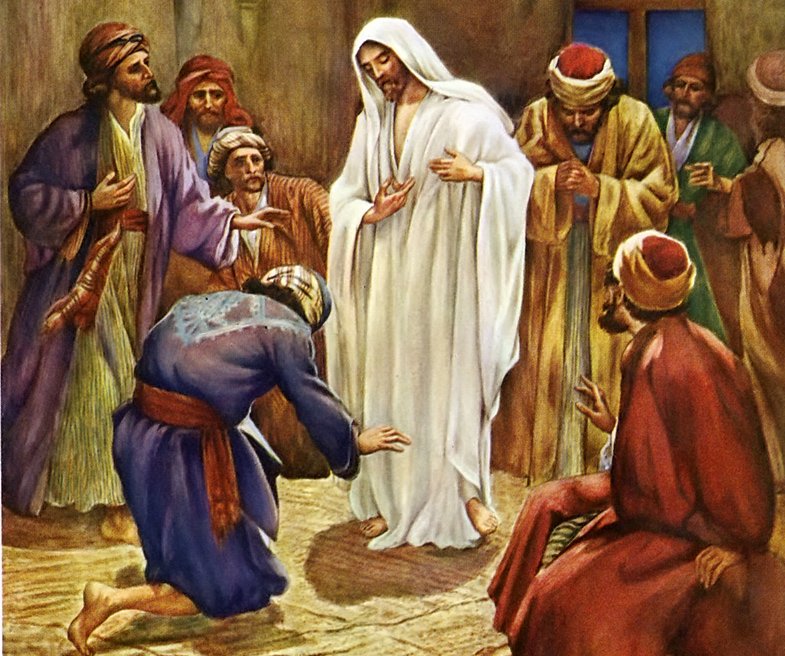
As I mused on this, I recalled John’s account of Thomas, the apostle, following the resurrection of Christ. Jesus was crucified during Passover and placed in a tomb where He laid for three nights and three days (John 19:38-42). Then early on the first day of the week (Sunday), He reclaimed His life and rose from the grave (John 20:1). There He was seen by Mary Magdalene who clung to Him when she saw Him. “Jesus saith unto her, Touch me not; for I am not yet ascended to my Father: but go to my brethren, and say unto them, I ascend unto my Father, and your Father; and to my God, and your God” (John 20:17). Apparently, His absence was brief. Mary Magdalene gave Jesus’ message to the disciples who were holed up in the upper room “for fear of the Jews” (John 20:19). It was the same day in the evening (prior to 6 PM), when “came Jesus and stood in the midst, and saith unto them, Peace be unto you” (v. 19). Thomas was not in the group. When the others gave Thomas the news, “he said unto them, Except I shall see in his hands the print of the nails, and put my finger into the print of the nails, and thrust my hand into his side, I will not believe” (John 20:25). The following Sunday, Jesus once again appeared to His disciples, and this time Thomas was with the group.

Then saith he to Thomas, Reach hither thy finger, and behold my hands; and reach hither thy hand, and thrust it into my side: and be not faithless, but believing. And Thomas answered and said unto him, My Lord and my God. Jesus saith unto him, Thomas, because thou hast seen me, thou hast believed: blessed are they that have not seen, and yet have believed. (John 20:27-29, emphasis mine)

I see a parallel here between this account of Jesus’ resurrection and His return at the last days. The day of Jesus’ resurrection is the presentation of the Gospel which the Apostles received upon seeing Him. Thomas was not there to witness the risen Christ, but the message was presented to him, and he rejected it. The period between the Sunday of Christ’s resurrection and the following Sunday can be compared to the “Church Age” where the Gospel – the good news – is proclaimed but the only evidence is the testimony of the messengers. Those who believe must do so by faith and the credibility of the message. The following week, Christ returns and this time Thomas sees Him in the flesh. This can be compared to the end of this age when the Lord returns to set up His millennial kingdom (Revelation 20). At that time many of the Jews who rejected Him by faith shall look upon Him “whom they have pierced, and they shall mourn for him, as one mourneth for his only son, and shall be in bitterness for him, as one that is in bitterness for his firstborn” (Zechariah 12:10). And Jesus will say, “because thou hast seen me, thou hast believed: blessed are they that have not seen, and yet have believed” (John 20:29, emphasis mine). Jesus will return very soon. Don’t wait to see Him in order to believe. It may be too late then.

2 Comments

Filed under Bible, Christianity, Easter, End Times, Evangelism, Gospel, Religion, Resurrection, Salvation, Second Coming of Christ, Theology

Building the Ark

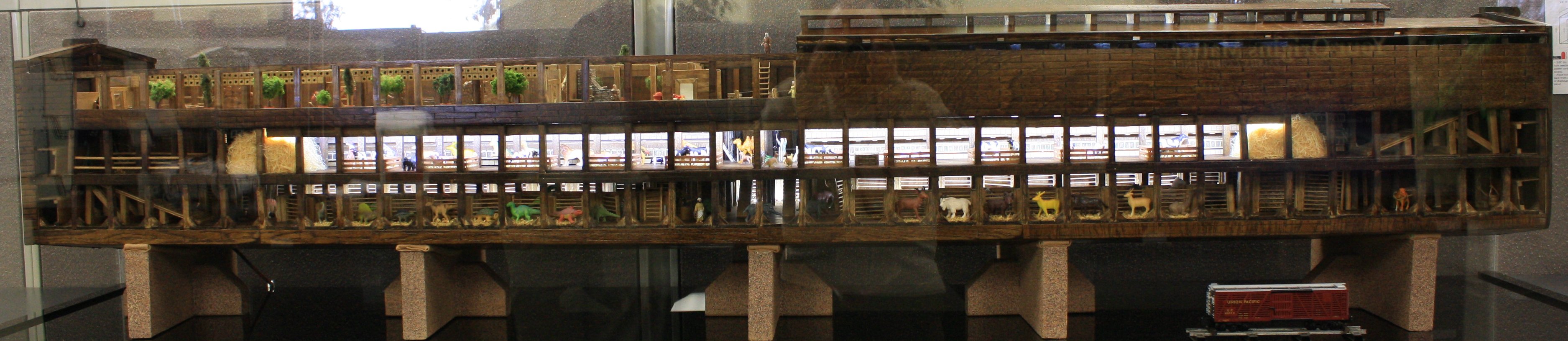
Noah's Ark Model on display at the Institute for creation Research, Dallas, Texas

Noah’s Ark Model on display at the Institute for Creation Research, Dallas, Texas

 Make thee an ark of gopher wood. (Genesis 6:14)

About five years ago, March 2010, God woke me in the middle of the night and gave me a vision to build a scale model of Noah’s Ark. At the time, I was in the middle of working on my M.C.Ed degree in Biblical apologetics from the School of Biblical Apologetics (SOBA) at the Institute for Creation Research (ICR), and I needed a Master’s project or a thesis in order to fulfill the requirements for the degree. The Noah’s Ark model would fulfill that requirement.

As with Noah, God gave me a “big picture” vision of all the details that would need to go on the model. Part of that vision included donating the completed model to ICR. In the end, I was unable to complete the model in time for graduation, so I fulfilled my requirements by writing a thesis. However, that did not squelch my determination to complete the model and make good on my promise. So the work continued a few hours every night after work and on weekends. My only limitation was my own “wimpyness.” My garage, where I built the Ark, is not climate controlled, so in the summer temperatures were unbearably hot, and in the winter temperatures were numbingly cold. The five-year timeframe was due to those limitations, but in that time, I spent 1379 hours to complete the task.

The importance of my God-given task results from what Peter wrote: “Knowing this first, that there shall come in the last days scoffers, walking after their own lusts” (2 Peter 3:3). Scoffers attack anything “Bible,” but one of their favorite targets is the book of Genesis and what it has to say about Creation, the Fall, and the Global Flood. They say stupid things like, “How could all those animals fit inside the Ark?” Sadly, too many Christians, rather than defend God’s Word, take the side of the scoffers. Therefore, this model serves to encourage Christians to trust God’s Word completely and bolster their faith in defending the Word of God.

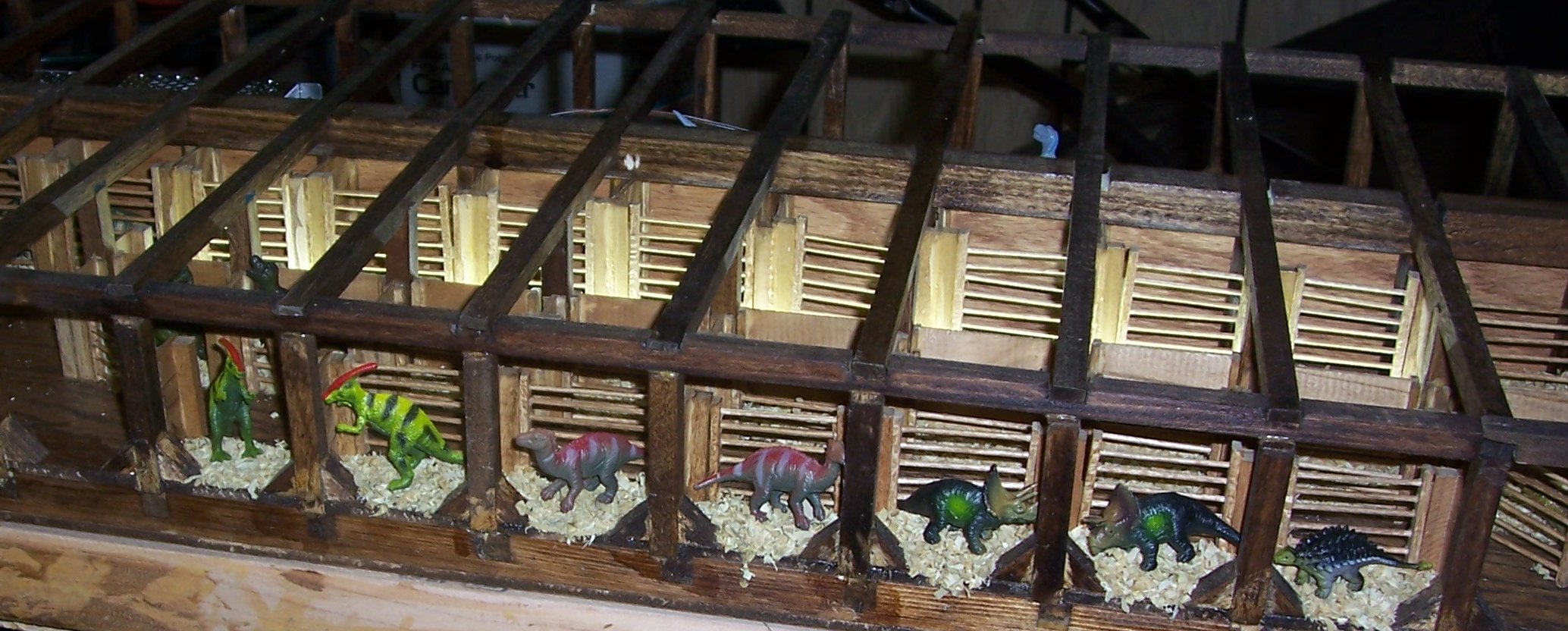
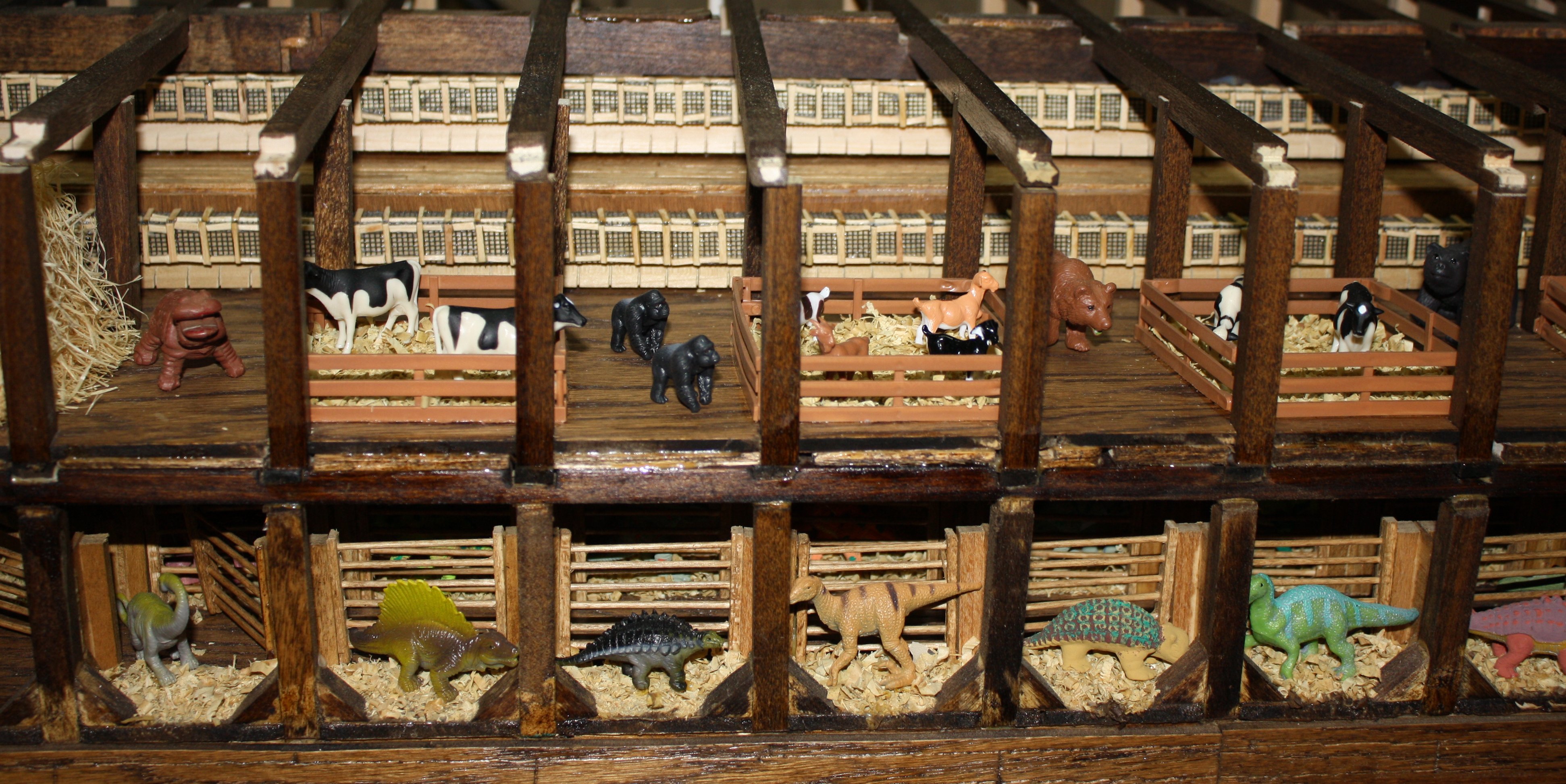
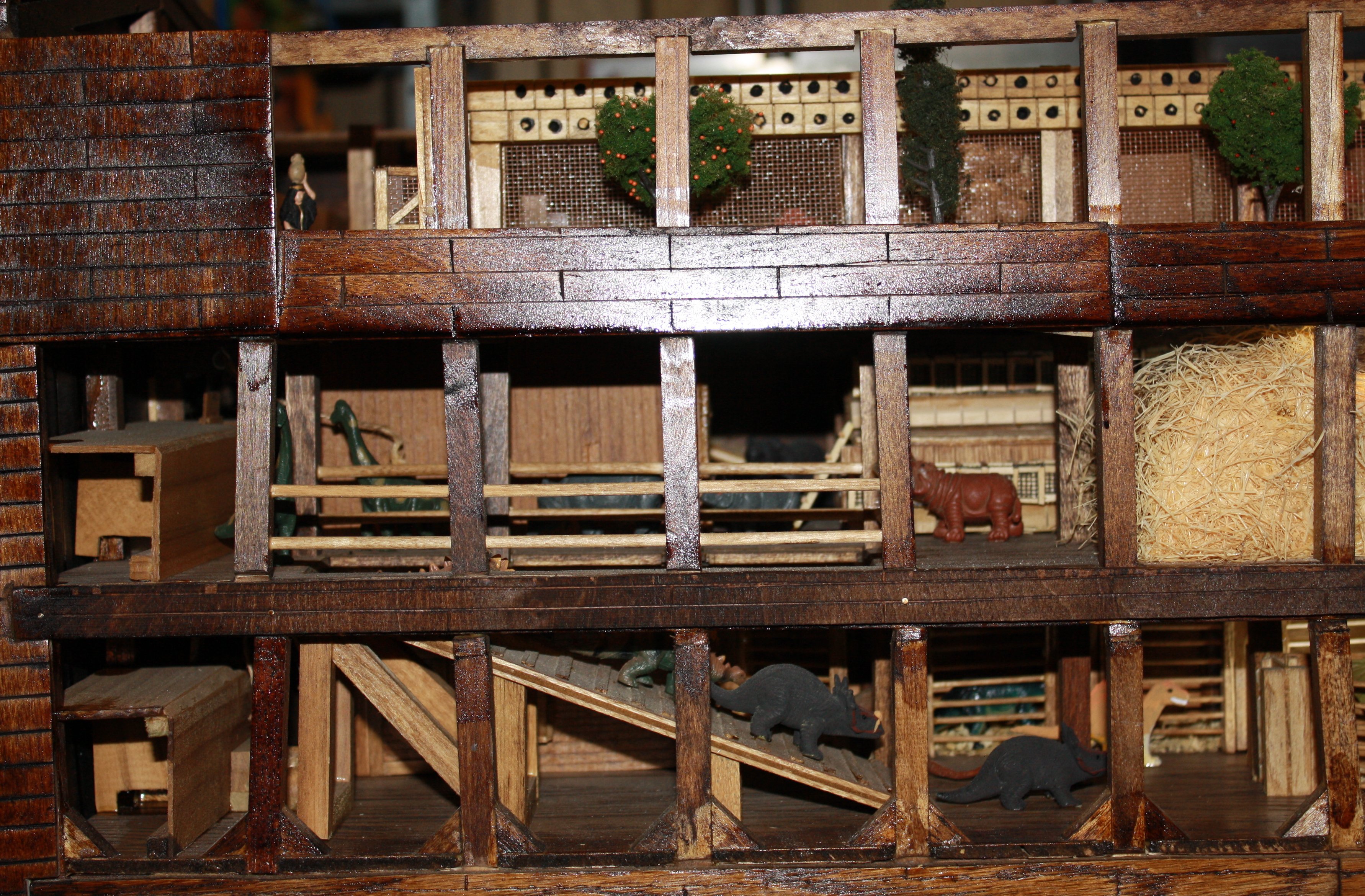
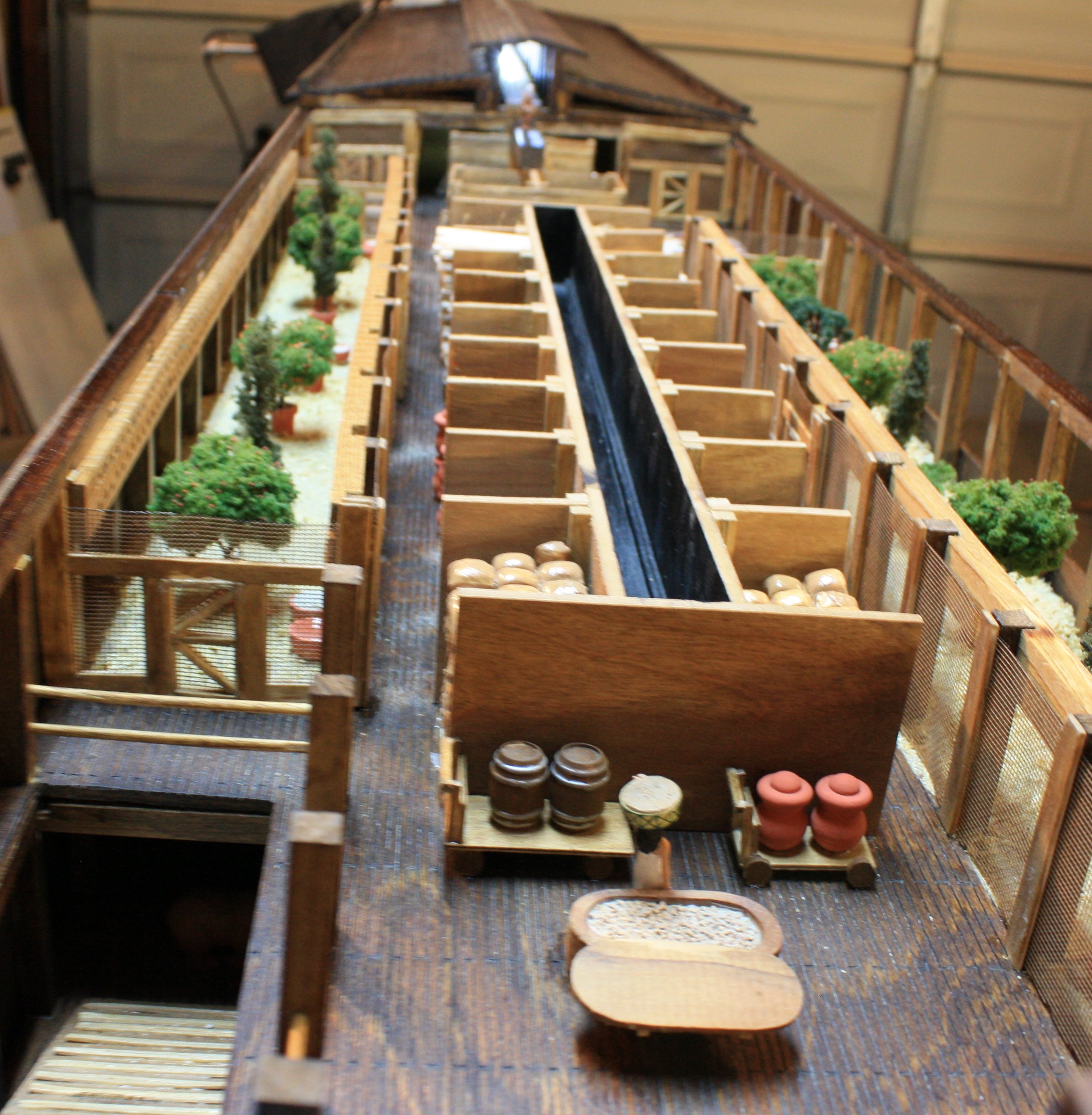
Large animal pens. Note the dinosaurs.

Large animal pens. Note the dinosaurs.

God said to Noah, “Make thee an ark of gopher wood; rooms shalt thou make in the ark” (Genesis 6:14).  The Hebrew word translated “rooms” is qên and it literally means “nests.” That indicates that these would not be large pens where the animals could move around a lot. Noah, his family, and all the menagerie endured 371 days onboard the Ark.

Genesis 6_14(3)

Small animal cages

  That being the case, it is my opinion that God caused the animals to hibernate during that time, so large spaces were not required for the animals. Furthermore, since the average size the animals was about the size of a small cow, a good majority of the animals were small. In order to represent this, made small animal cages for the second deck.

I tried to represent a variety of “kinds” of animals: clean and unclean, mammals, reptiles (dinosaurs) and birds.

I tried to represent a variety of “kinds” of animals: clean and unclean, mammals, reptiles (dinosaurs) and birds.

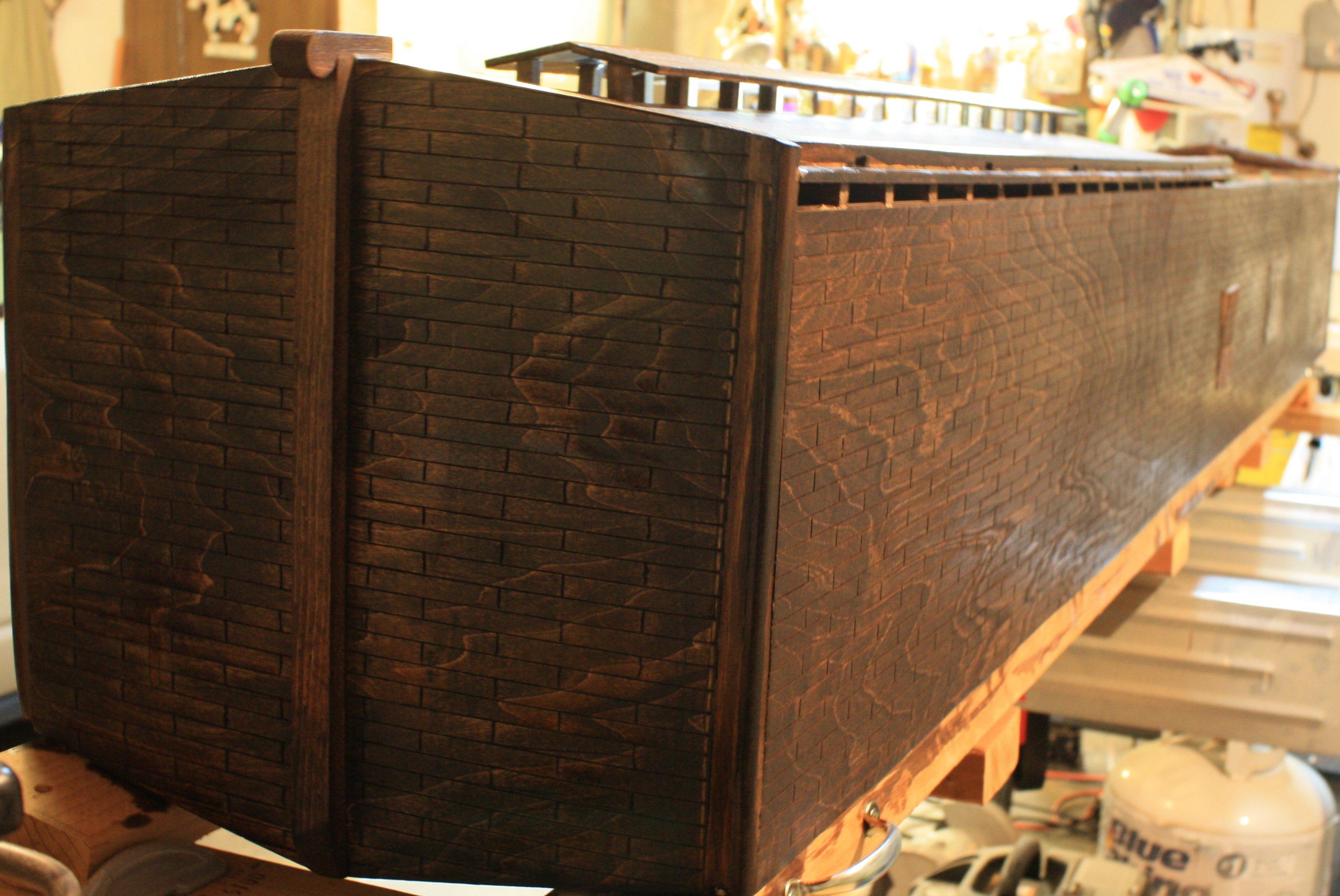
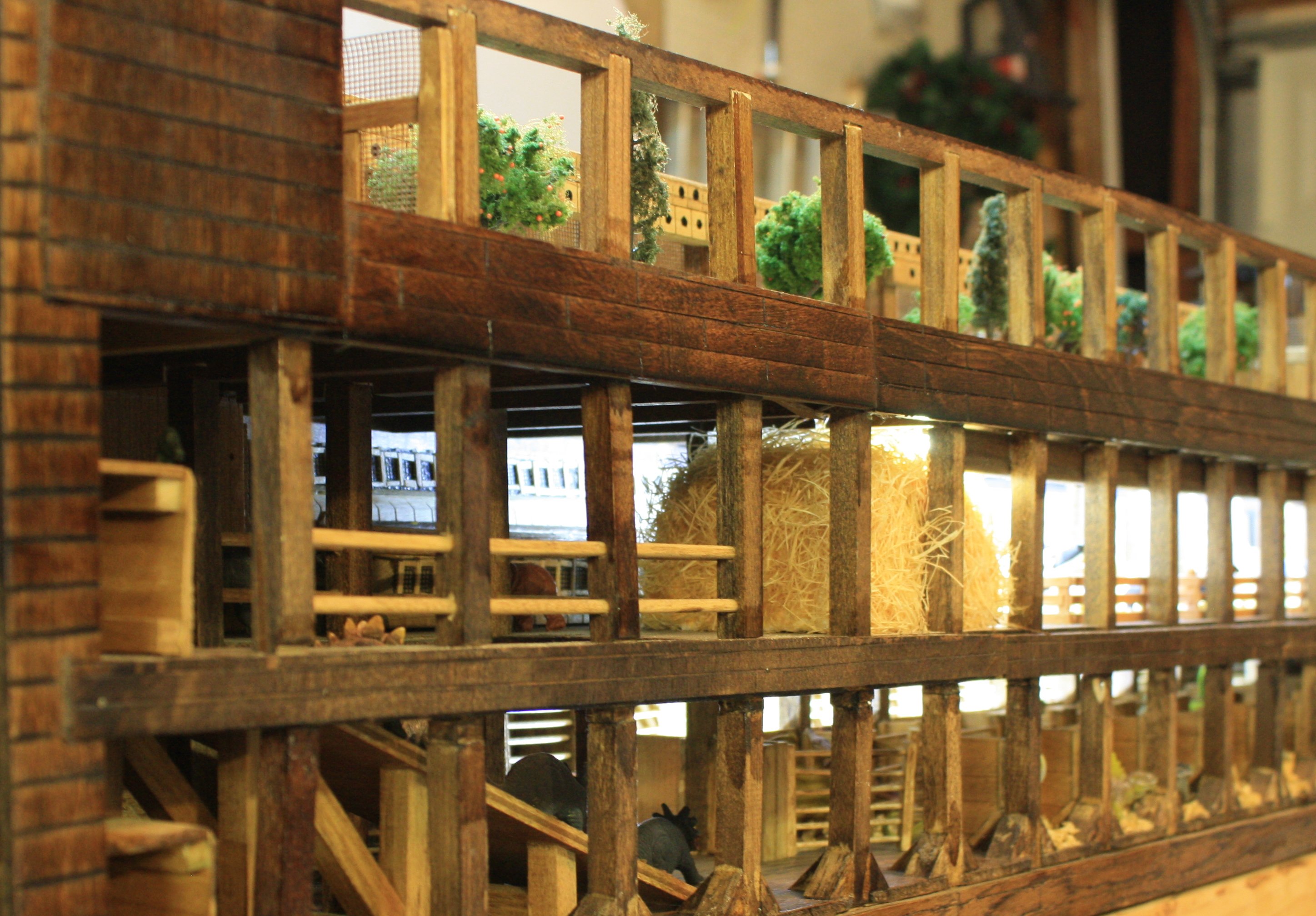
Starboard Side of the Ark

Starboard Side of the Ark

God gave Noah the dimensions of the Ark as follows: “And this is the fashion which thou shalt make it of: The length of the ark shall be Starboard Side of the Ark three hundred cubits, the breadth of it fifty cubits, and the height of it thirty cubits” (Genesis 6:15). Based on an 18-inch cubit, that would make the Ark 450 feet long (the length of one and one half football fields), 75 feet wide, and 45 feet tall. My model is 1/60 scale making it 7.5 feet (90 inches) long, 15 inches wide, and 9 inches tall. (Those are inside dimensions.)

The tsôhar

The tsôhar

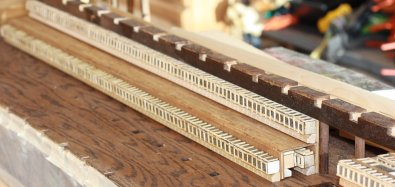
Noah was also instructed to make a “window” for the Ark. “A window shalt thou make to the ark, and in a cubit shalt thou finish it above” (Genesis 6:16). The Hebrew word translated “window” is tsôhar and it literally means a “light” or “double light” as in midday or noon. Only in this passage is it translated “window,” so evidently it was some way to allow outside light into the Ark. Toward the end of the voyage we are told, “And it came to pass at the end of forty days, that Noah opened the window of the ark which he had made” (Genesis 8:6, emphasis mine). In this case, the Hebrew word is challôn and this word does mean “window” and is so translated throughout the Old Testament.

The challôn

The challôn

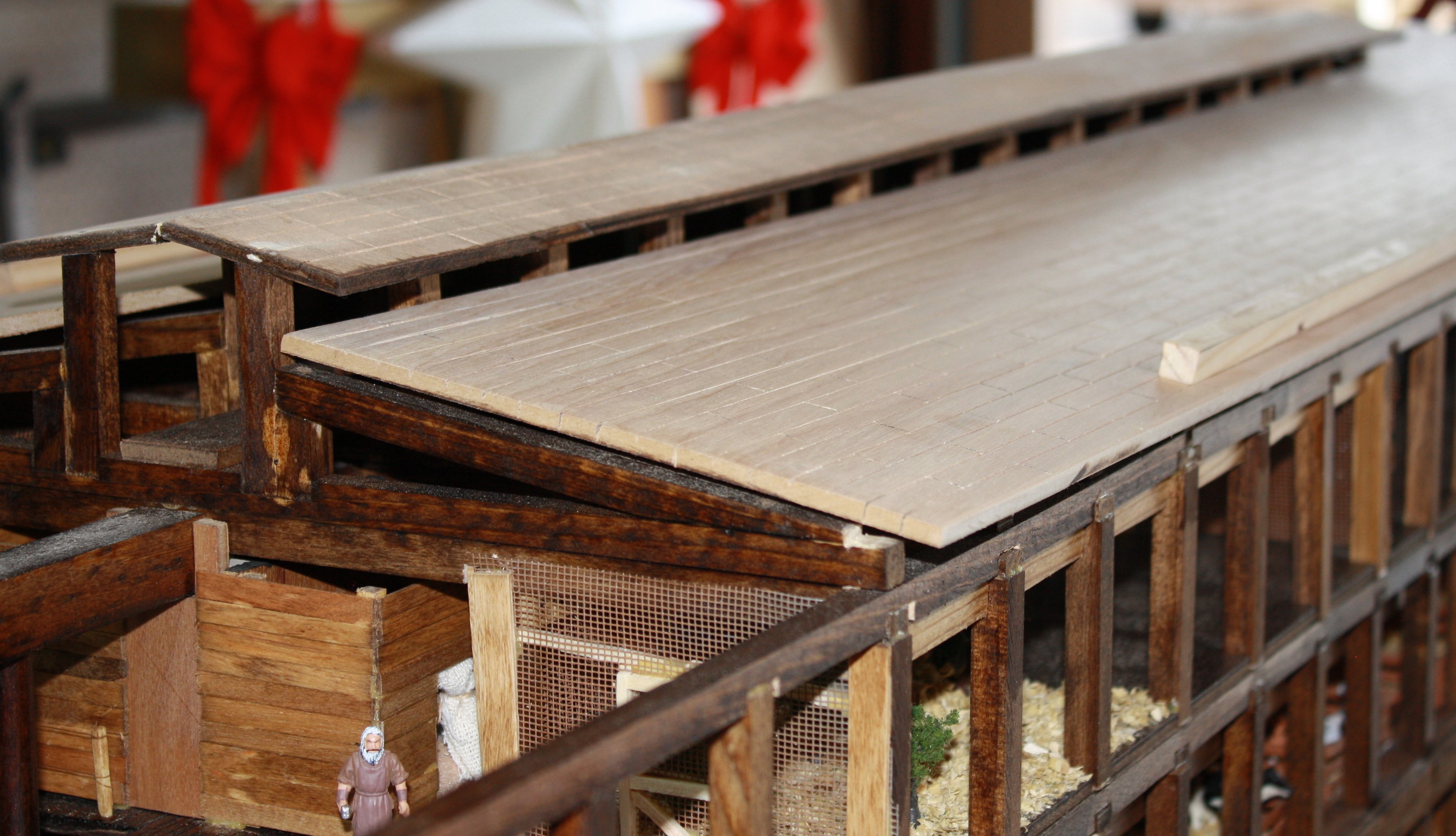
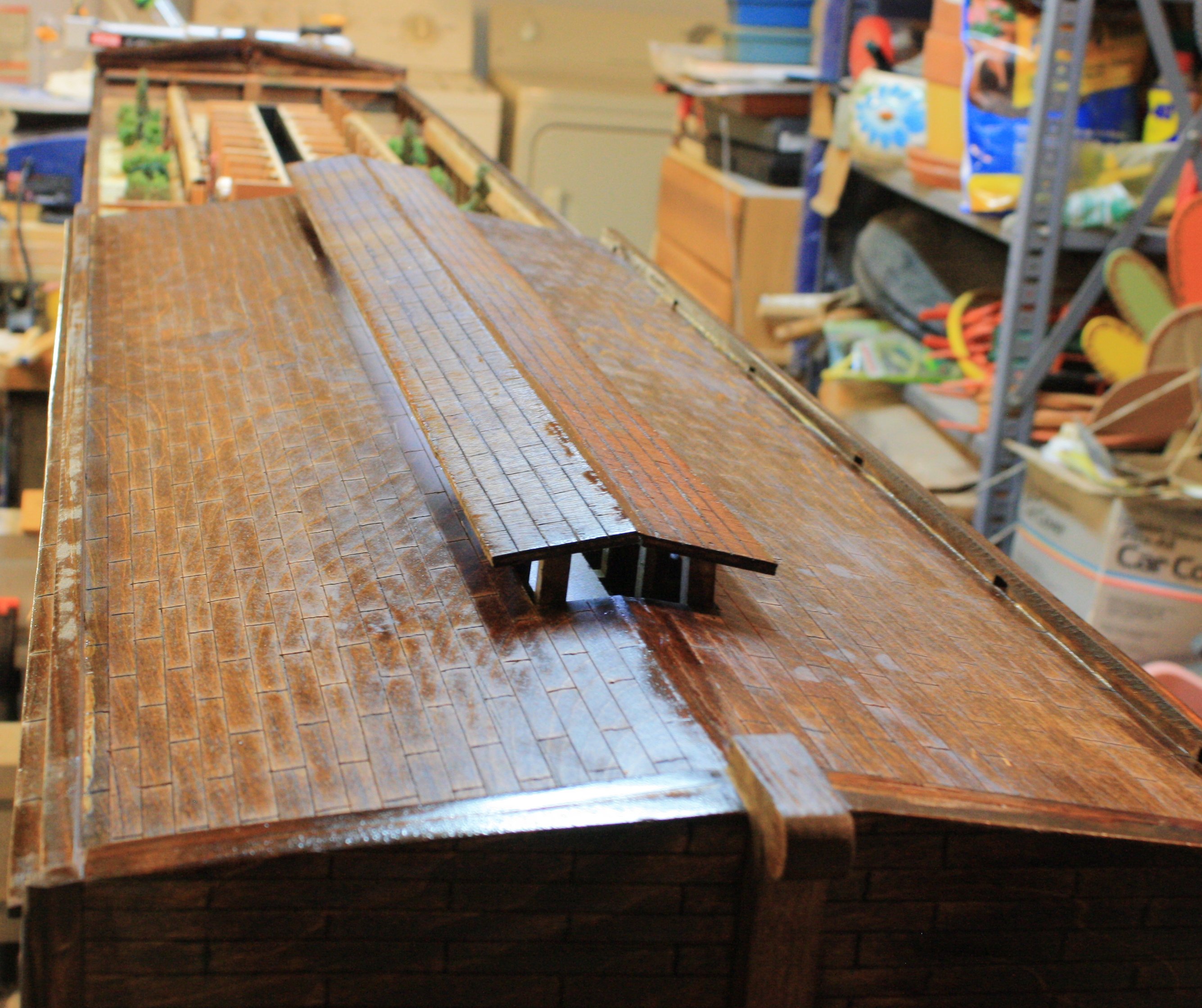
This tells me that Noah had some leeway in the construction of the Ark and not every detail was strictly dictated by God. This fact gives me confidence in using my “sanctified imagination” in creating the detail for the model not specified in Scripture.  The roof, therefore, features an opening beneath the eave of the main roof extending the length of the Ark on both sides as well as the vent opening above the main roof. These two sets of “windows” would allow for air circulation and ventilation.

The finished roof with “window”

The one and only door

Noah’s instructions also included “the door of the ark shalt thou set in the side thereof” (Genesis 6:16). Unlike the blasphemous “Noah” movie, the Ark had only a single door.

God also specified three “stories” or decks for the Ark: “with lower, second, and third stories shalt thou make it” (Genesis 6:16). 

God also specified three “stories” or decks for the Ark: “with lower, second, and third stories shalt thou make it” (Genesis 6:16).

First story - large animals; Second story - "clean" and small animals; Third story - aviary and storage

First story – large animals; Second story – “clean” and small animals; Third story – aviary and storage

Grain storage (silo)

Grain storage (silo)

Noah was also instructed to carry provisions for his family and for all the animals. “And take thou unto thee of all food that is eaten, and thou shalt gather it to thee; and it shall be for food for thee, and for them” (Genesis 6:21). All of these things came to mind in building the model as I attempted to represent, to a limited extent, what would have been carried on the Ark.

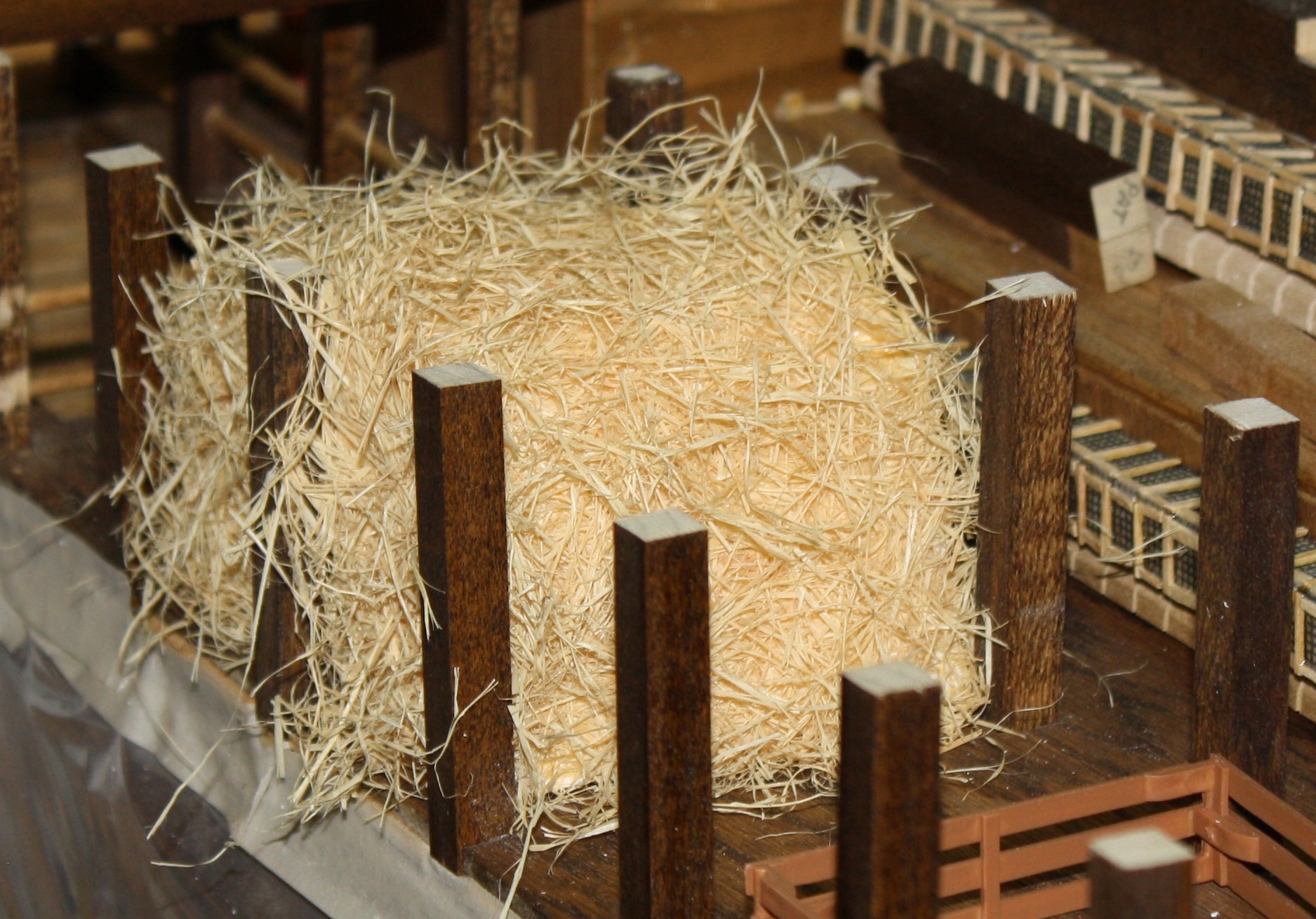
Lots of hay

Lots of hay

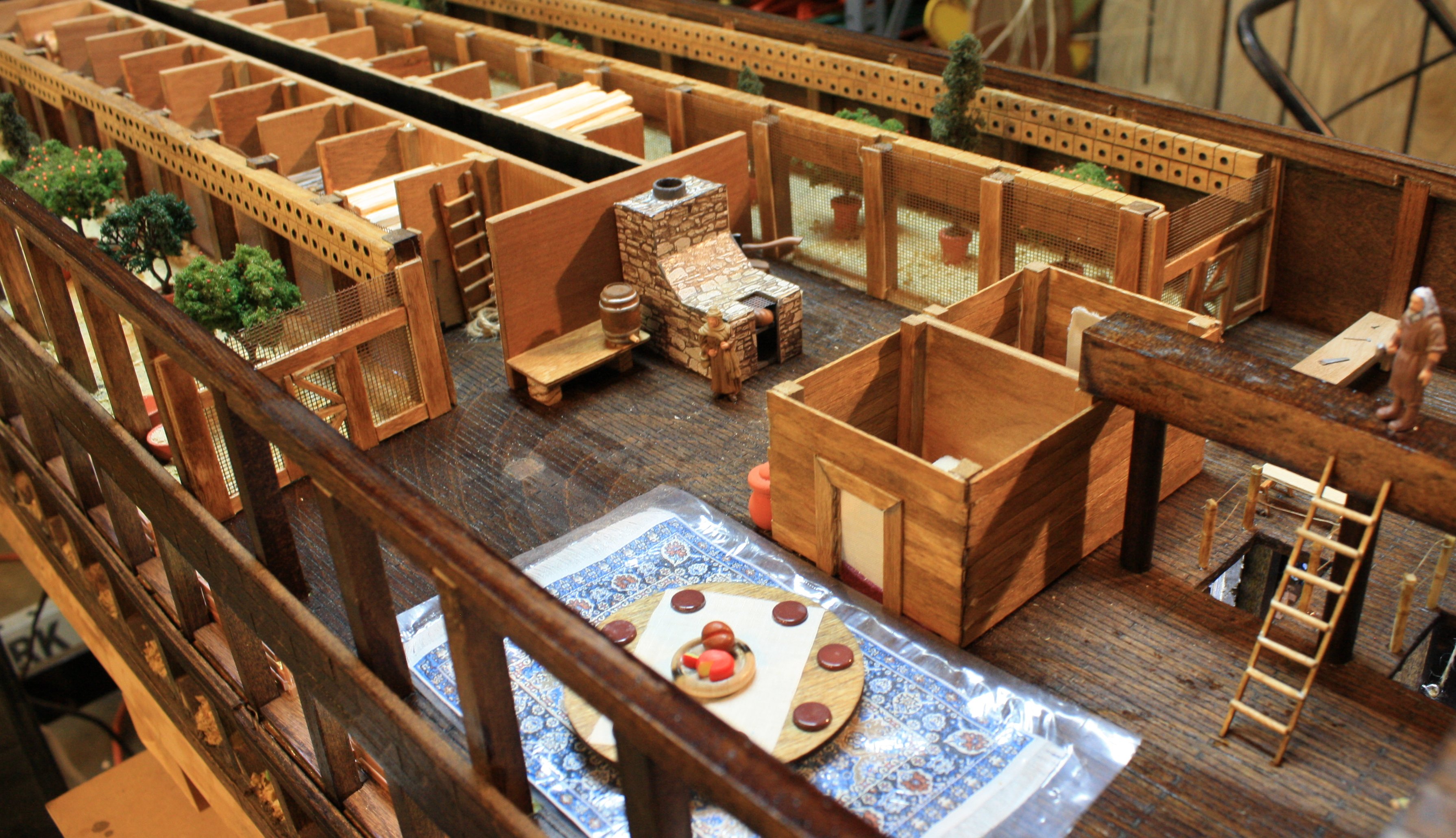
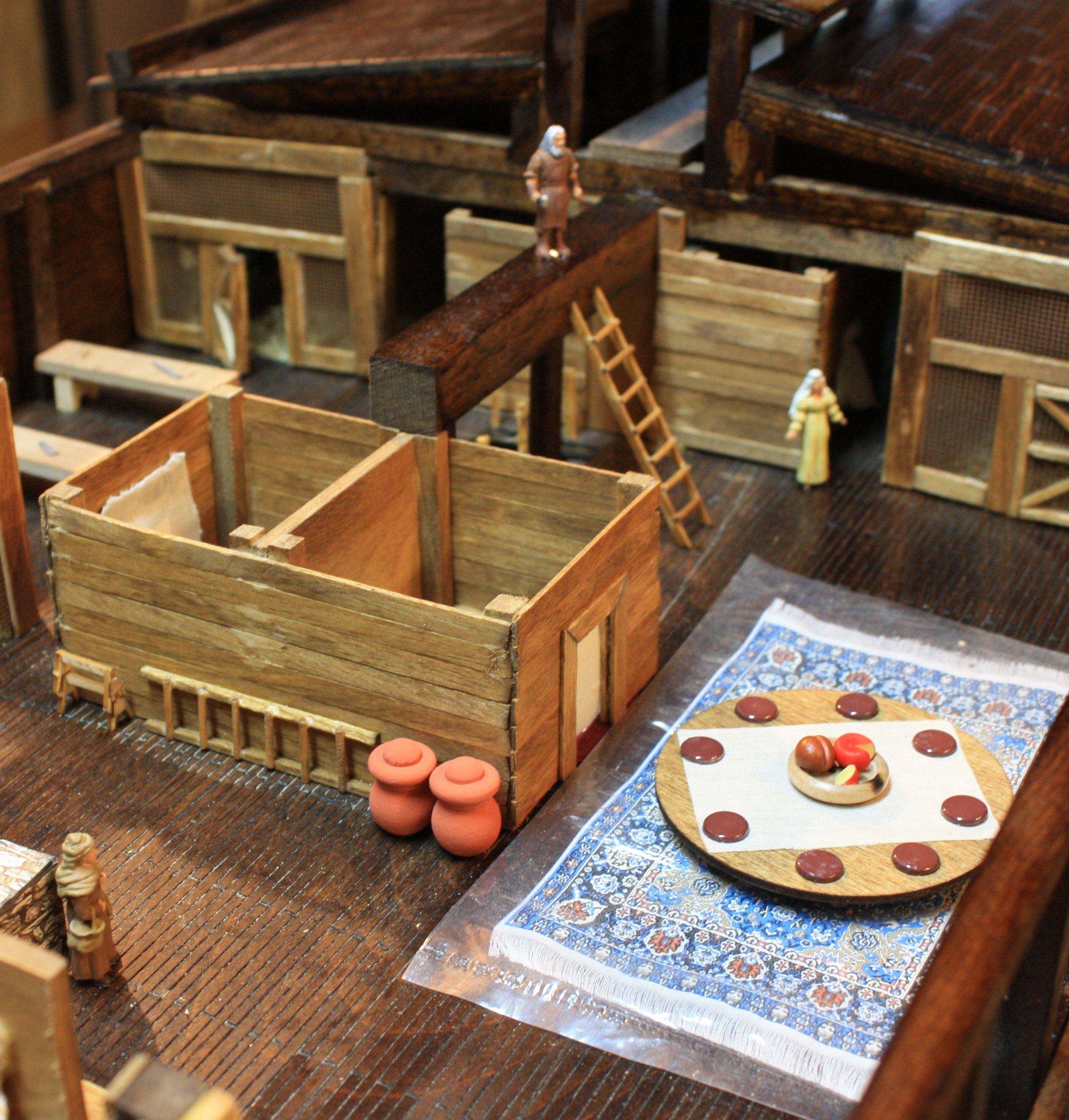
Family gathering area and work spaces

Family gathering area and work spaces

Aviaries, food stores and fill ports for the forward grain silo

Aviaries, food stores and fill ports for the forward grain silo

Family living quarters, aft aviaries and storage

Family living quarters, aft aviaries and storage

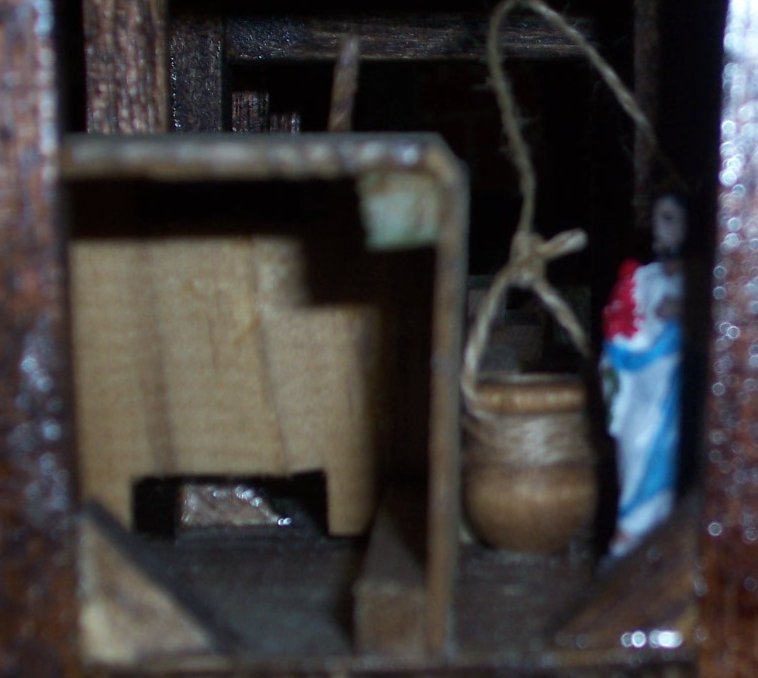
Detail showing stone oven, forward starboard side aviary and storage

Detail showing stone oven, forward starboard side aviary and storage

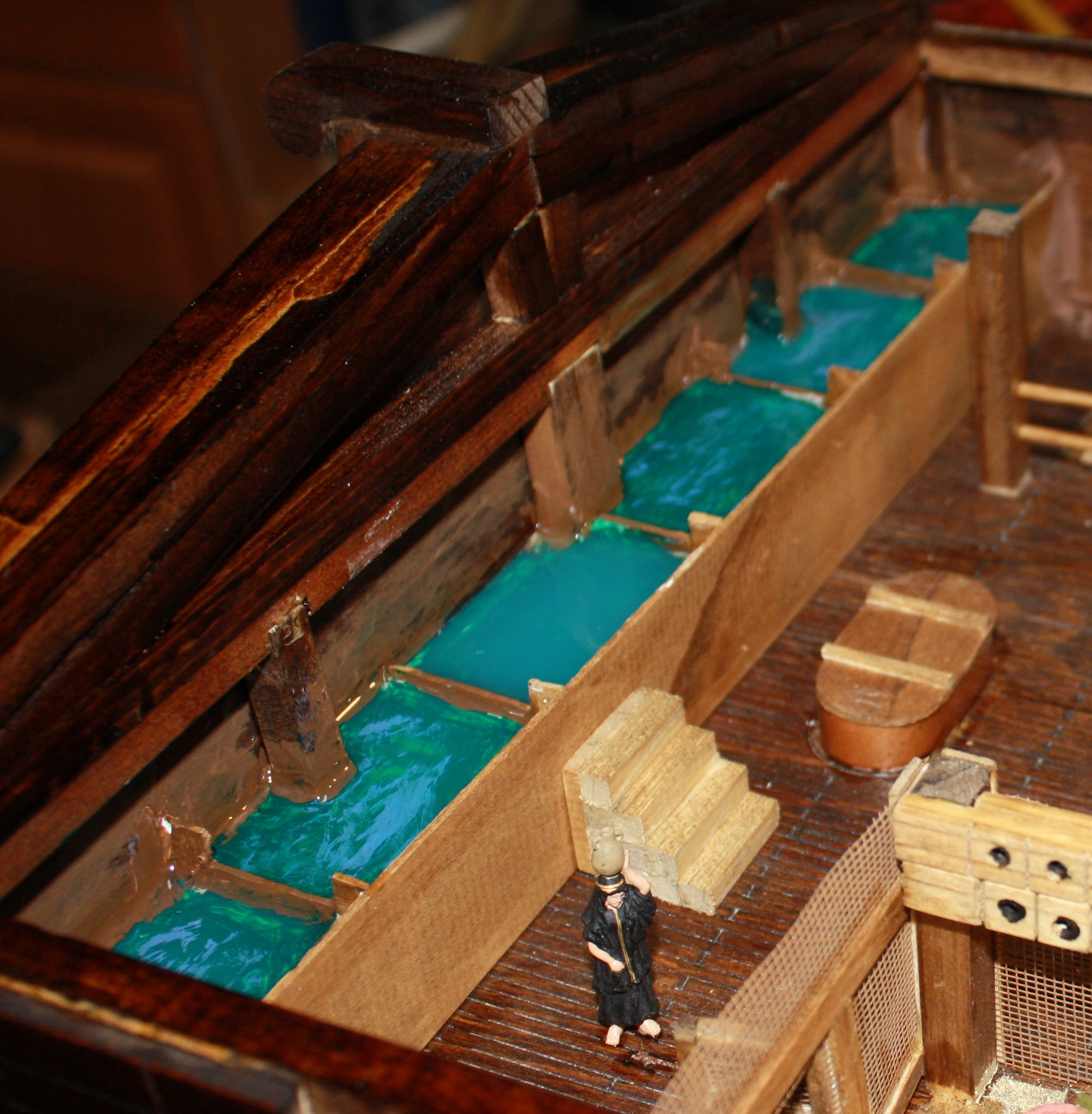
One of six cisterns for water storage - two on each deck, fore and aft

One of six cisterns for water storage – two on each deck, fore and aft

Cistern detail showing baffle for dampening "slosh"

Cistern detail showing baffle for dampening “slosh”

Cistern detail showing water

Cistern detail showing water

The Noah’s Ark model visually represents the Gospel message in the Ark as a “type” of Christ. The Bible tells us that the world had become so corrupt “And it repented the LORD that he had made man on the earth, and it grieved him at his heart … The earth also was corrupt before God, and the earth was filled with violence.” (Genesis 6:6, 11). Things have not changed in all the years since that time. “For all have sinned, and come short of the glory of God” (Romans 3:23). In His holiness must judge and punish sin, “For the wages of sin is death” (Romans 6:23). Just as God is holy, He is also merciful. “But Noah found grace in the eyes of the LORD” (Genesis 6:8) and He provided a way of salvation. Noah had 120 years to build the Ark. During that time the Bible tells us that Noah was “a preacher of righteousness” (2 Peter 2:5) pleading for all to repent of their sin and find refuge in the Ark for God is “not willing that any should perish, but that all should come to repentance” (2 Peter 3:9). The Ark had only one door by which men could enter. Jesus said, “I am the door: by me if any man enter in, he shall be saved, and shall go in and out, and find pasture” (John 10:9). God had complete control of the door to Noah’s Ark. When the fountains of the deep burst open and the deluge descended upon the earth, “And they that went in, went in male and female of all flesh, as God had commanded him: and the LORD shut him in” (Genesis 7:16). There is still only one way obtain salvation. Jesus said, “I am the way, the truth, and the life: no man cometh unto the Father, but by me” (John 14:6). The way of salvation in Noah’s day was the wooden Ark with its single door. Today, the way of salvation is through the wooden cross upon which Jesus died; it is the only way. Eight people were saved on the Ark out of the billions that lived on earth at that time. Jesus said, “Because strait is the gate, and narrow is the way, which leadeth unto life, and few there be that find it” (Matthew 7:14, emphasis mine). Today those that place their faith and trust on the cross of Jesus Christ will be saved from eternal death. “But as many as received him, to them gave he power to become the sons of God, even to them that believe on his name: Which were born, not of blood, nor of the will of the flesh, nor of the will of man, but of God” (John 1:12-13). My prayer is that you have found your Ark in Jesus Christ.

See the article in the March 2015 issue of Acts & Facts: http://www.icr.org/article/noahs-ark-model.

7 Comments

Filed under Apologetics, Christianity, Evangelism, Gospel, Religion, Salvation, Theology