
Category Archives: Salvation

Transformed Not Conformed

I beseech you therefore, brethren, by the mercies of God, that ye present your bodies a living sacrifice, holy, acceptable unto God, which is your reasonable service. And be not conformed to this world: but be ye transformed by the renewing of your mind, that ye may prove what is that good, and acceptable, and perfect, will of God. (Romans 12:1-2)

As our world grows continually darker, it becomes more and more difficult to distinguish between Christians and non-believers. Surely one can find “Christians” in church, but how about outside the walls of the church? Can you spot them? Very often, no clear distinction exists. Christians, by and large, behave much like unbelievers and often one will find non-believers doing “Christian” good deeds.

Vladimir Putin mounted his righteous steed and recently criticized the “west” – mainly the United States – for the immorality it was exporting to the rest of the world: homosexuality, pedophilia, pornography, gender dysphoria, abortion, etc. These sins provoke his hatred for the west, and he wants to protect Russia from such evil. His strong talk makes one think Putin is a righteous man and perhaps a strong Christian. His speech really puts us to shame. However, do not let his righteous blather fool you. Putin is a cold-blooded killer who has no regard for human life and has no problem killing innocent people.

One cannot judge the condition of a man’s heart by the words that exit his lips. On the other hand, one cannot necessarily judge a man’s heart by his “good” deeds “for by the works of the law shall no flesh be justified” (Galatians 2:16).

Yet, for the Christian, God has a standard of conduct that He expects from His children. “But ye are a chosen generation, a royal priesthood, an holy nation, a peculiar people; that ye should shew forth the praises of him who hath called you out of darkness into his marvellous light” (1 Peter 2:9, emphasis mine). Royalty carries with it certain expectations. “But as he which hath called you is holy, so be ye holy in all manner of conversation [i.e., “life conduct”]; Because it is written, Be ye holy; for I am holy” (1 Peter 1:15-16, emphasis mine). To be “holy” simply means to be set apart from the world; to be “consecrated,” i.e., set aside for the service of God.

So, there should be a clear distinction between a Christian and a non-believer. We may dress like the world – hopefully in modesty and not in a way to call attention to ourselves. However, the likeness should stop there. A Christian should not exhibit fear because of world conditions knowing that our Lord and our Redemption is very near; that should be a cause for joy, not dread. Our faces should express deep joy and peace. Our speech should be pure and free of profanity. “Finally, be ye all of one mind, having compassion one of another, love as brethren, be pitiful [i.e., “full of pit/compassion”], be courteous: Not rendering evil for evil, or railing for railing: but contrariwise blessing; knowing that ye are thereunto called, that ye should inherit a blessing” (1 Peter 3:8-9). More could be added to the list, but this should make the point.

How does one accomplish such a feat? Certainly not in our own strength or by our own efforts. Paul gives us the simple formula in our starting verses (Romans 12:1-2). Paul says to “present” your bodies. The word in the Greek means “to place a person or thing at one’s disposal.” Your body is that thing that transports your soul from place to place and is often the thing that carries you into sin by “the lust of the flesh” (1 John 2:16). We need to place our bodies at God’s disposal.

Your body needs to be a “living sacrifice.” Normally, a sacrifice must die. Paul says, “For I through the law am dead to the law, that I might live unto God. I am crucified with Christ: nevertheless I live; yet not I, but Christ liveth in me: and the life which I now live in the flesh I live by the faith of the Son of God, who loved me, and gave himself for me” (Galatians 2:19-20, emphasis mine). We are dead to sin and the law, but we are alive through faith in Christ who died for us. Hence, our sacrifice is a “living” one, and a “holy” one that is set apart for God.

Understanding what Jesus did on our behalf, it is logical (“reasonable”) that we should render our service or “worship” to God, and this is a pleasing and “acceptable” sacrifice or offering to Him.

In order to offer God an “acceptable” sacrifice, we must not “conform” or take the shape of this world. “World” translates the Greek word aiōn, meaning “an age.” “The word used here properly denotes an age, or generation of people.”[1] Do not allow this age, this world in which we live, to mold you into its form. Rather, be “transformed,” (i.e., metamorphosed) by the renewing of your mind. There is a new adage for the computer age that says “garbage in, garbage out.” What you put into your mind affects much of what you think and do. So, the opposite is also true: good things in/ good things out. That comes through the constant feeding on God’s Word and prayer. When you do this, you will “prove” (i.e., “test”) “what is that good, and acceptable, and perfect, will of God”

What is the “will of God”? “For whom [God] did foreknow [i.e., “His children], he also did predestinate to be conformed to the image of his Son, that he might be the firstborn among many brethren” (Romans 8:29, emphasis mine). Do you want to know what God’s will is for your life? There it is! His will is that you be “conformed,” not to this world, but to the “image of His Son.”

What shape have you taken on, that of the world or that of Christ? Please read my page on “Securing Eternal Life” and make sure you are in the right shape.

Notes:

[1]  “Albert Barnes’ Notes on the Bible”
Comments Off on Transformed Not Conformed

Filed under Apologetics, Bible, Christianity, Gospel, Salvation, Theology, Worship

Answering For What You Know

And thou his son, O Belshazzar, hast not humbled thine heart, though thou knewest all this; (Daniel 5:22)

Following the death of Nebuchadnezzar in 562 B.C., Babylon started to decline from its former glory. Evil-Merodach succeeded his father and reigned for two years. He was murdered by his brother-in-law, Neriglissar (referred to as Nergal-Sharezer in Jeremiah 39:3, 13), in 560 B.C. He reigned four years, died in 556 B.C., and was succeeded by his young son, Labashi-Marduk, who ruled for two months and was assassinated by Nebonitus. Although Nebonitus became king, his interests in restoring the religion of the moon god, Sin, kept him away from Babylon for 10 out of the 17 years he reigned. In his stead, he named his son, Belshazzar as coregent of the kingdom.[1]

On October 12, 539 B.C., while the Persian army, led by Ugbaru, besieged Babylon, Belshazzar threw a party for 1000 of his nobles proudly trusting in the impregnable walls of that great city. Babylon straddled the banks of the Euphrates River. The river’s entrance and exit through the city were protected by iron-bar gates preventing man or beast from passing through. The Persians were not so easily deterred. While Belshazzar partied, the Persians were busy diverting the waters of the Euphrates so that the flow through the middle of the city dried up. The dry riverbed now provided unrestricted entry into the city, and the Persians caught the Babylonians with their proverbial pants down. Considering the engineering effort to divert the Euphrates around the city, it seems apparent that no one was watching. The Persians conquered Babylon, they killed Belshazzar, and Nebonitus was somewhere in Arabia clueless that he lost his kingdom.

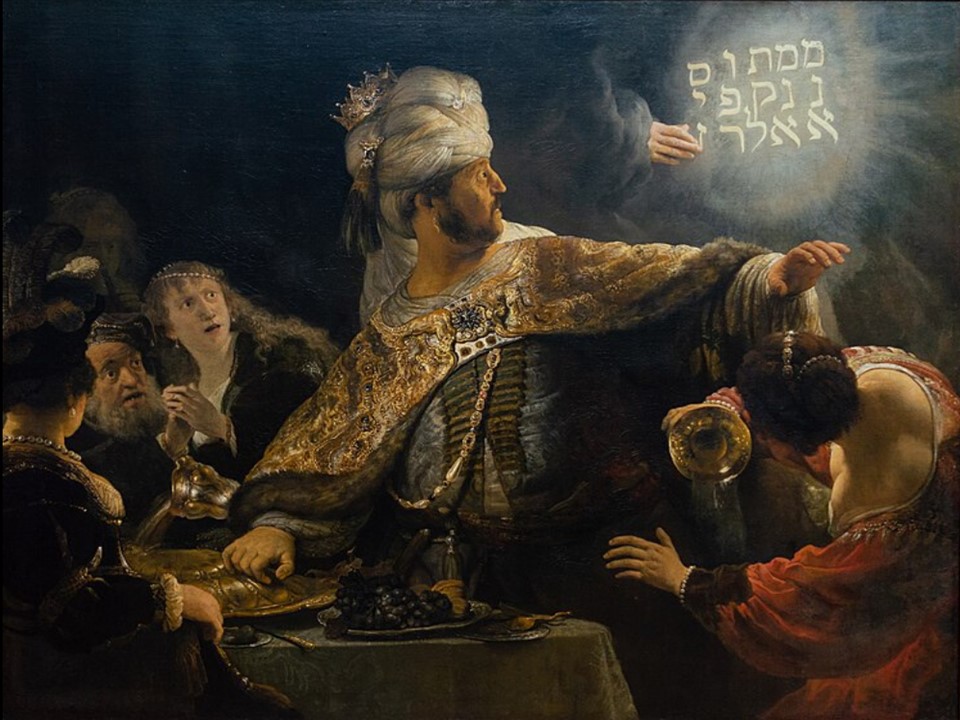
In the middle of all of this drama, Daniel records the final night of Babylon’s glory.[2] As the wine freely flowed into vessels taken from God’s Temple in Jerusalem, Belshazzar saw “the fingers of a man’s hand” writing on the wall. The “vision” so terrified him that he lost control of his bowels.[3] The writing was real. It was not imagined. Belshazzar called his “wise” men to interpret the writing, but they failed. Then Belshazzar’s mother remembered about Daniel and his abilities, so she came to the king to offer advice. “There is a man in thy kingdom, in whom is the spirit of the holy gods; and in the days of thy father light and understanding and wisdom, like the wisdom of the gods, was found in him; whom the king Nebuchadnezzar thy father, the king, I say, thy father, made master of the magicians, astrologers, Chaldeans, and soothsayers. Forasmuch as an excellent spirit, and knowledge, and understanding, interpreting of dreams, and shewing of hard sentences, and dissolving of doubts, were found in the same Daniel, whom the king named Belteshazzar: now let Daniel be called, and he will shew the interpretation.” (Daniel 5:11-12).

Belshazzar called for Daniel and offered him a third of the kingdom if he would interpret the writing. Such status would put Daniel on equal standing with Nebonitus and Belshazzar. However, Daniel refused the offer. He knew it would be short-lived anyway; he knew what was coming. Rather than meet the request directly, Daniel recited Nebuchadnezzar’s history.[4]

O thou king, the most high God gave Nebuchadnezzar thy father[5] a kingdom, and majesty, and glory, and honour: And for the majesty that he gave him, all people, nations, and languages, trembled and feared before him: whom he would he slew; and whom he would he kept alive; and whom he would he set up; and whom he would he put down. But when his heart was lifted up, and his mind hardened in pride, he was deposed from his kingly throne, and they took his glory from him: And he was driven from the sons of men; and his heart was made like the beasts, and his dwelling was with the wild asses: they fed him with grass like oxen, and his body was wet with the dew of heaven; till he knew that the most high God ruled in the kingdom of men, and that he appointeth over it whomsoever he will. (Daniel 5:18-21, emphasis mine)

Daniel charged Belshazzar with the same pride that brought Nebuchadnezzar down. “And thou his son, O Belshazzar, hast not humbled thine heart, though thou knewest all this” (Daniel 5:22, emphasis mine). Belshazzar was not ignorant of this fairly recent history, and yet he blasphemed the only God that could save him.

He knew this, and God held him accountable for what he knew to be true. He would answer for it. Daniel read the writing and gave the interpretation:

And this is the writing that was written, MENE, MENE, TEKEL, UPHARSIN. This is the interpretation of the thing: MENE; God hath numbered thy kingdom, and finished it. TEKEL; Thou art weighed in the balances, and art found wanting. PERES; Thy kingdom is divided, and given to the Medes and Persians. (Daniel 5:25-28, emphasis mine)

“In that night was Belshazzar the king of the Chaldeans slain. And Darius the Median took the kingdom, being about threescore and two years old” (Daniel 5:30-31).

God has given every human on earth enough information so that they can recognize and worship Him as God. “Because that which may be known of God is manifest in them; for God hath shewed it unto them. For the invisible things of him from the creation of the world are clearly seen, being understood by the things that are made, even his eternal power and Godhead; so that they are without excuse” (Romans 1:19-20, emphasis mine).

Indeed, Paul says that those who do not know the law of God follow that law instinctively. “For when the Gentiles, which have not the law, do by nature the things contained in the law, these, having not the law, are a law unto themselves: Which shew the work of the law written in their hearts, their conscience also bearing witness, and their thoughts the mean while accusing or else excusing one another” (Romans 2:14-15, emphasis mine).

Everyone will have to answer for what they know. However, God’s standard requires perfection, and no one – whether knowing the written law of God, or whether knowing the law of God instinctively – can keep the law perfectly. And James says, “For whosoever shall keep the whole law, and yet offend in one point, he is guilty of all” (James 2:10, emphasis mine). In the end, everyone will have to answer for what they know. “And I saw the dead, small and great, stand before God; and the books were opened: and another book was opened, which is the book of life: and the dead were judged out of those things which were written in the books, according to their works … and they were judged every man according to their works. And death and hell were cast into the lake of fire. This is the second death. And whosoever was not found written in the book of life was cast into the lake of fire” (Revelation 20:12-15, emphasis mine).

Reader, Jesus is coming very soon. Are you prepared to meet Him? Now especially, having read this, you will answer for what you know. There is only one way to avoid that judgment. Ask Jesus to be your Savior. Please read my page on “Securing Eternal Life.”

Notes:


[1]  John F. Walvoord and Roy B. Zuck, The Bible Knowledge Commentary, (Victor Books, SP Publications Inc., 1985), p. 1344.

[2]  Daniel 5

[3]  Daniel 5:6 “his loins were loosed”

[4]  Recorded in Daniel 4

[5]  Belshazzar was not related to Nebuchadnezzar. The term “father” is used as a metaphor meaning predecessor or founder.

Comments Off on Answering For What You Know

Filed under Apologetics, Evangelism, Gospel, Salvation, Theology

Tisha B’Av

For the Lord himself shall descend from heaven with a shout, with the voice of the archangel, and with the trump of God: and the dead in Christ shall rise first: Then we which are alive and remain shall be caught up together with them in the clouds, to meet the Lord in the air: and so shall we ever be with the Lord.  (1 Thessalonians 4:16-17)

At the posting of this article, August 6-7, 2022, Jews everywhere solemnly observe Tisha B’Av or the Ninth of Av. Av is the fifth month on the Jewish calendar which begins with the month of Nissan. Christians, for the most part, are ignorant of Jewish observations and feasts; but the same God that gave observations to the Jews is not a God who does things arbitrarily or at random and without purpose, and He does not change. So, even though Christians are under a different “covenant” than the Jews, that does not render these observations meaningless. It behooves Christians to study and understand the Jewish feasts and observances because, while they may not directly apply to us, they have great significance in our understanding of our God.

Tisha B’Av, like Purim and Chanukah, was not given by God as one of His seven Feasts of the Lord.[1] These “observances” were started by the Jews as memorials to God’s intervention in the life of the nation. Purim looks back to God’s salvation of the Jews that were in Babylon from the hand of Haman.[2] Chanukah commemorated the miraculous preservation of the oil in the menorah for eight days at the cleansing of the Temple after it was desecrated by Antiochus Epiphanes.[3]  

Tisha B’Av, however, reminds the Jews of God’s judgments on the nation for one sin or another. These judgments always fell on the Ninth of Av beginning when 10 of the 12 spies sent to spy out the Promised Land returned with a bad report.[4] The website “Rapture Ready” lists 29 judgments against the Jews from Av 9, 1312 BC to Av 9, 2020 AD.[5]

Perhaps the most significant judgments to the Jews were those involving the Temple. The Babylonians razed Solomon’s Temple on Av 9, 586 BC. The Romans destroyed the second temple, Herod’s Temple, on Av 9, 70 AD. Pete Garcia, a graduate of Dallas Theological Seminary, suggests the possibility (not the inevitability) that the Rapture of the Church could take place this year on Tisha B’Av.[6] (I recommend that you read his article in the link provided below. He goes into much greater detail than I plan to go into here.) Pete got his idea from Greg Lauer,[7] another student and teacher of end-times prophecy. (I recommend that you read his lengthy article as well. He goes into great detail to develop his theory and he employs sound logic in doing so. You can find the link to his article in the endnotes below.)

In brief, here is the summary of the idea that the Rapture could take place on Tisha B’Av – perhaps even today, August 7, 2022. By way of disclaimer, allow me to emphasize that neither of these men are setting a date for the Rapture, which “of that day and hour knoweth no man, no, not the angels of heaven, but my Father only” (Matthew 24:36). We cannot know the exact day or the hour; however, we can observe the signs and the season so that we should be ready. Therefore, Jesus said, “Watch therefore, for ye know neither the day nor the hour wherein the Son of man cometh” (Matthew 25:13). How can we watch if we do not know what to watch for?

We already see many of the signs of which Jesus spoke[8] taking place: Israel reborn, wars and rumors of wars, famines, and pestilences, economic collapse, worldwide hatred of Israel, the formulation of the Gog of Magog alliance,[9] [10] etc. These “labor pains” are increasing in number and frequency alerting us to the soon return of Christ as King of Kings and Lord of Lords. However, before that happens, the Church must be removed, and that is where the idea of the Rapture on Tisha B’Av comes to play.

Here is the idea in a nutshell. When Solomon dedicated the first temple, the glory of God filled the Temple to the point that the priests could not minister in the Temple.[11] Several hundred years later, the Prophet Ezekiel records seeing the glory of God depart the Temple.[12] The Babylonians then entered Jerusalem and destroyed the Temple of God on Av 9, 586 BC.

After 70 years of captivity, the Medo-Persian Empire conquered Babylon and Cyrus allowed the Jews to return and rebuild Jerusalem and the Temple. There is no record that this second temple enjoyed the filling by the glory of God. It was not until the time of Christ that the Temple experienced the presence of God in the form of Jesus Christ. Recall how at the cleansing Jesus declared, “My house shall be called the house of prayer; but ye have made it a den of thieves” (Matthew 21:13, emphasis mine). Of course, we know what happened later. The Jews rejected and crucified their Messiah during Passover, 30 AD (or 33 AD, the exact year is debatable). As a result, the Romans destroyed the Temple on Av 9, 70 AD.

The First Temple enjoyed the presence of God the Father. The Second Temple enjoyed the presence of God the Son. There is yet a Third Temple that enjoys the presence of God the Holy Spirit. Where might that Temple be? “Know ye not that ye are the temple of God, and that the Spirit of God dwelleth in you?” (1 Corinthians 3:16). The Holy Spirit resides within believers, the Church, the Bride of Christ. This Temple restrains Satan’s forces on earth and must be removed in order for God’s judgment to come upon the God-rejecting world. “And now ye know what withholdeth that he might be revealed in his time. For the mystery of iniquity doth already work: only he who now [restrains] will [restrain], until he [i.e., the Holy Spirit] be taken out of the way. And then shall that Wicked be revealed, whom the Lord shall consume with the spirit of his mouth, and shall destroy with the brightness of his coming” (2 Thessalonians 2:6-8, emphasis mine). When the Holy Spirit is taken “out of the way,” He will take His Temple with Him. This is what we understand as “the Rapture” of the Church.

So, since God does not do things arbitrarily or at random, it makes sense that the “Third Temple,” belonging to the Holy Spirit should also be removed, like the first two, on Tisha B’Av. If not today, then next year, or the next.

No man knows the day or the hour when Jesus will call His Bride home. As His Bride, we should be prepared daily for Him to call us home. It does not necessarily have to be on Tisha B’Av. It could be on Rosh HaShanah, or perhaps on Pentecost or any day when we least expect it. The point is to be ready and watching daily. We have work to do, and when our Lord calls us home, we want Him to find us working to increase His kingdom.

Are you ready to meet Jesus? If not, please read my page on “Securing Eternal Life.”

Notes:


[1]  “Rosh HaShanah” — https://erniecarrasco.com/2016/10/03/rosh-hashanah/

[2]  Read the book of Esther.

[3]  Read the apocryphal books of the Maccabees.

[4]  Numbers13:25-14:12

[5]  https://www.raptureready.com/2021/07/15/the-ninth-of-av-tisha-bav-by-jeff-van-hatten/

[6]  “This B’Av Rapture?” — https://www.rev310.net/post/tish-b-av-rapture

[7]  “A Pattern with a Hole” — https://www.alittlestrength.com/articles/2022/2206-pattern.htm

[8]  Matthew 24

[9]  Ezekiel 38-39

[10]  “Magog, Tubal, and Persia” — https://erniecarrasco.com/2022/07/24/magog-tubal-and-persia/

[11]  2 Chronicles 5:11-14

[12]  Ezekiel 9:3; 10:18

Comments Off on Tisha B’Av

Filed under Apologetics, Christianity, Current Events, End Times, Eschatology, Feasts of the Lord, Gospel, Holy Spirit, Rapture, Salvation, Satan, Second Coming of Christ, Theology

Is the Number of Stars Definite or Indefinite?

a2218_hstkelly

And he is before all things, and by him all things consist (Colossians 1:17)

Is the number of stars definite or indefinite? I recently posted that question my Facebook status, and I was completely unprepared for the firestorm of controversy that seemingly innocuous question would raise. The question, to me, seems simple enough. I have identified a subject – the number of stars – and offered an either-or response.

One person responding to the question suggested that the number of stars is indefinite. Certainly from man’s perspective that is true. There is no way for us to ever know the exact number of stars. There are billions of galaxies in our known universe, and each is composed of billions .of stars. Such numbers are staggering. And then there is that outside possibility that new stars are being “born” regularly. That has never been observed, and it is based solely on very questionable evolutionary theories – more on that later.

But from God’s perspective, the number of stars is definite. The psalmist says, “He telleth the number of the stars; he calleth them all by their names” (Psalm 147:4). The Hebrew word translated “telleth” (tells) is mânâh and it means to “weigh out, to allot, or to enumerate” and so could be translated as “to number.” By this we know that God keeps a complete inventory of the stars. He “calls” them – Hebrew qârâ’, which means “to call out to” or “to address” each individual star by name. Well, one might say, God could still be creating stars, and He would still know the number each time He creates a new one. That is also true. Jesus says that the very hairs of my head are numbered (Matthew 10:30). God knows exactly how many hairs on my head I started with, the maximum count I had at my zenith, the number of hairs I have lost and He knows my current count now. So, whether God has created new stars since the beginning of creation, or whether the number has remained static since creation, to God, the number is always definite.

One perceptive individual responded “Yes!” In other words, he was saying it’s both. I wrongly responded “No. It has to be one or the other.” But after thinking about it, he was more right than anyone, considering what I have just explained above. To man, the number is indefinite, but to God the number is definite.

But, as these “conversations” tend to go sometimes, it quickly degenerated into a discussion about whether God was still actively creating or not. Since the subject is “stars” I would suggest that the answer is no; God is not actively creating new stars, or anything else for that matter. I see all those red flags going up right now! Before you burn me at the stake as a heretic, hear me out. I base this on two very basic verses in Genesis. As we read the creation account in Genesis one, we see that at the end of almost every day, God’s assessment of the process was as that “it was good.” This is true of every day of creation except for the second day where earth was, for lack of a better term, a big mud ball; it wasn’t bad, but it wasn’t good enough to be called “good” by God. At any rate, we get the feeling that God was pleased with His creative work. Then when the sixth day of creation was completed “God saw every thing that he had made, and, behold, it was very good” (Genesis 1:31). “Very good” (Heb. ṭôb me‘ôd) meaning vehemently good. Such an assessment coming from a perfectly good Creator implies that it could not be made better than this; it cannot be improved upon. So, when God “made the stars also” (Genesis 1:15), the number of them was perfect by His assessment. Furthermore, we read in Genesis 2:2 that “on the seventh day God ended his work which he had made; and he rested on the seventh day from all his work which he had made.” That He “ended his work” translates the Hebrew word kâlâh, which means “to cease” or “to be finished.” This too seems to have a note of finality – it’s done! In addition to that, it says that “He rested.” God was not tired and in need of a break! The Hebrew word used here is shâbath, which also means to “desist from exertion.” What I get from this, is that when God finished His creative work, He set in motion the laws of physics and nature that maintain the current state of the universe in stasis. This is alluded to in our opening verse (Colossians 1:17): “by [Jesus] all things consist,” i.e., “hold together.” The Greek word translated “consist” is the compound word sunistaō from sun meaning together and histēmi meaning “to stand” or “to abide.” We see that it is God – Jesus – Who is keeping everything from flying apart! We see God’s promise to keep things together following the Flood. God promised, “While the earth remaineth, seedtime and harvest, and cold and heat, and summer and winter, and day and night shall not cease” (Genesis 8:22); in other words, things will continue as God designed.

There is a danger in seeing this from a deistic perspective and concluding that God, like a divine clock maker just got it all wound up and let it go without further involvement. That would be a very wrong conclusion considering the record of God’s involvement in the affairs of man that are contained in Scripture. Does this mean that God no longer creates? The answer is both yes and no. God is no longer creating the “stuff” of the universe; the first law of thermodynamics confirms that. But He has not stopped creating altogether. Each time a baby is conceived, God has created a whole new soul. God’s involvement in the development of a baby in the womb is beautifully described by the psalmist in Psalm 139:14-16:

I will praise thee; for I am fearfully and wonderfully made: marvellous are thy works; and that my soul knoweth right well.

My substance was not hid from thee, when I was made in secret, and curiously wrought in the lowest parts of the earth.

Thine eyes did see my substance, yet being unperfect; and in thy book all my members were written, which in continuance were fashioned, when as yet there was none of them.

Jesus performed creative acts during His earthly ministry. He turned water into wine (John 2:1-11).  He healed a boy of a fever by reversing the effect of the first law of thermodynamics (John 4:46-54). He healed a paralytic and restored the atrophied muscles to his legs (John 5:1-9). He fed the 5000 (men, not counting women and children) from just two fish and five buns (John 6:1-14). He walked on water suspending the laws of physics that would cause Him to sink (John 6:16-21). He healed a man who had been blind since birth (John 9:1-7). He raised Lazarus from the dead (John 11:1-44).  All these He did by just His word. And His greatest creation miracle of all is when He gives new life to the walking dead by the regeneration of the “new birth” (John 3:3; John 1:12; 2 Corinthians 5:17).

Not only does God continue to create in this way, but He will one day create a New Heaven and a New Earth (Revelation 21:1). But new stars, for now, I don’t think so.

For more on star creation listen to Ken Ham’s commentary on the subject: Star Formation – Can it Happen? Also, Answers in Genesis has a couple of short articles on the subject:

Classic Conundrum

Star Formation and Creation

4 Comments

Filed under Apologetics, Christianity, Creation, End Times, Evolution, Gospel, Religion, Salvation, Theology

Shiftless Hired Hand

Brueghel-j_bad-shepherd

But he that is an hireling, and not the shepherd, whose own the sheep are not, seeth the wolf coming, and leaveth the sheep, and fleeth: and the wolf catcheth them, and scattereth the sheep.  (John 10:12)

Jesus began this passage in the form of a contrast.  “I am the good shepherd: the good shepherd giveth his life for the sheep” (v. 11).  Jesus substantiated this claim by giving His life on the cross for us, His sheep.  In contrast to this is the shiftless hired hand who is more concerned about his wages and his own skin than for the well-being of the flock.

Who is this no account hireling, and how does this illustration apply to us?  A hireling can be compared to a pastor or a teacher who is responsible for the care and nurture of those God has assigned to him.  The New Testament word is “bishop” (episkopos) meaning superintendent or overseer, and it is used only five times.  “Take heed therefore unto yourselves, and to all the flock, over the which the Holy Ghost hath made you overseers, to feed the church of God, which he hath purchased with his own blood” (Acts 20:28).  “A bishop then must be blameless,” (2 Timothy 3:2; Titus 1:7).  Jesus is compared to a bishop: “For ye were as sheep going astray; but are now returned unto the Shepherd and Bishop of your souls” (1 Peter 2:25).

The no account hireling, then, would be the pastor or teacher who neglects the responsibility God has given him.  Sadly, there are some who have taken on the responsibility for reasons of self-aggrandizement rather than to serve the flock assigned to them by the Good Shepherd.  These, when trouble comes, shirk their responsibilities and abandon their post, leaving the flock to fend for themselves, often with devastating outcomes.

As Christians, we are all leaders in one way or another – as teachers, parents, friends, workers – we are all given a sphere of influence.  God has given each of us some “sheep” to nurture and defend.  Let us not be found negligent in the responsibility God has given us.


Comments Off on Shiftless Hired Hand

Filed under Christianity, Gospel, Religion, Salvation