In my Father’s house are many mansions: if it were not so, I would have told you. I go to prepare a place for you. And if I go and prepare a place for you, I will come again, and receive you unto myself; that where I am, there ye may be also. (John 14:2-3)
An old Gospel song that goes by the same title talks about “a mansion just over the hilltop in that bright land where we’ll never grow old.”[1] The singer dreams of having a “gold one that is silver lined.” Does that not seem somewhat esurient to covet the riches of heaven? I admit that the thought did not occur to me until recently.
When I think of a mansion, I imagine the $5 million (or more) homes of the super-rich or the palaces of royalty. Somehow, I do not think that is exactly to what Jesus referred when He spoke the words of our beginning verse above.
Consider this. “Heaven” as described in Revelation 21-22 enjoys a perfect environment much like that of the Garden of Eden[2] that God originally created. So perfect was that environment, that the first couple could run around naked[3] and not worry about getting sunburned, rained on, or frost bitten. Furthermore, all their nutritional needs were provided. It was a perfect place. Their only shelter were the stars above (and oh, how the stars must have sparkled at night in the pollution-free sky!). There was no need for any kind of building for shelter, much less a mansion.
Heaven will be like that, I think. No mansions of gold with silver trim. Before ending His earthly ministry, Jesus promised that in His Father’s house – only ONE house – are many mansions. That word in the Greek is monē, which means “a staying, abiding, dwelling, abode.” If Jesus meant some kind of building, He could have used the word “castle” – Greek parembolē meaning something like a fortress. Or, He could have used the word “palace” – Greek aulē, meaning “a yard (as open to the wind); by implication a mansion: – court, ([sheep-]) fold, hall, palace.”[4] However, Jesus used the word monē promising that we would have a place to stay and He has many places to stay and dwell for those who follow Him.
Sadly, we too often derive our “theology” from the songs we sing rather than from the Word of God. Next time you hear that old Gospel song, put that golden mansion out of your mind and be happy that Jesus has given you a place in His Father’s house.
Reader, if you are unsure of your eternal abode, please read my page on “Securing Eternal Life.” Jesus has a reservation for you in His Father’s house, but you have to take Him up on His invitation.
Notes:
[1] “Mansion Over the Hilltop” by Ira Stanphill, 1949.
Behold, I shew you a mystery; We shall not all sleep, but we shall all be changed, In a moment, in the twinkling of an eye, at the last trump: for the trumpet shall sound, and the dead shall be raised incorruptible, and we shall be changed. (1Corinthians 15:51-52)
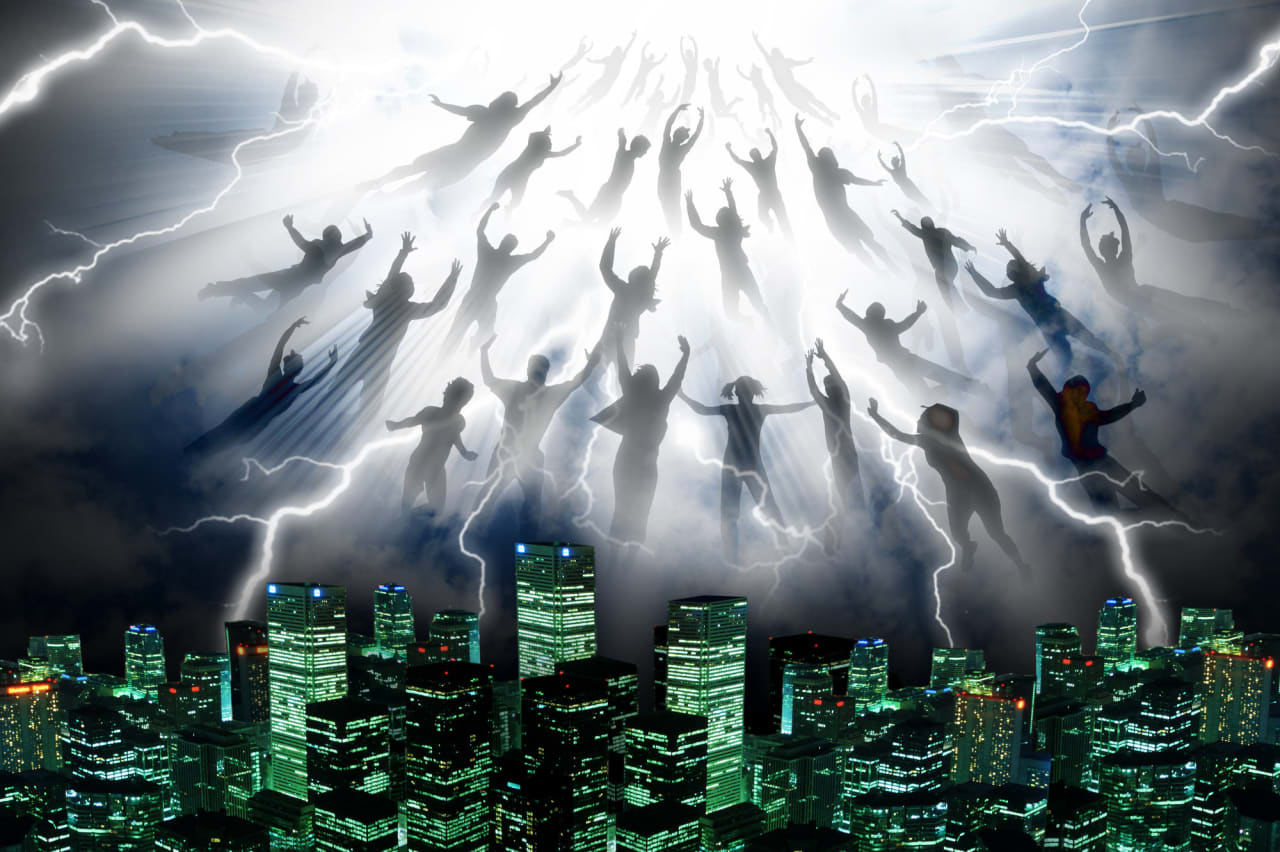
We hear a lot about the Rapture lately, but a lot of confusion exists about what the Rapture is and when it is supposed to take place. Some critics deny the Rapture claiming, that the word “rapture” is not in the Bible. However, the word “Bible” is not in the Bible, nor is the word “Trinity,” yet no Christian would deny these terms. To be clear, while the English word “Rapture” cannot be found in the Bible, its Greek root is. “To the church in Thessalonica, [Paul] wrote: ‘For this we say unto you by the word of the Lord, that we which are alive and remain unto the coming of the Lord shall not prevent [i.e., “go before”] them which are asleep. For the Lord himself shall descend from heaven with a shout, with the voice of the archangel, and with the trump of God: and the dead in Christ shall rise first: Then we which are alive and remain shall be caught up together with them in the clouds, to meet the Lord in the air: and so shall we ever be with the Lord” (1 Thessalonians 4:15-17, emphasis mine). The Greek word translated ‘caught up’ is harpazō, which means ‘to seize, carry off by force’ or ‘to snatch out or away.’ That word is further translated into Latin as rapturo [rapiemur] from which we get our word ‘rapture.’”[1]
Paul also describes the purpose of the Rapture to the Corinthians when he says, “that flesh and blood cannot inherit the kingdom of God; neither doth corruption inherit incorruption” (1 Corinthians 15:50). Our corrupt and sinful bodies cannot enter into heaven; therefore, they must be changed into incorruptible, sinless bodies. “Behold, I shew you a mystery; We shall not all sleep [i.e., “die”], but we shall all be changed, In a moment, in the twinkling of an eye, at the last trump: for the trumpet shall sound, and the dead shall be raised incorruptible, and we shall be changed. For this corruptible must put on incorruption, and this mortal must put on immortality” (1 Corinthians 15:51-53, emphasis mine).
Jesus promised the Rapture. “Let not your heart be troubled: ye believe in God, believe also in me. In my Father’s house are many mansions: if it were not so, I would have told you. I go to prepare a place for you. And if I go and prepare a place for you, I will come again, and receive you unto myself; that where I am, there ye may be also” (John 14:1-3). About 60 years after His ascension, Jesus dictated seven letters to John, the last living of His apostles. The sixth letter was addressed to the Church of Philadelphia to whom Jesus said, “Because thou hast kept the word of my patience, I also will keep thee from the hour of temptation, which shall come upon all the world, to try them that dwell upon the earth” (Revelation 3:10). Many scholars see the seven churches (real churches existing in John’s time) as representative of the characteristics of the Church throughout different epochs in church history. The Philadelphian Church represents the “evangelical” church that sprang up around the end of the 18th century and will continue to the Rapture. The Rapture will fulfill Jesus’ promise to keep them “from the hour of temptation – i.e., trial, testing, tribulation – that is to come upon all the earth”
So, the concept of the Rapture finds solid support in Scripture although some will still try to explain it away.
Some still conflate the Rapture with the Second coming. These are two separate events. The Rapture takes place before the seven-year Tribulation;[2] the Second Coming is when Jesus returns to establish His Kingdom on earth[3] at the end of the Tribulation. At the Rapture, the Church is taken to meet Jesus in the air;[4] at the Second Coming, Jesus will set His feet on Planet Earth.[5]
Many signs accompany the Second Coming: wars, rumors of wars, pestilences, famines, earthquakes, etc.[6] Perhaps the greatest sign of all is the miraculous revival of the nation of Israel as predicted by the Old Testament prophets, but particularly by Ezekiel in his vision of the valley of dry bones.[7] This prophecy came true on May 14, 1948 when Jews from all over the world returned to the land promised to them by God to became a nation once again.
However, there are no signs for the Rapture. About the Rapture, Jesus said. “But of that day and hour knoweth no man, no, not the angels of heaven, but my Father only” (Matthew 24:36). However, as His Second Coming approaches we observe those signs rapidly increasing in frequency and intensity. America is rapidly vanishing from the scene as a superpower. That means that Israel is losing her strongest ally, and she will be left to face her enemies alone. Again, the Prophet Ezekiel predicts an invasion of Israel from a confederation of nations on her northern border.[8] Already, those armies are staging in Syria – Russia, Turkey, Iran and their allies. With the USA out of the way, nothing will stop them from falling into God’s trap. Ezekiel foretells that Israel, left alone, will be defenseless against the invasion; however, God will intervene in such a way that no one, especially Israel, will doubt the power of God.
The Gog of Magog war described above will probably take place after the Rapture, but because we see the stage already being set, we can infer that the Rapture is not too far off. Consider the weakened condition of the USA. Then think about millions of American Christians suddenly vanishing. The majority of Christians are solid citizens who work and pay taxes contributing to the national economy. Think of the impact to the economy when these millions are suddenly gone! Many Christians serve in the military and in police forces. What happens when they disappear? What about healthcare workers, nurses, doctors, medical technicians? With the plandemic already stressing hospital staffing, what happens when many more of these are gone? There are also many solid Christians in positions of leadership at different levels of government. Imagine what will happen when all these people are taken out in the Rapture! Our already weak America will be in total chaos and capable of only making a weak protest, “Art thou come to take a spoil? hast thou gathered thy company to take a prey? to carry away silver and gold, to take away cattle and goods, to take a great spoil?” (Ezekiel 38:13).
We are very near that point now. For many years now I come to this time of year with a heightened sense of expectation. Monday evening, September 6 begins Rosh HaShanah,[9] the Feast of Trumpets.[10] Jesus fulfilled the first four “Feasts of the Lord” – Passover, Unleavened Bread, First Fruits, and Pentecost – at His First Coming. The last three fall feasts have not been fulfilled. The next one is the Feast of Trumpets; therefore, I believe (and I could be wrong) that the Rapture will take place at Rosh HaShanah. At that feast, trumpets were blown calling all the congregation of Israel to assemble. So, it is a “calling in” or a “gathering” of the congregation. Earlier I cited 1 Thessalonians 4:16, where “the trump of God” will sound, and we shall be gathered to Him in the air. The Feast of Trumpets is also known as the feast where “no man knows the day or the hour.” That is because it is based on the first sighting of the new moon; therefore, it is observed over two days because it is not known exactly when the new moon will appear. For those reasons, it makes sense to me that the Rapture can take place during the Feast of Trumpets.
Given the sudden and rapid decline of the USA, the general turmoil around the world, the rise of globalists seeking to rebuild the Tower of Babel (metaphorically speaking), and the increase in end-times signs, I feel this week (Monday evening to Wednesday evening) would be a good time for the Rapture to take place. I am not making any predictions; I am only saying that it seems like a good time for it, in my opinion.
How about you reader? If Jesus were to call His children home, would you be ready? If you are not sure, please read my page on “Securing Eternal Life.”
He that hath ears to hear, let him hear. (Matthew 11:15)
Lately I find myself at a loss for subject matter about which to write. I want to make my articles encouraging and uplifting, but as I look at what is going on around me, in our nation, and in the world, I find very little that is positive. Our government lacks leadership. Those in positions of power seem to be following the dictates of some unseen puppet master. Ultimately, that puppet master is Satan, but that is another topic altogether. Our world fares no better. Economies are failing all over the world placing the whole world at the brink of war. The powers that be continue to increase control over the populous through fear tactics over the supposed pandemic that threatens to kill us all. Pressure to take “the jab” comes from all directions so that, at least in the USA, the government can feign innocence in pushing an unconstitutional mandate. Soon we will not be able to travel, work, buy, or sell without proof that we have been jabbed. No, the jab is not the “mark of the beast,” but it is a good conditioning method to train a compliant society.
All of this may sound depressing to some, but I am actually encouraged. These “signs” indicate that the return of Christ is very near. Jesus foretold all of these things in his Olivet Discourse.[1] Of course, Jesus prophesied of the events that would take place during the Tribulation period seven years before[2] His Second Coming. Before that happens, those who are part of the “true Church,” His Bride, will be raptured out of this world to meet Him in the air.[3]
Some imagine that the Tribulation will begin as soon as Jesus takes His Church out of the world. Then all the Tribulation judgments will begin and escalate rapidly. However, I do not hold that opinion. I believe that the signs will begin slowly, and then steadily increase in frequency and intensity. Jesus described His Second Coming (at the end of the Tribulation) as “A woman when she is in travail hath sorrow, because her hour is come: but as soon as she is delivered of the child, she remembereth no more the anguish, for joy that a man is born into the world” (John 16:21). “All these are the beginning of sorrows” (Matthew 24:8). “And when these things begin to come to pass, then look up, and lift up your heads; for your redemption draweth nigh … So likewise ye, when ye see these things come to pass, know ye that the kingdom of God is nigh at hand.” (Luke 21:28; 31).
All the things of which Jesus spoke cannot take place in an instant. Things have to progress (or regress depending on your perspective) slowly. Economies must fail. Desperation must increase. Distrust in leaders must diminish. Governments must maneuver to gain advantage and power. Wars and rumors of wars will increase. Currently, the USA is under threat from China, Russia, Iran, and North Korea. Israel is surrounded by hostile nations. Iran, Turkey and Russia along with their allies are staging their armies in Syria and Lebanon to threaten Israel’s northern border.
The situation seems rather grim. I have heard several prophecy teachers offer this illustration: “When you see the Christmas decorations going up in all the stores, you know Thanksgiving is near.” In the same way, as we see all of the signs for His Second Coming intensify in number and frequency, we can be sure that the Rapture of the Church is very close.
For the believer, that should be cause for joy, hope, and anticipation! At least, that is how I feel about it. So, imagine my surprise when I recently shared a link to one of Jan Markell’s pod casts[4] and a “sister” asked me to remove her from my mailing list because she did not want to hear anything “political.” It occurred to me that some of our brothers and sisters in Christ want to plug their ears and not hear about what is going on in our world. They want to live their lives as “normal” without anything to disrupt the status quo. Ignorance is bliss, the saying goes. Jesus described these days as the days of Noah and the days of Lot[5] when people carried out their lives as normal without a care in the world of the impending doom. When judgment came, they were caught by surprise. In context, Jesus referred to the time of Tribulation, but the same principle can be applied to the time before the Rapture.
Many “blissful” Christians will be caught by surprise when Jesus snatches them out of this world. That is not so bad you may think. However, think of all those left behind who did not hear the Gospel because Jesus’ servants were carrying on their lives as if nothing were happening. Jesus described such servants in two separate parables.[6] In both examples, one servant did nothing with the charge left to him by his Master, and when the Master returned demanding an accounting, the unfaithful servant was chastised and demoted. So, how will these blissful Christians react when Jesus asks for a reckoning? “Lord! I didn’t know you were coming so soon!”
That is what will happen when you go around with plugged ears refusing to hear what is going on around you and what the Bible has to say about it. At least a third of the Bible, I am told, deals with end-times prophecy. It stands to reason that God put that much prophecy in the Bible to prepare us for the things to come. We cannot prepare for the coming days if we go around with plugged ears. The Bible commends the children of Issachar for their situational awareness. “And of the children of Issachar, which were men that had understanding of the times, to know what Israel ought to do; the heads of them were two hundred; and all their brethren were at their commandment” (1 Chronicles 12:32, emphasis mine). We should follow their example. “He that hath ears to hear, let him hear” (Matthew 11:15)
Reader, perhaps you do not have plugged ears, you are very aware of the decaying condition of the world around you, and you wonder what in the world is going on. I have many articles on the topic of last days under “Categories” that may help answer some of your questions. However, it will all be moot if you do not know the Savior. I encourage you to please read my page on “Securing Eternal Life.”
And they were filled with madness; and communed one with another what they might do to Jesus. (Luke 6:11)
These days I find it difficult to find topics about which to write. I want to write about encouraging topics, but politics and the social condition of our times occupy much of my thinking, and the only encouraging thing that comes to mind is the proximity of our Lord’s return to call His Bride home. As I look forward and look up, I am excited with anticipation, and I am encouraged. However, when I, like Peter,[1] look at the raging storm around me, my mood changes to desperation.
So, like Peter, I cried out “Lord, save me!” I took my Bible, and without looking, opened it at random, zigzagged my finger down the page and stopped at the verse above (Luke 6:11). This is not my usual method of Bible study, nor do I recommend it as an acceptable practice for searching the Scriptures, but on this occasion the Lord was merciful and gave me a thought.
It is never good to take one verse out of context and build a lesson on it, so I went to the top of the chapter and read the full context of the verse. At the beginning of Chapter 6, we find Jesus and His disciples walking through a grain field (barely or wheat, we are not told). Luke points out that it was “on the second sabbath after the first” (Luke 6:1). One commentator suggests that it is “an obscure expression, occurring here only, generally understood to mean, the first sabbath after the second day of unleavened bread. The reasons cannot be stated here, nor is the opinion itself quite free from difficulty.”[2]
Whatever Luke meant by including this detail, the issue remains that the act took place on a Sabbath. As usual, the Pharisees hovered around Jesus like vultures to see what infractions they could find for which to accuse Him. As Jesus and His disciples walked through the grain field, they plucked off heads of grain, rubbed them together between their hands to remove the chaff, and ate the grain. Ah ha! They were harvesting and winnowing on the Sabbath. That was work, and a clear violation of the fourth commandment![3] The Pharisees wasted no time in accusing Jesus of breaking the Sabbath law. Jesus responded by citing Scripture of the time when David ate the “show bread” from the Tabernacle that was reserved for the priests alone.[4] Then He made the audacious statement “That the Son of man is Lord also of the sabbath” (Luke 6:5). Well, it may have been an audacious statement to the Pharisees but Jesus made a truth claim, and it did not go unnoticed by the Pharisees.
Luke then goes on to recount another Sabbath in which Jesus was teaching in a local synagogue. Again, the Pharisees were present taking notes. In attendance was a man with a withered right hand.[5] He may have been there as a “plant” by the Pharisees as the verse seems to suggest. “And the scribes and Pharisees watched him, whether he would heal on the sabbath day; that they might find an accusation against him” (Luke 6:7). A well respected Bible teacher suggested that the man’s condition may have been a birth defect where the right arm never developed properly. Therefore, the miracle Jesus performed in healing the man gave evidence of Jesus’ divine power of creation.
However, that detail escaped the Pharisees who were more concerned about their legalities than in the welfare of the disabled man. Luke records that “they were filled with madness” (Luke 6:11). The Greek word translated “madness” is anoia. It sounds like it may be the root of our English word “annoy,” but it means more than that. It means to be “without understanding,” i.e. “foolish.” It is a “madness expressing itself in rage.” These men were so outraged at Jesus’ supposed infraction of their standards on top of Jesus’ claim to be “Lord of the Sabbath” that they failed to comprehend the significance of the miracle before their eyes. Crazy!
As I considered this, my mind drifted back to our current condition. Without getting into specifics, we see a mounting intolerance toward Bible-believing Christians. Regardless of the good acts performed by Christian organizations, just the fact that Christians believe that there is only one way to salvation makes Christians akin to “haters” and “terrorists.” Well, we can take courage knowing that the trend only brings us closer to the soon return of Christ. As for “crazy,” you ain’t seen nothing yet!
Reader, if you are not sure of your eternal destiny, please read my page on “Securing Eternal Life.” There really is only One Way.
[2]Jamieson, Fausset and Brown Commentary, A Commentary on the Old and New Testaments by Robert Jamieson, A. R. Fausset and David Brown, Note on Luke 6:1.
Yea, though I walk through the valley of the shadow of death, I will fear no evil: for thou art with me; thy rod and thy staff they comfort me. (Psalm 23:4)
Fear paralyzes the fearful, rendering them ineffective in that thing which they fear. Dictionary.com defines fear as “a distressing emotion aroused by impending danger, evil, pain, etc., whether the threat is real or imagined;”[1] (emphasis mine). The fact remains that 10% of most things feared or the things over which we worry never come to pass.
A long list of phobias exists which we could examine: fear of height, fear of flying, fear of germs, fear of needles, etc. However, the most ubiquitous fear held by the majority of people is the fear of dying. One can understand the nature of this fear; it is basically the fear of the unknown. What happens when one dies? Is this life all there is? Is there life after death? Do the dead come back in a different form – reincarnation? Are heaven and hell real? If heaven and hell are real, how does one arrive at one place and not the other? Does dying hurt?
For one who believes the Bible and the God of the Bible, death terminates physical life, but the spiritual essence that energizes the soul (the complete person) transitions on to eternity. The eternal destination depends on the spiritual condition of the soul at the time of death, one is either “saved”[2] or “lost.”[3]
Jesus spoke of two men who met death and ended up in different destinations.[4] Prior to Jesus’ death and resurrection, Jews believed that those who died went to the “abode of the dead” known as Sheol. Sheol had two compartments, one for the unrighteous known as “torments” and one for the righteous known as “Abraham’s bosom” or “paradise.” So the two men died, one was rich and the other a beggar. The rich man ended up in the place of torments not because he was rich, but because he was unrighteous, i.e., “lost.” The poor beggar ended up in Abraham’s bosom not because he suffered poverty, but because he was righteous, i.e. “saved.” After Jesus’ resurrection and ascension, the destination for the “saved” changed to “the presence of the Lord.” The Apostle Paul makes this clear, “We are confident, I say, and willing rather to be absent from the body, and to be present with the Lord” (2 Corinthians 5:8, emphasis mine). The lost still end up in “torments” (“hell”) to await their final destiny in the “lake of fire” that burns forever and ever.[5]
For those who do not have a personal, saving faith in Jesus Christ as their Lord and Savior, death is a legitimate fear indeed. Some may salve their fear by ignoring, or by choosing to believe that death is the end, or by hoping in reincarnation, or by imagining that they will somehow meld into the vast universe, i.e., “become one with the universe.” However, all of these notions only produce doubt, and the fear remains.
The Christian, on the other hand, should not harbor the fear of death. Death, as Paul reminded us, means that we are absent from the body, but we are present with the Lord in the same place where He resides. For the Christian, there should be no fear of death. In another place, Paul reminds us that, for Christians, our “citizenship” (“our conversation”) is not in this world, but in heaven. “For our conversation is in heaven; from whence also we look for the Saviour, the Lord Jesus Christ: Who shall change our vile body, that it may be fashioned like unto his glorious body, according to the working whereby he is able even to subdue all things unto himself” (Philippians 3:20-21, emphasis mine). For the Christian, the “afterlife” promises the possession of a physical body like that of the resurrected Christ in His presence.
I look forward to passing from this rapidly decaying world to be forever in the presence of the One who died in my place to save me from my sin for eternity. I have no fear of death. I realize that while He has me here in this world, I need to serve Him in every task that He lays before me. Then when that day comes, whether by physical death or by translation from this world into His presence in the Rapture, I will enter His courts with joy.
If you fear death or you are insecure about your eternal destiny, please read my page on “Securing Eternal Life.”