Category Archives: Second Coming of Christ

Evil Servant

Tell us, when shall these things be? and what shall be the sign of thy coming, and of the end of the world?

But and if that evil servant shall say in his heart, My lord delayeth his coming; (Matthew 24:48)

Matthew 24 begins what is known as Jesus’ “Olivet Discourse.” Jesus spoke these words on the Mount of Olives just two days before He went to the cross (Matthew 26:2). Jesus had just issued a series of eight “woes” against the Jewish religious leaders—the scribes and Pharisees (Matthew 23:13-33). Here as in other places in the Gospels, Jesus asserts His authority as God when He predicts, “Wherefore, behold, I send unto you prophets, and wise men, and scribes: and some of them ye shall kill and crucify; and some of them shall ye scourge in your synagogues, and persecute them from city to city; That upon you may come all the righteous blood shed upon the earth, from the blood of righteous Abel unto the blood of Zacharias son of Barachias, whom ye slew between the temple and the altar. Verily I say unto you, All these things shall come upon this generation” (Matthew 23:34-36, emphasis mine). Jesus then laments over Jerusalem (Matthew 23:37-39).

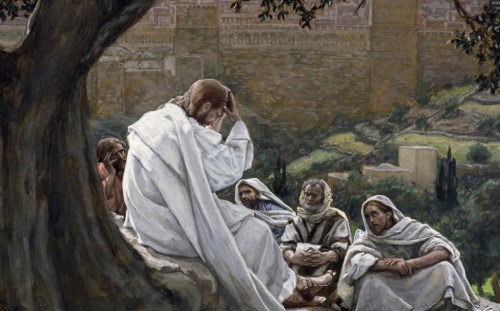
As the disciples stood around hearing these words, their curiosity piqued. “And as he sat upon the mount of Olives, the disciples came unto him privately, saying, Tell us, when shall these things be? and what shall be the sign of thy coming, and of the end of the world?” (Matthew 24:3, emphasis mine).

Before continuing, I must add a point of clarification here. Those asking the question, the disciples, were Jews. They based their question on their understanding of Old Testament prophecies concerning the reign of Messiah, whom they understood to be Jesus (Matthew 16:16). All prophecy—both in the Old and New Testaments—centers around Israel and Messiah’s reign in and from Jerusalem. The Old Testament alludes to the Church, but as Paul points out, it was a “mystery” to Old Testament writers (Ephesians 5:32). Furthermore, at the point of this dissertation, the Church did not exist. The Church was not established until after Jesus’ ascension and the coming of the Holy Spirit (Acts 2:1-4). Jesus, therefore, focused His response on “the time of Jacob’s trouble” (Jeremiah 30:7), a.k.a. “great tribulation” (Matthew 24:21; Revelation 2:22; 7:14). This prophecy was for the Jews and Israel, not for the Church.

Jesus goes into great detail about what will take place during the Tribulation. Even though this prophecy is not directed at the Church, He does provide signs for the Church to discern. “Now learn a parable of the fig tree; When his branch is yet tender, and putteth forth leaves, ye know that summer is nigh: So likewise ye, when ye shall see all these things, know that it is near, even at the doors. Verily I say unto you, This generation shall not pass, till all these things be fulfilled” (Matthew 24:32-34, emphasis mine).

The “fig tree” symbolizes the nation of Israel. Jesus had already predicted the demise of Israel (Judah at this time). “Behold, your house is left unto you desolate [i.e., barren; laid waste; devestated]” (Matthew 23:38, emphasis mine). The fulfillment of this prophecy took place in 70 A.D. when the Roman general Titus razed Jerusalem to the ground. The budding of the fig tree indicates the rebirth of Israel. This took place almost 70 years ago on May 14, 1948. Jesus said this generation, which witnesses the rebirth of Israel, “shall not pass, till all these things be fulfilled” (Matthew 24:34). We are that generation! Then Jesus guaranteed His prophecy, not with “Thus saith the Lord” (Jesus is Lord), but with “Verily, I say.” Then He affirmed, “Heaven and earth shall pass away, but my words shall not pass away” (Matthew 24:35, emphasis mine).

Jesus goes on to encourage watchfulness “for ye know not what hour your Lord doth come” (Matthew 24:42). For those of us who yearn for the Rapture of the Church and also for those who will live through the Tribulation, that means that we cannot predict that event with precision. However, Jesus provided enough information that we can determine the proximity, so we encouraged to “watch.”

Jesus then asks, “Who then is a faithful and wise servant, whom his lord hath made ruler over his household, to give them meat in due season?” (Matthew 24:45, emphasis mine). These are the pastors and teachers whom God has placed over His churches. Jesus instructs these servants to “give them—the churches, i.e., the “flock”—meat in due season.” “Meat” means nourishment, and since Jesus speaks of His “household,” He means “spiritual” nourishment. He made this point clear to Peter at Peter’s restoration when three times Jesus asked him, “Lovest thou Me?” To Peter’s weak responses, Jesus commanded three times, “feed My sheep” (John 21:15-17). In the context of this end-times discourse, the “meat” nourishes the “flock” in preparation for that which is sure to come.

Jesus then contrasts the “faithful and wise servant” with the “evil servant” who “shall say in his heart, My lord delayeth his coming; And shall begin to smite his fellowservants” (Matthew 24:48-49, emphasis mine).  This one does not take the Lord’s return seriously. The Greek word translated “smite” is tuptō and it means to beat with a whip or stick. The Thayer’s Greek Definitions adds that metaphorically the word implies “to wound, disquiet one’s conscience.” This indicates that the abuse is of a spiritual nature, where the pastor or teacher neglects the proper care and feeding of the flock. The flock is spiritually malnourished and completely unequipped for the Lord’s return.

Sadly, we have too many “evil servants” that neglect to prepare the flock for the Lord’s return. They offer many excuses. The worst of the lot simply do not believe in the imminent return of Christ. They do not regard end-times prophecy literally and attribute it to allegory to be spiritualized.  Others think the teaching is too controversial. They fear confusing or offending their congregation. Still, others have church growth as a top priority. “Doom’s Day” teaching might scare off seekers and stunt church growth. They believe church must be a fun and “safe” place. They would not risk making anyone uncomfortable. Some, while saying they believe that Jesus will return soon, feel they must give greater priority practical teaching to equip the flock for dealing with the daily issues of life. In some ways, this last group is the most dangerous. While it is true that pastors/teachers must equip their congregations to face the day-to-day challenges of life; they are still obligated to teach the “whole counsel” of God’s Word (Acts 20:27). That includes encouraging the flock “and so much the more, as ye see the day approaching” (Hebrews 10:25, emphasis mine). That does not mean that every sermon must be an end-times message, but every exhortation should be peppered with the expectation that the Lord may come at any moment.

Any pastor/teacher who fails to teach the imminency of Christ’s return is, according to these words of Jesus, an “evil servant.” For the evil servant who thus abuses his flock, Jesus says, “But whoso shall offend one of these little ones which believe in me, it were better for him that a millstone were hanged about his neck, and that he were drowned in the depth of the sea” (Matthew 18:6, emphasis mine). Jesus concludes this portion of the discourse with this severe warning: “The lord of that servant shall come in a day when he looketh not for him, and in an hour that he is not aware of, And shall cut him asunder, and appoint him his portion with the hypocrites: there shall be weeping and gnashing of teeth” (Matthew 24:50-51).


Comments Off on Evil Servant

Filed under Apologetics, Christianity, Current Events, End Times, Religion, Second Coming of Christ

End of the World

Tares – a kind of darnel, resembling wheat

The Son of man shall send forth his angels, and they shall gather out of his kingdom all things that offend, and them which do iniquity; (Matthew 13:41)

In the thirteenth chapter of the Gospel of Matthew, Jesus relates several parables illustrating the “kingdom of heaven.” Beginning with verse 24, He compares the kingdom of heaven to a field that a farmer sowed with wheat (“good seed”). Then at night, while the farmer slept, an enemy came and sowed tares in the same field. The tares to which Jesus referred were probably some kind of darnel that looks much like wheat before it matures. Once it matures the difference becomes obvious.

The farmer’s hired hands detected the tares early on and reported their discovery to the farmer. “So the servants of the householder came and said unto him, Sir, didst not thou sow good seed in thy field? from whence then hath it tares?” (Matthew 13:27). They suggested pulling out the tares to keep the wheat from being stunted. The farmer wisely told the workers to leave them alone lest they accidentally pull up some of the wheat. Once the crop matured, the wheat would be separated from the tares and the tares would be burned.

Jesus compared the field to the world. He, “the Son of Man,” is the field owner that sowed the good seed. One commentator suggested that the “good seed” is the Word of God and the “bad seed” – the tares – is false doctrine sown by Satan, the enemy. There is an element of truth in that interpretation; however, it is not interpretation Jesus gave. Jesus said, “the good seed are the children of the kingdom; but the tares are the children of the wicked one” (Matthew 13:38). The enemy is the devil who sowed the tares – products of his false doctrine no doubt – and the reapers are the angels (Matthew 13:39).

Jesus portrays the image of the world where His “seed” and Satan’s seed exist together.[1] Often, and sadly, they are indistinguishable from one another. Jesus says that “the harvest is the end of the world” (Matthew 13:39). This cannot be the Second Coming of Christ, because when He comes again, He will set up His kingdom on earth (Revelation 19:11-16), and He will reign for 1000 years (Revelation 20:4).

The “end of the world” comes after the 1000-year reign of Christ on earth. “But the rest of the dead [the tares that died prior to Jesus’ Second Coming or were killed in the battle of Armageddon] lived not again until the thousand years were finished. This is the first resurrection” (Revelation 20:5, emphasis mine). “And when the thousand years are expired, Satan shall be loosed out of his prison” (Revelation 20:7, emphasis mine). Satan then incites many on earth to rebel against the rule of Christ, but the insurrection ends quickly (Revelation 20:9).

The tares – “the rest of the dead” – are raised and brought before “a great white throne” (Revelation 20:11) to be judged. Many today hope that on “judgment day” their good deeds will outweigh their bad deeds on the great cosmic scales. Indeed, good and bad will be judged.  “And I saw the dead, small and great, stand before God; and the books were opened: and another book was opened, which is the book of life: and the dead were judged out of those things which were written in the books, according to their works” (Revelation 20:12, emphasis mine). “The books” contain the life record of every individual that ever lived – both good deeds and bad deeds. “The dead,” i.e. the “tares,” are judged by the content of their books. Note that the “good seed,” i.e. the “wheat,” are not being judged. They were “gathered up” before the 1000-year reign and ruled with Christ for the 1000 years (Revelation 20:4).

James says that “whosoever shall keep the whole law, and yet offend in one point, he is guilty of all” (James 2:10). “And the sea gave up the dead which were in it; and death and hell [sheol – “the grave] delivered up the dead which were in them: and they were judged every man according to their works” (Revelation 20:13, emphasis mine). No one will be found guiltless. “For all have sinned, and come short of the glory of God” (Romans 3:23). To be fair, none of us can live up to such strict standards, so “the tares” are given one final test. Their names are checked against the Book of Life,[2] “And whosoever was not found written in the book of life was cast into the lake of fire” (Revelation 20:15, emphasis mine).

That is the end of the world, but it is not the end. “And I saw a new heaven and a new earth: for the first heaven and the first earth were passed away; and there was no more sea. And I John saw the holy city, new Jerusalem, coming down from God out of heaven, prepared as a bride adorned for her husband. And I heard a great voice out of heaven saying, Behold, the tabernacle of God is with men, and he will dwell with them, and they shall be his people, and God himself shall be with them, and be their God. And God shall wipe away all tears from their eyes; and there shall be no more death, neither sorrow, nor crying, neither shall there be any more pain: for the former things are passed away” (Revelation 21:1-4).

Reader, is your name recorded in the Lamb’s Book of Life? Has Satan filled your mind with false teachings and turned you into a tare? While there is breath in your body, you can alter your destiny and secure your name in the Book of Life. Call on Jesus; He alone can save you. “For whosoever shall call upon the name of the Lord shall be saved” (Romans 10:13). For more information, read my page on Heaven from the tab at the top of this page.

Notes:


[1]  “Tares Among the Wheat” – https://erniecarrasco.com/2013/05/19/tares-among-the-wheat/

[2]  “The Book of Life” – https://erniecarrasco.com/2014/02/03/the-book-of-life/

Comments Off on End of the World

Filed under Apologetics, Christianity, End Times, Evangelism, Gospel, Heaven, Hell, Religion, Resurrection, Salvation, Satan, Second Coming of Christ

All Things New

And he that sat upon the throne said, Behold, I make all things new. And he said unto me, Write: for these words are true and faithful. (Revelation 21:5)

For me, 2017[1] ends with mixed reviews. Beginning in January, the uncertainty of a Trump presidency offered a sense of cautious optimism. By this time, however, my opinion of President Donald Trump has swung to a strong positive. I still wish he would learn to control what comes out of his mouth. Then again, he is not a “politician,” so he pretty much tells it like it is. I can appreciate that about him. Of course, his lack of political correctness makes his opponents in government and the media dig in their heels even deeper, but with “his pen and his phone,” he managed to undo much of the harm created by the last administration. One has to admire his tenacity! Here are just some of our President’s accomplishments in his first year:

  1. Passing the tax-cut bill (promise kept)
  2. Neil Gorsuch confirmation to the Supreme Court (promise kept)
  3. Roll-back of [many] regulations (promise kept)
  4. Travel Ban [from terrorist spawning countries] (promise kept)
  5. Declaring Jerusalem the capital of Israel (promise kept)
  6. Withdrawal from the Paris climate deal (promise kept)
  7. Pulling out of NAFTA (promise kept)
  8. Roll-back of “some” of Obama’s Cuba policies (promise kept)
  9. Moving to repeal Obama’s net neutrality rules
  10. Fighting and further degrading ISIS (promise kept)[2]

In many ways, our nation improved in 2017. Economically, things are looking up. Companies are beginning to employ more workers due to the reduction in regulations and the prospect of corporate tax cuts. AT&T and others gave substantial year-end bonuses to their employees for the first time in many years. America has regained her status as the leader of the free world and earned back the respect lost by the last administration. However, that has also escalated the tensions with hostile nations like Iran, North Korea, China, and Russia. North Korea has grown more volatile since the days of the last administration. We wonder where that will lead in 2018. Even though America has seen many improvements in 2017, the world remains in a state of unrest as wars and rumors of wars continue to escalate.

Twenty-seventeen brought some disappointments for me. Supposedly, 2017 was the 70th Year of Jubilee[3] since God gave the observance to Moses 3500 years ago. The Jewish year was 5777. The number 10 in the Bible represents completeness, as does the number seven. The number three represents completeness also, but it is usually associated with the triune nature of God. Working together, all these numbers made 2017 significant apocalyptically. The 70th Jubilee is 7 x 10, and the Jewish year included three sevens in a row. Along with that, the U.S. experienced a significant total eclipse[4] all across the continent – a sign for Gentile nations. That was followed by “The Revelation 12 Sign,”[5] which took place on September 23.  Twenty-seventeen was also the 70th anniversary of the United Nations recognizing Israel as a sovereign nation and the 50th anniversary of Israel regaining control of their capital city, Jerusalem, in the 1967 Six-day War. All these things together along with our Lord’s words, “This generation shall not pass, till all these things be fulfilled” (Matthew 24:34), made 2017 an excellent time for our Lord’s return.

I do and have for many years held the opinion that Jesus will come for His Bride, the Church, on or around the Feast of Trumpets, which in 2017 took place on September 23/24. However, those days came and went, and we are all still here. One adamant YouTube advocate for the Revelation 12 Sign was often unfairly accused of being a “date setter” by more conservative end-times prophecy “experts” for suggesting that the Rapture “might” take place on the 23rd. Sadly, when the event did not take place, the young man stopped producing YouTube messages. I sympathize with his disappointment, but I have no doubt that Jesus will return for His Church at the appropriate time. When He does come, I want Him to find me occupied in my Father’s business.

We still look for Christ’s return with great anticipation. Some suggest that 2018 could be the year that Jesus comes for His Church. These revised predictions find their basis on the 70th anniversary of Israel declaring its independence on May 14, 1948.  That is as good as any other prediction considering the fact that Jesus never gave us a definite time.

The key factor in all end-times prophecy is the Nation of Israel. All end-times prophecy centers around Israel. Following the destruction of Jerusalem and the scattering of the Jews in 70 AD, the Nation of Israel ceased to exist, and for 2000 years, the land remained a barren ruin – a Valley of Dry Bones (Ezekiel 37). Then at the turn of the 20th Century, with the Balfour Declaration of 1917, the prophet’s vision was realized. The bones started coming together and then the sinew, the flesh, and the skin until in 1948 the dry bones stood up – a mighty army. Never in world history has a people been utterly disseminated among other nations and managed to maintain their identity and customs – and this for over 2000 years. Even the Hebrew, once considered a dead language, has revived as the national language of Israel. The Nation of Israel is nothing less than a miracle.

The fig tree symbolizes the Nation of Israel. Jesus alluded to the fig tree in His prophetic discourse.  He said that when you see the fig tree (Israel) put forth its leaves, you know that summer is near. “So likewise ye, when ye shall see all these things, know that it is near, even at the doors. Verily I say unto you, This generation shall not pass, till all these things be fulfilled” (Matthew 24:33-34, emphasis mine). The fig tree has not only budded, but it is now in full-bloom and producing fruit! Jesus guaranteed the truth of His statement. “Heaven and earth shall pass away, but my words shall not pass away” (Matthew 24:35). Seventy years – threescore and ten (Psalm 90:10) – qualifies as a generation. The time is near!

Frivolous distractions by the “fake news” and the “selective news” media blind us to the “rumors of wars” stirring in the Middle East. The Prophet Ezekiel spoke of the armies of Magog (Russia), Tubal (Turkey), Persia (Iran), and a few others gathering against Israel in the “last days” (Ezekiel 38-39). We see that happening now, but few are paying attention. God is preparing the scene for the coming of our Lord. Perhaps 2018 will be the year. I hope so. Regardless, our Lord is faithful, and Jesus will come soon. Therefore, “Humble yourselves therefore under the mighty hand of God, that he may exalt you in due time: Casting all your care upon him; for he careth for you” (1 Peter 5:6-7). We can look forward to the New Year knowing that God has all things well under control. I am excited about whatever He has in store for us!

Happy New Year!

Notes:


[1]  “A New Thing” – https://erniecarrasco.com/2017/01/01/a-new-thing/

[2]  From The Hill, “Trump’s Top 10 accomplishments of 2017” – http://thehill.com/homenews/administration/366429-trumps-top-10-accomplishments-of-2017

[3]  “Coming Soon!” – https://erniecarrasco.com/2017/07/09/coming-soon/

[4]  “Now’s A Good Time” – https://erniecarrasco.com/2017/09/17/nows-a-good-time/

[5]  “Coming Soon!” – https://erniecarrasco.com/2017/07/09/coming-soon/

3 Comments

Filed under Christianity, Current Events, End Times, Holidays, New Year's Day, Politics, Religion, Second Coming of Christ

The ILLUMINATI: Once a Secret Society Now Recruiting For Members Online

I have often wondered if the Illuminati are “for real.” I’ve heard a lot of talk, but I have seen zero evidence. If they really are a “secret” society, their secret has been well kept. However, the more we see the “signs of the times,” this shouldn’t come as a big surprise. If it were not for HE that is within me, Who is greater than he that is in the world, (1 John 4:4) this could be a little spooky. As their commercial encourages, I have no fear, but not because of anything they have to promise.

via The ILLUMINATI: Once a Secret Society Now Recruiting For Members Online

“I began researching the internet to find this “Illuminati website.”  What I found shocked me to my core.  At first I thought that it was a hoax, but the more I searched, I realized that this once “secret” society had not only become open – but they were actually recruiting people to join. At least it seems this way.”

Read more … https://grandmageri422.me/2017/11/22/the-illuminati-once-a-secret-society-now-recruiting-for-members-online/


3 Comments

Filed under Current Events, End Times, Random Musings, Second Coming of Christ, Uncategorized

Jerusalem

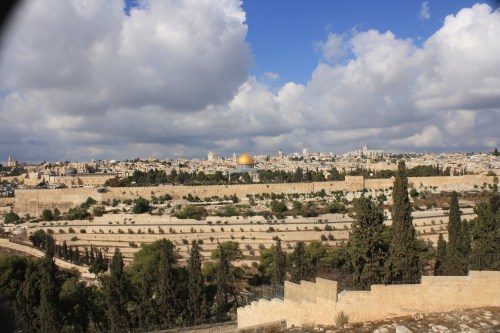
Modern Jerusalem viewed from the Mount of Olives

And unto his son will I give one tribe, that David my servant may have a light alway before me in Jerusalem, the city which I have chosen me to put my name there. (1 Kings 11:36)

Emerging from the tunnel cut through the mountain from Jericho, I caught my first glimpse of the “Eternal City,” Jerusalem. I was completely unprepared for the overwhelming emotional “rush” I would get upon my first view of the city – God’s city. Although Jerusalem is in every way a modern city – nothing like it was in Jesus’ day – building codes imposed on new construction maintain the “old” appearance of the city. That probably contributed to my emotional response.

There are cities in the Middle East more ancient than Jerusalem. Damascus, Syria, for example, is first mentioned in Genesis 14:15.  In this account, a confederation of four kings from the area around Damascus came against the kings of the south, in the area around the Dead Sea. One of those cities was Sodom where Abram’s nephew Lot was living. The invading kings sacked the five cities including Sodom and carried off captives of which Lot was one. Abram mustered up a small army of his own servants, pursued the four kings, rescued Lot, and the other captives, and took back the booty taken by the marauding kings. On his return, he encountered Melchizedek, king of Salem (Genesis 14:17-20). Some have supposed that Salem was the same as Jerusalem, but I disagree for several reasons.[1]

Jerusalem[2] is built on the mountains in the land of Moriah. It was “upon one of the mountains” (Genesis 22:2) there that God instructed Abraham to sacrifice his only son Isaac. It is noteworthy that God did not instruct Abraham to go to Salem, Jerusalem, or Jebus (Judges 19:10-11; 1 Chronicles 11:4-5). Jebus was the “city of the Jebusites” and the Jebusites were in the land when Abram first arrived (Genesis 15:21), and it seems it would have been an excellent landmark if it existed at the time of Abraham. Instead, God instructed Abraham to go the “land of Moriah” and sacrifice Isaac on one of the mountains there. A normal reading of the text leads one to see this place as isolated and uninhabited. However, this would later become the site of Jerusalem, and the particular mountain on which Isaac was offered would become the site of the Temple “in the threshingfloor of Ornan the Jebusite.” (2 Chronicles 3:1). Eventually, God would sacrifice His own Son, on the mountains of Moriah.

This alone makes Jerusalem a special place. Geographically, Jerusalem is located near the center of earth’s total landmass.[3] More than this, God stamped His name on Jerusalem.[4] Jews associate the Hebrew letter “Shin” (ש) with the name of God. They derive this from the “Shama” (meaning “hear”) in Deuteronomy 6:4 – “Hear, O Israel: The LORD our God is one LORD.” Jerusalem – the “Old City” is situated on the mountains of Moriah, which are flanked by two valleys – the Kidron, and Tyropean – with a third, the Hinnom (Gehenna), that runs down the center to join the other two. The topography forms the letter “Shin” the symbol of God’s name. The land of Israel has a similar stamp where the three headwaters of the Jordon River join together to form the letter “Shin.”

The mountains of Moriah are made up of three mountain heads: Ophel, Moriah, and Zion. “Ophel” means “My Fortress” and represents God the Father. “Moriah” means “to see God” or “to be seen of God” and represents God the Son. “Zion” means “the Mark” and represents God the Holy Spirit who is the “seal” or the “mark” of all believers. One mountain range with three heads representing one God in three persons.

Jerusalem, as stated earlier, is the “Eternal City.” When Jesus returns to reign as King of Kings and Lord of Lords, He will come to Jerusalem. “And his feet shall stand in that day upon the mount of Olives, which is before Jerusalem on the east, and the mount of Olives shall cleave in the midst thereof toward the east and toward the west, and there shall be a very great valley; and half of the mountain shall remove toward the north, and half of it toward the south” (Zechariah 14:4, emphasis mine). Jesus will physically reign from His Temple in Jerusalem. A river will flow from his throne here and will run to the east and into the Dead Sea, which will be healed (Ezekiel 47:8-9).

At the end of the 1000-year reign of Christ on earth, God will create a “new heaven and a new earth,” and a “New Jerusalem” will descend from heaven to a recreated earth (Revelation 21:1-2) where those of us who are His children will reign forever with Him. As beautiful as Jerusalem is today, it will not compare to the New Jerusalem where not just God’s name will dwell, but God Himself will dwell with us!

Reader, if you are unsure where you will spend eternity, read my page on Heaven.

Notes:


[1]  “Is Salem Jerusalem?” – https://erniecarrasco.com/2015/08/16/is-salem-jerusalem/

[2]  “Hebrew Word Study – Jerusalem – Part I” – http://livingwordin3d.com/discovery/2016/12/18/hebrew-word-study-jerusalem-part-i/

[3]  “The Center of the Earth” – http://www.icr.org/article/50

[4]  “Jerusalem – I Will Put My Name There – Amazing Revelations” – https://www.youtube.com/watch?v=aZO_eRmR2ho

2 Comments

Filed under Bible, Christianity, End Times, Gospel, Heaven, Religion, Salvation, Second Coming of Christ, Theology