
Category Archives: Theology

Resurrection

colorful sunset

Jesus answered and said unto them, Destroy this temple, and in three days I will raise it up … When therefore he was risen from the dead, his disciples remembered that he had said this unto them; and they believed the scripture, and the word which Jesus had said. (John 2:20, 22)

Christians today, especially in the Middle East, suffer martyrdom by the hundreds at the hands of brutal ISIS executioners. These undergo a gruesome and horrific death by beheadings or being burned alive. Yet, as ghastly as we may perceive such brutality, the pain and suffering of these victims is short-lived, unlike that experienced by our Lord Jesus Christ on the cross.[1]

On the Lord’s Feast of Passover,[2] Jesus, already physically drained from lack of sleep[3] and subjected to a sham of a trial by the Jewish religious leaders, was brutally beaten and scourged at hands of Roman soldiers, experts at inflicting pain without killing the victim. Then in that depleted condition, He was forced to carry His own cross to the place of execution, and whether it was a fully assembled cross or just the cross beam, for a man in Jesus’ condition at that time was next to impossible – but He did it. Under the weight of that burden, determined to complete His mission, He faced the horror of the cross. God, wrapped up in human flesh, with His host of angelic armies standing at the ready awaiting the command to rain down vengeance upon His tormentors. At the time of His arrest, Peter pulled his sword in His defense, but Jesus stopped him. “Thinkest thou that I cannot now pray to my Father, and he shall presently give me more than twelve legions of angels?” (Matthew 26:53).  Nothing would deter Him from His mission. “[He] made himself of no reputation, and took upon him the form of a servant, and was made in the likeness of men: And being found in fashion as a man, he humbled himself, and became obedient unto death, even the death of the cross” (Philippians 2:7-8).

Determined to give to the very last, He carried Himself up Calvary’s hill, laid Himself down upon the timbers and spread His arms out to receive the nails – our pain, our guilt, our sins. “For [God the Father] hath made him [Jesus] to be sin for us, who knew no sin; that we might be made the righteousness of God in him” (2 Corinthians 5:21). At the last, He gave His life. He did not die. Jesus said, “… I lay down my life, that I might take it again. No man taketh it from me, but I lay it down of myself. I have power to lay it down, and I have power to take it again. This commandment have I received of my Father” (John 10:17-18, emphasis mine). He was not killed. “Jesus, when he had cried again with a loud voice, yielded up the ghost” (Matthew 27:50, emphasis mine). He was not the victim. He was in full control until the very last. John, the beloved disciple, and the only one of the twelve to witness the event said, “When Jesus therefore had received the vinegar, he said, It is finished: and he bowed his head, and gave up the ghost” (John 19:30, emphasis mine). Finished! Paid in full!

That was not the end. On the first day of the week, on that spring Sunday morning, He broke the chains of death and brought sheol’s captives with Him. Matthew records, “And the graves were opened; and many bodies of the saints which slept arose, And came out of the graves after his resurrection, and went into the holy city, and appeared unto many” (Matthew 27:52-53).[4]

His resurrection is key! Had Jesus died and remained in the tomb, we would venerate a martyr, nothing more. His bones would be marked by an ornate shrine. Perhaps followers would make faithful pilgrimages to the site to stand in awe and wonder. If that was the case, our faith’s reward would be death and eternal separation from our Creator with no hope of redemption. “And if Christ be not risen, then is our preaching vain, and your faith is also vain” (1 Corinthians 15:14). “But thanks be to God, which giveth us the victory through our Lord Jesus Christ” (1 Corinthians 15:57).  Because of His resurrection, “Death is swallowed up in victory” (1 Corinthians 15:54). “For if we have been planted together in the likeness of his death, we shall be also in the likeness of his resurrection” (Romans 6:5). So now we can say, “O death, where is thy sting? O grave, where is thy victory?” (1 Corinthians 15:55).

Before going to the cross, Jesus left us with this promise: “Let not your heart be troubled: ye believe in God, believe also in me. In my Father’s house are many mansions: if it were not so, I would have told you. I go to prepare a place for you. And if I go and prepare a place for you, I will come again, and receive you unto myself; that where I am, there ye may be also” (John 14:1-3). His resurrection guarantees the promise. On that day, “the Lord himself shall descend from heaven with a shout, with the voice of the archangel, and with the trump of God: and the dead in Christ shall rise first: Then we which are alive and remain shall be caught up together with them in the clouds, to meet the Lord in the air: and so shall we ever be with the Lord” (1 Thessalonians 4:16-17).

Our Christian brothers and sisters in the Middle East and elsewhere in the world are brutally killed daily by the enemy of God. We can thank God that for many, death is swift; it is nothing like what their Lord and our Lord endured for our sakes. But the guaranteed promise of the resurrection assures us that one day soon, we will be together with Him in His house.

Notes:


[1]  It is said that victims could linger on the cross up to three days until succumbing to dehydration and asphyxia.

[2]  Despite conventional tradition, this even could not have taken place on Friday. Jesus said He would rise in “three days,” not three partial days. Jesus specified “three days and three nights” (Matthew 12:39-40). No matter how one may try to convolute the time to fit a “Good Friday” scenario, one cannot get “three days and three nights” from Friday evening to Sunday morning. Jesus said, “three days and three nights” – 72 hours, nothing less will do!

[3]  Jesus had spent the night in prayer while His disciples slept (Matthew 26:36-46; Mark 14:32-42; Luke 22:39-46) before being betrayed by Judas, arrested and tried.

[4]  Matthew’s recording of this event that seems to coincide with Jesus’ death and the renting of the veil to the Holy of Holies, but a close inspection of the text reveals that this event occurred after the resurrection. See again Matthew 27:52-53.

2 Comments

Filed under Apologetics, Christianity, Easter, Evangelism, Gospel, Religion, Resurrection, Salvation, Theology

Good For Who?

Set Apart

For I am the LORD your God: ye shall therefore sanctify yourselves, and ye shall be holy; for I am holy: neither shall ye defile yourselves with any manner of creeping thing that creepeth upon the earth.  (Leviticus 11:44)

We are right in the middle of the Lenten Season observed by many mainline Protestant denominations and different varieties of Catholic churches (Roman, Greek, Russian, etc.). Beginning with Ash Wednesday (this year observed on February 10, 2016), the faithful observe 40 days of “fasting” in preparation for Easter. (I prefer calling it Resurrection Sunday.) Celebrants observe the season by giving up something “sacrificial” for Lent. The sacrifice could be anything like giving up TV, Snickers candy bars, eating meat on Fridays, not going to movies or anything equally superfluous, but prior to the season of deprivation, celebrants indulge in a day of depravation known as Fat Tuesday. They stoke up on enough indulgence to last through the 40 days of deprivation.

If it sounds as if I am making light of the observance, please understand that I know many who are sincere in the practice, and that is admirable; however, there are more who observe the season by rote without taking into account the significance. However my theme here is not about Lent, but rather it is about holiness. Would it not be better to live a godly lifestyle consistently as a matter of practice rather than trying to force upon oneself a token meaningless act that, if kept, lasts for a short time and then is forgotten? Indeed, God would have us conduct ourselves in holiness all the time.

I have addressed this topic in the past perhaps because the older I get, the more I recognize my own deficiency in this area. I also see the growing invasion of “worldliness” spreading in our churches, including our more “conservative” evangelical churches. I attribute much of this to a general lack of biblical literacy, especially with regard to Old Testament teaching regarding the Mosaic Law.[1] To many modern Christians, only the New Testament applies to us because we are living under “Grace,” not under the “Law.”[2] That, I believe, comes from a misunderstanding of both Grace and Law.

I recently read through the book of Leviticus, and it once again became apparent to me that many of the laws given had no other purpose than to distinguish the “people of God” from the goyim (Gentiles/nations) among whom they lived. The phrase “be holy” is repeated some 29 times in the Pentateuch, and whether applied to objects used in worship or to the people themselves, it means to set that thing apart for a special and unique purpose. Our leading verse instructs the people to “sanctify yourselves,” i.e. consecrate or set yourselves apart. Where the implements of worship were concerned, they were not to be used for common purposes. Every object used in the Tabernacle (and later in the Temple) was dedicated only for the purpose it was designed. If a platter held the showbread, it could not be used for any other purpose. It was “holy” – dedicated, consecrated, sanctified, set apart for one purpose only.

The people likewise were to be set apart. “Ye shall be holy: for I the LORD your God am holy” (Leviticus 19:2, emphasis mine). For what were they to be holy? “And ye shall be unto me a kingdom of priests, and an holy nation” (Exodus 19:6, emphasis mine). God’s purpose for His people has not changed in that regard. Note John’s description of the risen Christ in his address to the churches: “Unto him [the Lord Jesus Christ] that loved us, and washed us from our sins in his own blood, And hath made us kings and priests unto God and his Father; to him be glory and dominion for ever and ever. Amen (Revelation 1:5b-6).  Just like the nation of Israel, the Church of Christ (not the denomination that takes that name) is to be holy – set apart – to be a kingdom of priests to the world around us.[3]

As kings and priests, we should exemplify the Law of God. We do not obey the Law in order to obtain our position as kings and priests, but because we have obtained that position through Grace. In order to obey the Law, we must first know and understand the Law, and that understanding comes from studying the Law that God gave to Israel in the Old Testament. Granted, much of particulars, such as dress code and dietary laws do not apply to us, but the principle of distinctiveness from the “world” remains.

One example that came to mind was the prohibition from wine that was given to the priests. “And the LORD spake unto Aaron, saying, Do not drink wine nor strong drink, thou, nor thy sons with thee, when ye go into the tabernacle of the congregation, lest ye die: it shall be a statute for ever throughout your generations: And that ye may put difference between holy and unholy, and between unclean and clean” (Leviticus 10:8-10, emphasis mine). Notice that the prohibition was limited to their going into the Tabernacle (later that applied to the Temple). Now consider what Paul said to the Corinthian Church: “Know ye not that ye are the temple of God, and that the Spirit of God dwelleth in you? If any man defile the temple of God, him shall God destroy; for the temple of God is holy, which temple ye are” (1 Corinthians 3:16-17, emphasis mine). Not only are we kings and priests, but we are also the Temple of the Holy Spirit, so with regard to “wine and strong drink” Christians should abstain. Yet there are many Christians that will excuse themselves from this prohibition by saying that the Bible only condemns drunkenness and not simply the occasional glass of wine or just one brewski. Well then, what about the fact that we are kings and priests and that we are the Temple of God? We are to be “holy” in all things. “Be ye holy” was not only meant for the Israelites; it applies to us as well. “But as he which hath called you is holy, so be ye holy in all manner of conversation; Because it is written, Be ye holy; for I am holy” (1 Peter 1:15-16, emphasis mine). That archaic word “conversation” refers to one’s life-conduct; so in every manner in which we conduct our lives, we should be holy.

More examples could be cited. What about the prohibition against tattoos (Leviticus 19:28)? Yet we have many Christians following the pattern of the world rather than being distinct from the world. But the point here is not so much about following an arbitrary set of rules, but following the One who put those rules in place. Over 73 times in the Pentateuch God emphasizes “I AM the LORD.” Forty-five (45) of those (62%, almost 2/3) appear in the book of Leviticus. Might God be trying to tell us something – “Do what I say because I AM the Lord!”

In closing, let me stress that this is meant for God’s people. One does not have to keep the Law to become a child of God. But as any good son desires to please his father, should not God’s children desire to please their Heavenly Father? And how does one do that? One does it by following His laws. He gave them to us as a pattern for our life conduct. Can we do that perfectly? I know I can’t, but that does not mean I don’t try. Nor should it be something over which we fret, because He has given us His Holy Spirit to help our weakness. “I am crucified with Christ: nevertheless I live; yet not I, but Christ liveth in me: and the life which I now live in the flesh I live by the faith of the Son of God, who loved me, and gave himself for me” (Galatians 2:20, emphasis mine). The faith “of the Son of God” is our source of strength. We live holy lives for Him and by Him.

Notes:


[1]  See “Is the Law Sin?” https://erniecarrasco.com/2014/06/08/is-the-law-sin/

[2]  See “God’s Laws” https://erniecarrasco.com/2016/01/10/gods-laws/

[3]  See “Kings and Priests” https://erniecarrasco.com/2015/09/06/kings-and-priests/

1 Comment

Filed under Apologetics, Bible, Christianity, Easter, Religion, Theology

Says Who?

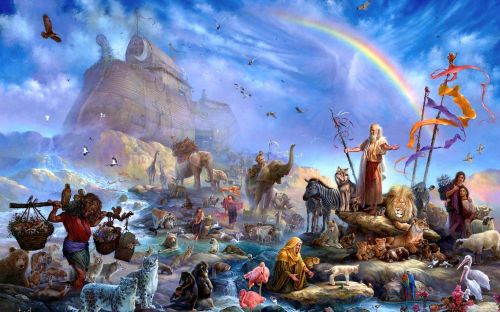
After the Flood

Knowing this first, that there shall come in the last days scoffers, walking after their own lusts,   (2 Peter 3:3)

“Scoffers,” as defined by the Apostle Peter in the context of this verse, are those who reject the teaching of Scripture concerning the return of our Lord Jesus Christ, but more generally, scoffers ridicule all teachings of Scripture. Scoffers become, as the Apostle Paul described, “fools” – “Professing themselves to be wise” (Romans 1:22). A “fool,” as defined by the Bible, is one who “hath said in his heart, There is no God” (Psalm 14:1). While the world has always had a good number of “foolish scoffers,” it seems, to me at least, that their ranks have swelled in these “last days,” or perhaps they have just gotten more brazen. The open and unapologetic Christian will sooner or later encounter scoffers that will mock and challenge one’s faith in the Word of God. When that happens, Peter says, “sanctify the Lord God in your hearts: and be ready always to give an answer to every man that asketh you a reason of the hope that is in you with meekness and fear” (1 Peter 3:15, emphasis mine).

Recently I had an electronic exchange with a scoffer pretending to be a Christian. (“Wherefore by their fruits ye shall know them.” Matthew 7:20) This scoffer mocked the account of the Global Flood recorded in Genesis. He questioned the construction of the Ark, the collecting of the animals, the supposition that dinosaurs were carried onboard and the logistics of taking care of the menagerie. He asserted that dinosaurs did not live at the same time as the biblical account of the Flood, then chided that it made “me ashamed that fundamentalist Christianity is part of our culture, that these ‘adults’ actually live in a mass fantasy world, manipulated by others in their own fantasy world, some of whom have PhD after their name” – referring to creation scientists. He continued, “Don’t you realize that the New Testament gives us permission to abandon the fantastic myths of the Old Testament, and that the only teaching of Jesus is compassion, for which we don’t need a Bible, or for that matter, a religion?” (emphasis mine)

Proverbs teaches us to “Answer a fool according to his folly, lest he be wise in his own conceit.” (Proverbs 26:5) I assumed the scoffer to be “Christian” from his suggestion “that the New Testament gives us permission to abandon the fantastic myths of the Old Testament.” Although I found it rather astounding that a “Christian” would only accept less than one-third of the Bible. Obviously, he does not know his Bible very well, which is not something for which to be proud, if one really is a Christian. Consider the following:

In the beginning was the Word, and the Word was with God, and the Word was God. The same was in the beginning with God. All things were made by him; and without him was not any thing made that was made … And the Word was made flesh, and dwelt among us, (John 1:1-3, 14)

Obviously, that is talking about Jesus, but compare that with Genesis 1:1 “In the beginning God created the heaven and the earth.” Here the New Testament (NT) claims that Jesus IS God. That being the case, consider the following:

But from the beginning of the creation God made them [Adam and Eve] male and female. For this cause shall a man leave his father and mother, and cleave to his wife; And they twain shall be one flesh: so then they are no more twain, but one flesh. (Mark 10:6-8, emphasis mine)

For in those days shall be affliction, such as was not from the beginning of the creation which God created unto this time, neither shall be. (Mark 13:19, emphasis mine)

Ye are of your father the devil, and the lusts of your father ye will do. He was a murderer from the beginning, and abode not in the truth, because there is no truth in him. When he speaketh a lie, he speaketh of his own: for he is a liar, and the father of it. (John 8:44, emphasis mine)

In the verse above Jesus was referring to Genesis 3:1-5, “Now the serpent [the devil] was more subtil than any beast of the field which the LORD God had made. And he said unto the woman, Yea, hath God said, Ye shall not eat of every tree of the garden? … And the serpent said unto the woman, Ye shall not surely die” (emphasis mine)

But as the days of Noe [Noah] were, so shall also the coming of the Son of man be. For as in the days that were before the flood they were eating and drinking, marrying and giving in marriage, until the day that Noe entered into the ark, (Matthew 24:37-38, see also Luke 17:26-27, emphasis mine)

Verily I say unto you, It shall be more tolerable for the land of Sodom and Gomorrha in the day of judgment, than for that city. (Matthew 10:15, emphasis mine)

But I say unto you, That it shall be more tolerable for the land of Sodom in the day of judgment, than for thee. (Matthew 11:24, emphasis mine)

And whosoever shall not receive you, nor hear you, when ye depart thence, shake off the dust under your feet for a testimony against them. Verily I say unto you, It shall be more tolerable for Sodom and Gomorrha in the day of judgment, than for that city. (Mark 6:11, emphasis mine)

But the same day that Lot went out of Sodom it rained fire and brimstone from heaven, and destroyed them all. (Luke 17:29, emphasis mine)

For as Jonas [Jonah] was three days and three nights in the whale’s belly; so shall the Son of man be three days and three nights in the heart of the earth. The men of Nineveh shall rise in judgment with this generation, and shall condemn it: because they repented at the preaching of Jonas; and, behold, a greater than Jonas is here. (Matthew 12:40-41, emphasis mine)

Jesus said unto them, Verily, verily, I say unto you, Before Abraham was, I am. (John 8:58, emphasis mine)

By now, it should be obvious to even the most Bible illiterate that Jesus, who is God the Creator, affirmed the “myths” of the Old Testament (OT). Not only that, but being God Himself, He is also Author of those “myths.” The NT says that ALL Scripture is “breathed out” by God.

All scripture is given by inspiration of God, and is profitable for doctrine, for reproof, for correction, for instruction in righteousness (2 Timothy 3:16, emphasis mine)

Knowing this first, that no prophecy of the scripture is of any private interpretation. For the prophecy came not in old time by the will of man: but holy men of God spake as they were moved by the Holy Ghost. (2 Peter 1:20-21, emphasis mine)

The writers of the NT only knew the OT as “Scripture.”  So, how did they view the “myths” of the OT?

And to make all men see what is the fellowship of the mystery, which from the beginning of the world hath been hid in God, who created all things by Jesus Christ: (Ephesians 3:9, emphasis mine)

He that committeth sin is of the devil; for the devil sinneth from the beginning. For this purpose the Son of God was manifested, that he might destroy the works of the devil. (1 John 3:8, referring to Genesis 3:1-5, emphasis mine)

By faith Noah, being warned of God of things not seen as yet, moved with fear, prepared an ark to the saving of his house; by the which he condemned the world, and became heir of the righteousness which is by faith. (Hebrews 11:7, emphasis mine)

Which sometime were disobedient, when once the longsuffering of God waited in the days of Noah, while the ark was a preparing, wherein few, that is, eight souls were saved by water. (1 Peter 3:20, emphasis mine)

And [God] spared not the old world, but saved Noah the eighth person, a preacher of righteousness, bringing in the flood upon the world of the ungodly; And turning the cities of Sodom and Gomorrha into ashes condemned them with an overthrow, making them an ensample unto those that after should live ungodly; (2 Peter 2:5-6, emphasis mine)

Even as Sodom and Gomorrha, and the cities about them in like manner, giving themselves over to fornication, and going after strange flesh, are set forth for an example, suffering the vengeance of eternal fire. (Jude 1:7, emphasis mine)

By faith they [Israel] passed through the Red sea as by dry land: which the Egyptians assaying to do were drowned. By faith the walls of Jericho fell down, after they were compassed about seven days. (Hebrews 11:29-30, emphasis mine)

So, the NT confirms all of these “myths.” What then should we do? Discard the New Testament? If Jesus is who the NT says He is, then the scoffer needs to rethink his prideful arrogance. If all the accounts of the OT are simply myths, then Jesus was either misinformed, which precludes His omniscience, or He was lying. In either case, He would be disqualified as God because God, by definition, is all-knowing, and He cannot lie (Numbers 23:19; Hebrews 6:18)

If the scoffer really is a “Christian,” (which I doubt), he should take into consideration that the NT confirms the OT miraculous accounts. Therefore, at least by NT standards, the OT is true. If the OT is true, then science rightly practiced will validate what it has to say about Creation, the Fall, the Flood, and the division of nations, as well as all other fantastic accounts of the Bible. The Institute for Creation Research does scientific research that confirms what the Bible has to say about creation and other matters of science. The Bible is not a science text book, but when it speaks on scientific matters, it is accurate and trustworthy. The scoffer knows neither the Bible nor science.

3 Comments

Filed under Apologetics, Atheism, Bible, Christianity, Creation, End Times, Evangelism, Gospel, Origins, Religion, Satan, Science, Second Coming of Christ, Theology

Eyes That See Not

Miracles 9812570_ml

Son of man, thou dwellest in the midst of a rebellious house, which have eyes to see, and see not; they have ears to hear, and hear not: for they are a rebellious house.  (Ezekiel 12:2)

In this day of technological marvels it is increasingly more difficult to believe in miracles. It seems that every extraordinary accomplishment or phenomenon can be explained by some naturalistic means. Today we possess the ability to send men to the moon and return them safely. We send probes deep into space to explore distant planets in our solar system. Our space telescopes look deep into the far reaches of our universe. Medical science, while it has yet to find the cure for cancer, has made remarkable progress in healing patients having the dread disease. Scientists in the study of eugenics continue to make inroads into the modification of human DNA with the hopes of creating super humans with capabilities for greater physical endurance, greater mental agility and intellectual acuity, better vision with the ability to see into the infrared light spectrum, and all of this while consuming less food.[1],[2] This, of course, is for the betterment of mankind, and is seen as our next step in human evolution.

No wonder, then, that scoffers deny the miracles recorded in the Bible. However, this is nothing new. Skepticism in the Word of God has existed since the Garden of Eden: “Yea, hath God said …” (Genesis 3:1). During the Age of Enlightenment (a misnomer in my opinion) “reason” supplanted “faith” so that every effect resulted from a natural cause. Reason, then, eliminated miracles because from this perspective, everything has a natural explanation. Enlightened theologians attempted to explain the miracles of the Bible though natural means. Some who were less capable for the task simply rejected the miracles altogether and relegated them to the category of myth. Thomas Jefferson, for example, redacted the New Testament by excluding every record of Jesus’ miracles from the Gospels.[3]

Rejection of the Bible continues today in greater force due to our technological advancements. So, what is a miracle, anyway? By definition, a miracle is “an effect or extraordinary event in the physical world that surpasses all known human or natural powers and is ascribed to a supernatural cause”[4] (emphasis mine). By definition, a miracle has no natural explanation and can only be attributed to the supernatural. Arguably, the greatest miracle of all is the universe itself, and all that it contains – from the largest star to the tiniest subatomic particle. Even though there is great disagreement among atheistic scientists about the origin of the universe, they all tenaciously seek a natural explanation for the existence of it all. The Big Bang theory is in such crisis that some have proposed an “eternal” universe disregarding the Second Law of Thermodynamics (entropy – everything is dying). Yet the Bible offers the simplest explanation of all: “In the beginning God created the heaven and the earth” (Genesis 1:1, emphasis mine) – beginning (time), heaven (space), earth (matter/energy) – the universe. The existence of the universe is a miracle – an immense effect brought about by a “supernatural” cause – God.

If one rejects this greatest of all miracles, which has no natural explanation despite all the theories man can contrive, then no other miracles recorded in Scripture are credible. For this reason, liberal theologians contend that the Global Flood (Genesis 6-9) was just local in spite of the unreasonableness of the command to build an Ark for the event. The confusion of tongues at the Tower of Babel mythically explains the diversity of languages. The destruction of Sodom and Gomorrah resulted from an asteroid impact or a long-since vanished volcano. The Red Sea crossing came about by a hot easterly wind that died up the very shallow Reed Sea – a marsh. The quail with which God fed the Israelites in the wilderness (Exodus 16:13) were migrating and coincidently tired out exactly where Israel was camped so that about a million Israelites ate until full. Downplaying such miracles takes little effort, but they are equally defensible by employing some simple logic. What about the sun stopping (Joshua 10:11-13), or regressing ten degrees (2 Kings 20:11)? Can an ax head really float (2 Kings 6:5-6)? These things defy the physical laws as we know them, and since the skeptic fails in concocting natural explanations for such occurrences, these miracles are attributed to either fantasy or myth. Either way, the skeptic rejects all miracles. For the skeptic, miracles either have a natural explanation, or they will have a natural explanation when “science” learns more, or they are simply fantasy.

These are they who “have eyes to see, and see not” (our starting verse); but for those who “have eyes to see,” miracles are real, and they happen every day.  The creation of a new life in the womb occurs thousands of times daily. Those who “see not” attribute that to natural biological reproduction. But out of millions of sperm cells deposited during sexual intercourse, how does one particular sperm cell just happen to fertilize one particular ovum to create one very unique individual? Who writes the DNA code for the 46 chromosomes (23 from each parent) that make up the one-of-a-kind person we are individually? Even identical twins are not exactly identical. The naturalist has no explanation for this and attributes it to random chance. God says, “Before I formed thee in the belly I knew thee; and before thou camest forth out of the womb I sanctified thee …” (Jeremiah 1:5). Those who have “eyes to see” respond, “I will praise thee; for I am fearfully and wonderfully made: marvellous are thy works; and that my soul knoweth right well. My substance was not hid from thee, when I was made in secret, and curiously wrought in the lowest parts of the earth. Thine eyes did see my substance, yet being unperfect; and in thy book all my members were written, which in continuance were fashioned, when as yet there was none of them” (Psalm 139:14-16). They who “have eyes to see, and see not” suffer from a spiritual blindness that prevents them from seeing the supernatural work of God – the miracles that take place every day.

They who have “eyes to see,” believe the words of Jesus when He said, “Again I say unto you, That if two of you shall agree on earth as touching any thing that they shall ask, it shall be done for them of my Father which is in heaven” (Matthew 18:19). When God answers their prayer, they who have “eyes to see” recognize the Source and give credit to Whom credit is due.

Recently my brother-in-law was involved in a farming accident where he was run over by a huge farm tractor. There are so many ways that he could have died that day. He tells me that when the tractor ran over him he was completely at peace knowing that he would soon see Jesus. He says, “I kept looking around expecting to see heaven, but all I could see was corn stalks.” The tractor he had been driving was pulling a trailer full of silage, and it was coming toward him to get him a second time. The tractor had crushed his pelvis and broken his hip so that he was unable to move, yet he felt that “Someone” rolled him out of the way of the oncoming trailer. Some time elapsed before his son-in-law found him and contacted emergency services. He was flown to Omaha where he spent two weeks in the Intensive Care Unit of the hospital. He had several surgeries to reconstruct his pelvis and replace his hip. Today, nearly four months after the accident, he has returned to work and is walking with the assistance of a cane. The skeptic would attribute his recovery to the excellent work of the physicians that attended him, and they completely miss the miracle that transpired. Those who have “eyes to see” know that even before anyone knew of the accident, God was already at work to preserve his life. Then as soon as “believing” friends and family were made aware of the situation, petitions to the Father started flooding the gates of heaven on his behalf and continued throughout his recovery. Those with “eyes to see” see the miracle that those who “see not” miss.

For them who “see not” the miracles that God performs every day but have a desire to see, Jesus says, “blessed are they that have not seen, and yet have believed” (John 20:29). “But without faith it is impossible to please him: for he that cometh to God must believe that he is, and that he is a rewarder of them that diligently seek him” (Hebrews 11:6). “Now faith is the substance of things hoped for, the evidence of things not seen” (Hebrews 11:1). Jesus said, “Ask, and it shall be given you; seek, and ye shall find; knock, and it shall be opened unto you: For every one that asketh receiveth; and he that seeketh findeth; and to him that knocketh it shall be opened” (Matthew 7:7-8).  To have eyes that see requires only that one take God at His Word and ask. “[I]f thou shalt confess with thy mouth the Lord Jesus, and shalt believe in thine heart that God hath raised him from the dead, thou shalt be saved” (Romans 10:9). If you have “eyes that see not,” Jesus says, “anoint thine eyes with eyesalve, that thou mayest see” (Revelation 3:18). That “eye-salve” is the Word of God contained in the Bible. It will teach you how to see the miracles of God.

Notes:


[1]  http://www.inhumanthemovie.com/

[2]  Horn, Thomas and Nita Horn, Forbidden Gates: How Genetics, Robotics, Artificial Intelligence, Synthetic Biology, Nanotechnology, and Human Enhancement Herald The Dawn Of TechnoDimensional Spiritual Warfare, (Defender Publishing LLC, January 1, 2011)

[3]  https://en.wikipedia.org/wiki/Jefferson_Bible

[4]  http://dictionary.reference.com/browse/miracle?s=t

Comments Off on Eyes That See Not

Filed under Apologetics, Atheism, Bible, Christianity, Creation, Death, Evangelism, Evolution, Gospel, Heaven, Origins, Prayer, Religion, Salvation, Science, Theology, Worship

Knowing the Way

Dallas Hi-5 Traffic

Jesus saith unto him, I am the way, the truth, and the life: no man cometh unto the Father, but by me.  (John 14:6)

Traffic in and around Dallas, especially during rush hour, is an adventure to say the least. I never know from one day to the next how long my daily commute will take. Mondays seem to be the worst. Perhaps due to overindulgence over the weekend, the attentiveness of some drivers is sorely lacking. Combine that with technical distractions (aka “smart” phones), and it is no surprise the number of incidents that emerge along the way to impede and prolong one’s travel.

Except for the fact that my concentration focuses on staying alive, I sometimes find the insanity rather amusing and even entertaining. One interesting maneuver I have witnessed on more than one occasion is the last-minute dash from the far left lane across a crowded, bumper-to-bumper, fast-moving (in Dallas rush hour that means anything over 20 mph) highway, picking his way across the four-lane maze of cars to take his exit that is less than a quarter mile away. Did he not realize – a long time ago – that his exit was coming up? That is just poor planning, or else he is paying more attention to his smart phone rather than to his geographic location. Perhaps the driver is new to the area, and this is the first time he has driven this route, and the exit just caught him by surprise. I’ve been there.

This kind of frantic maneuvering generally results from not knowing the way. Unfortunately, in Monday morning rush hour, this lack of awareness culminates in the incidents that impede the progress of drivers who do know the way. I usually do not experience those kinds of problems on my commute because I know the way. I know the location of all my exits, and I logistically maneuver my vehicle into the proper lane to make my exit long before the exit comes up. I relax and enjoy the ride without stress (while staying alert for the crazies).

Life can sometimes be like rush-hour traffic full of roadblocks, near misses, and incidents. Not knowing your destination can further complicate the journey. Too many distractions often leave one unprepared for the sudden diversions one will encounter along the way. When this happens we can become desperate, and franticly struggle to get back on course or find an alternate route. Too many times our solutions lead to incidents that halt our progress and impede the progress of others.

Jesus knew the way. He knew the road blocks along the way, and He knew how to get around them. He knew the exit He must take. “And it came to pass, when the time was come that he should be received up, he stedfastly set his face to go to Jerusalem” (Luke 9:51). He knew the cross awaited Him, and He allowed nothing to deter Him. When well-meaning “Peter took him, and began to rebuke him, saying, Be it far from thee, Lord: this shall not be unto thee” (Matthew 16:22), Jesus sternly and resolutely responded, “Get thee behind me, Satan: thou art an offence unto me: for thou savourest not the things that be of God, but those that be of men” (Matthew 16:23). Nothing was going to deter Jesus from His destination.

In the final hours before the cross, His disciples were still distracted with illusions of greatness with Jesus as king. “They said unto him, Grant unto us that we may sit, one on thy right hand, and the other on thy left hand, in thy glory” (Mark 10:37). – Evidently they had been watching their smart phones instead of watching the road! – So when Jesus said, “I go to prepare a place for you” (John 14:2), it is not surprising that “Thomas saith unto him, Lord, we know not whither thou goest; and how can we know the way?” (John 14:5).  Nor was their reaction surprising when they encountered the roadblock, i.e. Jesus’ arrest, “And they all forsook him, and fled” (Mark 14:50), but Jesus knew the way He must travel.

It’s a good thing that Jesus knew the way, and that He stayed the course. By staying true to His course, He made the way for us to follow. “Jesus saith unto him, I am the way, the truth, and the life: no man cometh unto the Father, but by me” (John 14:6, emphasis mine).

All life is eternal life. That is how God intended it in the beginning: “But of the tree of the knowledge of good and evil, thou shalt not eat of it: for in the day that thou eatest thereof thou shalt surely die” (Genesis 2:17, emphasis mine). But because of Adam’s disobedience, the end result is eternal separation from God – death. Eternal life has two destinations. One destination has many roads, many distractions, many diversions, i.e. many ways. “Enter ye in at the strait gate: for wide is the gate, and broad is the way, that leadeth to destruction, and many there be which go in thereat” (Matthew 7:13, emphasis mine). The Greek word translated “destruction” is apōleia, and it does NOT mean annihilation; rather it means ruin or loss (physical, spiritual, or eternal). This is the meaning of “death,” and Jesus said that many go down that “broad way.”

The other destination is “narrow” or “strait.” “Because strait is the gate, and narrow is the way, which leadeth unto life, and few there be that find it” (Matthew 7:14, emphasis mine). That destination is not easily found, but Jesus said, “I am the way … and the life.” Since He made the way, He knows best route to take. One finds the way in Christ alone; “no man cometh unto the Father, but by me,” He said. There is no other way; “Neither is there salvation in any other: for there is none other name under heaven given among men, whereby we must be saved” (Acts 4:12, emphasis mine).

The road to eternal life with God is “strait and narrow,” but it is not impossible to find or even difficult. Knowing the Way is essential. Jesus said, “I AM the Way.”

By the way, knowing the Way does not ensure an incident-free journey, but when Jesus takes the wheel, He knows how to steer you around – even through – the trouble spots. Give Him the wheel and let Him drive! He knows the way. You can know the way too!

2 Comments

Filed under Christianity, Death, Evangelism, Gospel, Heaven, Hell, Religion, Salvation, Theology