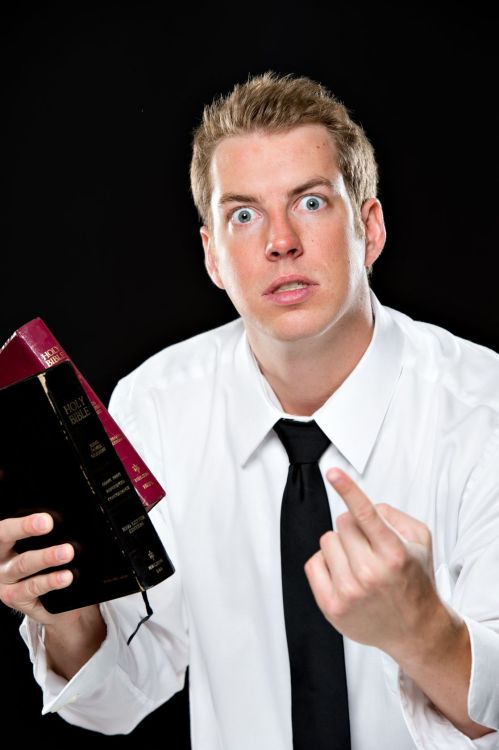
Borrowed from: http://www.jonathanmerritt.com/tag/gay-marriage/
Know ye not that the unrighteous shall not inherit the kingdom of God? Be not deceived: neither fornicators, nor idolaters, nor adulterers, nor effeminate, nor abusers of themselves with mankind, Nor thieves, nor covetous, nor drunkards, nor revilers, nor extortioners, shall inherit the kingdom of God. (1 Corinthians 6:9-10)
This week the United States Supreme Court met to hear arguments for and against constitutional protection or sanction of same-sex “marriage” nationwide. Regarding traditional marriage – between one man and one woman – Justice Anthony M. Kennedy made this poignant statement: “This definition has been with us for millennia, and it’s very difficult for the court to say, ‘Oh, well, we know better.’”[1] Chief Justice John G. Roberts, Jr. zeroed in on the agenda driving the gay rights same-sex marriage movement. He rightly pointed out, “You’re not seeking to join the institution [of marriage] – you’re seeking to change what the institution is. “The fundamental core of the institution is the opposite-sex relationship, and you want to introduce into it a same-sex relationship.”[2] Justice Antonin Scalia points out the religious issues that might arise from a favorable ruling from the court. “I’m concerned about the wisdom of this court imposing through the Constitution a requirement of action which is unpalatable to many of our citizens for religious reasons. They are not likely to change their view about what marriage consists of. And were the states to adopt it by law, they could make exceptions to what is required for same-sex marriage, who has to honor it and so forth.”[3]
Regardless of what side of the issue you favor, with all due respect, your opinion on this matter and that of the Supreme Court is irrelevant. While the court’s ruling on this will have far-reaching implications for the course of our nation, the rule for human unions was issued at the beginning of creation from the One whose law supersedes all human laws and institutions. “And the rib, which the LORD God had taken from man, made he a woman, and brought her unto the man. And Adam said, This is now bone of my bones, and flesh of my flesh: she shall be called Woman, because she was taken out of Man. Therefore shall a man leave his father and his mother, and shall cleave unto his wife: and they shall be one flesh” (Genesis 2:22-24, emphasis mine). In Scripture, every reference to marriage is always and only presented as between a man and a woman. As Justice Kennedy pointed out, the definition of marriage as a male-female union “has been with us for millennia” – six millennia to be exact. God established marriage between a man and a woman, primarily for procreation, and secondly as the nucleus of social order. The most fundamental form of government is the family unit, and when that nucleus is destroyed, the social order breaks down.
The Bible, both Old and New Testaments, supports the nuclear family unit with one man and one woman as husband and wife. Any time there is a deviation from God’s plan presented in the Bible, there is always trouble associated with it. Take, for example, the relationship between Abraham, Sarah and Hagar, (Genesis 16 and 21). This relationship produced two sons, Ishmael and Isaac, whose descendants harbor aggression toward one another to this very day. Lot, Abraham’s nephew, after he was saved from the destruction of Sodom and Gomorrah, had incestuous relations with his two daughters that produced the pagan nations of Moab (Moabites) and Ammon (Ammonites) (Genesis 19). Then there was Jacob with his two wives and two concubines that resulted in 12 half brothers from a single father, but four different mothers. That became the nation of Israel, and there was constant trouble among the brothers. The father of Samuel had two wives and there was contention in that home (1 Samuel 1). Then there was David with all of his wives and the trouble that existed in that family. Not to be outdone, David’s son Solomon had 700 wives and 300 concubines (1 Kings 11:3), and following his death the kingdom was divided. The Bible is clear. Any marriage other than between one man and one woman is doomed for disaster. Jesus supported marriage between one man and one woman. “And he answered and said unto them, Have ye not read, that he which made them at the beginning made them male and female, And said, For this cause shall a man leave father and mother, and shall cleave to his wife: and they twain shall be one flesh? Wherefore they are no more twain, but one flesh. What therefore God hath joined together, let not man put asunder” (Matthew 19:4-6, emphasis mine). The New Testament outlines the proper function of the family unit (Ephesians 5:20-33; 6:1-4; Colossians 3:18-21; 1 Peter 3:1-7). There is never given such instruction for homosexual couples. According to God’s Word, “marriage” always and only properly exists between one man and one woman.
Now, this is my personal blog, and I am not beholding to or obligated to anyone for political correctness. I really do not care whether you favor “gay marriage” or whether you oppose it. My concern is for God’s opinion on the matter. Some may object by charging that this is just “my” interpretation of Scripture, and that I have simply misread the text. I will gladly take my lumps if I can be proven wrong (from Scripture), but there is no “interpretation” needed to see the obvious truth of the Bible. Take the following passages for example (and please feel free to read the passage in context, i.e., read the verses that precede and those that follow):
Thou shalt not lie [for intercourse] with mankind [Hebrew: zâkâr, i.e., a male], as with womankind [Hebrew: ‘ishshâh, i.e., a woman]: it is abomination [Hebrew: tô‛êbah i.e., something disgusting and abhorant] … For whosoever shall commit any of these abominations [including incest and bestiality (in context)], even the souls that commit them shall be cut off from among their people. (Leviticus 18:22, 29)
Wherefore God also gave them up to uncleanness [Greek: akatharsia, i.e., impurity] through the lusts [Greek: epithumia, i.e., longing, desire] of their own hearts, to dishonor [Greek: atimazō, i.e., to render infamous, contemn or maltreat] their own bodies between themselves … For this cause God gave them up unto vile [Greek: atimia, i.e., indignity or disgrace] affections [Greek: pathos, i.e., passion, inordinate affection, lust]: for even their women did change the natural [Greek: phusikos, i.e., physical, instinctive] use [Greek: chrēsis, i.e., sexual intercourse] into that which is against nature [Greek: phusis, i.e., growth (by germination or expansion), natural production]: And likewise also the men, leaving the natural use of the woman, burned [Greek: ekkaiō, i.e., to inflame deeply] in their lust one toward another; men with men working that which is unseemly [Greek: aschēmosunē, i.e., and indecency], and receiving in themselves that recompence of their error which was meet [Greek: dei, i.e., necessary] (Romans 1:24, 26-27).
Know ye not that the unrighteous [Greek: adikos, i.e., unjust, wicked, treacherous] shall not inherit the kingdom of God? Be not deceived: neither fornicators [Greek: pornos, i.e., a male prostitute, a debauchee], nor idolaters, nor adulterers, nor effeminate [Greek: malakos, i.e., soft, figuratively a catamite (a boy in a sexual relationship with a man)], nor abusers of themselves with mankind [Greek: arsenokoitēs, i.e., a sodomite]. (1 Corinthians 6:9).
The above passages are linked to Biblegateway.com in case the reader does not have a Bible handy. The text stands on its own merits, but I felt that translation of some of the words into their original languages was necessary to demonstrate how strongly God really feels about this issue. Homosexuality is a sin. It is abhorrent to God primarily because it goes against His “very good” design for human sexuality, procreation, and the social order of family. Homosexuality is unnatural. Even the gay activists that are fighting for same-sex marriage admit that fact. Two men or two women cannot produce children together. Procreation requires a man and a woman, and as previously noted, “marriage” from a biblical perspective can only be between a man and a woman.
I am firmly against same-sex “marriage.” That does not make me a homophobe. I do not have a phobia, i.e., a “fear,” of homosexuals, and I find the accusation insulting. I cannot speak for all Christians, but I am sure many would agree. I stand against homosexuality because God is against homosexuality. It is just that simple. I really do not care if gays want to practice their perversion; that is between them and God. However, it is the responsibility of every Christian to identify it for what it is – sin – and it is wrong for Christians to roll over and let the gay community try to redefine marriage. Marriage is, and always has been between one man and one woman.
Homosexuality is not the only sin that God hates, and it is not the “unpardonable” sin. Our starting Bible passage included a long list of other sins, not just that of homosexuality. Jesus said that all sin can forgiven except blasphemy against the Holy Spirit (Matthew 12:31). Blasphemy against the Holy Spirit simply means to reject the Holy Spirit’s call upon one’s heart. The Holy Spirit’s job description is to “convince” the individual of the truth of God’s Word, and “convict” him of his sin and his need to heed the message of God’s Word (John 16:7-11). To blaspheme against the Holy Spirit, then, is basically to call Him a liar. Homosexuality, like every other sin, can be forgiven, but it requires repentance, i.e., to agree with God, the Holy Spirit, that it is sin and, with God’s help, be willing to turn away from that lifestyle. God will forgive that sin as He will every sin, but the offender must first recognize it as sin.
This issue of gay “marriage” will ruin our nation. “There is a way which seemeth right unto a man, but the end thereof are the ways of death” (Proverbs 14:12). Too many very loud voices clamor to make this perversion the law of the land claiming “natural” rights, equality, etc., but they are wrong, and God promises that the consequence of such folly is destruction. Note what God said in the Leviticus passage quoted earlier:
Defile not ye yourselves in any of these things [all the illicit sex acts listed]: for in all these the nations are defiled which I cast out before you: And the land is defiled: therefore I do visit the iniquity thereof upon it, and the land itself vomiteth out her inhabitants … (For all these abominations have the men of the land done, which were before you, and the land is defiled) That the land spue not you out also, when ye defile it, as it spued out the nations that were before you. For whosoever shall commit any of these abominations [all the illicit sex acts listed], even the souls that commit them shall be cut off from among their people. (Leviticus 18:24-25, 27-29, emphasis mine)
God often receives a bad rap because He instructed the Israelites to kill every living thing in the land He was giving them. The reason for this was because of the perversion of the people inhabiting the land. These people were practicing homosexuals. They practiced bestiality. They had male and female temple prostitutes. They were incestuous. They offered their babies up as burnt sacrifices to their pagan gods. Furthermore, God had given them opportunity to repent through the witness of Abraham, Isaac and Jacob plus over 400 years that the children of Israel were in Egyptian captivity, but they didn’t. These were vile people and God judged them to death at the hand of the Israelites. How much clearer a picture does one need to recognize the intensity of God’s abomination for this sin! Note His warning to the Israelites should they fall into the same practice. That warning speaks to our nation as well.
Gay marriage is not “marriage.” Homosexual unions are wrong, not because of public opinion, but because God, who designed us male and female for procreation and companionship, says it’s wrong, and because it goes against His purpose. The opinion or ruling of the United States Supreme Court holds no sway over the Creator. “For I am the LORD, I change not” (Malachi 3:6). The final ruling by the Supreme Court will be sometime in June 2015. If they rule contrary to God’s law, our nation is doomed, and we will see a rise in the persecution of Christians who hold fast to God’s law. There is still time to pray.
Notes:
[1] From The Washington Post, “Supreme Court hears arguments in historic gay-marriage case” http://www.washingtonpost.com/politics/courts_law/supreme-court-will-hear-historic-arguments-in-gay-marriage-cases/2015/04/27/083d9302-ed24-11e4-8666-a1d756d0218e_story.html, accessed April 29, 2015.
[2] Ibid.
[3] Jeffrey Rosen, YahooNews, “The Supreme Court gay marriage arguments: What the justices revealed — quote by quote” https://www.yahoo.com/politics/the-supreme-court-gay-marriage-arguments-what-the-117695904751.html, accessed April 29, 2015.