Tag Archives: Bible

Doing the Right Thing

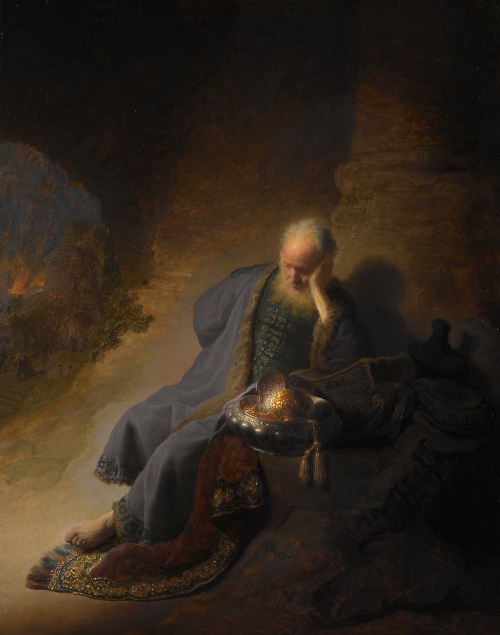
Rembrandt van Rijn, “Jeremiah Lamenting the Destruction of Jerusalem”, c. 1630

For I will surely deliver thee, and thou shalt not fall by the sword, but thy life shall be for a prey unto thee: because thou hast put thy trust in me, saith the LORD. (Jeremiah 39:18)

Jeremiah prophesied before, during, and after the time of Nebuchadnezzar’s siege of Jerusalem and the captivity that followed. His ministry started during the in the 13th year of good king Josiah’s reign.[1] Josiah was eight years old when he started to reign[2] thus making him about 21 when Jeremiah started his ministry.

Josiah was the last of Judah’s “good” kings, and the Bible records that he reigned for 31 years. He was killed in a battle at Megiddo[3] (Armageddon) attempting to stop Pharaoh Necho who was on his way to assist Assyria at Carchemish against the Babylonians.

Josiah was succeeded on the throne by his son, Jehoahaz (a.k.a. Shullum) who reigned for only three months.[4] Pharaoh Necho lost the battle at Carchemish, and on his return to Egypt through Judah, he stopped off at Jerusalem and took Johoahaz captive to Egypt replacing him with his brother Jehoiakim (a.k.a. Eliakim).[5]

Jehoiakim reigned for 11 years. It was during his reign that Nebuchadnezzar conquered Jerusalem and took away the first round of captives to Babylon. Daniel the prophet was taken in this first round of captivity. Jehoiakim was also taken captive, and his son (Josiah’s grandson), Jehoiachin (a.k.a. Jechoniah, a.k.a. Coniah), took his place on the throne. Jechoniah appears in Jesus’s genealogy through Joseph.[6] However, Jechoniah’s (Coniah’s) line was cursed by God so that none of his descendants could sit on the throne of David.[7] This fact could have disqualified Jesus for the throne had Joseph been his earthly father.

Jechoniah’s reign was shortlived as Nebuchadnezzar replaced him with another of Josiah’s sons, Mattaniah, whose name he changed to Zedekiah.[8] Zedekiah reigned in Jerusalem as a vassal king of Babylon for eleven years. However, in the ninth year of his reign, he rebelled against Nebuchadnezzar and refused to pay the required tribute. Nebuchadnezzar laid siege to Jerusalem a second time, and two years later, after exhausting all their food and water stores, the city surrendered. Nebuchadnezzar made Zedekiah watch as his children were all slaughtered before his eyes.[9] That was the last thing Zedekiah saw before his eyes were gouged out. Then Nebuchadnezzar took Zedekiah and the remaining able-bodied people back to Babylon leaving only the poorest and weakest of the population behind. This was the second captivity.

Jeremiah is known as the “Weeping Prophet” because he prophesied during the final 40 years before the complete demise of Jerusalem. His unpopular message of pending doom fell on deaf and rebellious ears. He was persecuted, beaten, and imprisoned for sounding the call to repent with the promise that repentance would stay the pending punishment of God.

During Zedekiah’s reign, Jeremiah urged the king to submit to Nebuchadnezzar so that Jerusalem would experience peace. Zedekiah’s refusal to submit brought the wrath of Nebuchadnezzar upon the city. During the two-year siege, conditions became so bad that women cannibalized their children for food.[10] Jeremiah encouraged men to surrender to the Babylonians to save themselves and their families.

For this, Jeremiah was treated as a traitor and thrown into a cold, muddy dungeon.[11] “Now when Ebedmelech the Ethiopian, one of the eunuchs which was in the king’s house, heard that they had put Jeremiah in the dungeon; the king then sitting in the gate of Benjamin; Ebedmelech went forth out of the king’s house, and spake to the king, saying, My lord the king, these men have done evil in all that they have done to Jeremiah the prophet, whom they have cast into the dungeon; and he is like to die for hunger in the place where he is: for there is no more bread in the city” (Jeremiah 38:7-9, emphasis mine).

We do not know a lot about Ebedmelech. We can surmise that he was a black man since Scripture records that he was an Ethiopian. He also served the king since he is identified as a eunuch. Jeremiah does not record his name, only his position in the king’s service. It is possible that Jeremiah did not even know his advocate. “Ebedmelech” is two words in Hebrew, ‛ebed melek. “Ebed” means “servant” and “melek” means “king.” The two words together mean “servant of the king.” We can infer from the fact that he was a eunuch that he was a high ranking servant of the king holding a very trusted position. As such, he could approach the king on Jeremiah’s behalf.

Surely the servant of the king had heard Jeremiah’s warnings. He probably understood that Jeremiah was the Lord’s prophet, and he took it to heart when Jeremiah said, “Thus saith the Lord.” He probably perceived that Jeremiah’s preaching was for the good of the people and that his intentions for their welfare.

When the servant of the king learned of Jeremiah’s plight, he went directly to the king to plead his case, and Zedekiah listened to his servant. “Then the king commanded Ebedmelech the Ethiopian, saying, Take from hence thirty men with thee, and take up Jeremiah the prophet out of the dungeon, before he die” (Jeremiah 38:10). Jeremiah was not set free. However, his conditions were much improved. The eunuch transferred him from the “miry pit” to the “court of the prison”[12] allowing him more freedom and improved conditions although he was still under “house arrest.”

In spite of opposition and his subservient position, this humble servant did the right thing. Doing the right thing in the midst of opposition takes real courage especially when there is little, if any, hope for reward.

Not long after this, Jerusalem surrendered. Nebuchadnezzar’s army entered the city, destroyed the Temple and carried away captives including the humiliated king Zedekiah.

Just before the fall of Jerusalem, God spoke to Jeremiah the prophet and said, “Go and speak to Ebedmelech the Ethiopian, saying, Thus saith the LORD of hosts, the God of Israel; Behold, I will bring my words upon this city for evil, and not for good; and they shall be accomplished in that day before thee. But I will deliver thee in that day, saith the LORD: and thou shalt not be given into the hand of the men of whom thou art afraid. For I will surely deliver thee, and thou shalt not fall by the sword, but thy life shall be for a prey unto thee: because thou hast put thy trust in me, saith the LORD” (Jeremiah 39:16-18, emphasis mine).

Doing the right thing requires trusting the Lord. When we trust the Lord, abundant life (our “prey”) is our reward. Jesus said, “I am come that they might have life, and that they might have it more abundantly” (John 10:10). Doing the right thing is always the right thing to do. The nameless servant may have been unknown to Jeremiah, but his righteous deed did not escape God’s notice, and God blessed him for doing the right thing. Likewise, we should follow his example with purity of heart and “not with eyeservice, as menpleasers; but in singleness of heart, fearing God” (Colossians 3:22). May God catch us all doing the right thing!

Notes:


[1]  Jeremiah 1:2

[2]  2 Kings 22:1; 2 Chronicles 34:1

[3]  2 Kings 23:29-30; 2 Chronicles 35:20-27

[4]  2 Kings 23:31; 2 Chronicles 36:1-2

[5]  2 Kings 23:34, 36; 2 Chronicles 36:4-5

[6]  Matthew 1:11

[7]  Jeremiah 22:28-30

[8]  2 Kings 24:17; 2 Chronicles 36:10-11

[9]  2 Kings 25:7

[10]  Lamentations 4:10

[11]  Jeremiah 38:1-6

[12]  Jeremiah 38:13

3 Comments

Filed under Bible, Theology

Another One Gone!

But my covenant will I establish with Isaac, which Sarah shall bear unto thee at this set time in the next year. (Genesis 17:21)

It seems like yesterday that we faced the prospect of 2018, and here we stand on the threshold of 2019. The truth of the adage, “time flies,” manifests itself more conspicuously each year that goes by. It is said that once one reaches middle age (whenever that is), it’s all downhill from there. What is not said is also true. The closer one gets to the bottom of the hill the faster the slide goes. I can confirm that from experience!

As I approach the foot of the hill and the skid velocity increases, it’s the big scenes rushing by that captures my attention. I know what awaits at the bottom of the hill, and it is not the sudden stop that most people would suspect. No. At the bottom of my hill is a beautiful warm eternal ocean, and the events that lead to that peaceful place are the things that capture my attention.

There were several such events in 2018. The nation of Israel celebrated its 70th year as a nation. Students of the Bible recognize the significance of the number 70; 7 represents perfection, and 10 represents completeness. Together (7×10), “it symbolizes perfect spiritual order carried out with all power. It can also represent a period of judgment.”[1] Twenty-eighteen was a Jubilee year for Israel.[2] Not only that, but it was the 70th Jubilee since the Law was given to Moses.

At the celebration of Israel’s “re-birth” day in Jerusalem, the United States, at the direction of our President Donald J. Trump, opened the US Embassy in Jerusalem confirming our country’s recognition of Jerusalem as the capital of Israel.

With all of these milestone events converging with other “signs of the times,” I sincerely expected the Rapture to take place sometime around the Jewish New Year – Rosh HaShanah – that transpired between September 10-30. Obviously, because I am still here along with all my brothers and sisters whom the Lord has not taken home, the Rapture did not take place.

End-times prophecy focuses mainly on Israel. While many “signs of the times” have general application like, signs in the sun, moon, and stars,[3] wars and rumors of wars,[4] famines, pestilences, and earthquakes,[5] days like those of Noah,[6] and the general decline in “common” decency,[7] (we see these things occurring all over the world), the true indicator of the proximity of our Lord’s return is the nation of Israel and those things pertaining particularly to her.

The greatest of these signs was Israel’s rebirth as predicted by several of the Major Prophets, but particularly by the Prophet Ezekiel. Ezekiel described the re-gathering of the Jews from the four corners of the globe to their ancient homeland given to them by God. Ezekiel saw a valley full of dry bones come together and rise to be a mighty army.[8] His vision came true on May 14, 1948, and indeed, Israel has become a “mighty army,” who, even for its tiny size, boasts the eighth strongest military in the world. Jesus compared Israel to a fig tree. He said that the generation that sees the fig tree bud would see all these prophecies come to pass.[9]

Ezekiel also prophesied a confederation of nations that would attack Israel from the north.[10] The names of those nations, translated from their ancient biblical names, are Russia, Turkey, and Iran. Twenty-eighteen has seen the strengthening of these nations within the borders of Israel’s northern neighbor, Syria.

Interestingly, Syria is not part of the prophesied coalition. The Prophet Isaiah provides insight as to why Syria is not counted among Israel’s attackers. “The burden of Damascus. Behold, Damascus is taken away from being a city, and it shall be a ruinous heap” (Isaiah 17:1, emphasis mine). Damascus, Syria’s capital, is the oldest continuously inhabited city in the world. However, the prophet predicts that it will be a “ruinous heap.” Current pictures of the city suggest that it is almost there. When Damascus is completely destroyed, Syria will functionally cease from being a nation, which explains why she is not mentioned in Ezekiel’s prophecy. The players are in place for the fulfillment of this prophecy.

Very recently, President Trump announced that the US will rapidly pull all of its troops out of Syria within the next few months. Needless to say, this announcement for Israel is cause for grave concern. Without the US in Syria, there is nothing to stop Iran (whose whole purpose in life is to eradicate Israel), Russia, and Turkey from setting up shop in Syria. Who is to stop them? So far, Israel has managed to keep Iran at bay by bombing Iranian military installations in Syria. Russia has “allowed” this probably due to US presence, but with the US pullout, things may change. Iran’s buildup of arms in and around Damascus could bring about the complete destruction of the city by Israel as prophesied by Isaiah and could prompt the invasion of Israel by the coalition. Israel’s misplaced concern about an attack from the north will subside when God comes to her rescue.[11]

For those who are watching and paying attention, 2018 has been an exciting year. When the Rapture did not take place as I anticipated, I was a little disappointed, but not disheartened. Jesus promised, “In my Father’s house are many mansions: if it were not so, I would have told you. I go to prepare a place for you. And if I go and prepare a place for you, I will come again, and receive you unto myself; that where I am, there ye may be also” (John 14:2-3, emphasis mine). Jesus will come to Rapture His Bride to keep her from “the hour of temptation.”[12] However, that event is imminent; it could happen at any moment. There are no “signs” to alert us to its proximity. Based on the seven Feasts of the Lord,[13] and knowing that Jesus fulfilled the spring feasts at His first coming, I reasoned that He would fulfill the fall feasts at His Second Coming. That conclusion is still correct. However, His Second Coming takes place at the end of the seven-year Tribulation period.

Some suggest that the Second Coming takes place in two phases. In the first phase, Jesus comes for His church, and we meet Him in the air;[14] He does not come to earth at that time. In the second phase, He returns with His Bride (His “armies”),[15] and the touch of His foot on the Mount of Olives will cause the mountain to split.[16] At that point, He will establish His 1000-year reign on earth.

What I learned in 2018 is that the Feasts of the Lord, like the prophecies of last days, are meant for Israel, not the church. Jesus wants His Bride to be ready at all times, as we learn from the Parable of the Ten Virgins.[17] The Bride Groom may come at any hour when we least expect it. He will not come at the Feast of Trumpets, the Day of Atonement or the Feast of Tabernacles. Those feasts are for Israel, not the Church. However, as we discern the signs of the times, and keep an eye on God’s timepiece, Israel, we can be sure that our Bride Groom will come for us very soon. So, be ready. Keep plenty of oil so that your lamp won’t go out. Jesus may come to take us home in 2019 – or not. Regardless, we need to be ready at all times!


[1]  Meaning of Numbers in the Bible: http://www.biblestudy.org/bibleref/meaning-of-numbers-in-bible/70.html

[2]  Leviticus 25:8-13

[3]  Luke 21:25

[4]  Matthew 24:6; Mark 13:7; Luke 21:9

[5]  Matthew 24:7; Mark 13:8; Luke 21:11

[6]  Matthew 24:37; Luke 17:26

[7]  2 Timothy 3:1-7

[8]  Ezekiel 37:1-14

[9]  Matthew 24:32-35

[10]  Ezekiel 38-39

[11]  Ezekiel 38:17-39:4

[12]  Revelation 3:10

[13]  “Rosh HaShanah” – https://erniecarrasco.com/2016/10/03/rosh-hashanah/

[14]  1 Thessalonians 4:17

[15]  Revelation 19:14

[16]  Zechariah 14:4

[17]  Matthew 25:1-13

6 Comments

Filed under Bible, Christianity, Current Events, End Times, Holidays, New Year's Day, Second Coming of Christ

Pride

Only by pride cometh contention: but with the well advised is wisdom. (Proverbs 13:10)

Pride is not all bad. There is nothing wrong with having a “dignified sense of what is due to oneself or one’s position or character,” i.e., “self-respect; self-esteem.”[1] It took almost five years to build, but I was proud of the 1/60th-scale model of Noah’s Ark that I built for ICR, and I get a sense of pride when people come by and admire it. There is nothing wrong with that kind of pride. If you think about it, God demonstrated that kind of pride at the end of each day of creation when He declared everything “good.” Then on the final day of creation, He declared it all “very good” (Genesis 1:31).

However, pride is wrong when it becomes “a high or inordinate opinion of one’s dignity, importance, merit, or superiority, whether as cherished in the mind or as displayed in bearing, conduct, etc.” [2] The Bible says, “The wicked, through the pride of his countenance, will not seek after God: God is not in all his thoughts” (Psalm 10:4).

Recently, I was saddened when this kind of pride was demonstrated in a very public way by one Christian against another. If I named the parties involved, many of my readers would know them both, as they are both well known in the “creationist” community. I personally know and love both of these men, so the fact that one is attacking the other is disappointing, to say the least. I have been disappointed by many people in my life, and I am certain this will not be the last time. That something like this should happen does not surprise me, but because I know both men so well, the attack of one upon the other is especially heartbreaking.

I will not detail the particulars of the attack otherwise, but I will invent fictitious names for ease of reading. The proud one I will call “Sky” and his victim I will name “Adam.” Both Sky and Adam are highly trained scientists albeit in very different disciplines. Both Sky and Adam are professing Christians, and both are excellent Bible scholars. Adam is “earthy” and humble in his demeanor. Although he is very well educated and experienced in his profession, he sees his achievements as gifts from God to be used in service to God. Sky tends to be full of himself and proud of his academic achievements. As a result, he holds tenaciously to his opinions which are always right in his own eyes. He also likes to associate himself with others holding similar views of themselves, who are, in other words, prideful.

Some of Sky’s “associates” boast degrees related to those in Adam’s field of training. They criticize Adam for attempting to alter some scientific language to give greater credit to the Creator rather than attributing creation to an act of nature. These associates prefer the language of evolutionists because they fear that adopting “Creator friendly” language will make them appear more “unscientific” to their secular peers even though creationists have little hope of being respected by secular scientists.

Sky’s star-status has dimmed of late, so, perhaps to bolster waning popularity, he verbally attacked Adam by name in a popular science journal to discredit him. His ad hominem attack made no sense considering he knows nothing of Adam’s field of expertise. Because Sky’s associates disagree with Adam’s “new language,” and because Sky fancies himself a peerless debater, he assumed the task of tearing down his friends’ nemesis – and this is a Christian brother.

I have seen this kind of pride in academic and church circles. Academians, especially those with doctoral degrees, spend years developing their ideas. It takes many long years of study and research to earn a doctoral degree. The challenge often involves coming up with a new, never-before-thought-of idea and develop that idea into a doctoral dissertation. When completed, the doctoral candidate must defend his/her dissertation before a panel of “doctors.” The challenge is not an easy one, so it easy to see why the successful candidate might become prideful. Getting a Ph.D. is a great achievement, and a certain amount of pride is well-deserved and understandable.

However, what happens later on when someone challenges that cherished idea with the possibility of being proven wrong? The wrong kind of pride will fight for that idea whether it be right or wrong. The right kind of pride that carries along with it a sense of humility accepts the challenge and the possibility of being proven wrong in order to learn an even better way.

I fear for my brother Sky and his associates. The Bible says, “Pride goeth before destruction, and an haughty spirit before a fall” (Proverbs 16:18). “A man’s pride shall bring him low: but honour shall uphold the humble in spirit” (Proverbs 29:23). The Lord “hath scattered the proud in the imagination of their hearts” (Luke 1:51b). “The LORD will destroy the house of the proud” (Proverbs 15:25a). “God resisteth the proud, but giveth grace unto the humble” (James 4:6; 1 Peter 5:5).

I know my brother Adam. He is a man of gentle spirit and a kind heart. I pray that God will grant him the wherewithal to absorb this attack without retaliation. (I know that in an honest debate, Adam can shred Sky to pieces.) “Better it is to be of an humble spirit with the lowly, than to divide the spoil with the proud” (Proverbs 16:19). It is a shame that things like this happen within a community of believers – very sad. “Behold, how good and how pleasant it is for brethren to dwell together in unity!” (Psalm 133:1) – if not in this life, for certain in the next. In that day all pride shall be consumed. “For, behold, the day cometh, that shall burn as an oven; and all the proud, yea, and all that do wickedly, shall be stubble: and the day that cometh shall burn them up, saith the LORD of hosts, that it shall leave them neither root nor branch” (Malachi 4:1).

Notes:


[1]  Definition of “pride” – https://www.dictionary.com/browse/pride

[2]  Ibid.


Comments Off on Pride

Filed under Christianity, Current Events, Religion

The Soul

Behold, all souls are mine; as the soul of the father, so also the soul of the son is mine: the soul that sinneth, it shall die. (Ezekiel 18:4)

My twice-brother and I engaged in a discussion a few nights ago concerning the meaning of “the soul.” What is the soul? Most people think of the soul as the spiritual essence of a person. The English dictionary seems to support that view:

noun

  1. the principle of life, feeling, thought, and action in humans, regarded as a distinct entity separate from the body, and commonly held to be separable in existence from the body; the spiritual part of humans as distinct from the physical part.
  2. the spiritual part of humans regarded in its moral aspect, or as believed to survive death and be subject to happiness or misery in a life to come: arguing the immortality of the soul.
  3. the disembodied spirit of a deceased personHe feared the soul of the deceased would haunt him.[1] et al. (emphasis mine)

Our English language (especially American English) has “evolved” considerably since the founding of the United States, so I thought it might be interesting to see how the 1828 Webster’s Dictionary defined “soul.” I found the following definition:

SOUL, n.

  1. The spiritual, rational and immortal substance in man, which distinguishes him from brutes; that part of man which enables him to think and reason, and which renders him a subject of moral government. The immortality of the soul is a fundamental article of the christian [sic] system. Such is the nature of the human soul that it must have a God, an object of supreme affection.
  2. The understanding; the intellectual principle. The eyes of our soul then only begin to see, when our bodily eye are closing.
  3. Vital principle. Thou son, of this great world both eye and soul.
  4. Spirit; essence; chief part; as charity, the soul of all the virtues. Emotion is the soul of eloquence.
  5. Life; animation principle or part; as, an able commander is the soul of an army.
  6. Internal power. There is some soul of goodness in things evil.
  7. A human being; a person. There was no a soul present. In Paris there are more than seven hundred thousand souls. London, Westminster, Southwark and the suburbs, are said to contain twelve hundred thousand souls.[2] et al. (emphasis mine)

The idea that the soul is the immaterial “substance” or “essence” that animates us enjoys a long history of support, but I think there is more to the soul than that. Normally, the first and second definition listed in a dictionary provides the general understanding of the word. However, in this case, I prefer the seventh definition provided by the 1828 Webster’s Dictionary. It basically says that “the soul” is a human being or a person, and I believe I can show scriptural support for that idea.

The best place to start is at the beginning. “In the beginning God created the heaven and the earth” (Genesis 1:1). “God,” ‘ĕlôhı̂ym, is a plural noun. We understand God as Triune being – Father, Son, and Holy Spirit – three persons (we say) in one “Godhead.” We simply say “God,” but we understand His Triune nature.

God created humans according to His image. “And God said, Let us make man in our image, after our likeness: … So God created man in his own image, in the image of God created he him; male and female created he them” (Genesis 1:26-27, emphasis mine). All humans bear the “image of God” and share many of His attributes albeit without the “Omni” prefix. It follows that we too possess a triune nature (more on that later).

As we examine the creation account, we see that God created all living creatures by divine fiat, i.e., He spoke them into being. However, He took special care in creating man. “And the LORD God formed man of the dust of the ground, and breathed into his nostrils the breath of life; and man became a living soul” (Genesis 2:7, emphasis mine).

Humans and air-breathing animals possess the “breath of life.” The Hebrew word neshâmâh is defined as: “a puff, that is, wind, angry or vital breath, divine inspiration, intellect or (concretely) an animal: – blast, (that) breath (-eth), inspiration, soul, spirit.”[3] We see in Genesis 7:22 that animals possess the “breath of life.” That phrase is also found in Genesis 6:13 and 7:15, but the Hebrew word for “breath” there is rûach, which means: “wind; by resemblance breath, that is, a sensible (or even violent) exhalation; figuratively life, anger, unsubstantiality; by extension a region of the sky; by resemblance spirit, but only of a rational being (including its expression and functions): – air, anger, blast, breath, X cool, courage, mind, X quarter, X side, spirit ([-ual]), tempest, X vain, ([whirl-]) wind (-y).”[4] Both neshâmâh and rûach are similar in meaning, but the latter includes the idea of a “spirit.”

To further confuse matters, Genesis 2:7 says that “man became a living soul.” The word “soul” is the Hebrew nephesh, which is defined as: “a breathing creature, that is, animal or (abstractly) vitality; used very widely in a literal, accommodated or figurative sense (bodily or mental): – any, appetite, beast, body, breath, creature, X dead (-ly), desire, X [dis-] contented, X fish, ghost, + greedy, he, heart (-y), (hath, X jeopardy of) life (X in jeopardy), lust, man, me, mind, mortality, one, own, person, pleasure, (her-, him-, my-, thy-) self, them (your) -selves, + slay, soul, + tablet, they, thing, (X she) will, X would have it.”  It is not difficult to see that nephesh is related to neshâmâh in that both carry the aspect of “breathing.” However, nephesh includes the physical aspect of the creature.

Both man and animals possess a nephesh. The Hebrew word first appears in Genesis 1:20. “And God said, Let the waters bring forth abundantly the moving creature that hath life, and fowl that may fly above the earth in the open firmament of heaven” (emphasis mine). The Hebrew words translated “hath life” are nephesh chay (life), or “soul life.” Also, the following verse reads, “And God created great whales, and every living creature that moveth, which the waters brought forth abundantly, after their kind, and every winged fowl after his kind: and God saw that it was good” (Genesis 1:21, emphasis mine). The Hebrew word translated “creature” is nephesh. I could give more examples, but I want you to stay with me on this.

We see that both man (humans) and animals have souls – nephesh. What differentiates a human soul from that of an animal is the way in which it was given. Recall earlier that God created animals by divine fiat. He also created them en masse. Man was unique. He created one human couple. He did not speak them into being as he did with the animals. He “formed” man – the Hebrew word yâtsar meaning to mold as a potter forms and shapes a clay vessel. Then God breathed into man His own breath “and man became a living soul” (Genesis 2:7).

Looking back at the 1828 Webster’s definition of “soul,” the seventh definition becomes clear here. The clay figure on the ground came to life when God breathed into it, and he became a human being, a person, a living soul – made in the image of God, with a triune nature like his Maker.

So, what is the triune nature of man? As I see it, just as God is Father, Son, and Holy Spirit, man is mind, body, and spirit. The Father, Son, and Holy Spirit is the God, or the Godhead if you prefer. The mind, body, and spirit is the soul. God has a physical body. That body is the Son, Jesus Christ. The other two “persons” of God are immaterial and invisible – the Father and the Holy Spirit. “No man hath seen God at any time; the only begotten Son, which is in the bosom of the Father, he hath declared him” (John 1:18, emphasis mine). Likewise, the mind and spirit of the soul are immaterial and invisible, but the body reveals the soul. We have all heard the expression, “The eyes are the windows to the soul;” the eyes are physical, but they often reveal what is “inside.” In summary, the soul is the entire being or person, mind, body, and spirit.

We can know that the soul is more than some nebulous ethereal, intangible animator of our being by the consideration given “the soul” in Scripture. For example, when God called Abraham (Abram) out of his homeland, we read, “And Abram took Sarai his wife, and Lot his brother’s son, and all their substance that they had gathered, and the souls that they had gotten in Haran; and they went forth to go into the land of Canaan; and into the land of Canaan they came” (Genesis 12:5, emphasis mine). Those “souls” (nephesh) were not disembodied spirits; they were people. When Abraham went down to Egypt he told Sarah (Sarai), “Say, I pray thee, thou art my sister: that it may be well with me for thy sake; and my soul shall live because of thee” (Genesis 12:13, emphasis mine). Abram was not thinking of his “spirit being;” he wanted to save his own skin! That nephesh refers to the whole person is clearly demonstrated when Abraham went to rescue his nephew Lot from the marauding kings of the north. “And the king of Sodom said unto Abram, Give me the persons, and take the goods to thyself” (Genesis 14:21, emphasis mine). The word translated “persons” is the Hebrew word nephesh.

Another part of the nephesh is the “mind.” We find that example when Sarah died, and Abraham negotiated for a plot of land in which to bury her. “And he communed with them, saying, If it be your mind that I should bury my dead out of my sight; hear me, and intreat for me to Ephron the son of Zohar” (Genesis 23:8, emphasis mine). The Hebrew word translated “mind” is nephesh.

I could cite many more examples, but these should suffice. The point is that we do not have souls; we are souls. Each soul made in the image of God is a triune being with mind, body, and spirit. For a soul to exist, all three must be present. Take away any one of the three, and the soul (at least in this present life) ceases to exist. A soul is immortal; it exists forever. However, because of Adam’s sin in the Garden, the physical part dies even though the mind and spirit continue; the soul is incomplete. At the end of time, the mind, body, and spirit will reunite for eternity, but not all souls will enjoy the same destiny. Some souls will live eternally in the presence of God; other souls will exist eternally separated from God in hell. Soul, where will you spend eternity? If you have doubts, please read my page on “Securing Eternal Life.”

Notes:


[1]  Dictionary.com – https://www.dictionary.com/browse/soul

[2]  1828.mshaffer.com – https://1828.mshaffer.com/d/word/soul

[3]   Strong’s Definitions: H5395

[4]   Strong’s Definitions: H7307

6 Comments

Filed under Apologetics, Bible, Christianity, Creation, Death, End Times, Heaven, Hell, Religion, Resurrection, Theology

A Nutshell History of the World

Remember the former things of old: for I am God, and there is none else; I am God, and there is none like me, Declaring the end from the beginning, and from ancient times the things that are not yet done, saying, My counsel shall stand, and I will do all my pleasure: (Isaiah 46:9-10)

World history can evenly be divided into three segments of 2,000 years each: from creation to Abraham; from Abraham to Jesus; and from Jesus to the present. I realize that academic historians and anthropologists with Ph.D. degrees will disagree, but they have earned the right to be wrong; so I will acknowledge their opposition and move on.

Beginning with Genesis 1, the Bible records the creation in just six 24-hour days. Genesis 2 details the creation of man – Adam and Eve. Genesis 3 records the Fall of man and the first promise of Messiah. This event probably took place less than a month after creation. I come to this conclusion because God instructed Adam and Eve to be fruitful, multiply, and fill the earth (Genesis 1:28). Considering God’s assessment of His “very good” creation (Genesis 1:31), Adam and Eve were perfect human specimens and should not have had any trouble reproducing.

Additionally, a woman’s menstrual cycle lasts about 28 days. It takes 14 days for the ovary to release a ripened egg (ovum).[1] The ovum has another week where it is ready for fertilization. If not fertilized within that week, it will be sluffed off in the menstrual period, and the cycle begins again. Considering this, the Fall may have been less than two weeks after creation.

Genesis 4 records the first murder – Cain killing his brother Abel – and the ungodly descendants of Cain. Genesis 5 records the Godly descendants of Seth (Adam’s son to replace Abel). That genealogy records a period of about 1,658 years.[2], [3] When reading the genealogies recorded in Genesis 5, one must keep in mind that these records are from event to event – the age of the father at the birth of that son. Furthermore, the birth of the named son does not demand that he be the firstborn as precluded by the common phrase “and he begat sons and daughters (Genesis 5:4, 7, 10, 13, 16, 19, 22, 26, 30). Therefore, one can employ simple addition to add up the ages of the father at the birth of the named son.[4]

Genesis 6-9 records the depravity of man that brought God’s judgment upon the Earth through the Global Flood. Only Noah, his family. and all the animals that God brought to the Ark were saved. The animals included dinosaurs, and the Bible does mention dinosaurs although not by that name. Sir Richard Owen first coined the word dinosaur in 1841. The King James Bible was published in 1611, more than 200 years before the word “dinosaur” was invented. Before that time, these creatures were collectively known as “dragons.” The Book of Job names two of these creatures, Behemoth and Leviathan (Job 40-41), whose description is unlike anything known to modern man.

The Flood lasted 370 days (Genesis 7:11; 8:14), based on a 360-day year. After the Flood, the Earth was still in turmoil with a lot of active volcanos and much warmer oceans. These factors contributed to the Ice Age that followed.[5] The Book of Job, considered by many Bible scholars as the oldest book in the Bible, speaks more about snow, ice, and cold than any other book of the Bible suggesting that the earth was experiencing the Ice Age at that time. Creation scientists believe the Ice Age lasted only about 200-400 years, but there was only one, not many as the secular scientists suggest.

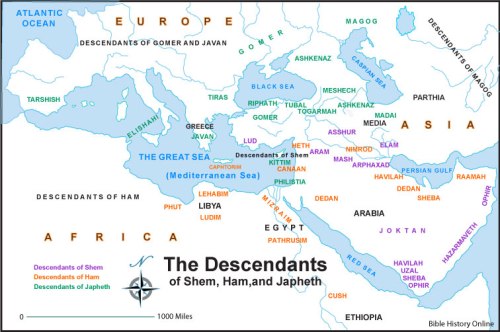
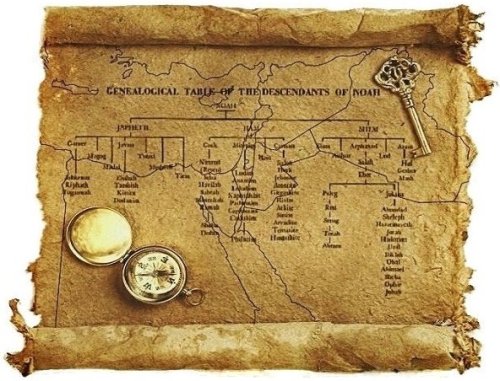
Genesis 10 is called the Table of Nations. It records the descendants of Noah’s sons, Shem, Ham, and Japheth and where they settled around the world after their dispersion at Babel. Shem’s descendants ultimately led to the Lord Jesus Christ (Luke 3:36).

Finally, Genesis 11 records the Tower of Babel and the confusion of tongues/languages. This event is the origin of all the ethnic groups (not “races”) in the world. Neanderthals were among those that scattered at Babel. Recent scientific discoveries show that Neanderthals are/were 100% human. Genesis 11 also records the genealogy of Abraham through whom God would bless all the nations of the earth 2,000 years later. The rest of the Old Testament deals with the history and the future history of Abraham’s descendants.

The future history concerns the coming of Messiah to rule all nations from His throne in Jerusalem. The Old Testament records future history in two parts. At His first coming/advent, “He came to His own, and His own received Him not” (John 1:11). He was crucified, buried, but He rose from the dead after three days and ascended to heaven (Acts 1:9-10; Ephesians 1:19-23). From there we await His return – His second coming (John 14:1-3; Acts 1:11). At that time, He will fulfill the future history recorded by the Old Testament prophets concerning His reign on earth. The time of His second advent draws near. As there were six days of creation and a Sabbath day of rest (Genesis 1:1-2:3), so have there been six millennia of history, and we await the seventh millennium (Revelation 20:1-7) of rest where Messiah will rule the nations with a “rod of iron” (Psalm 2:9; Revelation 2:27; 12:5; 19:15).

At the end of the millennial reign of Christ, world history ends and eternity, for us, begins. Are you ready? See my page on “Securing Eternal Life.”

Notes:


[1]  “Female Reproductive System” – https://tulsafertilitycenter.com/female-infertility/female-reproductive-cycle.php

[2]  “Age of the Earth” – https://erniecarrasco.com/2018/10/14/age-of-the-earth-2/

[3]  “Age of the Earth” – https://erniecarrasco.com/2014/02/23/age-of-the-earth/

[4]  James J. S. Johnson, J.D., TH.D, “How Young Is the Earth? Applying Simple Math to Data Provided in Genesis” – http://www.icr.org/article/how-young-earth-applying-simple-math-data-provided/

[5]  Jake Hebert, Ph.D., “Was There an Ice Age?” – http://www.icr.org/article/was-there-ice-age

2 Comments

Filed under Apologetics, Bible, Christianity, Creation, Evangelism, Origins, Religion, Salvation, Second Coming of Christ, Theology