And Jesus answering said unto them, Do ye not therefore err, because ye know not the scriptures, neither the power of God? (Mark 12:24)
Jesus faced His crucifixion just days away. Jerusalem was already in full Passover mode as Jews descended on the capital city from all over the Roman world. This was one of three holy convocations where Jews were to gather to celebrate the Feasts of the Lord (Leviticus 23). The Jewish religious leaders were already plotting to have Jesus killed, but because of His popularity, they couldn’t just kill Him. They had to bring up charges against Him that would warrant execution, so they tried to trip Him up with questions regarding their Jewish laws and traditions.
So it was in this case. First they approached Him with a question on paying taxes to Rome. They first tried to butter Him up with false flattery: “Master, we know that thou art true, and carest for no man: for thou regardest not the person of men, but teachest the way of God in truth” (Mark 12:14). They addressed Him as “Master,” i.e., “teacher,” yet they disregarded His teaching even though they stated that He “taught the way of God.” Their question failed to challenge Jesus. The answer was easy: “Render to Caesar the things that are Caesar’s, and to God the things that are God’s” (Mark 12:17).
The Sadducees, who “say there is no resurrection” (Mark 12:18), followed up with a question concerning the resurrection. Their question was well thought out – they thought. Seven brothers had the same wife, and they all died including the wife. In the resurrection, whose wife shall she be? Aha! Answer that one, Jesus! Jesus replied that there is no marriage in heaven, but before giving His answer, He chided them for their ignorance of Scripture and consequently the power of God (our verse above).
We do often err because we “do not know the Scriptures.” It’s no great challenge to find this ignorance working in a non-believing world, but it’s sad to find the same ignorance, albeit perhaps not as pronounced, among “believers.” One common example is the controversy over creation. Did God cause the Big Bang and then use millions of years of death and suffering to create life by means of evolution? Or did God create in six 24-hour days as clearly recorded in Genesis 1?
Those believers that support the Big Bang and evolution come in different varieties, but they all prefer “science falsely so called” (1 Timothy 6:20) over the clear teaching of Scripture. They hold the word of man in higher regard than the Word of God. They do err because they “know not the scriptures, neither the power of God.” The power of God! God says, “My counsel shall stand, and I will do all my pleasure” (Isaiah 46:10). “I the LORD have spoken it, and I will do it” (Ezekiel 36:36). “And Jesus looking upon them saith, With men it is impossible, but not with God: for with God all things are possible” (Mark 10:27). If God cannot do what He clearly said He did in Genesis 1, then neither can He part the waters of the Red Sea, cause the Sun to stop, or turn back ten degrees, make an ax head float, cleans a leper’s spots, turn water into wine, walk on water or calm the raging sea. If God cannot create as He said He did in Genesis 1, neither can He raise the dead, much less raise Himself from the dead. You do err because you do not know the Scriptures, and because you do not know the Scriptures, you do not know the power of God. What you don’t know can lead you astray. Jesus said, “Search the scriptures; for in them ye think ye have eternal life: and they are they which testify of me” (John 5:39).
Therefore shall a man leave his father and his mother, and shall cleave unto his wife: and they shall be one flesh.(Genesis 2:24)
From the very beginning, when God created the first couple, the design purposed the propagation of the human race. “And God blessed them, and God said unto them, Be fruitful, and multiply, and replenish the earth, and subdue it” (Genesis 1:28, emphasis added). Note that God did not create Adam and Steve or Bev and Eve. Such a combination would not have yielded the desired effect that God purposed. The family unit and the survival of mankind demanded both a father and a mother.
God, in a very real sense, is the First Father and the Father of the human race – our Father. His love for His children – His creation – is first illustrated in the life of Abraham as he offers his only son in sacrifice to God (Genesis 22:1-18). Abraham was the father of Isaac, Isaac the father of Jacob (Israel), Jacob the father of Judah, Judah the progenitor (father) of David, and David was the progenitor of the Lord Jesus Christ who would be the realization of the sacrifice portrayed by Abraham. The father is an important figure throughout Scripture and throughout history. In fact, God’s first “horizontal” commandment says, “Honour thy father and thy mother: that thy days may be long upon the land which the LORD thy God giveth thee” (Exodus 20:12). Paul repeats this commandment in Ephesians 6:1-3.
Earthly parents are far from perfect, yet we have this assurance of our Heavenly Father, “When my father and my mother forsake me, then the LORD will take me up” (Psalm 27:10). “Like as a father pitieth his children, so the LORD pitieth them that fear him” (Psalm 103:13). Yet even in their imperfection, we are exhorted to listen to the counsel of our fathers: “Hear, ye children, the instruction of a father, and attend to know understanding” (Proverbs 4:1). My father was not perfect, yet “I was my father’s son, tender and only beloved in the sight of my mother” (Proverbs 4:3). My Heavenly Father, encourages, “My son, keep thy father’s commandment, and forsake not the law of thy mother” (Proverbs 6:20). For “what man is there of you, whom if his son ask bread, will he give him a stone? Or if he ask a fish, will he give him a serpent?” (Matthew 7:9-10). Human fathers may not always get it right, but any father who loves his child always has the best in mind for his children.
However, “There is a generation that curseth their father, and doth not bless their mother” (Proverbs 30:11). Indeed, Jesus said, “Think not that I am come to send peace on earth: I came not to send peace, but a sword. For I am come to set a man at variance against his father, and the daughter against her mother, and the daughter in law against her mother in law. And a man’s foes shall be they of his own household” (Matthew 10:34-36, emphasis added). We may be experiencing that very thing now. “This know also, that in the last days perilous times shall come. For men shall be lovers of their own selves, covetous, boasters, proud, blasphemers, disobedient to parents, unthankful, unholy, Without natural affection, trucebreakers, false accusers, incontinent, fierce, despisers of those that are good, Traitors, heady, highminded, lovers of pleasures more than lovers of God” (2 Timothy 3:1-3, emphasis added). This may be demonstrated in open rebellion or in passive aggressive behavior. Either way, the son has departed from the teachings of his father. To a father who loves his son, nothing can cause more heartache than a son who rejects his father’s teaching.
I am eternally grateful for my imperfect father, who despite his imperfections demonstrated (and still demonstrates) unwavering love for me. I learned much from my father – how to drive a car at the age of ten, how to throw a curve ball, how to work hard, how to respect authority, how to love. But the most important thing my father taught me was to love and trust God and to unquestionably trust in God’s Word. Those lessons have never failed me, and they are the lessons I would impart to my sons, who now have children of their own.
My pastor recently, in a Mother’s Day sermon, offered the following illustration. A prison warden thought it would be good to offer all inmates that wanted a Mother’s Day card with free postage to be sent to the prisoner’s mother. Without exception, every single inmate took him up on the offer. The warden was so impressed with the success of the exercise that he thought he would do the same for Father’s Day. To his surprise, not a single inmate took him up on the offer. Fathers are important, but even when our earthly fathers fail us, our Heavenly Father never, never fails us. He is “A father of the fatherless,” (Psalm 68:5).
“For in six days the LORD made heaven and earth, the sea, and all that in them is …” (Exodus 20:11)
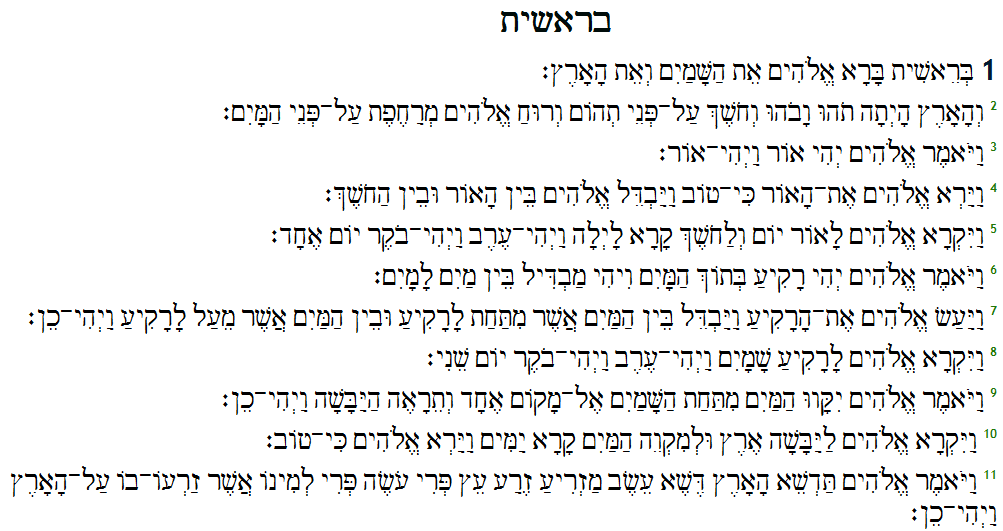
There is no argument that the age of the earth debate between evolutionists and creationists has no resolution because there can be no middle ground for compromise on either side. At issue is the question of origins: did all that exists come about by random chance over billions of years through natural causes, or did an omnipotent, omniscient Creator bring it all into being? It is one or the other, and the one who holds either view holds that view religiously and tenaciously. There is no “give.”
Lamentably, the real battle exists in the Christian camp (among “brothers”) where a variety of opinions persist. Is the earth 4.5 billion years old as the evolutionists claim, or is it only 6,000 years old as the Bible seems to indicate? Most Christians accept that God created all that exists, but beyond that opinions vary as to how God created. That God spoke everything into being as the Bible records is too simplistic an answer for some. There are basically two major divisions in this debate. The first group contends that God created everything in six 24-hour days around 6000 years ago. The second group comes in several flavors, but basically they agree with the evolutionists that God created everything over 13.7 billion years ago and used evolution in one form or another to create life. However, they will contend that man was a “special” creation of God and did not evolve from lower life forms. My intent here is to give a brief defense of the first group. The second group is indefensible in my opinion.
I wish to respond to three questions recently posed to me. (1) Where, exactly, does the Bible say that the earth is only six thousand years old? (2) How do we know that the creation spoken of in the Bible took place in six literal 24-hour days, as opposed to uncounted eons of time? (3) In 2 Peter 3:8, it says “that one day is with the Lord as a thousand years, and a thousand years as one day.” Is this passage pointing to God as being outside of time, or is it the basis for the 6-day/6-thousand years belief?
In answer to the first question, the Bible does not give an age for the earth per se. God did not exactly “date stamp” His creation. Archbishop James Ussher determined that the earth was created in the year 4004 BC by using the genealogies found in Genesis along with other sources.[1] When one begins with the Genesis account of creation (Genesis 1) and counts the generations from Adam to the Flood, one gets about 1656 years. From the Flood to the birth of Abraham was 297 years for a total of about 1953 years.[2] We can round that off to about 2000 years. Then we have about 2000 years to Jesus and from Jesus until now we have another 2000 years for a total of 6000 years – give or take a couple of hundred years.
Second, God created everything in six literal days. The Hebrew word used for “day” is yom, and it almost always means a normal 24-hour day. On those few occasions when it does not mean a literal 24-hour day, context lets us know that, as in the case of “the day of the Lord.” Furthermore, just in case it is not clear enough for us, God further specifies that “the evening and the morning was the first day, second day, third day,” etc., making it clear that God means a literal 24-hour day (Genesis 1:5, 8, 13, 19, 23, 31). Later, in Exodus 20:11, as God gave the commandment concerning the keeping of the Sabbath, God says, “For in six days the LORD made heaven and earth, the sea, and all that in them is, and rested the seventh day: wherefore the LORD blessed the sabbath day, and hallowed it.” In other words, God is saying, “I gave you the example by creating in six days and resting on the seventh, and I want you to follow My example.”
The third question deals with what a “day” means to God. When we look at 2 Peter 3:8 we need to keep the context in mind. Peter is talking about the Second Coming of Christ, and he is encouraging his readers, in the midst of persecution, not to lose heart in waiting for Christ’s return. In essence he says that God does not mark time the way we do; He is not bound by time as we are. Furthermore, Peter employs simile when he says “one day is with the Lord as [or “like”] a thousand years, and a thousand years as [or “like”] one day.” Notice what he DID NOT say: “one day is with the Lord a thousand years, and a thousand years is one day.” We need to take care when reading the Bible not to read into Scripture what is not there.
There is no scriptural reason not to believe in a young earth, nor is there any scientific reason to not to believe in a young earth; but I will let the scientists at the Institute for Creation Research argue those finer points of science. Trust what God says in His Word – ALL of it! Seriously, who would you rather believe? The words of fallible man or the Word of Infallible God?
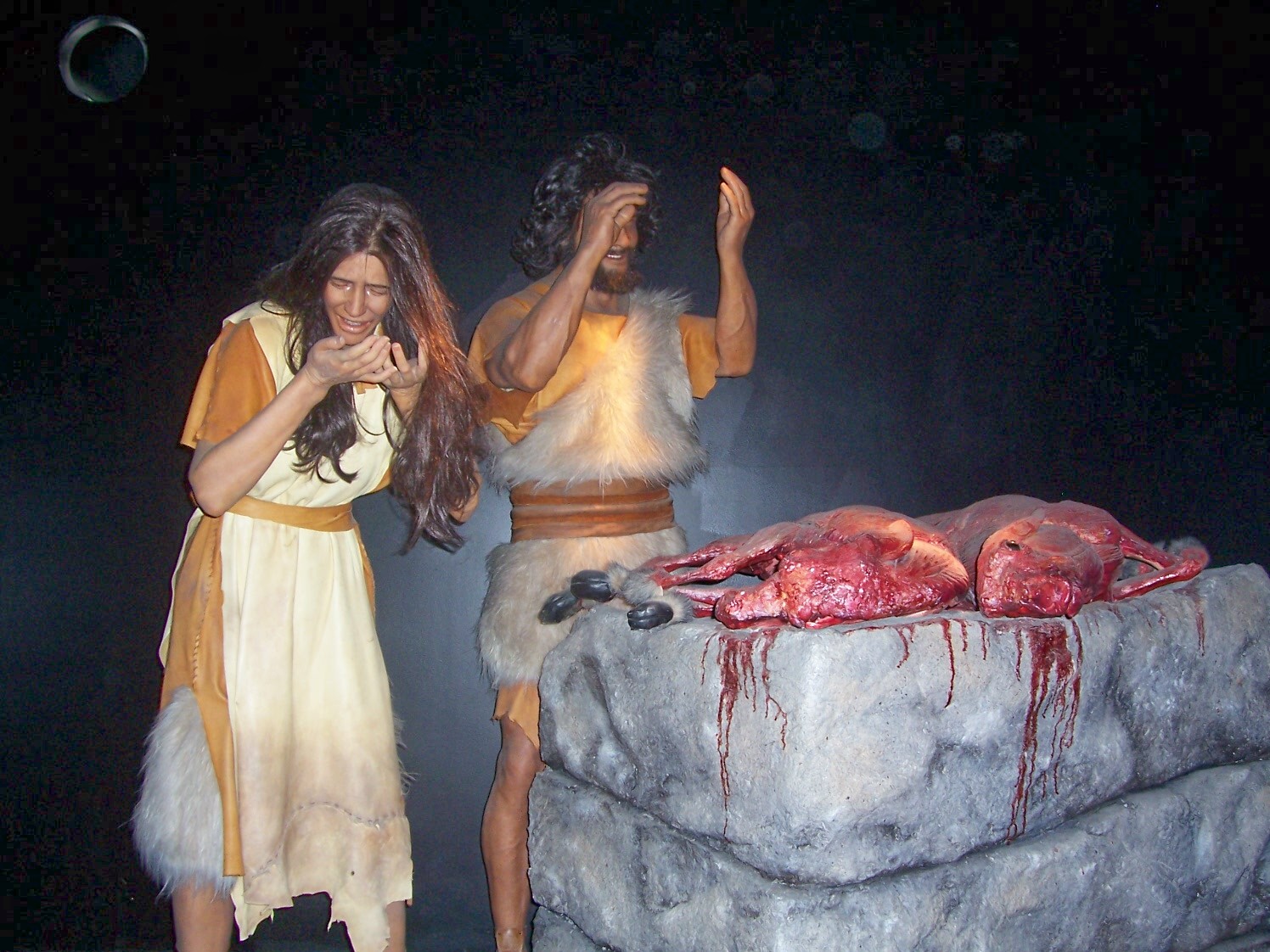
For Adam and Eve, this was the first time the first couple witnessed death. Innocent blood spilled to cover the consequence of their sin. (Romans 6:23)
“Unto Adam also and to his wife did the LORD God make coats of skins, and clothed them.” (Genesis 3:21)
Recently someone asked me a very interesting question: “Did God use human form to sacrifice the first animals, or was that done spiritually, without a body?” Of course, this is one of those questions for which we cannot give a definitive/authoritative answer. The problem is that the Bible does not provide enough detail for us make an assertive statement one way or the other. Consider our text above: “Unto Adam also and to his wife did the LORD God make coats of skins, and clothed them” (Genesis 3:21). That is it. That is all we have to go by. Anything beyond that is pure speculation on anyone’s part.
However, having said that, I believe that God took the form of the pre-incarnate Christ and performed the sacrifice before them – in their sight – so that they could witness for themselves the price or cost of their sin. Some innocent animal’s blood had to be shed in order to cover (atone for) their sin. Since they had never killed anything or experienced death in any way, they had to see how this was done in order for them to continue the practice. That they continued the practice is evidenced in the following chapter where Abel sacrificed a lamb from his flock (Genesis 4:4), while Cain offered “the fruit of the ground” (Genesis 4:3). Cain’s offering was rejected by God because it did not follow what God had prescribed in the beginning (Genesis 4:5).
This same practice of sacrifice was followed by Noah after the Flood (Genesis 8:20), by the patriarchs Abraham, Isaac and Jacob (Israel), and finally by the children of Israel after they came out of Egypt. I believe this practice of sacrifice was handed down, generation after generation beginning with Adam, and it was learned by the example given by the pre-incarnate Christ who would ultimately be the perfect Lamb of God.
“… and they that dwell on the earth shall wonder, whose names were not written in the book of life from the foundation of the world …” (Revelation 17:8)
In my last post, “The Book of Life” I talked about the Book of Life that will be opened at the Great White Throne Judgment. Anyone whose name is not found written in the Book of Life is sentenced to an eternity in hell. I also expressed my understanding that everyone who has ever been born has their names written in the Book of Life initially, but whether they remain there depends on how they respond to God’s offer of salvation.
I said this was true with some exceptions, but I did not want to go into the details at that time. The reason I did not elaborate on the “exceptions” is because it might sound a little strange or even weird to some people, and trying to explain it in one or two paragraphs would be next to impossible. In fact, books have been written on the subject, so it would be difficult to explain in just a few words.
Just by way of disclaimer: what I am suggesting in the following paragraphs should not be taken as “gospel.” These are simply my thoughts based on studies that I have done, and are not meant to represent any kind of ecclesiastical dogma. There are many things in God’s Word that are not made clear to us, and to attempt to build a case on a shaky foundation is simply foolish. So, I recommend a healthy dose of skepticism before continuing. You may think I am full of bologna, and that is fine. This is something I “think” is true, but I wouldn’t bet my next paycheck on it. So, read on.
You remember in Genesis 3 that Satan came to Eve in the form of a serpent and tempted her to eat of the fruit of the Tree of the Knowledge of Good and Evil. She then shared the fruit with Adam who also ate of the fruit so that both sinned by disobeying God’s only commandment – that they should not to eat of that tree. God punished them, as He had warned them, by causing them to die in two ways: (1) they would no longer live forever (when God created man, He intended them to live forever), and (2) they were separated from their Creator. This is what we know as original sin, and all generations since Adam and Eve have inherited original sin. We all have a “sin nature.” That is why the Bible says that “all have sinned and come short of the glory of God” (Romans 3:23, emphasis added). God also cursed the ground from which man was taken so that all of God’s creation suffers because of man’s sin. “For we know that the whole creation groaneth and travaileth in pain together until now” (Romans 8:22, emphasis added). Adam’s punishment was that work would be hard for him, and Eve’s punishment was that she would have pain in bearing children.
Following that (about 1600 years later), we are told that violence increased in the world. “And GOD saw that the wickedness of man was great in the earth, and that every imagination of the thoughts of his heart was only evil continually. And it repented the LORD that he had made man on the earth, and it grieved him at his heart” (Genesis 6:5-6). That was bad enough, but the first verses of Genesis 6 talks about something that is very strange, and has puzzled biblical scholars for ages . It says:
1 And it came to pass, when men began to multiply on the face of the earth, and daughters were born unto them,
2 That the sons of God saw the daughters of men that they were fair; and they took them wives of all which they chose …
4 There were giants in the earth in those days; and also after that, when the sons of God came in unto the daughters of men, and they bare children to them, the same became mighty men which were of old, men of renown. (Genesis 6:1-2, 4, emphasis added)
The “sons of God” in the Hebrew is bene elohim. This term always refers to angels in the Old Testament. (See Job 1:6; Job 2:1; and Job 38:7.) There are two kinds of angels: Satan’s angels (demons) and God’s angels. (Something to keep in mind is that even the devil is God’s devil. God created him, and he rebelled against God. But the devil (Satan) cannot do anything without God’s permission. This is demonstrated in the first three chapters of Job.) So, these demons “mated” with human females to create a mighty race of men. Now, angels cannot procreate directly, so what probably happened is that these demons possessed human males in order to mate with the human females. This somehow altered the DNA of the children born from these demonic unions so that they created “giants.” The Hebrew word used for “giants” is nephalim, and it literally means “fallen ones.”
Imagine just how bad things got that God felt He had to destroy them all. “But Noah found grace in the eyes of the LORD” (Genesis 6:8) and “Noah was a just man and perfect in all his generations, and Noah walked with God” (Genesis 6:9, emphasis added). The phrase that Noah was “perfect in all his generations” does not mean that he was sinless. Remember, “all have sinned.” What this means, then, is that his blood line was not contaminated by the satanic unions of the others.
When I say that there are “some exceptions,” this is to what I’m referring. Revelation 17 discusses the apostate church during the Tribulation who the Antichrist will eventually destroy. About those who follow that apostate church it says, “The beast that thou sawest was, and is not; and shall ascend out of the bottomless pit, and go into perdition: and they that dwell on the earth shall wonder, whose names were not written in the book of life from the foundation of the world, when they behold the beast that was, and is not, and yet is” (Revelation 17:8, emphasis added). It is very clear that these were never written in the Book of Life – “from the foundation of the world.” It is as if these were never meant to be born.
One would think that the Global Flood should have taken care of all of the “bad seed.” Well, perhaps not all of them. As we continue the narrative in Genesis 6, God sent the Flood that covered the entire earth for almost a whole year. The Bible tells us that Noah and his wife and his three sons and their wives were in the Ark for 371 days, before the earth was once again livable.
Then follows an incident where Noah got drunk, and his son Ham saw him naked (Genesis 9:20-29). Ham, instead of covering his father went and told his brothers, Japheth and Shem. So they went into Noah’s tent backward so as not to see the nakedness of their father and they covered him up. When Noah awoke from his drunk and discovered what Ham had done, he cursed Canaan, Ham’s youngest son. So the question is, why did Noah curse Canaan and not Ham or Ham’s other sons? The answer may be that Ham’s wife may have carried some of the “bad seed” of the Nephalim in her, and it showed up in Canaan. One of the characteristics of Nephalim is that they had six fingers. (Goliath’s father had six fingers on each hand and six toes on each foot (2 Samuel 21:20).) Canaan was probably born with six fingers and when Noah saw it, he cursed him. So, some of these probably still exist in our world today with or without six fingers, but God knows who they are. These would not qualify to be written in the Book of Life.
Canaan’s descendants settled in the “Land of Canaan” which was given to Abraham and his descendants (Genesis 13:14-18; 15:18-21). Genesis 10:15-20 describes who these people were and where they settled. “And the border of the Canaanites was from Sidon, as thou comest to Gerar, unto Gaza; as thou goest, unto Sodom, and Gomorrah, and Admah, and Zeboim, even unto Lasha” (Genesis 10:19). These are the people that the children of Israel had to face when they entered the Promise Land. As they prepared to enter into the land, 12 spies were sent in to spy out the land and report back what they encountered. The book of Numbers records the bad report returned by 10 out of the 12 spies. “And there we saw the giants, the sons of Anak, which come of the giants: and we were in our own sight as grasshoppers, and so we were in their sight” (Numbers 13:33). Again, here the Hebrew word for “giants” is nephalim – the “fallen ones.” In The Henry Morris Study Bible, Dr. Morris makes this note about this verse:
There were also other tribes of giants in the land. “That was also accounted a land of giants: giants dwelt therein in old time; and the Ammonites call them Zamzummims; A people great, and many, and tall, as the Anakims” [i.e., sons of Anak] (Deuteronomy 2:20, 21). Here, and in a number of other passages, the word for “giants” is Rephaim, evidently a tribe descended from the “Rephaims” associated with the “Zuzims” and the “Emims” of Genesis 14:5. The Emims also were called “a people great, and many, and tall, as the Anakims” (Deuteronomy 2:10).
All of these references indicate that there had been another irruption of the fallen “sons of God” just as in the days before the Flood. This time the irruption was probably in connection with the events surrounding the rebellion at Babel and the subsequent worldwide dispersion of the occult religious system introduced there. These demon-possessed men and women became the progenitors of tribes characterized by giantism, just as in the antediluvian days. (http://www.icr.org/bible/numbers/13:33/)
So, it is apparent that these nephalim somehow managed to survive the Flood. These who survived were descendants of Canaan, which explains why Noah cursed Canaan and not Ham. Oh, and by the way, Ham begat other sons before Canaan: Cush, Mizraim (Egypt), and Phut. Canaan was the youngest, but evidently, he carried the “bad seed.”
Now, to further complicate things, I am sure you have heard of UFOs and of aliens abducting humans. I believe (and I am not alone in this) that these are demons that are doing the same thing today as they were doing back in Genesis 6. (See my article “Aliens?”) These creatures, that may look very human, were never meant to be born, so their names are not written in the Book of Life.
Unless you are one of the nephalim (and you probably are not, if you are reading this), your name is written in the Book of Life. My question to you would be, is your name permanently written in the Book of Life, or is there a possibility that it could be blotted out? That choice is up to you.
Watch “On the Trail of the Nephalim” on YouTube with L.A. Marzulli.



 Ernie's Musings