Tag Archives: Christ Jesus

Imminent

He which testifieth these things saith, Surely I come quickly. Amen. Even so, come, Lord Jesus. (Revelation 22:20)

Secretary of State, Mike Pompeo, and Secretary of the Treasury, Steve Mnuchin, gave a press briefing on Friday, January 10, 2020,[1] concerning increased sanctions for Iran following Iran’s rocket attacks on US bases in Iraq. At the end of the briefing, they opened the floor for questions from the press corps. As has become common practice these days, the questions coming from the Press avoided the topic at hand, and rather addressed the irrelevant question of the killing of Iranian General Qasem Soleimani. Someone questioned the targeting of a “foreign diplomat,” and Pompeo pointed out that our intelligence found that Soleimani planned to strike our embassies in the area and that the threats were imminent. One genius fake news reporter challenged the Secretary, “What is your definition of ‘imminent’?” I had to laugh!

It comes as no surprise that the request for a definition of the word “imminent” should arise. The “left” in this country, and around the world, has become proficient in distorting the language so that words become whatever the user wants them to be. For example, “hate” means “to dislike intensely or passionately; feel extreme aversion for or extreme hostility toward [something or someone]; detest [something or someone].”[2] However, for the left, “hate” means opposition to anything they favor. The practice of redefining terms probably started much earlier than this, but my first vivid recollection of this practice came at the impeachment of William Jefferson Clinton. Remember his now infamous line? “It depends on what the meaning of the word ‘is’ is.”

Words used to have meaning. However, in a day when biology no longer determines the sex of a person, words can take on whatever meaning the user wants them to mean. Not so with God. He emphatically states, “For I am the LORD, I change not…” (Malachi 3:6). The writer to the Hebrews says of God the Son, “Jesus Christ the same yesterday, and to day, and for ever” (Hebrews 13:8). Of His Word, Jesus said, “For verily I say unto you, Till heaven and earth pass, one jot or one tittle shall in no wise pass from the law, till all be fulfilled” (Matthew 5:18).

The word “imminent” does not appear in the King James Bible; however, the concept is there. The word “imminent” means that something is “likely to occur at any moment.”[3] The precise moment of such an event cannot be known or determined. It could happen at any time. If one can know or determine the time of a future event, it is no longer “imminent” because it is now “expected.” The two words are synonymous, however with expectation comes the connotation of the precise timing and location of a future event. The expectation of an impending event allows for ample preparation. Jesus said, “But know this, that if the goodman of the house had known in what watch the thief would come, he would have watched, and would not have suffered his house to be broken up” (Matthew 24:43). If the man of the house had “known” when the thief would come, he would have been “expecting” him and made preparations. The implication here is that the coming of the thief was “imminent,” not “expected.”

The fake news reporter exhibited her ignorance by asking Pompeo what he meant by “imminent.” Our military intelligence could not predict where or when Soleimani would strike, only that his intention was to strike soon. That made it imminent.

Christ’s return for His Bride, the Church, is imminent. It has been imminent for over 2000 years. Before His crucifixion, Jesus promised, “And if I go and prepare a place for you, I will come again, and receive you unto myself; that where I am, there ye may be also” (John 14:3). Paul taught the imminency of the Lord’s return at “the last trump” when we would “not all sleep, but we will all be changed in a moment, in the twinkling of an eye,”[4] but he did not say when. It’s imminent. It could happen at any time. To the Thessalonians, Paul wrote, “But of the times and the seasons, brethren, ye have no need that I write unto you. For yourselves know perfectly that the day of the Lord so cometh as a thief in the night” (1 Thessalonians 5:1-2). His coming is imminent, like “a thief in the night.”

Unlike the “goodman of the house” in Jesus’ example who was unprepared for the imminency of the thief’s arrival, we have good reason to be expectant of the Lord’s imminent return. We cannot know the day nor the hour when the Lord will return.[5] It could be at any time. It is imminent. Therefore, we must watch expectantly, and make preparations.

We have waited for over 2000 years. How imminent can His return be? Many become discouraged at the delay, like the five virgins without extra oil for their lamps.[6] Such attitudes are to be expected. The Apostle Peter predicted, “Knowing this first, that there shall come in the last days scoffers, walking after their own lusts, And saying, Where is the promise of his coming? for since the fathers fell asleep, all things continue as they were from the beginning of the creation” (2 Peter 3:3-4).

Many prophecies concerning “the last days” address Jesus’ return to set up His thousand-year reign on earth. The Old Testament contains most of these prophecies. Jesus spoke of these times in His Olivet Discourse,[7] and most of the Book of Revelation focuses on the time of Great Tribulation just before He returns. These prophecies provide great detail of the events that will transpire in “the last days” during the seven years[8] before the Lord’s return. However, no signs detail the “Rapture”[9] of the Church. We are told that it will happen, but we are not told when or how; it’s imminent. The Rapture[10] must take place before the time of Tribulation “For God hath not appointed us [His Church] to wrath, but to obtain salvation by our Lord Jesus Christ” (1 Thessalonians 5:9).

So, although we have waited more than 2000 years for the Bridegroom[11] to come for His Bride (the Church), we can know the time is near. How? We can know because of the convergence of the end-time signs. Israel, because it is the focus of all end-time prophecy, and the events surrounding Israel, is our primary sign. None of the end-time prophecies can come to pass without Israel being in her place. Of the rebirth of Israel, God’s “fig tree,” Jesus said, “Verily I say unto you, This generation shall not pass, till all these things be fulfilled” (Matthew 24:34). We are that generation. It has been almost 72 years since Israel’s rebirth, and according to the psalmist, a man’s life is between 70 and 80 years (Psalm 90:10). There are too many signs to include in this article, but the fact that Israel is in place makes all the other signs that much more relevant. The signs tell us the end is near, so the Rapture of the Church is more imminent now than ever before. It could happen anytime now.

Notes:


[1]  Press Briefing with Secretary of State Mike Pompeo and Secretary of the Treasury Steve Mnuchin: https://www.youtube.com/watch?v=lTCErLFbu4Q

[2]  Hate: https://www.dictionary.com/browse/hate?s=t

[3]  Imminent: https://www.dictionary.com/browse/imminent?s=t

[4]  1 Corinthians 15:50-53

[5]  Matthew 25:13

[6]  Matthew 25:1-13

[7]  Matthew 24-25; Mark 13; Luke 21

[8]  Daniel 9:24-27

[9]  End-Times 101 – https://erniecarrasco.com/2018/06/10/end-times-101/

[10]  End-Times 102 – https://erniecarrasco.com/2018/06/17/end-times-102/

[11]  Matthew 25:1-13

Comments Off on Imminent

Filed under Apologetics, Christianity, Current Events, End Times, Religion, Second Coming of Christ, Theology

O Holy Night

And there were in the same country shepherds abiding in the field, keeping watch over their flock by night. (Luke 2:8)

“The stars are brightly shining. It is the night of our dear Savior’s birth.” It was a “holy” night – sacred, pure, consecrated. There was no night like it before, and there has been no night like it since.

It was a holy night because Jesus entered the world on that night. The birth itself was nothing special. Surely He was not the only baby born on that night. According to Luke’s account, Mary and Joseph were in Bethlehem some time before the birth. “While they were there, the days were accomplished that she should be delivered” (Luke 2:6). Surely in the small village of Bethlehem word of a young expectant mother got around quickly. Surely the town had at least one midwife to help with the birth, and the ladies of the town would be more than eager to help a young mother, “great with child,”[1] deliver her firstborn. Just because there was no room for them in the inn, does not mean the couple was totally on their own. So, the birth was itself was unremarkable.

The miraculous conception nine months earlier is another matter. The Creator[2] took the form of the “created” when the angel told Mary, “The Holy Ghost shall come upon thee, and the power of the Highest shall overshadow thee: therefore also that holy thing which shall be born of thee shall be called the Son of God” (Luke 1:35). The “Son of God” was God Himself growing inside the virgin’s womb for the normal human gestation time.[3] At conception, He became Emmanuel, God with us.[4]

But now, on this holy night, the incarnate God, entered the world He created. It was a very holy night indeed.

Notes:


[1]  Luke 2:5

[2]  John 1:1-3

[3]  John 1:14

[4]  Matthew 1:23

Comments Off on O Holy Night

Filed under Apologetics, Christianity, Christmas, Religion

Christmas Excitement

Behold, the former things are come to pass, and new things do I declare: before they spring forth I tell you of them. (Isaiah 42:9)

It’s that time of year once more. The places I work and worship sparkle with bright red, green, and gold decorations consistent with the colors of the Christmas season. Long before Thanksgiving Day, merchants displayed all their Christmas wares enticing shoppers to covet without first giving thanks. Television commercials attempt to instill a sense of privation so the viewer feels the need for what they are selling.

GMC™ produces two commercials that really stand out to me. They show a young couple, probably in their late twenties or early thirties, with no children, and a big fancy house. In one of the commercials, the husband buys GMC ™ vehicles for both of them. In the other, the husband gets the wife a puppy, and the wife gets him a big crew-cab pickup. Seriously, how many young people, on the average, have that kind of cash? Most young people that age, if they graduated from a college or university, are saddled with enormous school debt and are doing well to afford payments on a Honda Civic™ much less a $60,000 fully decked out pickup truck!

Regardless of how we feel about the materialism associated with the Christmas season, we cannot get away from the sense of expectation. At church, our choir and orchestra are working hard a polishing up the music for our Christmas concert. It will be wonderful, and we are excited about presenting it. Our church looks forward to our Christmas Eve services and our sharing of the Lord’s Supper, aka communion.

We celebrate the birth of our Savior. Think about what that means. The same God that created heaven and earth and all things, the same God that created human beings in His very image, is the same God that implanted Himself in the womb of a virgin girl to be born like any other human baby, live a sinless life among His creation, and give Himself as a sacrifice for humanity’s sin. That is awesome! That boggles the mind!

We anticipate with excitement the celebration of Christmas, the First Advent, but our celebration should look forward to the Second Advent yet to come. The prophets of old foretold of Jesus’ first coming. Beginning in Genesis, the Bible promises that the “seed of the woman” would crush the head of the serpent, i.e., Satan.[1] Isaiah tells us that the woman would be a virgin.[2] In Genesis, we also learn that He would come from the line of Abraham, Isaac, Jacob, and Judah.[3] Isaiah foretold that Jesus would be in the line of King David[4] and the psalmist concurred.[5] The conniving Balaam unwittingly predicted that a star would announce His coming.[6] Micah pointed to Bethlehem as the place of His birth,[7] and Hosea said He would come up from Egypt.[8] These are just some of the prophecies of His First Advent. Many more prophecies foretold of His life, ministry, death, burial, and resurrection – all with 100% accuracy.

Christmastime should cause excitement as we anticipate His Second Advent. There are more prophecies concerning His second coming than there are for His first coming. Since all prophecies of His first coming came true as predicted, should we not expect the same accuracy of the prophecies predicting His second coming? Celebrating Christmas should excite us knowing that the Baby Jesus is the soon-coming King of Kings and Lord of Lords.

One of the carols we sing at Christmastime is not really a Christmas carol. In fact, “Joy to the World”[9] reminds us that Christ will return to rule the world as king.

Joy to the world the Savior reigns; let men their songs employ; while fields and floods, rocks, hills, and plains repeat their sounding joy.

No more let sins and sorrows grow, nor thorns infest the ground; He comes to make His blessings flow far as the curse is found.

He rules the world with truth and grace, and makes the nations prove the glories of His righteousness, and wonders of His love.

We know historically that did not happen at His first coming. We might spiritualize those sentiments. Certainly, the Savior reigns within the hearts of all believers, albeit not perfectly. Sin and sorrow continue as always and “the curse” goes on unabated. He does not rule the world, and “the nations” care nothing about His glories or righteousness. All of these are attributes of His yet-to-come millennial reign.[10] The prophet Isaiah provides some insight into Jesus’ millennial reign on earth. That will be a time when even the animal kingdom will be at peace.[11] Knowing what is coming should make Christmas even more exciting than all the GMC™ pickups the world can afford!

Notes:


[1]  Genesis 3:15

[2]  Isaiah 7:14

[3]  Genesis 12:3; 26:4; 28:14; 49:10-11

[4]  Isaiah 11:1

[5]  Psalm 132:11

[6]  Numbers 24:17

[7]  Micah 5:2

[8]  Hosea 11:1

[9]  Carol by Isaac Watts, 1718

[10]  Revelation 20:1-7

[11]  Isaiah 11

Comments Off on Christmas Excitement

Filed under Apologetics, Christianity, Christmas, Gospel, Holidays, Salvation, Second Coming of Christ, Theology

White As Snow

White As Snow – by Henry M. Morris, Ph.D.*


“I beheld till the thrones were cast down, and the Ancient of days did sit, whose garment was white as snow, and the hair of his head like the pure wool: his throne was like the fiery flame, and his wheels as burning fire.” (Daniel 7:9)

In this amazing vision of the everlasting God on His fiery judgment throne, we find one of the six occurrences in the Bible of the fascinating phrase “white as snow.” As the symbol of holiness, pure white finds its clearest natural expression in the beautiful snow when it has freshly covered the ground.

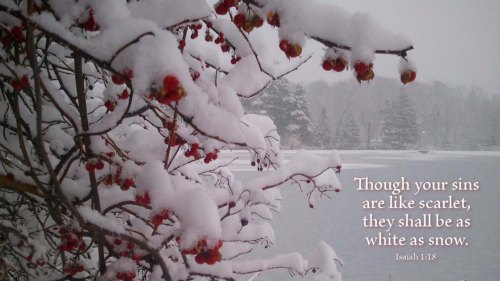
Twice the phrase is used to describe the cleansing of a guilty sinner by the grace of God. David, after confessing his own sin, prayed: “Have mercy upon me, O God. . . . Wash me throughly from mine iniquity, and cleanse me from my sin. . . . wash me, and I shall be whiter than snow” (Psalm 51:1-2, 7). Then, God promises through His prophet: “Come now, and let us reason together, . . . though your sins be as scarlet, they shall be as white as snow” (Isaiah 1:18). The cleansing blood of Christ, the Lamb of God, is the only substance that can turn blood-red scarlet into snowy white.

When Christ ascended the Mount of Transfiguration, “his raiment became shining, exceeding white as snow” (Mark 9:3), which confirmed to the three disciples that He was the Son of God, even as the voice from heaven had said (Matthew 17:5). At the empty tomb following His resurrection, “the angel of the Lord” also had “raiment white as snow” (Matthew 28:3). Finally, when John saw Christ in His glorified body, he testified that “his head and his hairs were white like wool, as white as snow” (Revelation 1:14).

It is marvelous that the raiment of the angel of God, the transfigured Christ, and the Ancient of days, as well as the head of Christ in His glory, are all described with the same phrase as the soul of one whose sins are forgiven!

*From Days of Praise, December 1, 2019

Comments Off on White As Snow

Filed under Christianity, End Times, Gospel, Religion, Salvation, Second Coming of Christ, Theology

What the Law Does

Therefore by the deeds of the law there shall no flesh be justified in his sight: for by the law is the knowledge of sin. (Romans 3:20)

Many Christians today adopt the attitude that the Old Testament Law no longer applies because we are not under the Law but under Grace. That is certainly true. However, the fact that we are under Grace does in no way render the Law irrelevant or make it of no effect.

The Law given in the Old Testament accomplished two things. It codified what God expected of His people, Israel, and it provided specific practices for God’s people to follow that set them apart from the pagan nations among whom they lived. They were to be “holy” as their God in heaven is holy, i.e., set apart, consecrated, distinct.

The Law provided a third way for the people to relate to God through the sacrificial system which provided a way to atone for or “cover” the sins of the people. However, the sacrificial system did not provide a permanent solution to the sin problem. Sacrifices were made for all kinds of infractions of the Law, and like sin, they were a perpetual practice. The continual offering of sacrifices illustrated the insufficiency of sacrifices to fully atone for the sin of the people. Even so, the sacrifices required faith in the offering otherwise they became a ritual practice akin to pagan practices. God rejected such sacrifices.

To what purpose is the multitude of your sacrifices unto me? saith the LORD: I am full of the burnt offerings of rams, and the fat of fed beasts; and I delight not in the blood of bullocks, or of lambs, or of he goats. (Isaiah 1:11)

To what purpose cometh there to me incense from Sheba, and the sweet cane from a far country? your burnt offerings are not acceptable, nor your sacrifices sweet unto me. (Jeremiah 6:20)

For it is not possible that the blood of bulls and of goats should take away sins. (Hebrews 10:4)

One thing we learn from the Old Testament is that it is impossible to keep the Law, and that it is insufficient to atone for sin. Our opening verse makes it clear, “by the deeds of the law there shall no flesh be justified in his sight” (Romans 3:20). The only sacrifice sufficient to atone for sin is the one offered by God Himself in the person of Jesus Christ and the blood He shed on the cross. Sin – all sin, for all time – was paid in full when Jesus exclaimed, “It is finished: and he bowed his head, and gave up the ghost” (John 19:30). However, Jesus did not remain dead. On the third day, He rose from the dead and conquered the “last enemy”[1] giving us access to eternal life by the simple act of believing. “And as Moses lifted up the serpent in the wilderness, even so must the Son of man be lifted up: That whosoever believeth in him should not perish, but have eternal life” (John 3:14-15).

Romans 3:23 says that “all have sinned, and come short of the glory of God.” The Old Testament teaches us that we are incapable of keeping God’s Law, therefore we are doomed by that standard. “For the wages of sin is death; but the gift of God is eternal life through Jesus Christ our Lord” (Romans 6:23, emphasis mine). Grace is God’s gift to us. Grace is “unmerited favor.” Grace cannot be earned through any human effort because “by the deeds of the law there shall no flesh be justified in his sight” (Romans 3:20). Grace is a gift, bought and paid for by Jesus’ sacrifice on the cross. “For by grace are ye saved through faith; and that not of yourselves: it is the gift of God: Not of works, lest any man should boast” (Ephesians 2:8-9). As with any gift, it must be accepted before it becomes one’s own possession.

What good, then, is the Old Testament Law, if one cannot gain salvation, i.e., eternal life, by keeping it (not that you could if you tried)? Paul provides the following affirmation: “Therefore we conclude that a man is justified by faith without the deeds of the law” (Romans 3:28). We are declared “just” when we place our “faith” in what Jesus did for us on the cross. That is a “done deal” outside the keeping (“the deeds”) of the law. Then Paul poses and responds to our question. “Do we then make void the law through faith? God forbid: yea, we establish the law” (Romans 3:31). The Greek word translated “establish” is histēmi, and it means “to cause to stand.”

The Law still stands. It is not required to gain eternal life nor is it needed to maintain our salvation. However, it does serve as our guide to holy living which God still requires of His children. “But as he which hath called you is holy, so be ye holy in all manner of conversation; Because it is written, Be ye holy; for I am holy” (1 Peter 1:15-16). Jesus tied our love for Him to the keeping of His commandments.[2] Jesus spoke these words 25-30 years before the first Gospel was written, so His commandments were the same commandments He gave to Moses, which are summarized in two great commandments: love the Lord your God with all your heart, soul, and mind (your whole being), and love your neighbor as yourself.[3]

But what does that look like? Our opening verse tells us: “for by the law is the knowledge of sin” (Romans 3:20). Granted, much of the Mosaic Law had direct application to the culture of that time, however, the principles therein apply to our modern time. Take for instance the laws given to dress. The reason for those laws served to make the children of Israel distinct from the people among whom they lived. God still wants the same for us today. We shouldn’t dress and look like the lost world around us. We should be distinct. We should be holy as our Father in heaven is holy – set apart from the world. Speaking of us, Jesus said, “They are not of the world, even as I am not of the world” (John 17:16). What the law does is show us how not to live like the world.

Notes:


[1]  1 Corinthians 15:26

[2]  John 14:15, 21; 15:10

[3]  Matthew 22:36-40

1 Comment

Filed under Apologetics, Bible, Christianity, Gospel, Religion, Salvation, Theology