Tag Archives: Christ Jesus

Why Christmas?

For God sent not his Son into the world to condemn the world; but that the world through him might be saved. (John 3:17)

It is said that “familiarity breeds contempt.” One need look no further than the season of Christmas to see the truth of this axiom. Forget about the lost world that has no concept of the true meaning of Christmas. Christians, who should possess at least a rudimentary understanding of the significance of the season, too often get caught up in the madness associated with “the holidays” right along with those who know no better.

In all the cacophony of TV and radio commercials, traffic noise, buzzing shopping malls, clanging Salvation Army bells, and “holiday” music at every turn, does the question even come up? Why Christmas? Why all the fuss? In spite of all the warm sentiments intoned by joyful holiday songs, the season carries with it an increase in stress, depression and even suicide. So much for “Happy Holidays!” Why bother?
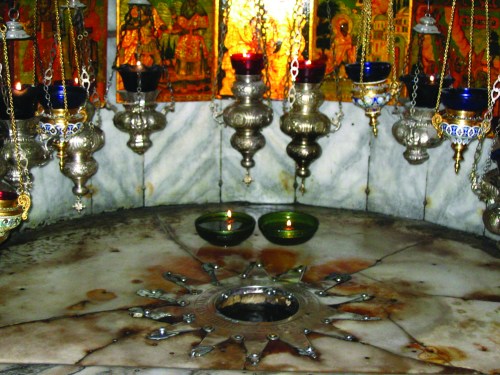
Church of the Nativity, Bethlehem, Israel

I remember visiting the Church of the Nativity in Bethlem, Israel last year. We stood for two and a half painful hours on hard, uneven limestone floors waiting to see the supposed place of Jesus’ birth. When we finally crouched through the constricted cave opening, we found a small alcove adorned with a plethora of lighted candles illuminating a gold 14-pointed star in the center of a polished marble floor. A hole in the center of the star marked the very spot where Mary gave birth to the baby Jesus. The garish display rendered the prolonged anticipation anticlimactic. Perhaps in a similar fashion, the significance of Christmas has been long lost to the millennia of ostentatious trappings and traditions we have attached to it.

So, why Christmas? Stop! Silence the noise! Trash the shiny paper and bright bows and ribbons! Douse the twinkling lights! Be still and think!

We, humans, suffer from a terminal condition called death. We inherited this terminal condition from our original parents, Adam and Eve (Genesis 3). They were originally created to live forever, but their disobedience to God’s only command brought upon them the death penalty. Did I mention that they were created to live forever? The death penalty, therefore, comes in two phases: physical death and spiritual death. Because of Adam’s sin, we all die physically. “And as it is appointed unto men once to die, but after this the judgment” (Hebrews 9:27). However, the spirit continues through eternity. Spiritual death is eternal separation from the Creator; the Bible calls that the “second death.” “And death and hell were cast into the lake of fire. This is the second death” (Revelation 20:14).

Because of Adam’s sin, all humans suffer the same fate. “Wherefore, as by one man sin entered into the world, and death by sin; and so death passed upon all men, for that all have sinned” (Romans 5:12). No one is excluded from the death sentence, and all must pay the price. “For the wages of sin is death …” (Romans 6:23).

However, God made a temporary provision for covering the sins of man. It was the blood sacrifice of an innocent animal, but that was not a permanent fix. “For it is not possible that the blood of bulls and of goats should take away sins” (Hebrews 10:4). The fact remains that sin is humanity’s problem. Animals do not sin; they are innocent. Therefore, the “wages of sin” must be paid by man, not animals, but that is the problem. No human is innocent, i.e., sinless. “All have sinned, and come short of the glory of God” (Romans 3:23).

The Bible teaches God loves us, even though we are all sinners. However, God is holy and just, and He cannot and will not allow sin to go unpunished. “The Lord is not slack concerning his promise, as some men count slackness; but is longsuffering to us-ward, not willing that any should perish, but that all should come to repentance” (2 Peter 3:9, emphasis mine). God does not want us to be eternally separated from Him, but the sin debt must be paid.

Therefore God became a man born of a virgin untouched by any man so that He could be born completely free from the curse of sin. He grew up like any other man but without sin. “For we have not an high priest [Jesus Christ] which cannot be touched with the feeling of our infirmities; but was in all points tempted like as we are, yet without sin” (Hebrews 4:15, emphasis mine). “Let this mind be in you, which was also in Christ Jesus: Who, being in the form of God, thought it not robbery to be equal with God: But made himself of no reputation, and took upon him the form of a servant, and was made in the likeness of men: And being found in fashion as a man, he humbled himself, and became obedient unto death, even the death of the cross” (Philippians 2:5-8, emphasis mine). “For Christ also hath once suffered for sins, the just for the unjust, that he might bring us to God, being put to death in the flesh, but quickened by the Spirit” (1 Peter 3:18).

Why Christmas? “For God so loved the world, that he gave his only begotten Son, that whosoever believeth in him should not perish, but have everlasting life” (John 3:16, emphasis mine). There’s your Christmas present! God became a man to be the perfect sacrifice to pay the wages of sin in our stead so that we will not have to be eternally separated from Him. He offers us our redemption as a gift if we choose to accept it. That’s why Christmas.

7 Comments

Filed under Christianity, Christmas, Evangelism, Gospel, Holidays, Salvation, Theology

It’s Here Again

Glory ye in his holy name: let the heart of them rejoice that seek the LORD. (1 Chronicles 16:10)

Thanksgiving Day came and went. We enjoyed a no muss, no fuss Thanksgiving, just June, me, and our dog pack. We brought the old pre-lit Christmas tree down from the attic and set it up. Another section of lights failed. That makes two sections that need to be filled in. We decided the tree is going to the curb at the end of this season. We will look for a new one at the end of season close-out sales.

June and I spent the day decorating the Christmas tree. The dogs just watched or got in the way. Personally, I don’t think the all trouble is worth the effort. The tree is up for five or six weeks. Few people ever see it other than June, me, and the dogs, and, because both of us work, it’s only seen a couple of hours a day except for weekends. Then at the end of the season, it all has to be disassembled and put back up in the attic again until next year. I just don’t see the point.

We don’t do Black Friday as a rule. However, I needed some plastic putty for a model I’m building and decided to go to Michael’s ™ to hunt for some. June never allows me to go shopping without checking for coupons. She found a Michael’s ™ flyer advertising their Christmas trees for half off, so she decided to accompany me on my quest. We found a perfect replacement for our condemned tree and other small items, but no putty. No worries, Amazon ™ has anything one could want as long as one is willing to wait for delivery.

With our errands done, we prepared to enjoy a nice evening with our very good friends. We played some table games and then enjoyed a non-traditional Thanksgiving meal together. Truth be told, every day should be a day of thanksgiving.

We set aside Saturday to decorate the outside of the house for Christmas. I exercise fairly regularly, but the older I get, the less benefit I seem to get from all the effort. By the end of the day, my back ached, and my feet cried out for mercy. After a quick dinner of leftovers, we worked on completing the inside decorating. Decorating the house for Christmas involves much more than putting up a Christmas tree. June and I have a collection of more than 60 nativities that we like to display. However, before displaying them, we have to make space for them by putting away other knickknacks. This too is a lot of effort considering the limited audience that will enjoy them. The dogs don’t care. Still, the house looks nice, and it feels like Christmas.

I have written much about Christmas. If interested, the reader can find those in the “Categories” column on the right under “Christmas.” The reader will find that I have a low opinion of all the “trappings” of Christmas. I do not care for the commercialization of Christmas. I do not care for the sentimentality attached to Christmas. I do not care for all the hubbub associated with the season. It is doubtful that “the reason for the season” was born in December.

That said, there is much I do like about Christmas. I love the music of Christmas, especially the carols. In my church, the Sunday following Thanksgiving, we start singing the Christmas carols. The carols remind me that the Creator of the universe, the Maker of you and me, lowered Himself to human form and entered His world as a helpless human baby. THAT is awesome! But it did not end there. He grew up and lived among His creation as the only perfect and sinless man to ever walk the face of the earth. Finally, He gave Himself as the only suitable sacrifice to atone for our sins. THAT is amazing! But He did not just die. He conquered death for you and me so that we can live forever with Him.

He ascended into heaven, but He left with the promise to return for those who have trusted Him. The time draws near of His return. When He returns, He will reign as King of Kings and Lord of Lords on earth for 1000 years. People mistake the hymn “Joy to the World” for a Christmas carol describing Jesus first coming, but it is not. The hymn describes His second coming and His future reign on earth. Next time you sing it, pay close attention to the lyrics.

I love what Christmas represents. I believe Jesus was born sometime in September. No one knows for sure. Regardless, it is good to set aside a time to reflect on just what an incredible thing God did to save His creation. He offers His salvation as a gift. However, as with any gift, it must be accepted before it is appropriated. Reader, if this great gift is not yours and you would like to take it as your own, read my page on “Securing Eternal Life.”

I cannot change the things I do not like about Christmas, and being a Scrooge benefits no one. Therefore, I will try to overlook the Christmas distortions and focus on the awesome and amazing gift of God. He is the reason for the season after all.

Comments Off on It’s Here Again

Filed under Christianity, Christmas, Current Events, Gospel, Holidays, Random Musings, Salvation, Second Coming of Christ, Theology

The Soul

Behold, all souls are mine; as the soul of the father, so also the soul of the son is mine: the soul that sinneth, it shall die. (Ezekiel 18:4)

My twice-brother and I engaged in a discussion a few nights ago concerning the meaning of “the soul.” What is the soul? Most people think of the soul as the spiritual essence of a person. The English dictionary seems to support that view:

noun

  1. the principle of life, feeling, thought, and action in humans, regarded as a distinct entity separate from the body, and commonly held to be separable in existence from the body; the spiritual part of humans as distinct from the physical part.
  2. the spiritual part of humans regarded in its moral aspect, or as believed to survive death and be subject to happiness or misery in a life to come: arguing the immortality of the soul.
  3. the disembodied spirit of a deceased personHe feared the soul of the deceased would haunt him.[1] et al. (emphasis mine)

Our English language (especially American English) has “evolved” considerably since the founding of the United States, so I thought it might be interesting to see how the 1828 Webster’s Dictionary defined “soul.” I found the following definition:

SOUL, n.

  1. The spiritual, rational and immortal substance in man, which distinguishes him from brutes; that part of man which enables him to think and reason, and which renders him a subject of moral government. The immortality of the soul is a fundamental article of the christian [sic] system. Such is the nature of the human soul that it must have a God, an object of supreme affection.
  2. The understanding; the intellectual principle. The eyes of our soul then only begin to see, when our bodily eye are closing.
  3. Vital principle. Thou son, of this great world both eye and soul.
  4. Spirit; essence; chief part; as charity, the soul of all the virtues. Emotion is the soul of eloquence.
  5. Life; animation principle or part; as, an able commander is the soul of an army.
  6. Internal power. There is some soul of goodness in things evil.
  7. A human being; a person. There was no a soul present. In Paris there are more than seven hundred thousand souls. London, Westminster, Southwark and the suburbs, are said to contain twelve hundred thousand souls.[2] et al. (emphasis mine)

The idea that the soul is the immaterial “substance” or “essence” that animates us enjoys a long history of support, but I think there is more to the soul than that. Normally, the first and second definition listed in a dictionary provides the general understanding of the word. However, in this case, I prefer the seventh definition provided by the 1828 Webster’s Dictionary. It basically says that “the soul” is a human being or a person, and I believe I can show scriptural support for that idea.

The best place to start is at the beginning. “In the beginning God created the heaven and the earth” (Genesis 1:1). “God,” ‘ĕlôhı̂ym, is a plural noun. We understand God as Triune being – Father, Son, and Holy Spirit – three persons (we say) in one “Godhead.” We simply say “God,” but we understand His Triune nature.

God created humans according to His image. “And God said, Let us make man in our image, after our likeness: … So God created man in his own image, in the image of God created he him; male and female created he them” (Genesis 1:26-27, emphasis mine). All humans bear the “image of God” and share many of His attributes albeit without the “Omni” prefix. It follows that we too possess a triune nature (more on that later).

As we examine the creation account, we see that God created all living creatures by divine fiat, i.e., He spoke them into being. However, He took special care in creating man. “And the LORD God formed man of the dust of the ground, and breathed into his nostrils the breath of life; and man became a living soul” (Genesis 2:7, emphasis mine).

Humans and air-breathing animals possess the “breath of life.” The Hebrew word neshâmâh is defined as: “a puff, that is, wind, angry or vital breath, divine inspiration, intellect or (concretely) an animal: – blast, (that) breath (-eth), inspiration, soul, spirit.”[3] We see in Genesis 7:22 that animals possess the “breath of life.” That phrase is also found in Genesis 6:13 and 7:15, but the Hebrew word for “breath” there is rûach, which means: “wind; by resemblance breath, that is, a sensible (or even violent) exhalation; figuratively life, anger, unsubstantiality; by extension a region of the sky; by resemblance spirit, but only of a rational being (including its expression and functions): – air, anger, blast, breath, X cool, courage, mind, X quarter, X side, spirit ([-ual]), tempest, X vain, ([whirl-]) wind (-y).”[4] Both neshâmâh and rûach are similar in meaning, but the latter includes the idea of a “spirit.”

To further confuse matters, Genesis 2:7 says that “man became a living soul.” The word “soul” is the Hebrew nephesh, which is defined as: “a breathing creature, that is, animal or (abstractly) vitality; used very widely in a literal, accommodated or figurative sense (bodily or mental): – any, appetite, beast, body, breath, creature, X dead (-ly), desire, X [dis-] contented, X fish, ghost, + greedy, he, heart (-y), (hath, X jeopardy of) life (X in jeopardy), lust, man, me, mind, mortality, one, own, person, pleasure, (her-, him-, my-, thy-) self, them (your) -selves, + slay, soul, + tablet, they, thing, (X she) will, X would have it.”  It is not difficult to see that nephesh is related to neshâmâh in that both carry the aspect of “breathing.” However, nephesh includes the physical aspect of the creature.

Both man and animals possess a nephesh. The Hebrew word first appears in Genesis 1:20. “And God said, Let the waters bring forth abundantly the moving creature that hath life, and fowl that may fly above the earth in the open firmament of heaven” (emphasis mine). The Hebrew words translated “hath life” are nephesh chay (life), or “soul life.” Also, the following verse reads, “And God created great whales, and every living creature that moveth, which the waters brought forth abundantly, after their kind, and every winged fowl after his kind: and God saw that it was good” (Genesis 1:21, emphasis mine). The Hebrew word translated “creature” is nephesh. I could give more examples, but I want you to stay with me on this.

We see that both man (humans) and animals have souls – nephesh. What differentiates a human soul from that of an animal is the way in which it was given. Recall earlier that God created animals by divine fiat. He also created them en masse. Man was unique. He created one human couple. He did not speak them into being as he did with the animals. He “formed” man – the Hebrew word yâtsar meaning to mold as a potter forms and shapes a clay vessel. Then God breathed into man His own breath “and man became a living soul” (Genesis 2:7).

Looking back at the 1828 Webster’s definition of “soul,” the seventh definition becomes clear here. The clay figure on the ground came to life when God breathed into it, and he became a human being, a person, a living soul – made in the image of God, with a triune nature like his Maker.

So, what is the triune nature of man? As I see it, just as God is Father, Son, and Holy Spirit, man is mind, body, and spirit. The Father, Son, and Holy Spirit is the God, or the Godhead if you prefer. The mind, body, and spirit is the soul. God has a physical body. That body is the Son, Jesus Christ. The other two “persons” of God are immaterial and invisible – the Father and the Holy Spirit. “No man hath seen God at any time; the only begotten Son, which is in the bosom of the Father, he hath declared him” (John 1:18, emphasis mine). Likewise, the mind and spirit of the soul are immaterial and invisible, but the body reveals the soul. We have all heard the expression, “The eyes are the windows to the soul;” the eyes are physical, but they often reveal what is “inside.” In summary, the soul is the entire being or person, mind, body, and spirit.

We can know that the soul is more than some nebulous ethereal, intangible animator of our being by the consideration given “the soul” in Scripture. For example, when God called Abraham (Abram) out of his homeland, we read, “And Abram took Sarai his wife, and Lot his brother’s son, and all their substance that they had gathered, and the souls that they had gotten in Haran; and they went forth to go into the land of Canaan; and into the land of Canaan they came” (Genesis 12:5, emphasis mine). Those “souls” (nephesh) were not disembodied spirits; they were people. When Abraham went down to Egypt he told Sarah (Sarai), “Say, I pray thee, thou art my sister: that it may be well with me for thy sake; and my soul shall live because of thee” (Genesis 12:13, emphasis mine). Abram was not thinking of his “spirit being;” he wanted to save his own skin! That nephesh refers to the whole person is clearly demonstrated when Abraham went to rescue his nephew Lot from the marauding kings of the north. “And the king of Sodom said unto Abram, Give me the persons, and take the goods to thyself” (Genesis 14:21, emphasis mine). The word translated “persons” is the Hebrew word nephesh.

Another part of the nephesh is the “mind.” We find that example when Sarah died, and Abraham negotiated for a plot of land in which to bury her. “And he communed with them, saying, If it be your mind that I should bury my dead out of my sight; hear me, and intreat for me to Ephron the son of Zohar” (Genesis 23:8, emphasis mine). The Hebrew word translated “mind” is nephesh.

I could cite many more examples, but these should suffice. The point is that we do not have souls; we are souls. Each soul made in the image of God is a triune being with mind, body, and spirit. For a soul to exist, all three must be present. Take away any one of the three, and the soul (at least in this present life) ceases to exist. A soul is immortal; it exists forever. However, because of Adam’s sin in the Garden, the physical part dies even though the mind and spirit continue; the soul is incomplete. At the end of time, the mind, body, and spirit will reunite for eternity, but not all souls will enjoy the same destiny. Some souls will live eternally in the presence of God; other souls will exist eternally separated from God in hell. Soul, where will you spend eternity? If you have doubts, please read my page on “Securing Eternal Life.”

Notes:


[1]  Dictionary.com – https://www.dictionary.com/browse/soul

[2]  1828.mshaffer.com – https://1828.mshaffer.com/d/word/soul

[3]   Strong’s Definitions: H5395

[4]   Strong’s Definitions: H7307

6 Comments

Filed under Apologetics, Bible, Christianity, Creation, Death, End Times, Heaven, Hell, Religion, Resurrection, Theology

How Long, O Lord?

And when he had opened the fifth seal, I saw under the altar the souls of them that were slain for the word of God, and for the testimony which they held: And they cried with a loud voice, saying, How long, O Lord, holy and true, dost thou not judge and avenge our blood on them that dwell on the earth? (Revelation 6:9-10)

I still have my head on my shoulders. I have not lost it or even had the threat of losing it over my faith in Christ. The verse above describes the Tribulation saints martyred for their faith. However, it makes me wonder about the many of our brethren that have died for their faith in other parts of the world. Are they asking the same question? “How long, O Lord do you not judge and avenge our blood?”

I have nothing about which to complain. I see persecution of Christians increasing in our nation, but it has not reached the level of imprisonments or beheadings – yet. Still, I wonder, “How long, O Lord?” How long must we wait for Jesus to come and call us home? How long until He returns to earth with His saints to set up His early kingdom for a thousand years? How long before we can experience true peace on earth? How long, O Lord?

The stage is set. Israel dwells in relative peace in her land of “unwalled villages” (Ezekiel 38:11). She has been there for 70 years. Because of her presence, the desert rejoices and blossoms as a rose” (Isaiah 35:1). Seventy Jubilees have passed since Moses received the commandment on Mt Sinai (Leviticus 25:10). Russia, Turkey, and Iran position themselves for the war described in Ezekiel 38-39. There have been “signs in the sun, and in the moon, and in the stars; and upon the earth distress of nations, with perplexity; the sea and the waves roaring” (Luke 21:25). In reality, not much else needs to be fulfilled. How long, O Lord?

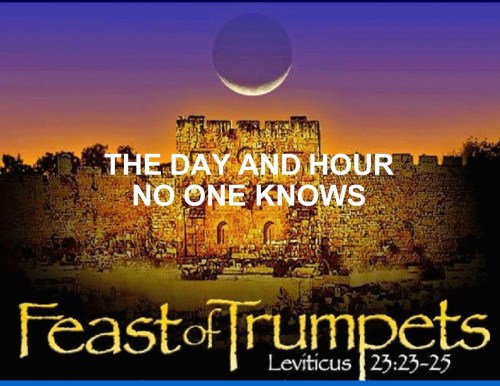
Last week, the Feast of Trumpets came and went uneventfully. I really hoped to hear the Lord shout, “Come up hither” (Revelation 4:1), but nothing. Nothing says the Lord must come at the Feast of Trumpets or any other “special” time, for that matter. However, as I have written before, there is a good reason to consider these “high watch” days. This week brings the Day of Atonement (Leviticus 23:26-32) which is immediately followed by the Feast of Tabernacles (Leviticus 23:33-44). These are “Feasts of the Lord.” They are His divine appointments; therefore, it is not unreasonable to consider these days more likely than any others. However, we need to keep in mind Jesus’ words, “But of that day and hour knoweth no man, no, not the angels of heaven, but my Father only” (Matthew 24:36). Some debate about what that really means. The fact remains that we do not know. So, we wait. The time is near, but how long, O Lord?

4 Comments

Filed under Apologetics, Christianity, End Times, Religion, Second Coming of Christ

Still Listening Again

Behold, I shew you a mystery; We shall not all sleep, but we shall all be changed, In a moment, in the twinkling of an eye, at the last trump: for the trumpet shall sound, and the dead shall be raised incorruptible, and we shall be changed (1 Corinthians 15:51-52).

Every year for at least the last decade – ever since I learned about the Feasts of the Lord[1] – around this time of year, I start getting a little anxious with excitement wondering if this will be the year that Jesus will call His bride home.[2], [3], [4], [5], [6] This Monday, September 10, the Feast of Trumpets comes around again. For those of us who look forward to the Rapture of the Church, this is a “high watch” day. The reason for this, as I have explained in the past, is because this is the next Feast not fulfilled by Jesus’ First Advent. Therefore, it stands to reason that Rosh Hashanah (the Feast of Trumpets) would be a good time for Jesus to summon His Bride, the Church, home. Every year as I have waited, the day has come and gone, and we are still here. You might think that eventually I would experience “Rapture Fatigue” and give up on the whole idea. However, I still have oil in my lamp and even some extra! (Matthew 25:4)

Some will criticize and remind us that Jesus said, “But of that day and hour knoweth no man, no, not the angels of heaven, but my Father only” (Matthew 24:36). The Rapture is imminent. It could happen at any time, and we ought always to be ready. Nothing prophetically remains unfulfilled for this event to take place. Israel celebrated her 70th rebirthday this past May. We live in the generation that witnessed the “fig tree” bud (Matthew 24:32-33). This year wraps up the 70th Year of Jubilee since Moses gave the ordinance 3500 years ago. Israel is the focal point of end-times prophecy, so our attention must focus on current events in the Middle East. The stage is being set for what “prophecy watchers” call the “Ezekiel 38-39 War.” At the time of this writing, Russia, Turkey, and Iran are meeting concerning their involvement in Syria. Damascus almost resembles the ruinous heap described in Isaiah 17:1.

Will these things happen before or after the Rapture? We cannot tell. No man knows the day or the hour, but we sense that the time is near. Will the Rapture take place at the Feast of Trumpets? Perhaps. The Feast of Trumpets is celebrated over two days because it is based on the verified appearance of the new moon. Since the exact time of the appearance cannot be accurately predicted, the Feast of Trumpets is known as the feast of which “no man knows the day or the hour.” This year the watch is set for Monday and Tuesday, September 10 & 11 beginning at sundown on Sunday, September 9 (the date of this posting).

Will Jesus call for His Bride in the coming weeks? I do not know, but I hope so, and I am ready! How about you? If you are unsure, read my pages on “Securing Eternal Life” and on “Heaven.”

Notes:


[1]  “Rosh HaShanah” https://erniecarrasco.com/2016/10/03/rosh-hashanah/

[2]  “Still Waiting!” – https://erniecarrasco.com/2017/09/24/still-waiting/

[3]  “Now’s A Good Time!” https://erniecarrasco.com/2017/09/17/nows-a-good-time/

[4]  “Coming Soon!” https://erniecarrasco.com/2017/07/09/coming-soon/

[5]  “Rosh HaShanah”  https://erniecarrasco.com/2016/10/03/rosh-hashanah/

[6]  “Still Listening” https://erniecarrasco.com/2015/09/20/still-listening/

3 Comments

Filed under Apologetics, Christianity, Current Events, End Times, Evangelism, Gospel, Religion, Second Coming of Christ, Theology