Tag Archives: Christ

The Days of Noah

But as the days of Noe were, so shall also the coming of the Son of man be. (Matthew 24:37)

Last weekend was a sad time in American history. First, a mass murder took place at a Walmart in El Paso, Texas followed by another in Dayton, Ohio. The nation reels in the aftermath of such senseless violence groping for elusive answers to a problem with no apparent solution. The left blames the President claiming that his rhetoric is divisive and that it fans the flames of hatred. Others on the left blame the guns, and they want to ban all scary-looking rifles. Others want to legislate stricter gun laws. Even the President now calls for better background checks for gun purchases. Mr. President, we already have background checks for gun purchases. I had an FBI background check for every firearm I possess. Background checks will not stop wackos from getting their hands on firearms or from committing mass slaughter.

Several have accurately identified the problem as a problem of the heart, however, they fall short of coming up with a solution. As a Christian, I know the solution to the problem in every case. The answer is Jesus indwelling every individual heart, or at the very least, a clear understanding of who God is and every person’s accountability to Him. But that is out of the question. God is off-limits in our schools, our institutions of higher learning, in the public square and in our government. As long as that remains true, there is no solution to the growing violence in our nation.

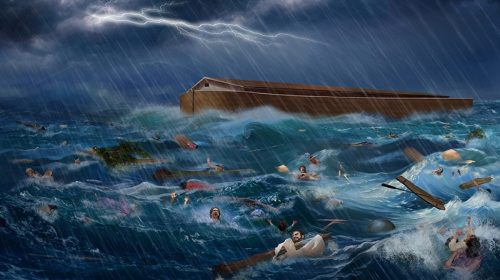
This is a sign of our times. Jesus said that the days nearing His return would be like the days of Noah. What were the days of Noah like? Genesis Chapter Six suggests that fallen angels (sons of God) were somehow “breeding” with human women and producing demigod-like creatures known as the Nephilim (“giants”).[1] Today transhumanists[2] seek to evolve humans to a higher level through gene manipulation. These people, undoubtedly guided by the same “sons of God,” are unwittingly doing the same thing that was going on in Noah’s day.

However, that is not all that took place in Noah’s day. The Bible tells us that people had become exceedingly wicked and violent.[3] Our world grows increasingly evil and violent. The LGBT… movement has forced its way into our society demanding not only tolerance but that we accept their deviance as “normal.” However, that is not enough, they want our children trained at a very early age that such behavior is normal and acceptable. Not only that, but children are encouraged to follow their examples. If this were not bad enough, we have those in our government that promote and encourage this perverse movement, and if we protest, we are the “haters.”

The violence continues. Not only do we have mass shootings, but we are seeing more “peaceful protests” against our elected (Republican) officials that are anything but peaceful. We are living in the “days of Noah,” and Jesus said, “For as in the days that were before the flood they were eating and drinking, marrying and giving in marriage, until the day that Noe entered into the ark, And knew not until the flood came, and took them all away; so shall also the coming of the Son of man be” (Matthew 24:38-39). I have heard many sermons preached on these verses and they all minimize the significance of the text. Yes, Jesus said that the people during this time would be conducting their lives as normal, clueless of the impending doom. What these preachers omit is that in the days of Noah, the world was filled with wickedness and violence with much demonic activity taking place.

We should not be surprised or amazed when we see these things taking place, nor should we think that we can solve the problem through any human measure. The only remedy for our sick world is for Jesus to return to set things right. He is the only answer. He is our only hope. Our days are as the days of Noah. That should alert us to Jesus’ imminent return. The time is right. Are you ready? If not, find out how to get ready by reading my page, “Securing Eternal Life.”

Notes:


[1]  Genesis 6:1-4

[2]  Transhumanism – https://en.wikipedia.org/wiki/Transhumanism

[3]  Genesis 6:5, 11

7 Comments

Filed under Apologetics, Christianity, Current Events, End Times, Second Coming of Christ, Theology

Building Up the Temple

And Jesus went into the temple of God, and cast out all them that sold and bought in the temple, and overthrew the tables of the moneychangers, and the seats of them that sold doves, (Matthew 21:12)

Last week I wrote about a special assignment[1] I was given for the ICR Discovery Center for Science and Earth History. An ICR benefactor donated a Life of Christ diorama for exhibition in the Discovery Center. The set contains thousands of pieces – buildings, tents, people, animals, furnishings, etc. – fabricated mostly by an Italian company, and it often hints of Catholic influence.

One of the scenes will be of Jesus cleansing the Temple before His crucifixion. The “temple” that came with the set is patterned after Greco-Roman architecture. It in no way represents the Temple that Jesus would have known. Perhaps visitors to the Discovery Center will not notice the discrepancy, but others, like me, will see the flaw. That bothers me. We cannot allow anything to distract from the Gospel message.

Determined to correct the error, I took the dimensions of the Temple given in the Bible[2] and converted the cubits to feet and the feet to inches.  Then I measured the width of the set “temple” to get the scale the footprint for the model I would build of the Temple. As it turned out, a scale model would be 58 inches tall and would probably cause a greater distraction than the building that came with the diorama. So, I scrapped my idea and resolved to use the incorrect building that came with the set.

When I told Henry, (the MIC) of my decision, he encouraged me to follow through with my idea. He reminded me that the Temple model did not need to be an exact scale; it just needs to “look” like the Temple of Jesus’ day. Pictured above is the beginning of what will be the Temple model. To see the completed model, you will need to visit the ICR Discovery Center for Science and Earth History when it opens this September (2019).

Jewish religious life revolved around the Temple and Jesus, being an observant Jew, followed all the laws regarding it. When He was just eight days old, His earthly parents presented Him along with the required sacrifice to the priests at the Temple.[3] He had His bar mitzvah in the Temple at the age of 12,[4] and as Scripture points out, He went to the Temple each year for the Passover.

In His final week of life, He exercised the practice of ridding His house of “leaven” in preparation for the Passover by cleansing the Temple of the illegal trade that took place there. “And [He] said unto them, It is written, My house shall be called the house of prayer; but ye have made it a den of thieves. (Matthew 21:13, emphasis mine). The Temple was His house.

The Temple bears the shape of a cross. At the foot of the cross is the altar where the sacrifices are burned. Jesus gave His life as our eternal sacrifice. Beyond the altar resides the laver or mikvah where the priests would wash before entering the Temple. Jesus is the “living water” that cleanses us from all sin.[5] The Temple has only one door through which the priests can enter. Jesus said, “I am the door: by me if any man enter in, he shall be saved, and shall go in and out, and find pasture” (John 10:9, emphasis mine). Jesus saith unto him, I am the way, the truth, and the life: no man cometh unto the Father, but by me” (John 14:6, emphasis mine). As one enters through the door of the Temple, on the left stands a seven-branch menorah. Jesus said, “I am the light of the world: he that followeth me shall not walk in darkness, but shall have the light of life” (John 8:12, emphasis mine). On the right is the table of the “showbread.” Jesus said, “I am the bread of life: he that cometh to me shall never hunger; and he that believeth on me shall never thirst,” (John 6:13, emphasis mine). Directly ahead stands the altar of incense which represents the prayers of the people going up to God. Jesus said, “And whatsoever ye shall ask in my name, that will I do, that the Father may be glorified in the Son” (John 14:13).

Beyond the altar of incense rises a heavy curtain from floor to ceiling that separates this holy place from the Holy of Holies where the very presence of God resides. Inside that sanctum resided the Ark of the Covenant, covered by the Mercy Seat upon which the sacrificial blood was spilled on behalf of all the people. This place was so holy that only the high priest could enter and then only once a year on the Day of Atonement,[6] Yom Kippur.  When Jesus died on the cross, He carried His own blood into the heavenly Holy of Holies spilling it on God’s mercy seat. “And, behold, the veil [the curtain] of the temple was rent in twain from the top to the bottom; and the earth did quake, and the rocks rent” (Matthew 27:51, emphasis mine), and the way into the presence of God was opened for us.

Today every true believer is the Temple of God[7] because we have His presence within us.[8] The model temple I am building is a simple replica of the one that used to be. But the real Temple is me and anyone else who has invited the Lord to save them and take up residence within. I want to build an excellent model for visitors to the Discovery Center to enjoy, but even more important is the maintenance of the Temple in which God now resides.

If what I am saying sounds strange, visit my page on Securing Eternal Life.

Notes:


[1]  “On a Hill Far Away” – https://erniecarrasco.com/2019/05/12/on-a-hill-far-away/

[2]  1 Kings 6:2

[3]  Luke 2:22-24

[4]  Luke 2:41-52

[5]  1 John 1:7

[6]  “Rosh HaShanah” – https://erniecarrasco.com/2016/10/03/rosh-hashanah/

[7]  Living Temples – https://erniecarrasco.com/2018/03/18/living-temples/

[8]  1 Corinthians 3:16

3 Comments

Filed under Apologetics, Christianity, Evangelism, Gospel, Random Musings, Religion, Salvation, Theology

On A Hill Far Away…

And Other Biblical Misconceptions

 And he bearing his cross went forth into a place called the place of a skull, which is called in the Hebrew Golgotha: (John 19:17)

With the forthcoming opening of the ICR Discovery Center for Science and Earth History, I and a co-laborer (whom I cannot name because I did not request his permission) have been honored with the task of creating the scenery for the Life of Christ Diorama that will reside across from the Empty Tomb exhibit. An ICR benefactor donated the diorama for exhibition in the Discovery Center. The set contains thousands of pieces – buildings, tents, people, animals, furnishings, etc. – fabricated mostly by an Italian company. The extensive collection cannot all fit in the space allotted, so our leaders determined only to display pivotal scenes in the life of Christ.

Not to give away all the details of the diorama, I want to focus on the crucifixion scene. Where to position the crucifixion scene came into question. Should it be elevated on top of a hill or should it be placed on a lower level between the road and the hill? As Christians, we know the familiar words of the old hymn, “The Old Rugged Cross.” The lyrics say, “On a hill far away, stood an old rugged cross…” I do not know if it is due to the lyrics of the beloved hymn or due to some other handed down tradition, but we all imagine that Jesus was crucified at the top of Mount Calvary. However, musical lyrics or timeless tradition should not be the basis for what we believe. What does the Bible say?

And when they were come unto a place called Golgotha, that is to say, a place of a skull… (Matthew 27:33)

And they bring him unto the place Golgotha, which is, being interpreted, The place of a skull. (Mark 15:22)

And when they were come to the place, which is called Calvary, there they crucified him, and the malefactors, one on the right hand, and the other on the left. (Luke 23:33)

And he bearing his cross went forth into a place called the place of a skull, which is called in the Hebrew Golgotha: (John 19:17) (Emphasis mine)

The Bible does not often provide specific detail of events, but very often it does. The language of the Gospels is Greek. The Greek word for “hill” is either oros or bounos; the latter used only in Luke 3:5, and the former used in several passages in the N.T.[1] Furthermore, Greek prepositions indicate precise positions. The Greek preposition for “on” or “upon” is epi. It means “superimposition,” that is, to be “over” or “upon.” None of the four Gospels give any indication that the crucifixion took place “on a hill called Mount Calvary”[2] regardless of what the song lyrics say. Furthermore, the public spectacle of crucifixion[3] intended as a deterrent against lawlessness took place in the most public of places, usually, a busy roadside where passersby could get a close look at the suffering victims.

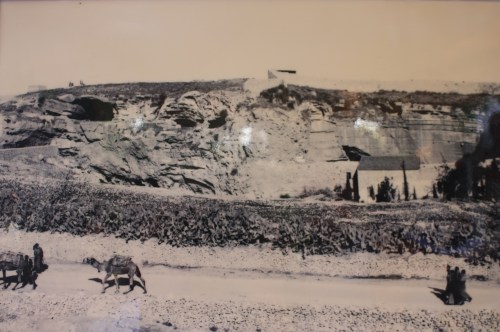
I researched, albeit not extensively, information about the location of the crucifixion. Most of the information[4] argues about three possible “places,” and most shy away from making dogmatic statements. The possible locations offered are, The Church of the Holy Sepulcher (which supposedly houses both the crucifixion and burial sites), The Garden Tomb[5] area (which is very near a limestone formation whose face features two prominent grottos that look like the eye sockets of a human skull), or just some unknown place outside of the Old City (of Jerusalem) designated by the Romans for public executions. All of these resources spoke of the “place” but none ventured to suggest whether the crucifixion took place “on” the hill or “by” the hill, but all agreed that it was “at” Golgotha/Calvary.

The “experts” fail to commit to “on” or “by”, but all four Gospels omit the preposition epi (on). To me that says that Jesus was crucified “at” Calvary, not “on” Calvary. My conclusion led me to determine that the diorama will feature the crucifixion scene near the road with a skull-shaped hill in the background. Besides scriptural reasons, there are practical reasons for my decision. A crucifixion on top of a hill, while it might be visible to all, could easily be ignored by passersby thus defeating the deterrent factor of the event. To get a close-up view – and who would want to – would require extra effort making it a disincentive for gathering a crowd, thus defeating the intended purpose of the Romans. However, if the crucifixion took place on a busy road, the only way to avoid the spectacle would be to take the long way around to enter the city. A roadside crucifixion makes more sense to me.

What does that have to do with salvation? Nothing. Jesus dying for you and me on the cross and rising again on the third day matters more than the place or the position. However, there are many non-believers who will find fault with any perceived discrepancy in Scripture. As Christians, we need to “be ready always to give an answer to every man that asketh you a reason of the hope that is in you with meekness and fear” (1 Peter 3:15). Controversies like these will come up. For example: “Jesus said He would be in the grave three days and three nights.[6] There are not three days and three nights between Friday and Sunday. The Bible is wrong!” Another example is the anointing of Jesus. “All the Gospels give accounts of Jesus’ anointing, but they are all different”[7] How would you respond to this challenge? A careful study of Scripture will reveal that there were three separate anointings; Matthew and Mark refer to one before the crucifixion, Luke recounts one before the Transfiguration, and John records one by Mary after Jesus raised her brother Lazarus after four days dead.

Other examples can be cited, but the point is that we need to “Study to shew thyself approved unto God, a workman that needeth not to be ashamed, rightly dividing the word of truth,” (2 Timothy 2:15) rather than relying on song lyrics, traditions, or human scholarship. Do not just read your Bible, study it!

Notes:


[1]  Matthew 5:14; Luke 1:36, 65; 3:5; 4:29; 9:37

[2]  “I Believe In A Hill Called Mount Calvary” – https://www.youtube.com/watch?time_continue=12&v=OPByLTzkctc

[3]  “Crucifixion” – https://en.wikipedia.org/wiki/Crucifixion

[4]  “Where Was Jesus Crucified? – Golgotha ‘the Place of the Skull’” – https://www.biblestudytools.com/bible-study/topical-studies/where-was-jesus-crucified.html

[5] “Jesus’ crucifixion site? (A ‘Skull’, Garden & Tomb)” – https://www.youtube.com/watch?time_continue=7&v=-7fHnnqre1o

[6]  “Three Days, Three Nights” – https://erniecarrasco.com/2014/07/13/three-days-three-nights/

[7]  “Jesus Last Days” – https://erniecarrasco.com/2018/03/25/jesus-last-days/

Comments Off on On A Hill Far Away…

Filed under Apologetics, Bible, Christianity, Religion, Salvation

It Does Matter

For as Jonas was three days and three nights in the whale’s belly; so shall the Son of man be three days and three nights in the heart of the earth. (Matthew 12:40)

Recently I listened to a message on the crucifixion. The message excelled in many respects by providing insight into that fateful day of our Lord’s life. However, one part of the message troubled me. The messenger commented that some theologians believe Jesus was crucified on Friday, while others say He was crucified on Thursday. I know that; I’ve heard those arguments before. That is not what troubled me. What troubled me was his comment that the day on which the crucifixion took place does not really matter. The fact of the crucifixion is what really matters.

WOAH!

It does matter! Jesus said very specifically that “the Son of man [shall] be three days and three nights in the heart of the earth” (Matthew 12:40). That is three full days and three full nights.[1] You cannot get three full days and three full nights from a Friday crucifixion even if you allow for partial days and nights. Why does that matter?

One reason it matters is that “according to one Jewish tradition, the soul hovered about the body for three days in hope of reentering it.”[2] If it were not three full days and nights, then, as some have asserted, He could have resuscitated in the coolness of the tomb and walked out. (There are many problems with that idea, but that rabbit can be chased another day.)

Jesus raised Lazarus four days after his death. Lazarus was so dead that “by this time he stinketh: for he hath been dead four days” (John 11:39). Decomposition had already set in. That being the case, would it have been better for Jesus to remain in the tomb four days rather than three? No, because Scripture predicted that Jesus’ body would not decompose: “For thou wilt not leave my soul in hell; neither wilt thou suffer thine Holy One to see corruption” (Psalm 16:10). For that reason, it needed to be three full days and three full nights – long enough for the spirit to depart (in the estimation of the Jews), yet not long enough for decomposition to set in.

Another argument against a Friday crucifixion finds its basis in history. Most theologians hold the opinion that Jesus was crucified in A.D. 30. Passover, the day on which Jesus was crucified, always falls on Nissan 14 – the fourteenth day of the first month of the year.[3] Nissan 14, 30 A.D. fell on a Wednesday, not a Friday.[4] A Wednesday crucifixion allows for three full nights and three full days, meaning that Jesus would have risen anytime after 6:00 PM on Saturday evening, the first day of the week by Jewish reckoning – the day begins after sundown.

I believe those are good arguments against a Friday crucifixion, but they are not the best argument. The best argument is Jesus’ own words. He very specifically said that He would be in the heart of the earth, i.e., the grave, for three days and three nights. Anything less than that makes Jesus a liar. Do you really want to go there! If we believe God’s Word is inerrant – and Jesus IS God – then we must accept what HE said, and reject what errant men say. It Does Matter!

HE IS RISEN INDEED!

Notes:


[1]  “Three Days, Three Nights” – https://erniecarrasco.com/2014/07/13/three-days-three-nights/

[2]  Herschel Hobbs, The Illustrated Life of Jesus, (Nashville, Holman Bible Publishers, 2000), 183.

[3]  Leviticus 23:5

[4]  http://www.cgsf.org/dbeattie/calendar/?roman=30

2 Comments

Filed under Apologetics, Bible, Christianity, Easter, Gospel, Religion, Resurrection, Theology

April Fools’ Day

The fool hath said in his heart, There is no God. They are corrupt, they have done abominable works, there is none that doeth good. (Psalm 14:1)

We recognize the first day of April as April Fools’ Day. It “is an annual (primarily) Western celebration commemorated on April 1 by playing practical jokes and spreading hoaxes. The jokes and their victims are called April fools. People playing April Fool jokes often expose their prank by shouting ‘April fool(s)’ at the unfortunate victim(s). Some newspapers, magazines and other published media report fake stories, which are usually explained the next day or below the news section in smaller letters. Although popular since the 19th century, the day is not a public holiday in every country. Little is known about the origins of this tradition.”[1]

Victims of harmless pranks can hardly be called “fools.” Anyone is susceptible to deception at the hands of someone they trust. If that is a fool, then we all qualify.

The Bible has a much harsher view of a fool. The epithet is so severe that Jesus said, “whosoever shall say to his brother, Raca, shall be in danger of the council: but whosoever shall say, Thou fool, shall be in danger of hell fire” (Matthew 5:22, emphasis mine). The word “Raca” is of Chaldean origin and it means, “empty or worthless one.” A fool, on the other hand, is one who is “impious”[2] or “godless.” Strong’s defines such a one as “dull, stupid or heedless.” The Greek word is mōros, from which we get our word “moron.” It is interesting that Jesus should offer such a severe condemnation as “hell fire” for the offense of calling someone a fool.

Jesus’ prohibition of the application of that word against another person comes at the beginning of His Sermon on the Mount. In the same sermon, He later said, “Judge not, that ye be not judged. For with what judgment ye judge, ye shall be judged: and with what measure ye mete, it shall be measured to you again” (Matthew 7:1-2). This verse gets misquoted and misunderstood often as meaning that we are never to exercise rational discernment about someone’s actions. However, that is not at all what Jesus was saying as subsequent verses reveal. The Greek words translated as “judge” and “judgment” are krinō and krima respectively. Both have to do with making a judgment that results in condemnation and punishment. We get our English words “crime” and “criminal” from these Greek words. The kind of judgment Jesus is describing is reserved for God alone. Therefore, if judging someone as “fool” condemns the one judging to “hell fire,” then the punishment for being a “fool” must also be “hell fire.” We deduce this from Jesus’ words, “with what measure ye mete, it shall be measured to you again.” In other words, because the punishment for being a fool is “hell fire,” then the one judging the fool will receive the same judgment because only God can make that judgment.

The English word “fool” appears often in the Bible translating other Greek or Hebrew words, but the strong word Jesus used, mōros, appears only a few times and always in the context of strong condemnation. For example, in Matthew 7:26 Jesus uses it to describe the “foolish man” who built his house on a foundation of sand. Jesus likens those hear His Word and ignore it to the fool who builds his house on sand. In Matthew 25:1-13, Jesus tells the Parable of the Ten Virgins and He calls the five unprepared virgins “foolish” because they were not ready to meet the bridegroom. The condemnation is they are not allowed into the wedding. Paul warns his young protégés, Timothy and Titus to avoid “foolish” (moronic) questions because they are unprofitable and vain and they only lead to strife.[3]

Our lead verse appears again in Psalm 53:1, “The fool hath said in his heart, There is no God. Corrupt are they, and have done abominable iniquity: there is none that doeth good.” The Hebrew word translated “fool” is nâbâl, and like mōros, it means stupid, wicked, (especially impious). Someone who does not believe in God, or rejects God is a fool. God condemns such a person to “hell fire,” which is why Jesus admonishes us not to make that judgment.

Paul describes how one sinks to that condition:

For the wrath of God is revealed from heaven against all ungodliness and unrighteousness of men, who hold the truth in unrighteousness; Because that which may be known of God is manifest in them; for God hath shewed it unto them. For the invisible things of him from the creation of the world are clearly seen, being understood by the things that are made, even his eternal power and Godhead; so that they are without excuse: Because that, when they knew God, they glorified him not as God, neither were thankful; but became vain in their imaginations, and their foolish heart was darkened. Professing themselves to be wise, they became fools” (Romans 1:18-22, emphasis mine).

By examining this passage more closely, we see that “the wrath of God” – His anger, i.e., “hell fire” – is revealed “against all ungodliness and unrighteousness of men,” i.e., “foolishness.” It is doubtful that “true” atheists exist because here we see that God reveals Himself through His creation. The “invisible things,” like viruses, bacteria, atoms, quarks, etc., clearly testify to the greatness of God. Every human being on earth can see the magnificence of God’s creation so that no one has an excuse for not acknowledging God. Everyone, even the atheist, knows that God exists, but they reject Him and refuse to glorify Him choosing rather to follow their own unintelligent (i.e., foolish) imaginations. As a result, their heart is darkened. This progressive condition results in a “reprobate mind,”[4] i.e., a mind that has lost its ability to properly reason. They think they are wise when in fact they have become fools.

“The fool hath said in his heart, There is no God” (Psalm 14:1; 53:1). And “The way of a fool is right in his own eyes” (Proverbs 12:15). “Every way of a man is right in his own eyes: but the LORD pondereth the hearts” (Proverbs 21:2). We are all fools at some time in our lives. “As it is written, There is none righteous, no, not one: There is none that understandeth, there is none that seeketh after God” (Romans 3:10-11, emphasis mine). We may all start out as fools, but we do not need to remain in that condition. If you do not know the Lord, please read my page on “Securing Eternal Life.” Don’t be an April Fool!

Notes:


[1] Wikipedia, “April Fool’s Day” – https://en.wikipedia.org/wiki/April_Fools%27_Day

[2]  “not pious or religious; lacking reverence for God, religious practices, etc.; irreligious; ungodly” Dictionary.Com definition – https://www.dictionary.com/browse/impious?s=t

[3]  2 Timothy 2:23; Titus 3:9

[4]  Romans 1:28

5 Comments

Filed under Apologetics, Atheism, Christianity, Creation, Current Events, Evangelism, Gospel, Hell, Theology