Tag Archives: Christ

False Religion

coexist

But though we, or an angel from heaven, preach any other gospel unto you than that which we have preached unto you, let him be accursed. As we said before, so say I now again, If any man preach any other gospel unto you than that ye have received, let him be accursed. (Galatians 1:8-9)

In my last post, I attempted to point out some broad characteristics that distinguish “True Religion.” In the article “I Am A Christian,” I went into greater detail on what it means to be a Christian, which is the only true religion. But in order to distinguish between true religion and false religion, one must be able to recognize false religion on sight.

First of all, a false religion denies the God of the Bible. Immediately that includes all pagan religions that worship multiple gods (polytheism), or believe that everything is god (pantheism). By the way, evolutionism or naturalism is a form of pantheism in that it attributes to nature creative abilities and intellect. Evolution/naturalism in turn gives rise to secular humanism that, for all practical purposes, bestows upon mankind a divine nature. They perhaps would not go so far as to call themselves gods (although some have), but the ideology attributes value to mankind apart from God, so in essence, man is God. Romans 1:23 encapsulates false religion this way: “And changed the glory of the uncorruptible God into an image made like to corruptible man, and to birds, and fourfooted beasts, and creeping things” (emphasis mine). This list would include Hinduism (which is both pantheist and polytheist), Buddhism, and a variety of others (the list is too long for this post). Islam would also be included here. Although many may argue that Islam’s god, Allah, is the same as the God of the Bible, a close comparison reveals that they are not the same. See my article “God Is Not Allah.”

Second, a false religion rejects the deity of Christ. All those listed above fall into this category, but now the list broadens to include the Jewish religion. While the Jewish religion accepts the God of the Bible, their Bible ends with the book of Malachi. (Technically, the Hebrew Scriptures end with Chronicles; it is only a matter of how the books are arranged.) Jews reject the Messiah that was prophesied in their own Scriptures. The New Testament is clear: “Who is a liar but he that denieth that Jesus is the Christ? He is antichrist, that denieth the Father and the Son” (1 John 2:22). “Christ” is the Greek rendering of “Messiah” which means “anointed one.” John would say that the Jews who deny that Jesus is the Christ are liars. It is a false religion.

The Church of Jesus Christ of Latter Day Saints (the LDS church otherwise known as the Mormons) while associating their religion with Jesus Christ, denies the unique deity of Christ. To the Mormons, Jesus is one of many “sons of God.” In their belief system, Jesus is brother to Lucifer. LDS adherents believe that they too will become gods and be in charge of their own worlds. Of course, when the young “Elders” come knocking on your door, they will not willingly volunteer any of this information. The Bible teaches that the “Word,” by whom all things were created (John 1:3), became flesh, and John testifies that “we beheld his glory, the glory of the only begotten of the Father” (John 1:14, emphasis mine). “No man hath seen God at any time; the only begotten Son, which is in the bosom of the Father, he hath declared him” (John 1:18, emphasis mine). The moniker “only begotten Son” (see also John 3:16, 18; 1 John 4:9) clearly indicates that there is no other. That automatically disqualifies Lucifer and all others that the Mormons might want to add to the list.

The Jehovah’s Witnesses also deny the deity of Christ. These too are fervent “evangelists” for their cause and they are very well trained in the use of Scripture taken out of context. They are not well trained in Scripture; they are trained in Watch Tower literature. One of the verses they like to use as proof text to deny the deity of Christ is John 1:1: “In the beginning was the Word, and the Word was with God, and the Word was God.” In their mistranslation of the Scriptures the verse ends: “and the word was a god.” They attribute this to the fact that in the Greek, theos (god) is not preceded by the definite article. However, the same construct appears again in John 1:6: “There was a man sent from God, whose name was John,” but here they render it correctly. So, why is there an inconsistency? They cannot tell you. They have other problems as well, but denial of Christ as God is their greatest problem.

Muslims, while they acknowledge Jesus as a great prophet second only to Mohammed, and even accept His virgin birth, also deny the deity of Christ. So, not only is Jesus not God, but He is less than the human prophet Mohammed.

Finally, false religion minimizes or altogether rejects the Word of God, the Holy Bible. Many pagan religions, like Hinduism, and Buddhism have their own holy books. Islam, while it acknowledges the Holy Bible and affords it some value, has the Koran (Quran). The Mormons accept and give verbal assent to the Bible, but in practice they prefer the Book of Mormon and The Pearl of Great Price. In doing so, they have overlooked Paul’s stern warning in Galatians 1:8-9 that even if an angel (like Moroni) preach any other gospel than what is preached in the Bible, that one should be accursed. The Jehovah’s Witnesses violate the Word of God by rewriting it to conform to their preconceptions. They ignorantly disregard the admonition from Scripture against tampering with the Word of God (Deuteronomy 4:2; Revelation 22:19). The Roman Catholic Church venerates the Bible, but in practice they prefer the edicts of the Pope over the teachings of the Bible. In fact, the Roman Catholic Church teaches that the Bible cannot be understood by the common layperson, or even the priests. Only the Pope has the authority to give proper interpretation and meaning to Scripture. Worthless as it may be, at least they claim some authority. Many mainline Protestant denominations with their liberal theologians have divested Scripture of all authority and set their adherents aimlessly adrift on a sea of relativistic humanism and existentialism. Recently I heard a Methodist minister base his sermon on Ephesians 6:3-4 (two completely unrelated verses regardless of their proximity). He never addressed the Scripture, but instead built his sermon on Harry Chapin’s “Cat’s In the Cradle.” Build your theology on that!

The Bible tells us that God’s Word is eternally trustworthy. “For ever, O LORD, thy word is settled in heaven” (Psalm 119:89). “Thy word is true from the beginning: and every one of thy righteous judgments endureth for ever” (Psalm 119:160). “The grass withereth, the flower fadeth: but the word of our God shall stand for ever” (Isaiah 40:8). God says, “So shall my word be that goeth forth out of my mouth: it shall not return unto me void, but it shall accomplish that which I please, and it shall prosper in the thing whereto I sent it” (Isaiah 55:11). Jesus said, “For verily I say unto you, Till heaven and earth pass, one jot or one tittle shall in no wise pass from the law, till all be fulfilled” (Matthew 5:18). Any religion that rejects any part or the entire Bible has nothing on which to stand and has built a house on shifting sand (Matthew 7:26-27).

Any one or all of these characteristics identify a false religion. False religion will reject the God of the Bible. False religion rejects the deity of Christ. False religion rejects the authority of the Bible.

2 Comments

Filed under Apologetics, Christianity, Evangelism, Evolution, Gospel, Religion, Theology

Three Days, Three Nights

For he taught his disciples, and said unto them, The Son of man is delivered into the hands of men, and they shall kill him; and after that he is killed, he shall rise the third day. (Mark 9:41)

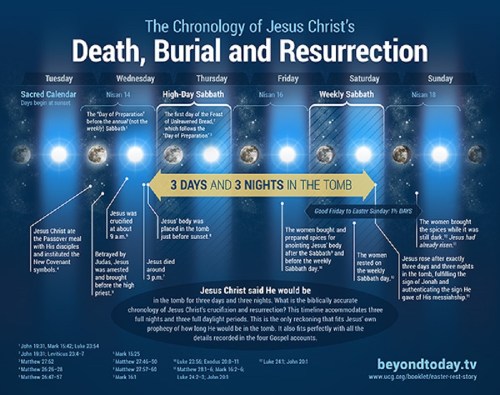
Bible critics often charge the Scripture with error pointing out that Jesus said He would be in the tomb three days and three nights, but the actual time from Friday evening to Sunday morning is less than 36 hours. That would give Him one full day and two full nights in the grave. That is not exactly what He prophesied. So, is the Bible wrong on this account?

First of all, we need to make one thing perfectly clear: Jesus was raised on the “third day” (Acts 10:40) which was the “first day” of the week (Matthew 28:1; Mark 16:2; Luke 24:1; John 20:1). So, Jesus was in the tomb three days; however, the problem comes up in how those days are reckoned.

Secondly, we need to remember that much of our Christian “practice” has come to us by way of almost 2000 years of “tradition.” The birth of Christ being celebrated on December 25 is one such tradition and “Good Friday” being another. Neither have biblical support. The important thing to remember is that Christ was born, He lived, He died and He rose again. Those events are well worthy of memorializing and celebrating even if our dates (and by that I mean the time of year) are in error. Of course, for those of us who really want to go deeper, those questions do matter, and they are important.

Now, the arguments for the crucifixion having occurred on Friday are weak ones, in my opinion. I arrive at that conclusion from what Jesus clearly said in Matthew 12:40 (at least it’s clear to me): “For as Jonas was three days and three nights in the whale’s belly; so shall the Son of man be three days and three nights in the heart of the earth” (emphasis mine). To me that sounds like 72 hours, but bound by the tradition that Jesus was crucified on Friday, many commentators try to make it work by arguing that any part of a day is considered a day. Jesus was buried at the end of the day (before 6 PM) on Friday; that is one day. He was in the tomb all day on Saturday; that is two days. Finally He arose on Sunday morning (after 6 AM); that makes three days. However, even given partial days counting as a whole, there is no way to get three nights out of that.

In the book, Hard Sayings of the Bible (Intervarsity Press, 1996) the writers argue:

[We] know (emphasis mine) that Jesus was not in the tomb more than thirty-six to thirty-eight hours, since he was buried at evening (which began at about 6 p.m.) on Friday and rose by morning (about 6 a.m.) on Sunday. (p. 380)

Note that they “know.” How do they know? They concede that we understand the phrase “three days and three nights” to mean a 72-hour period, but:

[We] know (emphasis mine) that the phrase “three days and three nights” was not a problem for Matthew, for he can use both that and “on the third day” and include no explanation, which he does in other cases where he senses a problem. (pp. 380-381)

The problem with this argument is that the phrase “three days and three nights” and the phrase “on the third day” have different meanings and certainly different connotations. They go on:

In quoting the scriptural phase [Matthew 12:40] Jesus probably (emphasis mine) did not mean that he [sic] would be buried the exact length of time as Jonah was in the fish, but that he [sic] would like Jonah be “buried” for that approximate (emphasis mine) time and then be “raised.” (p. 381)

Now, I have a real problem with second guessing Jesus. Jesus spoke clearly, and even when He spoke in parables to hide His meaning from the Pharisees, He later clarified the meaning for His disciples. Even when He did not explain His sayings to His disciples, the Gospel writers would parenthetically interpret His meaning. For example, when Jesus said, “Destroy this temple, and in three days I will raise it up” (John 2:19), John quickly explains, “But he spake of the temple of his body” (v. 21). There is no such clarification in Matthew 12:40 given by either Jesus or the Gospel writer, Matthew. That leads me to conclude that when Jesus said He would be in the earth “three days, and three nights,” that is exactly what He meant. A Friday burial does not allow for that even if one concedes partial days because this allows for only two nights, which contradicts Jesus’ words. As an aside, note how God defines His creation days in Genesis 1 by “the evening and the morning;” both are necessary to define a complete 24-hour day. Why would Jesus, the Creator (John 1:1-3), redefine His terms on such an important issue without clarifying His meaning, if He meant something other than what He said?

Some argue for Friday because Scripture tells us that Jesus had to be buried quickly because the following day (which started at 6 PM) was a Sabbath (Mark 15:42; Luke 23:54-56; John 19:31). This error comes from the mistaken idea that the Sabbath means the seventh day of the week (Saturday). The fact is that all Jewish feast days are considered Sabbaths (a day of “rest” – the meaning of the word in Hebrew) regardless of the day of the week on which they fall. Christians do not normally pay attention to Jewish feast days, but if they did, they would find that Passover does not always fall on the same day of the week. Furthermore, the day following Passover is the Feast of Unleavened Bread, and that too is considered a Sabbath regardless of the day of the week on which it falls (see Leviticus 23:4-7). So, the fact that they had to quickly bury Jesus because the following day was the Sabbath does not necessarily mean that the following day was Saturday; it could have been Thursday or Friday.

It might be apparent by now that I do not favor a Friday crucifixion and burial. I base my conclusion solely on the words of Jesus and that He meant exactly what He said, i.e., that He would be in the earth (the tomb) three days and three nights. Some reckon this to mean that He was buried on Wednesday and rose on Sunday morning, but this gives four nights and three days if one discounts any part of Wednesday afternoon (3 PM to 6 PM). This is more than 72 hours. However, this discrepancy is resolved when one considers that the first day of the week started after 6 PM on Saturday, so that eliminates Jesus having to spend an extra night in the tomb. I would also be comfortable with a Thursday crucifixion and burial counting the last three hours of Thursday (3 PM to 6 PM) as “a day” with the resurrection taking place on Sunday morning after 6 AM. This will render three days and three nights albeit not exactly 72 hours. Either of these two options are preferable to a Friday crucifixion and burial.

The Bible is not in error because the Bible never specifies the day of the week on which Jesus was crucified. We know that Jesus was crucified on Passover. We know that the following day was “the Day of Preparation” ( Matthew 27:62; Mark 15:42; Luke 23:54; John 19: 42) otherwise known as the Feast of Unleavened Bread – a Sabbath. We also know that Jesus rose on the first day of the week (Matthew 28:1; Mark 16:2; Luke 24:1; John 20:1), and we know He was in the tomb three days. So, counting back three full days from Sunday takes us back to Thursday or Wednesday, but not Friday. So, the Bible is true and the traditions of men are false.

2 Comments

Filed under Apologetics, Christianity, Easter, Evangelism, Gospel, Religion, Resurrection, Salvation, Theology

Is the Law Sin?

The Law

What shall we say then? Is the law sin? (Romans 7:7)

In recent years I have heard Christians reject the Old Testament as if it no longer applies. One young man tattooed the inside of his left arm with: ουδεν αρα νυν κατακριμα τοις εν χριστω ιησου. In case you do not read Koine Greek, it says, “Therefore there is now no condemnation for those who are in Christ Jesus.” (Romans 8:1, NASB). This reading is translated from the liberal Westcott-Hort Greek New Testament. That text omits the phrase: μη κατα σαρκα περιπατουσιν αλλα κατα πνευμα – “who walk not after the flesh, but after the Spirit” (Romans 8:1, KJV). This additional phrase is included in the Textus Receptus Greek New Testament from which the KJV is translated. (Bear with me; there is a point to this.) When I pointed out the biblical prohibition against tattoos (Leviticus 19:28) to this young man, a seminary student at the time, he lashed out at me pointing out that we are not under Law, but under Grace. Then when I pointed out the missing phrase in his tattoo, he lashed out against the King James Bible. Hmm! The missing phrase “who walk not after the flesh, but after the Spirit” suddenly takes on greater significance. Perhaps the compilers of the Westcott-Hort Greek New Testament did not like that phrase either.

So Paul asks an important question: “Is the Law Sin?” Judging from this seminary student’s reaction the answer must be, “Yes!” But what does Paul say? “God forbid. Nay, I had not known sin, but by the law: for I had not known lust, except the law had said, Thou shalt not covet” (Romans 7:7, emphasis added). So, where do we get the idea that we are to disregard the Law contained in the Old Testament? Jesus quoted from the Old Testament exclusively. Of course, that was all that existed at the time, but He never gave any indication that it no longer applied. In like manner, all the New Testament writers referred constantly to the Old Testament and never hinted that it was passé. In writing to Timothy, Paul affirms that “All scripture is given by inspiration of God, and is profitable for doctrine, for reproof, for correction, for instruction in righteousness” (2 Timothy 3:16, emphasis added). When he penned these words, there was no New Testament, only the Old. Instead of rejecting the Law, Paul says that “the law is holy, and the commandment holy, and just, and good” (Romans 7:12).

Salvation does not come through the keeping of the Law. That is impossible. “For whosoever shall keep the whole law, and yet offend in one point, he is guilty of all” (James 2:10). We know that “by grace are ye saved through faith; and that not of yourselves: it is the gift of God: Not of works [of the law], lest any man should boast” (Ephesian 2:8-9, emphasis added). So, does the Law serve any purpose? Paul seems to think so. “Was then that which is good made death unto me? God forbid. But sin, that it might appear sin, working death in me by that which is good; that sin by the commandment might become exceeding sinful” (Romans 7:13, emphasis added). The purpose of the law is to shine a spotlight on what is sin.

The Christian is saved by Grace, not by attempting to keep the Law (which is impossible to do), but the Law should be to the Christian a guide as to what God regards as sinful. God wants His children to be holy – set apart from the world, and the Law guides us to what pleases God. Can we keep the law flawlessly? Probably not, but we have the assurance that “If we confess our sins, he is faithful and just to forgive us our sins, and to cleanse us from all unrighteousness” (1 John 1:9). But how can we confess, if we do not know that we sinned? The Law helps us see that.

That young seminary student thought his tattoo would be a great witnessing tool. I venture to say (although I do not know for sure) that his tattoo has not helped him lead a single person to Christ. Perhaps, if he had taken to heart the omitted qualifying phrase in Romans 8:1 – “who walk not after the flesh, but after the Spirit” – he would not have violated the commandment against tattoos. I do not question the young man’s salvation, and I fully understand his motive however misguided; but when Paul said, “I am made all things to all men, that I might by all means save some” (1 Corinthians 9:22), I doubt that he meant for us to go out and get tattoos in order to win over tattooed people.

Is the Law sin? No, but it serves to show us what sin is and what we should avoid. God does not change (Malachi 3:6), and He has always expected holiness from His people. “But as he which hath called you is holy, so be ye holy in all manner of conversation; Because it is written, Be ye holy; for I am holy” (1 Peter 1:15-16). The Law is not sin; it reveals sin. The Law should be heeded, not disregarded.

3 Comments

Filed under Apologetics, Christianity, Evangelism, Gospel, Religion, Salvation, Theology

Everyone’s A Slave

No man can serve two masters: for either he will hate the one, and love the other; or else he will hold to the one, and despise the other. Ye cannot serve God and mammon. (Matthew 6:24)

In America, at least for the moment, we consider ourselves to be a free people. After all, we have the Declaration of Independence and the Bill of Rights – the first ten amendments to the United States Constitution. While this may be true in a temporal, earthly sense, it is not so in an eternal, ethereal sense. We are all slaves to something.

Jesus simplifies the slave masters down to two in our verse above. “Ye cannot serve God and mammon.” Mammon was the Aramaic term meaning “riches” or “money,” but the term can be broadened to all the trappings of this world. Anything that demands your time and your devotion is your master. “Know ye not, that to whom ye yield yourselves servants to obey, his servants ye are to whom ye obey; whether of sin unto death, or of obedience unto righteousness?” (Romans 6:16, emphasis added). Many, including Christians, deny that they are slaves to “sin” (i.e., Mammon), but they are self-deceived. This is very easy to prove. It always comes to a choice between the things of God or the things of this world. When confronted with the choice between going to church or Bible study (group or personal) and your favorite diversion, e.g., watching your favorite sports game, watching a favorite TV show or going to a movie, going fishing, boating, or camping, taking the kids to their soccer game, or dance recital, which one comes out on top? None of the things that I listed are necessarily sinful, except when given a superior position to the things of God. Of course, I could have listed really “sinful” choices, but Paul’s exhortation was given to Christians not to “heathen.” If Christians can be enslaved by the things of this world, how much more the non-Christian who is without the power of the Holy Spirit!

The Christian should be guided by a different standard. Paul says that the Christian, “Being then made free from sin, ye became the servants [slaves] of righteousness” (Romans 6:18). Being a “slave of righteousness” (i.e., slaves of God) for the Christian should not be a difficult task. If it is, that one should reevaluate his standing before God. Jesus said, “Take my yoke upon you, and learn of me; for I am meek and lowly in heart: and ye shall find rest unto your souls. For my yoke is easy, and my burden is light” (Matthew 11:29-30). Strange that Jesus should use a yoke as an illustration. Certainly the reader has seen pictures of yoke of oxen pulling a plow or a cart. The yoke that binds the two oxen together for the purpose of pulling a heavy load does not look “easy.” In training oxen to pull a load, a young, inexperienced ox is yoked to an older, experienced ox. The young ox will fight the load, but gradually learns from the older. In the interim, the older ox bears most of the load while the younger is learning. Jesus assures us that “[His] yoke is easy and [His] burden is light” because He “was in all points tempted like as we are, yet without sin” (Hebrews 4:15). He bears the greater load, and as we learn from Him, our load becomes easier to bear; but He must be the Master.

Everyone is a slave to something. You have the choice of who will be master of your life.

2 Comments

Filed under Christianity, Evangelism, Gospel, Religion, Salvation, Theology

What’s Special About Sunday?

In the end of the sabbath, as it began to dawn toward the first day of the week ... (Matthew 28:1)

In the end of the sabbath, as it began to dawn toward the first day of the week … (Matthew 28:1)

And very early in the morning the first day of the week, they came unto the sepulchre at the rising of the sun. (Mark 16:2)

Why should Christians worship on Sunday instead of Saturday as do the Jews and certain other “Christian” denominations? After all, in fourth of the Ten Commandments, God specifically says, “Remember the sabbath day, to keep it holy. Six days shalt thou labour, and do all thy work: But the seventh day is the sabbath of the LORD thy God: in it thou shalt not do any work, thou, nor thy son, nor thy daughter, thy manservant, nor thy maidservant, nor thy cattle, nor thy stranger that is within thy gates: For in six days the LORD made heaven and earth, the sea, and all that in them is, and rested the seventh day: wherefore the LORD blessed the sabbath day, and hallowed it” (Exodus 20:8-11). So, are we in violation of God’s commandment by worshiping on Sunday?

First of all, let me say that setting aside one day of the week for rest and worship is right and proper whether that day be Friday, Saturday, or Sunday or any day of the week for that matter.  “One man esteemeth one day above another: another esteemeth every day alike. Let every man be fully persuaded in his own mind” (Romans 14:5).

Much of the confusion comes with the interpretation of the word “Sabbath” in the Bible.  The word in the Hebrew does not mean “seventh” (shebəiʽi), but rather “rest” or “to rest” (shebbot).  Genesis 2:2 tells us that “on the shebəiʽi day God ended his work which he had made; and he shebbot on the shebəiʽi day from all his work which he had made.”  Translating that seventh day to mean Saturday “assumes” that God began His creative acts on Sunday, and we really have no textual basis for that conclusion other than what has been handed down to us by Jewish tradition – that, however, is not to say that this tradition is in error.  Furthermore, as you study the “Feasts of the Lord” given in Exodus and Leviticus, you find that each of those days is considered a shebbot (Sabbath) regardless of what day of the week it falls on.  So, we need to be careful not to become dogmatic over things on which the Bible is unclear.  However, it is clear that we need to “sanctify” – set aside – one day a week for the Lord.

Today, on Resurrection Day, we celebrate our Lord’s victory over death. (See “Risen Indeed,” where I cover the facts of the Resurrection.) The Resurrection is significant for us who believe because we have the promise that because Christ conquered death, we too can be assured of a resurrection to eternal life. “But if there be no resurrection of the dead, then is Christ not risen: And if Christ be not risen, then is our preaching vain, and your faith is also vain … But now is Christ risen from the dead, and become the firstfruits of them that slept.” (1 Corinthians 15:13-14, 20). Today we rejoice in Christ’s resurrection and look forward to our own resurrection to be with Him eternally.

In the New Testament, the first Jewish Christians went to the temple or synagogue on the Sabbath (Acts 13:14; 17:2; 18:4) for the sake of the Jews, but they also met on the First Day of the week (Acts 20:7; 1 Corinthians 16:2) because this was “the Lord’s Day” and also for the sake of the Gentiles which were not obligated to follow Jewish custom (Colossians 2:16). The reason for this change is because this is when Christ was raised from the dead (Matthew 28:1, Mark 16:2; Luke 24:1; John 20:1).

The First Day of the week was also the day that the Holy Spirit descended upon the disciples gathered in the upper room (Acts 2:1). Scripture does not specify the day of the week, but when you consider that Jesus arose on the first day of the week and count forward 50 days (the Day of Pentecost) you will find that day to be Sunday also. The day that Jesus arose was the “First Omer” (Nisan 16) and the Day of Pentecost was the “50th Omer (Sivan 6). Not only were these days important on the Jewish calendar, but they have even greater significance in the Christian calendar. For this reason, it is proper that Christians should meet on the First Day of the week to celebrate the Risen Lord and the coming of the Holy Spirit.

 So, as you celebrate this Resurrection Lord’s Day, remember why it is so special. He is risen indeed!

Comments Off on What’s Special About Sunday?

Filed under Apologetics, Christianity, Death, Evangelism, Gospel, Heaven, Hell, Religion, Salvation, Theology