Tag Archives: Christianity

The Gap – Not the Store

In the beginning God created the heaven and the earth. And the earth was without form, and void; and darkness was upon the face of the deep. And the Spirit of God moved upon the face of the waters. (Genesis 1:1-2)

For almost 200 years, well-meaning theologians have attempted to defend the veracity of the Bible against the current scientific discoveries that cast doubt on the truth of God’s word. Rather than taking a firm stand for what the Bible plainly teaches, they try to find ways to reconcile what the Bible says with what scientists say by way of compromises. One such popular compromise is known as the Gap Theory.

Because many theologians have been duped into believing that scientists have proven that the earth is billions of years old (4.5 billion to be precise), they need to find a place in Scripture to account for that vast amount of time. They recognize that biblical chronology only accounts for approximately 6000 years of earth history. They face a dilemma. How do they remain faithful to a literal interpretation of biblical creation and still maintain good rapport with the scientific community? They solve the problem by placing a gap of unknown time between verses one and two of Genesis 1.

However, with what does one fill a gap of billions of years while maintaining some credible ties to Scripture? According to Hugh Ross (who has his own issues with a young earth), “A few Bible scholars of the seventeenth century, wishing to establish the timing of Satan’s fall and the angels’ rebellion, had proposed a narrative gap (hence, a time gap of unspecified duration) between the creation of the universe (“the heavens and the earth” of Genesis 1:1) and the events of the creation week (Genesis 1:3-27) … Eighteenth century advocates of this view placed the gap precisely between Genesis 1:1 and Genesis 1:2, suggesting that Earth began, perhaps eons ago, as the abode of angels who ravaged and ruined it when they fell.”[1]

Genesis 1:1 refers to God’s initial perfect creation. Everything that God made was beautiful, there was no sin anywhere. Verse two, on the other hand, assumes that a great catastrophe occurred that caused the earth to become in a chaotic state through the judgment of God. According to the Gap Theory, the formless and void state, as recorded in Genesis 1:2, is in direct contrast to the perfect initial creation. Something happened between the first two verses of Genesis to cause the earth to become desolate and uninhabitable after having been made perfect. Those holding the Gap Theory contend that this state of ruin could have possibly lasted millions of years … The judgment is usually spoken of as a flood because of the statement of Genesis 1:2 – the earth was covered by water. This judgment is also known as the Luciferic flood named after the angel who became the devil. The cause for the judgment is usually given as the rebellion of Satan or some pre-Adamic race that sinned. All of the inhabitants of the earth were judged by God, leaving behind fossil remains.”[2]

When one reads the text of Genesis 1:1-2 and following verses giving the words their normal meaning in their normal context, it becomes obvious that much imaginative speculation must take place to insert millions or billions of years between verses one and two. From where did these ideas originate?

According to Dr. John D. Morris, “This particular compromise didn’t just appear; it’s been around at least since the early 1800s when old-Earth ideas were floated by James Hutton and Charles Lyell. Many theologians, under the mistaken impression that scientists had proved it, rushed to incorporate an old Earth into Scripture, hoping to maintain credibility with secular scientists”[3]

Sir Charles Lyell (1797-1876) “was a Scottish geologist who demonstrated the power of existing natural causes in explaining Earth history. He is best known as the author of Principles of Geology (1830-33 and later editions), which presented for a wide public audience the idea that the Earth was shaped by the same natural processes still in operation today, operating at similar intensities … The combination of evidence and eloquence in Principles convinced a wide range of readers of the significance of ‘deep time’ for understanding the Earth and environment … Building on the innovative work of James Hutton and his follower John Playfair, Lyell favoured an indefinitely long age for the Earth, despite evidence suggesting an old but finite age.”[4]

Confronted with such “evidence,” theologians quickly came to the Bible’s rescue. “Gap creationism became increasingly attractive near the end of the 18th and first half of the 19th centuries, because the newly established science of geology had determined that the Earth was far older than common interpretations of Genesis and the Bible-based flood geology would allow. Gap creation allowed religious geologists (who composed the majority of the geological community at the time) to reconcile their faith in the Bible with the new authority of science … From 1814, gap creationism was popularized by Thomas Chalmers, who attributed the concept to the 17th-century Dutch Arminian theologian Simon Episcopius.”[5] Chalmers’ “view was popularized by the Plymouth Brethren writer G. H. Pember in his book Earth’s Earliest Ages in 1876.”[6] “It gained widespread attention when a ‘second creative act’ was discussed prominently in the reference notes for Genesis in the influential 1917 Scofield Reference Bible.”[7]

Others came along later like Harry Rimmer (1890-1952). Rimmer “was an American evangelist and creationist. He is most prominent as a defender of creationism in the United States, a fundamentalist leader and writer of anti-evolution publications. He was the founder and President of the Science Research Bureau, Incorporated, a corporation set in Los Angeles, California, whose purpose he established as to prove the veracity of the Bible through studies of biology, paleontology and anthropology.”[8]

Surprisingly, many who profess to defend the inerrancy and infallibility of the Bible still hold to the Gap Theory and an old earth. One that I closely follow for his teachings on end-times prophecy is Gary Stearman of “Prophecy Watchers” based in Norman, Oklahoma.[9] In all other respects, Stearman is an excellent Bible teacher, but in this one area, he stumbles. He is not the only one. Dr. Arnold G. Fruchtenbaum founder of Ariel Ministrires[10] and excellent O.T. scholar says,

I do believe there is a gap of time between verses 1 and 2, but we must be very careful not to ascribe a gap there for the wrong reasons as people have done so often. They have also used it as a convenient place to fit in such things as the geological ages, the fossil record, dinosaur space, and the like. I do not believe the gap allows for dinosaur space because the Bible teaches that there was not any kind of physical death until Adam’s Fall. Rather, the gap is there for only one reason, the fall of Satan that will, in turn, account for the chaos described in verse 2. Hence, the gap need not be very long at all.[11]

Since so many respected theologians defend the Gap Theory, is there any biblical support for their position? As stated before, those who hold to the Gap Theory have been convinced by secular geologists that the earth is billions of years old based on their interpretation of the geologic column, the fossil record, and radiometric dating. Another factor that often comes into play is the distant starlight problem. Faced with these challenges, their inability to respond intellectually, and their strong conviction of the inerrancy and infallibility of God’s Word, they try to accommodate God’s Word to fit what the secular scientists are saying. In a word, they compromise.

Genesis 1 records creation in six 24-hour days and Gap theorists defend this position. However, biblical chronology, beginning with Genesis 5, limits the age of the earth to only about 6000 years. So how does one account for the 4.5 billion year age of the earth that secular scientists claim? Gap theorists found a way to squeeze billions of years between verse one and verse two of Genesis 1.

Genesis 1:2 says, “And the earth was without form, and void…” The Hebrew word translated “was” is hâyâh. Strong’s defines hâyâh as to exist, that is, be or become, come to pass (always emphatic, and not a mere copula or auxiliary). Gap theorists interpret hâyâh as “became;” therefore, “And the earth became formless and void.” Furthermore, the Hebrew words translated “without form and void” are tôhû (to lie waste; a desolation, formlessness, confusion, unreality) and bôhû (emptiness, void, waste, or ruin). According to the Gap Theory, “In the beginning God created the heaven and the earth” (Genesis 1:1), for an unspecified length of time and then the earth became tôhû and bôhû. God created a perfect world, and then the earth became tôhû and bôhû. What happened?

Rather than to simply admit they do not know what happened, they look to Scripture to fill the Gap. Ken Ham quotes, Weston W. Fields in his book, Unformed and Unfilled (page 7), “In the far distant, dateless past God created a perfect heaven and perfect earth. Satan was ruler of the earth, which was peopled by a race of ‘men’ without any souls. Eventually, Satan, who dwelled in a Garden of Eden composed of minerals (Ezekiel 28), rebelled by desiring to become like God (Isaiah 14). Because of Satan’s fall, sin entered the universe and brought on the earth God’s judgment in the form of a flood (indicated by the wafer of 1:2), and then a global ice age when the light and heat from the sun were somehow removed. All the plant, animal, and human fossils upon the earth today date from this ‘Lucifer’s Flood’ and do not bear any genetic relationship with the plants, animals and fossils living upon the earth today.”[12]

They had to fill the gap with something, but all their attempts to reconcile Scripture to science amount to nothing more than conjecture and speculation.  For example, the idea of “soulless men” is inconsistent with God’s character and the notion of “Lucifer’s Flood” finds no biblical support. Their appeal to Scripture with regard to Isaiah 14:12-15 and Ezekiel 28:12-19 does have some merit as they do speak of Satan’s fall. However, neither of these passages gives any hint of time, other than to imply that Satan’s fall occurred early on after Creation. “Thou hast been in Eden the garden of God…” (Ezekiel 28:13) According to Genesis 2:8, God planted the Garden of Eden on Day Six for Adam’s habitation; therefore this cannot refer to some unknown past.

One major hermeneutical problem with the Gap Theory is with the translation of the Hebrew verb hâyâh. “When this word [be] is printed in italics in the common English version, there is no corresponding word in the original text; when it occurs in common type [i.e., not italicized], it is generally the representative of hayah, havah, hava, “to be” in Hebrew.”[13] Sometimes hâyâh is translated “become or became” for ease of reading more than anything else. For example, Genesis 2:7 “And the LORD God formed man of the dust of the ground, and breathed into his nostrils the breath of life; and man became a living soul” (Genesis 2:7). In this case, “became” could just as easily be translated “was” and it would still make perfect sense. As soon as God breathed the breath of life into his nostrils, the man was a living soul. So the Gap theorists do not have a Hebraic leg to stand on in translating hâyâh as “became.”

Another problem with the theory is that the conjunction at the beginning of the sentence (Hebrew vav or waw) is an indication of the continuation of what came before. Had the Author (God) desired to show a break in events, He could have used the conjunction ‘âz (“then”) as in Genesis 4:26, “And to Seth, to him also there was born a son; and he called his name Enos: then began men to call upon the name of the LORD.” The grammar in Genesis 1:2 gives no indication of a break in thought. There is no grammatical “gap.”[14]

Then comes the matter of the earth being “without form and void” – tôhû and bôhû. We have seen that the earth did not “become” tôhû and bôhû, but rather that it “was” tôhû and bôhû. In Verse 1, God created the universe with all its elements: time (the beginning), space (the heavens), and matter/energy (the earth). At this point, the “earth” (matter/energy) was formless and empty. God had not shaped it into anything yet. The second half of Verse 2 informs us that God at this point started shaping the raw materials. We find no hint of destruction and reconstruction in these verses.

In spite of their well-intentioned effort to reconcile the Genesis creation account with modern science, Gap theorists unwittingly create some serious theological problems. First of all, the Gap Theory calls God’s integrity into question. God’s assessment of His finished work would have to be found faulty. “And God saw every thing that he had made, and, behold, it was very good. And the evening and the morning were the sixth day” (Genesis 1:31). Sin, death, and destruction in some unknown past do not qualify as a good creation, much less a “very good” creation.

Secondly, sin did not enter the world through Adam as the Bible claims (Romans 5:12) because it was present at Satan’s fall. Furthermore, death could not be the result of sin if death was already in the world.

Thirdly, the death penalty for (Romans 6:23) sin makes no sense when death preceded Adam’s sin.

Fourthly, if sin and death preceded Adam, then Jesus dying to pay the wages of sin for man seems pointless.

I grew up as a poor preacher’s kid. The greatest lesson my dad ever taught me was that the Bible was true and faithful even when it is difficult to understand. Whether we understand it completely or not, we can trust it to be true. God’s Word does not need to be reconciled to man’s way of thinking. Man’s thinking needs to be reconciled to God’s Word. “For my thoughts are not your thoughts, neither are your ways my ways, saith the LORD. For as the heavens are higher than the earth, so are my ways higher than your ways, and my thoughts than your thoughts” (Isaiah 55:8-9). Later on, the Apostle Paul says something very similar. “Because the foolishness of God is wiser than men; and the weakness of God is stronger than men” (1 Corinthians 1:25). Gap theorists forget this principle; they sway to the “strength” of fallen men rather than hold fast to the “foolishness” of the pure Word of God.

Notes:


[1]  Hugh Ross, “Closing the Gap: A Scientist’s Response to the Gap Theory” – https://www.reasons.org/explore/publications/facts-for-faith/read/facts-for-faith/2001/01/01/closing-the-gap-a-scientist-s-response-to-the-gap-theory

[2]  Don Stewart, “What Is the Gap Theory? (The Ruin and Reconstruction Theory?)” – https://www.blueletterbible.org/faq/don_stewart/don_stewart_654.cfm

[3]  John D. Morris, Ph.D., “How Does Old Earth Thinking Affect One’s View of Scripture’s Reliability?” – https://www.icr.org/article/how-does-old-earth-thinking-affect-ones-view-scrip

[4]  “Charles Lyell” – https://en.wikipedia.org/wiki/Charles_Lyell

[5]  “Gap Creationism” – https://en.wikipedia.org/wiki/Gap_creationism

[6]  Hank Hanegraaff, “The Gap Theory of Genesis 1:2 by Lee Irons” – https://www.oneplace.com/ministries/bible-answer-man/read/articles/the-gap-theory-of-genesis-12-by-lee-irons-16836.html

[7]  “Gap Creationism” – Wikipedia

[8]  “Harry Rimmer” – https://en.wikipedia.org/wiki/Harry_Rimmer

[9]  Gary Stearman, Prophecy Wathers – https://prophecywatchers.com/gary-stearman/

[10]  http://www.Ariel.org/

[11]  Arnold Fructenbaum, “THE SEVEN DAYS OF CREATION: GENESIS 1:1 – 2:3”, p.10, article available in PDF format from the Ariel Ministries website.

[12]  Kenneth Ham, “Closing the Gap” – https://www.icr.org/article/closing-gap

[13]  Robert Young,  Young’s Analytical Concordance to the Bible, (Grand Rapids, Eerdmans Publishing, 1970), 73.

[14]  Ernesto E. Carrasco, “No Gap” – https://erniecarrasco.com/2015/10/18/no-gap/

3 Comments

Filed under Apologetics, Bible, Christianity, Creation, Origins, Religion, Satan, Science, Theology

Draw Near to God

Draw nigh to God, and he will draw nigh to you. Cleanse your hands, ye sinners; and purify your hearts, ye double minded. (James 4:8)

What an amazing promise! It is amazing because we know that God is always near. “The LORD is nigh unto them that are of a broken heart; and saveth such as be of a contrite spirit” (Psalm 34:18). “The LORD is nigh unto all them that call upon him, to all that call upon him in truth” (Psalm 145:18). The truth is that God is present everywhere, and there is no place that He is not.

The psalmist, David, poses the rhetorical question, “Whither shall I go from thy spirit? or whither shall I flee from thy presence? If I ascend up into heaven, thou art there: if I make my bed in hell, behold, thou art there. If I take the wings of the morning, and dwell in the uttermost parts of the sea; Even there shall thy hand lead me, and thy right hand shall hold me. If I say, Surely the darkness shall cover me; even the night shall be light about me. Yea, the darkness hideth not from thee; but the night shineth as the day: the darkness and the light are both alike to thee. For thou hast possessed my reins: thou hast covered me in my mother’s womb” (Psalm 139:7-13).

If God is everywhere, why should we draw near to Him? How can we draw any nearer than we already are? The separation is not that of proximity, but rather that of relationship. We have all experienced having a strained relationship with a loved one for one reason or another. While we can be in the same room or even next to one another, we feel a separation until we get the matter resolved.

James, speaking to Christians, implies that we may experience a separation from God, not because He is removed from us, but because our sin has erected a barrier that strains our relationship with Him. He still loves us, but there is tension between Him and us. And just like with our human relationships, we must seek to reconcile the rift – “kiss and make up” as it were. Unlike with human relationships, the fault is never with God, but always with us, and unlike with human relationships, God is always ready to forgive and forget. “If we confess our sins, he is faithful and just to forgive us our sins, and to cleanse us from all unrighteousness” (1 John 1:9).

“Hands” are the agents of action, and for sin to be sin, it must be acted upon. Earlier in his epistle, James says, “But every man is tempted, when he is drawn away of his own lust, and enticed. Then when lust hath conceived, it bringeth forth sin: and sin, when it is finished, bringeth forth death” (James 1:14-15). So, we need to cleanse ourselves from sinful acts. Thankfully for the Christian, this is not something that we accomplish in our own strength, but through the power of the Holy Spirit within us. However, we still need to call upon that power and submit to His direction.

We purify our hearts and minds through what we “feed” them. If we continue to feed our hearts and minds on the things of this world, our desires will be for those things making us “double-minded.” Double-mindedness is a sad place to live. We want to enjoy our relationship with God and enjoy what the world offers at the same time. Jesus said you cannot serve two masters. “No man can serve two masters: for either he will hate the one, and love the other; or else he will hold to the one, and despise the other. Ye cannot serve God and mammon” (Matthew 6:24).

The old hymn repeats, “Trust and obey, for there’s no other way to be happy in Jesus, than to trust and obey.” So, when you feel far from God, guess who moved. God is nearby, He is not the one that caused the rift in your relationship. It might be time for you to take a serious self-check.

Comments Off on Draw Near to God

Filed under Christianity, Religion, Theology

Squirrel

As a dog returneth to his vomit, so a fool returneth to his folly. (Proverbs 26:11)

Oh! He is so smart! And persistent. And the girth of his plump furry body testifies to the success of his thieving ways!

He showed up at my bird feeder early this spring. I sicced Chico, our “chug,” on him a couple of times, but that only deterred him as long as Chico patrolled the back yard. Once Chico returned inside, he was at it again.

I shooed him off a couple of times, but he never went far. As soon as I went into the house, he was at the bird feeder again. So I thought maybe I should go have a talk with him to see if we could come to an agreement. The next time he showed up I walked up to him slowly in a non-threatening way. When I got within four feet of him, he hopped off the feeder and perched on the fence to see what I would do.

I looked him in the eye and spoke softly. “Hey, Squirrel. I put this seed out for birds, not for squirrels. If I wanted to feed you and your buddies, I would have made it more convenient for you. As it is, you have managed to outwit all the obstacles I’ve employed to keep you off of this feeder. I appreciate your cunning, but I would appreciate it more if you stopped getting fat on the seed I put out for the birds.”

He just stared me, as if to say, “What do you plan to do about it?” I could see that reasoning would get me nowhere with this critter. So, I waved my arms and ordered, “Get out of here, Squirrel!” He left but came back about ten minutes later. That’s it! I dug up my old pellet pistol, loaded it with a fresh CO2 cartridge, and filled the magazine with lead pellets. I went to the back door and slowly walked to a place where I could get a clear shot. Squirrel acknowledged me but kept on eating. I took careful aim and slowly squeezed the trigger. Poof! Nothing happened. Squirrel kept eating. I squeezed the trigger again. Poof! Again, nothing happened. I opened the firing chamber and found that my rounds were jamming in the magazine. This was not the first time this pistol failed me. Now I was more determined to get that pesky squirrel.

Online, I found a nice Glock ™ CO2 pistol. It looks exactly like a regular Glock 40 caliber semi-auto, but it fires pellets rather than bullets. So I ordered the Glock and within a couple of days, I was ready to face Squirrel again. When my package arrived, I went straight to the garage where I keep my “ammo” and picked up the container of pellets to load the magazine. This pistol holds 16 rounds! Eagerly, I pulled out the magazine on the Glock and went to load it. ARG! My pellets did not fit the fill hole in the magazine. This pistol required .177 caliber steel BBs! I placed another online order for BBs and waited another two days. In the meantime, I kept Chico busy chasing away Mr. Squirrel.

When the BBs arrived, I loaded up my Glock and waited. Sure enough, thieving Mr. Squirrel showed up at my bird feeder again. This time I was ready. I stepped outside. Squirrel just looked at me. I took careful aim, squeezed the trigger, and NOTHING! What? The pistol was on safety. Squirrel kept eating. Okay. Safety off, aim, fire! POW! The discharge sounded almost like a .22. The BB found its target and Squirrel didn’t know what hit him. He shot up the feeder, onto the fence and over. When he got to the backside of the fence, I knew I hit him because, as he hung there by his back legs, all I could see was his tail flicking as if to say, “Ouch! That hurt!”

I didn’t see Squirrel again for about a week. However, he must have gotten over the sting of being shot with a BB from a powerful CO2 pistol, because he was soon back to his thieving ways. I suspected that might happen, so I started keeping my Glock on the fireplace mantle by the door. There he was again with his back to me and his face firmly planted in my bird feeder. I opened the sliding glass door and slowly stepped outside. This time Squirrel took off before I could take aim. Oh well! At least I got him off my bird feeder.

About 30 minutes later, I looked out my back door, and there he was again. Fat, fluffy, fur-ball stuffing his face with my expensive bird seed! This time, I slowly opened the door. He was so busy stuffing his face that he took no notice of the door opening. Without stepping outside, I took aim through the open door. I had him square in my sights. I slowly squeezed the trigger. NOTHING!  Dang safety! Squirrel kept gorging. I took the pistol off of safety and this time the BB spat through the muzzle with a resounding POW! Right on target! Squirrel was so shocked by the sting that, instead of running away, he started running toward me aiming for our live oak. I aimed, shot again and missed. He ran straight up the live oak and hid within the thick branches. It took some effort, but I found him and shot him again. This time, he ran down the tree, across the yard, up the fence, and into the alley. That will show him!

It wasn’t long before Squirrel forgot again. Within three days he was back. I watched as he feasted on stolen booty. As I watched, I sensed he knew the cost of his sin. He munched a little and cast an eye toward the back door. Coast clear. Another nibble or two. I knew he was on the alert because he kept looking back toward the door, so I very slowly slid open the door. As soon as the air seal broke on the door Squirrel was gone. But he came back. Now I knew that he could hear the seal break on the door, so I started leaving the door cracked open just a bit. That worked … ONCE. I shot Squirrel again, but in a day or two, he was back again. This time, he mounted the bird feeder from the back side where he could keep an eye on the door while hiding behind the bird feeder. As soon as I open the door, he vanishes. I need to rethink my strategy.

Sometimes, we are a lot like Squirrel. We know certain acts – maybe even sinful acts – result in painful consequences. However, because we enjoy doing whatever it is that causes us pain, we continue the pursuit of “sin” hoping that perhaps this time we can get away with it. When we learn that the consequences persist, we pursue our desires by different means hoping that the next time there won’t be any consequences or that they will not be as bad. Kind of like our proverb says, “like a dog returning to his vomit.” We should learn from Squirrel and not be the “fool [that] returneth to his folly.”

8 Comments

Filed under Christianity, Random Musings

Building Up the Temple

And Jesus went into the temple of God, and cast out all them that sold and bought in the temple, and overthrew the tables of the moneychangers, and the seats of them that sold doves, (Matthew 21:12)

Last week I wrote about a special assignment[1] I was given for the ICR Discovery Center for Science and Earth History. An ICR benefactor donated a Life of Christ diorama for exhibition in the Discovery Center. The set contains thousands of pieces – buildings, tents, people, animals, furnishings, etc. – fabricated mostly by an Italian company, and it often hints of Catholic influence.

One of the scenes will be of Jesus cleansing the Temple before His crucifixion. The “temple” that came with the set is patterned after Greco-Roman architecture. It in no way represents the Temple that Jesus would have known. Perhaps visitors to the Discovery Center will not notice the discrepancy, but others, like me, will see the flaw. That bothers me. We cannot allow anything to distract from the Gospel message.

Determined to correct the error, I took the dimensions of the Temple given in the Bible[2] and converted the cubits to feet and the feet to inches.  Then I measured the width of the set “temple” to get the scale the footprint for the model I would build of the Temple. As it turned out, a scale model would be 58 inches tall and would probably cause a greater distraction than the building that came with the diorama. So, I scrapped my idea and resolved to use the incorrect building that came with the set.

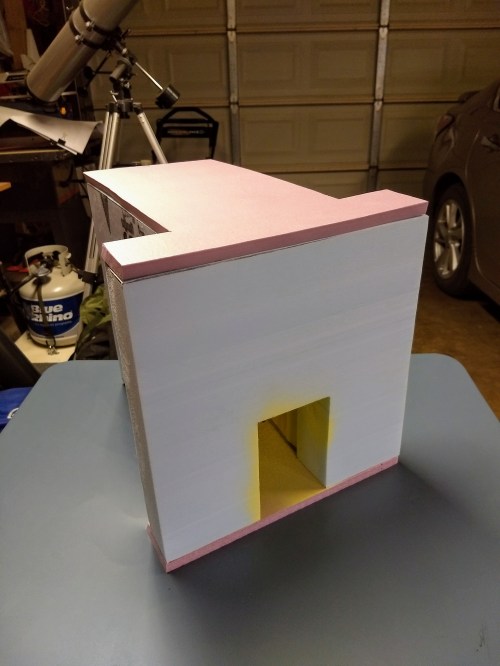
When I told Henry, (the MIC) of my decision, he encouraged me to follow through with my idea. He reminded me that the Temple model did not need to be an exact scale; it just needs to “look” like the Temple of Jesus’ day. Pictured above is the beginning of what will be the Temple model. To see the completed model, you will need to visit the ICR Discovery Center for Science and Earth History when it opens this September (2019).

Jewish religious life revolved around the Temple and Jesus, being an observant Jew, followed all the laws regarding it. When He was just eight days old, His earthly parents presented Him along with the required sacrifice to the priests at the Temple.[3] He had His bar mitzvah in the Temple at the age of 12,[4] and as Scripture points out, He went to the Temple each year for the Passover.

In His final week of life, He exercised the practice of ridding His house of “leaven” in preparation for the Passover by cleansing the Temple of the illegal trade that took place there. “And [He] said unto them, It is written, My house shall be called the house of prayer; but ye have made it a den of thieves. (Matthew 21:13, emphasis mine). The Temple was His house.

The Temple bears the shape of a cross. At the foot of the cross is the altar where the sacrifices are burned. Jesus gave His life as our eternal sacrifice. Beyond the altar resides the laver or mikvah where the priests would wash before entering the Temple. Jesus is the “living water” that cleanses us from all sin.[5] The Temple has only one door through which the priests can enter. Jesus said, “I am the door: by me if any man enter in, he shall be saved, and shall go in and out, and find pasture” (John 10:9, emphasis mine). Jesus saith unto him, I am the way, the truth, and the life: no man cometh unto the Father, but by me” (John 14:6, emphasis mine). As one enters through the door of the Temple, on the left stands a seven-branch menorah. Jesus said, “I am the light of the world: he that followeth me shall not walk in darkness, but shall have the light of life” (John 8:12, emphasis mine). On the right is the table of the “showbread.” Jesus said, “I am the bread of life: he that cometh to me shall never hunger; and he that believeth on me shall never thirst,” (John 6:13, emphasis mine). Directly ahead stands the altar of incense which represents the prayers of the people going up to God. Jesus said, “And whatsoever ye shall ask in my name, that will I do, that the Father may be glorified in the Son” (John 14:13).

Beyond the altar of incense rises a heavy curtain from floor to ceiling that separates this holy place from the Holy of Holies where the very presence of God resides. Inside that sanctum resided the Ark of the Covenant, covered by the Mercy Seat upon which the sacrificial blood was spilled on behalf of all the people. This place was so holy that only the high priest could enter and then only once a year on the Day of Atonement,[6] Yom Kippur.  When Jesus died on the cross, He carried His own blood into the heavenly Holy of Holies spilling it on God’s mercy seat. “And, behold, the veil [the curtain] of the temple was rent in twain from the top to the bottom; and the earth did quake, and the rocks rent” (Matthew 27:51, emphasis mine), and the way into the presence of God was opened for us.

Today every true believer is the Temple of God[7] because we have His presence within us.[8] The model temple I am building is a simple replica of the one that used to be. But the real Temple is me and anyone else who has invited the Lord to save them and take up residence within. I want to build an excellent model for visitors to the Discovery Center to enjoy, but even more important is the maintenance of the Temple in which God now resides.

If what I am saying sounds strange, visit my page on Securing Eternal Life.

Notes:


[1]  “On a Hill Far Away” – https://erniecarrasco.com/2019/05/12/on-a-hill-far-away/

[2]  1 Kings 6:2

[3]  Luke 2:22-24

[4]  Luke 2:41-52

[5]  1 John 1:7

[6]  “Rosh HaShanah” – https://erniecarrasco.com/2016/10/03/rosh-hashanah/

[7]  Living Temples – https://erniecarrasco.com/2018/03/18/living-temples/

[8]  1 Corinthians 3:16

3 Comments

Filed under Apologetics, Christianity, Evangelism, Gospel, Random Musings, Religion, Salvation, Theology

On A Hill Far Away…

And Other Biblical Misconceptions

 And he bearing his cross went forth into a place called the place of a skull, which is called in the Hebrew Golgotha: (John 19:17)

With the forthcoming opening of the ICR Discovery Center for Science and Earth History, I and a co-laborer (whom I cannot name because I did not request his permission) have been honored with the task of creating the scenery for the Life of Christ Diorama that will reside across from the Empty Tomb exhibit. An ICR benefactor donated the diorama for exhibition in the Discovery Center. The set contains thousands of pieces – buildings, tents, people, animals, furnishings, etc. – fabricated mostly by an Italian company. The extensive collection cannot all fit in the space allotted, so our leaders determined only to display pivotal scenes in the life of Christ.

Not to give away all the details of the diorama, I want to focus on the crucifixion scene. Where to position the crucifixion scene came into question. Should it be elevated on top of a hill or should it be placed on a lower level between the road and the hill? As Christians, we know the familiar words of the old hymn, “The Old Rugged Cross.” The lyrics say, “On a hill far away, stood an old rugged cross…” I do not know if it is due to the lyrics of the beloved hymn or due to some other handed down tradition, but we all imagine that Jesus was crucified at the top of Mount Calvary. However, musical lyrics or timeless tradition should not be the basis for what we believe. What does the Bible say?

And when they were come unto a place called Golgotha, that is to say, a place of a skull… (Matthew 27:33)

And they bring him unto the place Golgotha, which is, being interpreted, The place of a skull. (Mark 15:22)

And when they were come to the place, which is called Calvary, there they crucified him, and the malefactors, one on the right hand, and the other on the left. (Luke 23:33)

And he bearing his cross went forth into a place called the place of a skull, which is called in the Hebrew Golgotha: (John 19:17) (Emphasis mine)

The Bible does not often provide specific detail of events, but very often it does. The language of the Gospels is Greek. The Greek word for “hill” is either oros or bounos; the latter used only in Luke 3:5, and the former used in several passages in the N.T.[1] Furthermore, Greek prepositions indicate precise positions. The Greek preposition for “on” or “upon” is epi. It means “superimposition,” that is, to be “over” or “upon.” None of the four Gospels give any indication that the crucifixion took place “on a hill called Mount Calvary”[2] regardless of what the song lyrics say. Furthermore, the public spectacle of crucifixion[3] intended as a deterrent against lawlessness took place in the most public of places, usually, a busy roadside where passersby could get a close look at the suffering victims.

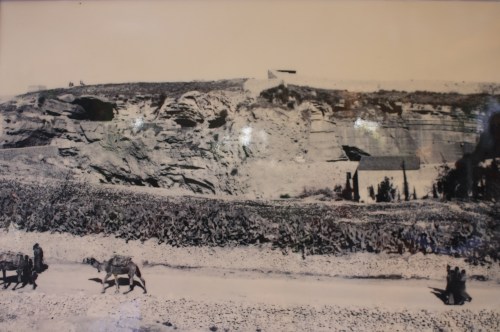
I researched, albeit not extensively, information about the location of the crucifixion. Most of the information[4] argues about three possible “places,” and most shy away from making dogmatic statements. The possible locations offered are, The Church of the Holy Sepulcher (which supposedly houses both the crucifixion and burial sites), The Garden Tomb[5] area (which is very near a limestone formation whose face features two prominent grottos that look like the eye sockets of a human skull), or just some unknown place outside of the Old City (of Jerusalem) designated by the Romans for public executions. All of these resources spoke of the “place” but none ventured to suggest whether the crucifixion took place “on” the hill or “by” the hill, but all agreed that it was “at” Golgotha/Calvary.

The “experts” fail to commit to “on” or “by”, but all four Gospels omit the preposition epi (on). To me that says that Jesus was crucified “at” Calvary, not “on” Calvary. My conclusion led me to determine that the diorama will feature the crucifixion scene near the road with a skull-shaped hill in the background. Besides scriptural reasons, there are practical reasons for my decision. A crucifixion on top of a hill, while it might be visible to all, could easily be ignored by passersby thus defeating the deterrent factor of the event. To get a close-up view – and who would want to – would require extra effort making it a disincentive for gathering a crowd, thus defeating the intended purpose of the Romans. However, if the crucifixion took place on a busy road, the only way to avoid the spectacle would be to take the long way around to enter the city. A roadside crucifixion makes more sense to me.

What does that have to do with salvation? Nothing. Jesus dying for you and me on the cross and rising again on the third day matters more than the place or the position. However, there are many non-believers who will find fault with any perceived discrepancy in Scripture. As Christians, we need to “be ready always to give an answer to every man that asketh you a reason of the hope that is in you with meekness and fear” (1 Peter 3:15). Controversies like these will come up. For example: “Jesus said He would be in the grave three days and three nights.[6] There are not three days and three nights between Friday and Sunday. The Bible is wrong!” Another example is the anointing of Jesus. “All the Gospels give accounts of Jesus’ anointing, but they are all different”[7] How would you respond to this challenge? A careful study of Scripture will reveal that there were three separate anointings; Matthew and Mark refer to one before the crucifixion, Luke recounts one before the Transfiguration, and John records one by Mary after Jesus raised her brother Lazarus after four days dead.

Other examples can be cited, but the point is that we need to “Study to shew thyself approved unto God, a workman that needeth not to be ashamed, rightly dividing the word of truth,” (2 Timothy 2:15) rather than relying on song lyrics, traditions, or human scholarship. Do not just read your Bible, study it!

Notes:


[1]  Matthew 5:14; Luke 1:36, 65; 3:5; 4:29; 9:37

[2]  “I Believe In A Hill Called Mount Calvary” – https://www.youtube.com/watch?time_continue=12&v=OPByLTzkctc

[3]  “Crucifixion” – https://en.wikipedia.org/wiki/Crucifixion

[4]  “Where Was Jesus Crucified? – Golgotha ‘the Place of the Skull’” – https://www.biblestudytools.com/bible-study/topical-studies/where-was-jesus-crucified.html

[5] “Jesus’ crucifixion site? (A ‘Skull’, Garden & Tomb)” – https://www.youtube.com/watch?time_continue=7&v=-7fHnnqre1o

[6]  “Three Days, Three Nights” – https://erniecarrasco.com/2014/07/13/three-days-three-nights/

[7]  “Jesus Last Days” – https://erniecarrasco.com/2018/03/25/jesus-last-days/

Comments Off on On A Hill Far Away…

Filed under Apologetics, Bible, Christianity, Religion, Salvation