Tag Archives: Christianity

Practical Atheism

people-jumping-off-cliff


If ye love me, keep my commandments. (John 14:15)

It could be argued that there are no true atheists. The Bible says that “that which may be known of God is manifest in them; for God hath shewed it unto them” (Romans 1:19), so they are, in fact, not ignorant of the existence of God. Instead, they “hold [down or suppress] the truth in unrighteousness” (Romans 1:18). According to a recent poll reported in the Washington Post, August 13, 2012, only five percent (5%) of Americans profess to be atheists. That represents a rise from one percent (1%), but it could hardly be called epidemic.

The same poll noted a decline of those who call themselves “religious” from 73% to 60%.  “Religious” is a rather nebulous term that could range from strict fundamental Christianity to navel-gazing new age mysticism. In an article that asks, “How Many Americans are Evangelical Christians? Born-Again Christians?” Bradley Wright points out that “Currently Evangelical Christianity in the US is at about its 40-year average, with 23%-24% of Americans affiliating with an Evangelical church or denomination.” Of course, just being affiliated with an evangelical church does not necessarily mean that the adherent is “born again.” Under this classification, Wright noted that 34% of Americans claim to be born again, and that includes mainline Protestants, and Catholics besides Evangelicals. Even here, the numbers may be misleading because many who claim to be “born again” really have no idea what that means. Probably the percentage of truly born again believers in America is less than 20%, and I base that on personal observation without any scientific proof.

My observation informs me that there exist many “practical atheists” out there. Many are in our churches and are familiar with church “lingo” so that they easily “pass” as genuine Christians. Most practical atheists, however, are either “non-religious,” that is, they profess to believe in God, but do not affiliate with any organized religion, or they are simply “spiritual” holding to one or more varieties of pantheism, and they will even “allow” for a “supreme being.” None of these would deny the existence of God outright, but they live their lives as if there is no God. Their egocentric lives are a series of choices based on what is expedient for them at the time. They never consider consulting God on a matter, but rather act on what suits them at the moment. To someone like this, James says, “Go to now, ye that say, [Today] or [tomorrow] we will go into such a city, and continue there a year, and buy and sell, and get gain: Whereas ye know not what shall be on the morrow. For what is your life? It is even a vapour, that appeareth for a little time, and then vanisheth away. For that ye ought to say, If the Lord will, we shall live, and do this, or that” (James 4:13-15).  To ask God’s direction in any plan would not even occur to a practical atheist.

A practical atheist thinks that all his possessions are his because of his own effort, or in the case of him who lives off subsidies, he believes that somehow these things are owed to him. Certainly Paul’s instruction to “In [everything] give thanks: for this is the will of God in Christ Jesus concerning you” (1 Thessalonians 5:18) would make little sense. The practical atheist gives low priority to “Not forsaking the assembling of ourselves together, as the manner of some is” (Hebrews 10:25). Even if he is a member of a church, often other activities will take priority over attending the worship service and Bible study on Sundays. The practical atheist has no need to “Pray without ceasing” (1 Thessalonians 5:17) or to “Study to shew thyself approved unto God, a workman that needeth not to be ashamed, rightly dividing the word of truth. (2 Timothy 2:15). For the practical atheist, personal prayer and Bible study are of little or no value. The practical atheist lives his life as though his future is guaranteed. He is oblivious to Jesus’ warning: “Surely, I come quickly” (Revelation 22:20).

Practical atheists are not necessarily “bad” people. Jesus told of a rich man that died and went to hell (Luke 16:19-32). Jesus’ description of the man was not necessarily an evil report; albeit he was self-centered and self-absorbed, and oblivious to the needs of Lazarus who begged outside his gates. The rich man went to hell because he was a practical atheist. He lived his life as if God did not exist even though he was probably very religious in practice, yet even his religious practice was all about him, and “God” was just part of the nomenclature of his religious life.

The practical atheist may profess a superficial belief in God, but he lives his life as if God does not exist, and as if he is not accountable to Him in any way. As Christians, we should strive to live our lives consistent with our profession and the teachings of God’s Word, and not as practical atheists.

6 Comments

Filed under Apologetics, Atheism, Christianity, End Times, Gospel, Religion, Salvation, Theology

Making God Laugh

Why do the heathen rage, and the people imagine a vain thing?  (Psalm 2:1)

The Bibles tells us “that there shall come in the last days scoffers, walking after their own lusts, And saying, Where is the promise of his coming? for since the fathers fell asleep, all things continue as they were from the beginning of the creation” (2 Peter 3:3-4).  These “evil men and seducers shall wax worse and worse, deceiving, and being deceived” (2 Timothy 3:13) while “Professing themselves to be wise, they [have become] fools” (Romans 1:22).

As the return of Christ approaches, we see the fulfillment of this prophesy all around us.  Hostility toward “God’s Anointed” and those who follow Him is rapidly increasing.  The word translated “heathen” here is the Hebrew word gowyim meaning non-Jewish nations or people.  It could also be translated “gentiles” referring to those who are not the people of God.  From a New Testament perspective, these would be any who are not Christians, and therefore not a part of God’s family.  These are they that “rage,” that is, they assemble as a tumultuous mob “against the LORD, and his anointed” [His Messiah; His Christ] (v. 2).

They “imagine a vain thing” (v. 1), that is, they imagine something that will never happen.  They rebel against God and say, “Let us break their bands asunder and cast away their cords from us” (v. 3).  Their end has been predetermined:  “And he gathered them together into a place called in the Hebrew tongue Ar-ma-ged’-don” (Revelation 16:16) “And the beast was taken, and with him the false prophet that wrought miracles before him, with which he deceived them that had received the mark of the beast, and them that worshipped his image.  These both were cast alive into a lake of fire burning with brimstone.  And the remnant were slain with the sword of him [Christ] that sat upon the horse” (Revelation 19:20-21).

Although God is “not willing that any should perish, but that all should come to repentance” (2 Peter 3:9), man’s obstinate and overt rebellion against His Anointed would be almost comical, if it were not so sad.  “Shall the thing formed say to him that formed it, Why hast thou made me thus?” (Romans 9:20).  The question is ludicrous!  “He that sitteth in the heavens shall laugh: the Lord shall have them in derision” (v. 4).

As the day of His return approaches we see more and more blatant attacks on Christians and Christianity by our government and by the liberal media.  These attacks will only grow worse as a lost populace lashes out against God and His people.  Little do they know that God just laughs at their insolence, but “Blessed are all they that put their trust in him” (v. 12).

Comments Off on Making God Laugh

Filed under Atheism, Christianity, Current Events, End Times, Religion, Theology

Sick and Tired

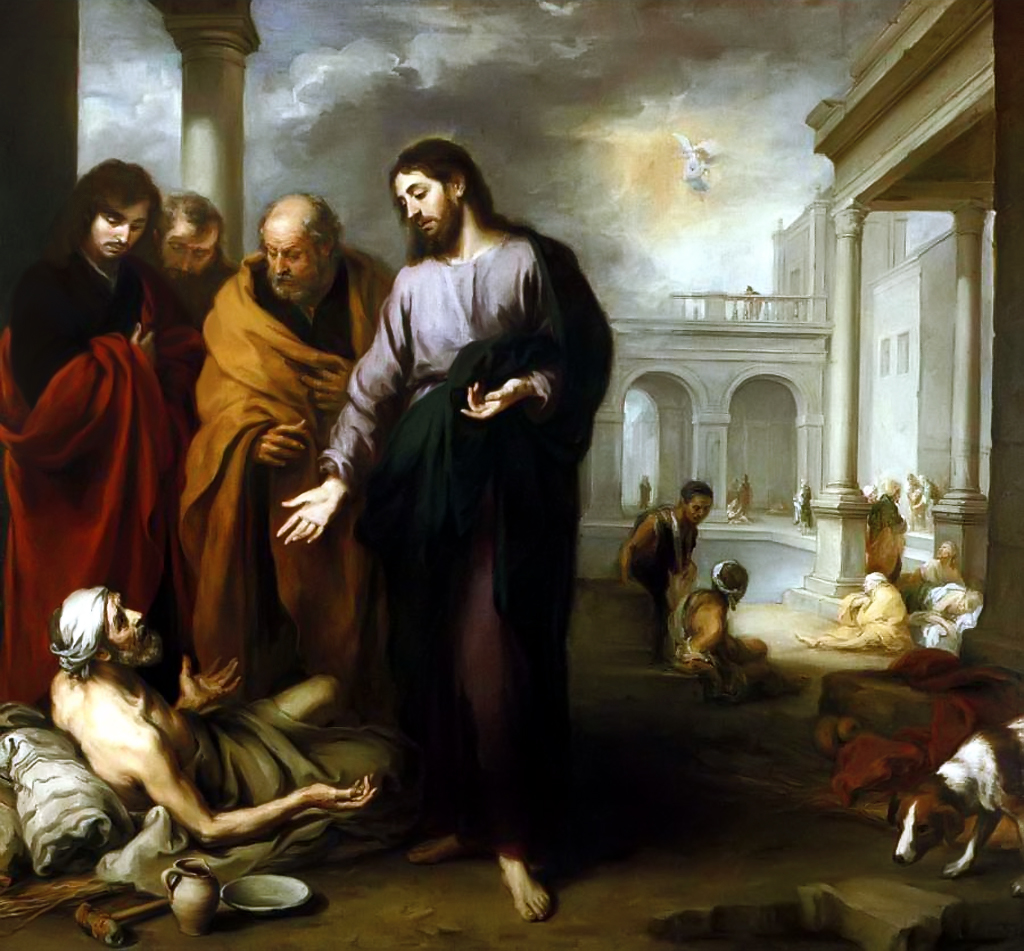
Christ Healing the Paralytic at the Pool of Bethesda — Murillo

And a certain man was there, which had and infirmity thirty and eight years. (John 5:5)

 The unidentified invalid in this narrative is an enigma that makes one wonder how anyone would wait thirty-eight years by the side of a pool in hopes of a cure for his ailment.  According to the text, “an angel went down at a certain season into the pool, and troubled the water: whosoever then first after the troubling of the water stepped in was made whole of whatsoever disease he had” (v. 4).  The text does not specify the nature of his infirmity, but the man was probably not lame.  Jesus healed the lame on several other occasions, and in those instances the infirm were clearly identified as “lame.”  Not so here.  Whatever the nature of his disease, this fellow felt unable to make it into the pool at the stirring of the waters.

Questions of his character also arise.  Did he not have family or friends willing to help him?  When Jesus asked him, “Wilt thou be made whole?” (v. 6), he offered up excuses: “Sir, I have no man, when the water is troubled, to put me into the pool: but while I am coming, another steppeth down before me” (v.7).  Had he alienated all of his friends and family by his self-pity and lack of personal responsibility?  Could the source of his disease be the reason he was abandoned?  We know that his sickness was a result of sin because after he was healed, Jesus admonished him, “Behold, thou art made whole: sin no more, lest a worse thing come to thee” (v. 14).  Some sexually transmitted diseases such as syphilis (which was not uncommon in Jesus’ day) can be very debilitating and even deadly.  Perhaps this was the nature of his infirmity and consequently the reason he was ostracized and alone.

The man also had a self-centered and ungrateful nature.  Note that “immediately the man was made whole, and took up his bed, and walked” (v. 9) and never even bothered to thank the Man that had healed him nor thought to even get acquainted with Him.  Could this be another reason why he was forsaken?

Sin brings all sorts of debilitating problems to a life that can rob a soul of all hope and demoralize one to the point that all effort seems futile.  One may even come to the pool of Bethesda (meaning the house/place of grace/mercy) and lack the strength to plunge in when the water is stirred.  Jesus is that pool of “living water” saying, “If any man thirst, let him come unto me and drink.  He that believeth on me, as the scripture hath said, out of his belly shall flow rivers of living water” (John 7:37-38).  No matter how horrific the sin that makes one sick and tired, Jesus can cure the disease.

Comments Off on Sick and Tired

Filed under Christianity, Religion, Theology

The Fallacy of Time and Chance

Image

In the beginning, God created … (Genesis 1:1)

If you had not eaten in over two weeks and you found a dollar, would you spend it on a burrito (a sure thing) or on a lottery ticket and a chance to win $10 million (not a sure thing)?  If all you have to do is pick five correct non-repeating numbers in no special order, your chance of picking all five correctly is 1 in 71.5 million.  If, on the other hand, the numbers must be in the correct sequence the odds decrease to 1 in 8.6 billion.[1]  With those kinds of odds, I am sure I would buy a burrito rather than a lottery ticket!

The odds for spontaneous generation of life from non-life are greater than that of winning the lottery.  “So even by the wildest ‘guesstimates,’ the universe isn’t old enough or big enough to reach odds like the 1 in 103,000,000 that Huxley, an evolutionist, estimated as the odds against the evolution of the horse.”[2]  With odds like these, one may as well consider evolution a veritable impossibility.

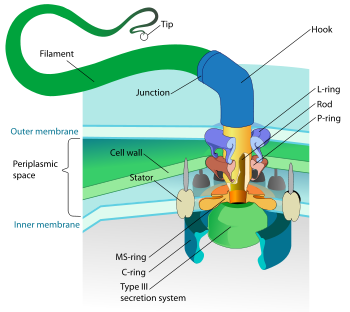
When one considers the irreducible complexity of the simplest single-cell bacteria, the evidence  should suffice to convince even the most recalcitrant skeptic, provided he has not abandoned all reason.  The motility of a bacterium is accomplished by a whip-like tail called a flagellum.   “The flagellum is constructed of 40 proteins, 10 of which are used in other structures in the cell, and 30 of which are unique to the flagellum.  The flagellum will not function unless all 40 proteins are put together the right way … If the flagellum is missing even one protein, it will not function.”[3]  I might also add that if only one protein is out of order, the flagellum will not function.

Image

Like creation, evolution cannot be proven scientifically or mathematically for that matter.  It takes an enormous amount of faith to believe “in the beginning hydrogen.”  Therefore, the only thing we can do is to consider the scientific evidence and see which origins model makes more sense or is more reasonable.

First of all, the universe and all that is in it “looks” designed.  Design demands a Designer.  Consider again the bacterium’s flagellum.


The flagellum has a motor that is about one-tenth of a micron in diameter, and a tail that turns at up to 100,000 rpm and acts as a propeller. The motor can reverse direction within a quarter turn. The electric motor of the flagellum is precisely analogous to our electric motors, but on a fantastically smaller scale, and it functions better than anything we can make.  One of the smallest man-made electric motors is 2 mm in diameter and was invented for use in boring plaque out of coronary arteries.  It involved the work of visionary cardiologists, as well as biomedical engineers.  These scientists, of course, stood on the shoulders of previous electricians, mathematicians, and engineers.

But the bacterial flagellum is 20,000 times smaller than this motor, works better, and turns faster!  The flagellum is fastened securely to the bacterial cell wall and has all the analogous parts of a man-made electric motor: It has a hook, or universal joint; a bushing; a rod (drive shaft); and an electrically-charged rotor and stator.[4]
Image

Intelligent scientists and engineers took years to design a tiny micro-motor that is clunky in comparison to the motor that drives the bacteria’s flagella, and yet we are amazed at the genius of the men that designed it.  But therein lays the answer:  men with intelligence designed it; it did not “evolve” on its own from an assortment of miscellaneous junk parts.  The same is true of the bacterial flagellum; it is of impeccable design, and only a fool will attribute its existence to the “blind watchmaker” of evolution.

From the smallest bacteria to the greatest galaxies, our universe displays incredible design and precision.  Evolution, on the other hand, wants to take credit for all that exists by claiming that 14 billion years ago some nondescript cosmic egg exploded, and that from all of the chaos of that primordial explosion, all that we now see “organized itself” into what we understand our universe to be.  It makes for a nice story, but it lacks substance.  Dr. Henry M. Morris offers five solid reasons why this “big bang” theory is a load of poppycock:

1.        The primordial explosion should have propelled all the matter/energy of the cosmos out radially from its center, and by the principle of conservation of angular momentum, none of it could ever thereafter have acquired any kind of curvilinear motion.  Yet there are all kinds of curving and orbiting motions of the stars and galaxies of the cosmos, a situation that seems quite impossible if the universe began with the big bang.
2.        Sensitive measurements in recent years have increasingly been showing that the background radiation is not homogeneous and isotropic (that is, the same in all directions), as it should be if it had been produced by the big bang, but is “anisotropic” in all directions.
3.        The universe is anything but uniform in large-scale structure, as both the big-bang and steady state theories require, but instead is full of huge agglomerations of matter in some regions and vast empty spaces in others, scattered around the cosmos in far from any uniform manner.  Some astronomers are now trying somehow to justify a primeval lumpy big bang!
4.        In the context of the primeval fireball, it is hard to justify the accumulation of any amount of matter in any one location such as a star.  If the explosion is driving all galaxies apart in the resulting expansion, how could it fail to drive all atoms apart before they came together in galaxies?
5.        The most serious objection comes back again in the second law of thermodynamics.  Explosions produce disorder, not order!  The primordial super explosion surely would have produced absolute chaos and the most utter disorder.  If the universe is indeed a closed system, as evolutionary cosmogonists allege, then how in the name of sense and science could this primeval chaotic disorder have possibly generated the beautifully organized and complexly ordered universe that we now have?  The big-bang idea, viewed in this light is as absurd as the steady state idea. [5]

“In the beginning hydrogen?”  Not hardly.  Order cannot come from disorder.  Life cannot come from non-life.  Evolutionists will attempt to deny, or otherwise skirt the issue, but the fact remains that even in the simplest form of life, all the creature’s parts must be present concurrently or the thing will not live, let alone survive.  Evolution from non-life would require that all the necessary proteins and amino acids come together instantaneously and in the proper configuration in order to produce life.  This has been attempted in the laboratory, and what was touted as a great success (the creation of a few amino acids) was in fact a miserable failure.[6] The resultant “building blocks” of life were the wrong blocks, and they did not fit together in any way to produce life.  Of course, that was conveniently left out of the headlines.

This fact alone should discredit the illusion of evolution, but the averse will adamantly cling to the myth claiming that all life originated from a single source billions of years ago.  Although it has been shown that spontaneous generation is next to impossible, let us assume an original source from which all life sprang.  Surely the fossil record would bear some evidence of transitional forms of one kind of life changing to another.  Without a doubt, several “proofs” have made the headlines only to be exposed as frauds, the lie to be revealed only in the most obscure sections of the printed media.  The fact is that the fossil record is remarkably silent on transitional forms.  Everything in the fossil record appears suddenly and fully formed, but bless their hard little hearts, the evolutionists continue their desperate search.

The Bible says that God created everything: space, time, matter/energy, earth, sky and sea, all plant life, sun, moon and stars, sea animals, land animals and at the top of His creation was man – created in the image of God.  All things were created in six 24-hour days, and at the end of each creation day, God declared His creation “good.”  Then on the final day of creation, He declared His creation “very good” – that is to say, “perfect.”  Declaring that each act of creation was good suggests that there was no need for improvement, i.e. “evolution.”  Plants were to bear seed “after its own kind.”  Animals were to reproduce “after their kind.”  This is what the fossil record bears out.

Neither creation nor evolution can be proven scientifically, but when compared side by side, creation, as recorded in the Bible, makes much more sense.  “In the beginning hydrogen?”  No!  In the beginning God!


[1] Calculation done on WebMath.Com: http://webmath.com/lottery.html

[2] From Answers in Genesis, “The Odds of Evolution,” http://aigbusted.blogspot.com/2007/11/odds-of-evolution_07.html

[3]  The Institute for Creation Research, The Creationist Worldview Program, Module 4, Course 2, Lesson 1, “Is Intelligent Design Unscientific?” Section : “Design: Purposeful Arrangement.”

[4] Ibid.

[5] Morris, Henry M., The Biblical Basis for Modern Science, (Green Forest, AZ, 2008), pp. 132-133.

[6] See article “Evolution Hopes You Don’t Know Chemistry: The Problem with Chirality” by Charles McCombs, Ph.D, http://www.icr.org/article/evolution-hopes-you-dont-know-chemistry-problem-wi/

Comments Off on The Fallacy of Time and Chance

Filed under Atheism, Christianity, Creation, Evolution, Religion