Tag Archives: Christmas

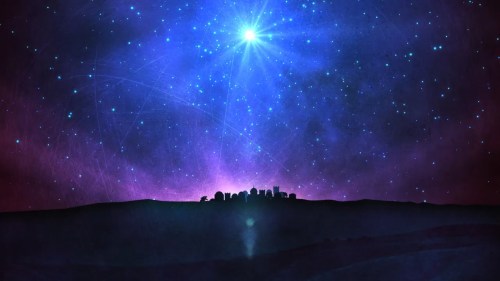
The Bethlehem Star

When they had heard the king, they departed; and, lo, the star, which they saw in the east, went before them, till it came and stood over where the young child was. (Matthew 2:9)

Once more the Christmas season arrived with all the usual pre-season hype of merchants competing for your hard-earned bucks by attempting to convince you that their product will bring you all the love an joy you deserve for “the holidays,” or that their product is the perfect gift to demonstrate your love for a loved one. As Christians, we know, or should know, that the celebration centers around the person of Jesus Christ – God’s gift to us.

Our church choir and orchestra performed our annual Christmas concert last Sunday. It was a program of beautiful Christmas music with a simple skit in the middle to give the choir a break. There was no pageantry; no live angles suspended in midair; no live animals herded down the aisles; no blinding laser lights flashing or smoke machines making fog. No, it was just good music meant to focus our attention on “the Reason for the season.”

This time of year should cause us to reflect on the significance of that incredible event when God came down to take on human flesh in the form of a baby. He came to a poor Nazarene couple. She was a virgin, pregnant out of wedlock.[1] He was a simple carpenter, an honorable man willing to fulfill his vow to his pregnant bride and to raise her child that was not his.[2]

Luke records the circumstances of their arrival to the little village of Bethlehem[3] and the birth of God-made-man in a stable – probably a grotto – meant for sheltering animals. It was a most malapropos place for the birth of the King of Kings and Lord of Lords. Yet, as Paul puts it, “[He] made himself of no reputation, and took upon him the form of a servant, and was made in the likeness of men” (Philippians 2:7).

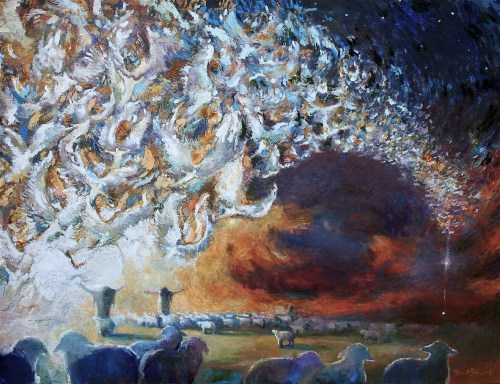
In the fields outside of Bethlehem, shepherds kept the sheep destined for Temple sacrifice. Luke tells of an angel appearing to the shepherds to announce the birth of their Good Shepherd and how an army of angels illuminated the night sky and filled the air with their chorus of praise to God, “Glory to God in the highest, and on earth peace, good will toward men” (Luke 2:14). It must have been a spectacular sight to behold, and yet only shepherds witnessed it. It was their private invitation.

Matthew records a visitation by foreigners – gentiles – of high estate. These were the Magi[4] from somewhere in Mesopotamia, perhaps even from Babylon. They were not invited to the “presentation” as were the shepherds. In fact, they did not arrive until more than a year later. We conclude this by comparing the two accounts. Luke calls the child a “babe” – Greek brephos meaning “infant.”[5] Matthew’s record describes the baby Jesus as a “young child” – Greek paidion meaning a “little one” or “little boy,” perhaps a toddler. We can further infer this because of Herod’s edict to kill all the baby boys in Bethlehem that were two years old and younger.[6] Additionally, the shepherds found the child wrapped in swaddling clothes in a manger,[7] while the Magi found Him in a “house.”[8]

The Magi were not invited. They were looking for Him. Some Bible scholars suggest that these “Wise Men” were of the “School of Daniel,” and were familiar with the Hebrew Scriptures and the prophecies of the coming Messiah. God revealed to Daniel, “Know therefore and understand, that from the going forth of the commandment to restore and to build Jerusalem unto the Messiah the Prince shall be seven weeks, and threescore and two weeks: the street shall be built again, and the wall, even in troublous times” (Daniel 9:25, emphasis mine). “Weeks” are groups of seven years. “Threescore” is sixty (60). Applying simple math, we get (7×7)+(60×7)+(2×7) or 483 years. The Magi were “Wise Men,” and they could do the math. They knew the time was near. Not only that, but they were astronomers who carefully studied the stars, which God created for signs (i.e., a signal, flag, beacon, etc.) and seasons (i.e., appointment or festival).[9]

As the Magi studied the night sky, they observed an unusual pattern in the heavens that alerted them to the birth of a new king. But who was this new king and where was he to be born? They searched the source where all wise men should look; they searched the Scriptures. There, in the Hebrew Book of Numbers, they found this prophecy, “I shall see him, but not now: I shall behold him, but not nigh: there shall come a Star out of Jacob, and a Sceptre shall rise out of Israel, and shall smite the corners of Moab, and destroy all the children of Sheth” (Numbers 24:17, emphasis mine). Ah ha! The king (the “Sceptre”) was to come from Jacob, i.e., Judah and a star would “beacon” His arrival. Add to this, Daniel’s prophecy of 483 years suggested that the time was up.

The Magi assembled a caravan and headed west toward the only place where a Jewish king would be born – Jerusalem. When they arrived, they went to the king’s palace – the only suitable place for the birth of a king, “Saying, Where is he that is born King of the Jews? for we have seen his star in the east, and are come to worship him” (Matthew 2:2, emphasis mine). This announcement was unsettling for Herod, but after inquiring of those who should have known, the Wise Men were directed to Bethlehem. “And they said unto him, In Bethlehem of Judaea: for thus it is written by the prophet [Micah 5:2], And thou Bethlehem, in the land of Juda, art not the least among the princes of Juda: for out of thee shall come a Governor, that shall rule my people Israel” (Matthew 2:5-6, emphasis mine).

So off they went toward Bethlehem, and something very strange happened. “When they had heard the king, they departed; and, lo, the star, which they saw in the east, went before them, till it came and stood over where the young child was” (Matthew 2:9, emphasis mine). That last statement has caused much controversy. “Stars” do not behave in that way. All stars rise in the east (because of the earth’s rotation) and set in the west, just like the sun does. Bethlehem is south-southeast of Jerusalem. For the star to go “before them,” it would have to alter its normal course from east to west and travel north to south instead.

For this reason, many have suggested that the star was a comet – “Have you seen what I’ve seen? A star, a star shining in the night with a tail as big as a kite.” However, a comet will not go before you and then stop and hover over a house.

Some have suggested that the star was a conjunction of Jupiter (the King Planet) and Venus (the Mother Planet). Still, others have suggested that it was a conjunction of Jupiter and Regulus (the King Star), which is the major star in the constellation Leo (Jesus is the “Lion of Judah). This conjunction has some possibilities for the star the Magi saw “in the east,” while they were still in Mesopotamia. On September 11 (hmmm, 9-11), 3 BC, Jupiter joined Regulus (chief star in Leo), Royal Planet and Royal Star. The sun was in Virgo (Virgin Constellation), and the New Moon in Royal Constellation Leo (Judah). It was the first day of Jewish New Year – Rosh HaShannah.[10] This conjunction announced the Savior’s Birth.

However, that does not explain the strange movement of the star that led the wise men to Bethlehem. Besides, the conjunction that alerted the Magi would not remain in that configuration for the duration of time that it took them to arrive in Jerusalem. This “Bethlehem Star” must have been something else. Interestingly, there was another phenomena that occurred the following year, December 25, 2 BC. “Jupiter began to move westward, At its stationary point in Virgo Winter Solstace [sic], Daystar in Coma[11] Overhead at Bethlehem at Dawn?” [sic][12] Jesus at this time would have been 15 months old (provided He was born on September 11, 3 BC) – a “young child.” Obviously, this is not the same star the Magi saw originally, and Matthew seems to confirm this. When they arrived in Jerusalem, the Magi announced that they had “seen” (past tense) “His star in the east” (Matthew 2:2, emphasis mine). However, in verse 9, Matthew simply calls it “the star, which they saw in the east.” Perhaps that is a difference without a distinction, but this phenomena, except for the presence of Jupiter, does not seem to shout “King” as clearly. Again, all stars rise in the east, so seeing the star in the east to me merely suggests the direction from which they observed the star rise. That still does not explain the strange movement of the star.

Here is what I think – and I can speculate just as well as the next man. In the evening, as the Magi made their way to Bethlehem, they looked toward the east and observed a bright conjunction of stars – perhaps it was the December 25, 2 BC phenomena. There in the midst of this bright gathering of stars appeared an angel. Angels are sometimes referred to as “stars” in the Bible.[13] As the Magi observed the star, the angel (star) descended from the midst of the stellar conjunction and dropped down into the atmosphere where it could lead the Magi to where Jesus was. In case you are skeptical of my suggestion, let me remind you again of what the shepherds witnessed out in the field. “And, lo, the angel of the Lord came upon them, and the glory of the Lord shone round about them: and they were sore afraid” (Luke 2:9, emphasis mine). That must have been a pretty dazzling angel!

It might have happened that way, or maybe not. Perhaps it was a one-time, special occasion miracle of God. Whatever it was, the message was clear. “For unto you is born this day in the city of David a Saviour, which is Christ the Lord” (Luke 2:11).

Notes:


[1]  Luke 1:26-38

[2]  Matthew 1:18-25

[3]  Luke 2:1-20

[4]  “Who Were the Magi?” – https://erniecarrasco.com/2014/12/14/who-were-the-magi/

[5]  Luke 2:16

[6]  Matthew 2:16

[7]  Luke 2:12, 16

[8]  Matthew 2:11

[9]  Genesis 1:14

[10]  “Summary of Conjunctions of Planets (“wandering stars”), Constellations and Stars: Meanings, Interpretations, Timetable, Other Astronomical Events Near Time Of Christ’s Birth” – http://www.tccsa.tc/articles/star_dates.html

[11]  Ibid. “The Star in the Head of the Infant in “Coma” visible in daylight for 300 years.”

[12]  Ibid.

[13]  Job 38:7; Revelation 1:20; 6:13;12:4

3 Comments

Filed under Apologetics, Christianity, Christmas, Gospel, Holidays, Religion, Theology

It’s Here Again

Glory ye in his holy name: let the heart of them rejoice that seek the LORD. (1 Chronicles 16:10)

Thanksgiving Day came and went. We enjoyed a no muss, no fuss Thanksgiving, just June, me, and our dog pack. We brought the old pre-lit Christmas tree down from the attic and set it up. Another section of lights failed. That makes two sections that need to be filled in. We decided the tree is going to the curb at the end of this season. We will look for a new one at the end of season close-out sales.

June and I spent the day decorating the Christmas tree. The dogs just watched or got in the way. Personally, I don’t think the all trouble is worth the effort. The tree is up for five or six weeks. Few people ever see it other than June, me, and the dogs, and, because both of us work, it’s only seen a couple of hours a day except for weekends. Then at the end of the season, it all has to be disassembled and put back up in the attic again until next year. I just don’t see the point.

We don’t do Black Friday as a rule. However, I needed some plastic putty for a model I’m building and decided to go to Michael’s ™ to hunt for some. June never allows me to go shopping without checking for coupons. She found a Michael’s ™ flyer advertising their Christmas trees for half off, so she decided to accompany me on my quest. We found a perfect replacement for our condemned tree and other small items, but no putty. No worries, Amazon ™ has anything one could want as long as one is willing to wait for delivery.

With our errands done, we prepared to enjoy a nice evening with our very good friends. We played some table games and then enjoyed a non-traditional Thanksgiving meal together. Truth be told, every day should be a day of thanksgiving.

We set aside Saturday to decorate the outside of the house for Christmas. I exercise fairly regularly, but the older I get, the less benefit I seem to get from all the effort. By the end of the day, my back ached, and my feet cried out for mercy. After a quick dinner of leftovers, we worked on completing the inside decorating. Decorating the house for Christmas involves much more than putting up a Christmas tree. June and I have a collection of more than 60 nativities that we like to display. However, before displaying them, we have to make space for them by putting away other knickknacks. This too is a lot of effort considering the limited audience that will enjoy them. The dogs don’t care. Still, the house looks nice, and it feels like Christmas.

I have written much about Christmas. If interested, the reader can find those in the “Categories” column on the right under “Christmas.” The reader will find that I have a low opinion of all the “trappings” of Christmas. I do not care for the commercialization of Christmas. I do not care for the sentimentality attached to Christmas. I do not care for all the hubbub associated with the season. It is doubtful that “the reason for the season” was born in December.

That said, there is much I do like about Christmas. I love the music of Christmas, especially the carols. In my church, the Sunday following Thanksgiving, we start singing the Christmas carols. The carols remind me that the Creator of the universe, the Maker of you and me, lowered Himself to human form and entered His world as a helpless human baby. THAT is awesome! But it did not end there. He grew up and lived among His creation as the only perfect and sinless man to ever walk the face of the earth. Finally, He gave Himself as the only suitable sacrifice to atone for our sins. THAT is amazing! But He did not just die. He conquered death for you and me so that we can live forever with Him.

He ascended into heaven, but He left with the promise to return for those who have trusted Him. The time draws near of His return. When He returns, He will reign as King of Kings and Lord of Lords on earth for 1000 years. People mistake the hymn “Joy to the World” for a Christmas carol describing Jesus first coming, but it is not. The hymn describes His second coming and His future reign on earth. Next time you sing it, pay close attention to the lyrics.

I love what Christmas represents. I believe Jesus was born sometime in September. No one knows for sure. Regardless, it is good to set aside a time to reflect on just what an incredible thing God did to save His creation. He offers His salvation as a gift. However, as with any gift, it must be accepted before it is appropriated. Reader, if this great gift is not yours and you would like to take it as your own, read my page on “Securing Eternal Life.”

I cannot change the things I do not like about Christmas, and being a Scrooge benefits no one. Therefore, I will try to overlook the Christmas distortions and focus on the awesome and amazing gift of God. He is the reason for the season after all.

Comments Off on It’s Here Again

Filed under Christianity, Christmas, Current Events, Gospel, Holidays, Random Musings, Salvation, Second Coming of Christ, Theology

Heavenly Host

And suddenly there was with the angel a multitude of the heavenly host praising God, and saying, Glory to God in the highest, and on earth peace, good will toward men. (Luke 2:13-14)

It was mid-September.[1] The night was warm, and because the first quarter moon had not yet risen, the night sky was velvet black except for the billions of shimmering jewels strewn across the heavens. Several shepherds gathered around the campfire. Their sheep were all accounted for and safe in the stone sheepfold that had probably been built by King David himself. No one knew that for certain, but the shepherds took pride knowing that their hero king had once kept his sheep in these very hills.

The fire was strategically placed in front of the only entrance to the sheepfold[2] and the shepherds made their beds at the entrance to guard against unwanted intruders.[3] They joked and told stories of the recent events around Jerusalem. The population around Jerusalem always more than doubled around this time of year. It was the Feast of Trumpets, followed by the Day of Atonement and then the jubilant celebration of the Feast of Tabernacles. The law demanded that all Jewish males attend the feast and offer sacrifices at the Temple. The shepherds tended the flocks that would be used for sacrifices there.

However, this year the population grew ten times greater, it seemed. The Roman emperor, Caesar Augustus ordered a census of the population and demanded that everyone return to their ancestral homes to be counted. The shepherds did not have to go far. Their ancestors herded sheep on these hills for centuries, but that was not true for many others. It seemed that the whole world had descended upon Jerusalem. Even Bethlehem’s population grew beyond capacity. Out-of-town guests filled every square inch of every home packing people in like clumps of dates on a desert palm.

The shepherds, though, had all the room in the world – fresh late summer breezes, infinite starlit skies spanning the heavens, and room to stretch. The conversation slowly waned until all that could be heard above the whisper of the wind was the occasional bleating of a sheep. Suddenly, an explosion of light brighter than the noonday sun chased away every star in the heavens until only the burst of light remained. Futilely, they shielded their eyes in an effort to identify the source of the light. Vaguely they distinguished the form of a man, but they could not be sure. Gripped with terror, they fell to the ground hiding their faces from the overwhelming radiance.

Then a voice, melodious and soothing in tone like the sound of a spring as it skips its way across its rocky path, stilled their racing hearts. “Fear not,” said the voice. “I bring you good tidings of great joy, which shall be to all people” (Luke 2:10). The gentle voice eased their fear, and while the light maintained its brilliance, it too seemed warm and comforting. “Good tidings”? With all of the trouble in the world, they could certainly use some good news. The news was not for them alone, but for “all people.” So why were they selected as beneficiaries of this good news? They were ready to hear more.

“For unto you is born this day in the city of David a Saviour, which is Christ the Lord. And this shall be a sign unto you; Ye shall find the babe wrapped in swaddling clothes, lying in a manger” (Luke 2:11-12). This was indeed good news! Could this be true? Their long-awaited Messiah born in their hometown – in the birthplace of their hero shepherd King David?

This was too good to be true, but it must be true, otherwise why such a dramatic announcement! “And suddenly there was with the angel a multitude of the heavenly host praising God, and saying, Glory to God in the highest, and on earth peace, good will toward men” (Luke 2:13-14). As if the brilliance of the one angel were not enough, now the sky was filled with a host – thousands upon thousands – of angles echoing back and forth like clarion trumpets sounding a fanfare of an approaching king. The exhilaration transported the shepherds to the very halls of heaven. Then, just as suddenly as they appeared, they vanished. Temporarily blinded by the luminescence of the angelic host, the shepherds stood there dazed struggling to regather their wits and their night vision.

Slowly the stars reappeared in the blackness of the night. On the eastern horizon, the first quarter moon shown a dim reflective light. What now? “And it came to pass, as the angels were gone away from them into heaven, the shepherds said one to another, Let us now go even unto Bethlehem, and see this thing which is come to pass, which the Lord hath made known unto us. And they came with haste, and found Mary, and Joseph, and the babe lying in a manger” (Luke 2:15-16). Glory to God on high, indeed! The heavenly hosts were right. Here in such a lowly estate lay the One – the Prince of Peace – for all mankind, even for lowly shepherds.

Notes:


[1]  Jesus may have been born on Feast of Tabernacles in 5 BC. Herod the Great died in 4 BC. In 5 BC, the Feast of Tabernacles took place between September 11 and September18. This is just speculation on my part based on the Apostle John’s account saying that “The Word became flesh and tabernacled among us” (John 1:14). The Gospels give us no hint as to the exact time that Jesus was born, but given that the shepherds were keeping sheep in the fields near Jerusalem suggests that it was for the purpose of the sacrifices offered on the Day of Atonement that precedes the Feast of Tabernacles.

[2]  John 10:1-10

[3]  John 10:9

2 Comments

Filed under Christianity, Christmas, Holidays, Religion

What’s The Rush!

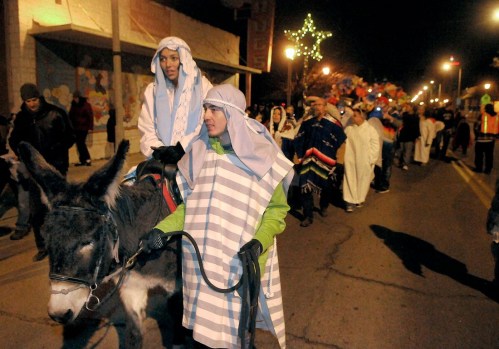
Typical “Las Posadas” Celebration

And so it was, that, while they were there, the days were accomplished that she should be delivered. (Luke 2:6)

Many Christmas traditions come from a fundamental misunderstanding or outright ignorance of Scripture. Such is the case of Joseph and Mary finding nowhere to stay in Bethlehem.

One of my favorite recent movies this time of year is The Nativity Story because it portrays a very realistic account of the birth of Christ, but even it resorts to unfounded tradition in its representation of the account. One of the most flagrant is the final tableau depicting the nativity scene complete with shepherds and wise men together on the night of the birth. It makes a pretty scene, but it is scripturally inaccurate.

Another error I discovered just recently is the scene when the Joseph and Mary arrive in Bethlehem. They arrive just when it starts to get dark. Suddenly, Mary starts having contractions and she pleads with Joseph to quickly find a place because the baby is coming. Frantically, Joseph runs from house to house banging on doors and pleading for someone to give them refuge in their desperate hour of need. No one has room to offer. Finally, one man offers a grotto where he shelters his animals. As the saying goes, “any port in a storm.” They take the offer and Mary gives birth to baby Jesus.

This tradition has been played out through the centuries. In Mexico and other Latin American countries, they observe Las Posadas (“the inns”) where a young girl and boy are selected to play the part of Mary and Joseph. They go from house to house in town followed by all the town’s people seeking refuge. Finally, they get to the last house where they are given posada, and the whole town enjoys a time of celebration.

Such traditions are neither good nor bad in themselves except that they have no basis in Scripture. Dr. Luke gives no indication that Joseph and Mary arrived in Bethlehem on the very night that Jesus was born. He does record that “there was no room for them in the inn” (Luke 2:7), but he gives a reasonable explanation for this.  Caesar Augustus had issued a census requiring everyone to go to his ancestral home of origin to be counted (Luke 2:1-3). Joseph and Mary both were descendants of King David whose birthplace was Bethlehem. Therefore, they were required to travel from Nazareth, their home, to Bethlehem in order to comply with Caesar’s decree. They arrived in Bethlehem. Visitors from all over Judea and Samaria overran the place so that every house in town was full. Joseph and Mary took the only place available – a shelter for animals.

They made the best of their accommodations. “And so it was, that, while they were there, the days were accomplished that she should be delivered” (Luke 2:6, emphasis mine). Luke gives no indication that they were in panic mode as tradition has taught. “Silent Night” makes more sense in a setting of peace rather than desperation. Yes, it was a stable, and yes, baby Jesus’ crib was a feeding trough for animals, but God, not desperation was in control.

After the crowd departed and returned to their homes, Joseph and Mary remained in Bethlehem for some time. With the excess population gone, they were able to find suitable lodging in a house. Matthew records that “wise men from the east” (Matthew 2:1) came in search of “he that is born King of the Jews” (Matthew 2:2).  “And when they were come into the house, they saw the young child with Mary his mother, and fell down, and worshipped him: and when they had opened their treasures, they presented unto him gifts; gold, and frankincense, and myrrh” (Matthew 2:11, emphasis mine). By this time, Jesus was no longer a “babe” (Luke 2:12) but a “young child” under two years of age (Matthew 2:16).

We often attach too much sentimentality to this event that may obscure of the real wonder of God’s entrance into the world of His creation. God became man, to live as a man – from conception to death – so that He could redeem His fallen creation from the curse of death by His own death, burial, and resurrection. Remove all the fluff from Christmas traditions, and what remains is staggeringly awesome!

Comments Off on What’s The Rush!

Filed under Apologetics, Christianity, Christmas, Holidays, Religion, Salvation, Theology

Happy Chanukah!

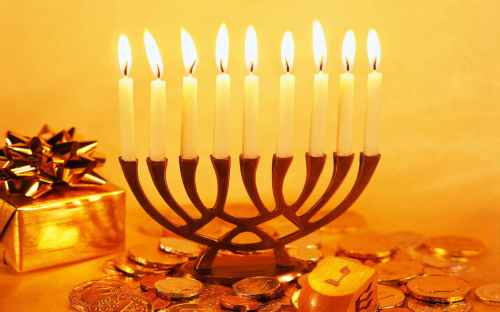
Hanukkah

In him was life; and the life was the light of men. And the light shineth in darkness; and the darkness comprehended it not.   (John 1:4-5)

Today, December 12, 2017 (at sundown), begins the Jewish Festival of Lights otherwise known as Chanukah (pronounced (with a guttural “H”) hah-noo-kah). The festival is observed for eight days, and while it is not one of the “Feasts of the Lord” (Leviticus 23) nor is it recorded anywhere in the Old Testament, it is nonetheless an important commemoration of God’s provision. Most Gentiles are vaguely aware of the celebration in that it takes place around Christmastime, but besides that, they really do not know much about it.

Chanukah originated in the second century B.C. during the “silent” period of the Bible – between the Old and New Testaments. It came about as a result of a Jewish rebellion against the Greek (Syrian) ruler Antiochus IV Epiphanes for his desecration of the Jewish temple in Jerusalem in 168 B.C. This act was prehistorically recorded by the prophet Daniel: “Then shall he return into his land with great riches; and his heart shall be against the holy covenant; and he shall do exploits, and return to his own land … And arms shall stand on his part, and they shall pollute the sanctuary of strength, and shall take away the daily sacrifice, and they shall place the abomination that maketh desolate.” (Daniel 11:28, 31, emphasis mine). Antiochus IV defiled the temple by erecting a statue of Zeus in the sanctuary and sacrificing a pig on the altar. This incited the Maccabean Revolt, and, as prophesied by Daniel: “the people that do know their God shall be strong, and do exploits. And they that understand among the people shall instruct many: yet they shall fall by the sword, and by flame, by captivity, and by spoil, many days” (Daniel 11:32-33, emphasis mine).  Two years later, 164 B.C. the Jews managed to expel the Syrians out of Jerusalem and take back their temple.

With the Greeks out of the way, the Temple had to be cleansed and rededicated. Part of the consecration required that the menorah, the “candlestick” or “lampstand,” that stood on the south wall of the Holy Place (Exodus 26:35), remain constantly lighted (Exodus 27:20). The problem was that there was only enough pure oil, i.e. oil that was undefiled, to last for only one day. So, they lit the menorah, and miraculously, the lamp continued to burn for eight days until sufficient oil was produced to replenish the supply from then on. And so, the Temple was dedicated. “Chanukah” means “dedication.”

Jesus celebrated Chanukah. We see in John’s Gospel “And it was at Jerusalem the feast of the dedication, and it was winter. And Jesus walked in the temple in Solomon’s porch” (John 10:22-23, emphasis mine). Just before this, He made the claim “I am the light of the world: he that followeth me shall not walk in darkness, but shall have the light of life” (John 8:12, emphasis mine). This He said after forgiving the woman caught in adultery (John 8:1-11). Not long after, He healed a man who was blind from birth (John 9) saying, “As long as I am in the world, I am the light of the world” (John 9:5, emphasis mine). That light would soon be extinguished, but not for long. In the spring following that Chanukah, Jesus would be nailed to a cross, and for three long days the world would be without the Light. The Sunday before His crucifixion, Jesus prepared His disciples (and us), “Yet a little while is the light with you. Walk while ye have the light, lest darkness come upon you: for he that walketh in darkness knoweth not whither he goeth. While ye have light, believe in the light, that ye may be the children of light” (John 12:35-36).

The menorah in the Temple was permanently extinguished in 70 A.D. when the Romans razed Jerusalem. Now it is only remembered on Chanukah. The Light of the World was temporarily extinguished, but He rose again, and His glory fills the heavenly Temple. Yet on Earth, His light still shines in those who are “the children of light.” “[Y]e are washed, but ye are sanctified, but ye are justified in the name of the Lord Jesus, and by the Spirit of our God” (1 Corinthians 6:11, emphasis mine). Since you are “sanctified,” that means you are “dedicated,” and Jesus said, “Ye are the light of the world. A city that is set on an hill cannot be hid … Let your light so shine before men, that they may see your good works, and glorify your Father which is in heaven” (Matthew 5:14, 16, emphasis mine). So, shine!

Happy Chanukah!

4 Comments

Filed under Christianity, Christmas, Evangelism, Gospel, Religion