Tag Archives: End Times

Stewardship

The earth is the LORD’S, and the fulness thereof; the world, and they that dwell therein. (Psalm 24:1)

When the topic of stewardship comes up in church, it typically comes up around the time of funding the next year’s church budget. The pastor usually brings a sermon encouraging church members to faithfully tithe – give 10% of their income – to the church. However, stewardship has almost nothing to do with tithing, although tithing is certainly a part.

A “steward,” by definition is a person who manages another’s property or financial affairs; one who administers anything as the agent of another. A steward is also a person who has charge of the household of another, buying or obtaining food, directing the servants.

We find the first example of a steward in the Bible in Eliezer of Damascus (Genesis 15:2). He was steward of Abram’s household and heir apparent of Abram’s possessions since Abram at that time had no children. After Isaac, the promised son, came along and after Sarah died (Genesis 23:1-2), Abraham sent Eliezer to Mesopotamia to find a wife for his son, Isaac (Genesis 24). The responsibility was unimaginably great, and Abraham entrusted Eliezer with great wealth trusting that God would direct him to the perfect bride. This was no small trust!

The second example of a steward in the Bible is Joseph, who was sold into captivity by his brothers (Genesis 37:28). In Egypt, Pharaoh’s Captain of the Guard, Potiphar, bought Joseph (Genesis 37:36) as a household slave. Soon, Joseph showed his worth and Potiphar put him in charge of his entire household. “And it came to pass from the time that he [Potiphar] had made him overseer in his house, and over all that he had, that the LORD blessed the Egyptian’s house for Joseph’s sake; and the blessing of the LORD was upon all that he had in the house, and in the field” (Genesis 39:5, emphasis mine).

Jesus offered two examples of stewards. In one parable, the master gave differing amounts of money to his three stewards to manage (Matthew 25:14-30), and he went off on an extended journey. When he returned, the ones to whom he gave five and two talents respectively doubled their master’s money, but the one to whom he gave only one talent did nothing with the talent and returned to his master the original amount.

In the second example, a “nobleman” gave his ten stewards equal amounts of money (Luke 19:11-27) and left on an extended journey to claim his kingdom. Seven of the ten refused to accept him as king when he returned and paid for it with their lives. One steward took what his master entrusted to him and returned ten times the amount. A second took the “pound” he was given and return five times the amount. The third did nothing with his charge and lost his position as a steward.

From these examples, we learn that the steward possesses nothing of his own; rather, he manages the possessions of his master. More than that, the “good” steward makes a profit for his master and increased the master’s wealth.

In a similar sense, we are the stewards of all that God has put into our possession. We own nothing. It all belongs to God, and we are responsible for everything He has placed in our trust. This not only applies to our money, but it includes our time, our family, and material possessions. It also includes how we relate to those around us, our government, and our environment – God’s creation. Everything that God has placed in our realm of influence is our stewardship responsibility. One day, maybe very soon, the King will return from His extended journey, and He will expect an accounting of all that He has entrusted into our care. Will we respond like the unfaithful stewards and return to Him only what He gave us?

Now, in regard to the tithe and in light of what has been presented, giving 10% of our income back to God is a small thing. Consider that all that money you earn is not really your own. From where do your abilities to earn income come? Who ultimately provided you a job? Everything, according to our lead verse (Psalm 24:1), everything belongs to God. He could demand that you return everything to Him with interest, but He does not. He only asks for 10% to test your faithfulness and your trust in Him for your provision. This too is stewardship.

Comments Off on Stewardship

Filed under Apologetics, Christianity, Religion, Second Coming of Christ, Theology

A Thousand-Year Day

But, beloved, be not ignorant of this one thing, that one day is with the Lord as a thousand years, and a thousand years as one day. (2 Peter 3:8)

The retirement lifestyle is a new experience for me. So far, it feels like an extra-long vacation. I’m enjoying doing things in the middle of the week and in the middle of the day that were out of the question when I was tied to a nine-to-five job. I am also enjoying the absence of fighting rush-hour traffic.

On Friday of this week, I experienced an outing to the ICR Discovery Center for Science and Earth History, my former employer, with a group of senior adults from our church. Of course, I know the place inside and out, but it felt different to visit as a “guest.” Our visit was too short (only two and a half hours). After that, we boarded our bus bound for lunch at El Fenix, the oldest Tex-Mex restaurant chain in the Dallas-Fort Worth Metroplex. Our driver took us to the one in Irving, Texas, not far from the Discovery Center.

In the course of conversation over lunch, a lady sitting at the table across from me asked me how I would respond to someone who thinks the Genesis creation account is a myth and argues for an old earth based on 2 Peter 3:8 (our verse above). Of course, attempting to change someone’s mind who is convinced that the miracle accounts in the Bible are myths will take some doing. Their main problem is that they have a very small view of God. They usually also have an overinflated view of man. However, their support for long ages based on 2 Peter 3:8 can be easily debunked.

Many use this verse to argue for long ages in the Genesis creation account. They wrongly interpret 2 Peter 3:8 to say, “one day is with the Lord a thousand years, and a thousand years is one day.” The Day-Age Theory[1] uses this interpretation to argue that the days of creation were 1000 years each making the creation event last 6000 years. Giving credit where credit is due, at least they are not arguing for millions or billions of years for creation. By their reckoning, Creation is about 12,000 years old. However, that raises the question; why does God need that much time to create? Furthermore, the purpose of the Day-Age compromise is to allow for evolution to take place, which brings up another question. Evolution requires death and suffering. How then can death be the penalty for sin[2] if death had taken place for thousands of years before the fall of man? And, how could God declare His creation “very good”[3] when He calls death “the enemy”?[4] Some concede that God used evolution to create. This raises yet another question. Why would God need to “experiment” on His creation in order to improve on it over time? Is He not all-knowing and all-powerful? Can God not simply speak things into being as described in the Genesis account of creation? The notion that God used evolution to create serves only to undermine faith in the power of God!

The resolution to the problem of misinterpreting 2 Peter 3:18 comes down to one word – “as.” Peter employs simile to describe the infinite nature of God. God created time; therefore, He is not bound by time. “Of old hast thou laid the foundation of the earth: and the heavens are the work of thy hands…But thou art the same, and thy years shall have no end” (Psalm 102:25, 27). “For a thousand years in thy sight are but as yesterday when it is past, and as a watch in the night” (Psalm 90:4). What Peter is saying is that, to God, one day is like a thousand years and a thousand years is like a day. Peter is not attempting to define time for God, but rather he is expressing the timeless nature of God. Therefore, attempting to define the days of creation as 1000 years each based on 2 Peter 3:18, misrepresents both Peter’s message and the Genesis account of creation.

However, without being dogmatic, a parallel could be drawn between 2 Peter 3:18, the days of creation, and historical time. God created in six 24-hour days and rested on the seventh. According to biblical chronology, the earth (all of creation) is about 6000 years old, and we look forward to a final, seventh, 1000-year of rest with Christ’s reign over all the earth.

A visitor to the Discovery Center showed me something in the Prophet Hosea that I had missed although I had read that passage many times. It reads as follows. “I will go and return to my place, till they acknowledge their offence, and seek my face: in their affliction they will seek me early. Come [Israel speaking now], and let us return unto the LORD: for he hath torn, and he will heal us; he hath smitten, and he will bind us up. After two days will he revive us: in the third day he will raise us up, and we shall live in his sight” (Hosea 5:15-6:2, emphasis mine).[5]

In the previous verse, the Lord (Jesus) says[6] that He will destroy Ephraim [the Northern Kingdom, i.e., Israel] and Judah. Then He says that He will return to His place (heaven) until they acknowledge their offence (i.e., the rejection of their Messiah) and seek His face. For over 2000 years, the Jews were scattered all over the earth until recent times (1948), but they, for the most part, have failed to seek His face – they still reject Jesus as their Messiah. However, they will return to Him in the near future. Then in Verse 2 of Chapter 6, they (the Jews) say, “After two days he will revive us: in the third day he will raise us up…”

My friend, referring to 2 Peter 3:18, pointed out that Jesus was crucified around A.D. 30, which means that the year 2030 will be 2000 years – two days.  On the third day (1000 years), Jesus will restore Israel. Although we cannot be dogmatic about such things, my friend’s reasoning is sound and his conclusion logical. If his assessment proves correct, that means the seven-year Tribulation could begin in 2023. The Rapture of the Church can take place anytime between now and then. Again, we must be careful not to be dogmatic about these things, but as Christians, the Word instructs us that the return of the Bridegroom for His Bride is imminent[7] and we must be ready at all times, “and so much the more, as ye see the day approaching” (Hebrews 10:25).

Are you ready? If you are unsure, please read my page on “Securing Eternal Life.”

Notes:


[1]  “Age of the Earth” – https://erniecarrasco.com/2018/10/14/age-of-the-earth-2/

[2]  Genesis 2:16-17; Genesis 3

[3]  Genesis 1:31

[4]  1 Corinthians 15:26

[5]  This quotation spans two chapters. The reader must keep in mind that the original text did not have chapter and verse divisions.  The first English Bible to include chapter and verse divisions was the 1560 Geneva Bible.

[6]  Hosea 5:14

[7]  “Imminent” – https://erniecarrasco.com/2020/01/12/imminent/

6 Comments

Filed under Apologetics, Christianity, Creation, End Times, Evolution, Origins, Second Coming of Christ, Theology

Imminent

He which testifieth these things saith, Surely I come quickly. Amen. Even so, come, Lord Jesus. (Revelation 22:20)

Secretary of State, Mike Pompeo, and Secretary of the Treasury, Steve Mnuchin, gave a press briefing on Friday, January 10, 2020,[1] concerning increased sanctions for Iran following Iran’s rocket attacks on US bases in Iraq. At the end of the briefing, they opened the floor for questions from the press corps. As has become common practice these days, the questions coming from the Press avoided the topic at hand, and rather addressed the irrelevant question of the killing of Iranian General Qasem Soleimani. Someone questioned the targeting of a “foreign diplomat,” and Pompeo pointed out that our intelligence found that Soleimani planned to strike our embassies in the area and that the threats were imminent. One genius fake news reporter challenged the Secretary, “What is your definition of ‘imminent’?” I had to laugh!

It comes as no surprise that the request for a definition of the word “imminent” should arise. The “left” in this country, and around the world, has become proficient in distorting the language so that words become whatever the user wants them to be. For example, “hate” means “to dislike intensely or passionately; feel extreme aversion for or extreme hostility toward [something or someone]; detest [something or someone].”[2] However, for the left, “hate” means opposition to anything they favor. The practice of redefining terms probably started much earlier than this, but my first vivid recollection of this practice came at the impeachment of William Jefferson Clinton. Remember his now infamous line? “It depends on what the meaning of the word ‘is’ is.”

Words used to have meaning. However, in a day when biology no longer determines the sex of a person, words can take on whatever meaning the user wants them to mean. Not so with God. He emphatically states, “For I am the LORD, I change not…” (Malachi 3:6). The writer to the Hebrews says of God the Son, “Jesus Christ the same yesterday, and to day, and for ever” (Hebrews 13:8). Of His Word, Jesus said, “For verily I say unto you, Till heaven and earth pass, one jot or one tittle shall in no wise pass from the law, till all be fulfilled” (Matthew 5:18).

The word “imminent” does not appear in the King James Bible; however, the concept is there. The word “imminent” means that something is “likely to occur at any moment.”[3] The precise moment of such an event cannot be known or determined. It could happen at any time. If one can know or determine the time of a future event, it is no longer “imminent” because it is now “expected.” The two words are synonymous, however with expectation comes the connotation of the precise timing and location of a future event. The expectation of an impending event allows for ample preparation. Jesus said, “But know this, that if the goodman of the house had known in what watch the thief would come, he would have watched, and would not have suffered his house to be broken up” (Matthew 24:43). If the man of the house had “known” when the thief would come, he would have been “expecting” him and made preparations. The implication here is that the coming of the thief was “imminent,” not “expected.”

The fake news reporter exhibited her ignorance by asking Pompeo what he meant by “imminent.” Our military intelligence could not predict where or when Soleimani would strike, only that his intention was to strike soon. That made it imminent.

Christ’s return for His Bride, the Church, is imminent. It has been imminent for over 2000 years. Before His crucifixion, Jesus promised, “And if I go and prepare a place for you, I will come again, and receive you unto myself; that where I am, there ye may be also” (John 14:3). Paul taught the imminency of the Lord’s return at “the last trump” when we would “not all sleep, but we will all be changed in a moment, in the twinkling of an eye,”[4] but he did not say when. It’s imminent. It could happen at any time. To the Thessalonians, Paul wrote, “But of the times and the seasons, brethren, ye have no need that I write unto you. For yourselves know perfectly that the day of the Lord so cometh as a thief in the night” (1 Thessalonians 5:1-2). His coming is imminent, like “a thief in the night.”

Unlike the “goodman of the house” in Jesus’ example who was unprepared for the imminency of the thief’s arrival, we have good reason to be expectant of the Lord’s imminent return. We cannot know the day nor the hour when the Lord will return.[5] It could be at any time. It is imminent. Therefore, we must watch expectantly, and make preparations.

We have waited for over 2000 years. How imminent can His return be? Many become discouraged at the delay, like the five virgins without extra oil for their lamps.[6] Such attitudes are to be expected. The Apostle Peter predicted, “Knowing this first, that there shall come in the last days scoffers, walking after their own lusts, And saying, Where is the promise of his coming? for since the fathers fell asleep, all things continue as they were from the beginning of the creation” (2 Peter 3:3-4).

Many prophecies concerning “the last days” address Jesus’ return to set up His thousand-year reign on earth. The Old Testament contains most of these prophecies. Jesus spoke of these times in His Olivet Discourse,[7] and most of the Book of Revelation focuses on the time of Great Tribulation just before He returns. These prophecies provide great detail of the events that will transpire in “the last days” during the seven years[8] before the Lord’s return. However, no signs detail the “Rapture”[9] of the Church. We are told that it will happen, but we are not told when or how; it’s imminent. The Rapture[10] must take place before the time of Tribulation “For God hath not appointed us [His Church] to wrath, but to obtain salvation by our Lord Jesus Christ” (1 Thessalonians 5:9).

So, although we have waited more than 2000 years for the Bridegroom[11] to come for His Bride (the Church), we can know the time is near. How? We can know because of the convergence of the end-time signs. Israel, because it is the focus of all end-time prophecy, and the events surrounding Israel, is our primary sign. None of the end-time prophecies can come to pass without Israel being in her place. Of the rebirth of Israel, God’s “fig tree,” Jesus said, “Verily I say unto you, This generation shall not pass, till all these things be fulfilled” (Matthew 24:34). We are that generation. It has been almost 72 years since Israel’s rebirth, and according to the psalmist, a man’s life is between 70 and 80 years (Psalm 90:10). There are too many signs to include in this article, but the fact that Israel is in place makes all the other signs that much more relevant. The signs tell us the end is near, so the Rapture of the Church is more imminent now than ever before. It could happen anytime now.

Notes:


[1]  Press Briefing with Secretary of State Mike Pompeo and Secretary of the Treasury Steve Mnuchin: https://www.youtube.com/watch?v=lTCErLFbu4Q

[2]  Hate: https://www.dictionary.com/browse/hate?s=t

[3]  Imminent: https://www.dictionary.com/browse/imminent?s=t

[4]  1 Corinthians 15:50-53

[5]  Matthew 25:13

[6]  Matthew 25:1-13

[7]  Matthew 24-25; Mark 13; Luke 21

[8]  Daniel 9:24-27

[9]  End-Times 101 – https://erniecarrasco.com/2018/06/10/end-times-101/

[10]  End-Times 102 – https://erniecarrasco.com/2018/06/17/end-times-102/

[11]  Matthew 25:1-13

Comments Off on Imminent

Filed under Apologetics, Christianity, Current Events, End Times, Religion, Second Coming of Christ, Theology

Christmas Excitement

Behold, the former things are come to pass, and new things do I declare: before they spring forth I tell you of them. (Isaiah 42:9)

It’s that time of year once more. The places I work and worship sparkle with bright red, green, and gold decorations consistent with the colors of the Christmas season. Long before Thanksgiving Day, merchants displayed all their Christmas wares enticing shoppers to covet without first giving thanks. Television commercials attempt to instill a sense of privation so the viewer feels the need for what they are selling.

GMC™ produces two commercials that really stand out to me. They show a young couple, probably in their late twenties or early thirties, with no children, and a big fancy house. In one of the commercials, the husband buys GMC ™ vehicles for both of them. In the other, the husband gets the wife a puppy, and the wife gets him a big crew-cab pickup. Seriously, how many young people, on the average, have that kind of cash? Most young people that age, if they graduated from a college or university, are saddled with enormous school debt and are doing well to afford payments on a Honda Civic™ much less a $60,000 fully decked out pickup truck!

Regardless of how we feel about the materialism associated with the Christmas season, we cannot get away from the sense of expectation. At church, our choir and orchestra are working hard a polishing up the music for our Christmas concert. It will be wonderful, and we are excited about presenting it. Our church looks forward to our Christmas Eve services and our sharing of the Lord’s Supper, aka communion.

We celebrate the birth of our Savior. Think about what that means. The same God that created heaven and earth and all things, the same God that created human beings in His very image, is the same God that implanted Himself in the womb of a virgin girl to be born like any other human baby, live a sinless life among His creation, and give Himself as a sacrifice for humanity’s sin. That is awesome! That boggles the mind!

We anticipate with excitement the celebration of Christmas, the First Advent, but our celebration should look forward to the Second Advent yet to come. The prophets of old foretold of Jesus’ first coming. Beginning in Genesis, the Bible promises that the “seed of the woman” would crush the head of the serpent, i.e., Satan.[1] Isaiah tells us that the woman would be a virgin.[2] In Genesis, we also learn that He would come from the line of Abraham, Isaac, Jacob, and Judah.[3] Isaiah foretold that Jesus would be in the line of King David[4] and the psalmist concurred.[5] The conniving Balaam unwittingly predicted that a star would announce His coming.[6] Micah pointed to Bethlehem as the place of His birth,[7] and Hosea said He would come up from Egypt.[8] These are just some of the prophecies of His First Advent. Many more prophecies foretold of His life, ministry, death, burial, and resurrection – all with 100% accuracy.

Christmastime should cause excitement as we anticipate His Second Advent. There are more prophecies concerning His second coming than there are for His first coming. Since all prophecies of His first coming came true as predicted, should we not expect the same accuracy of the prophecies predicting His second coming? Celebrating Christmas should excite us knowing that the Baby Jesus is the soon-coming King of Kings and Lord of Lords.

One of the carols we sing at Christmastime is not really a Christmas carol. In fact, “Joy to the World”[9] reminds us that Christ will return to rule the world as king.

Joy to the world the Savior reigns; let men their songs employ; while fields and floods, rocks, hills, and plains repeat their sounding joy.

No more let sins and sorrows grow, nor thorns infest the ground; He comes to make His blessings flow far as the curse is found.

He rules the world with truth and grace, and makes the nations prove the glories of His righteousness, and wonders of His love.

We know historically that did not happen at His first coming. We might spiritualize those sentiments. Certainly, the Savior reigns within the hearts of all believers, albeit not perfectly. Sin and sorrow continue as always and “the curse” goes on unabated. He does not rule the world, and “the nations” care nothing about His glories or righteousness. All of these are attributes of His yet-to-come millennial reign.[10] The prophet Isaiah provides some insight into Jesus’ millennial reign on earth. That will be a time when even the animal kingdom will be at peace.[11] Knowing what is coming should make Christmas even more exciting than all the GMC™ pickups the world can afford!

Notes:


[1]  Genesis 3:15

[2]  Isaiah 7:14

[3]  Genesis 12:3; 26:4; 28:14; 49:10-11

[4]  Isaiah 11:1

[5]  Psalm 132:11

[6]  Numbers 24:17

[7]  Micah 5:2

[8]  Hosea 11:1

[9]  Carol by Isaac Watts, 1718

[10]  Revelation 20:1-7

[11]  Isaiah 11

Comments Off on Christmas Excitement

Filed under Apologetics, Christianity, Christmas, Gospel, Holidays, Salvation, Second Coming of Christ, Theology

White As Snow

White As Snow – by Henry M. Morris, Ph.D.*


“I beheld till the thrones were cast down, and the Ancient of days did sit, whose garment was white as snow, and the hair of his head like the pure wool: his throne was like the fiery flame, and his wheels as burning fire.” (Daniel 7:9)

In this amazing vision of the everlasting God on His fiery judgment throne, we find one of the six occurrences in the Bible of the fascinating phrase “white as snow.” As the symbol of holiness, pure white finds its clearest natural expression in the beautiful snow when it has freshly covered the ground.

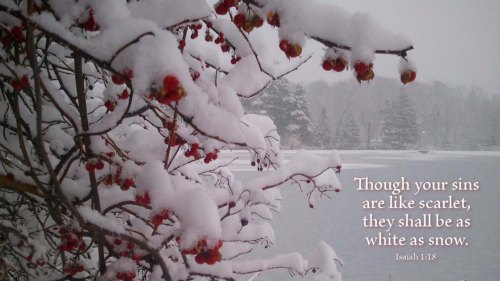
Twice the phrase is used to describe the cleansing of a guilty sinner by the grace of God. David, after confessing his own sin, prayed: “Have mercy upon me, O God. . . . Wash me throughly from mine iniquity, and cleanse me from my sin. . . . wash me, and I shall be whiter than snow” (Psalm 51:1-2, 7). Then, God promises through His prophet: “Come now, and let us reason together, . . . though your sins be as scarlet, they shall be as white as snow” (Isaiah 1:18). The cleansing blood of Christ, the Lamb of God, is the only substance that can turn blood-red scarlet into snowy white.

When Christ ascended the Mount of Transfiguration, “his raiment became shining, exceeding white as snow” (Mark 9:3), which confirmed to the three disciples that He was the Son of God, even as the voice from heaven had said (Matthew 17:5). At the empty tomb following His resurrection, “the angel of the Lord” also had “raiment white as snow” (Matthew 28:3). Finally, when John saw Christ in His glorified body, he testified that “his head and his hairs were white like wool, as white as snow” (Revelation 1:14).

It is marvelous that the raiment of the angel of God, the transfigured Christ, and the Ancient of days, as well as the head of Christ in His glory, are all described with the same phrase as the soul of one whose sins are forgiven!

*From Days of Praise, December 1, 2019

Comments Off on White As Snow

Filed under Christianity, End Times, Gospel, Religion, Salvation, Second Coming of Christ, Theology