Tag Archives: God

Natural Selection

Animals

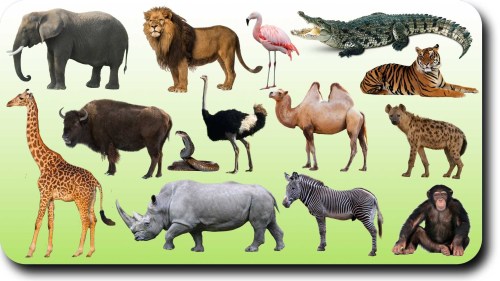
And God said, Let the earth bring forth the living creature after his kind, cattle, and creeping thing, and beast of the earth after his kind: and it was so. And God made the beast of the earth after his kind, and cattle after their kind, and every thing that creepeth upon the earth after his kind: and God saw that it was good. (Genesis 1:24-25)

Natural selection is the means by which Charles Darwin proposed all life on earth sprang from a common source. From where or how that common source first appeared he did not explain nor can his modern devotees.

According to Dictionary.Com, natural selection is “the process by which forms of life having traits that better enable them to adapt to specific environmental pressures, as predators, changes in climate, or competition for food or mates, will tend to survive and reproduce in greater numbers than others of their kind, thus ensuring the perpetuation of those favorable traits in succeeding generations” (emphasis mine). That is a very reasonable definition of what we observe in nature. (For purposes of this discussion, I will limit “life” to those creatures that have “breath” and “blood” in keeping with the biblical definition of life.) All living things possess traits that enable them to survive and thrive in their unique environments. A population achieves stasis when the dominant traits pass on to succeeding generations. Weaker elements of the population are eliminated either through infanticide (mothers kill their own young when they detect abnormalities) or through genetic deficiencies that prevent certain individuals from surviving in their environment. This “process” assures a healthy population.

Not long ago, my wife and I visited a raptor rescue organization in Sitka, Alaska dedicated to restoring to health bald eagles and other predatory birds found wounded in one fashion or another. Once the birds are healthy, they are returned to the wild. At the shelter, they had a female bald eagle that they kept for public education purposes. She was beautiful except that her upper and lower beak overlapped – crossed over each other – in a way that would prevent her survival in the wild. With her distorted beak, she would not be able kill and eat her prey. She could survive in the shelter only because she was handfed small portions of food that she could manage. The staff at the shelter neutered her so that she could not reproduce and pass on the defective trait to her progeny. However, in the wild, the process of natural selection would ensure that her defect would not propagate because she would likely starve to death before procreating. That is what natural selection accomplishes; it prevents perpetuation of unfavorable traits in succeeding generations.

Darwinian evolutionists acknowledge this attribute of natural selection but further attribute an additional process whereby minor changes in the traits over long periods enhance a creature’s ability to adapt to its environment. They suggest that minor beneficial mutations over time improve the creature’s chances of adapting to changing environments. Never mind that such beneficial mutations have never been observed or that such a notion violates the Second Law of Thermodynamics, i.e. entropy. Things in nature tend to degenerate; they do not improve. That is why natural selection is important to maintain stasis in a species.  Without it entropy takes over, and a species degenerates to the point of extinction.

Evolutionists “believe it is totally rational to explain that life’s complexity results from the ever-upward pressure of natural selection’s ability to see and save traits, though it, itself, is undirected and absolutely blind to any goal. [They] must use words like ‘undirected’ and ‘blind’ to reinforce that natural selection, not God, creates nature’s design.”[1] “Genetic alterations called mutations can profoundly affect expression. Evolutionists believe a major source of new genetic material is mutation. The vital need, however, is some type of management—a substitute designer that ‘sees,’ ‘selects,’ ‘saves,’ and ‘builds’ with mutations. ‘Natural selection’ is intended to fill this role.”[2]

So, unwittingly, evolutionists attribute to nature intelligence and discernment to select traits suited for the creature as dictated by their environment. Nature and natural selection effectively take the place of God as Designer and Creator.

The absurdity of the evolutionists’ notion of natural selection presents several problems besides the obvious. Nature is just what is. It does not possess the ability to think, to choose, or to select. Nature is simply what exists around us – our environment. It is the air around us, the earth beneath us, and the creatures that share our planet. That is all nature is. That aside, for nature to produce the diversity that we see in life, it would have to overcome the hurdle of irreducible complexity, i.e. everything needed for life and for reproduction must be present all at once in order for the creature to survive. Even the simplest single-cell life form is so complex that it cannot survive if a single protein is missing in its makeup. Not only that, but if nature could manage to create the first single-cell creature from which all other life would spring, it must accomplish this feat not only once, but multiple millions of times simultaneously to ensure survival of the prototype. Nature must then overcome or reverse the effects of entropy to allow minor beneficial mutations to change the creature into other forms without losing the original prototype. Variations at first reproduce asexually, but as they become increasingly complex over millions of years, sexual reproduction becomes necessary. Here nature must jump another huge hurdle. Nature now must create male and female simultaneously. If nature creates a male and no female, or vice versa, the new species dies – no evolution. The more we ponder this belief, the more the problems exacerbate. One wonders how such a notion qualifies as “science.” Of those who religiously hold to this fantasy, the Bible says, “Professing themselves to be wise, they became fools” (Romans 1:22).

God built into His creation a system by which stasis can be achieved and maintained. This system might be called natural selection or it might be called survival of the fittest, but in either case, the purpose is to maintain the health – the good traits – in a population. In nature, there exists a food chain where predator lives off prey, but if the predator exhausts its food supply, the predator will starve and die out as well. When the jackrabbit population explodes, the coyotes feast, until the jackrabbit population diminishes. Then the coyote population begins to die off. Only the strongest of the population survive. Meanwhile, with the diminishing coyote population, the jackrabbits multiply and there is resurgence. Eventually the coyote population comes back due to the abundance of food, and the cycle starts over. This is by God’s design and it has nothing to do with evolution. Following the Global Flood recorded in Genesis 6-9 God promised, “While the earth remaineth, seedtime and harvest, and cold and heat, and summer and winter, and day and night shall not cease” (Genesis 8:22). This is exactly what we see in nature. When God created sea creatures and creatures of the air on Day Five (Genesis 1:20-23), He determined that they would reproduce “after their kind.” He created them all complete and perfectly suited to their environments, and He declared His creation “good” (Genesis 1:21). When God created the land animals on Day Six (Genesis 1:24-25), He determined that they would reproduce “after their kind.” He created them all complete and perfectly suited to their environments. The Bible makes no allowance for evolution. Natural selection, as a system designed by the Creator, serves to maintain the health of a population, but its design does not promote evolution of one “kind” into another. God does not need “nature” to help Him create. He created nature, and all the systems needed to run this wonderfully complex world in which we live. Nature does not “select.” God creates!

Notes:


[1]  Randy Guliuzza, P.E., M.D., “Natural Selection Is Not ‘Nature’s Intelligence’” http://www.icr.org/article/natural-selection-not-natures-intelligence/

[2]  Randy Guliuzza, P.E., M.D., “Darwin’s Sacred Imposter: How Natural Selection Is Given Credit for Design in Nature” http://www.icr.org/article/darwins-sacred-imposter-how-natural/


2 Comments

Filed under Apologetics, Christianity, Creation, Evolution, Origins, Religion, Science, Theology

Dad

Left to right: Dad, Me, Ednoi, Eli and Esther

Left to right: Dad, Me, Ednoi, Eli and Esther

Behold, I have taught you statutes and judgments, even as the LORD my God commanded me…  (Deuteronomy 4:5)

He came to the United States from Mexico in 1943 with false papers under an assumed name and started working for the railroad. Not long after, his work brought him to the West Texas town of Monahans where his eye fell upon the lovely Elena, and his life changed forever. Elena was one of five children of store owner and Baptist lay preacher, Porfírio Enriquez. Elena was hard to get, especially since her father wanted her to have nothing to do with the “mojado” (“wetback”), especially since he was not a Christian. But, eventually Elena fell prey to his boyish charm and the couple soon married – he was 20, she was 18.

The “unequally yoked” couple (2 Corinthians 6:14) soon experienced struggle over religious differences. Chale (Chah-leh), as he was known to his friends, was a non-practicing Catholic, so “church” mattered little to him. In fact, he found the practice of praying to inanimate images silly and pointless, so church to him was a waste of time. Chale also loved to party, and he loved to dance, much to the chagrin of the good Southern Baptist girl he had married. But Elena was not without recourse. On Saturday nights when Chale wanted to go dancing, Elena promised to go with him, if he would come to church with her on Sunday. Chale would dance all night with all the other ladies while Elena sat patiently by and watched. She would later say that he looked like a little demon dancing around through the haze of cigarette smoke. That arrangement worked well. Chale honored his promise to attend church with her on Sunday, and before long Chale surrendered his life to the Lord, gave up his partying ways, and took after his father-in-law as a lay preacher.

Shortly after Chale surrendered his life to the Lord, Elena became pregnant with me. At that time, Chale still resided in the US under an assumed name and false documentation. His new “tenderized” conscience started to bother him not only because of his illegal status, but also because he did not want his son given some stranger’s name. Determined to set the record straight, he returned to Mexico to earn the right to return to the United States legally. Wenceslao Carrasco de Cortez (his legal name) was required to spend two years in the Mexican Army Reserves to fulfill his military obligation to that nation, while at the same time working with a Mexican lawyer to legally come to America. While in Juarez, Chihuahua, Mexico, he served as assistant pastor in a Baptist church in that city.

I was born in Monahans in 1950, and when I was about one year old, Elena, Mom, took me with her to be with Dad in Juarez. We lived there a year until Dad got all his legal matters resolved and fulfilled his military obligation to Mexico. We returned in 1952, and the following year I was blessed with a baby brother, Ednoi.

Dad continued to work on the railroad, and soon his work carried us to Odessa, Texas where, in 1955, another baby brother came along – Eliseo (Eli). Around this time Dad felt called of God to go into full-time ministry, and soon we moved to San Antonio, Texas for Dad to train for the ministry. W.C., as English speakers referred to him, was not well educated. He got as far as the third grade in Mexico where he learned reading, writing, and arithmetic, but the needs of his father’s ranch were of higher priority than education, and school fell by the wayside. Study at the Instituto Biblico Mexicano proved difficult for Dad, not to mention the burden of a family that needed provision. There were times when we had no food and no money for food. Mom told me of a time when she sent me to school with the last bit of beans folded in a flour tortilla (a bean taco), and after that no food was left for the rest of the family. That day, Dad was in the school chapel crying out to God; Mom was at home on her knees in prayer, when a knock came at the door, and some ladies from an Anglo church showed up, completely unaware of our need, with a month’s worth of groceries. In the meantime, the president of the school overheard Dad crying out to God and came to see what was troubling him. When he discovered the need, he reprimanded Dad for failing to make his need known, and promptly wrote him out a check for $100. In 1957, that was a lot of money! Dad couldn’t wait to come home to give Mom the news, and when he arrived, he found her in tears of joy for how God had provided.

I could relate many more stories just like that, but what I experienced in my young life taught me that God is real. His love is real, and He really does care about our every need, and He will provide exactly what we need, exactly when we need it.

W.C. spent five years in school preparing for the ministry. In the end, he left the school without having completed his training. Our family moved to Cotton Center, Texas in 1960 where Dad was ordained as a Baptist minister, and where he pastored his first mission church in that capacity. Many mission churches followed. In 1963 we moved to Raton, New Mexico where Dad served as pastor of his first non-mission church. In 1965, God blessed us with our baby sister, Esther. I only got to know her the first five years of her life, and then I was off to the Navy and a life of my own.

Dad taught me many things. He taught me to read and write in Spanish. He taught me how to play baseball and throw a curve ball. He taught me how to drive; in fact, at 10 years old, when we were living in Cotton Center, he would send me, by my 10-year-old self, in our 1956 Ford Victoria to pick up kids for Sunday school. By the time I was old enough for my driver’s permit, I was already the most experienced driver in my Driver’s Ed class! Dad taught me the value of hard work. And even though he was not yet a naturalized citizen of the United States, he taught me patriotism, love of my country, love of my flag, and respect for authority. Dad taught me to take responsibility for myself and to never shy away from a challenge. He would always say, “Si está hecho por hombres, yo también lo puedo hacer.” (If it’s done by man, I can do it too!). But the greatest thing Dad ever taught me was the love of God and the love of God’s Word. The lessons learned from that have kept me from drifting to the left or to the right knowing that God does not change, and God’s Word never changes. Some have thought me insensitive, or unmoving, but although Dad taught me to love, and God’s Word teaches me to love, I also know that some things, from God’s perspective, are non-negotiable, so I do not easily yield to compromise even when “love” comes into play. The love of God must always supersede all others.

Dad was always strong – a trait I greatly admired in him, and one that I tried to emulate. He almost always had a cheerful disposition. He loved life, and he loved people – something else I admired in him. And he sang (or hummed) incessantly – to the point of annoyance – oblivious to anyone around him. But even that I admired in him – there was always a song – usually a hymn – in his heart. The world could be falling apart all around us, but one would never know it around Dad.

After Mom went to be with Jesus in December 2001, he, now 75, continued on with life as before, only without his lifelong partner. Shortly after we buried Mom, he took the pastorate of a small dwindling church in Brady, Texas, and served and ministered to them the remaining years of his life. His knees gave him trouble since his late 60’s, but the fear of knee replacement surgery kept him from taking care of the problem. It finally got to the point where he could hardly get around, and that interfered with his ministry, which to him was a high priority. So he finally conceded to replace his knees, first the right one followed by the left the next year. Dad got a new lease on life with his new knees, and it was hard to slow him down at age 85. I found out through the grapevine that he helped a family put a new roof on their house. He was climbing ladders with bundles of shingles on his shoulder, and down on his new knees nailing shingles to the roof. He even outworked two much younger men that were helping him. I had to give him a good scolding for that, but that was just Dad. He would make the four and a half hour drive from Brady to Dallas and mix it up in Dallas traffic to make his doctors’ appointments.

He was an incredible man, my dad. As I watched him live his life – full-bore, filled with joy, loving the Lord with all of his heart and soul – I dreaded the thought of his decline into helplessness in later life. That would not have suited Dad at all, and I prayed and asked God not to allow my dad to decline physically or mentally, but rather that when his time came, that God would just take him. God answered my prayer on August 26, 2014. Dad got up that morning with respiratory issues (he had developed asthma late in life) and collapsed in the kitchen of his Brady home. My brother Ednoi, who was living with him, called emergency services, but by the time they arrived, Dad’s brain had been deprived of oxygen too long. The EMTs worked on him, got him to the Brady hospital, and then on a Care Flight to San Angelo. Dad lingered on a ventilator long enough for all of us kids, grandkids and some of his siblings to come and say goodbye. His body was functioning with the help of the ventilator, but he was not there. On August 28, 2014, we had the ventilator removed, and in a short seventeen minutes all life-functions stopped. Dad went to be with Jesus and to celebrate his 64th wedding anniversary with Mom the following day. Dad was exactly one month shy of his 88th birthday when he went to be with our Lord, but because of the greatest thing he taught me, I KNOW I will see him again, and maybe some time very soon.

This year (2015) marks the first year that I celebrate Father’s Day without my dad, but it will not be a time for sorrow. Rather it will be a time to thank God for the father He gave me, and for the instrument that he was in my life to instruct and guide me in the ways of God. It will be a time of joy knowing that soon I will be together with him again forever because God is faithful, and His Word is true. That is not hope. That is assurance! Happy Father’s Day, Dad! Thank you for all you meant to me, to our family, and to everyone whose life you touched. See you soon!

11 Comments

Filed under Bible, Christianity, Current Events, Death, End Times, Holidays, Prayer, Religion, Salvation

All Things Work Together For Good

Everything will be alright

And we know that all things work together for good to them that love God, to them who are the called according to his purpose. (Romans 8:28)

Were you to ask me what my all-time favorite verse of the Bible is, without hesitation I would say Romans 8:28.  I favor many verses for various reasons, for example, Genesis 1:1 is foundational: “In the beginning God created the heaven[s] and the earth.” God as Creator settles a lot of unanswered and unanswerable questions. Along with that is John 1:1-3, “In the beginning was the Word, and the Word was with God, and the Word was God. The same was in the beginning with God. All things were made by him; and without him was not any thing made that was made” reveals that Jesus Christ is the Creator, who “was made flesh, and dwelt among us” (John 1:14). It was He who, “being found in fashion as a man, he humbled himself, and became obedient unto death, even the death of the cross” (Philippians 2:8) because, “God so loved the world, that he gave his only begotten Son, that whosoever believeth in him should not perish, but have everlasting life” (John 3:16). I take comfort from knowing that, “The LORD is my shepherd, I shall not want” (Psalm 23:1). He will meet my every need.

Sometimes, everyone comes to a point in life, maybe more than once in a lifetime, when we feel abandoned by our Shepherd, and we feel that our needs are not being met. In those times, I take refuge in the assurance of Romans 8:28, but it can easily be misunderstood to mean that everything will always be good. That has certainly not been my life experience. To properly understand the significance of this verse, we must see it in its context and examine it in its original language, Greek.

In context, Paul is addressing a group of Christians in Rome. He assures them that for those who have placed their trust in Christ, there is “no condemnation to them which are in Christ Jesus, who walk not after the flesh, but after the Spirit” (Romans 8:1). Those who “are in Christ Jesus” manifest that fact in the way they conduct their lives, i.e. “who walk not after the flesh, but after the Spirit,” and he explains what that means in the succeeding verses. Those who walk (conduct their life) after (according to the leading of) the Spirit have the Spirit of God dwelling (residing) in them (v. 9). Let that thought sink in and penetrate your heart. If you are a child of God, you have His Spirit taking up residence in you! Because that is true, “The Spirit itself beareth witness with our spirit, that we are the children of God” (v. 16). If you are truly God’s child, you should never have a doubt about that. If you do, the Holy Spirit is there to reassure you of that fact. Now, if you never get that reassurance, you need to reexamine your status before God and get that settled. God will let you know whether you are His or not; He does not want you to be deceived.

Another benefit of being a child of God, is that you share the same inheritance with Christ (v. 17). All the unimaginable glory of heaven belongs to God’s children for eternity! The condition (“if so be that we suffer with him”) means we “who walk not after the flesh, but after the Spirit” (v. 1). Here in America, we have not experienced persecution like many of our brothers and sisters in other parts of the world, but we should not get too comfortable in that thought. Persecution may yet come. Jesus said, “If the world hate you, ye know that it hated me before it hated you. If ye were of the world, the world would love his own: but because ye are not of the world, but I have chosen you out of the world, therefore the world hateth you” (John 15:18-19, emphasis mine). Unless you have just not been paying attention, there is a growing animosity toward Christians in this nation. Have you sensed it? Have you been rejected by friends or family because of your faith in Christ? Have you suffered with Him and because of Him? Take heart, such suffering is only temporary for God’s children, but the payoff is out of this world (v. 18)!

God’s Spirit in us also helps us in our weakness. When we stray and “walk after the flesh,” the Spirit is there to remind us and bring us back in line. Also, when our heart is burdened to the point that we cannot express what is in our heart so that “we know not what we should pray for as we ought: but the Spirit itself maketh intercession for us with groanings which cannot be uttered” (v.26). Because God’s Spirit indwells us, He knows us intimately, better than we know ourselves, and He gives expression to the Father of what is on our hearts.

Verse 29 tells us that God, in His foreknowledge, predetermined (predestined) that His children would be conformed – molded into – to the image of His Son. That is God’s purpose for our lives. We are not completely passive in this process, but as we make ourselves available and malleable to the Holy Spirit’s leading in our life, God, not we, shapes us into the form of Jesus Christ to minister to the world around us, and yes, even to suffer for Him.

It is in this context we read, “And we know that all things work together for good to them that love God, to them who are the called according to his purpose” (v. 28). The Greek syntax places the words of greatest significance at the beginning of the sentence, and those of secondary significance at the end of the sentence. The strict translation of the Greek text is: “We know, moreover, that to those [who are] loving God, all things work together for good, to those according to [His] purpose called [are] being.” First, we who are His children know. This is not up for debate. It is firm. It is assured, and this we know because the Spirit informs us. We are those “who are loving God” consistently. For us, “all things” – the Greek panta is all inclusive – work together for our “good” (Greek: agathon, meaning benefit). This does not say that everything that happens to us will be “good.” Just look around. We see our brothers and sisters suffering with cancer or other illnesses. We see them losing employment or in financial difficulty. We see them struggle with familial difficulties or other relationship problems. Perhaps we experience those things ourselves. No one can say these things are “good.” But the promise of this verse is that God will use those trials for our benefit. God blesses us with many good things, but often, when things go well, we forget the source of those blessings. Sadly, it is the trials that come into our lives that draw us closer to God. Those are the times of our greatest benefit, and God uses those times to help conform us into the image of His Son. Remember, our inheritance is not in this world but with Christ.

God uses ALL things – good and bad – to work for good for His children. This promise does not apply generally to all people. This promise is specifically for God’s people – those “who are called according to His purpose” – that of being conformed to the image of His Son.

When I experience trials in my life, Romans 8:28 gives me the assurance that God works all things for my benefit, and I trust Him for that. Paul ends this chapter in Romans by asking, “If God be for us, who can be against us? … Who shall separate us from the love of Christ? shall tribulation, or distress, or persecution, or famine, or nakedness, or peril, or sword?” (vv. 31, 35). His answer, “Nay, in all these things we are more than conquerors through him that loved us … [nothing] shall be able to separate us from the love of God, which is in Christ Jesus our Lord” (vv. 37, 39). No, all of these things work together for our good – our benefit.

3 Comments

Filed under Apologetics, Christianity, Evangelism, Gospel, Religion, Theology

No Choice!

Bad Choices

Daniel answered and said, Blessed be the name of God for ever and ever: for wisdom and might are his: And he changeth the times and the seasons: he removeth kings, and setteth up kings: he giveth wisdom unto the wise, and knowledge to them that know understanding: (Daniel 2:20-21)

The Republican National Convention looms ahead within a few short weeks, and it appears that Donald Trump is the presumptive GOP candidate for President of the United States. The prospect is disheartening to many Christians including me, but unlike me, many Christians are resolved to “suck it up” and vote for Trump as the “lesser of two evils.” I don’t know about you, but I am tired of voting for the lesser of two evils. I voted for the lesser of two evils in 2008 when I voted for John McCain. I voted for the lesser of two evils when I voted for Mitt Romney in 2012. What did that get us? It got us eight years of Barrack Obama! To me, Donald Trump measures up so far below either McCain or Romney that it’s like drinking the dregs of cold, stale coffee.

I have stated openly that I will not vote for that man. Unless he assumes some real principles greater than his own ambitions, I cannot with clear conscience bring myself to cast my ballot for Trump. I will vote, but I will either vote for a reasonable third or fourth party candidate or write in my choice, which at the moment happens to be Ted Cruz – the only principled, constitutional conservative that ran in the primaries. Ted Cruz also holds solid Christian values, and lives by them.

Many of my friends criticize me for making that statement saying, “That will just guarantee Hillary will be the next President” (provided she doesn’t end up in prison). Is that true?

As Christians we should make our decisions based on biblical principles. Does the Bible give us any guidance? The verse above says that God removes and sets up kings, i.e. rulers. Arguably, presidents of the United States, are not “rulers” per se – at least not constitutionally – but now that is highly suspect considering how President Obama has performed in his administration. Whether kings, rulers, or presidents, the principle holds true: God sets up and takes down rulers.

At the installation of Solomon, King David blessed the Lord saying, “Thine, O LORD, is the greatness, and the power, and the glory, and the victory, and the majesty: for all that is in the heaven and in the earth is thine; thine is the kingdom, O LORD, and thou art exalted as head above all. Both riches and honour come of thee, and thou reignest over all; and in thine hand is power and might; and in thine hand it is to make great, and to give strength unto all” (1 Chronicles 29:11-12, emphasis mine). Clearly, David recognized God’s sovereignty over all earthly matters. The Apostle Paul applies this concept as to how we should relate to those in power over us. “Let every soul be subject unto the higher powers. For there is no power but of God: the powers that be are ordained of God” (Romans 13:1, emphasis mine). In Paul’s day, Rome resembled a republic somewhat like ours, except that citizens did not elect their leaders. The Senate was composed of the aristocracy, who obtained their position though inheritance, appointment or through bribe. The point is that citizens had no say in their government. Under these circumstances, Paul exhorts Christians to submit to their leaders because “the powers that be are ordained of God.” The Greek word translated “ordained” is tassō and it means “to arrange in an orderly manner.” When we consider some of the tyrants that ruled Rome and their persecution of the saints, we might wonder what kind of “orderly manner” God arranged, but Paul clearly affirms that God controls who sits in power. Nero, Diocletian, Muhamad, Napoleon, Hitler, Lennon, Stalin, Putin, Obama, Ayatollah Khomeini and many more could be listed – all had Divine appointments. No leader or ruler on earth exists or has ever existed that God did not put in place.

That said, if we truly believe God’s Word, can we honestly say we have any real influence on who will be our next President? Can we realistically assume the responsibility for who will lead us? The Bible says that God makes those decisions.

So, what is the use in Christians voting?

The United States of America is unique among all the nations of the world and among all the nations throughout history. In no other nation has God vested power in the governed, i.e. the people, rather than in governors. At the conclusion of the Constitutional Convention in 1788, it is said that a lady asked Benjamin Franklin what kind of government they had given us to which he replied, “A republic, Madam, if you can keep it.” We stand at the precipice of losing our republic. By many standards, one may say we have already lost it; but we can still vote for our leaders – for all the good that does. The problem is that most of the leaders we elect are unprincipled liars seeking their own gain, personal privilege, and power. They hear the people’s cries and promise to fulfill their wishes (like “repeal every word of Obama Care”), and once they are elected they become deaf to the voice of the people.

What are we to do? We must do what is right before God. That is what we do! “Blessed are they that keep judgment, and he that doeth righteousness at all times” (Psalm 106:3).  “Little children, let no man deceive you: he that doeth righteousness is righteous, even as he is righteous” (1 John 3:7). At the conclusion of his exposé on the vanity of life seeking pleasure and possessions, Solomon sums up, “Let us hear the conclusion of the whole matter: Fear God, and keep his commandments: for this is the whole duty of man. For God shall bring every work into judgment, with every secret thing, whether it be good, or whether it be evil” (Ecclesiastes 12:13-14, emphasis mine).

What is the right thing to do? Chief Justice John Jay, the first Chief Justice of the Supreme Court of the United States, said, “Providence [meaning “God”] has given our people the choice of their rulers, and it is the duty, as well as privilege and interest, of a Christian nation to select and prefer Christians for their rulers” (emphasis mine). For Christians, then, the right thing means preferring Christians as our rulers. Of course, someone will undoubtedly retort, “We are not electing a pastor, we’re electing a President.” Perhaps, at this point, it behooves us to elect a pastor in the truest sense of that word. A pastor, i.e. a “shepherd,” looks out for the welfare of his sheep even to the point of giving his life for them. Jesus said, “I am the good shepherd: the good shepherd giveth his life for the sheep” (John 10:11). Wouldn’t that be a great attribute in a President! – or any of our elected representatives for that matter!

Voting for a pastor as President might not be such a bad thing; however, there is not one running for the office. Many of my Christian brothers and sisters fear a Hillary Clinton presidency so much that they are willing to vote for the reprobate Donald Trump as the “lesser of two evils.” By what standard they make that judgment I cannot discern. Joel Rosenberg offered 32 reasons a Trump presidency would be a catastrophe for America.[1] I also wrote about this and provided links to other articles giving reasons why Christians should not support Donald Trump.[2]

Donald Trump is no pastor. Judging from his “fruits,” he is not even a Christian. He may be a Presbyterian, but he is not a Christian, I don’t care how he labels himself. If Christians are to prefer Christians as their leaders, then, my friends, we have no choice. That is why, unless God raises up a principled, Christian man (or woman) that cares about this nation more than he/she cares about him/herself, the only right thing I see to do is write in someone I, in good conscience, believe is worthy of the office. To me, at least for now, that is Ted Cruz. My conscience is clear, and I trust in the sovereignty of God for the outcome, even if it is Hillary Clinton.

Friends, our nation rejected God a long time ago. God’s judgment is not coming upon our nation; it’s already on us, like it or not. What we see these days – the violence, perversion, disregard for law and order, etc. – is the judgment of God. Read Romans 1:18 ff. Even if Trump is elected, do not deceive yourself into thinking that he will be any better than what we have already. Remember that choosing the lesser of two evils is still evil. For that reason, I cannot vote for Donald Trump. I feel I have no choice.

Notes:


[1] Joel C. Rosenberg’s Blog: https://flashtrafficblog.wordpress.com/2016/01/31/32-reasons-a-trump-presidency-would-be-a-catastrophe-for-america/

[2] “The Trump Sounds,” https://erniecarrasco.com/2016/02/28/the-trump-sounds/

12 Comments

Filed under Christianity, Current Events, End Times, Politics, Theology

No Accident


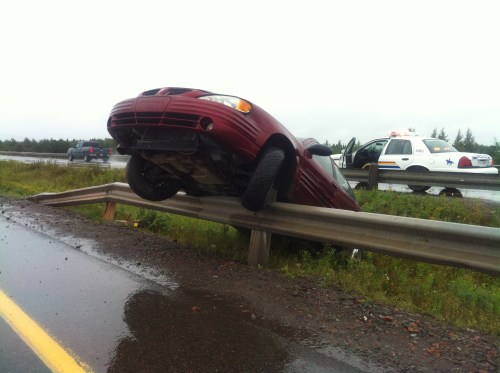
CAUSE: Hydroplaning. EFFECT: Wreck. No Accident!

CAUSE: Hydroplaning. EFFECT: Wreck. No Accident!

All things were made by him; and without him was not any thing made that was made. (John 1:3)

Commuting to work on the rain-drenched LBJ Freeway in Dallas, Texas this past week, I was at once amused and terrified at the maneuvers made by some crazy drivers obviously unaware of the hazardous road conditions. It reminded me of something that my old Driver’s Ed teacher repeated often a hundred years ago, “Accidents don’t happen; they are caused.” Apparently the crazies on LBJ never took driving lessons from my old Driver’s Ed teacher.

The truth of the adage obeys the very basic law of physics, that of cause and effect. Simply stated, everything that happens, i.e. every “effect,” has a cause. On the highway, this basic law expresses itself through Newton’s three Laws of Motion: (1) Inertia – an object in motion tends to stay in motion unless some external force acts upon it, (2) Acceleration – when a force acts on a mass (object) to produce motion, and (3) Reaction – for every action, there is an equal and opposite reaction. These three laws are expressions of the primary law of cause and effect. There is a series of cause-and-effect scenarios that propel a vehicle down the road at high rates of speed. Friction is a stabilizing force acting upon the tires of a car to counter the inertia that would maintain the car’s high rate of speed. However, on a wet, rainy day, friction yields to a phenomenon known as hydroplaning. This “cause” creates a thin barrier of water between the surface of the road and the tires, which effectively negates the force of friction on the tires. The tires lose contact with the road surface and now skim along on a slippery sheet of water. Inertia now controls the forward motion of the vehicle, and the incognizant operator unwittingly presumes he is in full control until he has to make a quick lane change or a sudden stop. It takes little imagination to visualize the “effects” that may result. The frequent “mishaps” witnessed on the highway are “incidents” not “accidents.” The majority of the time, the main cause of these incidents is the loose nut behind the wheel. Lesson: be aware of road conditions!

Forgive the defensive driving lesson, but the point was to illustrate the law of cause and effect. Nothing that exists just happens. There are no accidents. This simple and common fact is overlooked or ignored by naturalists/evolutionists/atheists when dealing with the matter of origins. What caused the universe? The Big Bang they say. What caused the Big Bang? They say that an infinitesimal “singularity” rapidly expanded and produced all that there is. Even though no one existed to witness or record this great event, they (the “theoretical” physicists) can tell us what happened one second after the Big Bang, one minute after, five minutes after, and so on. So, from where did this singularity come? What caused the singularity? What made it expand? “We don’t know,” they admit, “but we are still working on it.” This is what is passed off as science today.

Everything must have a cause, but cause-and-effect can only be taken back so far. Eventually, we must arrive at the cause that caused all other causes, and this cause cannot itself be caused. “Science” has no explanation for this, therefore hypotheses abound. In desperation, absurdities, like the “multiverse” hypothesis, arise to account for what cannot be proven in this universe. Since it cannot be proven in this universe, it must be true in another. The problem is that this universe is the only universe to which we have access to do science. There remains this nagging requirement for science called observation, and we cannot observe other universes, if indeed they do exist. Ours is the only universe we can observe. Our science is limited to what we can observe in this universe.

That brings us back to question of origins. How did our universe come to be? If nothing else, the Big Bang asserts that our universe must have had a beginning. But what caused it all? Reason demands that the original cause cannot itself have a cause. Our universe is no accident.

Where science fails us, the Bible provides a reasonable answer. Naturalists automatically reject this notion; however they offer nothing in its place that makes more sense. “In the beginning God …” (Genesis 1:1). Time, “the beginning,” was caused by God. The reader will note that nothing is presented before God, the Cause. God is the “uncaused Cause,” and the Scripture’s presentation of nothing prior to God expresses His eternal nature, His infiniteness. His eternal existence is the only reasonable and logical response to an infinite series of causes and effects. God is no accident. He is and always has been and ever will be. He is the eternal “I AM THAT I AM” (Exodus 3:14). John identifies Jesus as the eternal Creator (John 1:1-3), and later records the Lord’s self-identification as the Eternal One: “I am Alpha and Omega, the beginning and the end” (Revelation 1:18; 21:6), “I am Alpha and Omega, the first and the last” (Revelation 1:11), “I am Alpha and Omega, the beginning and the end, the first and the last” (Revelation 22:13). He is the One, the initial Cause that started it all. Before Him nothing else existed.

Our universe is no accident; it had a cause – God the Creator. Our world, our earth, is no accident; it had a cause – God the Creator. You and I are no accidents. We have a Creator that fashioned us in His own image (Genesis 1:27), and loved us enough to give us the choice to accept or reject Him. Either choice produces eternal effects. If we choose to reject Him, that decision is eternal. If we choose to accept Him, that decision is eternal. The choice is no accident.

2 Comments

Filed under Apologetics, Atheism, Bible, Christianity, Creation, Evangelism, Evolution, Gospel, Origins, Philosophy, Religion, Science, Theology